
By: Staff Writer
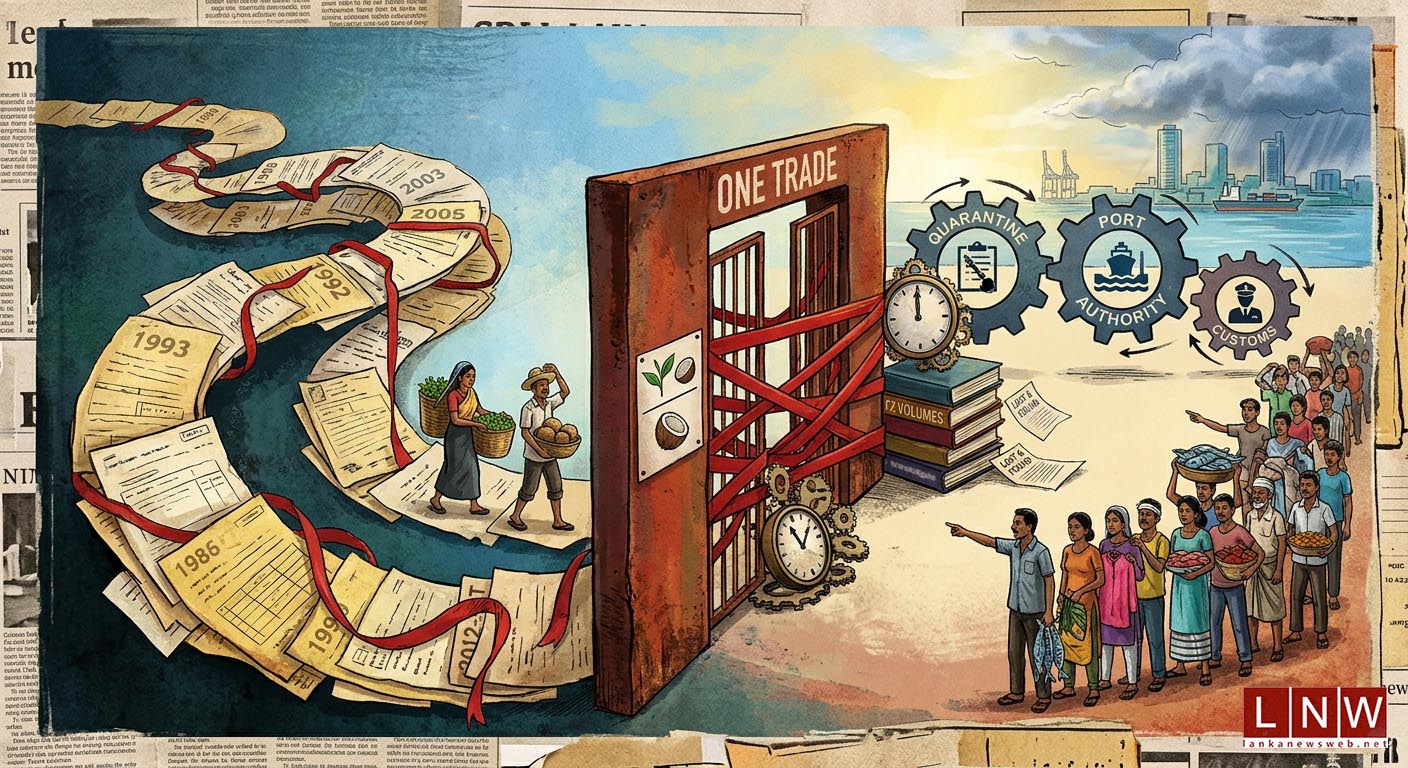
November 08, Colombo (LNW): Sri Lanka’s long-awaited National Single Window for Trade has finally become operational, but its restricted launch raises a fundamental question about the country’s ability to overcome administrative inefficiency and deliver meaningful economic reforms. After nearly 30 years of planning, the new OneTRADE platform has admitted only tea and coconut exporters, while the Government has yet to disclose when the remaining export industries and relevant regulatory agencies will be connected.
The launch represents an important step towards modernising Sri Lanka’s international trade infrastructure. However, the gap between announcing a digital initiative and delivering a fully integrated national system remains a major concern.
The original concept dates back to 1993. It was intended to replace the fragmented system under which traders must deal separately with Customs, quarantine services, port authorities and other government institutions. Repeated documentation, counter visits and administrative approvals have long increased the cost of doing business.
Despite the importance of the project, implementation moved at an extraordinarily slow pace.
A World Bank-funded blueprint comprising 12 volumes was completed in 2018. Yet the documents were reportedly misplaced and had to be resubmitted in July 2019. Cabinet approval for phased implementation was secured only in June 2022, followed by a Rs. 200 million allocation in June 2023 to establish a project implementation unit.
The latest launch, therefore, should be assessed against this history of institutional delays rather than treated simply as another technological achievement.
OneTRADE is a joint initiative involving the Finance Ministry, the Ministry of Digital Economy and GovTech Sri Lanka Ltd., supported by the Lanka Software Foundation. Its first operational milestone came when a private-sector exporter submitted a Customs Declaration through the platform on November 5.
But the Government’s decision to begin with only two sectors raises concerns about the readiness of the wider system. The Treasury has promised further expansion after refining the platform based on operational experience, without providing a deadline or identifying the sectors scheduled to join next.
More importantly, the authorities have not disclosed how many government agencies are currently connected or what proportion of the complete import-export documentation process can be handled electronically.
Without such information, it is difficult to determine whether OneTRADE is genuinely replacing existing procedures or merely introducing another electronic layer alongside traditional bureaucratic requirements.
The international experience demonstrates what Sri Lanka stands to gain. According to a World Bank study cited by the Ceylon Chamber of Commerce, single-window systems can reduce trade processing times by 30–40%. Singapore’s TradeNet reduced processing from four days to 10 minutes, while South Korea achieved a 60% reduction in transaction costs.
These improvements are particularly important for Sri Lankan small and medium-sized enterprises, which frequently operate with limited working capital. Delays in Customs clearance and regulatory approvals can increase storage charges, financing costs and the risk of missing overseas delivery schedules.
Sri Lanka’s WTO commitments provide another reason for urgency. Although the country ratified the Trade Facilitation Agreement on May 31, 2016, implementation of its commitments currently stands at 34.9%, against a schedule extending to 2030.
The Government must now publish a clear implementation roadmap, including deadlines for sectoral expansion, agency integration, system coverage and measurable reductions in clearance times.
Parliament and the business community should also demand regular progress reports and independent assessments of the platform’s performance.
After three decades, Sri Lanka has finally opened the digital gateway. But unless administrative institutions cooperate and implementation is accelerated, OneTRADE could become another example of a promising national reform weakened by bureaucratic inertia.
The wider environmental threat
Overfishing, destructive fishing practices, illegal harvesting and marine habitat degradation threaten the long-term productivity of Sri Lanka’s fisheries.
These problems have implications extending beyond environmental protection. Declining fish stocks can reduce fishermen’s incomes, increase competition for limited resources and undermine the reliability of seafood supplies required by international buyers.
The consequences could be particularly damaging for small-scale fishing communities that lack alternative sources of income.
Furthermore, international seafood markets are increasingly demanding evidence of responsible sourcing. Failure to demonstrate effective fisheries management could eventually weaken Sri Lanka’s export competitiveness, even where individual exporters maintain acceptable production standards.
The Government must therefore recognise that environmental protection and export development are closely interconnected.
Who benefits from the certification?
Another important issue is whether the economic benefits of certification will reach the coastal communities responsible for harvesting the seafood.
The blue swimming crab industry provides employment to thousands of women in processing facilities, particularly in Mannar and Jaffna. However, expanding international market access must also improve the economic position of fishermen, processors and small-scale suppliers.
If exporters secure greater commercial opportunities without corresponding improvements in purchasing prices, working conditions and employment security, the benefits of international recognition could remain concentrated among a limited number of businesses.
The Fisheries Ministry should examine whether small-scale fishermen have adequate access to finance, modern equipment, storage facilities, technology and reliable market information.
Women employed in processing facilities must also benefit from improved skills, working conditions and opportunities for higher-value employment.
From one certified fishery to national responsibility
The MSC achievement offers opportunities for knowledge-sharing with fisheries improvement programmes in India, Thailand, Indonesia, Vietnam and the Philippines.
Sri Lanka should use this experience to establish a national programme identifying commercially valuable fisheries that could qualify for internationally recognised sustainability standards.
Such a programme requires cooperation among the Fisheries Ministry, Department of Fisheries, scientific institutions, seafood exporters and fishing communities.
More importantly, the Government must publish measurable progress on fish-stock assessments, enforcement, traceability and marine conservation.
The blue swimming crab certificate should not become merely an international publicity achievement.
Its real value will be determined by whether Sri Lanka protects its marine wealth, improves the livelihoods of coastal communities and builds an export industry capable of generating sustainable economic returns for future generations.