
By: Staff Writer
November 15, Colombo (LNW): Sri Lanka’s growing appetite for mobile phones, computers, electronic appliances and other digital devices is creating an environmental problem that remains largely hidden inside households, commercial establishments and landfills. Behind the country’s rapid technological transformation lies an increasingly serious question: what happens to millions of discarded electronic products when their useful lives end?
Old mobile phones, damaged laptops, discarded chargers, tangled cables and electronic toys may appear insignificant individually. Collectively, however, they represent a growing waste-management challenge that Sri Lanka has yet to address through a comprehensive national collection, monitoring and recycling system.
The warning becomes particularly significant when considering the country’s estimated annual generation of approximately 175,000 metric tonnes of electronic waste, according to the Global E-waste Monitor 2024, compiled by the United Nations Institute for Training and Research (UNITAR).
Globally, 62 million metric tonnes of electronic waste were generated in 2022. Yet only 22.3 per cent was formally collected and recycled through environmentally sound methods. Sri Lanka faces an additional problem: the absence of comprehensive data makes it difficult to determine how much of its electronic waste is safely processed and how much disappears into informal recycling networks or ordinary rubbish disposal.
Shyamani Periyapperuma, Deputy Director General (Waste Management) of the Central Environmental Authority (CEA), says improper disposal and unsafe recycling can release hazardous substances into the environment, affecting human health and contaminating soil, water and air.
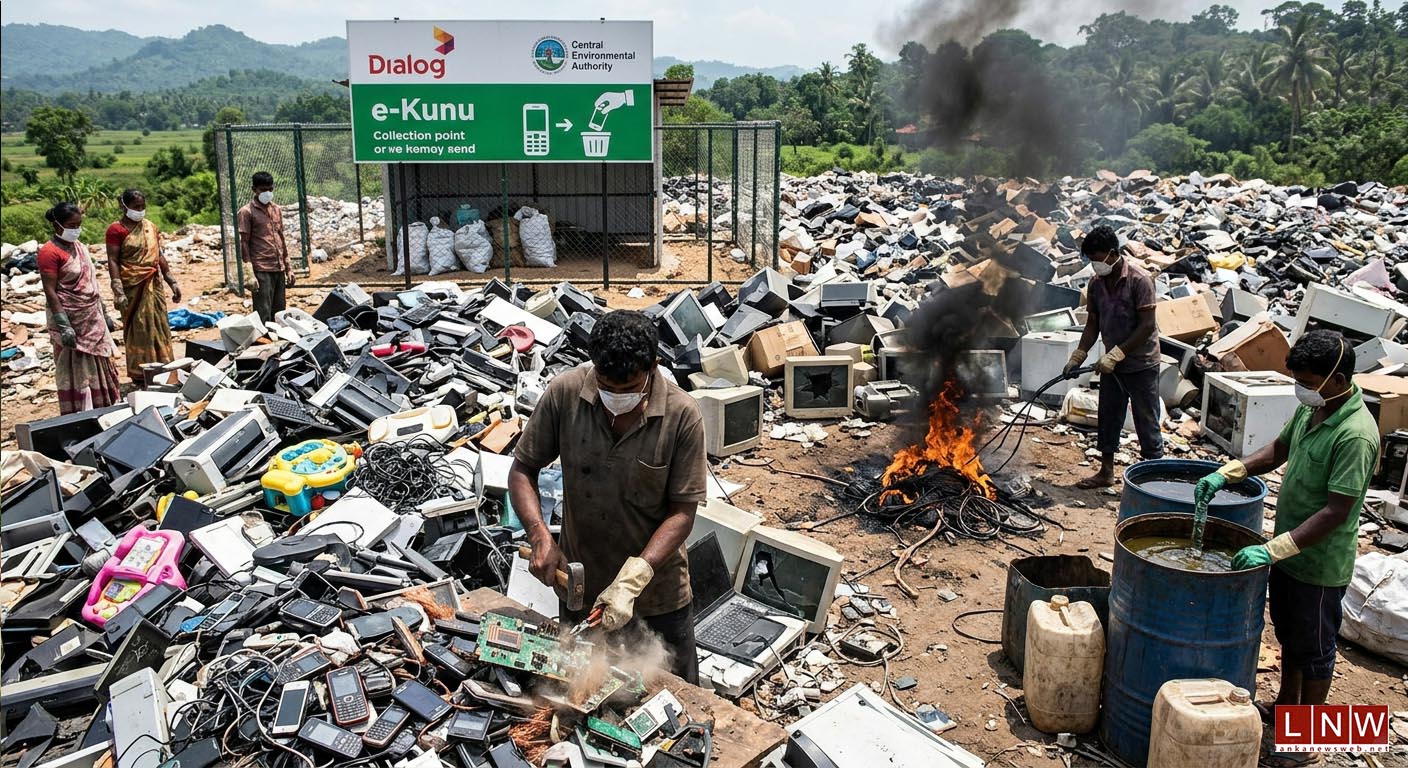
Open burning of discarded cables to recover copper and the use of acids to extract valuable metals are particularly concerning practices. Such activities can expose workers and surrounding communities to dangerous substances, potentially affecting respiratory health, the nervous system and child development.
Dr Dilhara Sethunga of the Department of Chemical and Process Engineering at the University of Moratuwa identifies five major weaknesses: inadequate data, unsafe informal recycling, weak policy implementation, the economic viability of recovery technologies and irresponsible consumer behaviour.
These challenges expose a fundamental weakness in Sri Lanka’s approach. Although electronic waste contains recoverable copper, aluminium and even gold, the country has yet to establish a sufficiently integrated system connecting consumers, collectors, recyclers and manufacturers.
According to the CEA, only 16 authorised e-waste collectors are currently operating, raising questions about whether existing collection capacity is sufficient for a country generating such substantial quantities of discarded electronics.
An initiative attempting to bridge this gap is Dialog Axiata’s e-Kunu programme, conducted in collaboration with the CEA. Dialog reports that it responsibly managed 3.74 metric tonnes of publicly collected e-waste and 668 metric tonnes of internally generated electronic waste in 2025.
Under the initiative, households, schools, businesses and institutions can deposit unwanted electronic equipment at designated Dialog Customer Care Centres for transfer to licensed waste-management partners.
However, isolated corporate initiatives cannot substitute for a comprehensive national system.
The National Environmental (Amendment) Act, No. 15 of 2026, endorsed on July 21, provides a legislative foundation for Extended Producer Responsibility (EPR). Yet the necessary regulations are still being drafted.
This delay raises an important question about enforcement. Without clearly established obligations, financing arrangements, collection targets and monitoring mechanisms, legislation alone cannot guarantee responsible disposal.
Environmental authorities must establish reliable national e-waste statistics, expand authorised collection facilities, strengthen enforcement against unsafe recycling and make responsible disposal accessible to ordinary households.
Sri Lanka cannot claim to be embracing a modern digital economy while allowing its technological leftovers to become tomorrow’s environmental liability.