
By: Ovindi Vishmika
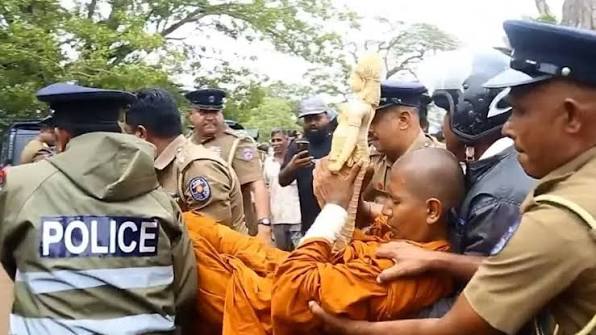
November 16, Colombo (LNW): As Buddhist monks led by Ven. Balangoda Kassapa Thera protest against the proposed redevelopment of Sri Lanka’s ancient sacred city, a deeper debate is unfolding over constitutional protection, religious freedom, government authority and the rule of law.
Anuradhapura,a city that has stood as a symbol of Sri Lanka’s Buddhist civilisation for more than two millennia has become the centre of an increasingly contentious national debate. What began as opposition to a government-backed development proposal has escalated into hunger strikes, confrontations between Buddhist monks, police intervention and court proceedings, raising fundamental questions about the relationship between religious heritage and the authority of the State.
At the heart of the controversy is the proposed Anuradhapura Sacred Area Development Plan, gazetted by the National Physical Planning Department on February 27, 2026. The plan proposes expanding the designated sacred area from approximately 28 to 38 square kilometres, alongside improvements to infrastructure, pilgrim facilities, transportation, sanitation and archaeological conservation.
However, a section of the Buddhist clergy, led by Ven. Balangoda Kassapa Thera, has strongly opposed the proposal, demanding the withdrawal of the Gazette. Their principal concerns relate to the possible restriction of traditional religious practices, changes to the character of the sacred landscape and the potential consequences of expanding the protected zone.
The disagreement has since developed into more than a dispute over urban planning. It has become a test of how Sri Lanka balances its constitutional responsibility to protect Buddhism with the government’s authority to administer public spaces and the rights of citizens affected by development.
A development plan or a threat to religious heritage?
Anuradhapura is home to some of the country’s most significant Buddhist monuments, including Ruwanweli Maha Seya, Jaya Sri Maha Bodhi, Thuparamaya, Abhayagiriya and Jetavanaramaya. Collectively associated with the Atamasthana, these sacred landmarks have made the ancient city an important centre of Buddhist pilgrimage and historical identity.
Recognised as a UNESCO World Heritage Site in 1982, Anuradhapura represents a living connection to Sri Lanka’s ancient civilisation.
According to the government, the proposed development programme is intended to preserve and enhance this historical landscape. Its objectives include improving roads and sanitation, introducing electric buses, developing pilgrim facilities, strengthening archaeological protection and establishing environmentally friendly barriers to safeguard sensitive sites.
The project is reportedly estimated to require an investment of approximately Rs. 8.8 billion.
Nevertheless, critics question whether the proposed expansion and associated conservation measures could affect established religious practices and the lives of people residing within the newly designated boundaries.
Residents and business owners have expressed concerns about the possibility of restrictions on their properties and livelihoods. Meanwhile, sections of the Buddhist clergy have questioned the need for protective fencing and raised concerns about other religious sites within the expanded area.
The National Physical Planning Department has rejected allegations that the plan proposes new religious structures or prevents Buddhist devotees from accessing sacred places. Its Director General, Ruchira Vithana, has maintained that the project is intended to protect archaeological remains and improve the sacred city rather than alter its religious character.
The central question, therefore, is whether the development plan genuinely protects Anuradhapura or whether its implementation could unintentionally undermine the religious and cultural traditions it seeks to preserve.
Article 9: The constitutional responsibility to protect Buddhism
The controversy inevitably brings Article 9 of the Constitution of Sri Lanka into focus.
Article 9 provides Buddhism with the foremost place in the country and places a constitutional responsibility on the State to protect and foster the Buddha Sasana, while assuring the religious rights guaranteed under Articles 10 and 14(1)(e).
This provision is particularly significant in relation to Anuradhapura, considering its exceptional importance to the country’s Buddhist heritage.
The State cannot treat the ancient city as an ordinary urban development area. Its religious, archaeological and historical significance must be central to any decisions concerning its future.
However, Article 9 does not grant Buddhist monks or religious organisations an unrestricted power to veto government development policies.
The constitutional obligation to protect Buddhism rests with the State. It does not automatically transfer the government’s administrative powers to individual religious leaders.
Consequently, the government has a responsibility to ensure that development does not damage the Buddha Sasana or interfere unjustifiably with religious practices. At the same time, it retains the authority to formulate lawful development and conservation policies.
The constitutional question is not whether Anuradhapura can ever be developed. Rather, it is whether such development is consistent with the State’s duty to protect the city’s religious and historical identity.
The right to protest versus the authority of the courts
The monks opposing the development plan are constitutionally entitled to express their grievances.
Article 14(1)(a) protects freedom of speech and expression, while Article 14(1)(b) guarantees the freedom of peaceful assembly. Article 14(1)(e) further protects the freedom to manifest one’s religion through worship, observance, practice and teaching.
These provisions provide a legal foundation for peaceful demonstrations, religious protests and public campaigns against government decisions.
However, constitutional freedoms are subject to lawful restrictions under Article 15. The right to peaceful assembly does not provide an unrestricted entitlement to occupy public spaces, obstruct access to religious sites or disregard valid judicial orders.
This distinction became particularly important when the Anuradhapura Magistrate’s Court intervened in the protest.
Following a police application, the court reportedly issued an order on November 7 directing the protesting monks to vacate the surrounding areas of Ruwanweli Maha Seya and Jaya Sri Maha Bodhi.
The monks subsequently challenged the order, arguing through their legal representatives that the demonstration was being conducted on premises traditionally used for dansals rather than within the actual courtyard of Ruwanweli Maha Seya. They also alleged that the police had misrepresented the circumstances when obtaining the order.
On November 9, Anuradhapura Chief Magistrate Siyapath Sasindu Wickramaratne ordered five monks, including Ven. Balangoda Kassapa Thera, to appear before court on November 20.
The legal proceedings raised an important constitutional question: can a religious leader claim exemption from a judicial order on the basis of religious authority?
Can religious authority override judicial authority?
One of the more controversial statements attributed to Ven. Balangoda Kassapa Thera was his reported position that he would not comply with the court’s directives, arguing that only a Sangha Adhikarana, or an appropriate Buddhist ecclesiastical authority, possessed the authority to issue directives concerning him.
From a legal standpoint, this argument raises an important distinction between ecclesiastical authority and the jurisdiction of the State.
A Sangha Adhikarana may exercise religious or disciplinary authority over Buddhist monks in accordance with the relevant religious traditions. However, that authority does not replace the jurisdiction of Sri Lankan courts in matters governed by civil and criminal law.
The Constitution and applicable legislation establish the authority of the judiciary. A person’s religious status does not automatically exempt that person from the jurisdiction of a competent court.
A Buddhist monk, like any other citizen, is entitled to challenge an order that he considers unlawful, seek its revocation or pursue appropriate judicial remedies. However, religious authority alone cannot invalidate a court order.
The principle is fundamental to the rule of law: no individual or institution can unilaterally place itself above the jurisdiction of the courts.
This does not mean that judicial orders are beyond criticism. If an order has been obtained through misrepresentation, exceeds the court’s jurisdiction or violates constitutional rights, it can be challenged through the appropriate legal procedures.
Nevertheless, the remedy lies within the legal system, not in unilateral defiance.
The Antiquities Ordinance and the protection of archaeological heritage
The controversy also raises questions concerning the legal protection of Anuradhapura’s archaeological remains.
The Antiquities Ordinance provides an important statutory framework for safeguarding ancient monuments and archaeological sites.
Among other matters, it regulates restoration, alteration and construction affecting protected monuments and archaeological reservations.
The government, therefore, cannot undertake development within protected archaeological areas without complying with the applicable legal requirements.
Equally, individuals participating in demonstrations cannot damage or interfere unlawfully with protected monuments under the justification of defending religious heritage.
The protection of Anuradhapura’s archaeological identity is not simply a matter of religious sentiment. It is also a legal responsibility.
The Antiquities Ordinance consequently applies to the actions of public authorities and private individuals alike.
What happens to the people living within the sacred area?
While much of the public debate has focused on the Buddhist clergy and the government’s position, the proposed expansion also raises concerns about ordinary residents.
Increasing the designated sacred area from approximately 28 to 38 square kilometres could have implications for people whose properties and businesses fall within the newly designated boundaries.
However, the legal consequences must be carefully distinguished.
The inclusion of privately owned land within a development or conservation zone does not automatically mean that ownership transfers to the government or that residents must relocate.
Restrictions on development, compulsory acquisition of land and resettlement are separate legal matters.
If the government intends to acquire private property for conservation or public development, it must follow the procedures established under the Land Acquisition Act, including applicable requirements relating to notice, inquiries and compensation.
Furthermore, Article 12 of the Constitution guarantees equality before the law and equal protection of the law.
The government must therefore ensure that the burden of preserving a nationally significant heritage site is not imposed unfairly on the residents whose homes and livelihoods are affected.
A development project cannot be considered successful merely because it protects ancient monuments. It must also account for the rights and legitimate interests of the people living around them.
Can the Gazette itself be challenged?
The monks and other affected parties are not without legal remedies.
If they believe that the development plan violates constitutional rights or exceeds the powers granted to the relevant authorities, they may consider challenging the administrative action through the appropriate judicial procedures.
Under Article 126 of the Constitution, the Supreme Court has jurisdiction over alleged infringements or imminent infringements of fundamental rights by executive or administrative action.
Under Article 140, the Court of Appeal has jurisdiction to issue writs, including certiorari, mandamus and prohibition, in appropriate circumstances.
A challenge could potentially examine whether the Gazette was issued under the correct statutory authority, whether mandatory procedures were followed, whether relevant stakeholders were adequately consulted and whether the authorities acted within the limits of their legal powers.
However, disagreement with government policy alone is insufficient to establish that a development plan is unlawful.
A successful legal challenge would require evidence of a specific legal or constitutional defect.
This makes judicial review a particularly important avenue for resolving the dispute. Rather than allowing the controversy to escalate through confrontation, the parties can place the legality of the government’s decisions before an independent court.
Violence and the November 12 confrontation
Tensions surrounding the protest escalated further on November 12, when two groups clashed near Ruwanweli Maha Seya.
According to police statements, the confrontation involved monks and their supporters on opposing sides of the development dispute. Several individuals, including Buddhist monks, reportedly sustained injuries.
Police arrested four Buddhist monks and four civilians following the incident.
The confrontation attracted considerable attention because it involved members of the Buddhist clergy, whose public standing traditionally carries considerable moral and social influence.
However, the incident also demonstrated how a disagreement concerning heritage conservation and government policy can deteriorate into a public-order problem.
The legal responsibility of each individual involved must be determined through proper investigation and judicial proceedings. Arrest does not establish guilt, and those accused remain entitled to the protections of criminal law.
Nevertheless, religious status cannot provide immunity from criminal investigation or excuse acts of violence.
A dispute concerning the protection of a sacred Buddhist site should not itself become a source of violence among those claiming to defend it.
Beyond the confrontation: Who has the responsibility to protect Anuradhapura?
The controversy surrounding the Sacred Area Development Plan exposes a fundamental challenge facing Sri Lanka: how to reconcile the preservation of religious heritage with modern development and constitutional governance.
The government maintains that the project will improve infrastructure and protect archaeological remains. Opposing monks fear that the proposed changes could affect traditional religious practices and the historical character of the sacred city.
Both conservation and religious freedom are legitimate concerns. However, neither should be pursued at the expense of the law.
The State must demonstrate transparency in its planning process, properly consider the views of religious custodians and affected residents, and ensure that every proposed development complies with the relevant legislation.
The Buddhist clergy, meanwhile, are entitled to question government decisions, organise peaceful demonstrations and seek judicial intervention. But religious authority does not confer immunity from the law or the jurisdiction of the courts.
Ultimately, Anuradhapura belongs to a history far greater than any individual government, political movement or religious leader.
Its preservation requires cooperation between the State, the Maha Sangha, archaeological authorities, local communities and the wider public.
The protection of Buddhism cannot be achieved by disregarding the rule of law, just as development cannot be justified by compromising the very heritage it claims to preserve.
The real challenge is not choosing between development and religion. It is ensuring that neither becomes an excuse to destroy the other.