
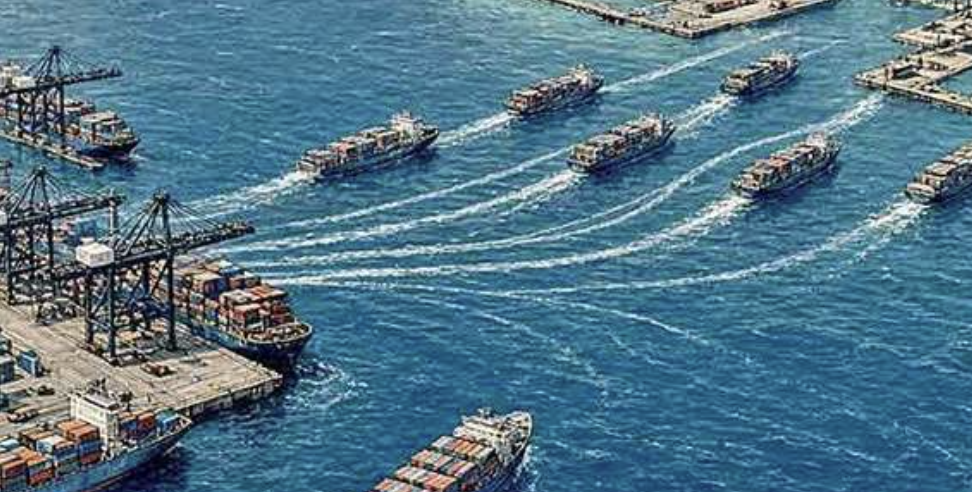
Sri Lanka’s ambition to become the Indian Ocean’s leading maritime and logistics hub is facing a strategic reality check as India’s rapidly expanding port infrastructure, growing investment capacity and regional connectivity ambitions increasingly challenge Colombo’s traditional position.
The warning raised by Samagi Jana Balawegaya (SJB) MP Dr. Harsha de Silva in Parliament exposes a critical weakness in Sri Lanka’s port development strategy: the country may be attempting to compete with India’s maritime expansion without adequately examining the economic interdependence that has sustained Colombo’s transshipment business for decades.
According to Dr. de Silva, approximately 60–70% of India’s transshipment cargo is handled through the Port of Colombo. This makes Indian cargo a fundamental component of Colombo’s port economy rather than simply another source of commercial business.
The emergence of India’s Vizhinjam International Seaport, however, raises serious questions about the future of this relationship.
The recent acquisition by Mediterranean Shipping Company (MSC) of a 49% stake in Adani Vizhinjam Port Private Ltd for US$1.4 billion highlights the scale of international capital flowing into India’s maritime infrastructure.
For Sri Lanka, this development presents both a competitive threat and an opportunity. If Colombo fails to modernise its logistics ecosystem, improve efficiency and attract international investment, shipping companies could increasingly consider alternative regional gateways.
But Dr. de Silva argued that Sri Lanka should not automatically regard India’s port expansion as a threat. Instead, Colombo must develop a strategy that complements India’s maritime infrastructure while protecting and strengthening its own competitive advantages.
One major obstacle, he argued, is Sri Lanka’s restrictive approach to foreign equity ownership in port-related services.
He questioned whether the Government was continuing to protect a handful of powerful business interests by maintaining restrictions that prevent foreign investors from holding more than 40% equity in certain logistics operations connected to the Port of Colombo.
He maintained that an internationally competitive maritime hub requires greater openness in warehousing, logistics, shipping agency and freight forwarding.
Countries such as India, Dubai and Singapore have developed integrated logistics ecosystems that attract international shipping companies, investors and service providers. Sri Lanka, meanwhile, risks limiting its own competitiveness through ownership restrictions and a business environment that may discourage potential investors.
The underlying issue is whether national economic policy is being shaped around the long-term competitiveness of the country or the commercial interests of established players.
The Government must also confront the stalled ETCA negotiations with India, which could provide a wider framework for cooperation in manufacturing, services and logistics.
Dr. de Silva’s argument raises another important question: can Sri Lanka realistically compete for maritime investment while maintaining regulatory restrictions that limit international participation?
The country’s geographical location remains a major advantage, but geography alone cannot guarantee commercial dominance. Port efficiency, investment freedom, regulatory certainty, skilled labour and integrated supply chains determine where shipping companies and international investors commit their capital.
The Government must therefore undertake a comprehensive review of its port and logistics policies before regional competition erodes Colombo’s existing advantages.
The real danger is not India’s growing maritime capacity. It is Sri Lanka’s failure to respond strategically to that growth.
Unless the Government balances national interests with international investment requirements, Colombo’s ambition to become the Indian Ocean’s maritime hub could remain an attractive political slogan rather than a sustainable economic reality.