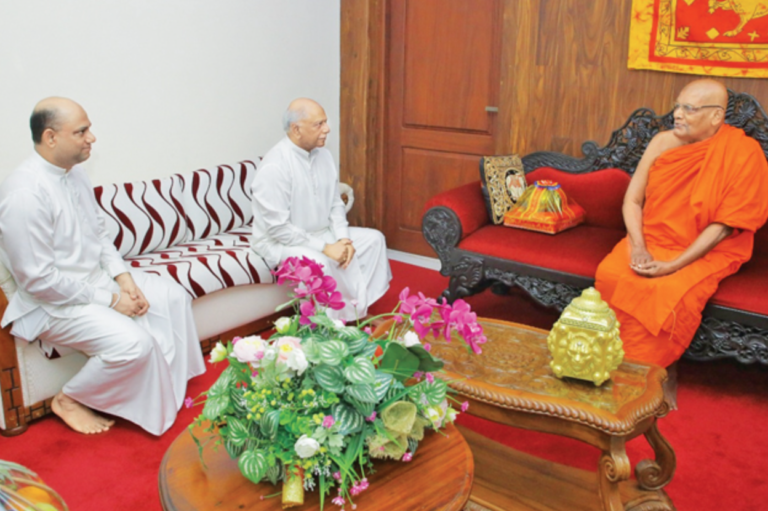
August 06, Colombo (LNW): Leader of the Mahajana Eksath Peramuna (MEP) and Prime Minister, Dinesh Gunawardena, paid a visit to Ven. Dr. Ittapane Dhammalankara Thera, the Chancellor of the University of Sri Jayewardanepura and Chief Prelate of Kotte Sri Kalayani Samagri Dharma Maha Sangha Sabha, at Dharmavijayaloka Maha Viharaya in Kottawa Rukmale yesterday.
The Prime Minister was accompanied by Deputy Secretary of the MEP, MP Yadamini Gunawardena, Deputy Secretary Lalith Rohana Liyanage, and several Central Committee Members of the MEP, including Savithri Gunasekara and Premachandra Hettiarachchi.
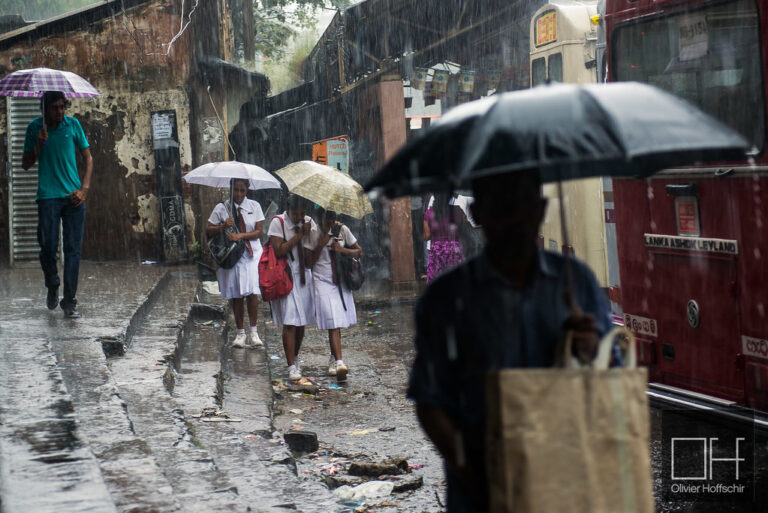
August 06, Colombo (LNW): Several spells of showers will occur in Western, Sabaragamuwa and North-western provinces and in Kandy, Nuwara-Eliya, Galle and Matara districts.
Showers or thundershowers may occur at several places elsewhere of the island during the evening or night. Fairly heavy showers above 50 mm are likely at some places.
General public is kindly requested to take adequate precautions to minimize damages caused by temporary localized strong winds and lightning during thundershowers.
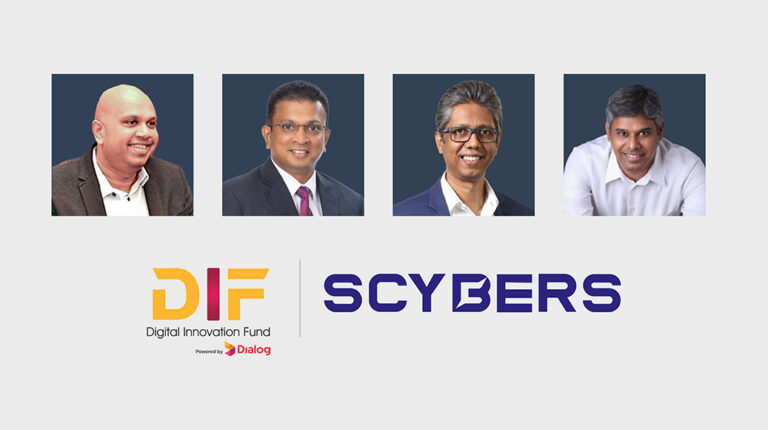
August 05, Colombo (LNW): Scybers Inc., a rapidly growing global cybersecurity firm, has announced a significant strategic investment from the Digital Innovation Fund, managed by BOV Capital and supported by Dialog Axiata PLC.
With cybersecurity becoming increasingly crucial due to the post-pandemic digital surge, a rise in ransomware attacks, stricter regulations, and a global shortage of cybersecurity professionals, this investment is timely.
The global cybersecurity market, valued at approximately $268.13 billion in 2024, is projected to grow to around $878.48 billion by 2034, with a Compound Annual Growth Rate (CAGR) of 12.6% during this period.
Scybers aims to help enterprises swiftly mitigate cyber risks, ensure compliance, and build resilience through its global delivery model, specialized cybersecurity expertise, and advanced AI-driven security platforms.
Madu Ratnayake, President of Scybers, highlighted the strategic advantage of the Digital Innovation Fund’s extensive network and relationships.
He noted that Dialog Axiata’s extensive experience in digital and communication services in the ASEAN and South Asian regions would significantly benefit Scybers as it expands its global reach. This partnership will be instrumental in scaling Scybers’ services.
Kugan Kulothungan, CEO of Scybers, expressed enthusiasm about the investment, particularly welcoming Supun Weerasinghe to the Scybers Board. Kulothungan praised Weerasinghe’s leadership and experience as the Group Chief Executive of Dialog Axiata PLC, which will be crucial for guiding Scybers through its next growth phase.
Supun Weerasinghe, Group Chief Executive of Dialog Axiata PLC, emphasized the role of investing in new technology as a key factor in advancing Sri Lanka’s digital economy. He underscored that the investment in Scybers aligns with Dialog Axiata’s vision of fostering innovation and enhancing global cybersecurity measures.
The Digital Innovation Fund reflects their commitment to supporting tech startups with the potential for significant local and international impact.
Prajeeth Balasubramaniam, Co-Founder and Managing Partner of BOV Capital, noted that since its inception in 2015, BOV Capital has been dedicated to supporting visionary founders in building exceptional businesses.
With $15 million in Assets Under Management (AUM) and a focus on scalable regional and global solutions, BOV Capital’s second fund, DIF, established in collaboration with Dialog Axiata PLC in 2017, found investing in Scybers a natural fit due to the critical importance of cybersecurity in the modern digital landscape.
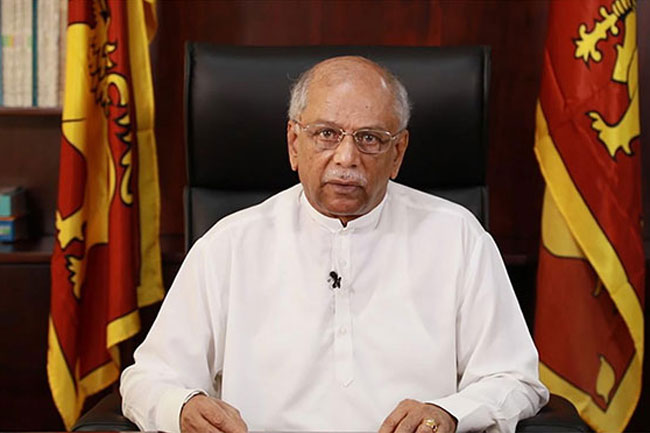
August 05, Colombo (LNW): Prime Minister Dinesh Gunawardena has urged South Asian entrepreneurs to focus on innovative new products and services to enhance regional economic cooperation.
Addressing the first South Asian Trade Fair 2024 at Excel World Colombo Convention Centre, he said the stronger connectivity with neighbouring regional markets such as India, Pakistan, Bangladesh and other South Asian countries would boost trading and investment cooperation.
The Prime Minister pointed out that the largest tea producer and exporter is South Asia and the regional countries should cooperate to obtain maximum benefits in the tea industry. He said there are many such common products where innovative methods could enhance the ability to compete in international markets.
“We have taken steps to ensure climate friendly businesses and technology based businesses. The Trade Fair and Business Forum has a larger purpose that goes beyond any individual business or organisation’s interest. This is a forum to achieve objectives of promoting socio economic cooperation and strengthening trade relations among South Asian countries,” he said.
He added that this forum gives an immense opportunity for trade and businesses in South Asia to showcase their products and services to grow beyond their usual parameters as it creates a platform for expanding their international trade at the export markets in South Asia and beyond.
Referring to Sri Lanka’s recovery, he said some countries and international fiscal institutions had stopped dealing with Sri Lanka in 2022, but they have started to open their doors again. The latest example is Japan, which has agreed last week to resume all the projects in Sri Lanka and also to explore new ventures.
“It is a pleasure for me to welcome all these investors and trading partners from our South Asian neighbours belonging to SAARC – India, Pakistan, Bangladesh, Maldives, Bhutan, Afghanistan and Nepal – as well as some observers such as China,” he said.
The Prime Minister thanked Indian Prime Minister Narendra Modi for extending support to Sri Lanka to enhance use of renewable energy through setting up solar and wind power projects.
August 05, Colombo (LNW): The Finance Ministry yesterday said Sri Lanka has received an initial assessment from its Official Creditor Committee (OCC) regarding the Comparability of Treatment (COT) under the Joint Working Framework (JWF) agreed upon between Sri Lankan authorities and the Ad-Hoc Group of bondholders.
It said further details are being sought to advance the engagement with bondholders and finalise the external debt restructuring process.
Immediately following the finalisation of a memorandum of understanding (MOU) with the Official Creditor Committee (OCC) and restructuring agreements with Exim Bank of China on 26th June 2024, the AHG and Sri Lanka resumed restricted negotiations on the 27th – 28th of June in Paris.
The AHG had submitted a new proposal which made further adjustments to address Sri Lanka’s concerns on the four outstanding points. During the negotiations in Paris, further adjustments were agreed in a Joint Working Framework
The Joint Working Framework negotiated with the AHG provides a fair balance of risk sharing and sufficiently addresses the concerns of Sri Lanka and the requirements of bondholders.
The MLB structure, following the adjustments made through the evolution of the proposed instrument, enables the appropriate sharing of upside between creditors and the debtor, whilst also ensuring that in this process, the debt sustainability of the debtor sovereign is not compromised.
These terms require formal confirmation by the Secretariat of the Official Creditor Committee and the IMF staff in order to confirm conformity with comparability of treatment requirements and compliance with Sri Lanka’s IMF program debt sustainability targets.
The Ministry also said during the visit of the IMF Staff Mission, discussions centred on the ongoing debt restructuring process. This included an assessment of the JWF and evaluation focused on ensuring compliance with program parameters and debt sustainability considerations.
In a statement, the Finance Ministry said the IMF Staff mission led by Senior Mission Chief Peter Breuer cautioned against any policy slippage that could jeopardise the hard-won economic gains achieved thus far, whilst acknowledging the positive developments in the economic landscape and underscoring the critical importance of sustaining the momentum of reforms.
The team concluded a visit to Sri Lanka spanning from 25 July to 2 August where the primary objective was to assess the progress of Sri Lanka’s macroeconomic reforms and economic performance.
The Finance Ministry noted that the IMF acknowledged the progress made in terms of recovery of economic growth, improved fiscal outcomes through revenue enhancement, supported by tax reforms, effective control of inflation, and enhancement of foreign exchange reserves.
The staff visit also discussed the recent reform efforts, such as the passage of the Public Financial Management Act and the Public Debt Management Act, noting the potential of these measures to support fiscal discipline and improve debt management.
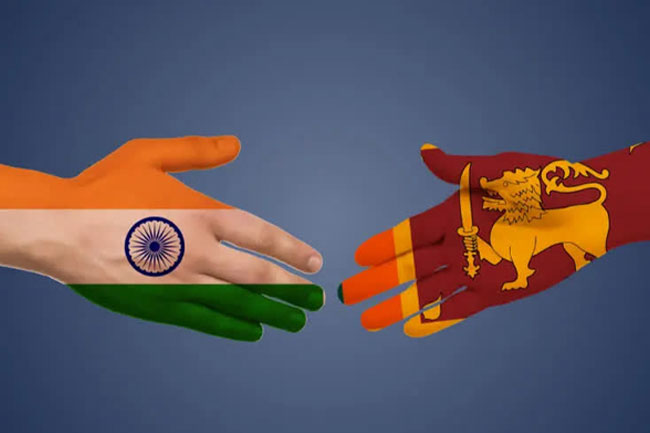
August 05, Colombo (LNW): India and Sri Lanka are progressing towards finalizing the Economic and Technology Cooperation Agreement (ETCA) after a five-year hiatus in negotiations.
The Indian Commerce Department has sought input from industry sectors on key areas such as product-specific rules for tariff concessions.
Initial inputs were submitted last year, but further views are needed as negotiations advance, particularly on rules of origin.
The decision to resume ETCA talks came after Sri Lankan President Ranil Wickremesinghe’s visit to India in July last year. Negotiations restarted in Colombo on October 30, 2023. Sri Lanka hopes the agreement will help mitigate its economic crisis, worsened by the COVID-19 pandemic.
ETCA aims to expand on the bilateral Free Trade Agreement (FTA) signed in 2000, which increased Sri Lankan exports to India in key commodities.
The agreement includes chapters on trade in goods and services, technical barriers, sanitary measures, rules of origin, customs procedures, trade remedies, economic and technological cooperation, and dispute settlement. It seeks to eliminate non-tariff barriers and improve trade facilitation.
India anticipates that ETCA will provide greater market access for automobiles, auto parts, pharmaceuticals, certain textiles, chemicals, and various services.
Industry research indicates Sri Lanka could become a significant part of the Indian supply chain, with Indian manufacturers potentially establishing factories there to export products to countries with existing or planned FTAs with Sri Lanka.
India is negotiating for customs duty concessions on goods such as cars, commercial vehicles, and machinery and seeks easier visa norms for professionals.
The 14th round of talks recently concluded in Colombo, covering rules of origin, goods, services, and technical barriers to trade.
Sri Lanka is requesting the removal of a quota on apparel exports to India and duty concessions on tea and certain agricultural commodities. The next round of negotiations will take place after Sri Lanka’s elections.
Both countries have already implemented an FTA in goods and are working to expand it to include more goods and services.
The India-Sri Lanka Free Trade Agreement (ISFTA), effective since March 2000, has improved economic relations by reducing tariffs on various goods.
Both countries have been negotiating to expand ISFTA into a Comprehensive Economic Partnership Agreement (CEPA) to include services, investment, and other economic cooperation areas.
Under the current FTA, India allows limited imports of garments and tea from Sri Lanka at reduced tariffs.
Sri Lanka seeks the removal of the garment import quota, citing India’s duty-free garment imports from Bangladesh under the South Asia Free Trade Agreement (SAFTA) for Least Developed Countries (LDCs).
Sri Lanka has restricted imports of automobiles and electrical goods. Since ISFTA’s implementation, trade between the two countries has grown significantly.
India’s exports to Sri Lanka increased from USD 499.3 million in FY 2000 to USD 4.17 billion in FY 2023-24, while imports grew from USD 44.3 million to USD 1.4 billion over the same period.
Finance State Minister Shehan Semasinghe says President Ranil Wickremesinghe’s first public rally for his Presidential Election campaign is set for August 17 at Salgado Stadium, Anuradhapura: praises Wickremesinghe’s leadership in overcoming the socio-economic crisis and urges SLPP support to continue this progress: The announcement was made at a meeting with Anuradhapura’s local government representatives.
Former Sri Lankan cricketer Hashan Thilakaratne joins the Samagi Jana Balawegaya (SJB) to support Opposition Leader Sajith Premadasa in the upcoming Presidential Election: Thilakaratne, currently the Head Coach of Bangladesh’s women’s cricket team, previously led Sri Lanka’s women’s team: His wife, Apsari Thilakaratne, also joined the SJB and serves as the Convenor of Women’s Cricket in Sri Lanka.
NPP leader Anura Kumara Dissanayake reveals state intelligence services have flagged significant contributions by overseas Sri Lankans and the Retired Tri-Forces Forum to the NPP’s recent successes: notes the intelligence report suggested the government investigate these influences, highlighting the pivotal role of retired military personnel in the NPP’s achievements.
Transport Minister Bandula Gunawardena clarifies he never accused President Ranil Wickremesinghe of involvement in the Central Bank bond scam: asserts Wickremesinghe should not be held accountable for the actions of individuals he appointed: emphasises his support for Wickremesinghe’s national policy: This contrasts with Gunawardena’s earlier criticisms of Wickremesinghe in 2015 and 2018.
The National Election Commission rejects claims that voters can cast their ballots at any polling station for the upcoming Presidential Election: clarifies voters must vote at their assigned polling stations within their registered divisional areas, according to the electoral register: emphasises reports suggesting otherwise are inaccurate and misleading.
The Commercial Bank of Ceylon has been honoured as ‘Sri Lanka’s Best Bank for ESG’ at the 2024 Euromoney Awards for Excellence, recognising its strong commitment to Environmental, Social, and Governance practices: The award reflects the Bank’s efforts in sustainability, including reforestation, carbon neutrality, and community initiatives. The accolade highlights the Bank’s leadership in integrating ESG principles into its operations and long-term strategy.
Rohana Hettiarachchi, Executive Director of PAFFREL, reports approximately 60 election law breach complaints ahead of the Presidential election: The majority involve misuse of state resources and power, including improper distribution of goods, controversial appointments, and dismissals of officials: Although reported as isolated incidents, these breaches have significant societal impacts.
The Human Rights Commission stresses the importance of impartial legal protection by police and state officials as per Article 12 of the Constitution: It will now accept complaints about election law breaches by police and government personnel during the Presidential Election, with dedicated contact options and new guidelines to ensure electoral integrity and address human rights violations effectively.
The Kandy Esala Perahera festival begins today (05) with the traditional ‘Kap’ planting ceremony at the Devalayas of Natha, Vishnu, Kataragama, and Pattini at 4:10 a.m.: The festival will feature the first Kumbal Perahera on August 10, followed by the Randoli Perahera on August 15, and conclude with the grand Randoli Maha Perahera on August 19.
Sri Lanka defeats India by 32 runs in the second ODI at R. Premadasa International Stadium: Jeffrey Vandersay excelled with 6 wickets for 33 runs, supported by Charith Asalanka’s 3 wickets for 20 runs, dismissing India for 208: Despite a strong start from Rohit Sharma and Shubman Gill, Sri Lanka’s total of 240 was defended successfully, with Vandersay earning the man of the match award.
August 05, Colombo (LNW): Rohana Hettiarachchi, Executive Director of the People’s Action for Free and Fair Elections (PAFFREL), disclosed that around 60 complaints concerning breaches of election laws have emerged ahead of the Presidential election.
He noted that most complaints involve the misuse of state resources and power, which, despite being reported as isolated incidents, have a broader societal impact.
Issues include improper distribution of goods, controversial appointments and transfers, and the dismissal of presidents and chairpersons from various state and corporate positions.
August 05, Colombo (LNW): The deadline for submitting postal vote applications is today, August 5.
Completed forms must be delivered to District Returning Officers via the District Election Office by midnight.
Applications can be obtained free of charge from locations displaying the voters’ lists, district election offices, or the Election Commission’s website.
The Election Commission has stated that applications received after today’s deadline will be rejected, and claims circulating on social media about an extension are false.
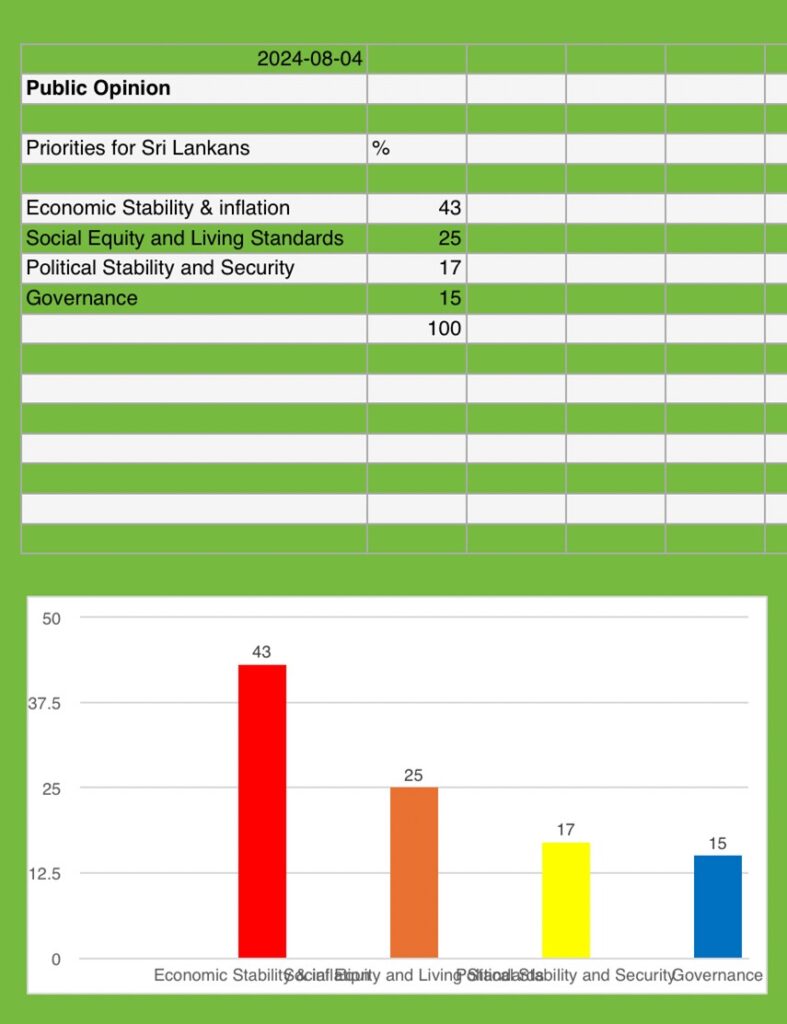
August 05, Colombo (LNW): Despite several surveys done by various people and companies, according to several survey houses the numbers are still unclear and too early to predict. Whoever claims that they are winning, are only day dreaming.
But the key issues for the public are very clear. The public is still struggling with the Economic crisis that is causing severe hardships for the population. Prices of essential goods, including food and fuel, skyrocketed, and many are struggling to afford basic necessities. With the IMF package now in play , it may lead to a crisis if the terms and conditions are changed without the consent of the IMF. Political talk is good for the platform.
We cannot afford to allow half baked politicians to get away with political rhetoric. People’s livelihoods cannot be played around like in the Gotabaya Rajapaksa era any more. Ironically, Despite the economic mayhem and hardship the Rajapaksa Group created for the people.
The Rajapaksa family still think they are popular and people have forgotten and forgiven them for the economic mayhem they created 21-22. The other big issue for Sri Lanka is the substantial debt burden. In 2027 nearly $10 Billion has to be paid. Are we going to borrow at commercial rates to repay ? We need answers. The Ranil government is seeking international financial aid and negotiating with creditors to restructure debt.
Effective debt management is crucial to avoid default and to stabilize the economy. The President has done a good job so far to keep the ship afloat. The 3 rd issue for the public is Political Stability and Governance. Ensuring political stability and effective governance is essential for implementing reforms and maintaining public trust. Managing diverse political factions and fostering an inclusive political environment are key challenges for the country.
The abuse of state resources to provide security for half baked government officials and politicians must be stopped. People know they are paying for their joy rides. In the UK ministers use London Underground to travel. Whilst half baked government officials and military move around in Sri Lanka like their lives are at risk. The opposition leader is no better. That is why the NPP is scoring. The other issue is Social Equity and Living Standards.
Addressing public dissatisfaction due to economic hardships is important. Policies aimed at improving living standards, reducing inequalities, and mitigating social tensions are crucial for maintaining social stability. Then for the cocktail circuit men and women and those commenting on WhatsApp groups; Sustainable Development and Environmental Protection is key.
Implementing sustainable development policies, protecting natural resources, and addressing climate change impacts are significant concerns. These efforts are essential for long-term national development and environmental sustainability. If politicians like Sajith and Anura only continue to criticize without offering hard solutions they will only end up in the dustbin like Gotabaya.
These issues collectively represent the major challenges and priorities for Sri Lankan people as it navigates its economic recovery and bring sanity to the political landscape. For most Sri Lankan politicians Politics is the art of looking for trouble, finding it everywhere, diagnosing it incorrectly, and applying the wrong remedies. This quote, often attributed to Groucho Marx, he succinctly captures the essence of poorly executed political maneuvering and the pitfalls of superficial governance.