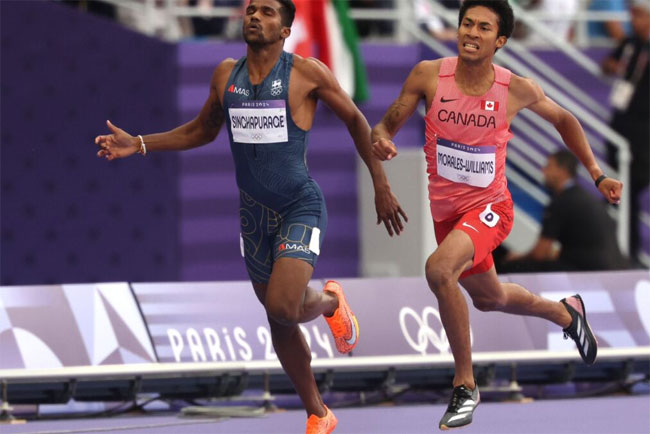
August 05, Colombo (LNW): Sri Lankan sprinter Aruna Darshana has secured a spot in the semifinals of the Men’s 400m at the 2024 Paris Olympics, having finished third in his heat.
Darshana set a personal best with a time of 44.99 seconds in Heat 5, qualifying for the semifinals scheduled for Tuesday (06).
Grenada’s Kirani James won the heat with a time of 44.78 seconds, whilst Canada’s Christopher Morales-Williams was second at 44.96 seconds.
Darshana recently impressed by winning the Men’s 400m at the 2nd Belt and Road Invitational Athletics Championship in China.
He is regarded as a promising athlete, drawing comparisons to former Sri Lankan star Sugath Thilakaratne, and previously won the 400m event at the 2018 National Athletics Championships with a time of 46.16 seconds.
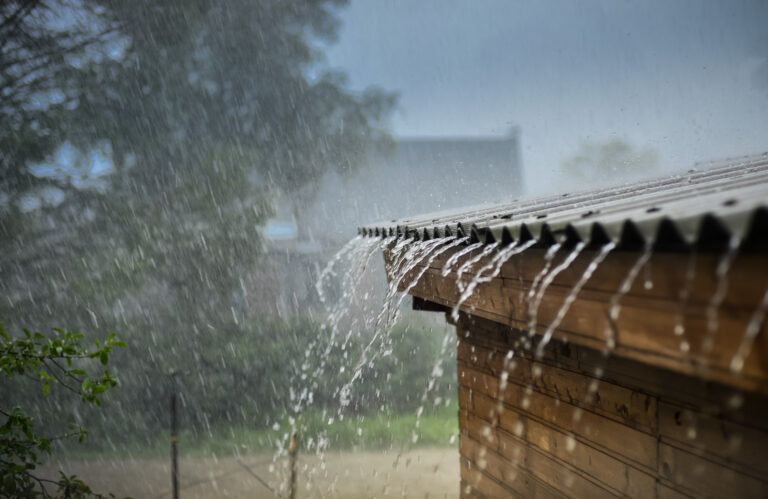
August 05, Colombo (LNW): Showers will occur at times in Western and Sabaragamuwa provinces and in Kandy, Nuwara-Eliya, Galle and Matara districts, with several spells of showers being expected to occur in North-western province, the Department of Meteorology said in its daily weather forecast today (05).
Showers or thundershowers may occur at several places elsewhere in the island during the evening or night. Fairly heavy showers above 50 mm are likely at some places.
General public is kindly requested to take adequate precautions to minimise damages caused by temporary localised strong winds and lightning during thundershowers.
Marine Weather:
Condition of Rain:
Showers will occur at several places in the sea areas off the coast extending from Puttalam to Galle via Colombo. Showers or thundershowers will occur at a few places in the other sea areas around the island particularly during the afternoon or night.
Winds:
Winds will be westerly to south-westerly and wind speed will be (30-40) kmph. Wind speed can increase up to 50 kmph at times in the sea areas off the coasts extending from Kankasanthurai to Puttalam via Mannar and from Hambantota to Pottuvil.
State of Sea:
The sea areas off the coasts extending from Kankasanthurai to Puttalam via Mannar and from Hambantota to Pottuvil will be fairly rough at times.
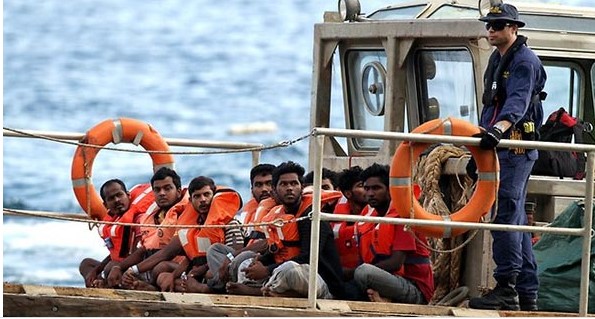
August 04, Colombo (LNW): Amid a surge in illegal migration attempts driven by the economic crisis, immigration authorities caution against falling prey to racketeers exploiting their desperation.
The Immigration and Emigration Department has noted a dramatic rise in intercepted forged documents at Bandaranaike International Airport (BIA) over the past five years, with 181 forged documents intercepted in 2023 alone.
This is a significant increase from the 62 cases reported in 2022, according to the 2023 Annual Report of the Border Enforcement Unit.
The report, released at a ceremony at Waters Edge in Battaramulla, attended by high-ranking government officials and foreign ambassadors, outlines various types of document and identity frauds.
These include 110 counterfeit cases, 25 biodata page substitutions, 13 impersonations, 11 face substitutions, 11 fraudulently obtained passports, 4 fantasy documents, 4 document alterations, 2 counterfeit Sri Lankan affidavits, 1 stolen Sri Lankan affidavit, and 1 stolen blank document.
The Border Enforcement Unit is committed to collecting information on individuals and victims involved in transnational organized crime and sharing it with law enforcement agencies, including details on human trafficking.
Recently, several foreigners have been apprehended at BIA during illegal migration attempts.
Among them were an Indian couple attempting to travel to the Netherlands on forged passports and a Chadian national with a forged Canadian passport.
P.P. Aluthge, Chief Immigration Officer of the Border Surveillance Unit (BSU), highlighted the various methods employed in human smuggling.
Some individuals present genuine Sri Lankan passports and travel documents at immigration counters, holding legal visit visas to destinations like Dubai, Malé, Thailand, or Malaysia.
However, they also carry separate forged passports and travel documents, intended for use after disembarking to reach their final destinations.
Mr. Aluthge emphasized the skill and technical support that BSU officers possess in detecting such forgeries.
The BSU maintains close relations with agencies such as the United Nations Office on Drugs and Crime (UNODC), the International Organization for Migration (IOM), and foreign missions in Colombo, including those of the US, Australia, Canada, and Switzerland.
These relationships facilitate local and international training for immigration officers and provide the technology necessary to identify forged documents.
Additionally, several embassies have stationed Airline Liaison Officers (ALO) at BIA to assist immigration officers. For instance, in the case of a chef caught with a forged Canadian visa, the ALO of the Canadian High Commission confirmed the visa’s falsification.
Sri Lankan authorities have had success in preventing large groups of illegal migrants from setting out by boat. As a result, human smugglers are now sending individuals to other countries in the region, from where boats are launched.
August 04, Colombo (LNW): Sri Lanka’s merchandise trade deficit continued to shrink monthly in June 2024, as export earnings increased more rapidly than import expenses. The country exported goods worth US $1,077 million and imported goods valued at $1,447 million, resulting in a trade deficit of $370 million.
Exports grew by 6.5% and imports by 3.0% from the previous month, leading to a 5.9% reduction in the trade deficit. In May, the deficit was $393 million, down significantly from $558 million in April. Compared to a year ago, June’s exports rose by 7.2% and imports by 5.7%, causing a 1.7% increase in the deficit.
Cumulatively, the trade deficit for the first six months of the year reached $2,540 million, an 11% increase from the same period last year. This high deficit is typical for Sri Lanka, which heavily relies on imported goods, especially for energy and manufacturing inputs for both domestic consumption and exports.
The increasing import bill and trade deficit signal that Sri Lanka’s economy is stabilizing after severe inflation, foreign exchange shortages, and high taxes and interest rates, which led to a deep recession in 2022 and 2023. During this period, production and consumption were drastically reduced.
A higher trade deficit isn’t a short-term concern if the country can generate enough inflows through service exports and other current and capital account inflows. Investments and borrowings collected into the capital account should be used to develop export-oriented industries, which can reduce the trade deficit in the medium to long term.
However, successive governments have struggled to achieve this, and the current International Monetary Fund program has made it even more challenging due to significantly higher taxes on all industries.
In June, the main contributors to export growth were petroleum products, food and beverages, tobacco, rubber products, and tea. Industrial product exports were driven by increased volumes of bunkering and aviation fuel, while agricultural exports were boosted by spices, particularly higher volumes of pepper and tea.
The import bill for June was primarily driven by machinery and equipment, textiles and textile articles, chemical products, and building materials. Consumer goods imports declined due to lower imports of wheat flour, edible oils, and medical and pharmaceutical products, indicating that consumption levels have not yet returned to pre-crisis levels. This trend was also reported by some consumer companies during the week.
Sri Lanka imported $365.4 million worth of fuel in June, a 26% increase from a year ago, although the cumulative six-month fuel bill was down by 6.2% at $2,209.2 million. Fuel remains the country’s largest import commodity as Sri Lanka does not produce oil.
The overall economic picture suggests a gradual return to normalcy, with cautious optimism for managing the trade deficit through strategic investments and increased export capacity.
August 04, Colombo (LNW): India’s Adani Group has received legal relief temporarily to proceed with the 484 MW wind power stations in Sri Lanka, a crucial investment for the island nation to meet its goal of sourcing 70% of its energy from renewables by 2030.
The project includes two wind energy initiatives: a 250 MW project in Mannar and a 234 MW project in Pooneryn, with a total proposed investment of USD 750 million.
A five-member senior bench in the Supreme Court, appointed by the Chief Justice to handle the Adani Wind Power case, acknowledged the project’s importance to Sri Lanka’s economy and energy sustainability.
On August 2, the court rejected a request for an early hearing and additional support days by the petitioners, scheduling the next hearing for October
The court did not issue any stay orders against the objections raised by the Wildlife Nature Protection Society, Dr. Rohan Pethiyagoda, and some scientists, who challenged the May 6, 2024, cabinet decision to award the tender to Adani.
The group had also challenged the action by Minister of Environment Pavithra Wanniarachchi to exclude the Mannar district’s Viddathalathivu area from being a forest reserve, an action taken to facilitate the project.
This decision included entering a power purchase agreement (PPA) with Adani to buy wind power at 8.26 cents per kWh for the next 20 years.
The environmental rights group had claimed in court that a decision by the Cabinet to treat the Adani wind power project as a Sri Lanka-India government-to-government venture was illegal and that it would cause immense damage to the migratory bird population causing environmental hazards.
Adani’s investment represents the largest renewable energy investment in Sri Lanka, exceeding USD 1 billion.
The project will develop the country’s largest wind power plant, with a capacity of 484 MW, and feature the longest 400 kV transmission backbone line, essential for connecting new renewable energy plants with a combined capacity of 1,200 MW.
The generated wind energy is expected to save Sri Lanka approximately LKR 30 billion annually and reduce consumer tariffs by nearly LKR 17 per unit, offering the lowest wind tariffs in the country and enhancing Sri Lanka’s competitiveness in the renewable energy sector.
If Adani were to withdraw, Sri Lanka would lose significant foreign direct investment, signaling to the global community a reluctance to accept FDI in renewable energy.
Recent projects, like a 50 MW initiative, have been funded by local investors without international involvement, highlighting Adani’s unique capability to undertake the 484 MW project. Adani’s commitment, even during Sri Lanka’s economic crisis, sets a benchmark that other investors might not match.
Losing this investment could deter future international investors from viewing Sri Lanka as a viable market for large-scale renewable energy projects.
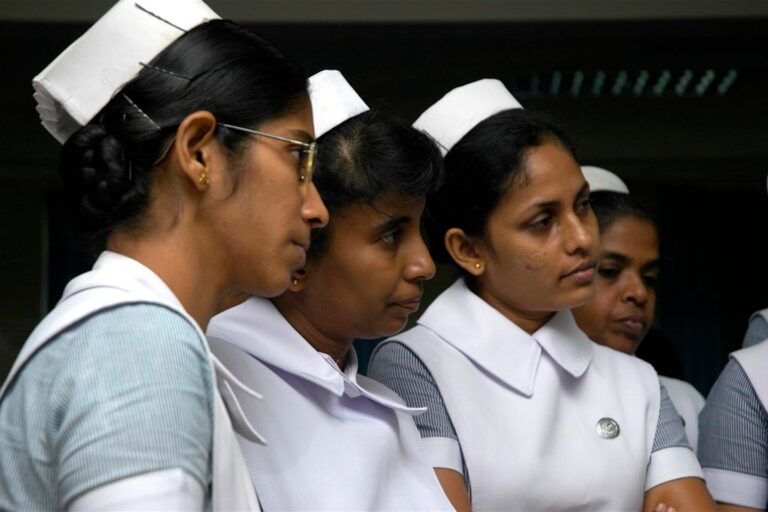
August 04, Colombo (LNW): More nurses are fleeing Sri Lanka’s economic crisis, leaving the healthcare system on its knees and the poorest patients most at risk.
The High Commission of Sri Lanka in Singapore has revealed that over 400 Sri Lankan nurses currently work in Singapore.
A group of 100 nurses arrived at the Changi Airport in Singapore on 15 March 2024, under an ongoing collaboration with Singapore’s Ministry of Health Holdings, making this the largest group of nurses to be deployed to Singapore simultaneously.
Under the ongoing collaboration, nurses from Sri Lanka get the opportunity to serve within the Singapore healthcare system for a period of two years.
The Singaporean Government also provides air tickets for both ways and accommodation free of charge. Apart from the wages a one-time relocation allowance of SGD 1,000/- is given to each person.
The Minister of Health of Singapore Ong Ye Kung states that Singapore is looking to recruit more nurses from Sri Lanka.
During a meeting held at the Ministry of Health of Singapore recently with High Commissioner of Sri Lanka in Singapore Senarath Dissanayake, the Singapore Health Minister has advised the ministry officials to connect SingHealth with the High Commission of Sri Lanka to discuss further the continuity and expansion of collaborative projects in Sri Lanka.
The Minister has also proposed further discussions with the Sri Lankan Ministry of Health on exchanging medical professionals, sharing best practices, and arranging capacity-building initiatives for Sri Lankan healthcare professionals.
The Sri Lankan High Commissioner has further discussed with the Minister of Health of Singapore Ong Ye Kung, the opportunities for cooperation in the health sector between the two countries.
The High Commissioner expressed gratitude for Singapore’s assistance in reinforcing Sri Lanka’s healthcare response to the pandemic, High Commission of Sri Lanka in Singapore said.
Minister Ong Ye Kung welcomed the ongoing collaboration between the two countries in the health sector and highlighted the successful integration and outstanding performance of the nurses recruited from Sri Lanka within Singapore’s healthcare community. He noted that Singapore is looking to recruit more nurses.
More nurses are fleeing Sri Lanka’s economic crisis, leaving the healthcare system on its knees and the poorest patients most at risk.
The High Commission of Sri Lanka in Singapore has revealed that over 400 Sri Lankan nurses currently work in Singapore.
A group of 100 nurses arrived at the Changi Airport in Singapore on 15 March 2024, under an ongoing collaboration with Singapore’s Ministry of Health Holdings, making this the largest group of nurses to be deployed to Singapore simultaneously.
Under the ongoing collaboration, nurses from Sri Lanka get the opportunity to serve within the Singapore healthcare system for a period of two years.
The Singaporean Government also provides air tickets for both ways and accommodation free of charge. Apart from the wages a one-time relocation allowance of SGD 1,000/- is given to each person.
The Minister of Health of Singapore Ong Ye Kung states that Singapore is looking to recruit more nurses from Sri Lanka.
During a meeting held at the Ministry of Health of Singapore recently with High Commissioner of Sri Lanka in Singapore Senarath Dissanayake, the Singapore Health Minister has advised the ministry officials to connect SingHealth with the High Commission of Sri Lanka to discuss further the continuity and expansion of collaborative projects in Sri Lanka.
The Minister has also proposed further discussions with the Sri Lankan Ministry of Health on exchanging medical professionals, sharing best practices, and arranging capacity-building initiatives for Sri Lankan healthcare professionals.
The Sri Lankan High Commissioner has further discussed with the Minister of Health of Singapore Ong Ye Kung, the opportunities for cooperation in the health sector between the two countries.
The High Commissioner expressed gratitude for Singapore’s assistance in reinforcing Sri Lanka’s healthcare response to the pandemic, High Commission of Sri Lanka in Singapore said.
Minister Ong Ye Kung welcomed the ongoing collaboration between the two countries in the health sector and highlighted the successful integration and outstanding performance of the nurses recruited from Sri Lanka within Singapore’s healthcare community. He noted that Singapore is looking to recruit more nurses.
During a meeting with the staff of ‘Udayan’ newspaper in Jaffna, President Ranil Wickremesinghe stresses the importance of national unity to address Sri Lanka’s challenges, including the ethnic issue: highlights the need to overcome bankruptcy, which has been resolved, and now aims to focus on job creation and provincial development: President assures support for strengthening provincial councils to meet youth expectations.
Political sources indicate the Sri Lanka Podujana Peramuna (SLPP) is working to reconcile MPs who previously supported President Ranil Wickremesinghe: Efforts are underway to individually approach these MPs and persuade them to return to the SLPP, backing the party’s presidential candidate announced on August 7: Some MPs have already shown willingness to rejoin the SLPP.
The Sri Lanka Podujana Peramuna (SLPP) announces temporary district leader appointments: MP Namal Rajapaksa for Anuradhapura, State Minister Indika Anuruddha for Gampaha, State Minister Mohan De Silva for Galle, and MP Nipuna Ranawaka for Matara: These changes follow former district leaders’ alignment with President Ranil Wickremesinghe, shifting away from SLPP’s candidate support strategy.
The Election Commission suspends the ‘Urumaya’ land distribution initiative led by President Ranil Wickremesinghe: The programme is expected to resume following the Presidential election.
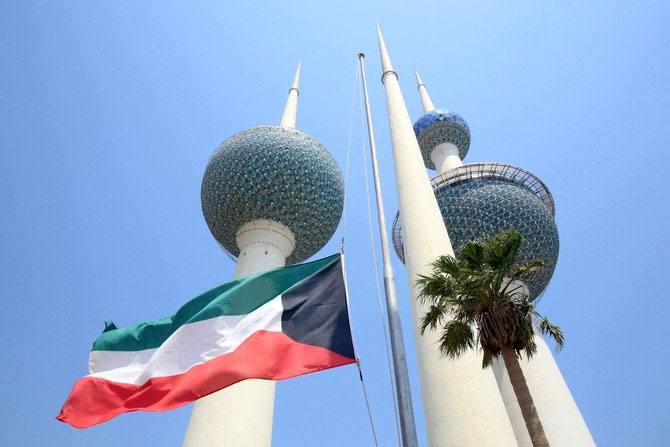
The Ministry of Foreign Affairs confirms the release of 24 Sri Lankans, including artists Indrachapa Liyanage, Samanalee Fonseka, and Upeka Nirmani, detained in Kuwait on August 2: They were arrested for holding an event without proper permits: Following intervention by the Sri Lankan Embassy, the detainees were released on August 3, though two organisers remain in custody: Labour Minister Manusha Nanayakkara says the event was organised by the JVP-affiliated ‘Ethera Api’ organisation.
The Sri Lanka Tourism Promotion Bureau (SLTPB) wins the Best International Tourism Board award at the Global Tourism Awards 2024, as announced on 2 August in New Delhi: Minister Harin Fernando, who attended the ceremony, returned to Sri Lanka on 3 August: The SLTPB’s efforts have led to significant tourism growth, with 1.2 mn international arrivals recorded from January to 1 August.
The Committee on Public Accounts (CoPA) urges the promotion of Wallapatta cultivation for its foreign exchange potential: During a discussion with the Department of Forest Conservation, Chair Lasantha Alagiyawanna highlighted its economic benefits: Forest officials noted that while Wallapatta cultivation is legal, transport from forests without permits is not: Plans are underway to scientifically distinguish Wallapatta from Aquilaria to combat smuggling.
The Postal Department will deploy around 8,000 staff members to distribute polling cards for the upcoming Presidential Election: Deputy Post Master General Rajitha Ranasinghe’s circular informs all post offices of this initiative: Special arrangements are also being made to manage regular postal letters by increasing personnel.
Sri Lanka Police are seeking public help to find three suspects involved in a July 8, 2024, shooting in Athurugiriya that killed two and injured four: Suspects are Waruna Indika de Silva alias “Sankha,” Peti Harambage Ajith Rohana alias “Chandi,” and Muthuwandura Tharindu Madhusanka de Silva alias “Bahirawaya”: Contact numbers for tips are 072 4222223 and 071 8591657.
Sri Lanka’s preparations for the second ODI against India have been disrupted as Wanindu Hasaranga is ruled out with a hamstring injury sustained during the first match: Jeffrey Vandersay replaces Hasaranga, who will miss the rest of the series: The injury comes after fast bowlers Matheesha Pathirana and Dilshan Madushanka were also sidelined: Despite these challenges, Hasaranga had a strong performance in the first ODI.
August 04, Colombo (LNW): The Ministry of Public Security has announced that a conclusive decision on the tourist visa issuance process for Sri Lanka will be made tomorrow (05).
This decision will follow consultations with the Department of Immigration and Emigration.
On Friday (02), the Supreme Court issued an interim order halting the Cabinet’s decision to delegate the Online Visa Electronic Travel Authorisation to two private firms.
The court also granted an injunction against the agreements with these foreign companies and allowed petitions related to the issue to proceed.
As a result, the Department of Immigration and Emigration has temporarily suspended e-visa issuance as of 2 August.
The relevant e-visa application website has been deactivated, and the department is processing refunds for those who have paid for visas.
Consequently, tourists must now obtain an On Arrival visa at the airport upon entering Sri Lanka.
August 04, Colombo (LNW): The Sri Lanka Podujana Peramuna (SLPP) has revealed a series of temporary appointments to district-level positions within the party.
Reports indicate that MP Namal Rajapaksa will take on the role of SLPP leader for the Anuradhapura District.
In Gampaha, State Minister Indika Anuruddha has been designated as the new district leader, a significant post given the district’s political importance.
State Minister Mohan De Silva will now lead the Galle District, while MP Nipuna Ranawaka has been appointed to head the Matara District.
These appointments come in the wake of several former district leaders aligning themselves with President Ranil Wickremesinghe, diverging from the SLPP’s strategy of supporting its own candidate.
August 04, Colombo (LNW): The Ministry of Foreign Affairs has confirmed the release of 24 Sri Lankans, including well-known artists, who were detained in Kuwait on 2nd August.
The group, which included figures such as Indrachapa Liyanage, Samanalee Fonseka, ‘Jolly Seeya,’ and Upeka Nirmani, was arrested during an event organised by the JVP-affiliated ‘Ethera Api’ organisation.
The arrests occurred due to the event being held without proper permissions.
Alongside the artists and event organisers, the music band and their instruments were also confiscated.
Following the intervention of the Sri Lankan Embassy in Kuwait, the 24 detainees were released on the night of 3rd August.
However, two members of the organising committee remain in police custody, according to the Ministry of Foreign Affairs.