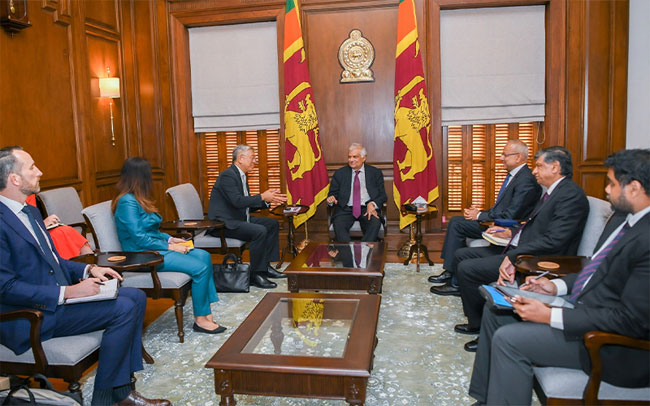
May 14, Colombo (LNW): United States’ Assistant Secretary of State for South and Central Asian Affairs, Donald Lu, met with President Ranil Wickremesinghe yesterday (13) at the Presidential Secretariat in Colombo.
The meeting revolved around extensive discussions concerning Sri Lanka’s economic recovery strategies, according to a statement.
The President’s Media Division highlighted the appreciation for President Wickremesinghe’s steadfast dedication and commitment to implementing the economic reform programme.
President Wickremesinghe was accompanied by Senior Advisor on National Security and Chief of Staff, Sagala Ratnayaka, Secretary to the President, Saman Ekanayake, and US Ambassador to Sri Lanka Julie Chung.
May 14, Colombo (LNW): Water Supply and Estate Infrastructure Development Minister Jeevan Thondaman assured that the government is prepared to address any legal challenges should estate companies contest the government’s decision to raise wages for estate workers.
Previously, plantation companies asserted an inability to raise workers’ basic salary by even a single rupee.
However, following the government’s announcement of a daily wage of Rs. 1700, Minister Thondaman revealed that companies proposed a Rs. 200 increase in the basic salary for estate workers.
He underscored the companies’ capability to enhance wages for estate workers.
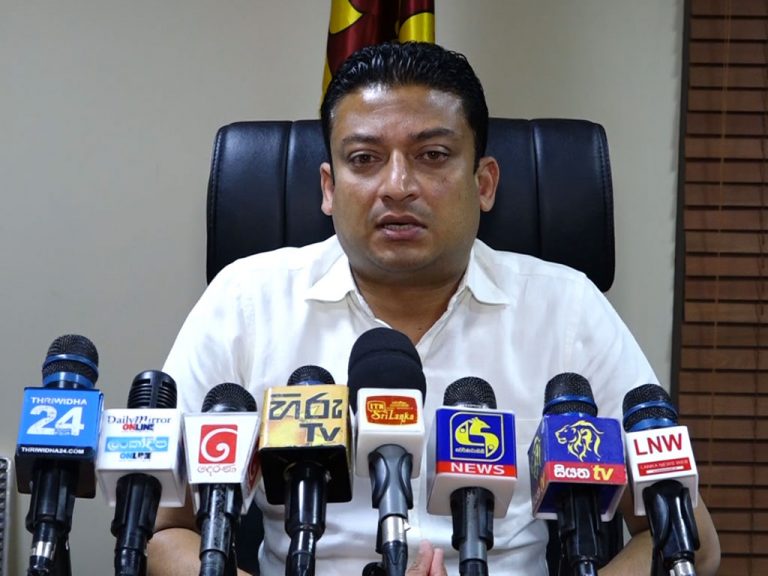
Speaking at a press briefing at the President Media Centre (PMC) on Monday (13), themed ‘Collective Path to a Stable Country’, the minister highlighted the acute shortage of drinking water in the Jaffna peninsula, necessitating urgent measures.
Presently, only 11 per cent of the peninsula has access to clean drinking water.
However, with the ongoing construction of a desalination plant, approximately 40 per cent of the Jaffna peninsula will soon have access to drinking water, marking a significant development in addressing water scarcity, he noted.
Amidst a severe economic crisis impacting the nation, estate workers are among the hardest hit.
Enduring prolonged hardships amidst economic turmoil, their main struggle centres on wage issues, Thondaman emphasised.
In response, the government has taken decisive action by officially mandating a daily wage of Rs. 1700 for estate workers under President Ranil Wickremesinghe’s leadership, through a gazette notification.
It is now imperative for estate companies to comply with this official directive.
Moreover, the government stands ready to confront any legal challenges from estate companies disputing the wage increase for plantation workers, he asserted.
Previously, plantation companies claimed an inability to raise their workers’ basic salary by even a rupee. However, upon the issuance of a government gazette notification setting the daily wage for plantation workers at Rs. 1700, the same companies promptly increased the basic salary by Rs. 200.
This underscores their capacity to uplift the wages of estate workers, he contended.
“Simultaneously, the government is actively improving the estate community’s quality of life by addressing housing shortages among plantation workers, expanding educational and employment opportunities, and now, by increasing salaries. This concerted effort undeniably benefits our estate community, providing tangible advantages to our people.”
“However, as the election season approaches, certain parties often make numerous promises to our people. Among these commitments, some pledge to transform estate workers into small estate owners. However, they frequently fail to elaborate on the mechanisms behind such proposals,” he remarked.
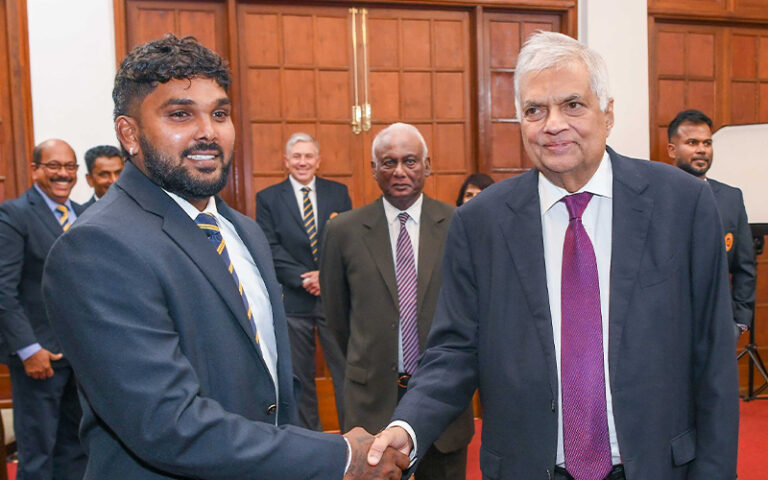
May 14, Colombo (LNW): President Ranil Wickremesinghe conveyed his best wishes to the Sri Lankan Cricket Team as they prepare to participate in the upcoming Twenty-20 World Cup Cricket Tournament, slated to be held in the U.S. and the West Indies from June 1st to June 29th.
During a meeting convened at the Presidential Secretariat yesterday (13) afternoon, the President engaged in an affable exchange with the team, led by Wanidu Hasaranga.
He offered words of encouragement and extended congratulations to the players for representing the nation with distinction, reported the Presidential Media Division (PMD).
The Sri Lankan cricket squad, comprising 15 players, is scheduled to depart the island on the morning of the 14th.
Wickremesinghe commended the team for their dedication to achieving success on the international stage.
In addition to the cricket team, President Wickremesinghe had the opportunity to meet with the Sri Lankan Rugby team, who emerged victorious in the Asian Rugby Championship held in Sri Lanka, competing in the first division.
Expressing profound pride in this significant rugby triumph, President Wickremesinghe lauded the team’s exceptional skills and congratulated them on their remarkable achievement.
The meeting was attended by Minister of Tourism, Lands, Sports, and Youth Affairs, Harin Fernando, Minister of State, Arundika Fernando, and the President’s Senior Advisor on National Security and Chief of Staff, Sagala Ratnayaka.
May 14, Colombo (LNW): Due to a low-level atmospheric disturbance in the vicinity of Sri Lanka, showery condition is expected to be continue further, the Department of Meteorology said in its daily weather forecast today (14).
Showers or thundershowers will occur at several places in most provinces of the island after 1.00 p.m., with heavy showers about 100mm being likely to occur at some places in Southern, Central, Eastern and Uva provinces.
Showers may occur at Western and Southern provinces during the morning as well.
General public is kindly requested to take adequate precautions to minimise damages caused by temporary localised strong winds and lightning during thundershowers.
Marine Weather:
Condition of Rain:
Showers or thundershowers will occur atseveral places in the sea areas around the island.
Winds:
Winds will be south-westerly or variable and wind speed will be (20-30)kmph
State of Sea:
The sea areas around the island will be slight. Temporarily strong gusty winds and very rough seas can be expected during thundershowers.
May 13, Colombo (LNW): The much awaited and long overdue bill to amend the Telecommunications Regulatory Act after 28 years was presented to the Parliament State Minister for Technology, Kanaka Herath said.
The Cabinet of Ministers approved the publication of the draft bill for the amended Sri Lanka Telecommunication Regulatory in the Government gazette and present the same in the Parliament for approval.
“The move follows the receipt of Attorney General clearance for the draft bill, which has been carefully prepared in all three languages by the Legal Draftsman,” Cabinet Co-Spokesman and Minister Bandula Gunawardena said at the post-Cabinet meeting media briefing.
The decision to amend the Sri Lanka Telecommunication Regulatory Act No. 25 of 1991 was initially approved by the Cabinet in their meeting held on 1 January 2024.
He also assured that this piece of legislation has no connection to the previously approved Online Safety Act.
The Sri Lanka Telecommunications (Amendment) Bill, containing clauses aimed at penalising persons who spread false information via telephone leading to public disturbance, was introduced to Parliament on Friday.
As per the bill presented to Parliament, by Leader of the House Susil Premajayantha, persons persistently making telephone calls or transmitting messages to cause annoyance or inconvenience without reasonable excuse may face fines up to Rs. 100,000 and disconnection of their telephone connections.
Moreover, those deliberately making calls or sending messages to incite public commotion or disrupt public tranquillity may incur fines up to Rs. 1 million or imprisonment, with continuous offenders facing fines of Rs. 1,500 per day of offence.
Furthermore, persons providing misleading or false information to telecommunication officers may face fines up to Rs. 100,000, with telecommunication apparatus used for false information being forfeited to the State upon magistrate order.
The bill also empowers the Telecommunications Regulatory Commission to oversee submarine cables in Sri Lanka’s territorial waters, with assistance from the Sri Lanka Navy, Department of Coast Guard, and Sri Lanka Police.
Additionally, provisions in the bill enable radio service providers to engage in interconnection agreements.
However, concerns have been raised by industry experts on the legislation which is to be amended after 28 years as the Government has not called for any public consultations on the matter.
May 13, Colombo (LNW): Currently, Sri Lanka is the 5th fastest-growing tourism destination in the world and is all set to achieve even greater and more sustained success in 2024 with tourist arrivals expected to reach dizzying heights.
As per data released via www.travelofpath.com, Sri Lanka ranks behind Tunisia, Mexico, Morocco and the Dominican Republic as the 5th fastest growing tourism destination and on the back of such a milestone, more can be expected from the tiny island nation which has had its fair share of ups and downs in recent times.
Crucially, stakeholders within Sri Lanka’s tourism industry are of the opinion that as many as 4 million tourists will visit the country which will have a significant impact on the local economy.
Furthermore, a huge chunk of the credit must be given to the Ministry of Tourism and the Sri Lanka Tourism Development Authority for their combined efforts taken to enhance the appeal of Sri Lanka towards the latter half of 2023..
Sri Lanka’s tourism industry has demonstrated a remarkable resurgence, raking in over $ 1.25 billion in revenue during the first four months of 2024, marking a staggering 92% surge compared to the same period last year.
This robust performance not only signals a strong recovery but also highlights the industry’s potential for growth and resilience in the face of adversity.
The acceleration in revenue generation during the first four months is particularly noteworthy, considering that achieving such a milestone took the country seven months in the previous year.
April earnings amounted to $ 225.7 million, reflecting 52.3% increase year-on-year (YoY).
Although, on a month-on-month basis, April earnings experienced a 33% decline, indicative of the industry’s seasonal fluctuations, it remains the highest monthly earnings recorded since 2020.
Despite grappling with challenges stemming from the Easter Sunday attacks in 2019, Sri Lanka’s tourism industry has not only weathered many storms but emerged stronger. The resilience has instilled fresh confidence in the sector’s ability to bounce back and thrive.
Buoyed by ongoing promotional efforts and a renewed focus on safety and visitor satisfaction, Sri Lanka is poised to reclaim its position as a top tourist destination globally. The surge in arrivals, totalling an impressive 784,651 in the first four months of 2024, underscores this optimistic outlook, representing a significant increase from the previous year.
Looking ahead, Sri Lanka Tourism aims to attract 2.3 million visitors and generate over $ 4 billion in income for 2024. As tourism remains a crucial source of foreign exchange earnings for the country, efforts are underway to attract high-end tourists, with plans to increase the average spending per visitor to $ 4,000.
The Sri Lanka Tourism Development Authority (SLTDA) is targeting 2.5 million visitors to spend over $ 500 per day, with a focus on attracting high-spending travelers, who currently constitute a significant portion of tourists visiting the country.
May 13, Colombo (LNW): The US nominee to Sri Lanka Elizabeth K. Horst says she is committed to do more to counter Chinese investments in the country.
Responding to a question posed to her by the US Senate Foreign Relations Committee, Horst said that the US has an alternative and better model to offer Sri Lanka.
The US Senate Foreign Relations Committee questioned Horst on the possibility of urging Sri Lanka to maintain a moratorium on Chinese research vessels entering Sri Lankan waters.
Horst said that if confirmed she will discuss the moratorium issue but also ensure fair and equal access to ships from the US.
The nominee to be the US Ambassador to Sri Lanka told the US Senate Foreign Relations Committee that if confirmed she will support members of marginalized populations in Sri Lanka, accountability, truth and reconciliation, and transparency and justice.
“Sri Lanka is a vital partner to the United States in the Indo-Pacific region, and it has been for over 76 years. If confirmed, I would focus on three main pillars of the U.S.-Sri Lanka relationship: broadening our economic cooperation, bolstering our security interests, and deepening our ties with Sri Lanka’s diverse and vibrant population,” she said in her opening statement.
Horst said that Sri Lanka’s economy has great potential and strengthening trade relations, encouraging private sector-led growth, and promoting inclusive innovation and entrepreneurship are key aspects of her vision for enhancing economic ties between both countries.
She also said that while healing from the civil war that ended in 2009 and from the political and economic crises of 2022, Sri Lanka continues to make steady progress in the face of remarkable internal and external challenges.
The nominee said that today, as Sri Lanka regains its economic footing and confidence, the US will continue to be a strong partner to support the Sri Lankanpeople.
US Senate Foreign Relations Committee also appreciated the role played by current US Ambassador Julie Chung. Horst said that if confirmed she will look to continue the work of Ambassador Julie Chung.
May 13, Colombo (LNW): Sri Lanka is expecting to sign foreign direct investment agreements of US$ 3 billion in 2024, with the help of a refinery to be built by Sinopec of China, State Minister for Investment Promotion Dilum Amunugama said.
“The investment promotion ministry was given a target of one billion US dollars of FDI for 2024,” Minister Amunugama said, adding that though the final contracts have not been signed, discussions are steadily progressing to exceed that number.
“By the second quarter we are likely to be able to double it and by the end of the year may be treble it,” Amunugama said.
A renewable energy project by India’s Adani group, for which a power purchase agreement was approved by the cabinet this week, was valued at 800 million US dollars
Among the private industrial zones to be jointly established with the government near Trincomalee, Mankulam, Paranthan, and Kankesanthurai, the Kankesanthurai Private Industrial Zone is set to commence operations.
A Sri Lankan business group based in Canada is spearheading this endeavour with a US$ 500 million investment and has undertaken the responsibility of attracting projects to the zone, Amunugama shared.
Furthermore, under the Trincomalee District Development Plan, sectors like solar and wind energy, along with green hydrogen, are poised to emerge as significant investments in the country. “Following the completion of debt restructuring, we aim to expedite this development project in collaboration with India,” he stressed.
Sri Lanka is all set to triple the investment target set for 2024, State Minister of Investment Promotion Dilum Amunugama said, as the necessary activities to realise the goal for 1Q24, set by the Finance Ministry has been successfully rolled out.
Amunugama, addressing a press conference on Friday said that the authorities are confident in attracting over US$ 3 billion in investments to the country.
“It is important to note that the investment projects signed in 2023 will be executed this year, though they are not counted as part of this year’s investments,” added Amunugama.
He went on to stress that he can “confidently affirm” that the investment background has significantly improved, showing a 200 percent progress from two years ago, making Sri Lanka favourable for investors.
He shared that this year Sri Lanka initiated investment promotion efforts in foreign countries by appointing representatives to the investment board.
“Remarkable successes have already been achieved in countries such as Britain, Canada, France, Italy, and Germany through project promotion activities conducted via global forums comprising Sri Lankan businessmen residing abroad,” he noted.
President Ranil Wickremesinghe outlines plans for Sri Lanka’s economic growth and government reforms, aiming for a 3% growth rate by 2025: announces measures to raise government employee salaries and introduce key laws for economic development, including granting autonomy to the Central Bank: emphasises the importance of investment in education and healthcare.
CoPF Chief Dr. Harsha De Silva reveals the Office of International Trade (OIT) highlighted its staffing challenges to the Committee: adds the Chief Negotiator, A.G. Weerasinghe, revealed that the OIT lacks personnel for feasibility studies on pending FTAs with China and Thailand: proposes discussing the future of the Department of Commerce, suggesting either its continuation or closure, with a potential transfer of officers to the OIT if the Commerce Department ceases operations.
Ex President Mahinda Rajapaksa calls for the government to postpone plans to privatise national assets and state-owned enterprises until after a new government is elected: cites concerns over unrest among trade unions, political groups, and citizens, arguing that selling state-owned assets during the current interim period might not benefit the nation: Opposition MPs and former SLPP member MP Charitha Herath respond, urging the SLPP to oppose the government’s actions in Parliament and questioning the implications for President Ranil Wickremesinghe’s position.
State Minister Dilum Amunugama announces Sri Lanka’s ambitious goal to triple its investment target for 2024, aiming to attract over US$ 3 bn in investments: expresses confidence in the country’s improved investment landscape, citing a remarkable 200% improvement compared to two years ago: adds efforts to promote investment abroad have begun, with representatives appointed to the investment board and notable successes achieved in countries like Britain, Canada, France, Italy, and Germany.
To combat the entry of unsafe medicines, the NMRA plans to introduce security stickers on pharmaceutical registration certificates after recent scandals involving fraudulent certificates: Chairman Dr. Ananda Wijewickrama announced this move to ensure the authenticity of certificates, with implementation expected within a month pending receipt of the new stickers.
The IORA Business Conclave hosted by The Ceylon Chamber of Commerce, in partnership with the Ministry of Foreign Affairs, will focus on key sectors like Agriculture, ICT, Logistics, and Tourism: With participation from various countries, including Australia, India, and Malaysia, the event aims to foster strategic alliances and explore emerging trends: Featuring plenary sessions, breakout sessions, and B-2-B meetings, the Conclave offers insights into disruptive technologies and sustainable practices across the Indian Ocean Rim: Strategic Partners include the Australian Government and the Asian Development Bank, among others.
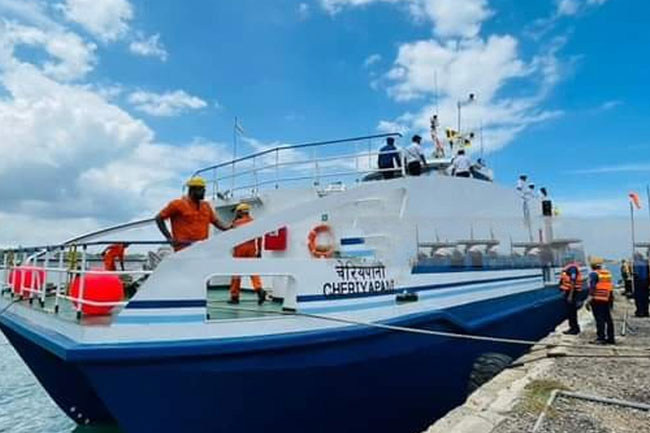
The passenger ferry service between Nagapattinam and Kankesanthurai faces a delay, pushed from May 13 to May 17 due to vessel arrival and regulatory requirements: Reservations for May 13-16 will be rescheduled for May 17.
Public Security Minister Tiran Alles vows strict action against police misconduct in the “Yukthiya” Operation, addressing concerns of human rights abuses and collusion with criminals: refutes claims of wrongful detentions under the operation, emphasising its focus on apprehending drug traffickers: While acknowledging issues within certain police stations, Alles pledges to uphold law enforcement integrity and combat drug-related crimes.
Sri Lankan author Kumar Hewage releases new book, “Beyond Myth, Rama, Ravana & the Secret of Star Gate”: The book follows the deciphering of the past involving the symbolism of Ramayanaya, legend of Ravana and Sigiriya, a lost scholar’s legacy, and the power of meditation: The journey leads them through the timeless epic of Ramayana, exploring hidden corners of India, Sri Lanka, and Southeast Asia: The book is now available on Kindle.
Sri Lanka ‘A’ team displays a strong performance on day two against Afghanistan ‘A’ at P. Sara Oval Stadium, scoring 435 runs in their first innings: Sonal Dinusha (145) and Wanuja Sahan (75) shone, with Dinusha almost reaching 150 before being stumped: Afghanistan ‘A’ lost one wicket and scored 18 runs by the close of play: Zia-ur-Rehman took 6 wickets for Afghanistan, while Milan Ratnayake dismissed Afghanistan’s opener for a duck: The match will resume at 9:45 a.m. on the third day.
May 13, Colombo (LNW): The resumption of the passenger ferry service between Nagapattinam and Kankesanthurai has encountered a delay, attributed to the tardiness in the arrival of the vessel and the need to fulfil regulatory requirements, The Hindu reported.
Originally slated to recommence operations on May 13, the service will now commence on May 17, announced IndSri Ferry Services Pvt. Ltd., the company overseeing the service, in a press release issued on Sunday (12).
The statement assured the public that all necessary certificates for regulatory compliance would be obtained promptly to facilitate the commencement of the service by Friday, May 17, 2024.
Passengers who had previously booked travel between May 13 and 16 will have their reservations rescheduled for May 17 accordingly.