Home Blog Page 1288

Danushka Gunathilaka found not guilty over sexual assault case

0

Sri Lankan international cricketer Danushka Gunathilaka has been found not guilty of sexual assault by a Sydney judge who said the evidence established there was “no opportunity” for him to have removed a condom during sex, and that he was truthful in his police interview, a report by The Sunday Morning Herald disclosed.

The 32-year-old batsman was accused of “stealthing” during sex with a 29-year-old woman without her knowledge in her eastern suburbs home on November 2, 2022. He pleaded not guilty to sexual intercourse without consent and faced a four-day trial before Judge Sarah Huggett in Downing Centre District Court.

Sri Lankan cricketer Danushka Gunathilaka (left) arrives at Downing Centre District Court for a judge’s verdict after he faced trial accused of sexual assault.
Sri Lankan cricketer Danushka Gunathilaka (left) arrives at Downing Centre District Court for a judge’s verdict after he faced trial accused of sexual assault.Credit: Kate Geraghty

Delivering a verdict of not guilty on Thursday, the judge said: “The evidence establishes that there was no opportunity for the accused to remove the condom … because that intercourse was continuous.”

The trial heard Gunathilaka, also known as Danny, and the woman matched on Tinder on October 29 and talked over Instagram and WhatsApp, including via video calls.

They met for drinks at the Opera Bar followed by dinner at Frankie’s Pizza and then caught a ferry to the complainant’s home, where Gunathilaka recorded her playing guitar and singing.

“The mood as captured by those videos seemed relaxed, happy and playful,” the judge said.

She said the complainant came across as intelligent and not as a witness “motivated by a desire to give deliberately false evidence”, but there were occasions when she formed the impression the woman appeared “motivated to paint the accused in an unfavourable light”.

The woman, who testified over two days, alleged Gunathilaka kissed her forcefully and slapped her buttocks on the ferry to her house, and “ambushed” her by pushing her back on the lounge. She accepted under cross-examination she had said “let’s go to my room” and lit candles “to create a mood”.

The woman claimed Gunathilaka choked her at least three times and slapped her buttocks during forceful intercourse in her bedroom for 10 to 15 minutes.

She said she noticed a condom on her bedroom floor within three to five seconds of the sex ending. The woman alleged Gunathilaka threw it there, but did not see him do it.

CCTV shows the pair leaving the Opera Bar arm-in-arm.

Crown prosecutor Gabrielle Steedman submitted the sexual episode “turned out very differently to what she [the woman] expected or wanted” and his behaviour was “entirely consistent with someone who would, in that state of mind, remove his condom, despite her clear wishes to the contrary”.

Gunathilaka’s barrister Murugan Thangaraj, SC, said there was “no window” for Gunathilaka to have removed the condom during sex, and the woman had described it as “continuous sexual activity”.

“That ends it. The Crown cannot prove its case at all, let alone to the requisite standard, with that evidence,” Thangaraj said.

Gunathilaka was arrested in the early hours of November 6 in the Hyatt Regency Hotel as the Sri Lanka team left for the airport. He let police search his hotel room, where they found a Burberry satchel bag containing two wrapped condoms.

“That he would wear a condom on occasion is supported by the fact that two unused condoms were located in his property,” the judge said.

Gunathilaka participated in a two-and-a-half hour recorded interview. Asked by police “At any point, did you put your penis into her without a condom on?” Gunathilaka replied, “No, no, no.”

He admitted he had told the woman he did not like to have sex with a condom, and she was the one who got a packet out.

“I never said ‘I want to do it without condoms’, and we did it with condoms,” Gunathilaka said.

The judge said Gunathilaka “answered every question asked of him in the interview, and I formed the distinct impression he was doing his best to be truthful and assist the police”.

“There is no reason at all to reject or disbelieve what he said in that interview,” Huggett said.

The court heard the woman had cried while telling friends Gunathilaka “turned into an animal” and “something really terrible happened”. Regarding the condom, she told them “I don’t know if he took it off” and “I’m not sure, I just have a feeling”.

The judge said: “In my view, the complaint evidence undermines rather than supports the complainant.”

Thangaraj said the woman was “demonstrably unreliable” and CCTV from the ferry and wharf showed the pair kissing and hugging, which did not match her narrative that his client was forceful and aggressive.

Gunathilaka was suspended from cricket following his arrest. He made his international debut in 2015 and has represented Sri Lanka in more than 100 matches including eight Tests. He travelled to Australia for the T20 World Cup but was ruled out with a hamstring tear after playing one match.

He was granted a judge-alone trial due in part to pre-trial media interest. The proceedings were expedited by consent after the court heard he financially supported his parents with his earnings.

Source: The Sunday Morning Herald

Today’s (Sep 28) weather: Advisory for heavy rain

0

By: Isuru Parakrama

Colombo (LNW): Due to active Southwest Monsoon conditions over the island, prevailing showery condition in south-western part of the island is likely to continue further, announced the Natural Hazards Early Warning Centre of the Department of Meteorology in an advisory statement today (28).

The Dept in its daily weather forecast said showers or thundershowers will occur at times in Western, Sabaragamuwa, Southern and North-western provinces and in Kandy and Nuwara-Eliya districts.

Heavy showers about 100mm can be expected at some places in Western and Sabaragamuwa provinces and in Galle and Matara districts, the Dept added.

Fairly strong winds about (40-45) kmph can be expected at times in western slopes of the central hills, Northern, North-central, and North-western provinces and in Trincomalee and Hambantota districts.

Showers or thundershowers will occur at several places in Uva and Eastern provinces during the evening or night.

General public is kindly requested to take adequate precautions to minimise damages caused by temporary localised strong winds and lightning during thundershowers.

Marine Weather:

Condition of Rain:
Showers or thundershowers will occur at several places in the sea areas off the coast extending from Puttalam to Hambantota via Colombo, Galle and Matara.
Winds:
Winds will be south-westerly and speed will be (30-40) kmph. Wind speed can increase up to (50-60) kmph at times in the sea areas off the coast extending from Puttalam to Kankasanthurai via Mannar and from Hambantota to Pottuvil. Wind speed can increase up to 50 kmph at times in the sea areas off the coast extending fromPuttalam to Hambantota via Colombo, Galle and Matara.
State of Sea:
The sea areas off the coast extending from Puttalam to Kankasanthurai via Mannar and from Hambantota to Pottuvil can be rough at times. The sea areas off the coast extending from Puttalam to Hambantota via Colombo, Galle and Matara will be fairly rough at times. Temporarily strong gusty winds and very rough seas can be expected during thundershowers.

Sri Lanka Original Narrative Summary: 28/09

0

  1. IMF Senior Mission Chief Peter Breuer dashes the Govt’s hopes: says “there’s no fixed timeline for the 2nd tranche to be disbursed”: also says the next disbursement will depend on sustaining reforms and progress in the debt front: analysts say this is a huge setback to the Govt which was solely dependent on this IMF programme for its continuity.
  2. Several analysts who strongly advocated an IMF programme last year as being the “only solution” to the crisis, offer reasons for the present debacle; Advocata’s Dhananath Fernando says SL has to improve its tax system by following “international standards of transparency”: Economist Talal Rafi says the main issue is the external debt restructuring and that he hopes President Ranil Wickremesinghe’s visit to China can make progress on this matter: also says this setback will force the Govt to work harder on structural reforms.
  3. Export Development Board says earnings from merchandise exports increased by 6.8% (month-on-month) in August’23 to USD 1.09 bn, compared to July’23, but down by 10.91% YoY, compared to August’22.
  4. Minister of Power & Energy Kanchana Wijesekara says legislation to restructure the Ceylon Electricity Board and Ceylon Petroleum Corporation will be presented to Cabinet within the next 2 weeks.
  5. Professionals’ Trade Unions Collective led by the Govt Doctors meet the IMF delegation: discuss their demands including tax relief: state they have been informed by the IMF delegation that it’s the Govt that must take measures to address the demands of professionals since the IMF has granted authority to the Govt to make suitable changes to its tax policy.
  6. Hatton National Bank MD/CEO Jonathan Alles says SL’s banking sector may have lost about 10,000 employees during 2023, out of which a significant number have migrated: also says banks now have to resort to massive recruitment drives to fill the vacancies.
  7. Well-known Human Rights Activist Jehan Perera says the country’s economy which shrank by over 7% last year and by 11% in the 1Q23, is continuing its downward plunge: also says the much touted absence of shortages & queues is not due to the economic performance picking up, but because people have less money to spend.
  8. SLPP MP Mahindanada Aluthgamage says doctors are leaving the country not because of higher taxes, but due to the education of their children: analysts however point out that SL experienced the exodus of qualified doctors & consultants mainly after the Govt raised taxes early this year.
  9. A representative of the Abhimani Women’s Collective says SL’s sex workers are facing fundamental rights violations including unlawful detention and cruel, inhumane & degrading treatment.
  10. SLPP rebel group spokesman Professor G L Peiris says the enactment of the Online Safety Law is to suppress political dissent: asserts that investors would be wary of having any dealings with the Wickremesinghe-Rajapaksa Govt as a result of the new Online Safety Law and the new Anti-Terrorism Law.

LGBTQIA+ community forms trade union with 6000 members

0

By: Editor (LGBTIQ)

Colombo (LNW): In a move to address the issues faced by their constituency subject to marginalisation and harassment for decades, the Sri Lankan LGBTQIA+ community took yet another step in forming a trade union with a membership of about 6,000 members.

This was disclosed by members of the LGBTQIA+ community during a recent meeting with Labour and Foreign Employment Minister Manusha Nanayakkara, where the significance of such a trade union being formed in upholding their constitutional rights as citizens was emphasised. 

The government has approved the establishment of a trade union for the LGBTQIA+ community, which has been endorsed and facilitated by the National Union of Seafarers Sri Lanka (NUSS).

Joining the discussion, Minister Nanayakkara directed the NUSS to seek a slot for the new LGBTQIA+ trade union in the National Labour Advisory Council (NLAC), thereby enabling their concerns to be addressed at the highest echelons.
The LGBTQIA+ community, who, despite being lawful citizens, often find themselves marginalised and subject to violence, and the most severe problems facing them is continuous harassment by the Police, noted NUSS Chief Palitha Atukorale. 

He revealed that the rising employment rate of LGBTQIA+ individuals in the country’s industrial sectors and free trade zones (FTZ) would allow them to address their issues on a trade union level, adding that trade unions of both state and private sectors have offered to back the newly formed LGBTQIA+ union. 

“No fixed timeline” for 2nd tranche of $3 bln loan, IMF official says after SL’s failure

0

ECONOMYNEXT (Colombo/September 27/2023) – Sri Lanka’s second tranche of a $3 billion loan from the International Monetary Fund is likely to be delayed as the island nation has failed to meet the programme objective and a global lender’s official said there is no fixed timeline on the disbursement of second tranche.

Sri Lanka’s government revenue is likely to face a 15 percent fall from the target agreed with the IMF, the global lender said, amid poor tax administration and lower collection.

An IMF delegation was in Colombo over a week for the first review of the loan before the global lender’s Executive Board approval for the second tranche.

“There is no fixed timeline,” Peter Breuer, Senior Mission Chief for Sri Lanka at the IMF’s Asia and Pacific Department, told reporters at a media briefing on Wednesday after concluding the first review of the loan.

“We are confident that it will be able to do with a little bit more time,” he said referring to Sri Lanka’s effort to raise revenue.

The IMF in March this year approved a 48-month, $3 billion extended arrangement under the Extended Fund Facility (EFF) to support Sri Lanka’s economic policies and reforms with the main emphasis on increasing the government revenue, boosting the international reserves, and reducing inflation.

Soon after the approval, the island nation which is going through an unprecedented economic crisis received the first tranche of $330 million. The first review is to assess the country’s performance against the IMF programme objective.

Breuer said Sri Lanka is yet to satisfy two key objectives.

“We need two important things to be satisfied. We need to reach agreement on set targets, policies, and reforms that will allow us to go forward… with the understanding that the objective of the programme can be reached,” Breuer said.

“So, now we have discovered there was a little bit of shortfall on one area during this year. So, we are looking to try and find ways to address that shortfall and compensate.

He said working in a direction of having agreement on these policies is an “important prerequisite.”

“Then the other one is in the area of debt,” Breuer said adding that reaching agreement with creditors will help store debt sustainability in Sri Lanka.

“When these two conditions are met, we can go forward. Of course, there is a little bit of administrative process also. It will take some time to write the reports that actually assesses the performance of the first review before steps to be considered by our executive board which will make the final decision on this.”

IMF expresses concern on Sri Lanka’s shortfall in revenue collection.

0

By: Staff Writer

Colombo (LNW): The International Monetary Fund is concerned about a shortfall in revenue collection by Sri Lanka’s government this year, though that is unlikely to derail a $2.9 billion loan programme for the crisis-hit country, two Sri Lankan sources said.

Sri Lanka has met International Monetary Fund quantitative targets for June 2023 except state revenues, Central Bank Governor Nandalal Weerasinghe claimed sometimes back.

The IMF program has a set of quantitative targets listed as ‘performance criteria’ which has to be mandatorily or seek a waiver and also indicative targets.

The central government tax revenue floor of Rs 1,300 billion rupees is an indicative target he added.

All the targets have been met, except the revenue target is below,” Governor Weerasinghe disclosed.

Sri Lanka’s tax revenues grew 50 percent to Rs. 1,198 billion rupees up to June 2023, and non-interest spending was kept in check, helping record a primary surplus, official data show.

Non-tax revenues grew 43 percent to Rs. 116.0 billion rupees, according to data released by the central bank.Total revenues grew 43 percent to Rs. 1,317 billion.

However current spending also grew 48 percent to Rs.2, 325.5 billion A large part of the current spending or rs. 1,211.8 billion was interest costs.

A delegation from the IMF met with Sri Lankan President Ranil Wickremesinghe, who is also the finance minister, and its central bank governor, earlier on Tuesday as part of the first review of the four-year loan deal agreed in March.

Such reviews are necessary to continue the programme, which is critical for the country that is slowly recovering from its worst economic crisis in at least seven decades.

“Sri Lanka has met most of the requirements needed to fulfil the first review. This includes progress on domestic debt restructuring,” said one of the sources, who are both government officials and declined to be named.

Sri Lanka’s junior finance minister, Ranjith Siyambalapitiya, told reporters last week that the shortfall could be about 100 billion rupees (about $312 million). The target for the government was to increase revenue to 11.3% of gross domestic product in 2023 from 8.3% last year.

Tax department’s RAMIS becomes a white elephant.

0

By: Staff Writer

Colombo (LNW): Sri Lanka’s Revenue Administration and Management Information System (RAMIS) being operated at the Inland Revenue Department has become a white elephant eating taxpayers money without much contribution to revenue collection, parliamentary sectoral committee report revealed.

The Committee observed that: when renewing the agreement with Singaporean company which developed and maintains RAMIS 2.0, attention should be focused to upgrade it in compliance with the proposed new taxes (Inheritance tax and Wealth tax etc.)

It has to be integrated with other state institutions connected with IRD.and use National Identity Card Number as the unique identification number

The system has to be upgraded with the technical capacity to prevent the delays in registration of tax files.

The development of all modules of RAMIS will be finalized by September 2023 Rs. 1258 million of default taxes has been accumulated due to a system error of RAMIS in the total amount of held over tax as at31.12.2022 and also the IRD has informed that there are lot of data entry errors in the RAMIS

The tax department’s RAMIS, currently doesn’t function properly. The proposals suggest that RAMIS would need to be updated properly in order to improve the IRD’s efficiency.

Back in 2014, the IRD under the Ministry of Finance, invested Rs 10 billion towards building RAMIS.

The idea was to modernize and improve the tax collection process. However, it’s now revealed that the system doesn’t operate as intended, despite the fact that “more money has already been spent to strengthen this system,”

The RAMIS should be fully automated without any manual process and it should be capable of preventing the accumulation of default taxes, the committee suggested. .

It has been initially proposed to interlink 6 public institutions with RAMIS and now it is expected to interlink 29 public institutions.

The agreement with the Singaporean Company to develop and maintain the RAMIS 2.0 will be expired by 31st January 2024, and the internal capacity including the human resources of the Department has not been developed to take over the full responsibility of the RAMIS 2.0 by the end of January 2024.

Business entities related to Betting and Gaming Levy Act, No.40 of 1988 such as Casinos are not included and operated by the RAMIS.

There is a lack of trained and technically competent officials to operate the RAMIS: Help Desk / Support Team (Front-line support for endusers and customers. They handle incoming inquiries, troubleshootcommon issues, and provide basic technical assistance)

System Administrators / Network Engineers responsible for managing and maintaining the IT infrastructure will have to be recruited, the committee observed.

Sinopec to Make Sri Lanka’s Largest Recent FDI with Refinery Operations

0

Minister of Power and Energy, Kanchana Wijesekera, announced that Sinopec China is set to make Sri Lanka’s most substantial foreign direct investment (FDI) in recent times by entering refinery operations in the country. The formal agreement for this strategic move will be announced and signed in October when President Ranil Wickremesinghe visits the People’s Republic of China.

Minister Wijesekera emphasized that this step would mark a significant milestone, strengthening the energy collaboration between Sri Lanka and China while creating new opportunities in the energy market. He noted that the entry of foreign players into the local petroleum market has not only contributed to lowering Sri Lanka’s fuel import expenses but has also transformed the landscape of the domestic fuel business.

Reflecting on the historical context, the Minister pointed out that it was President Ranil Wickremesinghe, who was then Prime Minister, that initially advocated the liberalization of the petroleum sector to attract foreign participation. He highlighted that despite Sinopec being shortlisted for involvement in the petroleum industry in the past, changes in political and policy dynamics prevented their participation. Now, two decades later, this vision has become a reality under President Wickremesinghe’s leadership.

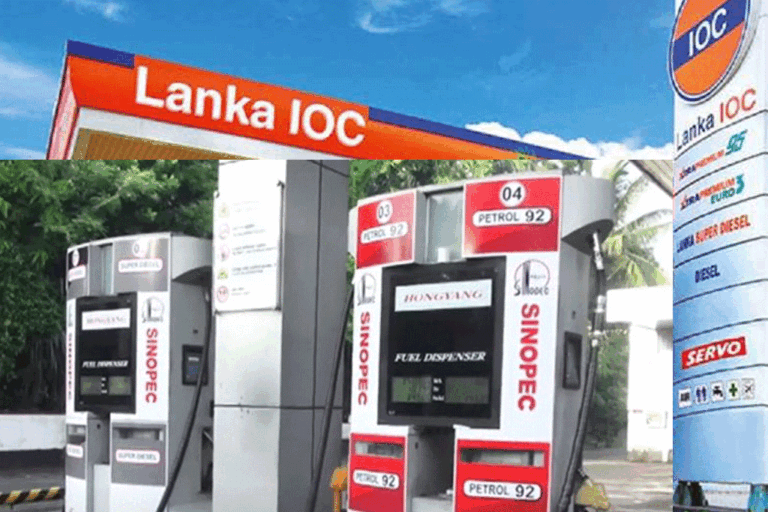
As part of the agreement between Sinopec and the Ministry of Power and Energy of Sri Lanka, Sinopec has obtained a 20-year license to franchise 150 existing filling stations across Sri Lanka and invest in an additional 50 filling stations. Sinopec is committed to leveraging its expertise to provide stable, high-quality oil products to the nation, fostering economic development, and ensuring energy stability in Sri Lanka.

Renowned as the world’s largest fuel refining company, Sinopec boasts an annual production capacity exceeding 250 million tons, affirming its capabilities to contribute significantly to Sri Lanka’s energy sector.

A new law to transform the Port City to “Colombo Financial Zone”

0

President Ranil Wickremesinghe, in his address at the 2023 Commercial Mediation Symposium at Colombo’s Hilton Hotel, emphasized the need for a cultural shift towards efficient dispute resolution in Sri Lanka. He acknowledged the long-standing reliance on trial courts and stressed the importance of embracing alternate dispute resolution methods.

Highlighting the government’s commitment, he mentioned the establishment of the Alternate Dispute Resolution Center in 2018 and expressed support for its continued growth. President Wickremesinghe urged the Ministry of Justice and Ministry of Investments to collaborate on supporting these initiatives.

“Alternate dispute resolution, arbitration, both have a long way to travel in Sri Lanka and that’s our problem. We have to first find ways of how we can adjust to this process. You need a change of culture. Change of culture where disputes can be resolved in the shortest possible time. Which means we are in a way wedded to the old concept of the trial court? Whether we have a domestic inquiry, we all want to follow the same procedure. I don’t know why. But nevertheless, this is one of the challenges that we have to face.”

He emphasized that success in dispute resolution was crucial for Sri Lanka’s aspirations to be an outward-looking economy. The President mentioned forthcoming legislation to transform the Port City as the Colombo financial zone and the transition from the BOI to the Economic Commission, both aimed at resolving disputes efficiently.

President Wickremesinghe also underscored the significance of international trade agreements and the need for Sri Lanka to become a center for alternate dispute resolution. He urged legal professionals to look beyond Sri Lanka’s borders and specialize in emerging fields like AI, Blockchain and green energy to secure the nation’s competitive future.

“Now we want Sri Lanka to be a center. One is the new legislation which will replace the port city to make it a Colombo financial zone with jurisdiction for offshore activity. The new law has been drafted. And we will see the light of day before the end of the year. Secondly, the BOI will be replaced with the Economic Commission. Which is also looking at the resolution of disputes. We will be entering a number of free trade agreements. We have got one with Singapore. We are about to finalize one with Thailand. We are discussing with India of upgrading agreement. Talking with Bangladesh. And more than that, we are moving to join the Regional Comprehensive Economic Partnership (RCEP).

That’s the largest trading community in the world. So this means that alternate dispute resolutions are going to be important.”
In a final call to action, he offered government funding to support learning and expertise development in these new areas, inviting all stakeholders to join in the journey towards a more efficient and forward-looking legal landscape in Sri Lanka.

President Wickremesinghe emphasized that Sri Lanka must position itself as the central player in the region. When examining Singapore as a benchmark, Sri Lanka should strive to match or surpass Singapore in various aspects, except for cost, where it should maintain a competitive advantage. This approach is crucial because there exists a noticeable void in this region, which Sri Lanka can effectively fill if it acts swiftly.

“This is the key lesson to be derived. Furthermore, it is essential for all lawyers and individuals involved in legal services to broaden their perspectives and explore opportunities beyond their current scope,” the President added.

The event was organized by International Alternative Dispute Resolution Centre (IADRC) and the event was graced by the presence of the Minister of Justice, Prison Affairs and Constitutional Reforms Dr. Wijeyadasa Rajapaksha P.C., State Minister of Justice, Prison Affairs and Constitutional Reforms Mr. Anuradha Jayarathne, Judges of the Supreme Court, Attorney General, Former Attorney Generals, Retired Judges of the Supreme Court, Resident Representative of UNDP Ms. Azusa Kubota, Secretary to the Ministry of Justice, Prison Affairs and Constitutional Reforms, Chairman of IADRC Dr. K. Kanag-Isvaran P.C, Director & Secretary General of IADRC Ms. Dhara Wijayatilake, legal professionals and the representatives of reputed companies in Sri Lanka.

New CB up on DDO conversion deal. 7 traces of misconduct punishable for criminal breach of trust

0

The press notice issued by the new CB (NCB) on 21 September 2023 (last Thursday) shows a list of new Treasury bonds and Treasury bills issued the Public Debt Department for the conversion of provisional advances and Treasury bills held by the CB under the Domestic Debt Optimization policy (DDO). See link: https://www.cbsl.gov.lk/sites/default/files/cbslweb_documents/press/pr/press_20230921_conversion_of_outstanding_credits_of_cbsl_to_government_into_negotiable_debt_instruments_under_ddo_e.pdf

  • Accordingly, 10 new Treasury bonds and 12 existing Treasury bills have been issued to the NCB on 21 September 2023 as indicated below.
  • Accordingly, total debt so converted amounted to Rs. 2,713,144,352,006 consisting of Rs. 2,492,347,352,006 into Treasury bonds and Rs. 220,797,000,000 into Treasury bills. Treasury bonds are issuances of new series while Treasury bills are reissuances to existing series.
  • The maturity of 10 new Treasury bonds is annualized for 10 years ranging from 15 March 2029 to 15 June 2038. The maturity of 12 Treasury bills ranges from 5 months to 12 months in 2024 .
  • Therefore, it appears that the NCB has restructured nearly 94% of total outstanding credit granted (of around Rs. 2,900 bn, i.e., Rs. 344 bn of provisional advances and Rs. 2,556 bn of Treasury bills) to the government through provisional advances and direct purchase of Treasury bills.

However, 7 areas of misconduct can be traced on the conversion deal as revealed from the limited information disclosed in the NCB press notice. These could be seen as insider acts pursued to raise financial benefits unduly to the NCB at a disadvantage to the government against the very objective of DDO strategy approved by the Parliament. 

The purpose of this short article is to highlight those 7 traces as given below. The target audience of the article is the group of professionals interested in the insight into the true outcome of the DDO process and relevant policy-makers.

1. Additional cost burden to debt service

Although the interest was not charged on provisional advances around Rs. 345 bn, the government now has to pay interest on converted bonds and bills. For example, converted bonds receive half-yearly coupons at 12.4%, 7.5% and 5% over the maturity. However, the additional interest cost to the government cannot be estimated as details of the conversion (i.e., underlying debt, interest rate and converted securities) are not disclosed.

2. Maturity restructuring not easing the debt unsustainability

Provisional advances did not practically have maturity dates where the total amount got accumulated with new advances granted each year consequent to new national budget (10% of the budgeted revenue). However, all converted bonds and bills now have maturity dates within next 10 years. New Treasury bills have maturity dates within next year. Therefore, the conversion has raised the burden of the debt unsustainability.

3. New bunching problem

The bunching is the problem of accumulating debt too much for repayment around a date or a week or a month or a year whare the government will find very difficult to raise funds of huge sums for repayment due to market limitations. The debt unsustainability is primarily connected with the bunching.

12 Treasury bills will add to the bunching problem already confronted as Treasury bills issued in the recent past also become due for repayment in almost every week, given the weekly routine of Treasury bill issuance.

Further, the maturity dates of all new Treasury bonds fall due in 2-4 months period from the maturity dates of new Treasury bonds (each face value of Rs. 267 bn) issued to the EPF on 14 September 2023 under the same DDO process. Meanwhile, there can be several other Treasury bonds and bills maturing around these months. 

Therefore, raising such huge sums of funds to repay all those bonds and bill will be a daunting task to the government. In that context, the only option would be to rollover them at the maturity at contemporary market interest rates as the government will not have such amounts of budgetary surpluses to redeem debt.

4. Conversion into 12 existing Treasury bills not justified

Issuance of Treasury bills is only a delay of repayment of debt by few more months, i.e., 5-12 months in this case. Therefore, restructuring of any Treasury bills held by the NCB into these 12 Treasury bills is meaningless. If any amount of provisional advances is converted into these Treasury bills, the government will confront a new debt service problem in 2024. 

Further, weighted average yield rates of these 12 Treasury bills have not been disclosed to assess whether these bills are financially favourable to the government on DDO. It appears that these are the Treasury bills recently issued at high weighted average yield rates around 28% to 15% which are costly to debt service.

5. Violation of the law

The conversion violates the DDO law and rules authorized by the Minister of Finance under sections 34 and 35 of the Registered Stocks and Securities Ordinance (RSSO) and several other legal provisions governing the government debt.

  • First, Minister’s DDO authorization does not cover the conversion of provisional advances into Treasury bonds issued under the RSSO. Accordingly, only debt that has been raised through securities (bonds, bills and other negotiable instruments) under any law can be converted into Treasury bonds. However, provisional advances are not securities or negotiable instruments.
  • Second, the conversion of debt into Treasury bills is not covered in the DDO authorization. 
  • Third, the issuance of Treasury bills is governed by the Local Treasury Bill Ordinance (LTBO) whereas the conversion as provided for in the RSSO is not authorized in the LTBO. The present procedure is to issue Treasury bills with maturities of 91 days, 182 days and 364 days as approved by the Minister of Finance where there is no procedure for part-issuances to the remaining maturities of the existing Treasury bills in the market.
  • The Central Bank of Sri Lanka Act certified on 14 September 2023 does not carry any provisions for the issuance of government securities outside government debt laws although it provides for the conversion of exiting provisional advances and Treasury bills held by the NCB into negotiable debt instruments of the government. Therefore, these debt instruments should be issued in compliance with government debt laws.

Therefore, the NCB has violated the DDO authorization by the Minister and provisions of RSSO and LTBO. Policy actions taken in violation of relevant legislation and authorizations become subject to the review by the Auditor General and law enforcement authorities as such violations accrue undue benefits to those who acted in violation. Therefor, violation of laws and public procedures is a publicly punishable offence.

6. Incorrect clarification given in the press notice regarding the benefits of the conversion

It states as “This conversion contributes to alleviating the Government’s short-term liquidity pressure whilst preserving CBSL financial soundness and ensuring compliance with the reduction in Net Credit to the Government committed to in the context of the Government’s IMF-supported program.” Contents are grossly incorrect and deceptive as highlighted below.

  • First, the preservation of the NCB’s financial soundness by the conversion is baseless because financial soundness of central banks are not questioned or assessed, given their non-profit seeking based money printing business not being subject to bank runs as in the case of other banks and financials intermediaries.
  • Second, the alleviation of the government’s short-term liquidity pressure is a baseless claim. The government never confronted any liquidity problems to repay dues to the central bank as they have been rolled over without requiring new funds. In fact, converted bonds and bills are likely to cause short-term liquidity problems to the government to service them due to the aggravated bunching problem.
  • Third, the compliance with the reduction in net credit to the government under the IMF programme conditionalities is baseless as the total outstanding credit to the government by the NCB does not fall or change because the conversion ends up in the same outstanding amount of credit to different debt instruments. Further, as highlighted above, the conversion does not ease the debt unsustainability problem first raised and publicized by the IMF itself whereas the net credit subject of the IMF is not a part of the debt law relevant to the DDO in the country.

7. Undercover legalization of violations committed on making loans to the government amounting to Rs. 2,713 bn.

The DDO conversion deal has been implemented as unique opportunity for an undercover rectification of violations willfully committed by CB officials in lending to the government for their own interests. Both types of lending have been in violation of relevant provisions and principles of the Monetary Law Act (MLA) up to 14 September 2023 as follows.

  • The rule of recovery of each provisional advance within a period of 6 months violated. Instead, advances have been accumulated for outstanding up to 10% of the budgeted revenue annually.
  • Direct purchases of Treasury bills were routinely carried out to control or stabilize the yield curve/government securities yields on Treasury bills and bonds at auctions in order to drive market interest rates in line with the requirements of the monetary policy. The relevant practice was to cutoff auction bids at yield rates preferred for the monetary policy targets and to provide the balance funding through the CB’s direct purchase of Treasury bills at the auction weighted average yield rates. In some occasions, outstanding amount of provisional advances at the beginning of the year was converted to Treasury bills through a direct issuance by the CB to the CB in order for the government to receive a fresh provisional advance to fund the new budget deficit. This direct purchase practice has been violating the MLA rule that prohibited the CB from underwriting the issuances of government securities whereas the CB was permitted only to submit bids directly to auctions of Treasury bills.

Therefore, relevant senior management of the CB has quietly framed a specific provision in the new CB legislation to convert all such outstanding credit of the CB to the government into negotiable debt instruments over a period of one year from the appointed date. 

The undercover objective was the rectification of the above stated MLA violations. Meanwhile, the DDO was found as the opportune conduit for the rectification job advocated for government debt sustainability.

Accordingly, total such violated credit accumulated as on 21 September 2023 was around Rs. 2,900 bn. i.e., Rs. 344 bn of provisional advances and Rs. 2,556 bn of Treasury bills and securities. This has been continuously criticized by economic and political activists as undue money printing to fund the government. Data show that the present CB Governor’s regime is responsible for the most share of such unlawful money printing.

Therefore, the DDO strategy aided the NCB to convert nearly 94% or Rs. 2,713 bn out of the outstanding into negotiable debt instruments. Accordingly, nearly Rs. 187 bn of credit granted through the purchase of government securities still remains as outstanding credit in the NCB books. This amount probably could be government securities purchased in the secondary market under monetary policy operations.

Accordingly, the DDO and new CB legislation have helped the NCB management to launder the CB’s unlawful money printing habitually carried throughout the past.

Concluding Remarks

  • The NCB management has willfully acted to accrue undue financial benefits to the NCB despite the fact that the NCB should have acted for the benefit of the government in order to improve the public finance from the present status of unsustainability and near-term default of domestic debt as alerted by both old CB and NCB being the official public debt manager and fiscal agent for the past 73 years.
  • The violation of the law of land as well as the sprit of the DDO process (envisaged to ease the financial bankruptcy of the government through domestic debt restructuring) is a punishable offence.
  • The very objective of a debt restructuring strategy is to ease the borrower’s immediate liquidity and financial condition in order to regain the borrower’s solvency at a fair cost to creditors. However, this DDO conversion brings undue benefits only to the creditor against the objective of the DDO.
  • Given the acute condition of public finance and its adversity on the socio-economic stability of the country and the central bank’s utter failure in debt management and fiscal agent for the past 73 years, the best strategy would have been the conversion of central bank credit to a long-term bond with a maturity at least 60 years at a nominal annual interest rate around 1% if the conversion had been designed for the country’s macroeconomic benefit and stabilization. This is the continuation of credit as a new book entry. Whatever said and done, the government will never be able to redeem this debt and, if redeemed, the monetary system/the NCB will be risker due to the conversion it to the private credit-based money printing. Therefore, this would be a fair option as even the present conversion doesn’t have criteria to justify the particular segmentation of bonds and bills, maturities and interest rates as the conversion is a pure private placement decided by the Superintendent of Public Debt outside his public duties to the proprietary trade account of his employer the NCB. Therefore, the conflict of interest is a serious issue in the governance behind this conversion deal. Further, ample evidence is available on significant irregularities involved in private bond placement system followed by the CB in debt management.
  • Overall, it is strange that the relevant Treasury authorities have blindly endorsed the said conversion deal for the NCB irrespective of fundamental concerns discernible over the deal’s impropriety as highlighted above.

(This article is released in the interest of participating in the professional dialogue to find out solutions to present economic crisis confronted by the general public consequent to the global Corona pandemic, subsequent economic disruptions and shocks both local and global and policy failures.)

P Samarasiri

Former Deputy Governor, Central Bank of Sri Lanka

(Former Director of Bank Supervision, Assistant Governor, Secretary to the Monetary Board and Compliance Officer of the Central Bank, Former Chairman of the Sri Lanka Accounting and Auditing Standards Board and Credit Information Bureau, Former Chairman and Vice Chairman of the Institute of Bankers of Sri Lanka, Former Member of the Securities and Exchange Commission and Insurance Regulatory Commission and the Author of 12 Economics and Banking Books and a large number of articles published. 

The author holds BA Hons in Economics from University of Colombo, MA in Economics from University of Kansas, USA, and international training exposures in economic management and financial system regulation)

Source: Economy Forward