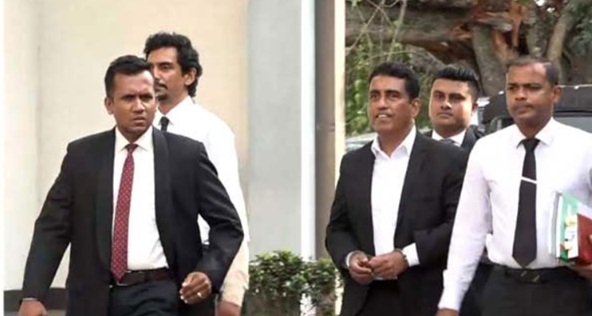
January 05, Colombo (LNW): Former Minister Johnston Fernando and his youngest son, Jerome Kenneth Fernando, who were taken into custody earlier today by the Financial Crimes Investigation Division (FCID), have been ordered to remain in remand custody until January 09.
The order was issued by the Wattala Magistrate’s Court following their production before the court, according to court sources. The arrests relate to an ongoing investigation into the alleged unauthorised use of a vehicle belonging to Lanka Sathosa during Mr Fernando’s time in office.
Police had earlier indicated that legal steps would be taken to secure the former minister’s arrest if he failed to appear before the FCID as directed. Investigators allege that the misuse of state-owned vehicles, including a Sathosa lorry, resulted in a substantial financial loss to the government.
The case has also led to the arrest of Indika Ratnamalala, who served as Transport Manager at Lanka Sathosa while Mr Fernando was Minister of Co-operatives and Internal Trade. He was taken into custody yesterday and subsequently remanded until January 09 after being produced before the same magistrate’s court.
Authorities allege that forged documentation was prepared to enable the use of a Sathosa lorry for operations linked to a private company said to be associated with the former minister’s family. Investigations are continuing as police gather further evidence and record additional statements.
Johnston Fernando and Son Remanded Over State Vehicle Investigation
Fuel Price Revision Announced
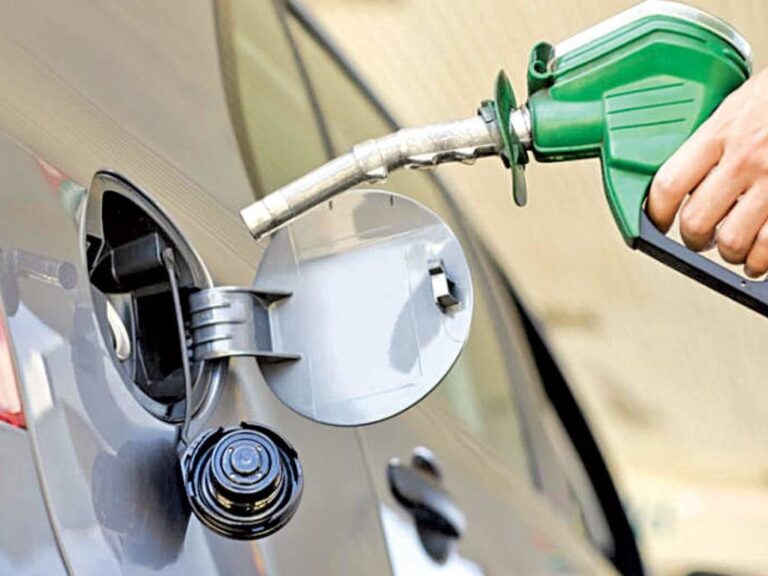
January 05, Colombo (LNW): The Ceylon Petroleum Corporation (CEYPETCO) has confirmed a fresh adjustment to local fuel prices, which will come into effect from midnight tonight.
Under the revised pricing structure, the cost of 92 Octane petrol will remain unchanged at Rs. 294, providing some relief to regular motorists. However, several other fuel types will see modest increases. Super Diesel has been raised by Rs. 5 to Rs. 323, while Auto Diesel will go up by Rs. 2 to Rs. 279.
Petrol 95 Octane has also been revised upwards by Rs. 5, bringing the new price to Rs. 340. Kerosene, widely used by lower-income households and in certain industries, will increase by Rs. 2 to Rs. 182.
The Arrest That Redefined the Rules
By: Faraz Shauketaly
There are moments in global politics when the event itself matters less than the precedent it sets.
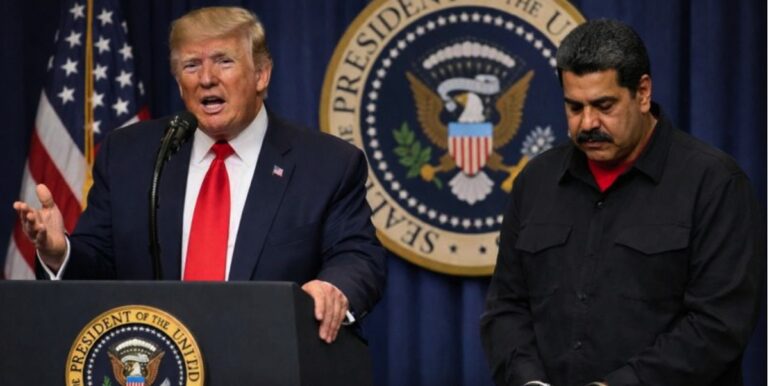
The capture and extradition of Nicolás Maduro is one of those moments.
For years, Maduro’s name has sat on U.S. indictments, sanctions lists, and diplomatic briefings — a president accused of narco-terrorism, drug trafficking, and state-enabled criminality. What changed this week is not the allegation. It is the method.
The United States did not negotiate.
It did not wait for an extradition process that was never coming.
It acted.
Maduro is now in U.S. custody, facing criminal prosecution in New York. A sitting head of state — however contested his legitimacy — removed by force, not by vote, treaty, or international tribunal.
That single fact has split the hemisphere.
Justice, or Power Wearing Legal Clothing?
Supporters call it overdue accountability.
Critics call it a violation of sovereignty.
Both can be true at the same time.
Maduro has long been accused of presiding over a criminalised state apparatus — one where drug flows, political repression, and economic collapse coexisted with the language of revolution. Few serious observers argue he governed democratically in recent years.
But this was not a court-ordered arrest carried out with international consent. It was a unilateral operation. And that is what unsettles capitals far beyond Caracas.
Because once a precedent is set — that a powerful state can physically seize a foreign leader under criminal indictment — the rules do not remain selective for long.
What Happened Next in Caracas Matters More Than the Arrest
Within hours of the announcement, Venezuela’s institutions closed ranks.
The Supreme Court named Vice President Delcy Rodríguez as interim president. The language was clear: continuity, legality, resistance.
This matters because the U.S. move did not automatically create a vacuum. It created parallel realities.
One version of Venezuela now exists in U.S. court filings and international headlines.
Another continues to function — imperfectly, defiantly — inside the country’s borders.
That tension is dangerous.
Regime loyalists frame the arrest as foreign abduction. Opposition voices are divided — some celebrating Maduro’s removal, others warning that imposed justice is not democratic transition.
The result is uncertainty, not clarity.
The Legal Debate Will Not Stop the Trial
There will be loud arguments about international law — and rightly so.
There is no clean extradition pathway here.
There is no multilateral mandate.
But inside the U.S. legal system, those arguments are unlikely to stop proceedings. American courts have long held that jurisdiction survives even irregular capture. That is cold precedent, not moral judgement.
Maduro’s lawyers will argue process. Prosecutors will argue substance. And the trial will move forward — slowly, politically, and under global scrutiny.
This is not a symbolic arrest. It is intended to end in a conviction.
Latin America Is Watching Closely — and Nervously
Reactions across the region expose an old fault line.
Some leaders see Maduro’s capture as a warning to autocrats.
Others see it as a reminder of a past they hoped was buried — where power, not law, determined outcomes.
Brazil and Mexico have voiced concern.
China and Russia have condemned the move outright.
European statements are careful, restrained, and uneasy.
No one is celebrating openly — except segments of the Venezuelan diaspora, for whom this moment feels personal, overdue, and emotional.
That contrast matters. Because foreign policy is not made by crowds. It is made by states calculating risk.
What Happens Now Will Define the Damage — or the Opportunity
Three paths are emerging.
First, the U.S. presses forward legally, regardless of diplomatic noise. The objective is clear: a criminal conviction that retroactively justifies the operation.
Second, Venezuela enters a prolonged legitimacy crisis. Rodríguez may govern administratively, but without broad recognition or trust. Opposition unity remains fragile. The economy remains exposed.
Third, international diplomacy hardens. Countries unsettled by this precedent will push back — not necessarily to defend Maduro, but to defend the idea that borders still mean something.
Oil markets, migration flows, and regional security calculations are already adjusting.
The Question No One Wants to Ask — But Everyone Is Thinking
If this can happen to Venezuela, where else could it happen?
That is the real discomfort.
The arrest of Nicolás Maduro may well mark the end of one political era in Venezuela. But it also signals something larger — a world where criminal accountability is enforced not by institutions, but by leverage.
Whether that produces justice or instability will depend on what follows — not on the arrest itself.
History will not judge this moment by headlines.
It will judge it by whether Venezuela emerges with legitimacy, stability, and agency — or simply trades one form of imposed power for another
Why Sri Lanka Cannot Afford Moral Purity: Survival, Pragmatism, and the Hard Choices of a Small Nation
By: Roger Srivasan
I have never pretended to admire the swagger of great powers, nor have I been instinctively sympathetic to leaders whose rhetoric unsettles minorities and coarsens public discourse. Moral discomfort, however, is a poor substitute for strategic clarity. The world we inhabit is not governed by ethical symmetry but by power, interest, and consequence. To deny this is not virtue; it is self-deception.
From a Sri Lankan standpoint—particularly from the perspective of a minority community long acquainted with fragility—the luxury of moral purity is precisely that: a luxury. For nations struggling to recover, survive, and stabilise, realism must sometimes take precedence over righteous posturing.
This is not cynicism. It is confessional realism: the courage to admit uncomfortable truths without apology or illusion.
Venezuela and the Anatomy of Collapse
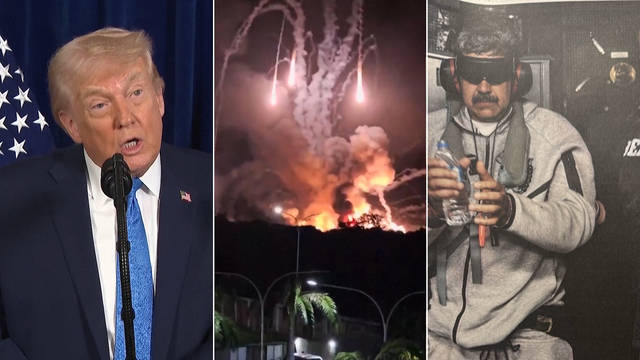
Venezuela stands as a sobering case study in how a nation can implode without a single foreign soldier crossing its borders. Blessed with the largest proven crude oil reserves in the world—approximately 303 billion barrels—it should have been an energy superpower and a regional anchor of prosperity. Instead, it became a cautionary tale.
To place this in perspective, Venezuela’s reserves exceed those of Saudi Arabia (approximately 267 billion barrels) and Iran (around 206–207 billion barrels), while the United States itself holds a comparatively modest 46–48 billion barrels of proven crude reserves.
In its heyday during the 1970s and 1980s, Venezuela produced close to three million barrels of crude oil per day. Today, production languishes at a fraction of that figure. The oil did not vanish. Capacity did. Ageing infrastructure, obsolete machinery, chronic under-maintenance, capital flight, corruption, sanctions, and the exodus of skilled professionals hollowed out the industry from within.
This collapse was not imposed by external force. It was self-inflicted decay, accelerated by ideological rigidity and administrative failure.
Power, Intervention, and the Unspoken Logic
International interventions are rarely driven by altruism alone. Official narratives speak of democracy, humanitarian concern, and regional stability—and these considerations are not trivial. Yet beneath them lies a harder, unspoken reality: energy security remains one of the principal currencies of global power.
Reviving a collapsed oil state is not a sentimental exercise. It demands colossal investment: modern drilling technology, refinery rehabilitation, pipeline replacement, environmental remediation, and the repatriation of human capital. Such undertakings run into tens, if not hundreds, of billions of dollars. No superpower commits resources on that scale without confidence in long-term strategic influence.
This is not moral failure; it is geopolitical arithmetic.
The Sri Lankan Predicament
For Sri Lanka, these realities are not academic. We are a small nation emerging from compounded adversity—economic collapse, social strain, and most recently, cyclones and floods of near-biblical proportions. Recovery is not a rhetorical exercise; it is a matter of survival.
When national survival is at stake, Sri Lanka must be prepared, if circumstances so demand, to dance with the devil—not out of moral surrender, but to preserve its integrity and future—as the nation struggles to claw its way back from the death and devastation wrought by natural catastrophe and economic exhaustion.
This is where moral absolutism becomes dangerous. Aligning reflexively with ideologically rigid or heavily sanctioned states may satisfy emotional impulses, but it carries tangible costs: constrained trade, restricted access to capital, diplomatic isolation, and strategic marginalisation. Small nations do not prosper by defiance for its own sake; they endure by reading power accurately.
A Minority’s Truth
There is an uncomfortable truth rarely articulated in polite discourse: when states collapse, minorities suffer first. Power vacuums are not filled by philosophers but by warlords, traffickers, and extremists. In such environments, order—even imperfect, externally reinforced order—can offer protection where chaos guarantees predation.
This is not an endorsement of domination. It is a recognition that the absence of authority is often more lethal than its flawed presence.
The Hard Conclusion
Sri Lanka must, at times, come forward with both arms raised—not in surrender, but in candour—acknowledging that moral purity is a privilege reserved for stable nations. For those clawing their way back from adversity, survival is not a choice but a prerogative. In such moments, criticism must yield to pragmatism, for a nation fighting to endure cannot afford the comfort of righteous exhibitionism.
The world is not fair. Power is unevenly distributed. Until a more just international order emerges, the choice confronting vulnerable nations is rarely between good and evil, but between imperfect order and unrestrained disorder.
To recognise this is not to abandon principle. It is to practise confessional realism—honesty without illusion, courage without theatre, and survival without apology.
Ex-Minister Johnston Fernando Taken Into Custody Over Sathosa Lorry Probe
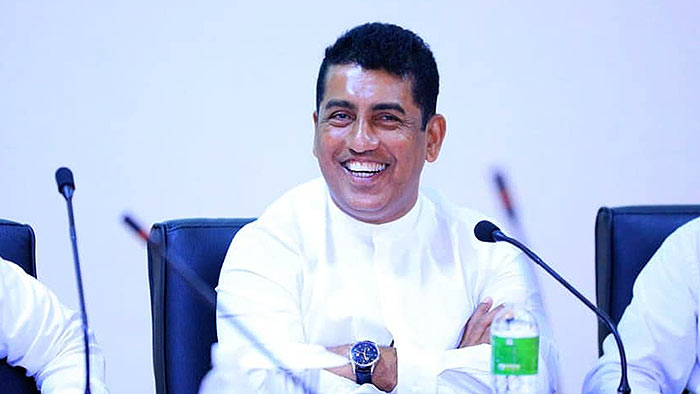
January 05, Colombo (LNW): Former Minister Johnston Fernando was taken into custody by the Financial Crimes Investigation Division (FCID) earlier today in connection with a high-profile financial misconduct inquiry.
Fernando arrived at the FCID headquarters this morning following a summons issued as part of the ongoing investigation. Police had previously warned that an arrest warrant would be sought through the courts if he failed to respond to the notice.
The case centres on allegations that the former minister misused a Lanka Sathosa lorry, resulting in financial losses to the state.
Mahaweli Authority Launches Islandwide Reservoir Safety Review Post-Ditwah
January 05, Colombo (LNW): The Mahaweli Authority has initiated an extensive programme of safety and quality checks across reservoirs under its control in the wake of landslides and flooding brought on by Cyclone Ditwah.
Chief Engineer D.M. Dharmadasa said the move is a precautionary response aimed at assessing whether recent extreme weather has compromised the structural integrity or operational safety of both major and minor reservoirs, including those linked to hydroelectric power production.
He noted that inspections are currently being carried out at 20 reservoirs managed by the Authority, among them 10 facilities that play a key role in supplying electricity to the national grid. These include prominent reservoirs such as Victoria, Kotmale, Rantambe, Randenigala, Dambulu Oya, Moragahakanda, Polgolla, Udawalawa, Bowatenna and Maduru Oya.
The assessment process is being conducted jointly with the National Building Research Organisation, while any potential safety concerns identified during inspections will be promptly communicated to the Disaster Management Centre for further action.
Mr Dharmadasa added that particular focus will be placed on the Kotmale and Uma Oya reservoir schemes, with inspection priorities guided by findings from earlier technical evaluations and risk assessments. He emphasised that the Authority’s objective is to ensure public safety while maintaining uninterrupted water management and power generation operations.
Renowned Journalist-Turned Lyricist Chandrasena Thalangama Passes Away
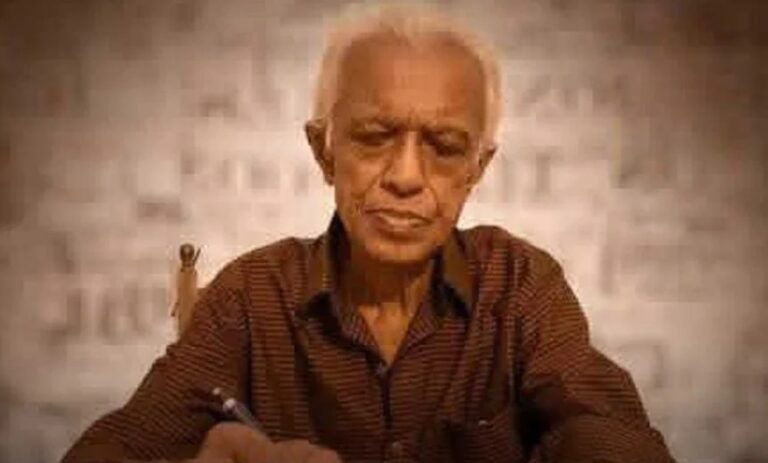
January 05, Colombo (LNW): Veteran journalist and acclaimed lyricist Chandrasena Thalangama passed away last night at the age of 71, leaving behind a distinctive legacy that bridged literature, journalism and modern Sri Lankan music.
Born in Thalangama in 1944, he entered the field of journalism in 1980, writing under the name Thalangama Chandrasena. For decades, his thoughtful prose and sharp observations earned him respect in media circles, even as another creative passion quietly took shape alongside his reporting.
Though he had been writing lyrics drawn from personal experiences and social realities for many years, they remained largely unnoticed until musician Charitha Atalage recognised their depth and musical potential. That collaboration marked a turning point, with his debut song Sansaraye Ma released in 2017, launching an extraordinary second career at a stage of life when many consider slowing down.
From that moment, Chandrasena Thalangama’s words struck a powerful chord with younger audiences. Songs such as Kuveni, Dura Akahe, Navum Kale, Dole and Duwe by Charitha Atalage, Soya Ava and Naadagam Gee by Ridma Weerawardena, and Radhavani by Supun Perera showcased his ability to move effortlessly between themes of love, history, identity and contemporary society.
He was particularly admired for refining lyrics that once relied on crude or dated language, reshaping them into thoughtful, poetic expressions without losing their popular appeal. His work demonstrated that meaningful songwriting could still thrive in modern music.
Chandrasena Thalangama’s journey stands as a rare example of a creative dream fulfilled later in life. His influence on Sri Lanka’s contemporary music scene endures, carried forward through songs that continue to resonate deeply with listeners across generations.
New School Term Begins With Revised Start Dates and Updated Teaching Guidelines
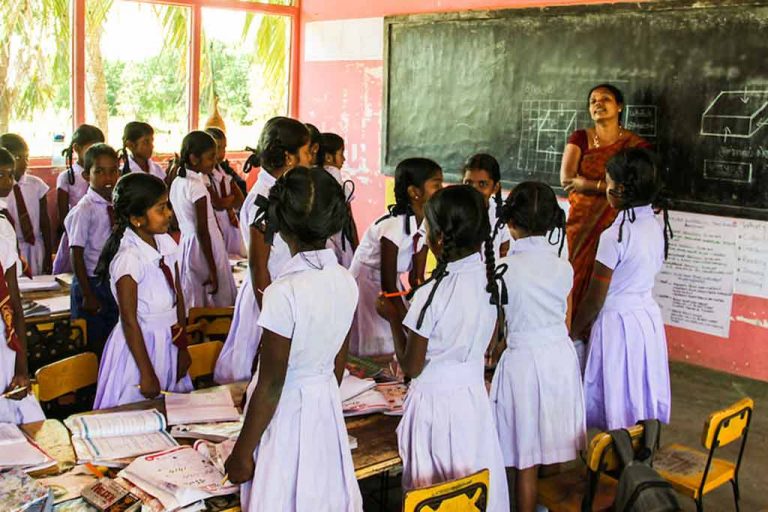
January 05, Colombo (LNW): Schools across the country resume the first term today (05) for most grades, though students in Grades 1 and 6 will begin under a staggered schedule introduced as part of recent education reforms.
The Ministry of Education announced that while the academic term opens for the majority of students, Grade 6 classes will commence later this month, on the 21st. For Grade 1 pupils, today will be limited to an orientation programme designed to help young learners settle into the school environment, with formal lessons set to begin on the 29th.
Alongside the revised term schedule, the Ministry has issued a new circular outlining changes to teachers’ workloads. Under the updated guidelines, teachers are expected to handle 35 periods per week in total, with at least 28 of those devoted to classroom instruction, excluding approved duty concessions.
Supervising teachers must conduct a minimum of 14 teaching periods weekly, while assistant principals and deputy principals are required to cover at least 10 and eight periods respectively.
In addition, adjustments have been made to the daily timetable for Muslim schools. These schools will continue to operate on Mondays from 7.30 a.m. to 1.30 p.m. From Tuesday to Thursday, classes will run until 2.15 p.m., with a short interval set aside around midday for religious observances. On Fridays, the school day will conclude at 11.15 a.m., allowing students and staff time to attend mosque, with only four teaching periods scheduled for the day.
Education officials say the changes are intended to better balance academic requirements, administrative responsibilities and religious considerations within the school system.
CID Asked to Furnish Details of UK Probe Into Alleged Misuse of State Funds
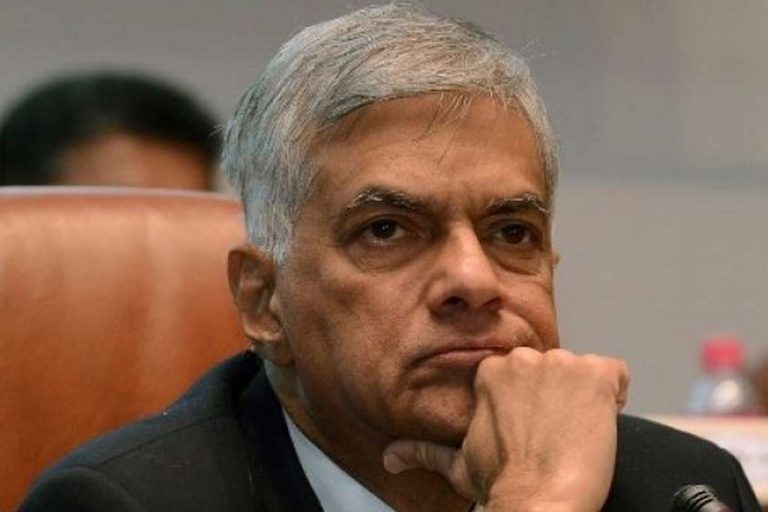
January 05, Colombo (LNW): The Criminal Investigations Department (CID) has been directed to provide updated information on follow-up inquiries carried out by a team that travelled to the United Kingdom as part of an investigation into the alleged misuse of public funds connected to a foreign visit by former President Ranil Wickremesinghe.
Media reports indicate that the Attorney General has requested the CID to submit relevant findings and extracts from the additional investigations undertaken in the UK, relating to allegations that state funds amounting to Rs. 16.6 million were improperly spent during the overseas tour in question. The request was conveyed through a formal letter issued to the CID Director and signed by Deputy Solicitor General Wasantha Perera.
It has also been noted that the Attorney General had earlier informed the Colombo Fort Magistrate’s Court of plans to seek the cooperation of British authorities through Mutual Legal Assistance, in line with the Mutual Assistance in Criminal Matters Act.
In his correspondence, the Attorney General has reportedly expressed concern that the officer leading the investigation failed to report to the AG’s Department despite being instructed to assist with the preparation of required documentation. The letter further highlights that the CID delegation proceeded to London without securing prior Mutual Legal Assistance approval from the UK, a procedural issue now under scrutiny as the investigation continues.
Nearly 500 Police Officers Face Sanctions Over Drug Offences
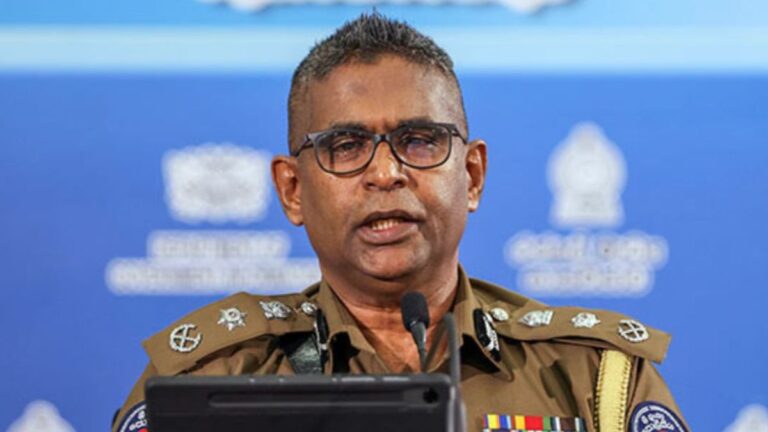
January 05, Colombo (LNW): Inspector General of Police (IGP) Priyantha Weerasuriya has revealed that disciplinary measures have been imposed on close to 500 police personnel in connection with drug-related misconduct, underscoring a renewed effort to clean up the force.
He stated that investigations have led not only to internal disciplinary action but also to the dismissal of a number of officers found to be involved in serious violations.
The IGP emphasised that the police service would not tolerate criminal behaviour within its ranks and that maintaining public trust remains a top priority.
Weerasuriya made these comments yesterday (04) while addressing a graduation ceremony for newly trained police officers at the Pahalagama Police Training College, where he urged recruits to uphold integrity, professionalism and the rule of law throughout their careers.