Colombo (LNW): In an unprecedented crackdown on narcotics trafficking and underworld activities, the “Yukthiya” (Justice) island-wide police operation has achieved remarkable success within just seven days of its launch.
13,666 suspects have been apprehended, in the law enforcement agencies’ commitment to addressing the pressing issues of narcotics and organised crime.
The government said it is determined to ensure the safety and well-being of citizens by dismantling criminal networks and disrupting illegal activities.
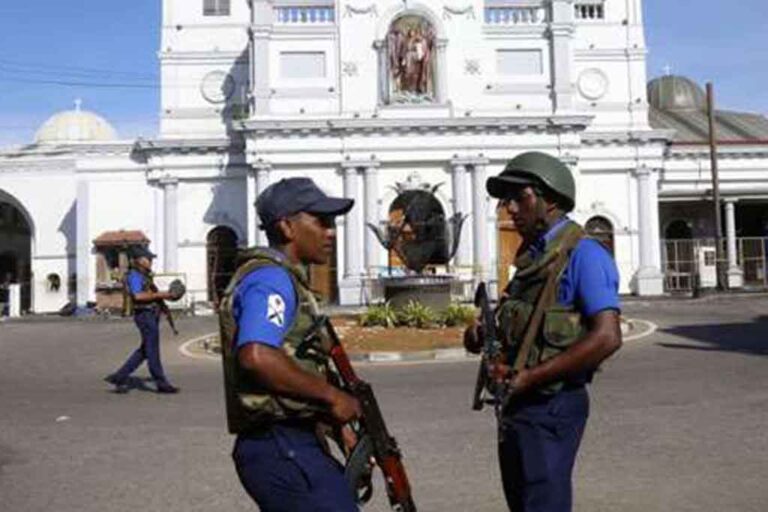
Colombo (LNW): With Christmas Day approaching, more than 2,300 churches nationwide are gearing up to hold masses, and special security measures have been put in place to ensure the safety of these gatherings.
Over 7,500 police personnel have been deployed to churches conducting Christmas Day masses.
The comprehensive security programme, spanning the entire country, aims to safeguard the public during the festive season.
Acting IGP Thennakoon has issued instructions to senior officers and OICs to coordinate necessary security arrangements, Police Spokesman SSP Nihal Thalduwa asserted.
Circulars outlining security protocols have been distributed to Senior DIGs and Police OICs.
Recognising approximately 2,862 churches across the country, a Civil Committee has been established at each church, and local police authorities are coordinating with these committees to implement security measures.
The Acting IGP has directed the use of the Special Task Force for relevant security measures and has urged seeking assistance from the Army or other security forces if necessary.
To address security concerns, a dedicated hotline (0112472757) has been established at Police Headquarters for priests of churches.
The public is urged to take precautions for the safety of homes and business premises during trips or events, and special operations targeting reckless drivers will be conducted during the festive season.
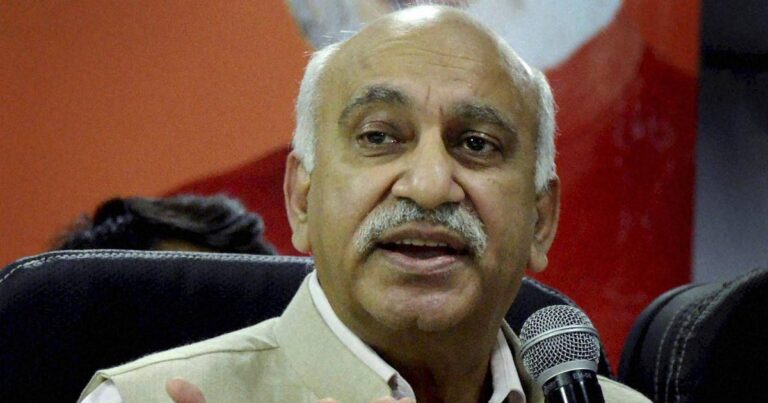
Colombo (LNW): Former Indian State Minister of External Affairs, M.J. Akbar, has expressed India’s expectation for Sri Lanka and other independent countries in the region to prioritise the safety of neighboring nations in their policy decisions.
Akbar made these comments during a webinar organised by the Pathfinder Foundation, where he discussed India’s expanding influence beyond its traditional neighbourhood.
He underscored India’s ‘neighbourhood first’ policy, emphasising the importance of mutual understanding among nations.
While acknowledging Sri Lanka’s independence and unique perspective, Akbar urged the country to take into consideration India’s security concerns in its decision-making processes.
Public Security Minister Tiran Alles says some religious leaders & lawyers who may be having links with drug dealers & underworld leaders are trying desperately to thwart the “Yukthiya” programme launched by the Govt & Police to eliminate narcotics distribution & organized crime: asserts he & the President will not be deterred by such efforts: assures the Govt will relentlessly pursue the goal to rid the country of the menace of narcotics & organized crime.
Ministry of Public Security says that during the islandwide operation over the 7 days ending 23rd Dec’23, 13,666 persons were arrested, while 9.8 kgs of Heroin, 4.6kgs of Ice, 272 kgs of Cannabis & 65,924 pills were recovered: also say that “ill-gotten gains” including properties & vehicles, valued at more than Rs.293mn have also been seized by the Illegal Assets Investigation Division of the Police.
Police say bodies of 2 persons shot to death recovered from an abandoned land at Tunnana in Padukka: the dead persons have been identified as those of underworld figure Don Indika alias ‘Manna Roshan’ and his accomplice ‘Supun’.
Dambulla Economic Centre Trade Assn Secretary I G Wijenanda says skyrocketing vegetable prices have driven traders to display prices for lower quantities (100g) of vegetables in order to sell their wares.
Former Secretary to the Ministry of Education Dr Tara de Mel says the existing system of School and State university education is outdated and has ceased to be inspiring or capable of firing the imagination of students: asserts the system doesn’t adequately prepare students for newer jobs of the emerging decades of the 21st century.
SL Banks Assn (SLBA) says banks exercise their legally-enshrined right to parate execution as a last resort: also says their objective is to protect depositors’ funds that had been lent to borrowers: asserts the parate execution remedy is aimed at recovering mortgaged assets from willful defaulters & businesses that are no longer viable.
Veteran actor Rex Kodippili, 85, passes away.
Statistics of SL Tourism Development Authority show that over 1,404,998 tourists visited SL by 21st Dec’23: in 2022, only 719,978 tourists visited SL.
A 30 ft. high Christmas tree with 2,000 live vegetable plants grown & sent by people from all over SL, erected at the Presidential Secretariat roundabout in Galle Face Green.
World Health Organization says SL ranks among the top 30 countries with the highest dengue endemicity worldwide: also says this year’s surprising spike in dengue infections represents a potentially high public health threat.
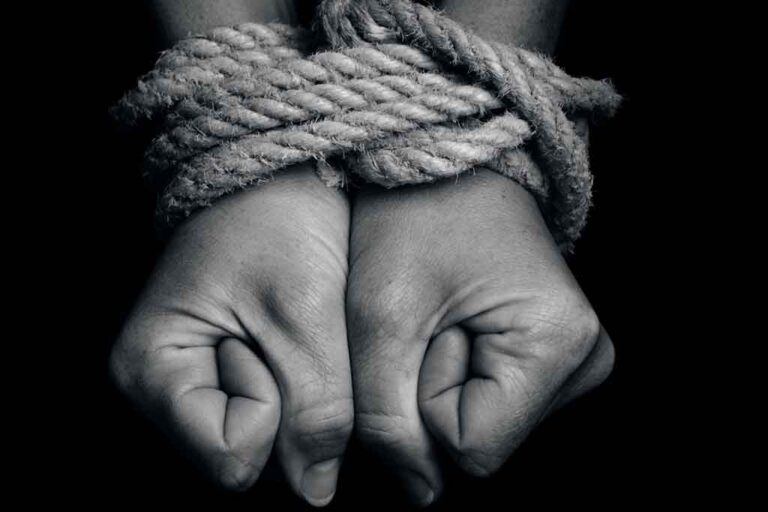
Colombo (LNW): The Human Trafficking, Human Smuggling, and Maritime Crimes Division of the Criminal Investigation Department (CID) have identified three individuals involved in the trafficking of Sri Lankans to Myanmar.
Through comprehensive investigations, the suspects, residents of Aralaganwila, Wathuregama, and Dorathiyawa, were located, but they have reportedly fled the areas.
According to CID reports, these individuals facilitated the travel of a group of Sri Lankans to Myanmar using visit visas.
Recent reports highlighted that 56 Sri Lankans are forcibly detained in a Burmese terrorist camp, working as cyber slaves. Three escapees, who managed to return to Sri Lanka, provided statements to the CID.
The escapees, comprising four young men and a young woman, had initially travelled to Myanmar in April 2023 with the expectation of working as Data Entry Operators but returned to Sri Lanka on November 4, 2023, following their escape.
Investigations are ongoing to unravel the complexities of this human trafficking network and address the welfare of the victims.
Colombo (LNW): Police have reported the discovery of two lifeless bodies, both victims of gunshot wounds, on a vacant plot of land in Tunnana, Padukka.
The deceased individuals have been identified as underworld figure Don Indika, also known as ‘Manna Roshan,’ and his accomplice.
Authorities suspect that the death of the duo occurred as a result of a clash between two rival underworld gangs.
Investigations are underway to ascertain the details surrounding this incident and to identify any potential motives or individuals involved in the altercation.
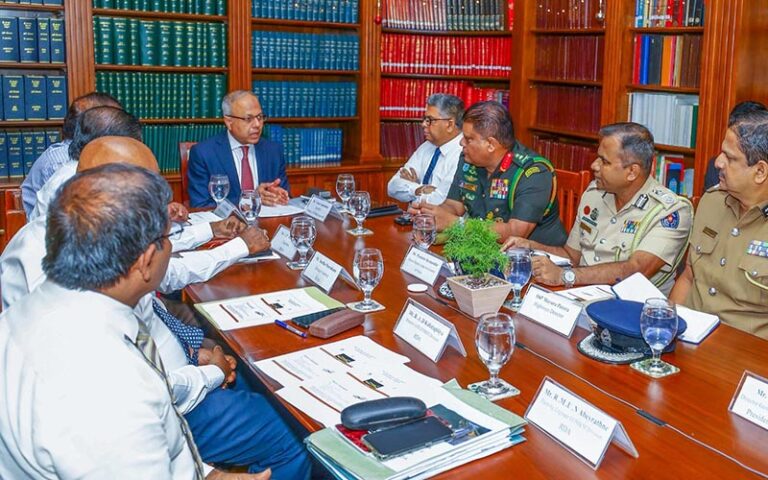
Colombo (LNW): A recent meeting was held at the Presidential Secretariat, chaired by Sagala Ratnayaka, Senior Adviser to the President on National Security and Chief of the Presidential Staff.
The primary focus of the discussion centred on the ongoing responsibilities of the Sri Lanka Police Special Task Force on the nation’s expressways, specifically addressing issues related to accidents, fires, and crimes.
During the meeting, there was a thorough exploration of the potential reassignment of these responsibilities, considering the withdrawal of the Police Special Task Force from its current duties.
The participants engaged in discussions about creating an alternative system to efficiently handle these tasks.
Ratnayaka underscored the importance of a specific programme and urged Chief of Defence Staff General Shavendra Silva to lead the prompt preparation of such a programme.
The overarching goal is to ensure a more responsible and formal execution of these tasks, with proper oversight from the Road Development Authority (RDA).
In the course of the meeting, Ratnayaka directed officials to expedite the development and submission of the programme.
The meeting was attended by Chief of Defence Staff General Shavendra Silva, accompanied by senior officers from the Road Development Authority and the Sri Lanka Police Special Task Force.
Colombo (LNW): In his Christmas Day message, President Ranil Wickremesinghe extended an invitation for everyone to come together and shoulder their responsibilities, acknowledging the genuine challenges facing the nation.
This year’s celebration of Christmas occurs against a backdrop of numerous challenges, with Wickremesinghe emphasising the importance of focusing on the authentic significance of Jesus Christ’s birth in a manger.
The President underscored the theme of “sharing a meal with the less fortunate” as a key aspect of this significance.
Additionally, he emphasised that the true meaning of Christmas lies in spiritual transformation within ourselves.
President’s Christmas Day message:
“Christmas represents the celebration of hope. “The individuals who traversed in obscurity, burdened with tears and sighs, have witnessed a profound light.” In the pursuit of revitalising that hope, I extend my wishes for all of us to conscientiously fulfil our responsibilities and duties, fostering a Christmas that instils fresh hopes in our nation.
“Amid our celebratory mood, it is crucial to maintain focus on the authentic significance of Jesus Christ’s birth in a manger, encapsulated by the theme “Sharing a meal with the less fortunate.”
‘Christmas serves as a reminder of the birth of Jesus Christ, who, in self-sacrifice on the cross, redeemed humanity from sin. Guided by Christian teachings, we are urged to forgive those who oppose us, those who have wronged us and to relinquish all feelings of animosity and resentment.
“While the external festivities of Christmas may be apparent, I posit that its true significance remains elusive unless accompanied by a profound spiritual transformation within us.
“This year, as we commemorate Christmas amidst a backdrop of numerous challenges burdening our society, I extend an invitation to everyone to unite in shouldering their responsibilities, recognising the genuine adversities confronting our nation.
“I wish you all a blessed and meaningful Christmas!”
Ranil Wickremesinghe President of the Democratic Socialist Republic of Sri Lanka
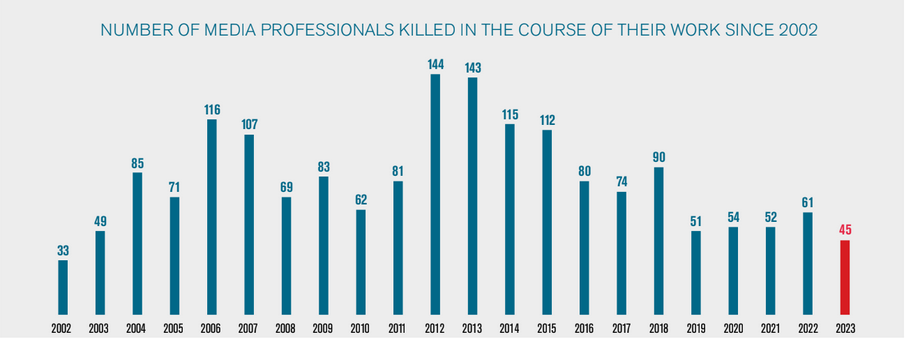
According to the annual round-up compiled by Reporters Without Borders (RSF), the number of journalists killed worldwide in connection with their work (45 as of 1 December 2023) is the lowest since 2002, despite the war in the Middle East. In Gaza, at least 13 journalists have been killed because of their work as journalists since the war began between Israel and Hamas, a total that rises to 56 if we include all journalists killed in the Gaza Strip, whether or not in the line of their work. Worldwide, 521 journalists are currently detained on arbitrary grounds linked to their profession (down 8.4% from 2022).
“Among civilians in Gaza, journalists are paying a heavy price. We’ve noted that the number of journalists killed in connection with their work is very high: at least 13 in such a tiny territory. We have filed a complaint with the International Criminal Court (ICC) to establish the facts and to what point journalists were knowingly targeted. On a global scale, it seems that the number of journalists killed in the course of their work or in connection with their work is in sharp decline, over a long period of time. The reasons? Security measures at news organisations, training and allocation of protective equipment, caution, the effects of the fight against impunity and actions by inter-governmental organisations. The work of NGOs is undoubtedly also having an effect…”
Christophe Deloire, RSF Secretary-General
An overall decline in the number of journalists killed in the line of duty or in connection with their work
In 2023, a total of 45 journalists were killed in connection with their work, 16 fewer than in 2022 (61). This is the lowest figure recorded since 2002 (33). In 2012 and 2013, more than 140 journalists were killed, mainly due to the wars in Syria and Iraq.
The gradual decline in the number of journalists killed in connection with their work over the past five years can be explained in part by security improvements for journalists and the end of deadly spikes in Iraq and Syria, where nearly 600 journalists were killed in the line of duty from 2003 to 2022. In times of peace, stronger measures to protect journalistic work, especially through legislative means, and mechanisms to combat impunity would seem to account for the less deadly toll.
A notable fall in the number of journalists killed in connection with their work in Latin America
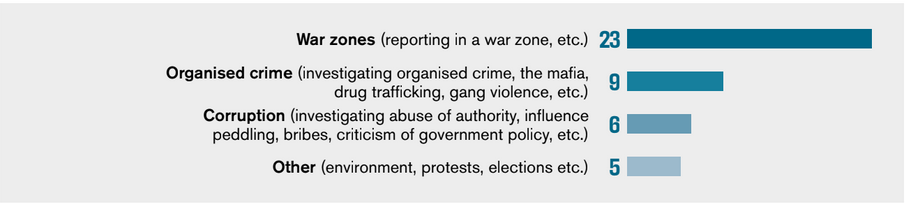
Although the number of journalists killed in Latin America has fallen significantly, from 26 in 2022 to six in 2023, working as a journalist in this region is still not safe, as recent abductions and armed attacks in Mexico demonstrate. The record level of violence registered in Latin America in 2022 has led to self-censorship, resulting in the proliferation of information black holes in the region, where organised crime and corruption top the list of topics that can cost journalists their lives.
War zones deadlier than countries at peace for journalists in 2023
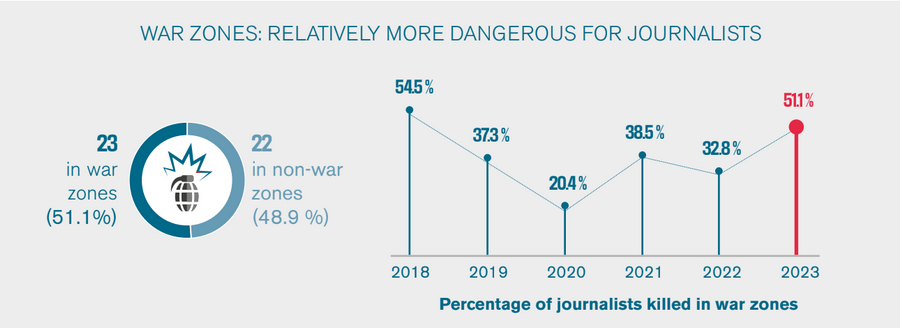
This year, 23 journalists have been killed in the course of their reporting in war zones. Most of them – 17 – were killed in the war between Israel and Hamas (including 13 in Gaza), during which 63 journalists lost their lives in total (including 56 in Gaza) if we include journalists killed in circumstances unproven to be related to their duties. For the first time in five years, more journalists have been killed in war zones than in peace zones.
● 521 journalists detained worldwide: Belarus becomes one of the three biggest jailers, joining China and Myanmar
A total of 521 journalists will begin 2024 in prison—versus 569 in 2022. China is yet again the world’s biggest jailer of journalists, with 121 media professionals locked up in its prisons (including 12 in Hong Kong and 42 in Xinjiang). This is nearly a quarter (23%) of the total number of journalists detained worldwide.
Alexander Lukashenko’s Belarus, with its increasingly repressive policies, is now one of the trio of countries detaining the most journalists: it is detaining 39 (or seven more than in 2022). Belarus is also the country with the second highest number of detained female journalists (10), coming in right after China (14).
The fall in the number of journalists detained worldwide (50 fewer on 1 December 2023 than on the same date in 2022) can be partly explained by the drop in the number of journalists in prison on that date in Iran (down 24) and Türkiye (down 23). Not being among the top three jailers doesn’t mean that these two countries don’t jail: One of the techniques of persecuting journalists inIran andTürkiye is actually to imprison them repeatedly. In 2023, a total of 43 Turkish journalists and 58 Iranian journalists spent time in prison.
● A total of 54 journalists held hostage worldwide at press time
A total of 54 journalists are being held hostage around the world. Of the seven abducted this year, two are still being held by their captors. They are the Malian journalists Saleck Ag Jiddou and Moustapha Koné, who weretaken hostage in northern Mali on 7 November, just seven months after the French journalist Olivier Dubois wasfinally freed by his captors in the same region of Mali. The other media hostages are located in just four countries: Syria (38), Iraq (9), Yemen (4) and Mexico (1).
● 84 journalists missing, with more than a third of them Mexican
Mexico continues to be the country with the most journalists listed as missing in the world, accounting for 31 out of a total of 84. All were reported missing prior to 2023, with the exception of media editor Juan Carlos Hinojosa Viveros, who disappeared on 6 July. Worldwide, more than half (43) of the cases of missing journalists are in Latin America.
Since 1995, Reporters Without Borders (RSF) has been compiling its annual round-ups of violence and abuses against journalists on the basis of precise data gathered from 1 January to 1 December of the year in question. The 2023 round-up figures include professional journalists, non-professional journalists and media workers. RSF gathers detailed information that allows it to affirm with certainty or a great deal of confidence that the detention, abduction, disappearance or death of each journalist was a direct result of their journalistic work. This methodology may explain statistical differences with other organisations.
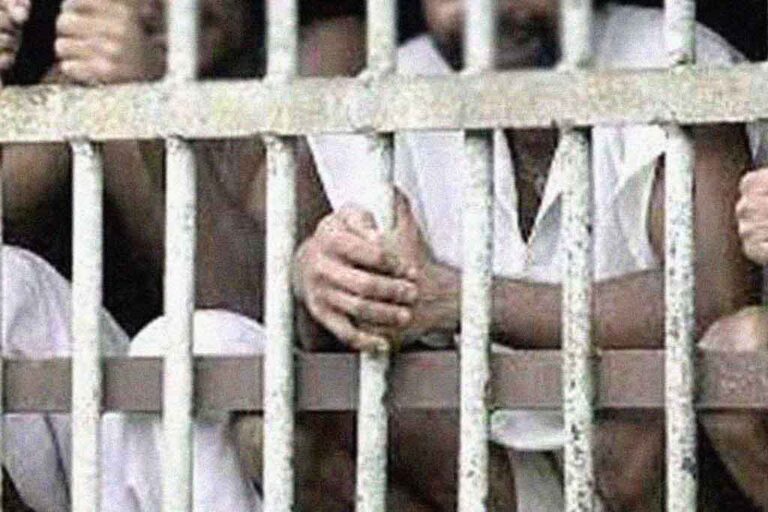
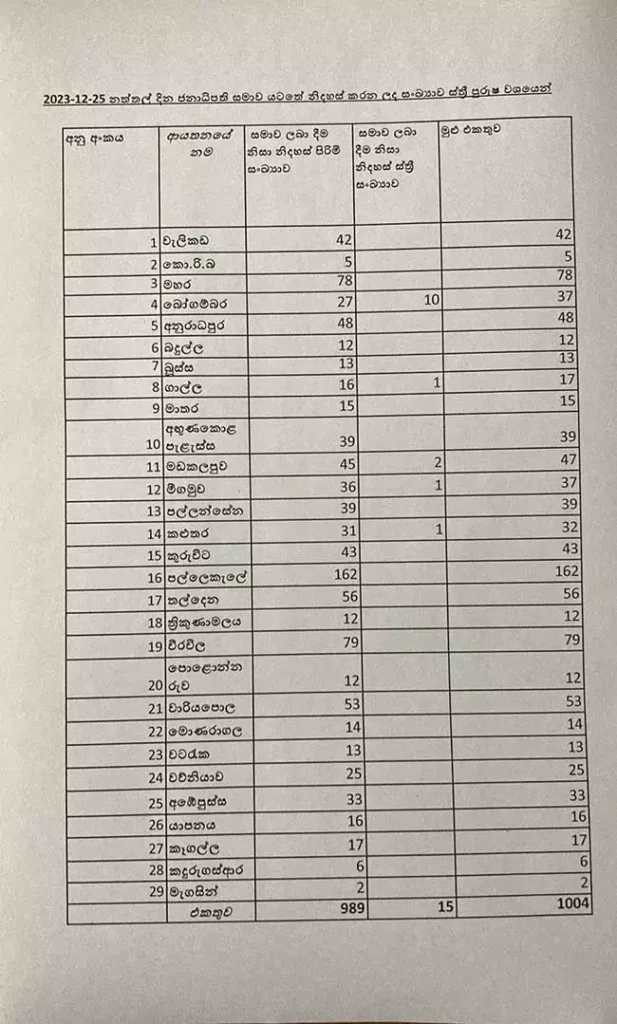
Colombo (LNW): In celebration of Christmas Day, the government of Sri Lanka has decided to grant a special state pardon to selected inmates in prisons across the country.
Accordingly, 989 men inmates and 15 women inmates have been granted pardon, revealed Spokesperson for the Prisons Commissioner Gamini B. Dissanayake.