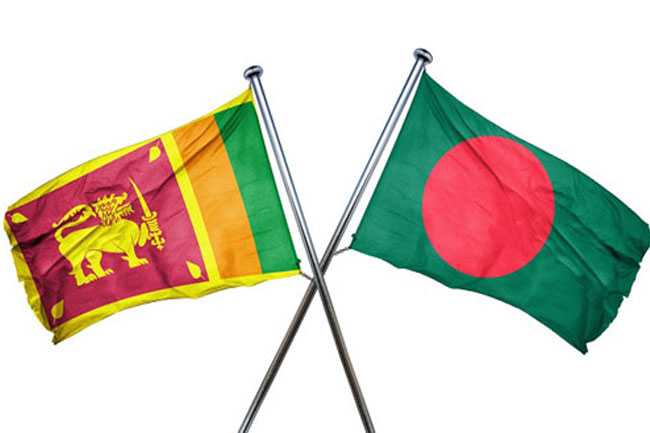
Colombo (LNW): Bangladesh has contributed essential medicines valued at US $1 million to Sri Lanka in a significant humanitarian gesture.
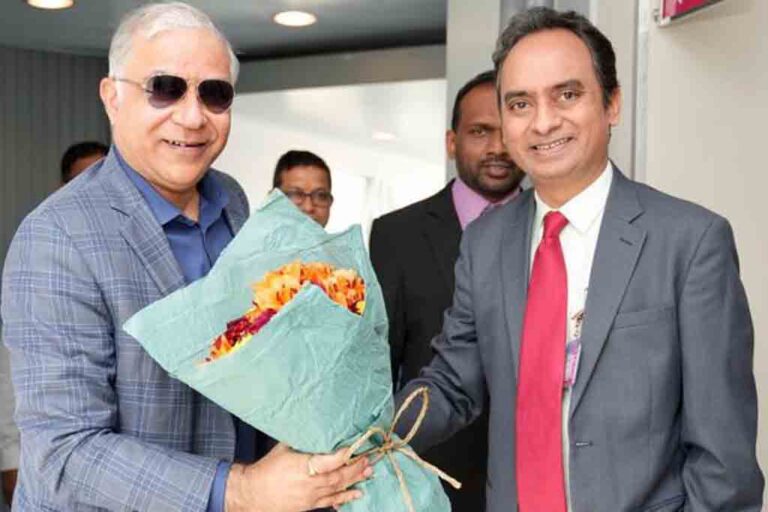
The official handover transpired in a concise ceremony at the office of Health Minister Dr. Ramesh Pathirana, where Bangladesh High Commissioner Tareq Md Ariful Islam formally presented the consignment.
This substantial donation, comprising twenty-four critical medical items, was procured from Bangladesh’s state-owned pharmaceutical entity, the Essential Drugs Company Limited (EDCL), aligning precisely with the specific requirements articulated by the Sri Lankan government.
The ceremony saw the presence of key officials from the Sri Lankan Health Ministry, including Health Secretary Dr. Palitha Mahipala, Director General of Health Services Dr. Asela Gunawardena, DDG MSD Dr. Dharmaratne, Director (Diplomatic Affairs) Dr. Anver Hamdani, and Director MSD Dr. Dias.
Health Minister Ramesh Pathirana expressed gratitude, acknowledging the friendly gesture of the government and people of Bangladesh. He also lauded the Bangladesh High Commission for its pivotal role in fortifying bilateral relations, particularly within the vital health and pharmaceutical sectors.
High Commissioner Tareq Md Ariful Islam reciprocated by characterising the donation as a manifestation of Bangladesh’s dedication and goodwill toward Sri Lanka. He underscored the substantial potential for collaboration between the two nations in the pharmaceutical and health sectors.
This recent contribution follows Bangladesh’s earlier goodwill gesture in May 2022, where medical supplies amounting to US $2.3 million were provided. The governments of both countries are actively exploring avenues for a more robust collaboration, particularly in the procurement of pharmaceutical products from Bangladesh.
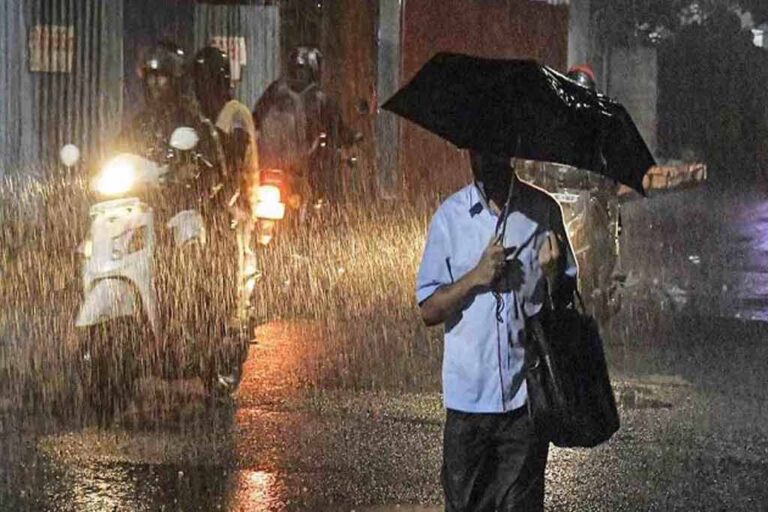
Colombo (LNW): A few showers will occur in Northern, Eastern and North-central provinces and in Matale district, with showers or thundershowers being expected at a few places in Western and Sabaragamuwa provinces and in Galle and Matara districts after 2.00 p.m, the Department of Meteorology said in its daily weather forecast today (22).
Misty conditions can be expected at some places in Western, Sabaragamuwa, Central and Southern provinces in the morning, the statement added.
The public is kindly requested to take adequate precautions to minimise damages caused by temporary localised strong winds and lightning during thundershowers.
Marine Weather:
Condition of Rain:
A few showers will occur in the sea areas off the coast extending from Puttalam to Pottuvil via Mannar, Kankasanthurai, Trincomalee and Batticaloa.
Winds:
Winds will be north-easterly and wind speed will be (20-30) kmph. Wind speed may increase up to (40-50) kmph in the sea areas off the coast extending from Colombo to Kankasanthurai via Puttalam and Mannar and from Galle to Hambantota via Matara.
State of Sea:
The sea areas off the coast extending from Colombo to Kankasanthurai via Puttalam and Mannar and from Galle to Hambantota via Matara can be fairly rough at times. The other sea areas around the island will be moderate. Temporarily strong gusty winds and very rough seas can be expected during thundershowers.
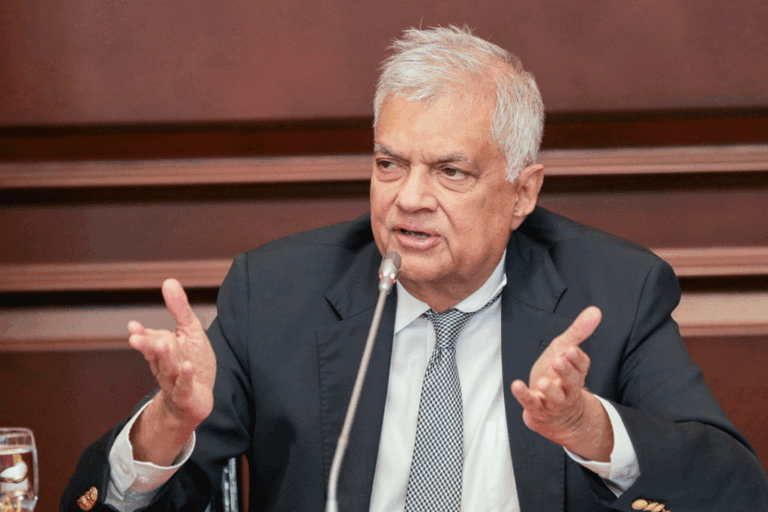
Colombo (LNW): President Ranil Wickremesinghe convened a meeting with Members of Parliament representing the Tamil community from the North and East at the Presidential Secretariat in Colombo yesterday afternoon (21).
The discussions centred on crucial topics, such as ensuring land rights for residents in the Northern and Eastern Provinces, the effective implementation of laws related to resettlement and reconciliation, and addressing challenges faced by Sri Lankans in refugee camps in India, the President’s Media Division (PMD) said.
Furthermore, the meeting delved into various issues related to district development in the Northern and Eastern Provinces.
In attendance were MPs from the Northern and Eastern Provinces, including R. Sampanthan, S. Rasamanickam, G. Karunakaran, Mr. T. Kalai Arasan, and Kulasingham Dileepan.
Notable figures present at the meeting included Justice and Prison Reforms Minister Dr. Wijayadasa Rajapaksha, State Minister for Higher Education Dr. Suren Raghavan, President’s Secretary Mr. Saman Ekanayake, Prime Minister’s Secretary Mr. Anura Dissanayake, and Justice and Prison.
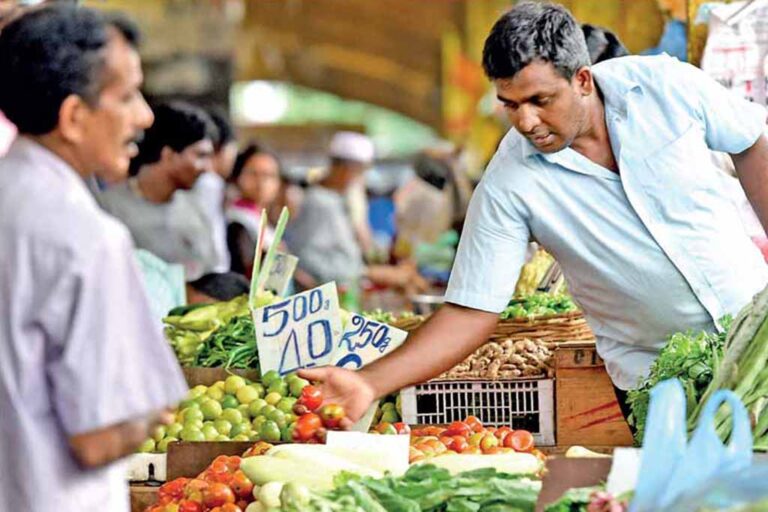
Colombo (LNW): The National Consumer Price Index (NCPI) registered a Year-on-Year (y-o-y) inflation rate of 2.8 per cent for November 2023, the Department of Census and Statistics (DCS) reported.
This reflects a notable increase from the October 2023 inflation rate of 1.0 per cent, marking a 1.8 per cent rise.
In terms of Food-Inflation, there was a shift from -5.2 per cent in October to -2.2 per cent in November 2023. Non-food inflation increased from 6.3 per cent in October to 7.1 per cent in November.
The overall NCPI for November 2023 stands at 206.0, representing a 2.4 index point increase or a 1.19 per cent rise compared to October 2023 (203.6). This translates to a Rs. 1231.49 increase in the expenditure value of the “market basket.”
Specifically, increases in index values were observed for items such as Vegetables (0.62 per cent), Rice (0.14 per cent), Sugar (0.09 per cent), Coconuts (0.06 per cent), Big onions (0.06 per cent), Green chilies (0.06 per cent), Red onions (0.05 per cent), Limes (0.03 per cent), Coconut oil (0.02 per cent), Potatoes (0.02 per cent), Mysore dhal (0.01 per cent), Tea dust/leaves (0.01 per cent), and Fresh fruits (0.01 per cent).
Conversely, decreases were noted for Fresh fish (0.19 per cent), Chicken (0.08 per cent), Dried fish (0.07 per cent), Eggs (0.07 per cent), Green gram (0.02 per cent), and Chili powder (0.01 per cent).
The uptick in the non-food group index values in November 2023, compared to the previous month, can be attributed to price increases in items under ‘Housing, Water, Electricity, Gas and Other fuels’ (Materials for Maintenance and Electricity bill) (0.53 per cent) and ‘Restaurants and Hotels’ (0.02 per cent).
On the other hand, decreases were reported in ‘Transport (Petrol)’ (0.08 per cent), ‘Alcoholic Beverages, Tobacco, and Narcotics’ (Beetle leaves) (0.02 per cent), and ‘Health’ (Spectacles) (0.02 per cent). Additionally, marginal price decreases were observed in ‘Clothing and Footwear’, ‘Furnishing, Household equipment, and Routine household maintenance’, ‘Recreation and Culture’, and ‘Miscellaneous Goods and Services’.
The report notes that the price indices for ‘Communication’ and ‘Education’ groups remained unchanged during the month.
Colombo (LNW): For a third consecutive day under the ‘Yukthiya’ (Justice) operation, the Sri Lanka Police conducted a 24-hour crackdown resulting in the seizure of a substantial quantity of narcotics and the arrest of 2,008 suspects.
Operation Yukthiya unfolded from 12:30 AM on Wednesday to 12:30 AM on Thursday (21). The confiscated contraband included a significant 2 kilograms and 400 grams of heroin, 1 kilogram and ice (Crystal Meth), 12 kilograms and 200 grams of cannabis, and an astonishing 73,833 cannabis plants.
In addition to these, the police apprehended smaller amounts of Hashish (12 grams), Mawa (5 kilograms and 200 grams), Ash (32 grams), Thul (844 grams), a narcotic substance identified as ‘Madana Modaka’ (4 kilograms and 100 grams), and another 17,054 prescription pills.
Out of the total arrests, 185 are currently under investigation based on detention orders. Notably, 228 individuals were already on the list of registered suspects by the Police Narcotics Bureau and the Special Bureau, highlighting the operation’s efficacy in targeting known offenders.
Asset investigations have been initiated against 33 suspects, and 209 individuals have been referred for rehabilitation programmes, underlining the comprehensive approach of the operation.
Colombo (LNW): In a momentous arrival, Indian Ambassador Santosh Jha landed in Sri Lanka on Wednesday, poised to lead the Indian High Commission with unwavering commitment.
The High Commission anticipates Ambassador Santosh Jha’s official assumption of duties as the esteemed High Commissioner of India to Sri Lanka today (21).
The culmination of this pivotal moment will transpire as Santosh Jha presents his credentials to President Ranil Wickremesinghe, solidifying his role as a key diplomatic representative between the two nations.
Start of a new innings! Amb @santjha arrived in Colombo today and took charge at @IndiainSL. After presentation of credentials, he will assume his new responsibilities as High Commissioner of #India to #SriLanka. pic.twitter.com/5djzQ5HZ9Q
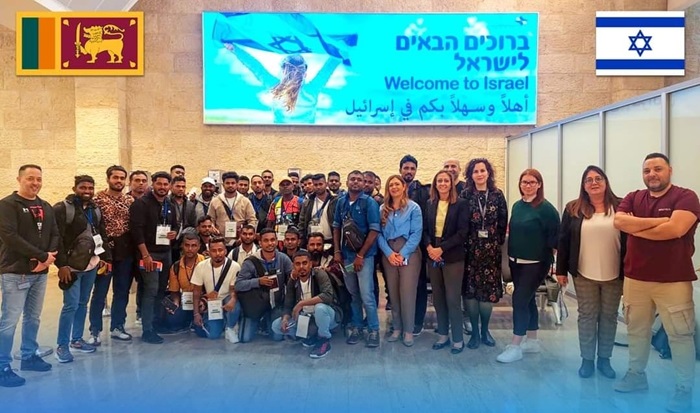
Colombo (LNW): The initial cohort of Sri Lankan workers for agricultural positions in Israel has arrived, marking the commencement of a bilateral agreement between the two nations.
Thirty individuals departed for Israel on Monday (Dec 18) under the established agreement, which aims to send a total of 10,000 Sri Lankans to Israel in the coming weeks.
Emphasising the transparency of the employment process, Minister of Labour and Foreign Employment, Manusha Nanayakkara, asserted that no payments are required for these job opportunities.
He cautioned that individuals found to have paid money for these positions would be repatriated.
Minister Nanayakkara underscored that both governments have mutually agreed on the repatriation process for those who may have made unauthorised payments to secure these job opportunities.
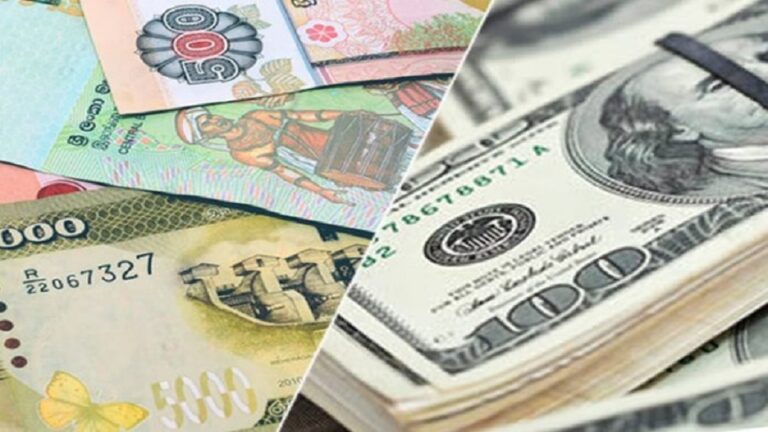
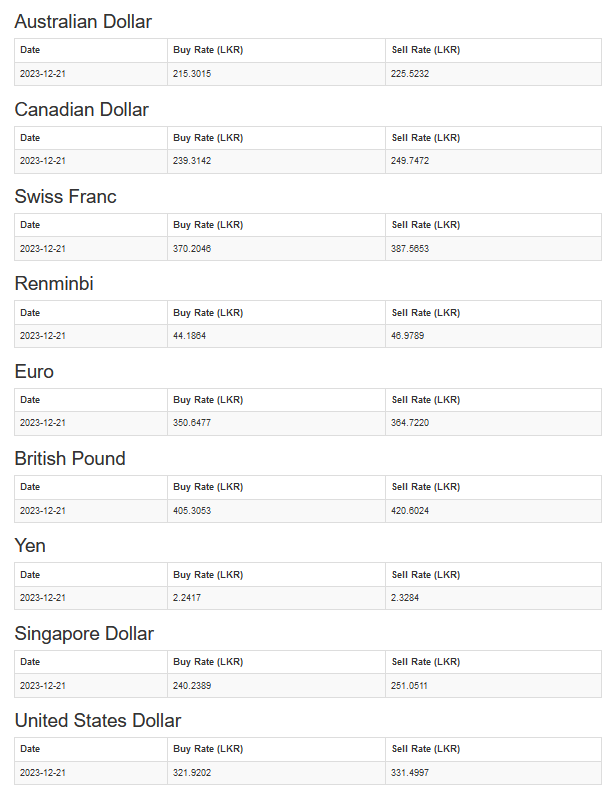
Colombo (LNW): The Sri Lankan Rupee (LKR) indicates fluctuation against the US Dollar today (21) in comparison to yesterday, as per the official exchange rates of the Central Bank of Sri Lanka (CBSL).
Accordingly, the buying price of the US Dollar has increased to Rs. 321.92 from Rs. 321.89, and the selling price has dropped to Rs. 331.49 from Rs. 331.70
The Sri Lankan Rupee, meanwhile, indicates appreciation against several other foreign currencies.
Colombo (LNW): The Government yesterday expressed confidence in boosting gross official reserves to over $ 4 billion by end 2023 with the receipt of $ 780 million so far in December.
The country took various initiatives, including securing a swap facility from the People’s Bank of China equivalent to approximately $1.4 billion.
Additionally, Sri Lanka encouraged its expatriates to remit their funds through formal channels, actively promoting this practice, apart from encouraging tourism, another key source of the island nation’s forex income, which slid during Covid years.
The Finance Ministry said following the completion of the First Review under the 48-month Extended Fund Facility (EFF) of the International Monetary Fund (IMF), the Government received the second tranche under the EFF, amounting to $ 337 million on 14 December 2023.
Subsequently, multilateral development banks also disbursed the tranches earmarked under several program financing channels.
Accordingly, the Asian Development Bank (ADB) released a total of $ 200 million on 15 December 2023 for Financial Sector Stability and Reforms Program.
Further, the World Bank released the second tranche of $ 250 million under Sri Lanka Resilience, Stability and Economic Turnaround (RESET) Development Policy Operation (DPO) on 20 December 2023.
The Finance Ministry said the Government has collectively received foreign exchange inflows of over $ 780 million during December 2023 and such inflows will further strengthen budget support and cushion Government’s gross financing needs in the period ahead.
“These notable inflows of foreign exchange to the Government will reinforce external buffers of the country. The gross official reserves are expected to surpass over $ 4 billion by the end of 2023, a level higher than anticipated earlier,” Finance Ministry said.
It said this significant foreign financing support by International Financial Institutions vouch for the satisfactory progress made by the Government of Sri Lanka on the implementation of the economic reform agenda.
“The Government remains committed to achieving sustainable economic recovery and ensuring public debt sustainability that will accrue benefits to the people in the period ahead,” the Finance Ministry added.
Authorities in Sri Lanka also encouraged migration and implemented measures over the past six months to boost both the outflow of people and the inflow of remittances.
Data from the Immigration Department reveals that in the first half of 2022, the government issued around 396,600 passports, surpassing the total issued in the entire 2021.
Also, Sri Lanka reduced the minimum age for women to work overseas to 21 and eliminated the requirement for female migrant domestic workers to submit a family background report.
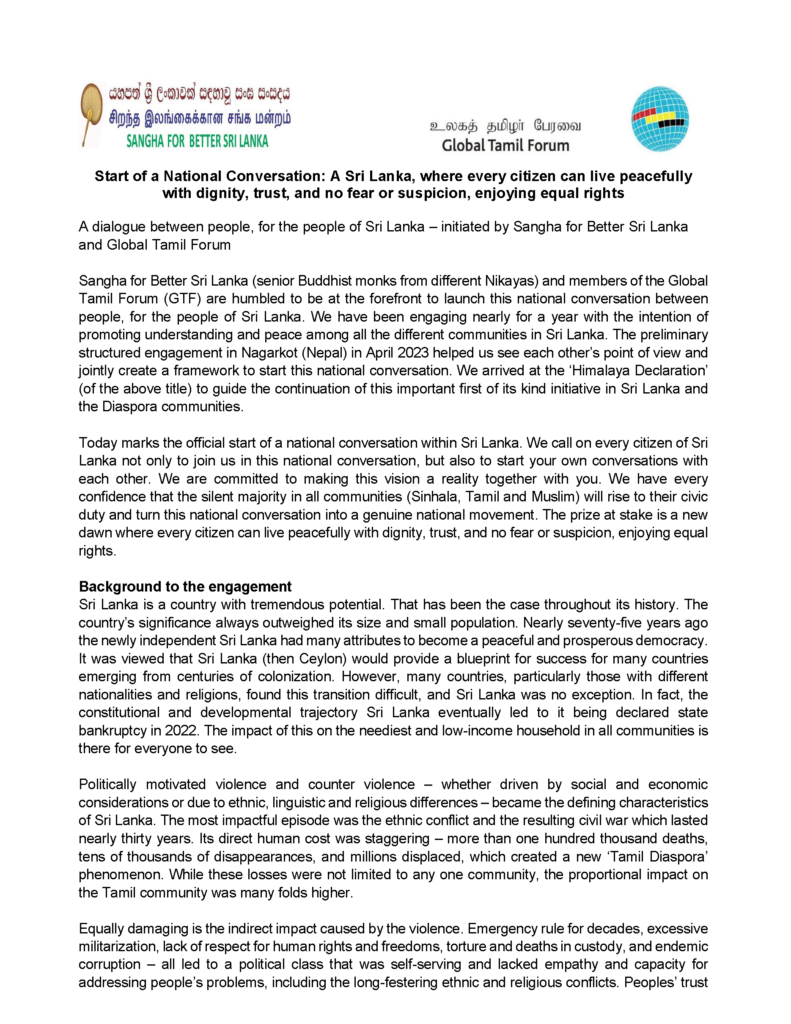
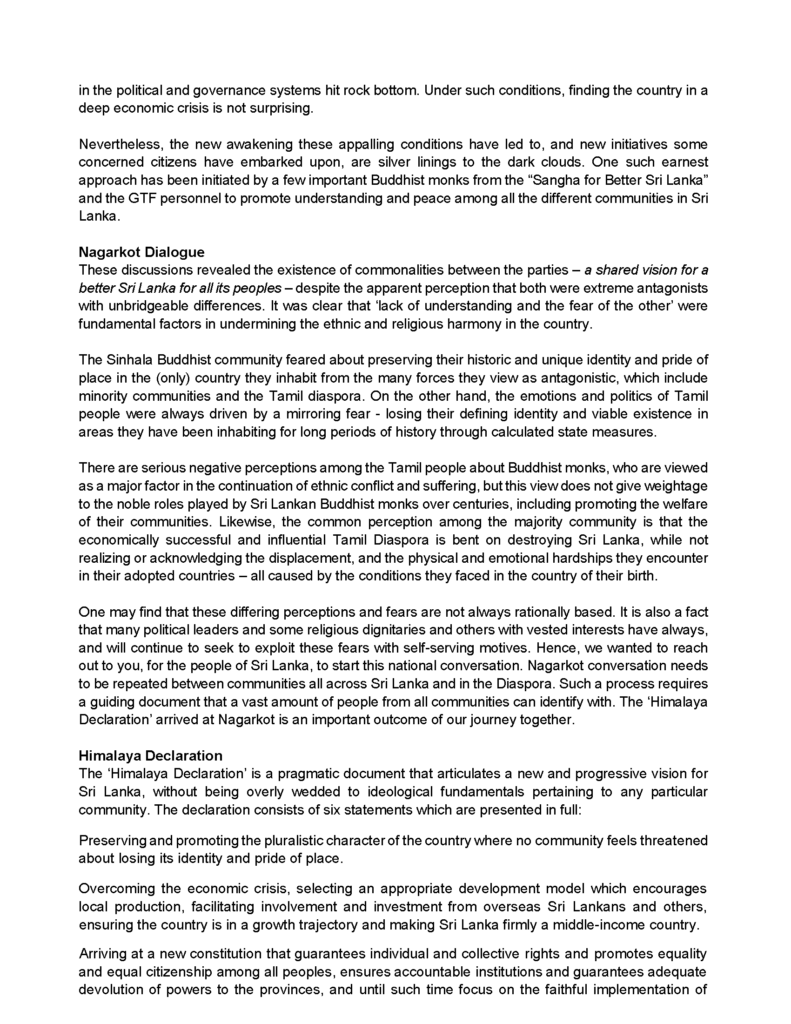
Following the launch of the ‘Himalaya Declaration’, the proposed “National Conversation” among communities in Sri Lanka and Diaspora will continue with much vigour and purpose
A ‘Delegation’ consisting of senior Buddhist monks from different Nikayas (Sangha for Better Sri Lanka or “SBSL”) and members of the Global Tamil Forum (“GTF”) had various engagements in Sri Lanka from December 7 to 15, 2023. This was continuation of our fruitful dialogue in Nagarkot (Nepal) in April 2023, where both parties arrived at “Himalaya Declaration” to facilitate our engagement and advocacy efforts among different communities in Sri Lanka. The “National Conversation” was officially launched in Sri Lanka and handed over to many religious, political and community leaders, and discussed during these meetings.
Promoting interreligious understanding and harmony was fundamental to this peace building initiative and therefore the engagements were primarily focused on religious leaders – including the Mahanayaka Theros of all four Buddhist chapters, the Nallai Atheenam, the Archbishop (Cardinal) of the Archdiocese of Colombo, Bishop of Jaffna, Bishop of Colombo representing the National Christian Council and leaders of the All Ceylon Jamiyyathul Ulama.
From the outset, we recognised the importance of the political process to achieve the envisioned outcomes. Hence, the Delegation met with the President, the Leader of the Opposition, all leaders of the national political parties including SLPP Party Leader Mahinda Rajapaksa, key political leaders representing Tamil, Upcountry Tamil and Tamil speaking Muslim communities, and past Presidents and former Speaker of Parliament involved in reconciliation efforts.
Mahinda Rajapaksa was met as the leader of a party with substantial support base among the majority community and due to the fact that his support base was built with the assistance of Buddhist temples and as the primary means of securing and holding onto positions of power in the country.
Both, the senior Buddhist monks and GTF recognised a true and sincere effort to initiate a ‘National Conversation’ must engage all – whether the leaders of political parties with substantial support base among the majority community or leaders with limited parliamentary seats in the minority communities. We made every effort to meet with those who made a kind gesture by accepting our joint invitation to hear about our work to date and the launch of the National Conversation. We appeal to that handful who didn’t meet us during this engagement because of their scepticism of our joint initiative to judge us by our actions.
The Speaker of the Parliament invited all 225 MPs for a discussion with the Delegation in the Parliament Complex. We also engaged with several important civil society members from North, East and South, representatives from the ‘Aragalaya’ and key media institutions and personnel from all three languages. Delegation also met with the most relevant diplomatic community based in Colombo including India, US, UK, Switzerland, Japan, Australia, South Africa, France, Canada, ICRC, UN.
The leaders and opinion makers we engaged during this one-week period were over a hundred, and the media coverage in all three languages was exceptional. The support, encouragement and blessings we received during every one of those meetings were inspiring and well beyond our expectations.
This is an initiative exclusively between two groups, SBSL and GTF with no involvement of any external political stakeholders or countries. The aim was to start the ‘National Conversation’ to promote understanding between all communities by removing the suspicions and fears plaguing them for decades. For example, from the Tamil perspective it was the Buddhist monks who always thwarted any attempt at political resolution, whereas the majority community (in the recent past) felt the influential Tamil Diaspora was bent on destroying the country and preventing its progress. So, a dialogue between the two ‘apparent antagonists’ seemed logical. The hope is such a process, when multiplied across the country, would create an environment conducive to address many current and past issues including the national question – a task repeatedly failed due to the inadequacies of the political classes and other main issues and concerns affecting all communities. The timing for this initiative has been questioned in some quarters. We recognise that 75 years of mistrust cannot be reversed in 7 days. But we firmly believe considering the extreme political and economic challenges the country was, and is, undergoing and the new awakening these conditions have led to, present fresh opportunities to reconcile and the National Conversation to start in earnest.
The ’Nagarkot Dialogue’ dealt with many complex issues with multiple stakeholders, and therefore the process could start only with sections from both sides that had progressive outlook. Further, it was imperative that the process remained confidential until it acquired sufficient momentum to withstand potential efforts to weaken it – such has been an established practice internationally. In addition, preparing the ground was an important requirement for successful launching of this initiative, hence the timing of last week’s many engagements, including all of the heads of various religious groups, most of the key political stakeholders and others. Furthermore, lawfully initiating a ‘National Conversation’ of this magnitude between communities meant that certain protocols, local traditions and laws have to be followed, including formally engaging the Head of State.
The Declaration at its core is a framework agreement between SBSL and GTF that articulates – a shared vision for a better Sri Lanka for all its peoples. We believe this is a guiding document that a vast amount of people from all communities can identify with, hence, serve as a useful starting point for a national conversation on peace building.
Ultimately it is the national conversation among people and communities in Sri Lanka, and the political processes available to them that can lead to political outcomes in the Country. Our joint initiative is limited to facilitating such a process (led by senior Buddhist monks and GTF) and creating a trusting environment where the political outcomes are likely to satisfy the aspirations of all citizens and communities.
Despite its broader focus that avoids concepts and terminologies that are considered controversial by any one community, the ‘Declaration’ pragmatically captures the issues that are important to all communities and particularly for the Tamil community. It promotes pluralistic character and equal citizenship in the country; calls for devolution of power to all the provinces (without referring to unitary state), including full implementation of the existing constitutional provisions; and stresses the importance of accountability measures and complying with international obligations.
We are very much encouraged this initiative and the declaration articulating for pluralism, power devolution and accountability have received the approval and blessings from almost all important stakeholders in the Country, including from the chief prelates of the Buddhist chapters. These are truly remarkable outcomes that could potentially transform the Country for the better.
The declaration isn’t set in stone. The “National Conversation”, which we believe have kick started in earnest, will be shaped by the people who participate in them – GTF, along with senior Buddhist monks and other religious clergy will be one of many parties to this Conversation.
We have noted some of the criticisms aimed at this initiative from some Tamil groups in Sri Lanka and in the Diaspora. Our humble view is that these views are grossly misplaced. However, we are very much encouraged by them expressing their views. It is important that all views are heard and listened to by each other and all parties contribute and shape the National Conversation which has now truly begun. Both, the senior Buddhist monks and GTF are clear that only promoting National Conversation to facilitate a good and durable outcome, rather than prescribing a particular solution or outcome.
GTF will continue to articulate to keep Sri Lanka under international scrutiny for its past and present human rights and international and local laws violations.
In the context of such misunderstanding expressed by some in the Tamil community, we want to make it crystal clear that this is not a negotiation process with the government or other leaders of the country for a political solution. It is the elected Tamil leaders on the ground who should undertake it at the appropriate time. By fostering more understanding between religious and ethnic groups, we believe when the real stakeholders negotiate a permanent solution to the national question, there will be less opposition to scuttle the outcome and support our vision of better Sri Lanka for all.
SBSL and GTF are conscious that we are groups with limited base of constituents. We acknowledged this in the joint statement that we issued last week (attached herewith for convenience). At the same time, we are aware that this initiative is unique and the first of its kind for Sri Lanka. Our immediate focus is on different religious communities and religious leaders, with a view to establishing inter-religious working groups in all twenty-five districts. As the national conversation progresses, the intention are to also initiate similar discourse within the various diaspora communities in different parts of the world.
We are certain that with progress achieved on promoting inter-religious understanding and harmony, many people in Sri Lanka and in the Diaspora will start to feel optimistic about the future trajectory of the country.
The support and encouragement shown by most of the key stakeholders in Sri Lanka, in the Diaspora and in the international community have given us confidence to take this initiative forward with much vigour and purpose. We also want to extend our thanks to all the diplomatic missions for their kind words of encouragement and wisdom.
We present below some of the quotes and experiences from the various stakeholders we met during last week.
Most Ven Asgiriya Mahanayake Thero – “The day we build a Sri Lanka based on brotherhood, equality and peace is when a successful Sri Lanka will be for real” explaining the point on equality, the Mahanayake Thero said, “only when we make people from any religion feel as equals, is when we can claim to have created a prosperous and successful Sri Lanka” “you have taken up a noble task of going to the people. I wish you well”
Most Ven Malwatte Mahanayake Thero – “It is true what the Tamil delegates said that it was the Buddhist Monks who came to the streets to block the various agreements between parties in the past (at this meeting and in every meeting, GTF referred to the many agreements between many leaders of the past including the “Chelva – Banda Pact”, “Chelva – Dudley Pact”, the “Ceasefire Agreement” with the LTTE and the “13th Amendment” to the Constitution). A minority of these monks who preach hatred and racism spoke loudly and won the day because majority of us who love peace and equality didn’t speak loud enough at those occasions, which we must in the future”.
The Mahanayake Thero himself recited section of Pirith to bless the delegation. We understood later, the Mahanayake Thero recites the Pirith himself only on occasions when he respects and loves the delegates.
Most Ven Amarapura Mahanayake Thero – “To go separately, one doesn’t need to have love, wisdom, common sense, or work hard. It’s easy to go in separate ways. However, to come together, we need love, common sense, wisdom and have to work hard. You are embarking on a noble cause to bring people together. It’s not going to be easy. It will need hard work. Many obstacles will come your way. Be determined, patient and resilient, you will eventually be successful and we pray for you and six of the Mahanayakes together recited a section of Pirith to bless the delegation”
Most Ven Rāmañña Nikāya Mahanayake Thero – “A Sri Lanka where everyone feels safe and secured to live in any part of the country is when we have created an equal Sri Lanka for all. I bless you all for taking up this great initiative forward”
Most Ven Nallai Atheenam Kurukkal – “If this initiative can resolve some of the injustices that are being committed against the Hindus of this country, then it is worth the efforts you are making”
His Lordship Bishop of Jaffna – “History hasn’t been kind to us Tamils of this country. You are taking a very important step along with the Buddhist clergy. If a future can be built on the premise of equality and justice, then it has to be a great endeavour. I wish you well.”
His Eminence Cardinal Archdiocese of Colombo – “Sri Lanka has to address the many injustices including to the victims of Easter Sunday bombing. Going to the people and bringing resolutions through a National Conversation is a novel idea. It is a great endeavour that I am sure the Bishops Conference too will support. Wish you all the very best”
The General Council of All Ceylon Jamiyyathul Ulama – “We support with whole heart of this initiative to create a national conversation on issues faced by the many communities in Sri Lanka. Please let us know how we can be of help in this process”
His Lordship Bishop of Colombo-NCC – “We have a long history of working with some of these Ven Buddhist Monks in many programs concerning various communities in Sri Lanka. I bless you well for successful outcomes from this noble endeavour.”
Without any exceptions, all the politicians including the sitting President His Excellency Ranil Wickramasinghe, Opposition Leader and Leader of SJB Hon Sajit Premadasa, Leader of NPP Hon Anura Kumara Dissanayake, Leader of SLPP and former President His Excellency Mahinda Rajapaksa, Leader of the TNA Hon R Sampanthan, Leader of SLFP and former President His Excellency Maithiripala Sirisena, Former President Her Excellency Chandrika Banadaranayake Kumarathunge, Leader of the Sri Lanka Muslim Congress Hon Rauf Hakeem, General Secretary of Ceylon Workers Congress Hon Jeevan Thondaman, Leader of Tamil Progressive Alliance & Democratic Peoples Front Hon Mano Ganeshan, Former Speaker of Parliament Hon Karu Jayasuriya, Current Speaker of Parliament Hon Mahinda Yapa Abeywardena, Justice Minister Hon Wijedasa Rajapakshe and the 35 plus Members of Parliament from various parties who attended the meeting held at the parliament were all supportive and shared words of encouragement for the process of National Conversation.
To quote the TNA Leader, Mr R Sampanthan, he said “We should have done this many years ago” He repeated the same at least three times. He told the Buddhist Clergy that “We are many years behind you”
Most of the civil society members met in Jaffna, Colombo and at various towns in the East were cautiously optimistic and certainly acknowledged this initiative as the first of this kind in Sri Lanka.
The diplomatic community shared words of encouragement with the delegates. United States Ambassador Julie Chung in her tweet stated that “We welcome their laudable initiative to expand cross-community understanding and seek lasting reconciliation”.
The Swiss Ambassador tweeted with a photo with the delegation and representatives from the various diplomatic missions present in Colombo, “It was an honour to meet with the @GTFonline and Buddhist Monks and to support the Himalayan Declaration, which outlines a vision for a united, pluralistic and peaceful Sri Lanka. A significant step towards reconciliation.”