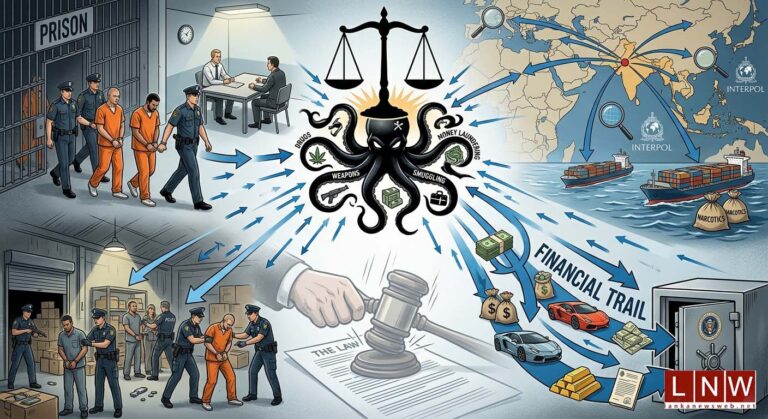
April 01, Colombo (LNW): The government is preparing to unveil a far-reaching piece of legislation within the coming fortnight, aimed squarely at dismantling entrenched organised crime syndicates and tightening the grip of law enforcement across the country.
Authorities have acknowledged that the current use of the Prevention of Terrorism Act (PTA) to detain suspected drug traffickers is merely a stopgap measure. This will soon give way to a more targeted legal framework, provisionally titled the “Organised Crime Control Bill”, which is expected to address longstanding loopholes that have enabled notorious figures to evade prosecution or continue orchestrating criminal activities even while incarcerated.
One of the most striking provisions in the proposed law would empower police to temporarily remove convicted offenders from prison custody and subject them to further questioning where fresh evidence or ongoing investigations demand it. Officials believe this will significantly disrupt criminal operations that are often directed from behind bars.
Senior law enforcement figures have indicated that the legislation is designed to send a clear message: influence and reputation will no longer shield individuals from scrutiny. The new framework aims to dismantle the culture of fear surrounding high-profile offenders, ensuring that no individual remains beyond the reach of the law, regardless of status.
Meanwhile, efforts to track down suspects who have fled overseas are being intensified through international partnerships. Authorities have increasingly relied on global legal mechanisms to identify, freeze, and seize illicit assets. In recent months alone, vast sums of money, along with luxury vehicles and property believed to be linked to criminal enterprises, have been confiscated under existing financial crime laws.
Law enforcement agencies have also stepped up cross-border operations, successfully identifying and apprehending dozens of major narcotics traffickers operating across South and Southeast Asia. At the same time, maritime surveillance has yielded significant results, with large-scale drug hauls intercepted at sea during the early months of 2026.
Officials remain confident that the forthcoming legislation will mark a turning point in the fight against organised crime, ensuring that neither geographical distance nor prison walls offer protection to those engaged in illicit activity.
Government to Fast-Track Sweeping Law to Crush Organised Crime Networks
Police Identify Overseas-Based Figures Behind Sri Lanka’s Drug Trade
By: Isuru Parakrama
April 01, Colombo (LNW): Sri Lanka’s narcotics underworld is largely directed by a small group of powerful figures operating from abroad, despite the steady stream of arrests targeting low-level offenders, law enforcement authorities disclosed.
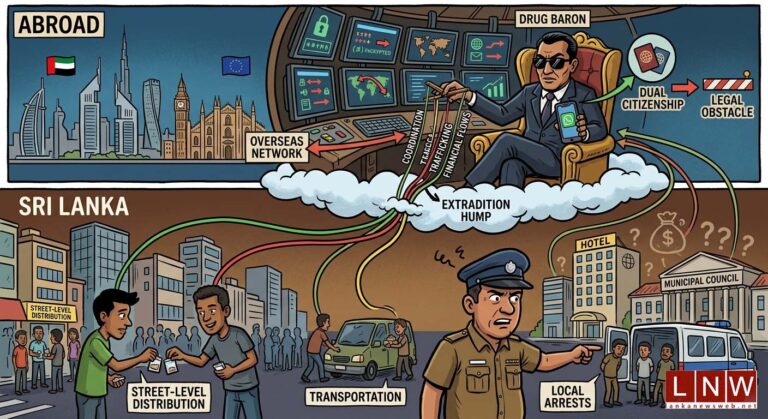
Speaking on the matter, Chandana Kodituwakku of the Central Crime Investigation Bureau indicated that five kingpins of crime are believed to be orchestrating the bulk of illicit drug activity linked to the island. All are Sri Lankan nationals who are currently based overseas, primarily in regions such as Dubai and several European countries.
According to investigators, these individuals manage their operations remotely, relying on sophisticated encrypted communication platforms to coordinate trafficking, distribution, and financial flows without setting foot in Sri Lanka. This has created a conduit for them to remain elusive while maintaining firm control over their networks.
Authorities maintain that these alleged masterminds have cultivated influential connections in their host countries, which, combined with factors such as dual citizenship in certain instances, have created significant legal and diplomatic hurdles in efforts to secure their extradition.
Police further noted that while local arrests often make headlines, those apprehended are typically minor players tasked with transportation or street-level distribution. The principal figures behind the trade, by contrast, operate discreetly and rarely attract public attention.
Investigations have also uncovered indications that some of these individuals have embedded themselves within legitimate business sectors in Sri Lanka. Certain enterprises, including high-end tourism ventures and hospitality establishments, are suspected of being used to channel and disguise illicit earnings.
In one notable instance, family members of a key suspect are reported to hold positions within a local municipal council, while another figure is believed to control a network of prominent businesses, some allegedly registered under proxies from economically disadvantaged communities in coastal regions.
Officials stress that although the whereabouts of these suspects are known, any attempt to bring them before Sri Lankan courts must proceed through established legal frameworks, a process that remains complex and time-consuming.
Suspected Drug-Smuggling Vessel Escorted to Harbour After Naval Interception
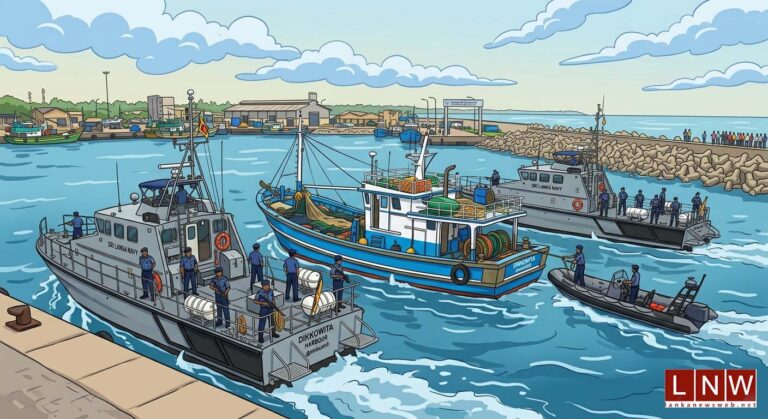
April 01, Colombo (LNW): A fishing vessel believed to have been involved in narcotics trafficking has been brought ashore at Dikkowita Harbour following a coordinated interception by the Sri Lanka Navy in waters to the south-west of the island.
The operation, carried out in deep sea conditions, targeted a locally operated multi-day fishing craft that had reportedly been under surveillance for suspicious movements over several days. Naval units moved in to intercept the vessel, suspecting it was transporting a significant quantity of illegal substances.
Six men found on board were taken into custody at the scene and are currently being held for questioning. Authorities believe the seizure may be linked to a wider smuggling network operating across regional maritime routes, although investigations are still at an early stage.
Following the interception, the vessel was escorted under naval guard to Dikkowita Harbour, where it will undergo a detailed search. Officials say further legal proceedings will be initiated once the inquiry is complete, with additional arrests not being ruled out.
GMOA Ends One-Day Strike, Further Action Under Review

April 01, Colombo (LNW): The 24-hour trade union action initiated by the Government Medical Officers’ Association (GMOA) came to an end at 8.00 a.m. today (01), bringing hospital services back to normal after a day of disruption.
According to the association’s media spokesperson, Dr. Chamil Wijesinghe, the union is now preparing to determine its next steps.
An urgent meeting of the executive committee is due to take place later in the day, where members are expected to assess the situation and decide whether further action is warranted.
Over 62% of A/L Candidates Secure University Eligibility in 2025 Results

April 01, Colombo (LNW): More than three-fifths of candidates who sat the 2025 G.C.E. Advanced Level examination have achieved the required standard for university entrance, the Department of Examinations has announced, marking a modest improvement compared with recent years.
The long-awaited results were published online on March 31, enabling students across the country to access their performance digitally. Candidates may view their results by entering their index numbers via the department’s official online portals.
This year saw a substantial number of participants, with 221,413 school candidates and a further 60,397 private applicants sitting the examination. Of these, 146,405 school candidates successfully met the criteria for university admission, while 30,122 private candidates also reached the qualifying threshold.
In total, 176,527 candidates have become eligible for state university placement, accounting for 62.64 per cent of all applicants. Education analysts note that the figure reflects a steady trend in performance, though competition for limited university places is expected to remain intense.
However, not all outcomes were finalised without issue. The Department confirmed that the results of 111 candidates have been withheld pending investigations into examination-related irregularities.
Officials have encouraged students to carefully review their results and follow the necessary procedures for university applications, which are expected to commence in the coming weeks.
Prevailing dry weather expected to change soon (April 01)

April 01, Colombo (LNW): The prevailing dry weather conditions over the island are expected to change from 02 April, the Department of Meteorology said today (01).
Warm weather conditions prevailing over the island is expected to continue.
Showers or thundershowers may occur at several places in Western, Sabaragamuwa and Southern provinces in the evening or night.
Mainly dry weather will prevail over the other parts of the island.
Misty conditions can be expected at some places in Central, Sabaragamuwa, Uva and North-Central provinces and in Galle and Matara districts during the early hours of the morning.
The general public is kindly requested to take adequate precautions to minimise damages caused by temporary localised strong winds and lightning during thundershowers.
Marine Weather:
Condition of Rain:
Showers or thundershowers may occur at a few places in the sea areas off the coast extending from Kaluthara to Pottuvil via Galle and Hambantota during the evening or night.
Mainly fair weather will prevail over the other sea areas around the island.
Winds:
Winds will be variable in direction. Wind speed will be (20-30) kmph.
State of Sea:
The sea areas around the island will be slight.
Temporarily strong gusty winds and very rough seas can be expected during thundershowers.
Massacre in Artibonite: Thousands flee as gang violence escalates in Haiti
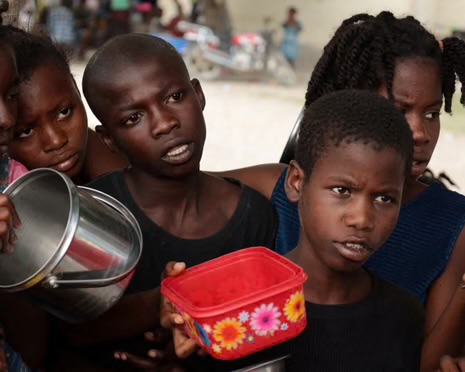
March 31, LNW (Colombo): At least 70 people have been killed and 30 others injured following a deadly gang attack in the Artibonite region of Haiti, according to a human rights organization, significantly exceeding earlier official estimates.
Initial police reports placed the death toll at 16 with 10 injured, while civil protection authorities later reported 17 fatalities and 19 wounded. However, the Collective Defending Human Rights described the incident as a “massacre,” stating that the violence forced nearly 6,000 residents to flee their homes.
The group criticized authorities for failing to respond adequately, accusing them of effectively abandoning the Artibonite region to armed gangs.
A spokesperson for the United Nations Secretary-General strongly condemned the attack, emphasizing the worsening security crisis in the country and calling for a full investigation.
Local officials said armed members of the Gran Grif gang launched the हमला around 3 a.m. on Sunday in the Jean-Denis area. The нападение follows recent UN reports that over 2,000 people were displaced by similar attacks in nearby Verrettes, prompting further displacement in Petite-Rivière.
The Artibonite department, a vital agricultural hub, has increasingly become a hotspot for violence as gang activity spreads beyond the capital, Port-au-Prince.
In March, the United States announced a reward of up to $3 million for information on the financial networks of the Gran Grif and Viv Ansanm groups, both of which have been designated as terrorist organizations.
Despite intensified operations by Haitian security forces—supported by a UN-backed mission and a US private military contractor—no major gang leaders have been apprehended.
Gang-related violence has displaced more than one million people across Haiti, worsening food insecurity. Since 2021, nearly 20,000 people have been killed, with the death toll continuing to rise each year.
Fried rice, kottu and tea prices go up from midnight
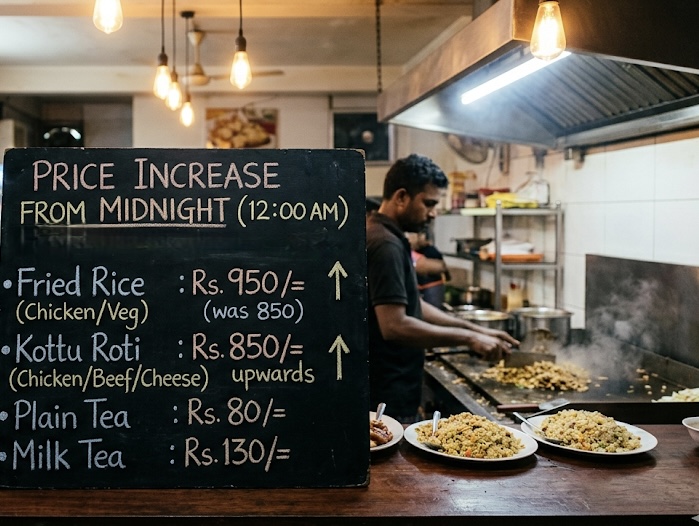
March 31, LNW (Colombo): Food prices at eateries across Sri Lanka will increase from midnight today (March 31), following a decision by the All-Island Canteen and Restaurant Owners’ Association due to rising operational costs.
Association President Harshana Rukshan stated that the prices of popular items such as fried rice and kottu have been raised by Rs. 30, while short eats will cost Rs. 10 more. Additionally, the price of plain tea and milk tea has been increased by Rs. 5.
He explained that the revision is mainly driven by the upcoming electricity tariff hike, which will take effect from April 1 and is expected to significantly raise operating expenses for food establishments.
Rukshan noted that many restaurants consume more than 180 electricity units per month, placing them in higher billing brackets and leading to increased utility costs.
He added that the price adjustment is essential to sustain the industry, as many restaurant owners are struggling to cope with the rising cost of electricity.
Man caught trying to smuggle banned medicinal plant to China
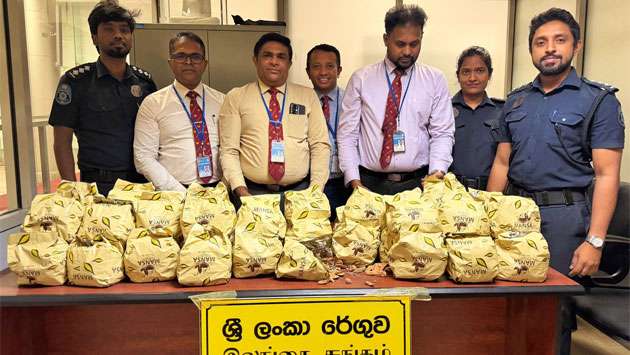
March 31, LNW (Colombo): A foreign national was arrested at Bandaranaike International Airport this morning (31) for attempting to smuggle a protected plant species out of the country, according to Customs officials.
The suspect, a 46-year-old Chinese national visiting Sri Lanka, was apprehended by Customs officers at the departure terminal in Katunayake.
Authorities discovered approximately 21 kilograms of Kotala Himbutu concealed inside his luggage. The plant material had been cut into smaller pieces and packed in wrappers bearing a well-known Sri Lankan tea brand, apparently in an effort to evade detection.
Kotala Himbutu is a protected species under Sri Lanka’s Fauna and Flora Protection Ordinance, and its export is strictly prohibited.
Further investigations are being conducted by Sri Lanka Customs, including officers from the Biodiversity, Cultural and National Heritage Protection Unit at Katunayake Airport.
Namal Rajapaksa urges accused Energy Minister to resign immediately
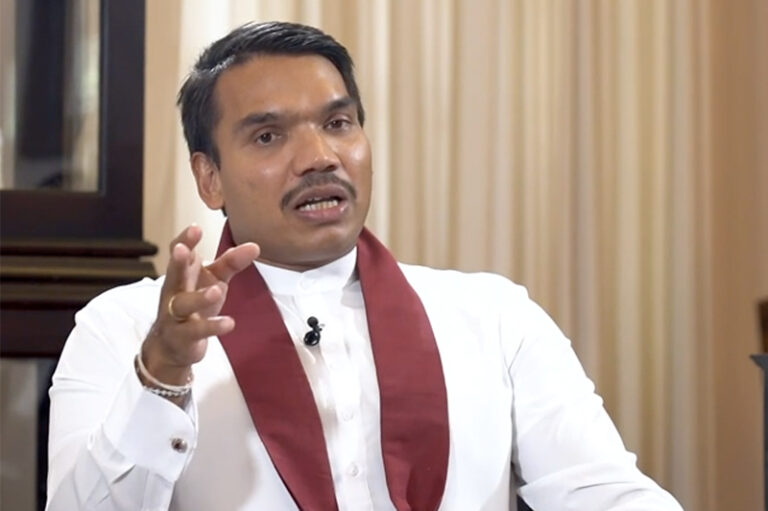
March 31, LNW (Colombo): Namal Rajapaksa, National Organiser of the Sri Lanka Podujana Peramuna (SLPP), has called on the country’s accused Energy Minister to step down without delay, insisting that such action should not depend on pressure from the opposition.
Addressing the media in Colombo, he emphasized that accountability must be upheld, particularly since the government has already acknowledged certain irregularities.
He claimed that ministers had admitted to importing low-cost coal, but cautioned that any financial losses resulting from the deal would ultimately be passed on to the public. He questioned the fairness of the situation, noting that while the government promotes the coal as inexpensive, the burden would fall on ordinary citizens.
Referring to earlier assurances by the ruling party that none of its members were involved in corruption, Rajapaksa pointed out that the indictment of the Energy Minister contradicts those claims. He stressed that under such circumstances, the minister should resign voluntarily rather than waiting for opposition demands.
Rajapaksa also commented on the broader political environment, highlighting the role of various leaders in shaping the country’s future. He mentioned figures such as Sajith Premadasa, Ranil Wickremesinghe, and Anura Kumara Dissanayake as key contributors to the evolving political landscape.
He further stressed the importance of maintaining a balance between experienced politicians and emerging young leaders. According to him, sidelining senior figures would be a mistake, and the country should instead focus on learning from past shortcomings while moving forward with modernization.