Home Blog Page 1343

Cabinet nods to import 92.1 mn eggs from India for next three months

0

Colombo (LNW): The Cabinet of Minister has granted approval to import 92.1 million eggs from India during the next three months, as per a proposal by the President in his capacity as the Minister of Finance, Economic Stabilisation and National Policies.

Accordingly, 92.1 millions eggs will be procured for a period of three months, through the State Trading (Misc) Corporation based on the recommendation made by the standing procurement committee appointed by the Cabinet.

Accordingly, quotations will be called in from Indian companies recommended by the Department of Animal Products and Health in this regard.

The move comes in with the objective of stabilising the prices of eggs in the local market.

CB issues official exchange rates today (29)

0

By: Isuru Parakrama

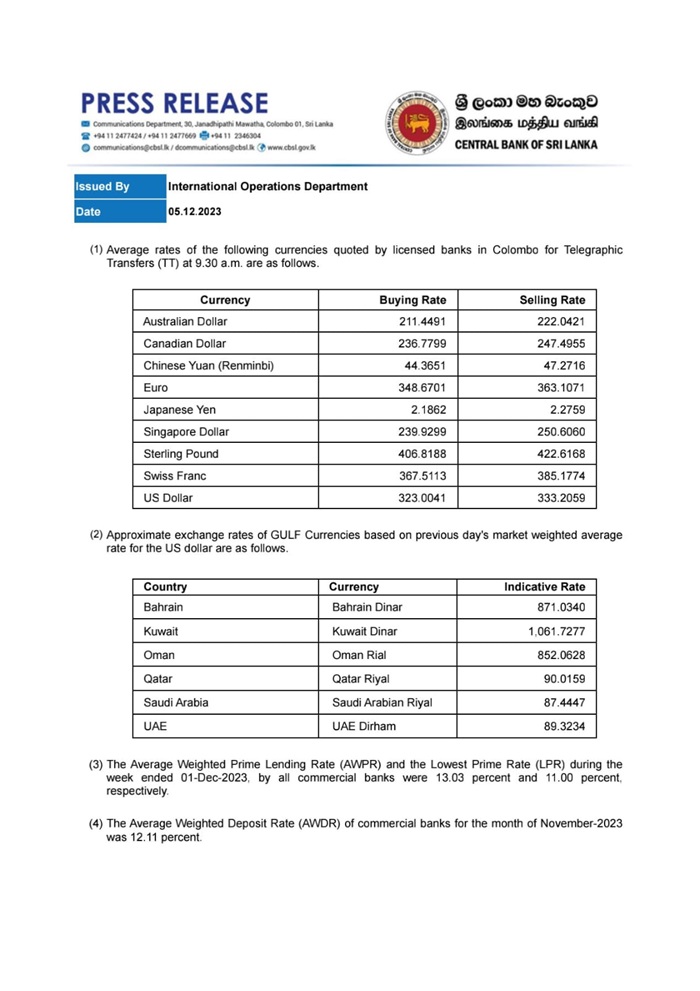
Colombo (LNW): The Sri Lanka Rupee indicates a slight fluctuation against the US Dollar today (29) in comparison to yesterday, as revealed by the official exchange rates list issued by the Central Bank of Sri Lanka (CBSL).

Accordingly, the buying price of the US Dollar has dropped to Rs. 317.83 from yesterday’s Rs. 317.96, and the selling price has increased to Rs. 329.54 from Rs. 329.52.

Meanwhile, the Sri Lanka Rupee indicates a subtle depreciation against several other foreign currencies, including Gulf currencies.

Debt restructuring, austerity and the IMF: a panacea or an exacerbation? Final Part – Part 6

0

Link to part 5

Dr. Lionel Bopage

Conclusive remarks

The IMF programme needs to be used to negotiate debt restructuring with commercial and multilateral creditors. It would create space to spend on priorities such as food and fuel. However, the country needs to urgently reinstate its fiscal responsibility, with a prescribed annual cap on fiscal deficits. A medium-term debt management plan updated for a certain period should be formulated and implemented with that cap limiting the expansion of non-concessional loans.

Necessity of Inclusivity

Stakeholders need to stop over-politicising economic issues, as populism has deeply clouded effective decision-making. What we need is the development of an inclusive, consensus-based and egalitarian approach towards a national development framework. The country needs to aggressively diversify its open economy, especially those that are mostly dependent on primary commodities, primitive value-added products, exports of human resources and tourism. Currently, the open economy is dependent on the export earners that are subject to significant volatility due to price fluctuations and regional instabilities.

A green and sustainable approach

Sri Lanka has a great potential for greener and sustainable economic development by utilizing its renewable energy sources and value-added industrial clusters such as for minerals processing. However, IMF debt restructuring, while not improving the country’s economic conditions, will only prolong its indebtedness. Instead, policies need to be formulated and implemented so as to ensure the population’s basic needs are met by guaranteeing the safety of food, energy and water. Significant cuts to unnecessary handouts and wastage in government and public service delivery will be necessary. This can include cutting down the size of the government including both the executive and legislature.

Performance evaluation

Performance targets need to be established in key result areas such as public finance, education, energy, health, and transport. Aggressive restructuring of state-owned enterprises can be carried out without selling them to the private sector. For example, hiring competent managers and firing inefficient ones, providing subsidies to those most in need of assistance, and trimming government expenditure by cutting down on excess political appointments. Education, health and energy need to remain as state flagship initiatives but be made efficient and result focused.

Alternatives and national dialogue

To come out of the current poly crisis, there are certain possibilities that could be adopted as alternatives; for example, progressive taxation, open governmental transactions, independent debt audits and prioritising social protection. However, all of these should be underpinned by a national public dialogue. This is about national social movements genuinely leading the national public dialogue in a transparent manner, where the behaviour and agenda of vested interest groups, both domestic and external, are curtailed. This involves sitting down together with civil society organisations, trade unions, government members, feminist collectives, human rights groups, NGOs, and community development organisations.

Vital role of government

The government’s guiding role in the economic and social development of a country is vital. As such, promoting a small government in developing countries where public services are essential and in extreme demand is misplaced. Instead of a bloated public service, there should be a service which is a productive, effective and people oriented. In the long term, we need to establish a skilled public service, where public servants bound by service charters will treat the general public fairly, with respect and courtesy, while catering towards satisfying people’s socio-economic needs. As demanded in many developing countries, Sri Lanka needs to implement a rights-based approach towards economic and social development.

Assured failure

The panaceas of neo-liberal economists do not eliminate periodic crises but generate worst ones over time. In the short term those panaceas reduce budgetary income received via tax receipts. However, businesses will demand governments reduce taxes on profits and investment, while the public will demand more services and provisions. Thus, such unplanned, competitive and antagonistic production relations will allow the state coordinated long-term regulative and growth strategies to fail.

Rights busting

Neoliberalism has succeeded in union busting and restricting workers from participating in political and institutional decision making. Throughout the world, union memberships have fallen and continue to fall. Another factor in this equation is the power within trade unions being moved away from grassroot workers to a growing bureaucracy. This bureaucracy receives increased privileges under a conservative form of leadership with its display of political timidity as their main characteristic. Trade unions do not represent politics of protest anymore.

Paralytic left

Though the Left works in the belief that capitalism has been always weak, decadent, and is in its final death throe, capitalism has survived under many guises. Yet, if able to unite under a single banner, workers may have more power than ever before. We are aware that capitalism is moving from one crisis to another, but it has not broken down yet and has not lost its political control. Moreover, the working class and the Left have not seen much of a surge. Rather neoliberalism has strengthened, pretending to be the best solution to the crisis generated by itself.

Diversity and exclusion

Instead of working together, activists in Sri Lanka try to undermine each other. Unfortunately, this is also a global experience. If everyone worked together instead of undermining each other, the situation could have been made better. Thus, people do not have any other choice to come out of this poly-crisis, but to confront this catastrophe holistically. Instead of dwelling solely on current issues, activists may need to focus on where it makes an impact, honestly acknowledging the challenges society is faced with and working towards long-term solutions for addressing the root causes of inequality and injustice.

A shared burden

Therefore, it is imperative for us to unite and bring to power a government with the political will and commitment that will share the burden of debt restructuring with those who can bear that burden without destroying the lives of people who are already at a disadvantage due to existing systemic issues. It is the affluent and the elite that are the most astute at using loopholes in the existing system to evade taxes. They then launder their ill-gotten gains in offshore tax havens. They need to be compelled to pay their fair share of tax. They also need to be held accountable for the lax in many cases of criminal and corrupt activity they have partaken in for many a decade. Everyone must keep in mind that the revenue and expenditure of a government are the commonwealth of all the people, not of a select few. Fiscal and monetary policy must be adapted accordingly.

This article is not arguing for building a socialist economy or a self-sufficient economy. However, it rejects the prevalent neoliberal model of capitalist production that is accompanied by corruption, mismanagement, waste, and lack of transparency and accountability and the sacrifice of national interests and sovereignty to satisfy international financial interests.

Sri Lanka needs to pursue an economic development strategy that is efficient, sustainable and equitable. The priority must be to produce in the country, the maximum amount of its essential commodities, i.e., goods and services necessary for the well-being of its inhabitants that can be sustainably and efficiently produced, while also utilising global markets to optimise the use of its resources to enhance overall national welfare.

Sri Lanka should avoid unsustainable imports and associated international indebtedness that result in ‘boom and bust ‘ cycles while undertaking appropriate investments and implementing appropriate policies to harness and enhance the natural and human resources needed for the country’s sustainable long-term development.

The end

28 August 2023

Related Articles:

Part II: Central bank policy interest rates without any macroeconomic rationale – Why monetary controls miserably fail

0

The part I of this series of article released on 22 August 2023 (Central bank policy interest rates don’t have a macroeconomic rationale – Sink in the crisis or look for alternative monetary instruments? Part I) in this blog proved that

  • central bank policy interest rates are overnight or very short-term risk free rates on central bank’s money printing-based credit operations,
  • credit operations of the rest of the monetary economy are taken place at various degree of risks,
  • interest rates are the prices of risks such as real business and inflation and,
  • therefore, policy interest rates-based monetary policy cannot drive market interest rates and credit flows unless central banks implement risk sharing and mitigation tools in the monetary policy.

In that context, this part II of the article shows why the Central Bank of Sri Lanka (CB) which pursues a policy interest rates-based monetary policy model along with its subsidiary policy tools introduced to support the monetary policy model like a God-given policy strategy is bound to fail.

The rationing of standing facilities effective from 16 January 2023, the cut of statutory reserve ratio (SRR) by 2% effective from 16 August and monetary order setting maximum lending rates of banks effective from 25 August are the three subsidiary tools covered in this article.

This article helps CB and other policy economists to learn simple market economic principles before they resort to such monetary market controls.

Rationing of standing facilities effective from 16 January

The rationing of standing facilities (or quantity controls) to any bank are as follows (see the article released on 16 January Monetary price controls and rationing – Promoting monetary black markets or controlling inflation?).

  • Standing lending facility only up to 90% of the SRR of the bank on the day.
  • Standing deposit facility only up to 5 days/times a month.

This is a rude violation of the economic principle of policy interest rates corridor model. In the model, inter-bank overnight interest rates are expected to prevail in the policy rates corridor as standing facilities are provided limitless at respective policy interest rates. Accordingly, policy interest rates are the price controls that are maintained through the unrestricted printing/supply of money by the CB. Therefore, if the CB imposes rationing on standing facilities (controls of market quantity), inter-bank market prices will move beyond the controlled prices depending on the supply and demand available in the market. 

This is simple economics that any sensible person understands from the state price controls in commodity markets. The outcome of price control and rationing is no exception to the monetary market. However, as policy interest rates are static numbers on the paper kept by the CB, they will remain like other controlled prices that are used in the computation of the consumer price indices. 

The objective of the CB for the new rule was to activate the dormant inter-bank market struggling from the financial bankruptcy of the economy and to bring down market interest rates through the liquidity already available in the market without policy rates cuts and injection of new liquidity from money printing.

However, data show that inter-bank interest rates continued to stay at high levels as the market activity did not rise. Therefore, the CB had to cut policy interest rate twice by total of 4.5% unexpectedly, i.e., 2.5% on 31 May and 3% on 30 July. Further, the CB has commenced reverse repo auctions (overnight and term basis) at an excessive scale on a regular basis to inject new liquidity to the inter-bank market in order to cover up the curtailed/rationed standing lending facility. Further, the most of reverse repo rates were cheaper than the standing lending facility rate without any justified reasons.

Finally, the use of the risk free policy interest rates corridor to target overnight inter-bank interest rates on risky lending is unfounded in economics and finance.

Therefore, the CB has miserably failed on the policy interest rates model and rationing tool.

SRR cut by 2% effective from 16 August

The CB in its press release dated 9 August stated that the SRR cut by 2% would release about Rs. 200 bn of new liquidity on a permanent basis to the domestic money market and reduce the cost of funds and lending rates of banks which will support the expansion of credit flows to the economy.

However, the utter failure of the CB on the SRR cutting tool is testified by the CB’s monetary order issued on 25 August prescribing maximum interest rates on bank lending products.

The CB’s press statement on SRR cut was factually flawed on several contents (see my article released on 9 August)(The CB cuts SRR by 2% – Another tribal monetary tool to deceive the public).

  • First, this is not a new liquidity injection, but only an increase of free reserves of banks at the existing liquidity. The new liquidity comes only from the money printing by the CB which continues with reverse repo auctions and lending to the government.
  • Second, there is no basis to state that bank credit flows will expand. It is the old monetary theory to state that credit creation will expand due to SRR cut and vise versa on the assumption of credit as a byproduct of deposits. According to the modern monetary theory, if there is demand for good credit, banks can first lend through book entries and then find the liquidity from other sources inclusive of money market and borrowing from the CB as part of managing the liquidity of the whole bank. Therefore, bank lending is not a business carried on pre-deposit mobilization whereas deposit business in fact is a byproduct of credit business in modern banking. Therefore, it is incorrect to state that banks will expand credit just because of the SRR cut as the CB states.
  • Third, the SRR cannot influence in interest rates on bank credit business as the SRR cannot determine and affect credit risks of bank borrowers and the economy. Everybody knows the alarming credit risk in the current context of the economic bankruptcy and impaired credit and investment portfolios of the banking sector.

Therefore, the reduction in the cost of funds and market interest rates and resulting expansion of bank credit flows due to the SRR cut are just a part of the old monetary policy story of the CB.

Monetary order on maximum interest rates on lending products effective from 25 August 

This is a normal act of bureaucratic price control to make political leaders feel happy that regulatory authorities act against unfair traders and markets. The CB also has followed this sort of price control from time to time for same purpose when the CB fails in the policy interest rates-based monetary policy model, so called market-based monetary policy.

Price controls on products such as coconut and egg testify that the authorities have no knowledge on the mechanism of respective markets. The same is true for CB’s price controls on banking service products although the CB employs international economists to study and recommend such market controls.

It is surprised why this order has been expeditiously issued under the Monetary Law Act already repealed by the new Central Banking Legislation awaiting the Speaker’s signature where the CB does not have such regulatory powers in the new legislation. Therefore, this order is to vacate very soon.

Highlights of maximum interest rates prescribed in the order are as follows.

  • 18% on pawning facilities
  • 23% on pre-arranged temporary overdrafts
  • 28% on credit card balances
  • In respect of other credit facilities (both new and existing) whose interest rates are less than 13.5%, a reduction of interest rates as least by 2.50% by 31 October 2023 and by further reduction of 1% by 31 December 2023
  • Reduction of penal interest rate on all credit products immediately to a level not exceeding 2%

The meaningless of the order as a bank credit market regulation is presented by following facts.

  • Interest rates are fixed by pricing the risks of credit products. However, the CB does not have a mechanism to gage the maximum risk each product encounters in order to fix the maximum interest rates. Further, the CB does not operate any credit risk insurance or mitigation measures to ensure that maximum risks are consistent with maximum interest rates. Therefore, setting of numerical limits on interest rates is meaningless.
  • The order refers to recent cuts in policy interest rates (by 4.5%) and SRR (by 2%) as the basis for the reduction in market interest rates. However, as pointed out above, risk free policy interest rates and bank reserves are not a basis for affecting interest rates on risky credit products unless the CB provides credit risk mitigation instruments such as refinance and credit guarantees.
  • The order also refers to the considerable easing in monetary conditions where interest rates of banks and financial institutions remain excessive and are not in line with current monetary policy stance. This is a flawed statement due to several reasons.
  • First, liquidity shortages reported from the bankrupt economy (i.e., government, banks, businesses and households) does not show any easing of monetary conditions. The CB does not give supporting figures to justify this order. In contrast, the fact that M2b annual monetary growth has declined from 16% in July 2022 to 6.2% in July 2023 and the reduction of the monetary base/reserve money from Rs. 1,436 bn in July 2022 to Rs. 1,374 bn in July 2023 (annual growth reduced from 35% to negative 0.9%) proves the opposite of the monetary easing. Therefore, the base statement in the order itself is flawed.
  • Second, high interest rates structure at present is in fact is a result of excessive interest rates forced by the CB through Treasury bill rates pushing from around 8% at the beginning of 2022 to around 32% towards the end of 2022 and default of public debt management. The CB also issued a monetary order on 21 April 2022 to remove maximum interest rates that prevailed at that time on credit card balances, pre-arranged temporary overdrafts and pawning advances and to force banks to raise interest rates of all banking products. However, the CB has just forgotten its reckless history and now blames banks for high interest rates. The CB unnecessarily mentions excessive interest rates charged by financial institutions although the order does not apply to them.
  • If banks comply with these interest rates ceilings due to unofficial threats of the CB being the bank regulator, they will immediately cut credit flows and entertain only customers and economic activities of lowers risks. This in fact will slow down credit expansion and will be a severe blow to the recovery of the economy already contracted by the unnecessarily tightened monetary policy pursued by the CB since the beginning of 2022, despite the economic crisis.
  • CB monetary policy economists must be well aware from both market economic principles and recent experiences that such maximum interest rates imposed for reducing the interest rates structure invariably fail. The plight of the most recent interest rates caps is as follows.
  • As per monetary order dated 26 April 2019, deposit rates up to 3 months were linked to standing deposit facility rate less a margin of 0.50% and other term deposits were linked to 364 day Treasury bill yield rate less 0.50% to plus 2.5% across the tenure. This was supported with a SRR cut of 2.5% to enhance the efficiency of the monetary transmission mechanism and expand credit flows. However, the order was withdrawn on 24 September 2019 after 5 months.
  • In contrast, a monetary order was issued on 24 September 2019 prescribing caps on lending interest rates on grounds and characteristics similar to the present order, for example, 28% on credit card advances, 24% on pre-arranged temporary overdrafts and reduction of penal interest rate to a level not exceeding 4%.
  • The caps were further reduced by the monetary order dated 21 August 2020 in view of the ultra relaxed monetary policy for the Corona-affected economy, i.e., 18% on credit card advances, 16% on pre-arranged temporary overdrafts, 10% on pawning and reduction of penal interest rate to a level not exceeding 2%.
  • All these caps were removed by the monetary order dated 21 April 2022 stated above as part of the high interest rates policy of the CB.
  • The monetary order does not contain a mechanism to ensure the compliance including the penalties in terms of the legislation. Further, the latest order issued on 28 August 2023 has not revoked the previous order dated 21 April 2022 and, therefore, banks have the option to choose the order they prefer. Therefore, abuses are unavoidable.

Therefore, the latest monetary order is simply a reopening of the old file on interest rates capping subject without any idea on its effectiveness as well as the current credit market conditions, given the bankrupt economy and the default of government debt.

Interim Remarks

  • The CB just look at monthly consumer price index-based statistical/annual inflation numbers and announces these bureaucratic price controls by resorting to the old monetary theory and waits till the next shock to the economy.
  • The recent history of such monetary policy tools (risk free policy rates model and price controls cited above) shows that they cannot influence various classes of credit risks confronted by modern monetary economies that operate on credit markets. Further, the CB does not have data to establish the effectiveness of such tools in the past.
  • As the CB does not implement any monetary tools to amend credit risk structure of economic activities, the present monetary policy model and money market control tools are baseless on macroeconomic grounds.
  • Therefore, monetary policy decisions of the CB are nothing but reopening of the old files to mislead the national leaders that the CB is dynamically engaged in recovering the bankrupt economy through enhanced monetary transmission mechanism and credit flows across the economy where the policy statements are nothing but meaningless words meant only for relevant economists and officials of the CB.
  • In that context, the CB’s monetary policy is not in a position to help recover the bankrupt economy unless it invents tools that are efficient in sharing and mitigating credit risks of priority sectors and activities. However, the CB is able to make billions of profit on its risk free monopoly money printing business carried out on very short-term basis with wholesale money dealers.
  • The danger of the attempt to implement such baseless policy tools and false statements is the uncertainties and bottlenecks created in markets and adverse impact on the recovery and stability of the economy. The literature on abuses of such bureaucratic controls at levels of both market participants and authorities is well known.
  • In general, unlike in developed market economies, interest rate is not a material factor to drive credit flows in Sri Lanka. What most matter are the access to credit and risks. Therefore, such credit market control tools will only be on the paper amongst the countless number of regulations relating to economic activities.
  • Interest rates/yield rates of government securities are well within the direct control of the CB. Therefore, the CB’s normal practice has been to set the yield rates in order to influence in interest rates in credit markets. However, the CB does not seem to reduce weekly Treasury bill yield rates during the past two months but sets ceilings on bank interest rates. Therefore, the CB should set the example for lower interest rates by first cutting the yield rates of government securities operating at its hand.
  • Therefore, national leaders are advised to think twice whether this is the national monetary policy that the country needs at this juncture to recover the public from the present bankruptcy as the monetary policy is not a rocket science but a concept-based intervention in the monetary side of the economy by the government for the benefit (creation of wealth and living standards) of the general public.

Overall, the tendency of the policy authorities in general to lie bravely to the public is normal. However, the present CB management lying to this extent and frequency as revealed from policy statements without specific economic research findings should be subject to serious concerns of the public, given its stability mandate.

(This article is released in the interest of participating in the professional dialogue to find out solutions to present economic crisis confronted by the general public consequent to the global Corona pandemic, subsequent economic disruptions and shocks both local and global and policy failures.)

P Samarasiri

Former Deputy Governor, Central Bank of Sri Lanka

(Former Director of Bank Supervision, Assistant Governor, Secretary to the Monetary Board and Compliance Officer of the Central Bank, Former Chairman of the Sri Lanka Accounting and Auditing Standards Board and Credit Information Bureau, Former Chairman and Vice Chairman of the Institute of Bankers of Sri Lanka, Former Member of the Securities and Exchange Commission and Insurance Regulatory Commission and the Author of 12 Economics and Banking Books and a large number of articles published. 

The author holds BA Hons in Economics from University of Colombo, MA in Economics from University of Kansas, USA, and international training exposures in economic management and financial system regulation)

Source: Economy Forward

Foreign Secretaries of SL and Thailand successfully conclude Bilateral Political Consultations

0

The 05th Round of Sri Lanka – Thailand Bilateral Political Consultations was held on 28 August 2023 at the Ministry of Foreign Affairs in Colombo.

The Sri Lanka delegation was led by Secretary, Ministry of Foreign Affairs Aruni Wijewardane, and the Thai delegation was headed by Permanent Secretary for Foreign Affairs of Thailand Sarun Charoensuwan.

During the discussion, a wide range of areas of mutual collaboration in the fields of trade & investment, defence, culture, fisheries and tourism were reviewed for further progress. Foreign Secretary Wijewardane informed the Thai side that as Sri Lanka moved forward with the stabilization of its economy, it placed high priority on enhanced bilateral relations with Thailand, as well as the broader ASEAN region. Sri Lanka has prioritized the conclusion of the Thailand-Sri Lanka Free Trade Agreement. In addition, Sri Lanka intends to join the Regional Comprehensive Economic Partnership (RCEP) Agreement, the world’s largest free trade area that came into effect on 01 January 2022. As one of the 15 founding members of the RCEP, Foreign Secretary Wijewardane requested Thai support for Sri Lanka’s application.

Foreign Secretary Wijewardane also congratulated Thailand on the progress made in BIMSTEC under its current Chairmanship, including initiating the Vision of a Prosperous Resilient and Open BIMSTEC by 2030.

The Thai Permanent Secretary for Foreign Affairs updated Sri Lanka on the latest developments in Thailand including the appointment of Srettha Thavisin as the new Prime Minister of Thailand. Permanent Secretary Charoensuwan welcomed Sri Lanka’s recovery since last year and informed that Thai technical assistance on various programmes under the Two-Year Implementation Plan will continue to support Sri Lanka’s efforts.

The two sides also reviewed ongoing developments in the regional and multilateral contexts including in ASEAN, BIMSTEC, IORA and the United Nations.

Parallel to the bilateral political consultations, a negotiation and business matching session was conducted between leading private sector companies of the two countries in the morning at the Siam Nivasa.

The Permanent Secretary for Foreign Affairs of Thailand called on Prime Minister Dinesh Gunawardena and Foreign Minister Ali Sabry in the afternoon.

Foreign Secretary Wijewardane was supported by senior officials of the Ministry of Foreign Affairs as well as officials from the Ministries of Defence and Fisheries, the Department of Commerce and the Department of External Resources (ERD). The Thai side included Thai Ambassador to Sri Lanka Poj Harnpol and other senior officials of the Thai Foreign Ministry.

32 SL migrant workers stranded in Oman repatriated

0

By: Isuru Parakrama

Colombo (LNW): 32 stranded Sri Lankan migrant workers have been repatriated from Oman on August 17 in a joint operation by the Embassy of Sri Lanka in Muscat, the Omani Foreign Ministry and the Department of Immigration of the Royal Oman Police.

Sri Lankans have been warned by the Embassy not to fall victim to human traffickers and arrive in Oman without confirmed jobs, after more illegal migrants were repatriated.

These migrant workers had entered Oman on visit/tourist visas with the anticipation of finding jobs and subsequently overstayed their visas without securing proper employment, the Embassy revealed in a statement.

“The issue of migrant workers arriving on visit/tourist visas and then overstaying due to lack of viable employment has been a challenge faced by many potential workers. From November 2022 to date the Sri Lanka Embassy in Oman has facilitated repatriation of more than 400 stranded migrants with support extended by the Omani authorities,” the statement read.

The stranded Sri Lankan migrant workers were provided with essential humanitarian support, including medical assistance, accommodation, and access to basic necessities by the Embassy.

The Oman Sri Lanka Social Club and other well-wishers have also extended their support to the Embassy during the operation.

The Sri Lankan Embassy in Muscat, Oman urged all Sri Lankans to seek jobs only though licenced agencies and register with the Sri Lanka Bureau of Foreign Employment prior to arriving in the Gulf state.

Indian NDC delegation meets SL Defence State Minister

0

An Indian National Defence College (NDC) delegation led by Rear Admiral Sanjay Sachdeva called on State Minister of Defence Premitha Bandara Tennakoon at his office in Colombo yesterday (28).

The delegation of senior foreign military officers who arrived at the Island as part of their tour on strategic neighbourhood studies was warmly received by the State Minister and had a cordial discussion with them.

Representing the delegation, Brig. Rajat Kumar and Col. Ushakov Rusian Leonidovich were also present at the meeting.

At the culmination of the discussion, the Minister Tennakoon conveyed his best wishes to the visiting delegation for successful future endeavours.

Assistant Defence Advisor to the Indian High Commision Lt. Col. Puneet Sushil was also present at the event.

LKR value against USD at commercial banks today (29)

0

Colombo (LNW): The Sri Lankan Rupee continues to remain steady against the US Dollar as revealed by several leading commercial banks in the country today (29) in comparison to the day before.

Accordingly, Peoples Bank reveals that the buying and selling prices of the US Dollar remain unchanged at Rs. 315.56 and Rs. 330.38, respectively.

At Commercial Bank, the buying price of the US Dollar has increased to Rs. 315.70 from yesterday’s Rs. 314.73, but the selling price remains unchanged at Rs. 328.

At Sampath Bank, the buying and selling prices of the US Dollar remain unchanged at Rs. 317 and Rs. 328, respectively.

Probe into death of patient at NHSL

0

Colombo (LNW): The Ministry of Health announced that it will be conducting a full investigation into the recent death of a patient at the National Hospital in Colombo upon being administered an antibiotic.

The decision was taken during a special discussion held on the matter yesterday (28) at the Ministry, according to Deputy Director General of Health Services Dr. G. Wijesuriya.

He noted that the cause of the death of the patient was an infection caused by the antibiotic administered, and the post-mortem examination had raised concerns about it.

The deceased was a 50-year old male who was admitted to the Colombo National Hospital for treatment for a cut wound.

In the meantime, the use of the antibiotic in question, Co-Amoxiclav, has temporarily been suspended.

Educate Sri Lanka Colombo Expo 2023 from 1-3 September at BMICH for all higher education and study abroad opportunities

0

Advertorial

Colombo (LNW): Educate Sri Lanka Colombo Expo 2023, the prestigious annual higher education and study abroad exhibition, is set to empower students with knowledge, inspiration, and opportunities as they seek to navigate today’s world of higher education. The event is organized by Evolution Events and Corporate Services (EECS) and will be held from 1st to 3rd September 2023 at the BMICH. The Colombo Career Expo 2023 will be held in parallel on the same days and venue.

Educate Sri Lanka Colombo Expo 2023 serves as an informative event where aspiring students, parents, universities and higher education institutions gather on one platform in Colombo to explore a wide range of educational prospects for the students and help them navigate the world of higher education and international study with ease. The event is ideally suited for students who have received their local O/L and A/L results, Cambridge O/L and A/L results as well as those who have completed their undergrad studies.

The dynamic dual event serves to meet several key objectives. It provides a platform for students to explore higher education opportunities in various fields based on their preference. It helps them to independently select the most suitable career pathways through professional career guidance and counselling. It also provides an opportunity for leading universities and educational institutes to engage with these students directly, allowing them to create awareness about scholarships, grants, and financial aid options available for Sri Lankan students pursuing higher education in foreign countries. It also facilitates networking opportunities for students, allowing them to connect with professionals from various industries and explore potential internships and job opportunities.

Sharing his thoughts on the event, Mr.Meshach Reuben, Director/CEO of Evolution Events and Corporate Services (EECS) stated, “The year 2023 marked a momentous milestone for Evolution Events as we successfully concluded a series of exhibitions under the brand Educate Sri Lanka Expo in Gampaha and Batticaloa as well as the prestigious Jaffna Education Fair in Jaffna. These events stood as shining examples of our commitment to empowering students across the nation with access to quality education and delivering unparalleled opportunities. I warmly invite all students and their parents to join us at this extraordinary dual event as we unlock the doors to knowledge, inspire lifelong learning, and pave the way to a brighter future for our younger generations.”

The Colombo Career Expo 2023 is an exclusive career and internship fair designed to provide a platform for job seekers, students, and professionals to explore exciting career opportunities and connect with leading organizations in the country. Recent graduates in IT, Business, Engineering, Marketing, Law, and many other disciplines will find the Career Expo the perfect setting to launch their careers and fulfill their career aspirations by exploring internship opportunities at the best organizations in Sri Lanka. Participating organizations gain access to this talent pool, increasing their chances of finding qualified candidates who align with their varied requirements and company culture.

Evolution Events and Corporate Services (EECS) specializes in organizing exhibitions, trade fairs, corporate events and conferences and provides a wide spectrum of event related solutions and media services to the corporate sector.