Home Blog Page 1372

Resolving economic challenges goes beyond the success of debt optimisation: President

0

PMD: President Ranil Wickremesinghe underscored the imperative to fortify the nation’s economy, ensuring that forthcoming generations are spared from enduring the unfortunate period that both the country and its people have weathered in the past two years. These remarks were made during his participation in the 150th Anniversary celebration of St. Thomas College in Matale today (13).

Mr. Ranil Wickremesinghe highlighted that resolving the country’s economic challenges goes beyond the success of the debt optimization program. He emphasized the need to promptly initiate an economy-building strategy guided by sound decisions. He cautioned that failure to proactively adopt a new program would inevitably result in the country facing another economic hurdle within a decade.

The President expressed his vision of propelling the country forward through comprehensive modernization. To achieve this, he announced the establishment of the Technology Promotion Council and the Digital Transformation Commission, aimed at accelerating the nation’s digital evolution.

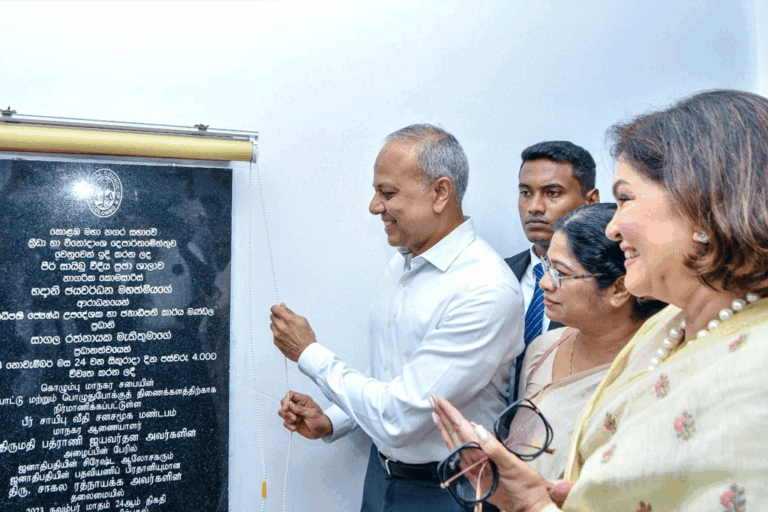
In an unprecedented event, President Wickremesinghe visited St. Thomas College in Matale, unveiling a commemorative plaque that marked the institution’s 150th Anniversary. He also graciously posed for a group photograph with the Alumni Association.

During the same occasion, the President also conferred certificates upon students who secured the top position in the district during the general education certificate examination.

Following is the speech delivered by President Ranil Wickremesinghe at this event;

It has been a century and a half since the inception of St. Thomas College in Matale. During its establishment, the country relied on a plantation-based economy with a significant focus on coffee cultivation. However, within a few years, the coffee industry collapsed, causing a severe economic downturn and depriving the government of its revenue stream. The economy struggled until the introduction of tea and rubber cultivation, which revitalized the nation’s financial standing.

As the 150th Anniversary of St. Thomas College in Matale is commemorated today, the country finds itself grappling with an ongoing economic crisis. The previous year’s economic turmoil left deep impacts on the nation’s economic, social, and political landscapes. During that period, the prospect of recovery seemed bleak. A poignant example of this was the lack of volunteers to assume the role of Prime Minister after Mr. Mahinda Rajapaksa’s resignation. Typically, such vacancies are eagerly pursued, but in this case, no one stepped forward.

Taking up the mantle of the presidency, I assumed responsibility, formed a cabinet, and embarked on finding both short-term and long-term solutions to address the economic crisis. Through decisive actions, we managed to eliminate the prevalent queues that had become emblematic of the nation’s struggles. The outcomes of our government’s decisions in September, January, and April of the previous year have been embraced positively by the populace.

As this year draws to a close, we hold the belief that our nation can overcome bankruptcy by successfully executing the credit appreciation program. Achieving this necessitates stringent control over public expenditures and a shift toward a more productive economy. We have already begun implementing these measures. However, it is essential to recognize that while our current endeavours may alleviate the “bankrupt” label unless further steps are taken promptly, we risk facing the same fate within a decade.

Consequently, the government’s course must be charted anew, underpinned by a revamped system. Sound financial discipline should guide our governance approach, extracting maximal benefits from each government institution. Initiatives to trim superfluous expenses within ministries are in the pipeline. Moreover, an inventory of government-owned land, buildings, and vehicles is being compiled under the Prime Minister’s Secretary’s leadership, with expectations of its completion by year-end.

The proposed measures for domestic debt optimization have been successfully passed in the Parliament, despite attempts to hinder the process through legal channels.

The EPF has introduced a draft law aimed at providing a 9% interest rate to all members, and this initiative is currently in progress. Consequently, there are no grounds to impede the advancement of this program. As stipulated in Article 04 of the Constitution, financial authority rests with the Parliament, thereby vesting it with the responsibility and competence to execute these actions. All legal cases related to this matter have been dismissed by the Supreme Court.

Upon the completion of the debt optimization endeavour, our focus should shift to the effective implementation of the subsequent economic program. Presently, there is a significant exodus of individuals from our nation. The departure of skilled experts and professionals has created a substantial void that cannot be easily filled. It is essential to reaffirm our commitment to establishing a robust economic foundation conducive to the well-being of all citizens.

Challenges confront our country today, primarily driven by insufficient government revenue and a trade imbalance skewed towards higher import costs relative to exports. A reliance on daily credit is not a sustainable solution. Once the debt consolidation process concludes, the same question emerges anew. We must proactively address this concern by bolstering our Gross Domestic Product (GDP) at a rapid pace, as an increased GDP directly translates to heightened national income.

Parallelly, we must intensify our efforts in the realm of exports. A comprehensive strategy for this endeavour should be formulated within the next decade.

In the current landscape, conventional political slogans have lost their relevance, even within both ruling and opposition parties. Instead, it is imperative to assess the country’s challenges and forge ahead with practical solutions. If the proposed solutions fail to gain traction, alternatives should be presented to address the issues at hand.

To propel the nation’s economic development, an annual influx of at least one billion dollars in foreign exchange is essential. The initial step toward achieving this goal involves augmenting foreign exchange inflows from existing sectors.

Our primary income sources are foreign employment and export earnings. Unfortunately, the economic situation in countries like Europe and America, particularly affecting the garment industry, has shown regression. Consequently, we shouldn’t anticipate substantial revenue from these sectors this year. Thus, our attention must pivot to tourism. Accordingly, we have devised comprehensive plans to significantly enhance our country’s tourism sector throughout this year and the following year.

Additionally, there is a pressing need to double our export revenue. To achieve this, attracting investors and providing them with the requisite facilities is essential. New initiatives such as the development of the port city have been set in motion. Furthermore, advancing rapidly over the next decade with technologies like artificial intelligence is paramount; our success or failure hinges on our ability to maintain this momentum.

In line with these objectives, plans are underway to establish several government and private universities. A subsidized loan program for students entering these institutions is also on the horizon. Our aim is to annually produce a minimum of 10,000 engineers and 7,500 doctors from Sri Lankan universities. The demand for IT expertise is also substantial, necessitating consistent efforts to meet these requirements.

Our aspiration is to construct a prosperous future for generations to come. It is our collective responsibility to fortify the economy to prevent a recurrence of last year’s adversities.

The government has undertaken numerous novel measures in pursuit of this goal. However, anticipated outcomes from the Board of Investment and the Export Board have fallen short. To address this, we have established an economic commission tasked with centralizing relevant powers. This will streamline the investment approval process, eliminating the need to navigate various ministries for clearance, and consolidating all procedures in one location.

Drawing inspiration from Mr. J.R. Jayawardena’s establishment of the Greater Colombo Economic Commission in 1978, we also aim to create a dedicated board to provide the necessary infrastructure for investments.

In tandem, we aspire to double the annual influx of tourists to our country from 2.5 million to 5 million. The Matale district possesses immense potential to contribute significantly to the burgeoning tourism industry.

Within the next two months, we intend to unveil an agricultural modernization program. Our current agricultural output, whether in terms of rice or other crops, falls short. It is imperative to promote the cultivation of these products.

Furthermore, we are in the process of establishing a Technology Promotion Council with the aim of acquiring the necessary technical expertise for our nation. Concurrently, a Digital Transformation Commission will be formed to propel digitization across the country. Envisioning comprehensive modernization across all sectors, our objective is to shape a developed Sri Lanka by the year 2048.

The event was attended by a multitude of individuals, including Education Minister Dr. Susil Premajayantha, Prime Minister’s Secretary Mr. Anura Dissanayake, Central Province Governor Mr. Lalith Y. Gamage, Ministry of Education Secretary Mr. Nihal Ranasinghe, former judge and Chairman of the Human Rights Commission Mr. M.P.B. Dehideniya, Professor Chaminda Ratnayake, Vice Chancellor of NSBM Green University, General Shavendra Silva, Chief of Staff of the Tri forces, Mr. Kaushalya Navaratne, President of the Sri Lanka Bar Association Mr. Dhammika Hewawasam, Principal of St. Thomas College in Matale, and a substantial gathering of faculty members, parents, and alumni.

Excise Dept receives directive for compulsory application of safety stickers on all liquor bottles by Sep 15

0

Colombo (LNW): In a move to combat the proliferation of counterfeit liquor bottles in the local market, the Parliamentary Committee on Ways and Means has issued a directive to the Excise Department stipulating the compulsory application of safety stickers on all liquor bottles by September 15, 2023.

Accordingly, local liquor production companies have been duly notified to ensure the affixation of safety stickers on their liquor products on or before September 15, 2023.

CAA earnings from raids surpass Rs. 130 million

0

Colombo (LNW): Over Rs. 132.6 million has been collected via shop raids conducted in the first half of the year 2023, and those convicted are subject to fines amounting to Rs. 23,641,000, disclosed the Consumer Affairs Authority (CAA).

During this period, more than 13,000 raids (13,493) were carried out in Sri Lanka, with 2,411 conducted in June alone, the Authority said.

Meanwhile, 18 large-scale raids were carried out in July this year, and the intervention focused on issued including but not limited to the non-display of proper price, selling products above regulated prices, and selling expired goods, the Authority added.

2nd round of IMF talks in September: Finance State Minister

0

By: Isuru Parakrama

Colombo (LNW): The second round of discussions with the International Monetary Fund (IMF) will take place in September this year, revealed Finance State Minister Ranjith Siyambalapitiya.

Accordingly, the second round of discussions with the IMF will take place from September 11 to 19, and an IMF delegation will be visiting the country during this period to engage in the talks, the Minster confirmed.

He added that the second tranche of about US $ 350 million, approximately amounting to Rs. 120 billion, is likely to be received following the first review scheduled for September, and that the government of Sri Lanka had agreed on nine conditions required to be fulfilled before the review.

Approximately 80 per cent of the stipulated conditions set by the IMF have already been fulfilled, Siyambalapitiya noted.

SL records workers’ remittance of US $541mn in July

0

By: Isuru Parakrama

Colombo (LNW): Sri Lanka’s foreign remittances indicates a 78 per cent increase in July, 2023 compared to the corresponding period last year, amounting to US $541 million, disclosed Labour Minister Manusha Nanayakkara.

This surge in remittances reflects the strong dedication and contribution of Sri Lankan expatriates to their home country’s economy, and the consistent rise in remittances underscores the global workforce’s commitment to supporting their families and communities back home, the Minister said in a Social Media remark.

“Since the onset of global economic challenges, these remittances have played a vital role in stabilising the national economy, enabling families to meet their financial needs, and contributing to local development projects. The cumulative remittance sent by the Sri Lankan global workforce has now reached a noteworthy USD $3363.6 million, further emphasising their indispensable role in the nation’s economic growth. The Sri Lankan government acknowledges and appreciates the immense efforts of its expatriate community and remains committed to creating an environment that fosters and supports their valuable contributions,” he added.

President issues directive to boost gem and jewellery industry revenue

0

PMD: During a recent discussion held at the Presidential Secretariat to address issues within the gem and jewellery industry, President Ranil Wickremesinghe urged officials to swiftly provide comprehensive plans for achieving the country’s objective of bolstering annual export earnings through enhancements in gem and jewellery exports and re-exports.

Within this discourse, the President highlighted the importance of promptly addressing challenges in the gem and jewellery sector to boost the country’s revenue from exports. He stressed that progress toward this year’s target growth in the industry has not met expectations compared to the previous year. As a result, he emphasized the necessity of implementing a well-structured strategy aimed at attaining an annual export revenue of at least two billion US dollars.

Furthermore, the President revealed that recommendations pertaining to tax policies for the advancement of the gem and jewellery sector were submitted to him by the “Sectoral Monitoring Committee on Environment, Natural Resources and Sustainable Development.” Deliberations extended to discussions on taxes impacting the industry as well as the export and re-export procedures. Pertinent stakeholders also shared insights with the President regarding the challenges that have arisen within the sector.

President Ranil Wickremesinghe assured that the government is fully prepared to provide necessary support and facilities if a formalized plan to elevate the gem and jewellery industry in Sri Lanka is promptly presented.

Notable figures present during the discussion included Minister of State for Investment Promotion Mr Dilum Amunugama, Secretary to the President Mr Saman Ekanayake, Senior Advisor to the President on Economic Affairs Dr R.H.S. Samaratunga, Chairman of the Sectoral Monitoring Committee on Environment, Natural Resources and Sustainable Development Mr Ajith Mannapperuma, committee members, and heads of associated line agencies.

Ex MP Ranjan Ramanayake completes his degree from OUSL

0

Colombo (LNW): Former MP Ranjan Ramanayake has completed his Bachelors in Arts (BA) in Youth and Community Development from the Open University of Sri Lanka (OUSL).

The popular Sri Lankan actor confirmed the completion of his degree in a Social Media remark.

Ramanayake has always been vocal about and an advocate for education and him wanting to become academically competent in order to serve the people of his country.

Import restrictions on vehicles used for public transport to be relaxed

0

By: Isuru Parakrama

Colombo (LNW): A gazette notification is expected to be issued this week relaxing restrictions imposed on import of vehicles used for public transport, revealed Finance State Minister Ranjith Siyambalapitiya.

Accordingly, import restrictions on lorries, trucks and buses may be relaxed withe the move, the Minister assured.

The move comes in regardless of the warnings from a number of economic analysts that such a relaxation would contribute to the weakening of the foreign exchange rate.

Deadly bacteria found on Bibby Stockholm: Migrants evacuated

0

BBC: All migrants have been removed from the Bibby Stockholm barge after traces of Legionella bacteria were found in the on-board water system.

The Home Office said all 39 migrants on board the vessel in Dorset were disembarked as a precaution.

The Legionella bacteria can cause Legionnaires disease – a type of pneumonia.

The barge is part of the government’s migration policy intended to cut the cost of housing asylum seekers.

One resident who spoke to the BBC said the migrants had been transferred to a new hotel and all had received a letter saying they will be moved back to the barge after a week.

The Home Office told the BBC “it does not recognise this claim” about the timeframe for returning to the vessel, adding that it would “remain in close contact with our partners and will adhere to all advice provided by relevant authorities over the coming days”.

The resident also said a few of those who had been on board had sore throats, and he himself had been coughing and having breathing problems.

Most people who contract Legionnaires disease make a full recovery but it can be deadly – around 10% of cases are fatal. People with underlying health conditions, the over 50s and smokers are at risk of serious illness.

The government eventually plans to house up to 500 men aged 18-65 on the barge moored in Portland Port, while they await the outcome of asylum applications.

A Home Office source has told the BBC that results showing “low levels” of Legionella in the water system on the Bibby Stockholm were received by a contractor on Monday.

It is understood the local council informed the Home Office on Wednesday evening, but at this stage the results being discussed were still “low levels”.

On Thursday further results “changed the picture”. There was a discussion with the UK Health Security Agency (UKHSA) who advised that the six newly-arrived asylum seekers should be disembarked.

Further testing has been done – by Dorset Council’s environmental health team – and it is expected that migrants will be moved back only if and when the water supply is completely clear of contamination.

The council added that the samples related “only to the water system on the vessel itself, not the fresh water entering the vessel”. It said there was “no risk for the wider community of Portland”.

To get rid of the Legionella bacteria, the water system needs to be flushed through with hot water.

In a letter, seen by the BBC, migrants were told it was “necessary to temporarily relocate” them “as a precautionary health and safety measure”.

“We are not aware of any individuals onboard with clinical signs of Legionnaires’ disease,” the letter said.

Ministers have said the barge would help cut the cost of housing asylum seekers being accommodated in hotels and described the barge as “perfectly acceptable”.

However, the initiative had already suffered a shaky start after delays over safety concerns and legal challenges had frustrated ministers’ attempts to ramp up the numbers of people boarding the barge.

Government sources have said they are complying with the UK Health Security Agency guidance and have gone “above and beyond” what has been recommended by removing people from the barge temporarily.

A Home Office spokesman said: “No individuals on board have presented with symptoms of Legionnaires’, and asylum seekers are being provided with appropriate advice and support. Legionnaires’ disease does not spread from person to person.”

Labour’s shadow immigration minister Stephen Kinnock said the government had turned itself “into a laughing stock this week”.

“They clearly haven’t completed the safety checks properly,” he claimed, saying the latest issues added to “a very clear sense that the government is in a state of shambles”.

Campaigners were also quick to hit out at the government over the development.

A charity representing asylum-seekers, Care4Calais, said its concerns over the safety of the barge had been justified. The charity is supporting a number of asylum seekers in legal challenges against being moved to the barge.

Alex Bailey from the Say No To The Barge campaign group said the news was “another example of the haphazard, incompetent way our government has approached this scheme from start to finish”.

Immigration minister Robert Jenrick is understood to have been chairing meetings about the situation.

Earlier this week he described accommodation on board the barge as “decent” but said there was “not a menu of options” for those seeking state-funded help as they sought asylum.

“We’ve got to be fair to the taxpayers as well as decent and compassionate to the individuals concerned.”

What are the risks of Legionella bacteria?

  • Legionella bacteria can cause a serious infection called Legionnaires’ disease
  • The bacteria are normally found in rivers and lakes, but can grow inside water tanks and plumbing systems
  • Problems emerge when people breathe in infected water and the bacteria get into the lungs
  • Showers that create a mist of water carrying the Legionella bacteria would pose a risk
  • Once in the lungs, the bacteria lead to pneumonia and symptoms can include a cough, shortness of breath and a fever
  • People infected will need antibiotics and, in more severe cases, oxygen support

Source: BBC

Covid prevalence increases by 80 per cent: WHO

0

By: Isuru Parakrama

Colombo (LNW): The number of new cases positive for Covid-19 has increased by 80 per cent around the world, disclosed the World Health Organisation (WHO).

The new reading appears despite the WHO’s previous declaration in May that the pandemic was no longer a global health emergency.

The continuous prevalence of the virus leading to mutation was already warned upon, and about 1.5 million new infections were discovered from July 10 to August 06, indicating a rise in the prevalence of about 80 per cent.