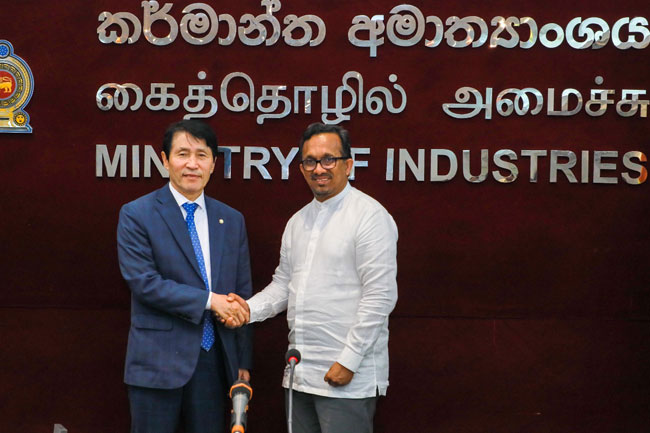
February 05, Colombo (LNW): Deputy Speaker of the National Assembly of the Republic of Korea, Lee Hak-young, has spoken warmly of the role played by Sri Lankan workers in supporting South Korea’s economy, offering his appreciation to Sri Lanka for their dedication and contribution.
The remarks were made during a meeting with Sri Lanka’s Minister of Industry and Entrepreneurship Development, Sunil Handunnetti, where both sides reflected on labour cooperation and broader economic engagement.
Minister Handunnetti, in turn, thanked the Korean government for opening employment avenues to Sri Lankan citizens, noting that the country’s workforce is known for its technical skills, adaptability and strong work ethic.
Discussions also explored opportunities for increased Korean investment in Sri Lanka, with particular emphasis on manufacturing and industrial ventures. It was noted that investors could take advantage of Sri Lanka’s skilled labour base while using the country as a gateway to major regional markets, including India, Pakistan and Bangladesh.
Drawing on South Korea’s own economic history, Deputy Speaker Lee observed that his country had navigated periods of severe financial difficulty in the past. Referring to Sri Lanka’s ongoing engagement with the International Monetary Fund, he expressed confidence that the island nation would emerge stronger and steadily move towards long-term economic development.
The meeting further covered practical issues such as easing visa-related challenges, deepening people-to-people links and building on five decades of diplomatic relations. Both sides reaffirmed their commitment to expanding cooperation and reinforcing the long-standing partnership between Sri Lanka and the Republic of Korea.
Korean Deputy Speaker Praises Sri Lankan Workforce and Signals Stronger Economic Ties
Excise Revenue from Local Liquor Tops Rs. 213 Billion in 2024
February 05, Colombo (LNW): Revenue generated from excise duties on domestically manufactured alcoholic beverages exceeded Rs. 213 billion last year, Parliament was informed today by Deputy Minister of Economic Development U.D. Nishantha Jayaweera.
Addressing the House, the Deputy Minister stated that the Excise Department collected Rs. 213.39 billion in 2024 from the sale of locally produced liquor, highlighting the sector’s continued contribution to state income. He noted that a duty of Rs. 1,832 is currently levied on a 750 ml bottle of locally produced Special Arrack.
The figures were disclosed in response to a parliamentary query raised by MP Rohitha Abeygunawardhane. According to the data presented, sales during 2024 included approximately 29.7 million bottles of 750 ml liquor, alongside 33.4 million bottles in the 375 ml category.
When questioned about the possibility of easing excise duties on locally consumed liquor, the Deputy Minister indicated that the matter remains under review, adding that the government is open to considering adjustments in line with broader economic and fiscal priorities.
On Independence, We Salute Four Presidents of Lanka
By Adolf
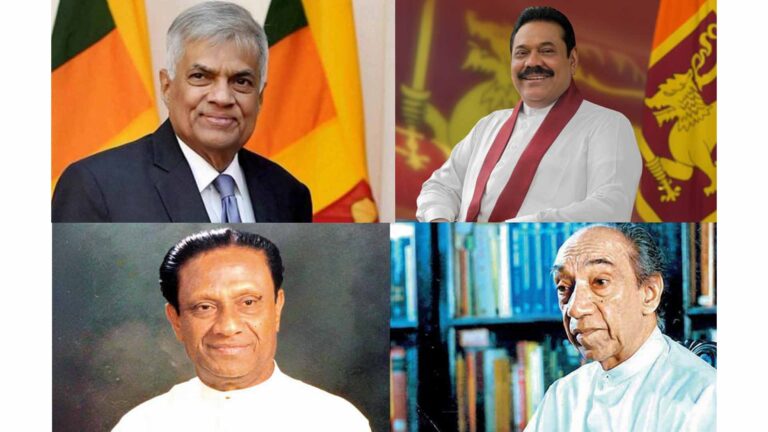
As Sri Lanka marks 78 years of Independence, it is a moment not only for celebration but for sober reflection. Independence is not merely about sovereignty—it is about leadership, vision, and the difficult decisions that shape a nation’s destiny. Over nearly eight decades, Sri Lanka has seen many leaders, but four Presidents stand out for the lasting and transformative contributions they made to the country at critical moments in its history.
JR Jayawardena
First among them is President J. R. Jayewardene, the architect of Sri Lanka’s open economy. At a time when the country was inward-looking and constrained by rigid controls, J. R. Jayewardene had the courage to liberalize the economy, open Sri Lanka to global trade, and promote foreign investment. This shift laid the foundation for private enterprise, export-led growth, and international confidence in Sri Lanka. Equally significant was his role in large-scale infrastructure development. Under his leadership, the Mahaweli Development Project—one of the largest multipurpose development projects in the country’s history—was accelerated and completed, delivering irrigation, hydropower, and livelihoods to vast rural regions. The dams constructed during this period continue to serve the nation decades later.
Ranasinghe Premadasa
The second leader we salute is President Ranasinghe Premadasa, whose focus was unapologetically pro-poor and rural-centric. Premadasa understood that economic growth without inclusion was hollow. His emphasis on rural roads, housing, and poverty alleviation brought development to areas long neglected. Most notably, his garment factory programme transformed Sri Lanka into a globally recognized apparel manufacturing hub. By decentralizing factories into rural areas, he not only created employment—particularly for women—but also laid the groundwork for one of Sri Lanka’s most resilient export industries. The garment sector remains a pillar of the economy today, a testament to the long-term impact of his vision.
Mahinda Rajapakse
The third President is Mahinda Rajapaksa, under whose leadership Sri Lanka finally emerged from the shadow of terrorism. For nearly 30 years, the civil war with the LTTE bled the country—economically, socially, and psychologically. It is estimated that Sri Lanka lost between 3–5% of GDP annually due to the conflict. In 2009, terrorism was decisively defeated, restoring territorial integrity and allowing the country to dream again of peace and development. While debates may continue on many aspects of that period, the fact remains that ending the war was a turning point that altered Sri Lanka’s trajectory.
Ranil Wickramasinghe
Finally, President Ranil Wickremesinghe deserves recognition for steering the country back from the brink of total economic collapse. When he assumed office, Sri Lanka was effectively bankrupt—crippled by 13-hour power cuts, fuel and gas queues stretching for miles, and a population reduced to celebrating the arrival of gas lorries. Within two years, through painful but necessary reforms, debt restructuring, and engagement with international partners, the country was stabilized and returned to a measure of economic viability. It is a bitter irony that a leader who undertook the most difficult rescue in Sri Lanka’s post-independence history now faces potential legal jeopardy over matters such as an overseas visit, reflecting an inability of a government to distinguish between the office and the individual.
AKD Rhetoric
Today, as the current administration led by Anura Kumara struggles to demonstrate a comparable legacy—beyond selective anti-corruption rhetoric that spares its own ranks—it is worth remembering that Independence was secured and preserved by leaders willing to take responsibility, absorb criticism, and act in the national interest. On this Independence Day, we salute not perfection, but impact—and the courage to lead when the country needed it most. “The prices of greatness is responsibility.” — Winston Churchill
High Court Defers Ruling on Preliminary Objections in Case Against Former Ministers
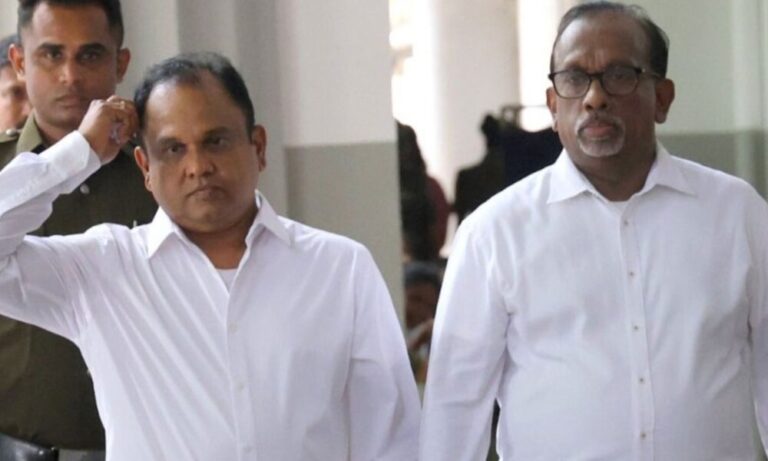
February 05, Colombo (LNW): The Colombo High Court has decided to put off delivering its ruling on the preliminary objections raised in the case instituted by the Attorney General against former cabinet ministers Mahindananda Aluthgamage and Nalin Fernando, along with retired Army Major General Nanda Mallawaarachchi.
Court officials confirmed that the decision, which was expected to clarify whether the case would proceed to the next stage, will now be delivered on March 25. The matter was taken up today (05), during which the bench informed parties that additional time was required to consider the submissions made.
Ditwah Catastrophe: Foreign Relief Coordination Committee Meets to Tighten Oversight and Delivery Mechanisms
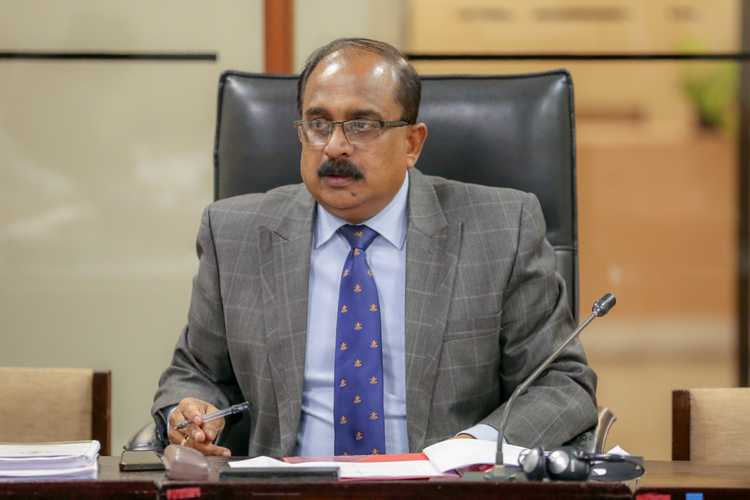
February 05, Colombo (LNW): The High-Level Committee responsible for coordinating foreign relief supplies met once again at the Parliamentary Complex, with proceedings chaired by Deputy Minister of Defence Major General Aruna Jayasekara (Retired).
Discussions focused on assessing the current handling of international relief assistance and introducing firm measures to enhance transparency, accountability and operational effectiveness across all aid-related activities. Particular attention was given to ensuring that relief reaches affected communities fairly and without delay.
Committee members examined strategies for improving the allocation and distribution of donated supplies through clearer procedures and stronger monitoring systems. The Ministry of Defence noted that the meeting also addressed long-term planning, with an emphasis on improving readiness and management structures for future humanitarian assistance.
Addressing the committee, the Deputy Minister stressed that close coordination among state institutions is essential to maximise the value of foreign aid. He reaffirmed the government’s intention to reinforce existing coordination frameworks so that relief operations remain efficient, credible and responsive to public needs. He further instructed that all relevant reports and documentation be promptly forwarded to the Presidential Secretariat.
The session was attended by committee members alongside senior officials from the Disaster Management Centre, the Office of the Deputy Minister of Defence, the Presidential Secretariat and Sri Lanka Customs.
Historic Devnimori Buddha Relics Brought to Sri Lanka for Public Veneration
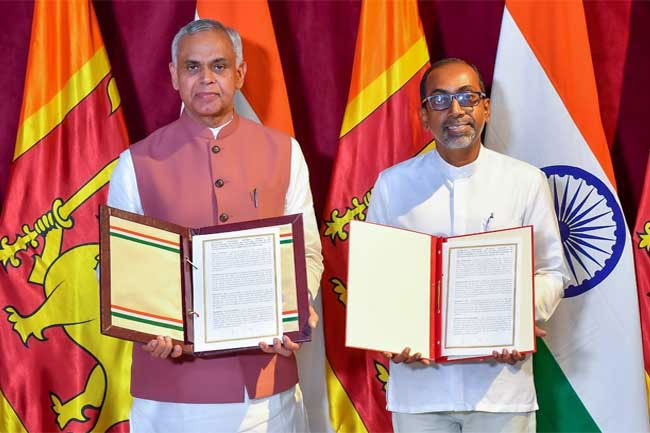
February 05, Colombo (LNW): An agreement paving the way for the public exposition of the revered Devnimori Buddha Relics in Sri Lanka was formally concluded with the exchange of a Memorandum of Understanding (MoU) between Minister of Buddha Sasana, Religious and Cultural Affairs Dr Hiniduma Sunil Senevi and India’s Acting High Commissioner to Sri Lanka, Dr Satyanjal Pandey.
The signing followed the arrival of the sacred relics at the Gangaramaya Temple in Hunupitiya, marking a moment of deep religious and cultural significance for the country. Arrangements for the exposition were made with the direct support of the Government of India, under the patronage of Indian Prime Minister Narendra Modi.
Unearthed during archaeological excavations in the 1960s at the ancient Devnimori site in Gujarat, the Devnimori relics are regarded as among the most precious physical remains associated with the Buddha. This visit marks the first occasion on which these relics have ever left Indian soil.
According to reports, the transfer was made possible following high-level discussions between President Anura Kumara Dissanayake and Prime Minister Modi during the Indian leader’s recent visit to Sri Lanka, opening an unprecedented opportunity for Sri Lankan devotees to pay homage to the relics.
Members of the public will be able to venerate the sacred Devnimori Buddha Relics at the Gangaramaya Temple in Colombo over a seven-day period, from today (05) until February 11.
Fairly heavy showers above 75 mm expected in several districts (Feb 05)
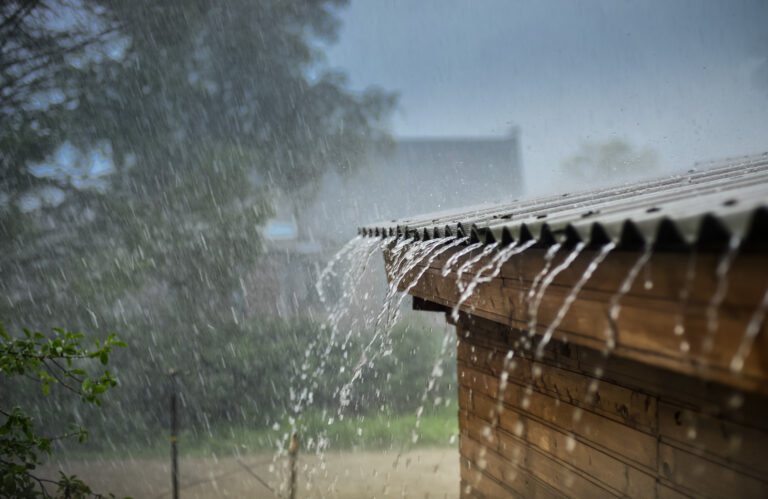
February 05, Colombo (LNW): Showers will occur at times in Northern, North-central, Eastern, Uva and Central provinces and in Hambantota district, with fairly heavy showers above 75 mm expected at some places in Uva province and in Batticaloa, Ampara, Hambantota and Nuwara-Eliya districts, the Department of Meteorology said in its daily weather forecast today (05).
Showers or thundershowers may occur at several places elsewhere after 2.00 p.m. Fairly heavy showers above 50 mm are likely at some places.
Fairly strong winds about (30-40) kmph can be expected at times over Northern and North-western provinces and in Matale, Trincomalee and Anuradhapura districts.
Misty conditions can be expected at some places in Western, Sabaragamuwa and Central provinces and in Galle, Matara and Badulla districts during the early hours of the morning.
The general public is kindly requested to take adequate precautions to minimise damages caused by temporary localised strong winds and lightning during thundershowers.
Marine Weather:
Condition of Rain:
Showers will occur at several places in the sea areas off the coasts extending from Pottuvil to Kankasanthurai via Batticaloa and Trincomalee. Showers or thundershowers may occur at several places in the other sea areas around the island in the evening or night.
Winds:
Winds will be north-easterly and wind speed will be (30-40) kmph. Wind speed can increase up to (45-50) kmph at times in the sea areas off the coast extending from Colombo to Mullaitivu via Puttalam and Kankasanthurai, and from Matara to Pottuvil via Hambantota.
State of Sea:
The sea areas off the coast extending from Colombo to Mullaitivu via Puttalam and Kankasanthurai, and from Matara to Pottuvil via Hambantota will be fairly rough at times. Other sea areas around the island will be moderate.
Temporarily strong gusty winds and very rough seas can be expected during thundershowers.
Turning Dialogue into Delivery for UK–Sri Lanka Trade
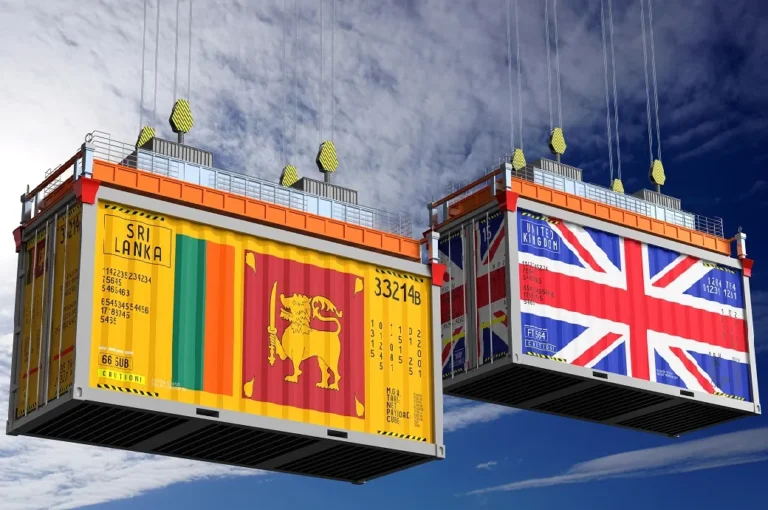
While challenges persist in expanding trade between Sri Lanka and the UK, recent engagements signal a growing recognition that solutions lie in better coordination, smarter policy tools, and targeted private-sector leadership rather than broad reforms alone.
The UK’s position as Sri Lanka’s second-largest export market offers a solid foundation. Preferential access under the Developing Countries Trading Scheme provides a competitive edge particularly for apparel and value-added manufacturing. Recent relaxations in Rules of Origin represent a timely opportunity to reposition Sri Lanka as a reliable sourcing destination at a time when UK companies are re-evaluating supply chains.
However, capitalising on this advantage requires moving beyond awareness-building toward hands-on execution. Exporters, especially SMEs, need structured advisory support to navigate compliance requirements, documentation, and logistics. Chambers of commerce and trade missions are well placed to bridge this gap by acting as practical facilitators rather than purely networking platforms.
Investment promotion also shows signs of recalibration. Sri Lanka’s emphasis on high-quality, targeted investment—particularly in IT, BPO, tourism, and real estate—reflects lessons learned from past volume-driven strategies. Colombo’s emerging business districts and digital services ecosystem offer credible entry points for UK firms seeking cost-effective regional platforms.
Encouragingly, there is growing acknowledgement that government and business must operate as partners rather than parallel actors. Aligning Board of Investment priorities with export development goals could help convert investor interest into export-linked growth, integrating Sri Lanka more firmly into UK-facing value chains.
Events such as Sri Lanka Expo 2026 present an opportunity to correct past shortcomings. If positioned strategically with curated buyer engagement, sector-specific matchmaking, and post-event follow-up the Expo could serve as more than a showcase, acting instead as a transaction-driven marketplace.
Brand development remains a critical frontier. Sri Lanka’s strengths in sustainability, ethical manufacturing, and skilled services resonate strongly with UK consumer and corporate values. Translating these attributes into coherent branding narratives could help exporters move up the value chain and secure longer-term partnerships.
Ultimately, the way forward lies in precision rather than scale: fewer slogans, more execution; fewer general forums, more sector-specific pipelines. With targeted reforms, better utilisation of existing trade schemes, and disciplined follow-through, UK–Sri Lanka trade can shift from potential to performance delivering tangible benefits to both economies.
Canwill Divestment Raises Legal, Fiscal, and Investor Confidence Questions

The Government’s renewed effort to divest its entire stake in Canwill Holdings Ltd. has reopened scrutiny of two long-stalled tourism projects—an unfinished mixed development in Colombo and a proposed hotel project in Hambantota—highlighting complex legal risks and broader economic implications.
Canwill Holdings, incorporated in 2011 as a fully State-owned enterprise, was intended to anchor Sri Lanka’s push into high-end hospitality infrastructure. Its flagship Colombo project, a 47-storey hotel and serviced apartment complex in Colombo 3, was largely completed structurally and granted Strategic Development Project status, qualifying it for significant tax concessions. Despite substantial capital expenditure and regulatory clearances, the project never became operational, tying up public funds for more than a decade.
The Hambantota hotel project presents even greater legal uncertainty. The 9.42-acre beachfront lease held by Helanco Hotels and Spa, a Canwill subsidiary, has expired due to the failure to commence construction. Government clarifications explicitly state there is no commitment to renew the lease, introducing a material risk that could deter potential investors or reduce valuation expectations.
The divestiture framework sets a minimum net worth or financial capability threshold of $50 million for bidders, signaling an attempt to attract credible investors capable of completing and operating complex developments. However, the absence of indicative valuation guidance at the Expression of Interest stage and the postponement of liability disclosures until the Request for Proposal phase place significant due diligence burdens on bidders.
From a legal standpoint, the structure of the transaction a full share sale rather than an asset disposal means that investors will inherit historical liabilities, including loans, guarantees, tax exposures, litigation risks, and regulatory compliance issues. While the Government has indicated it will adopt mechanisms to address past liabilities, the lack of detail raises questions about how risks will be apportioned and whether indemnities will be sufficient to reassure investors.
Economically, the prolonged stagnation of these projects has had measurable opportunity costs. The Colombo development alone could have generated foreign exchange earnings, employment, and downstream service sector activity. Instead, billions of rupees in public funds sourced from institutions such as the EPF and Sri Lanka Insurance remain locked in non-performing assets.
The divestiture, if executed transparently and competitively, could help revive investor confidence and signal a shift toward fiscal discipline. However, analysts caution that unresolved legal ambiguities, especially regarding land tenure and contingent liabilities, could suppress bid values and undermine the objective of maximizing returns to the State.
Ultimately, the Canwill case illustrates the broader challenge Sri Lanka faces in unwinding stalled public investments while balancing legal certainty, economic recovery, and accountability to public stakeholders.
Coal Deal under Fire as Power Crisis Deepens

Sri Lanka’s coal procurement process has come under intense scrutiny amid allegations that substandard coal was imported from an Indian supplier under the watch of the JVP-led government. The controversy has placed the Energy Ministry and state energy institutions at the center of a growing public debate, especially as the Energy Minister now faces corruption-related allegations being examined by the Bribery Commission.
At the heart of the dispute is a coal shipment supplied to the Lanka Coal Company that allegedly failed to meet mandatory quality standards specified in the procurement agreement. According to the Electricity Consumers’ Association (ECA), the coal’s calorific value measured approximately 5,900 kilocalories significantly below the contractual requirement of 6,150 kilocalories while ash content reportedly exceeded the permitted 16 percent threshold.
ECA General Secretary Sanjeewa Dhammika has strongly criticized attempts by officials to downplay the issue. He dismissed recent remarks by the Lanka Coal Company Chairperson, who described coal ash as beneficial, calling such claims neither scientifically sound nor industrially credible. Dhammika argued that quality verification should precede any discussion on usage or mitigation, stressing that the agreement clearly outlines remedies for non-compliance.
Under the contract, he explained, coal shipments failing to meet basic specifications must be rejected outright. Financial penalties or compensation mechanisms apply only if the supplier meets minimum calorific benchmarks, which, according to available test results, was not the case in the disputed shipment. Despite this, the coal was reportedly unloaded and used, raising serious questions about decision-making within key state institutions.
Beyond contractual breaches, the ECA warns of long-term consequences for critical infrastructure. Thermal power plant machinery, valued at billions of rupees, may suffer accelerated wear and damage when operated using inferior fuel. Dhammika compared the situation to running a modern vehicle on low-octane fuel an action widely known to degrade engine performance and lifespan.
The financial implications are equally alarming. Estimates suggest losses of nearly Rs. 75 million per day due to reduced efficiency and increased maintenance costs associated with the poor-quality coal. Consumer advocates argue that these losses ultimately burden electricity users already struggling with high tariffs.
Efforts to obtain responses from senior officials, including the Energy Ministry Secretary and the Acting Chairperson of the Ceylon Electricity Board, were unsuccessful, further fueling criticism over transparency. Meanwhile, Cabinet Spokesperson Dr. Nalinda Jayatissa has publicly acknowledged that independent testing confirmed the coal samples sent for analysis did not meet the required calorific standards.
As public pressure mounts, energy sector observers insist that accountability is essential—not only to address immediate losses, but to restore confidence in procurement practices under the current administration.