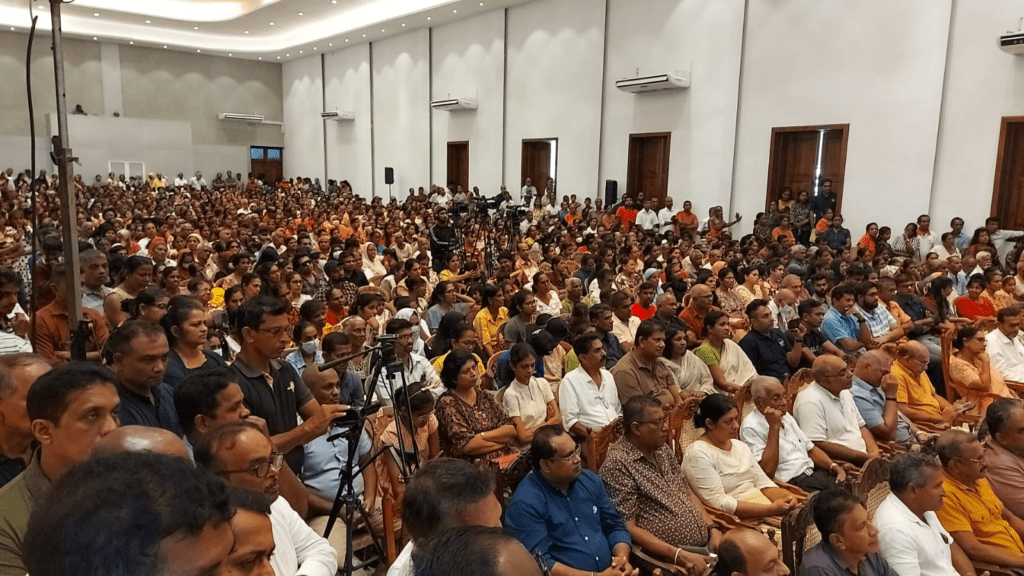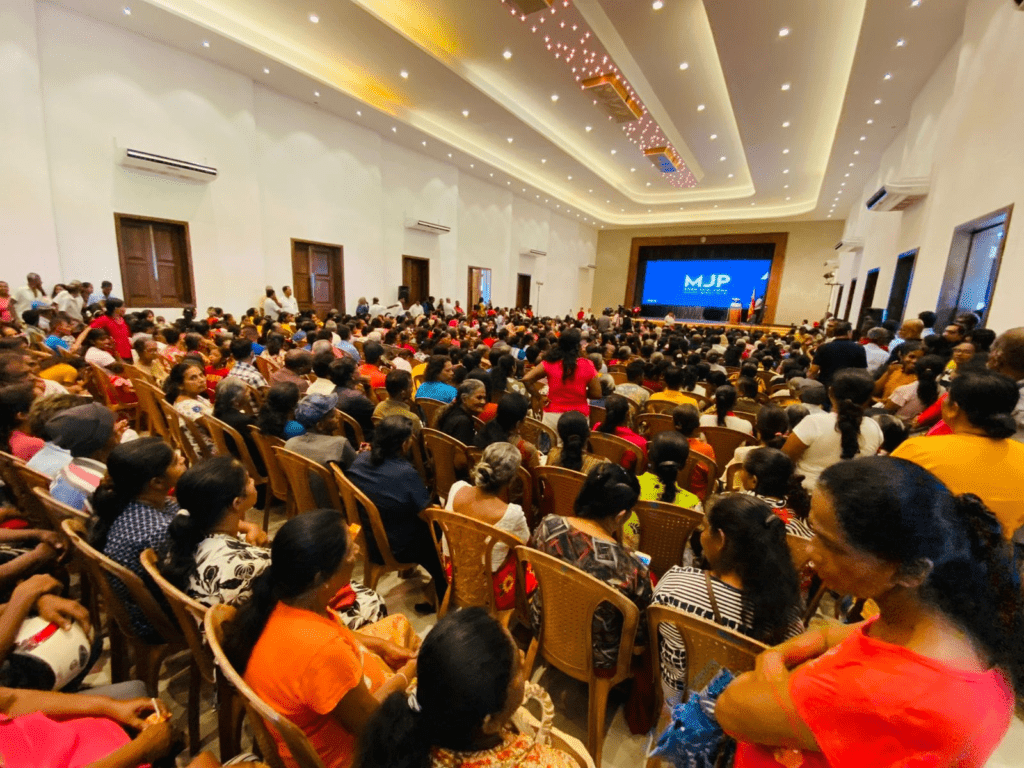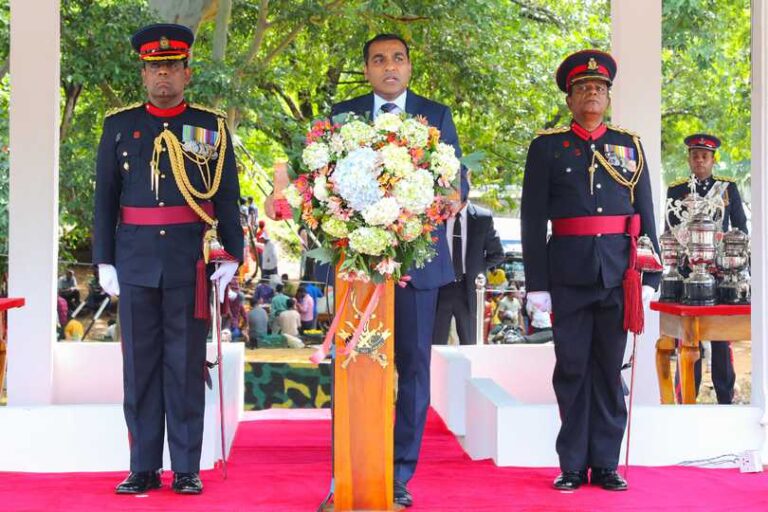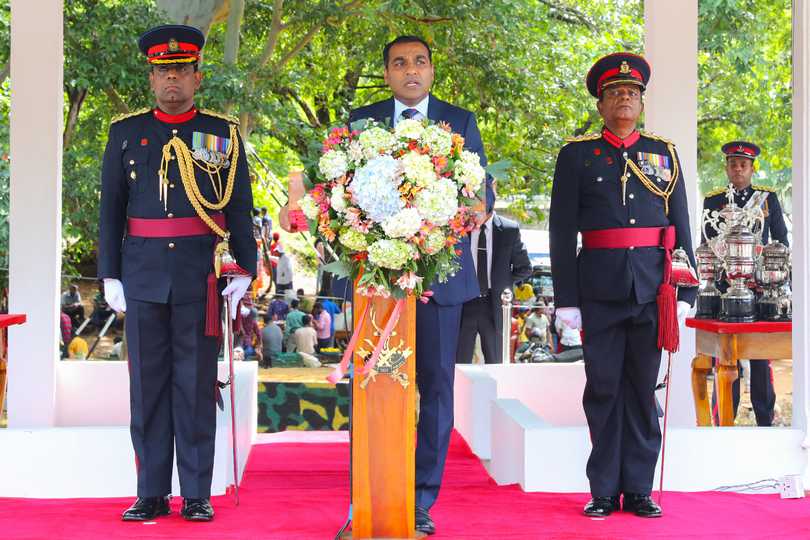
President Ranil Wickremesinghe strongly condemns the burning of the Holy Quran in Sweden; urges Western nations to uphold the value system of the Global South and refrain from allowing disturbances under the pretext of freedom of expression.
President’s Secretary Saman Ekanayake says President Wickremesinghe’s goal is not to pass the task of reconciliation in Sri Lanka to the next generation, but to solve it now: adds there is a strong need to resolve the issues related to the reconciliation process, and that if this effort is successful, there will be no need for the country to go to the UNHRC in Geneva for another year.
Finance State Minister Shehan Semasinghe says the government has spent Rs. 144 billion on welfare benefits last year; adds as per the agreements with the IMF and WB Sri Lanka had agreed to spend a minimum of Rs. 187 billion annually on welfare benefits: asserts the government expects to spend Rs. 206 billion annually on ‘Aswesuma’ programme.
Ven. Rajangane Saddharathana Thera who was arrested on the allegation of making comments harming religious co-existence granted bail: The Colombo Fort Magistrate imposes a bail condition preventing the Thera from making any statements using foul language.
The IMF says it did not hold any discussion on a digital services tax with the authorities of Sri Lanka, or whether the country should sign on to a OECD/G20 inclusive framework for international corporate tax: A parliament panel had recently discussed a digital services tax, claiming that internet companies are not paying tax.
Tamil political leaders slam SLPP MP Sarath Weerasekara for abusing parliamentary privileges and pressuring the judiciary by denouncing the race of a judge: warn Weerasekara is trying to stir up racist feelings among the Sinhalese by saying that a Tamil judge will intervene in the case related to the controversial Kurundi temple built at the Kurunthurmale archaeological site: Human rights activists, BASL, Mullaitivu Bar Association also stand against the ex Public Security Minister.
Fitch Ratings revises the Outlook on CEB’s National Long-Term Rating to Positive, from Stable, and simultaneously affirms the rating at ‘B(lka)’: adds the National Long-Term Rating of CEB’s outstanding senior unsecured debentures at ‘B(lka)’: asserts the positive outlook reflects the likely upgrade of the Sri Lankan sovereign’s Long-Term Local-Currency IDR to reflect the sovereign’s prospects following the completion of a DDE.
LKR once again indicates depreciation against the USD at leading commercial banks: Peoples Bank – buying price rises to Rs. 305.58 from Rs. 304.61, and selling price to Rs. 320.61 from Rs. 319.59; Commercial Bank – buying price to Rs. 305.83 from Rs. 304.61, and selling price to Rs. 319 from Rs. 317; Sampath Bank – buying price to Rs. 305 from Rs. 302, and selling price to Rs. 320 from Rs. 317.
Consultant Paediatrician at the LRH Dr. Deepal Perera divulges a measles outbreak has been identified at the hospital, with four confirmed cases; adds as of Monday (10), 12 children have displayed symptoms of measles, with four cases officially diagnosed: symptoms encompass high fever, cough, runny nose, watery eyes, and a characteristic rash known as the Measles rash; laments some children had not received the MMR vaccine for measles.
Maheesh Theekshana and Pathum Nissanka make big gains in the ICC’s ODI player rankings, after making significant contributions to the team’s unbeaten run at the Cricket World Cup Qualifier: Theekshana, who finished as the second-highest wicket-taker, one dismissal behind teammate Wanindu Hasaranga, rose 13 spots in the rankings for bowlers to 19th: Nissanka, the second leading run-scorer, rose nine places from 38 to 29, overtaking Charith Asalanka as the highest-ranked Sri Lankan batsman: Hasaranga meanwhile rose one place to eighth in the ranking for all-rounders.
Fitch Ratings – Colombo – 12 Jul 2023: Fitch Ratings has revised the Outlook on Ceylon Electricity Board’s (CEB) National Long-Term Rating to Positive, from Stable, and has simultaneously affirmed the rating at ‘B(lka)’. Fitch also affirmed the National Long-Term Rating of CEB’s outstanding senior unsecured debentures at ‘B(lka)’.
The Positive Outlook reflects the likely upgrade of the Sri Lankan sovereign’s Long-Term Local-Currency Issuer Default Rating (IDR) to reflect the sovereign’s prospects following the completion of a domestic debt exchange (DDE). We will equalise CEB’s ratings with that of the sovereign if the sovereign’s Long-Term Local-Currency IDR is upgraded to above ‘CC’, in line with our Government-Related Entities (GRE) Rating Criteria, resulting in a rating upgrade on the national scale. This is based on our assessment of a strong likelihood of support from the state.
The affirmation follows our de-linking of CEB’s rating from that of the sovereign after we downgraded Sri Lanka’s Long-Term Local-Currency IDR to ‘C’, from ‘CC’ on 5 July 2023. This is because, despite the government’s selective default on some of its local-currency debt, we do not believe CEB has entered a default or default-like process requiring a similar rating action. In addition, CEB’s current rating already reflects a probable near-term default, as the company’s ability to service debt depends on the continuity of government support.
Key Rating Drivers
State Support Intact: The government continues to provide financial support to CEB to sustain its operations, which would have been otherwise challenging. The government converted a LKR200 billion project loan, amounting to 35% of CEB’s outstanding debt as at 30 September 2022, to equity late last year, while state banks continued to provide working capital funding to secure feedstock. The government has also facilitated uninterrupted fuel supply to CEB’s thermal power plants from state-owned Ceylon Petroleum Corporation (CPC), despite CEB having large dues to CPC.
We believe state support will be forthcoming, despite the state’s weak financial profile, as CEB fulfils an essential service for the country. A default of CEB would disrupt this service, as the company accounts for most of Sri Lanka’s power-generation capacity. It would also make it difficult for CEB to source imported feedstock for power generation, such as heavy oil and coal. CEB’s independent power producer (IPP) agreements, which account for around 20% of the power generated, would also be affected, as they are external arrangements with no clear alternatives.
Cost Reflective Tariff Mechanism: The government has established a formula-based tariff mechanism to ensure CEB’s operating costs and interest obligations are recovered going forward. Prior to this, CEB supplied electricity at significant subsidies, resulting in large accumulated losses and an unsustainable capital structure. The consistent application of the cost-reflective tariff mechanism should allow CEB to breakeven at the cash flow from operations level, but such implementation has yet to be proven.
Indeterminate Standalone Profile: We don’t believe ascertaining standalone credit profile of CEB is possible in the foreseeable future, as its ability to operate depends on continued state support and it cannot be meaningfully delinked from the government. CEB had LKR284 billion of debt equally spread across working capital and project loans as at end-April 2023. We expect CEB to generate negative free cash flow in the medium term, despite the tariff mechanism, and to depend on the state for expansion and refinancing.
We may provide a standalone credit view should CEB maintain a record of profitable operation that improves its access to external funding with less reliance on the state.
Large Dues to Operating Creditors: CEB owed LKR208 billion to CPC, IPPs and renewable energy generators as of end-April 2023, up by 20% from November 2022. CEB expects to settle its debt to CPC and some IPPs with support from the government, while the renewable producers will be settled incrementally with cash generated from operations. CEB plans to settle part of the dues owed to renewables producers through new funding lines, but approvals are taking time. Consequently, we do not expect a material reduction CEB’s trade payable position in 2023.
CEB Restructure: The government is looking at unbundling CEB’s generation, transmission and distribution process by transferring CEB’s resources to 14 companies established under the Companies Act as part of the country’s energy sector reforms. We expect the unbundling to provide autonomy and flexibility for CEB operations, while improving its efficiency and competitiveness, but it is too early to ascertain how the proposed restructure would affect CEB’s credit profile, as the plan’s details are still vague.
Derivation Summary
CEB’s ratings reflect a probable near-term default, as it relies on the Sri Lankan government, which has begun a local-currency debt restructuring process, to continue its operations. However, CEB itself has not begun a default or default-like process.
Key Assumptions
Fitch’s Key Assumptions Within Our Rating Case for the Issuer
– Sri Lanka’s annual electricity demand growth to average around 6% over 2023-2026
– Generation mix to remain at 50% thermal, 30% hydro and 20% other over 2023-2026
– Tariff to be adjusted every six months to cover CEB’s operating costs and interest obligations
– Annual capex of LKR90 billion over the next two years for maintenance and building new generation capacity
RATING SENSITIVITIES
Factors that could, individually or collectively, lead to positive rating action/upgrade:
– the Sri Lankan sovereign’s Long-Term Local-Currency IDR being upgraded to above ‘CC’ after the completion of the DDE could result in corresponding action on CEB’s National Long-Term Rating.
Factors that could, individually or collectively, lead to negative rating action/downgrade:
– the Sri Lankan sovereign’s Long-Term Local-Currency IDR being rated at ‘CC’ after the completion of the DDE would result in the Outlook on CEB being revised to Stable.
For the sovereign rating of Sri Lanka, the following sensitivities were outlined by Fitch in the agency’s Rating Action Commentary on 5 July 2023:
Factors that could, individually or collectively, lead to positive rating action/upgrade:
– Following completion of the DDE, the sovereign LTLC IDR will likely be lifted out of ‘RD’ to a rating that appropriately reflects its prospects.
– For the LTFC IDR, completion of the foreign-currency commercial debt restructuring that Fitch judges to have normalised relationship with private-sector creditors may result in an upgrade.
Factors that could, individually or collectively, lead to negative rating action/downgrade:
– The LTLC IDR will be further downgraded once the government executes its domestic debt restructuring.
Liquidity and Debt Structure
Liquidity Support from Government: CEB had LKR17 billion in unrestricted cash at end-March 2023, against LKR128 billion in debt due in the next 12 months. More than 90% of the outstanding debt is for working capital, which we believe will be rolled over in the normal course of business. We believe the government will continue to provide funding support for CEB to meet its contractual maturities amid the company’s weak liquidity.
CEB also has significant payments due to feedstock suppliers, including CPC and IPPs. CEB plans to settle the debt by using additional cash flow from the increased electricity tariff and by securing new funding facilities from banks. CEB received LKR80 billion in funding in 2022 from the Ministry of Finance to settle its dues to CPC, and we expect similar liquidity support from the government, given the essential service that CEB provides.
Issuer Profile
CEB is Sri Lanka’s sole electricity transmitter and distributor. It is a fully owned state entity and accounts for 75% of domestic electricity generation through its network of hydro and thermal power plants.
REFERENCES FOR SUBSTANTIALLY MATERIAL SOURCE CITED AS KEY DRIVER OF RATING
The principal sources of information used in the analysis are described in the Applicable Criteria.
Public Ratings with Credit Linkage to other ratings
A change in Sri Lanka’s Long-Term Local-Currency IDR to a level above ‘CC’ may result in an upgrade of CEB’s ratings.
ECONOMYNEXT – The International Monetary Fund did not discuss a digital services tax with Sri Lanka or a whether Sri Lanka should sign on to a OECD/G20 inclusive framework for international corporate tax, a spokesman said.
A so-called Yellen tax sets corporate tax at 15 percent but corporate taxes in Sri Lanka are around 30 percent. The OEDB had G20 has been pushing for equal taxation to stop so-caleld Base erosion and profit shifting (BEPS), and tax holidays are discouraged.
The IMF has not discussed any plans for a digital services tax with the Sri Lankan authorities in the current program.
“…[N]or has it provided any recommendation on whether or not Sri Lanka should sign on to the OECD/G20 inclusive framework agreement for international corporate taxation,” the spokesperson said.
A Sri Lanka parliament panel had discussed a digital services tax recently, claiming that internet companies are not paying tax.
Protectionist domestic companies had claimed that foreign e-commerce firms were not paying income tax, though there is no information whether they are actually making profits.
Sri Lanka had already slammed a tax on credit card transactions to protect domestic e-commerce firms which has been deemed a multiple currency practice by the IMF.
Although there are personal income tax files exceeding 2,92,000 in this country, only 31,000 of them are paying tax, Mahindananda Aluthgamage, Chair of the Sectoral Oversight Committee on National Economic and Physical Plans said. He pointed out that there are 105,000 registered limited companies in the country, but 82% of the tax revenue is received from only 382 companies.
The Chair also emphasised that it is important to maintain the inflation, the reserves of the country and the government’s income in an optimal condition by December by the time of the second review of the International Monetary Fund, given that the said factors must be taken into account when granting loans. Therefore, the Chair said that his Committee will hold regular discussions with Sri Lanka Customs, Excise Department and Inland Revenue Department to provide necessary facilities to increase the state revenue.
He stated the above when the Sectoral Oversight Committee on National Economic and Physical Plans met in Parliament recently (06).
The Chair spoke at length about the failure of the Inland Revenue Department to collect the tax revenue and stated that the Committee is making positive improvements in this regard. There was also a discussion about the collection of 904 billion rupees in arrears which is due to the Inland Revenue Department.
The Chair also pointed out that discussions are being held with the Minister of Justice to amend the Inland Revenue Act. He added that he would also provide his utmost assistance to fill the existing employee vacancies in the Inland Revenue Department.
The Inland Revenue Commissioner General who spoke on the occasion said that he appreciated the support received from the Sectoral Oversight Committee on National Economic and Physical Plans to make the work of his department efficient.
The Commissioner stated that the tax revenue target given by the government for the year 2023 of Rs 1.6 trillion was expected to be earned by 40% in the first 6 months and 60% in the remaining 6 months, and the target for the first 6 months has already been met. Apart from the said, he stated that work is being done to generate expected tax revenue in the remaining 6 months.
The Chair mentioned that there is a need to establish a systematic mechanism to regulate the collection of tax revenue. Members as well as officials pointed out that due to the fact that the data provided for the registration of companies in this country is not true, they have to face problems in tax collection.
The Committee also discussed at length the need to establish a digital data system linking the Sri Lanka Customs Department, the Excise Department and the Inland Revenue Department as soon as possible, as well as the need to re-register the private tax file in the country.
Members of the Committee Wimalaweera Dissanayake, Eran Wickramaratne, Sudath Manjula, Gunathilaka Rajapaksha, Dhammika Perera, Udayana Kirindigoda, Karunadasa Kodithuwakku, Madhura Withanage, and Mohomad Muzammil were present at the Committee meeting held.
A group of officials including the Inland Revenue Commissioner General was also present at the Committee meeting held.
The government has spent Rs. 144 billion on welfare benefits last year and as per the agreements with the IMF and World Bank Sri Lanka had agreed to spend a minimum of Rs. 187 billion annually on welfare benefits State Minister of Finance Shehan Semasinghe said.
Meanwhile, the government expects to spend Rs. 206 billion annually on ‘Aswesuma’ program, he said.
It has taken about 20 years to put in line a systematic and a transparent method to identify the underprivileged and those in need of welfare benefits, the State Minister added.
Out of the 982 770 appeals has been received thus far, significantly 650,000 appeals have been received by the individuals whose names are already in the published list.
Meanwhile the first payment will be made within this month for all candidates elected and who have not received objections or appeals, State Minister Shehan Semasinghe said.
Commencing from August 1st, those who could not apply for ‘Aswesuma” this year or failed to submit appeals will have another chance to do so, he added.
He expressed these views July (12) during a press conference themed ‘Collective Path to a Stable Country’ held at the Presidential Media Centre (PMC).
State Minister of Finance Shehan Semasinghe further commented;
The time period given to all applicants whose names were not included in the list of ‘Aswesuma’ beneficiaries to file appeals terminated in July 10.
Accordingly 982 770 appeals and 62 368 objections has been received thus far.
Arrangements have been made to commence investigations pertaining to these appeals and objections received by the Divisional Secretaries under the supervision of District Secretaries.
Out of the 982 770 appeals that have been received thus far, significantly 650,000 appeals have been received by the individuals whose names are already in the published list demanding to upgrade their names from the category they are already in, to a category with more benefits. Only after investigating these appeals will a final decision will be made regarding which categories the benefits should be distributed under. They will either stay in the same category they have already been chosen or have their category modified.
In addition to this, only about 350,000 appeals have been received from those who have not been selected.
1287747 families already receiving ‘Samurdhi’ benefit have applied for ‘Aswesuma’. Out of them 70% (887 653) family units have been identified to be eligible to receive ‘Aswesuma’.
As per the directions of President Ranil Wickremesinghe it has been decided to execute the current list of beneficiaries receiving differently-abled, elderly, and kidney support allowances without subjecting to any change until a new system is implemented within a time period of 03-06 months.
We are working to make the first payment within this month for all candidates elected and who have not received objections or appeals.
We believed we would get more than 800,000 appeals. Accordingly, the appeals we have received thus far are within our estimated amount.
Accordingly, these appeals and objections will be promptly investigated and if the investigations reveal that he/ she/ family unit, is eligible to receive ‘Aswesuma’, their ‘Aswesuma’ allowance due on July, will be added to the August allowance and paid to that family.
Commencing from August 1st, those who could not apply for ‘Aswesuma” this year or failed to submit appeals will have another chance to do so.
‘Aswesuma’ hopes not to cut off any benefit received by low income groups or individuals receiving any form of welfare benefit but to enter all who eligible into the welfare system without losing anyone, State Minister of Finance Shehan Semasinghe said.
PMD: Presidential Secretary Mr Saman Ekanayake stated that President Ranil Wickremesinghe’s goal is not to pass the task of reconciliation in Sri Lanka to the next generation, but to solve it now.
The President’s Secretary pointed out that there is a strong need to resolve the issues related to the reconciliation process, and that if this effort is successful, there will be no need for the country to go to the UN Human Rights Council in Geneva for another year.
Mr. Saman Ekanayake, made these remarks at a civil society awareness discussion on the Truth and Reconciliation Mechanism held two day ago (11) at the Presidential Secretariat under the chairmanship of Foreign Minister Mr. Ali Sabri.
The Foreign Minister explained the objectives of the Truth and Reconciliation Mechanism, and the role of the Truth and Reconciliation Commission was discussed at length.
Mr. Saman Ekanayake, who sought the views and suggestions of the members of the civil society organisations who were present on the achievement of the objectives of the establishment of the commission, also stated that he expects everyone’s support to make the reconciliation process a success.
He emphasised that the agreement and support of all citizens is needed to move forward as a country.
Someone in Sri Lanka, right now as I write, is distraught because a child, a parent or a loved one has died, is dying or is seriously ill due to lack of medicine and medical care.
Some die because doctors just cannot handle the overwhelming number of patients, or they simply cannot afford the eyewatering private hospital charges. In a world of increasingly glaring disparities, we could dismiss such situations as inevitable, especially in a time of unprecedented economic stress, but such dismissal can only be defended if all necessary steps have been taken to ensure that what is possible can indeed be delivered. It is abundantly clear that this is not the case.
We are not talking about critical care necessitating costly drugs and sophisticated surgery, but non-serious medical situations that can be and have been treated successfully in Sri Lanka.
In a time of crisis hard choices must be made. Priorities must be revisited and revised. Cutbacks are inevitable even when it comes to areas that have previously been treated as untouchable. This is true of households, and it is true of nations. Consumption patterns quickly change in poorer households. Relative luxuries are shelved, but a lot of care is taken to make sure that nutrition and health are not compromised beyond certain minimum levels. It is not hard to understand. In the end it is life that counts. It is the same with a country. A nation without people is not a nation. A nation in which people are sick and cannot get the treatment is a sick nation. No amount of debt restructuring can cure such a nation.
Professionals jumping ship
Falling ill even with a minor malady has become a major matter. The severe dearth of medicines and medical equipment and the growing cost of health care constitute one side of the problem. The other side is the prevailing trend of medical professionals leaving the country, especially the most qualified and competent among them. In fact, we often hear of the accomplishments of Sri Lankan doctors currently domiciled or have citizenship in other countries. A massive loss in and of itself, but one that can easily get much worse considering that the best among those who chose to stay are contemplating leaving or have already left.
The bottom line is that we just cannot let our doctors go. Each and every one of us will one day be forced to put our lives in the hands of a doctor. A doctor is a treasure. Doctors and nurses are invaluable. We need them and they need to be protected.
Some short-sighted commentators who perhaps cannot see beyond the rupees and cents of things have seen this as a positive trend, considering the possibility of dollar and euro remittances. But what happens when the best healers leave the country? Aren’t they also the ones who set the standards? Aren’t they the principal mentors of the next generation of physicians? And since most of them are not just going abroad just for employment but are actually migrating with their families, how much will they remit, if at all? When doctors leave, there’s a very negative message being sent to everyone including other professionals: ‘leave if you can!’
Sri Lankan medical professionals are second to none in the world. This is true of doctors and other categories in the health sector such as nurses and medical technicians. They work tirelessly in less-than-ideal conditions. Despite meagre resources and having to attend on an inordinate number of patients, they are one of the main reasons why Sri Lanka’s health system is the envy of her neighbours and countries in the same or even higher brackets of economic prosperity. While there are those who chide doctors for engaging in private practice, it is often forgotten that the vast majority of them consider their work in the state-run hospitals as their primary vocation, despite the comparatively small remuneration package.
They don’t neglect this work. They not only work but incur the wrath of some who forget that Sri Lanka is not an affluent country and are ignorant of the fact that doctors in such countries see a fraction of the patients our doctors attend to for a fraction of the salary. We should not forget that even though working under extremely trying circumstances Sri Lankan doctors are among the most accessible professionals in the world.
Let us recall the adage, ‘people leave managers, not companies.’ It is applicable here. The one thing that can make a dent in the ongoing ‘brain drain’ is strong, compelling, articulate, and empathetic leadership.
Captain lacks support from crew
The onus in this crisis-ridden climate falls directly on President Ranil Wickremesinghe. In his favour is the fact that he had the self-belief that no one else had to take control of a sinking ship. He’s steadied it, picked a course and although it is still taking in a lot of water, there’s hope that it will remain afloat.
On the downside is the fact that he’s playing a lone hand for all intents and purposes. He has no team worth that name. So, it is a solo game. He’s a man with a country to worry about walking a tight rope that is suspended over an abyss while detractors at either end tweak the rope. To use a cricketing analogy, he’s the only one in the team who can be called a halfway decent batsman and halfway decent bowler; except that he must keep wickets, coach the team and chase the red cherry simply because the fielders seem to have sprung roots.
All the more reason for the president, handicapped as he is, to take matters into his own hands. The time for outsourcing responsibility for the health sector is long past. He can and must speak to the medical fraternity. It is unlikely they’ll listen or be moved by anyone else. The President himself has to convince them of the plans to turn things around, what has been done, what is going to be done, and why their support at this hour is so crucial for the wellbeing of the country and its citizens.
Such an address is necessary but certainly far from sufficient. The health sector serves the public, but it includes private enterprises. We have channelling services, dispensaries, all kinds of clinics, laboratories, nursing homes, care giving outfits and fully fledged hospitals. These too are faced with the same human resources problems. On the other hand, the potential for the expansion of this segment of the sector, the setting up of new private hospitals for example, needs to be explored and facilitated. If the market is expanded leading to greater competition, private health care might become more affordable and therefore more accessible to a larger share of Lankans.
With proper policy backing, there’s nothing to stop reputed universities the world over partnering such private hospitals to train doctors, nurses, and other medical professionals. For all this, the regulatory mechanism needs to be revisited and streamlined. Again, the onus is on the president. He can and must take the initiative to create the conditions. He can and must lay the foundation to turn Sri Lanka into a medical tourism hub for the region where all these facilities are complemented by the focused and planned development of the indigenous medical system in the country.
The same goes for the pharmaceutical sector. The question of affordability can be resolved to a great extent if competition is encouraged, and mechanisms set in place to ensure standards. Resolving the criminally tragic situation prevailing in the NMRA – a direct result of interference by incompetent politicians – is an urgent must. Conditions can be created to encourage investors, local and otherwise, to set up such industries here in Sri Lanka. The ‘greener pastures’ that medical professionals seek abroad can be ‘grown’ right here in this island.
All hands on deck
The President could start by talking to the business leaders in and out of the health sector. They need to be convinced that the problem is serious, and he is serious about not just resolving immediate issues but setting the wheels in motion to make things work in the long run.
The President has to convince the professionals that it is worthwhile fighting this battle. He must give them a reason to stay. He has to say it and do it. He must show vision and develop a plan based on this vision. He must demonstrate commitment to execute this plan. He must put together a team that can support him. He must set deadlines and work towards meeting them. Dispatching acquaintances to deputise for him in the matter of investigating random allegations will just not do it. Simply put, problems of this nature cannot be outsourced.
There’s someone somewhere grieving over a loved one who passed away or is about to because of a condition that would have been curable if curable ailments of the system had been sorted out. The dying person or the person who died could be you or me. You or I could be the person grieving. It is nothing but a tragedy when someone cannot buy medicine for a child or a parent. It is downright uncivilised in fact. Only those in such situations truly understand the dimensions of the tragedy. Unfortunately medical professionals are fighting a difficult battle, a battle which could be won if the relevant authorities opened their eyes, used their brains, and showed some kind of leadership. Politicians don’t need our health system. When they are unwell, they seek treatment not in our hospitals but abroad. The absolute majority of our people do not have that choice. They will live or die here. Can the President deliver for them?
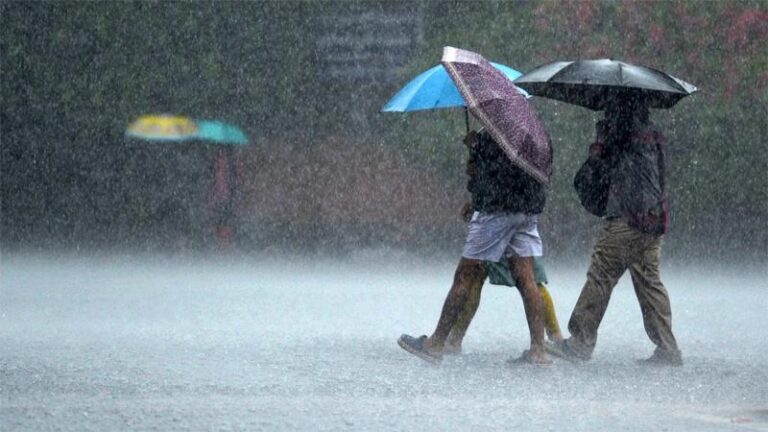
Colombo (LNW): Several spells of showers will occur in Western, Sabaragamuwa and North-western provinces and in Kandy, Nuwara-Eliya, Galle and Matara districts, the Department of Meteorology said in its daily weather forecast today (13).
Showers or thundershowers may occur at a few places in Uva province and in Ampara and Batticaloa districts during the evening or night, the statement added.
Fairly strong winds about (40-45) kmph can be expected at times in western slopes of the central hills, Northern and North-Central provinces, and in Puttalam, Hambantota and Trincomalee districts.
General public is kindly requested to take adequate precautions to minimise damages caused by temporary localised strong winds and lightning during thundershowers.
Marine Weather:
Condition of Rain:
Showers or thundershowers will occur at a few places in the sea areas off the coast extending from Puttalam to Matara via Colombo and Galle.
Winds:
Winds will be south-westerly and speed will be (20-30) kmph. Wind speed may increase up to (40-50)kmph at times in the sea areas off the coast extending from Hambantota to Pottuvil and in the sea areas off the coast extending from Puttalam to Kankasanthurai via Mannar.
State of Sea:
The sea areas off the coast extending from Hambantota to Pottuvil and in the sea areas off the coast extending from Puttalam to Kankasanthurai via Mannar will be fairly rough at times. Temporarily strong gusty winds and very rough seas can be expected during thundershowers.
Colombo (LNW): Spanning 269 hectares of ocean reclamation, Port City Colombo, which also includes first ever Special Economic Zone dedicated for exports of services is providing reliefs for investors include concessionary 50% tax rate; enhanced capital allowance; flexibility of currency choice on payment of dividends or other financial benefits by businesses
Initial 5-year roll-out plan envisages US $ 5.6 b in FDI which will fast-track Sri Lanka’s economic recovery, positioning both Port City and Sri Lanka as leading player in service export industry
Overall, Colombo Port City envisages creating over 140,000 direct job opportunities and contribute $13.8 b to Sri Lanka’s GDP annually
Estimated fiscal revenue of $ 1.7 b is expected at construction stage while recurring revenue of approximately $ 700 m per annum is expected at operational stage of project
In a major breakthrough to boost foreign direct investments, the incentives and tax exemptions for investors intending to start ventures in the Colombo Port City have been published by the Government via Extraordinary Gazettes (2339/31 and 2339/32) dated 7 July.
Two prospective groups of investors have been identified who will be able to avail themselves of these incentives and tax exemptions.
Businesses that invest $ 100 million per plot of land or a pro-rated investment in a subdivided plot of land according to the Colombo Port City (Development Control) Regulations or one that will make an investment of a minimum of $ 25 million in the plots of land for the Marina will be entitled to exceptions or incentives according to several schemes set out in the gazette.
These include an incentive of 50% of the prevailing corporate tax rate applicable for the respective year of assessment under the Inland Revenue Act, No. 24 of 2017 from all gains and profits and an incentive of an enhanced capital allowance of 300% of the expenses incurred on depreciable assets,
A second gazette issued on the same date stated companies can pay investors dividends or any other financial benefit on the investment in a designated foreign currency other than in Sri Lanka Rupees.
The Commission has leased out marketable land to a person or company under section 39 of the Act and a dividend or any other financial benefits accrues to the investor within a period of five years from the date of the lease paid,
It also set out that businesses operating within the Port City may accept payments in Sri Lankan Rupees in respect of any goods or services provided subject to several conditions including depositing it in a Rupee account of a licensed commercial bank and converting it to another currency through the same.
The gazette also identified investments that will be considered Secondary Businesses of Strategic Importance. These can include companies working in the areas of global and regional economic activity in international trade, shipping logistic operations, offshore banking and finance, IT etc ,
The initial 5-year roll-out plan envisages $ 5.6 billion in FDI which will fast-track Sri Lanka’s economic recovery, positioning both Port City and Sri Lanka as a leading player in the service export industry.
Overall, Colombo Port City envisages creating over 140,000 direct job opportunities and contributing $13.8 billion to Sri Lanka’s GDP annually.
Estimated fiscal revenue of $ 1.7 billion is expected at construction stage while a recurring revenue of approximately $ 700 million per annum is expected at the operational stage of the project.
Colombo (LNW): In a significant move towards State Owned Enterprise (SOE) reforms, seven identified entities the will set to undergo reforms under the supervision of transaction advisors soon.
Cabinet of Ministers at its meeting recently approved the recommended transaction advisors for this purpose.
“The decision is in line with the policy directive set by the government and aims to ensure effective and transparent divestiture of key entities,” said State Owned Enterprises Restructuring Unit (SRU) Director General Suresh Shah.
Under the leadership of President Ranil Wickremesinghe the relevant proposal was presented to the cabinet of ministers was approved resulting in the appointment of International Finance Corporation (IFC) a member of the World Bank Group for the divestiture of SriLankan Airlines Ltd., Lanka Hospitals Corporation PLC and Sri Lanka Telecom PLC.
For the four other entities Sri Lanka Insurance Corporation Ltd (SLIC), Hotel Developers Lanka Ltd (Hilton), Canwill Holdings Ltd (Hyatt) and Litro Gas Ltd (Litro, including Litro Gas Terminals Ltd) was carried out through a competitive bidding process following Government’s Consultant Procurement Guidelines.
Both local and international advisors submitted proposals, which were evaluated by a Special Cabinet Appointed Consultants Procurement Committee, appointed by the Cabinet. Following the procurement process, the committee recommended the appointment of transaction advisors as follows:
• Litro Gas Ltd (Litro, including Litro Gas Terminals Ltd): Deloitte Touche Tohmatsu India (Deloitte India) has been appointed as the transaction advisor.
• Canwill Holdings Ltd (Hyatt): Deloitte Touche Tohmatsu India (Deloitte India) has been appointed as the transaction advisor.
• Hotel Developers Lanka Ltd (Hilton): Colliers International Consultancy and Valuation (Singapore) Ltd and Platinum Advisors has been appointed as the transaction advisor.
• Sri Lanka Insurance Corporation Ltd (SLIC): Alvarez & Marsal Middle East Ltd., and Capital Alliance Partners LTD has been appointed as the transaction advisor.
Shah said the agreements with respect to these appointments will be concluded shortly, setting the stage for the next phase of the divestiture process including investor engagement.
To ensure transparency in the divestiture process, prospective investors will be invited to express interest (EOI) via advertisements to be published in both the local and international press.
Investors shortlisted via the EOI process will be provided access to data rooms populated with information necessary for a comprehensive due diligence.Thereafter such investors will be Requested to submit both technical and financial proposals in response to a Request for Proposals (RFP).
“These divestitures are expected to contribute towards sustainable economic growth and a more competitive economy whilst better safeguarding citizens interests,” Shah added.