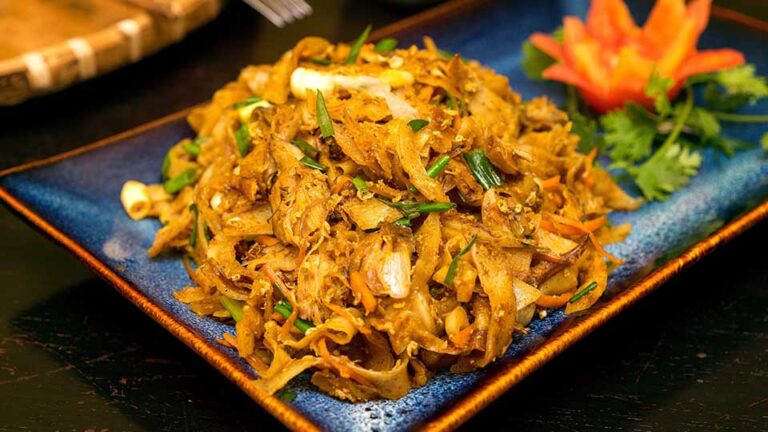
Colombo (LNW): The prices of three food items have been increased in response to the recent gas price hike, announced Harshana Rukshan, President of the All Island Canteen and Restaurant Owners’ Association today (05).
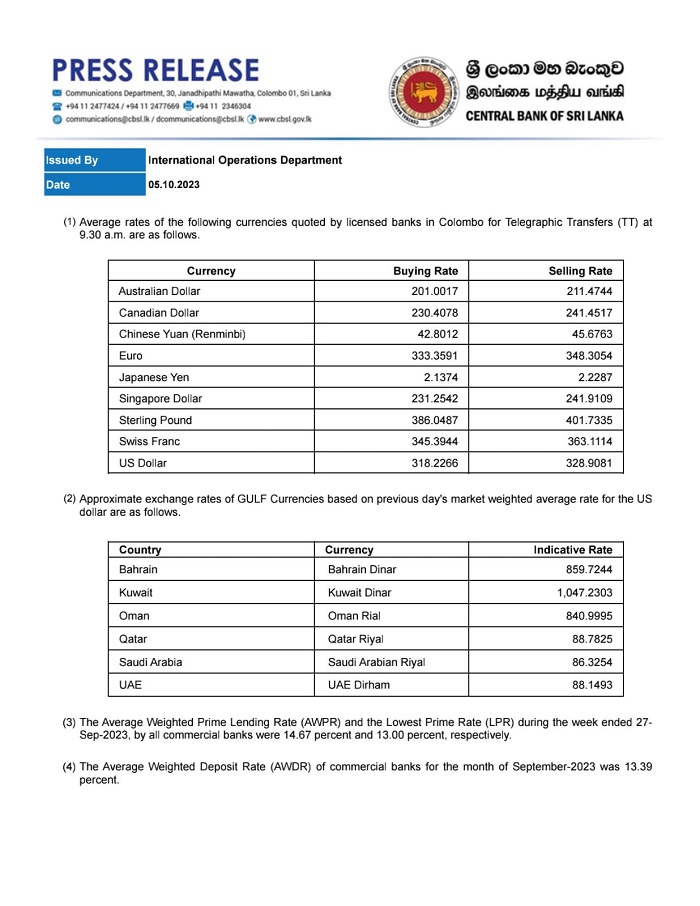
Colombo (LNW): The Sri Lankan Rupee (LKR) indicates a slight fluctuation against the US Dollar today (05) in comparison to yesterday, according to the official exchange rates list issued by the Central Bank of Sri Lanka (CBSL).
Accordingly, the buying price of the US Dollar has increased to Rs. 318.22 from Rs. 318.10, and the selling price has dropped to Rs. 328.90 from Rs. 328.91.
Meanwhile, the Sri Lankan Rupee has fluctuated against several other foreign currencies, including Gulf currencies.
Colombo (LNW): The Sri Lankan Rupee (LKR) indicates steadiness against the US Dollar at commercial banks in the country today (05) in comparison to yesterday.
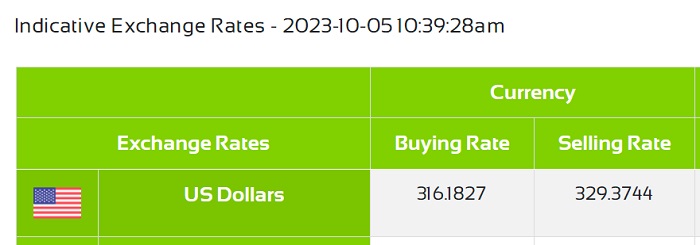
At Peoples’ Bank, the buying and selling prices of the US Dollar remain unchanged Rs. 316.18 and Rs. 329.37, respectively.
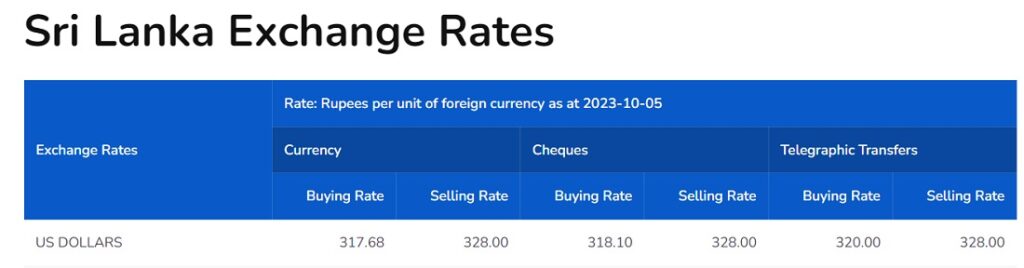
At Commercial Bank, the buying and selling prices of the US Dollar remain unchanged at Rs. 317.68 and Rs. 328, respectively.
Sampath Bank follows a similar patters, revealing unchanged buying and selling prices of the US Dollar at Rs. 318 and Rs. 328, respectively.
Colombo (LNW): As of September 2023, Sri Lanka’s official reserves amount to about US $3.5 billion, said the Central Bank of Sri Lanka (CBSL).
This amount includes a US $1.4 billion agreement with China’s People’s Bank, which comes with some conditions.
The CBSL shared in their recent report that from January to August 2023, the country spent less on imports, which reduced the trade deficit, and despite some decreases in merchandise exports, they were not as big as the reductions in imports.
In 2023, the money coming in from tourism and workers from other countries increased and is expected to grow further.
Although there were some significant outflows, the country saw a net gain in foreign investments in government securities this year.
So far this year, the Sri Lankan currency has grown stronger against the US dollar by about 12 per cent.
After some financial arrangements with Bangladesh Bank and efforts to restructure local foreign exchange, the country’s official reserves reached around US $3.5 billion by the end of September 2023.
Colombo (LNW): The Central Bank of Sri Lanka (CBSL) has announced a further drop in both the Standing Deposit Facility Rate (SDFR) and the Standing Lending Facility Rate (SLFR) by 100 basis points, setting them at 10.00 per cent and 11.00 per cent respectively.
The was made during the inaugural monetary policy assessment by the Monetary Policy Board, as outlined by the Central Bank of Sri Lanka Act, No. 16 of 2023, on October 4th.
The Board’s move to cut policy interest rates comes after a thorough examination of current and anticipated economic conditions.
They aim to stabilise inflation at a target of 5 per cent in the medium term by considering factors like low inflation and favourable inflation expectations, ultimately pushing the economy closer to its growth potential.
The CBSL’s Monetary Board is optimistic that these reduced policy interest rates, coupled with previous significant monetary policy relaxations, will expedite a decline in market interest rates.
This includes the CBSL’s directive for banks to cut interest rates and the considerable decrease in risk premiums on government securities.
In conclusion, the CBSL’s announcement encourages the financial sector to swiftly extend the benefits of relaxed monetary conditions to consumers and businesses, aiding the expected economic revival.
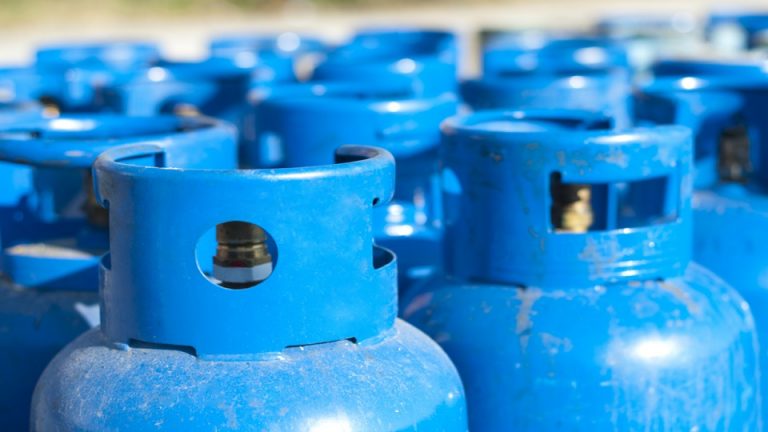
Colombo (LNW): State-run LP gas provider LITRO Gas Lanka and its private competitor LAUGFS Gas PLC have increased the prices of domestic LP gas cylinders, effective from midnight yesterday (04).
Revised Litro Gas prices;
12.5 kg cylinder price increased by Rs 343; new price Rs. 3,470
5 kg cylinder price increased by Rs. 137; new price Rs. 1,393
2.3 kg cylinder price increased by Rs. 63; new price Rs. 650
Revised Laugfs Gas prices;
12.5 kg cylinder price increased by Rs. 150; new price Rs. 3,985
5 kg cylinder price increased by Rs. 60; new price Rs. 1,595
Colombo (LNW): The Central Bank of Sri Lanka (CBSL) has circulated a notice directed at Attorneys-at-Law and Notaries Public, emphasising the appointment of a compliance officer for their respective business practices.
This directive is in compliance with the Section 33 of the Financial Transactions Reporting Act, No 06 of 2006, pertaining to certain business operations.
CBSL has further cautioned that non-adherence to the stipulations within the FTRA could result in administrative penalties.
In the heart of Australia, where the ancient song lines of the First Nations People echo through the red earth, a pivotal moment awaits us. On 14th October, we stand at the crossroads of history, poised to make a choice that resonates with the spirit of true democracy and equality.
The Uluru Statement from the Heart: A Cry for Recognition
It was a heartfelt plea, echoing from the Uluru Statement from the Heart, where the First Nations People sought not power, but a voice – a voice that would allow them to share their wisdom, their struggles, and their dreams. This is not about granting excessive power; it’s about recognising the inherent right of every Australian, regardless of their background, to shape the policies that shape their lives.
Why Say YES to the Indigenous Voice?
1. Empowering Communities, Enriching Lives
Imagine a future where the policies affecting the First Nations People are not dictated from a distance but are born from dialogue and understanding. Saying YES means acknowledging that every life in our diverse tapestry matters, and every voice deserves to be heard.
2. Better Policies, Wiser Choices
When we lend an ear to those most affected, policies become more nuanced, empathetic, and effective. By saying YES, we are saying yes to a brighter, more equitable future for all Australians.
3. Financial Wisdom, Responsible Governance
A YES vote is a vote for fiscal responsibility. By listening to the First Nations People, we ensure that taxpayer funds are spent wisely, channelled into programs and initiatives that yield real results.
4. Bridging Gaps, Building Bridges
Our journey to bridge the gap begins with understanding. The Indigenous Voice is a conduit for ideas, innovations, and practical solutions that can elevate Indigenous health, education, employment, and housing. It’s a step toward unity, progress, and shared prosperity.
5. Embracing Diversity, Embodying Inclusivity
The Voice embraces the rich tapestry of First Nations Peoples, incorporating the wisdom of women, the vitality of youth, and the resilience of the differently abled. It’s a celebration of diversity, ensuring that no voice is left unheard.
6. A Legacy of Engagement, A Future of Accountability
The Voice is not a whimsical proposal but the culmination of more than a decade of engagement. It’s a testament to careful planning, legal expertise, and the genuine desire for justice. By voting YES, we honour this legacy and ensure accountability in representation.
7. A Step Towards Truth and Treaty
By supporting the Indigenous Voice, we are not just voting for a present reality; we are paving the way for a future of reconciliation, truth, and treaty. It’s a powerful step toward healing the wounds of the past, fostering unity, and creating a stronger Australia for all.
Let the Heartbeat of 65,000 Years Guide Us!
For 65,000 years, the First Nations People have woven their stories into this land. For 250 years, we have not genuinely listened. Now, as we approach this momentous choice, let the heartbeat of Australia guide us. Let’s acknowledge the past, embrace the present, and shape a future where every Australian voice finds resonance.
The question asked from us is:
A proposed law: to alter the Constitution to recognise the First Peoples of Australia by establishing an Aboriginal and Torres Strait Islander Voice. Do you approve this proposed alteration?
Vote YES for the VOICE!
Together, let’s create a harmonious chorus, echoing the voices of the First Nations People. By saying YES, we aren’t just voting for a Voice; we’re voting for empathy, justice, and a brighter tomorrow for all Australians.
Colombo (LNW): Green economic recovery is a top priority for the European Union (EU) in Sri Lanka and the Maldives, the EU said in a statement today.
The EU Delegation to Sri Lanka and the Maldives launched its campaign “Let’s Go Green” which will continue until 10th November 2023 in the run up to the COP28 Summit.
The campaign aims to create awareness and advocate for responsible green behaviour around plastic usage, waste reduction and energy saving among consumers.
The campaign will include a series of competitions and awareness activities primarily aimed at school and university students encouraging them to debate and invent their own solutions to current issues around Sri Lanka’s environmental challenges.
The campaign also hopes to encourage green behaviour among businesses, bringing stakeholders from the private sector together to shed light on the importance of adopting circular business practices and integrating holistic solutions to reduce waste.
Green economic recovery is a top priory for the EU in Sri Lanka and the Maldives, with several projects implemented in both countries to support sustainable tourism, marine conservation and biodiversity protection.
These initiatives are carried out in the context of the European Green Deal which is a set of policy initiatives by the European Union with the overarching aim of making the planet greener.
The European Commission has suggested that the current GSP+ (Generalised Scheme of Preferences Plus) scheme be extended by 04 years, amidst the ongoing negotiations for the EU’s new GSP+ arrangement.
Taking to Twitter, the Delegation of European Union (EU) to Sri Lanka has mentioned that as one of Sri Lanka’s largest trading partners with nearly EUR 3.2 billion worth of Sri Lankan exports to the European Union in 2022 alone, it recognises the importance of GSP+ scheme for Sri Lankan exporters.
Accordingly, the European Commission has proposed a 4-year extension to the current scheme to be in effect until 31 Dec 2027.
“As negotiations for our new GSP+ arrangement are still ongoing between the EU’s co-legislators, the European Commission has proposed a 4-year extension to the current scheme until 31 Dec 2027 so that countries like Sri Lanka don’t lose their preferential access in the interim”, the EU delegation tweeted.
Furthermore, the EU delegation noted that for Sri Lanka, the GSP+ extension proposal means that, for now, nothing changes, and that it will provide the same access to European Union’s market and the same obligation to comply with the 27 international conventions, which are key to ensuring that the country’s economic recovery is “not just fast, but also fair, just, and green.”
Colombo (LNW): The World Bank yesterday reiterated that a higher and more efficient revenue mobilisation is fundamental for Sri Lanka’s sustainable fiscal path.
The multilateral donor releasing its latest “The Sri Lanka Development Update, Mobilising Tax Revenue for a Better Future,” stressed that improved revenue mobilisation is critical to Sri Lanka’s return to macroeconomic stability.
The country has one of the lowest tax-to-GDP ratios in the world. By 2022, the tax system was characterised by low, multiple, and frequently changing rates, a narrow and shrinking base, a high tax burden on labour rather than capital incomes, an over-reliance on indirect taxes, and a weak administration with poor compliance outcomes.
These features have made the system complex, inefficient and inequitable.A Government-led tax reform package has been under implementation since May 2022.
This includes the introduction of new taxes, a wide range of adjustments to the tax rates and bases, and an intention to improve the efficiency of tax collection and increase compliance.
The World Bank also said Sri Lanka’s economy is expected to grow by 1.7% in 2024 after contracting by 3.8% in 2023 signalling that the outlook is clouded with uncertainty and that growth prospects depend on progress with debt restructuring and the implementation of critical structural reforms.