Home Blog Page 153

Police Warn Against Misuse of ‘119’ Emergency Hotline

0

Sri Lanka Police have raised concerns over the increasing misuse of the ‘119’ emergency hotline by certain members of the public, stressing that such actions undermine the effectiveness of emergency response services.

Police Media Spokesman ASP F.U. Wootler stated that false and non-emergency calls to the ‘119’ service have continued even during periods of adverse weather, forcing the Police to take enforcement action against offenders. He emphasized that the hotline is intended strictly for emergencies, urgent situations, criminal incidents, and information requiring immediate police intervention to protect citizens’ civil rights.

However, the Police have observed a rise in misleading and unnecessary calls, including inquiries related to water and electricity services, financial matters, and land disputes. Such misuse, ASP Wootler warned, disrupts operations and can delay assistance to those facing genuine emergencies.

He revealed that several phone numbers responsible for repeated abuse of the hotline have been identified, and access to the ‘119’ service has been temporarily suspended for those numbers as a preventive measure.

Reiterating an appeal to the public, the Police urged citizens to use the ‘119’ emergency service responsibly and only for urgent police-related matters. To help reduce misuse, the Police also reminded the public of alternative hotline numbers available for non-emergency services and other specific public needs, including fire and rescue services, disaster management, child and women’s protection, transport, and government information services.

Three Remanded Over Torture and Burning of Wild Elephant in Mihintale

0

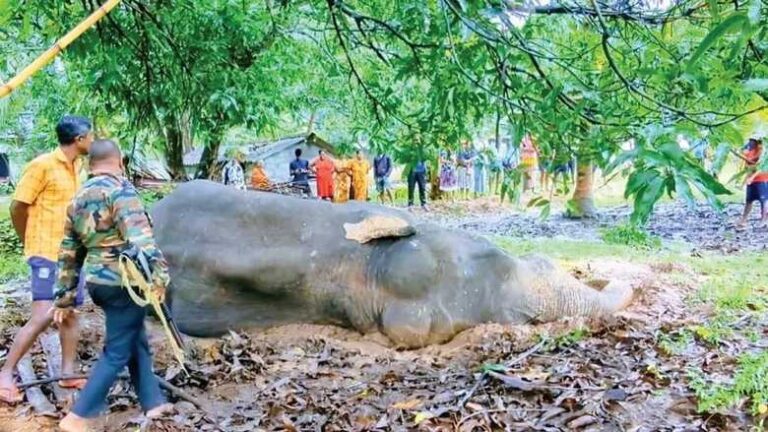
The Anuradhapura Magistrate’s Court has ordered that three suspects arrested in connection with the alleged torture and burning of a wild elephant in the Sippukulama area of Mihintale be remanded until December 24.

The arrests followed the circulation of a disturbing video on social media that showed a wild elephant being subjected to torture using fire. Acting on information obtained from the footage, Mihintale Police arrested three suspects aged 42, 48 and 50, all residents of the same locality.

The injured elephant was later found dead in the Sippukulama area. A post-mortem examination revealed that the animal had suffered from pre-existing kidney and liver conditions, which were severely aggravated by intense shock and fear caused by the burn injuries.

Investigations into the incident are continuing.

Two Sri Lankan Fishing Vessels Seized Near Maldives for Illegal Entry into SEZ

0

Two Sri Lankan fishing vessels were seized near Kelaa in Haa Alifu Atoll yesterday during an operation carried out by the Maldives National Defence Force (MNDF), according to Maldivian media reports.

The MNDF stated that the vessels were detained by the Coast Guard for illegally entering the Maldives’ Special Economic Zone (SEZ). The operation was conducted as part of a joint surveillance effort involving the Coast Guard and the Air Corps, based on intelligence shared by foreign and regional partners.

The vessels were intercepted at around 8:30 a.m., approximately 51 nautical miles off Kelaa. Following the seizure, the boats were handed over to the Maldives Police Service, which has launched further investigations into the incident.

The development comes amid heightened maritime security in the region, particularly in the wake of a major drug trafficking case last month. In that incident, a Sri Lankan fishing vessel carrying approximately 350 kilograms of narcotics was seized in Maldivian waters, leading to the arrest and remand of five Sri Lankan nationals. A Sri Lankan investigative team has since arrived in the Maldives in connection with that case.

Bangladesh Erupts in Violence After Death of Youth Leader Sharif Osman Hadi

0

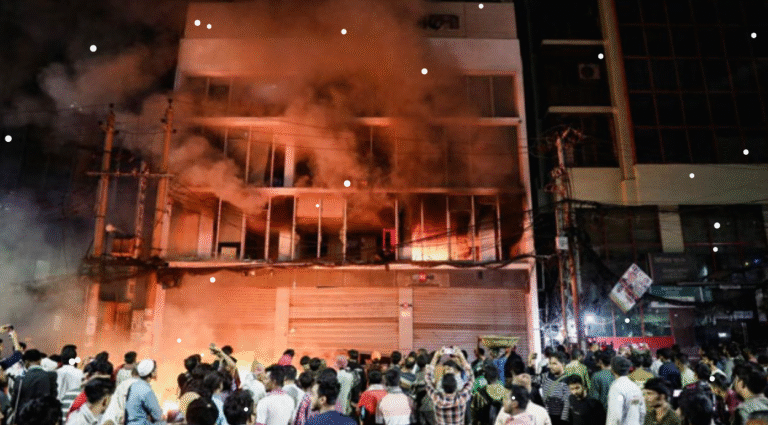
Violence has broken out in Bangladesh following the death of prominent youth leader Sharif Osman Hadi, a key figure in the movement that ousted former Prime Minister Sheikh Hasina.

Hadi, 32, was shot by masked attackers while leaving a mosque in Dhaka last week and later died from his injuries on Thursday while undergoing treatment in Singapore. The attack occurred just a day after authorities announced the date for Bangladesh’s first national elections since the 2024 uprising, elections that Hadi had planned to contest as an independent candidate.

As news of his death spread, hundreds of supporters gathered in central Dhaka in protest. The demonstrations later turned violent, with protesters vandalising the offices of leading newspapers The Daily Star and Prothom Alo, setting fire to one of the buildings. Police said troops were deployed to restore order, while firefighters rescued journalists trapped inside the premises.

Hadi was a senior leader of the student protest group Inqilab Mancha and a vocal critic of India, where former Prime Minister Hasina has remained in self-imposed exile since fleeing the country on 5 August last year.

Political parties across Bangladesh condemned the killing and called for swift justice. Interim government head and Nobel laureate Muhammad Yunus described Hadi’s death as “an irreparable loss for the nation,” warning that attempts to derail the country’s return to democracy through violence would not succeed.

“The country’s march toward democracy cannot be halted through fear, terror, or bloodshed,” Yunus said in a televised address, adding that the shooting appeared to be a premeditated attempt to disrupt the election process.

The interim government has declared a day of national mourning on Saturday. Investigations into the killing are ongoing, and several suspects have reportedly been detained.

The unrest comes amid continued political instability following the 2024 student-led protests that ended Hasina’s 15-year rule. In November, she was sentenced to death for crimes against humanity over the use of lethal force against protesters, which resulted in the deaths of around 1,400 people.

Schools in Central Province Closed on December 19 and 23 Due to Adverse Weather

0

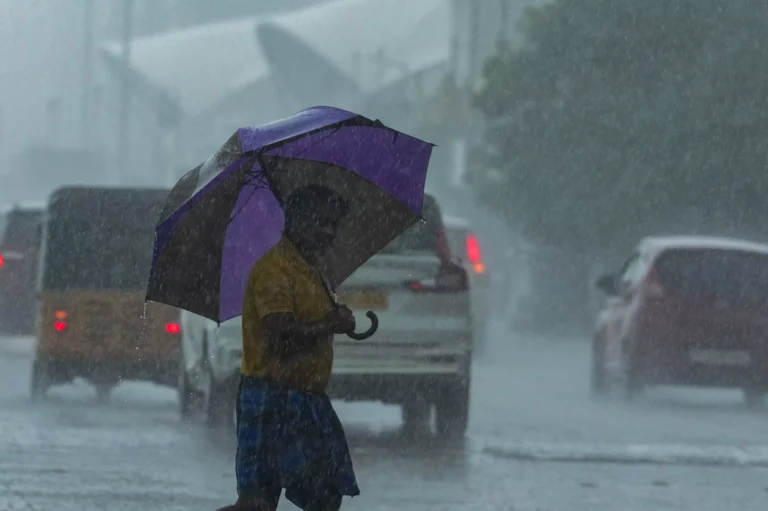
All schools in the Central Province will remain closed on Friday, December 19, and Monday, December 23, due to prevailing adverse weather conditions, according to the Chief Secretary of the Central Province.

The decision follows weather forecasts issued by the Department of Meteorology, which indicate that showers will occur at times in the Eastern, Uva and Central provinces, as well as in the Polonnaruwa and Hambantota districts. Fairly heavy rainfall exceeding 75 mm is expected in several areas.

The Meteorology Department has also warned of fairly strong winds reaching up to 40 kmph at times over the eastern slopes of the central hills, and across the Northern, North-Central and North-Western provinces, as well as in the Trincomalee, Hambantota and Monaragala districts.

Authorities have urged the public to remain vigilant and take necessary precautions in view of the expected weather conditions.

Showers will occur at times in Eastern, Uva and Central provinces

0

Showers will occur at times in Eastern, Uva and Central provinces and in Polonnaruwa and Hambantota districts. Fairly heavy falls about 75 mm are likely at some places in the above areas.

Several spells of showers may occur at Northern and North-western provinces and in Anuradhapura district.

Showers or thundershowers may occur at several places in the other areas of the island after 1.00 p.m.

Fairly strong winds of about 40 kmph can be expected at times over Eastern slopes of the central hills, Northern, North-central and North-western provinces and in Trincomalee, Hambantota and Monaragala districts.

Misty conditions can be expected at some places in Sabaragamuwa, Western and Central provinces and in Galle and Matara districts during the early hours of the morning.

The general public is kindly requested to take adequate precautions to minimize damages caused by temporary localized strong winds and lightning during thundershowers.

Emergency IMF Loan Tests Sri Lanka’s Reform Credibility

0

By: Staff Writer

December 18, Colombo (LNW): Sri Lanka’s appeal for US$200 million in disaster financing has become a critical test of whether emergency needs can coexist with long-term reform commitments under the IMF programme. The Executive Board’s December 19 meeting to consider funding under the Rapid Financing Instrument (RFI) comes as the country struggles to reconcile post-disaster spending pressures with rigid fiscal and monetary benchmarks embedded in the Extended Fund Facility (EFF).

Unlike EFF tranches, the RFI is disbursed upfront and does not involve formal programme reviews. However, policymakers and analysts caution that this technical flexibility does not equate to strategic leniency. The IMF has consistently signalled that Sri Lanka’s broader programme performance will remain under scrutiny, particularly as fiscal assumptions underpinning the 2026 budget are being fundamentally rewritten.

Cyclone Ditwah has added unexpected pressure to public finances, pushing projected government expenditure up by at least Rs. 500 billion next year. This fiscal shock has forced the postponement of the EFF review initially scheduled for mid-December. IMF officials are now expected to engage with Sri Lankan authorities in January 2026 to reassess targets, raising concerns about whether revised benchmarks will demand further fiscal tightening.

Monetary policy developments add another layer of complexity. Following the March rate cut and a shift away from strong deflationary policy, the Central Bank has struggled to build reserves at the pace originally envisaged under the IMF programme. While external debt repayments have continued, analysts argue that reserve accumulation remains insufficient relative to programme commitments.

The approval of multiple budget-support loans in December particularly from the Asian Development Bank has temporarily eased pressure. These inflows, which bypass domestic expenditure, are expected to strengthen the balance of payments or directly offset debt service obligations. Nevertheless, reliance on the Central Bank to supply dollars for government repayments has drawn criticism for blurring the lines between fiscal and monetary responsibility.

Economists also point to structural weaknesses in the IMF’s previous programme design, noting the absence of firm requirements to reduce the Central Bank’s domestic asset holdings. This, combined with political reluctance to sustain deflationary policy, has contributed to renewed pressure on the rupee and raised concerns over selective foreign exchange access for private importers.

At its core, the IMF’s position reflects institutional caution shaped by Sri Lanka’s 2022 default, which followed aggressive rate cuts, tax reductions, and expansionary policies aimed at artificial full-employment targets. The current moment, analysts argue, will determine whether Sri Lanka treats disaster financing as a temporary bridge or as another detour away from durable reform

A Test of Policy Credibility: Economics Behind Malwathu Oya Revival

0

By: Staff Writer

December 18, Colombo (LNW): The Cabinet’s decision to revive the Lower Malwathu Oya multipurpose development project is not merely about resuming stalled construction; it is a test of Sri Lanka’s ability to deliver large-scale infrastructure amid fragile economic conditions.

Approved in July 2019 at Rs. 22.9 billion, the project’s cost has risen to Rs. 47.18 billion by December 2025, underscoring how macroeconomic instability can dramatically alter public investment outcomes. The more than 106 percent increase in rupee costs cannot be attributed to construction inflation alone. Instead, it mirrors the collapse of the domestic currency following policy missteps that destabilized the economy.

Between 2019 and 2025, Sri Lanka attempted to operate an independent monetary policy under a flexible inflation-targeting framework while preventing the currency from adjusting freely. Aggressive interest-rate cuts, extensive money creation through open market operations, and sweeping tax reductions to boost growth combined to weaken fiscal and external balances. The result was a rapid depreciation of the rupee from 176 to over 300 per dollar and eventual sovereign default.

For infrastructure projects like Lower Malwathu Oya, this depreciation translated directly into higher costs for imported machinery, construction inputs, and foreign-funded components. Delays caused by the pandemic and foreign exchange shortages compounded the problem, leaving the project suspended at a critical stage.

Yet the economic rationale for completing the project remains strong. The scheme is designed to transform water management in the Malwathu Oya basin by expanding irrigation to tens of thousands of acres, improving agricultural productivity, and enabling cultivation during dry seasons. In regions where farming remains the primary livelihood, such gains can have multiplier effects on rural employment, food prices, and regional growth.

The hydro power component, though modest at 4.28 gigawatts, contributes to energy diversification and supports Sri Lanka’s transition toward renewables. Meanwhile, the provision of two million cubic metres of drinking water carries long-term social and health benefits that are difficult to quantify but economically significant.

However, economists warn that infrastructure sustainability depends not only on physical outcomes but also on policy credibility. Without reforms that prevent future currency collapses, similar projects could face escalating costs, reduced returns, and funding constraints. The Lower Malwathu Oya project thus highlights the hidden cost of macroeconomic instability: when policy errors inflate development spending, taxpayers ultimately bear the burden.
As construction resumes, the project’s success will hinge on whether Sri Lanka can maintain financial discipline and avoid repeating the conditions that once brought it to a halt

Cost Pressures Reshape Sri Lanka’s IT-BPO Growth Model

0

By: Staff Writer

December 18, Colombo (LNW): Sri Lanka’s IT and BPM industry is undergoing a structural adjustment as global inflation, fiscal instability, and shifting labour economics reshape its growth trajectory. The SLASSCOM Compensation and Benefits Survey Report 2025 reveals that companies are moving away from crisis-era salary expansion toward more disciplined, performance-linked compensation frameworks, reflecting broader changes in global cost structures.

During the height of Sri Lanka’s economic crisis, technology firms were forced to raise salaries aggressively to offset inflation and prevent talent erosion. However, as macroeconomic conditions stabilize albeit at a higher cost base companies are now recalibrating pay strategies to align with revenue growth and productivity gains rather than inflation-driven benchmarks?

These changes are unfolding within an inflationary global environment that continues to influence outsourcing decisions. The US CPI-U rose by about 27 percent between mid-2019 and late 2025, driven largely by post-pandemic monetary easing and sustained fiscal deficits. Inflationary pressures have complicated corporate planning worldwide, prompting multinational firms to reassess outsourcing costs, location strategies, and return-on-investment metrics.

In the past, low-inflation environments allowed governments and corporations to plan long-term expenditure with relative certainty. Today, inflation has transformed budgets into moving targets, particularly for developing economies reliant on imported inputs and foreign currency revenues. Sri Lanka’s experience since the early 1980s illustrates how persistent currency depreciation can magnify these challenges, eroding fiscal discipline and distorting cost structures across sectors.

For the IT-BPO industry, this environment has created a paradox. While Sri Lanka remains cost-competitive relative to developed markets, the margin for error has narrowed. Clients are increasingly demanding higher value, stronger compliance standards, and measurable productivity gains rather than purely low-cost service delivery.

Export data reflects this transition. IT and BPO service exports declined to US$671.6 million in the first ten months of 2025, down 3.8 percent year-on-year, signalling near-term pressures from global demand moderation. However, 2024 recorded export earnings of US$848 million, up 6.7 percent, underscoring the sector’s longer-term growth potential.

Industry leaders argue that the current phase represents a strategic reset rather than stagnation. Investment is shifting toward advanced analytics, cybersecurity, AI-driven services, and specialised BPM functions. Companies are also placing greater emphasis on reskilling existing employees instead of expanding headcount rapidly.

As Sri Lanka seeks to position itself as a stable, high-value digital services hub, the sector’s success may increasingly depend on productivity, innovation, and policy consistency rather than wage competitiveness alone. The pay normalisation now under way may prove a necessary adjustment in building a more resilient and sustainable IT-BPO ecosystem.

Global Competition Pushes Sri Lanka Tech Sector to Rethink Rewards

0

By: Staff Writer

December 18, Colombo (LNW): As global competition for technology talent intensifies, Sri Lanka’s IT and BPM industry is undergoing a strategic rethink of how it attracts, retains, and motivates skilled professionals, according to SLASSCOM’s 2025 Compensation and Benefits Survey.

The high response rate 72% of companies returning from last year’s survey signals a strong level of industry trust in the findings, while also providing a reliable snapshot of how organisations are responding to post-crisis realities. Rather than continuing aggressive salary-driven strategies, companies are now pursuing more balanced and targeted approaches.

A key shift identified in the survey is the movement away from blanket salary increases. Following extraordinary pay adjustments during the economic crisis, organisations are now focusing on differentiated rewards. IT firms, in particular, are planning to reward high performers more aggressively from 2026, while BPM firms expect relatively higher overall increments as competition for operational talent grows.

This evolution reflects a broader trend toward performance-based and skill-driven reward systems. Companies are increasingly aligning compensation with scarce and high-impact capabilities, signalling a departure from traditional, role-based structures. This change is also influencing workforce planning, with reskilling becoming essential as demand for certain legacy roles declines.

The survey highlights rising demand for specialised IT roles aligned with global technology trends, while traditional design and publishing functions are losing relevance unless supported by strong digital skill sets. This underscores the urgency for continuous learning and adaptability within the workforce.

Although organisations are introducing flexible work arrangements and personalised benefits, cash compensation remains the dominant priority for employees. Still, companies are investing more heavily in holistic employee experiences, including career growth pathways, learning opportunities, and well-being initiatives, recognising that long-term retention depends on more than pay alone.

Another notable development is the relative easing of employee migration pressures. While talent mobility remains visible especially among professionals seeking overseas education—it is no longer the industry’s most immediate concern. This suggests improved local opportunities and stabilising economic conditions are beginning to influence workforce decisions.

From an international standpoint, the report highlights growing competition among Global Business Services destinations. The emergence of two new outsourcing-friendly countries in 2025 has intensified the race to attract GCC investments. For Sri Lanka, this means maintaining a careful balance between cost efficiency and high-quality talent delivery.

The expanding presence of Global Capability Centres offers a strong foundation. With more than half of survey participants operating as GCCs, the sector continues to play a vital role in foreign exchange earnings and employment generation. SLASSCOM emphasised that strategic, data-driven reward decisions will be critical in ensuring Sri Lanka remains a compelling destination in an increasingly crowded global market.