In a significant development, former Mayoress of Colombo, Rosy Senanayake, has been appointed as the Advisor to the President on Local Government Affairs. The announcement was made today, marking a new chapter in Senanayake’s illustrious career.
Rosy Senanayake, renowned for her dedication to public service, previously served as the Mayoress of the Colombo Municipal Council (CMC) from 2018 to 2023. During her tenure, she spearheaded various initiatives aimed at enhancing the living conditions and overall well-being of the residents of Colombo.
Prior to her role as Mayoress, Senanayake held several prominent positions in government. She served as the Prime Minister’s Spokesperson and the Deputy Head of the Prime Minister’s Office for Ranil Wickramasinghe, showcasing her expertise in effective communication and strategic decision-making.
Colombo (LNW): Sri Lanka is heading close to the brink of regaining the confidence of Japan following the official visit of Sri Lanka President Ranil Wickremasighe using his intelligence, knowledge and vast experience in international politics following his late uncle President JR Jayawrdena ‘s foot steps.
New Sri Lanka Leader slowly but surely woos his Japanese counterparts, billionaire investors and business magnets to return to resurrect Sri Lanka rescuing the island nation from bankruptcy.
President Wickremasinghe is repeating a similar feat of President JRJ in a different sylely of his own in Japan impressing the Japanese leaders and people people so deeply that they continue to hold the abiding memory of his uncle’s speech at the San Francisco Peace Conference in September 1951 closely with profound gratefulness.
The President expressed his regret to the Japanese Government for the suspension of the Colombo Light Rail Transit (LRT) project, which was being implemented with Japanese support while extending support to Japan’s vision for a “Free and Open Indo-Pacific” and called for an open-ended dialogue among Asian nations to foster peace and cooperation in the region..
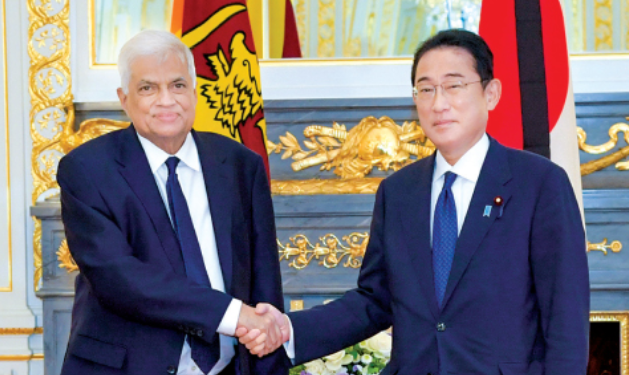
During the official meeting in Tokyo yesterday morning (25) between President Ranil Wickremesinghe and Japanese Prime Minister Fumio Kishida, the President emphasized the need for future legislation in the Parliament to ensure that bilateral large-scale projects cannot be halted or canceled without the agreement of both parties.
The Prime Minister of Japan warmly received President Ranil Wickremesinghe, and bilateral talks commenced after a friendly conversation between the two leaders.
In another meeting held on the same day (25) in Tokyo, President Wickremesinghe met with Japanese Finance Minister Shunichi Suzuki to discuss Sri Lanka’s debt restructuring and the International Monetary Fund’s program.
Subsequently, he met with Japanese Foreign Minister Yoshimasa Hayashi, focusing on strengthening long-term bilateral relations between Sri Lanka and Japan, including increased cooperation in economic and cultural fields.
Additionally, President Ranil Wickremesinghe and former Prime Minister of Japan Mr. Yasuo Fukuda participated in a breakfast meeting organized by the Japan-Sri Lanka Association in Tokyo on the same day (25).
During the meeting, President Ranil Wickremesinghe briefed the former Prime Minister of Japan on the ongoing economic recovery program in Sri Lanka. The President highlighted the favorable investment climate in Sri Lanka and extended an invitation to Japanese investors to return and invest in the country.
Furthermore, a meeting was held between the former Prime Minister of Japan, Mr. Taro Aso, and President Ranil Wickremesinghe, focusing on potential steps to strengthen the existing close and friendly relationship with Sri Lanka.
Sri Lanka’s President reiterated that he intends to apply for membership in the Regional Comprehensive Economic Partnership (RCEP) trade bloc, as his South Asian country strives to rebuild its crisis-hit economy.
Wickremesinghe told Nikkei’s Future of Asia forum on Thursday that Sri Lanka would look to join RCEP “with the aim of achieving a higher level of economic liberalization.
The Sri Lankan leader, who took office last year after his predecessor Gotabaya Rajapaksa was ousted in a wave of protests, painted a picture of smaller countries caught between two superpowers.
Colombo (LNW): Sri Lanka is expecting foreign direct investment inflows to rise by a fifth to $1.3 billion this year, a government official said on Wednesday, with India likely to play a lead role despite the Sri Lankan economy facing its worst crisis in decades.
Although it was pushed to the brink last year by power cuts, chronic shortages of fuel and food and soaring inflation, Sri Lanka managed to raise its FDI by 38% to $1.08 billion, data from the Board of Investment (BoI) showed.
Part of the bump came from India, which wants to keep China’s expansion in its neighbour in check. India’s Adani group signed up for two wind power plants worth $442 million last year.
In the first quarter, Sri Lanka has already received proposals worth $600 million, said BoI Director General Renuka Weerakone, with 22 new projects and six expansions.
“The acid test is really what comes in, that is what really helps the economy,” she said, adding that Sri Lanka is banking on information technology, solar and wind, bunkering and mineral processing to attract investments.
India’s MCS Group has signed a $20 million deal for mineral processing, the largest Sri Lanka has received so far in 2023, Weerakone said.
Other countries are also keen.”Japan is very interested in minerals, so is China,” she said. “The raw material we have is something we can really pitch to get new investments.”
Sri Lanka has untapped deposits of graphite, phosphate and other minerals to attract investors but policy frameworks are yet to be updated, creating a bottleneck for FDI, Weerakone added.
Over the last decade, China has invested about $3 billion in Sri Lanka, accounting for nearly a quarter of its FDI, while India made up about $1.3 billion. In the last two years, India took the lead, followed by the United Kingdom in 2022 and Netherlands in 2021.
Sri Lanka is also drawing up plans to identify new islands for investors to help resuscitate its $4 billion tourism industry.
Colombo (LNW): The International Labour Organization (ILO) extends, its support to boost economic recovery in collaboration with the Central Bank of Sri Lanka, the Office of the Governor of the Northern Province, and the Ceylon Chamber of Commerce.
It has successfully organized a national policy symposium focused on promoting youth entrepreneurship and generating greater private sector investments in Sri Lanka.
With a regional and sectoral focus, the symposium brought to the forefront challenges, insights, and interventions towards creating a favorable ecosystem for enterprise development and investment promotion in Sri Lanka.
The symposium is a joint initiative between two ILO flagship projects: Local Empowerment through Economic Development and Reconciliation (LEED+), and South Asia Leadership in Entrepreneurship (SALE).
One of the significant processes leading up to the symposium was sectoral discussions to identify opportunities and challenges for investments in the Northern Province.
This initiative of the ILO LEED+ project provided valuable insights into the specific requirements of the region, helping shape the policy discussions and recommendations.
The ILO SALE project, as part of its efforts to foster collaboration and knowledge-sharing among key stakeholders to create an entrepreneurship-friendly ecosystem, conducted joint policy forums with the Central Bank of Sri Lanka and the Ceylon Chamber of Commerce. The symposium saw discussions on the findings of this initiative.
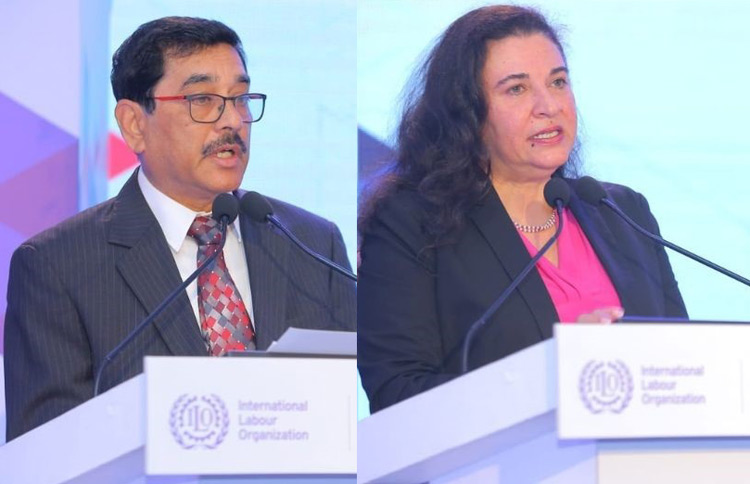
In his introductory remarks, Mr. S. M. Saman Bandulasena, Chief Secretary of the Northern Province highlighted that, “The way forward lies in the hands of the relevant line ministries that have a mandate to create a conducive environment for entrepreneurship and investment promotion.
By doing so, they aim to generate decent and productive employment opportunities for all, he said dding that It was underscored that both the government and other ecosystem players, including development sector entities, and private sector, have a crucial role to play in supporting emerging startups and promoting business resilience.
By providing the necessary support and guidance, they can help these startups thrive and contribute to the overall economic recovery of Sri Lanka, he claimed.
This symposium is a platform to share valuable insights gained through extensive engagement with diverse stakeholders, as well as practical and promising on the ground solutions, to influence favourable policy outcomes,” said Simrin, Singh, Director, ILO Country Office for Sri Lanka and the Maldives.
Shiran Fernanado, Chief Economist of Ceylon Chamber of Commerce said “This timely national policy symposium comes as a much-needed intervention within the context of Sri Lanka’s economic recovery.
By promoting investments and entrepreneurship, it aims to revitalize the economy and create sustainable growth opportunities.
The credibility of the symposium’s findings and recommendations is backed by the compilation of extensive research and insights obtained from diverse stakeholder consultations. The collaboration with numerous established and recognized partners further enhances the validity and reliability of the proposed solutions.
Colombo (LNW): Having the highest annual revenue target in 2023 of Rs.217 billion in history, the Department of Excise has experienced a tax revenue drop of 12.2%, to Rs. 25.1 billion in the first two months this year from Rs. 28.6 billion in revenue during the same period last year.
This was recorded despite a 20% increase in liquor tax. Compared to the income received during the first two months of the previous year.
In accordance with the annual revenue target of Rs.217 billion for the year 2023, which is the highest in the department’s history, the Excise tax revenue has dropped by 35% during January and February.
Department’s spokesperson, Excise Commissioner Kapila Kumarasinghe said several reasons would have affected this figure, including three recent price hikes of alcoholic beverages, owing to the excessive expenses on raw materials and also increasing of the Excise tax imposed by the government.
The decrease in the excise revenue, he said, was not due to a drop in the liquor consumption. Instead, the sale of illicit liquor had increased, he said
Finance State Minister Ranjith Siyambalapitiya had recently told Parliament that the consumption of illicit liquor had increased by 300 percent in Sri Lanka quoting WHO survey reports.
He noted that despite projections the Government would fall short of its excise revenue target by 30% there will be revision to the tax on alcohol products.
Siyambalapitiya told the house that following the price increase in January with new excise tax by over 20%, excise revenue from alcohol sales had dropped 7.4%. in March, which is usually a high volume month, had seen a dip in production this year of almost 40%.
He also noted that whilst it is good to reduce alcohol consumption, it has been observed that consumers have turned to cheaper illegal alternatives, and therefore a discussion has begun on finding ways to tackle this problem, without reducing prices.
He noted that in the current situation the Government has lost revenue, but consumers continue to drink unregulated products that can pose further burdens to the economy.
The Minister said prices of all goods have increased according to inflation and the Government has no intention to provide any exceptions to the alcohol industry.
Sri Lanka will hike taxes on alcohol and tobacco taxes again in June 2023, and will slap drinkers and smokers with taxes linked to inflation from January 2024, according to intentions declared in an International Monetary Fund program.
“The first increase was implemented on January 1 for tobacco and on January 3 for alcohol; the second increase to be implemented before the end of June 2023,” the IMF program said.
Sri Lanka will then move to “automatic indexation of exercises to inflation” from January 01, 2024. Sri Lanka plans to raise tax revenues to 15 percent of GDP by 2025.
In a shocking incident that unfolded near the Balapitiya Court this morning, a school teacher from the Ambalangoda educational zone was injured in a shooting, according to the police.
Details surrounding the incident are still emerging, but preliminary reports indicate that the shooting occurred in close proximity to the Balapitiya Court premises. The targeted individual, a dedicated school teacher whose identity has not been disclosed, sustained injuries as a result of the attack.
President Ranil Wickremesinghe meets Japanese PM Fumio Kishida: expresses appreciation for the support by Japan to SL to recover from the economic crisis: also says SL has made progress on debt restructuring and should conclude discussions by November, the latest.
President Ranil Wickremesinghe meets Japanese Finance Minister Shunichi Suzuki: talks focus on Sri Lanka’s debt restructuring and implementation of the IMF program: President also meets Singapore Deputy PM Lawrence Wong and re-affirms commitment to implement the Singapore Free Trade Agreement.
Economist Steve Hanke’s Annual Misery Index 2022 ranks SL as the 11th most miserable country in the world; the index provides rankings for 157 countries, based on year-end unemployment, inflation, and bank-lending rates, and the annual percentage change in real GDP per capita: Zimbabwe ranked as ‘most miserable’ while others include Venezuela, Syria, Lebanon, Sudan, Argentina, Yemen, Ukraine, Cuba, Turkey, Haiti, Angola, Tonga & Ghana: Switzerland emerges as ‘least miserable’.
The remains of late businessman Dinesh Schaffter were exhumed under judicial supervision at the Borella Cemetery.
President Ranil Wickremesinghe apologizes to the Japanese Govt for the “unilateral cancellation” of the Japanese Govt loan of USD 1.5 bn to construct the Light Rail Transit project in Colombo: says there’s a need for legislation to ensure that large-scale bilateral projects cannot be canceled without mutual agreement.
CB Governor Nandalal Weerasinghe says youth must try to become entrepreneurs instead of going overseas looking for greener pastures: over the past year, thousands of enterprises have crashed and over half a million persons rendered unemployed after the Central Bank under Weerasinghe increased interest rates to astronomical heights.
State Minister for Finance Shehan Semasinghe says Sri Lanka plans to lift import controls on 100 items that were banned during forex shortages in the past 2 years, out of 3,000 denoted by HS codes.
“Save the Children” quoting World Bank data, says children in Sri Lanka require critical life-saving support: says half a million jobs have been lost and 2.7 million additional people have fallen into poverty: also says 38% of families with children are unable to meet their basic food and education needs.
Sinopec Fuel denies claims that it has hired external agencies or 3rd parties to handle its fuel station operations or related business activities: clarifies it has no intention to transfer any right of the license of fuel station supply to any other entity.
Sprint sensation Yupun Abeykoon clocks 10.01 seconds to finish 2nd in the 100m finals at the Savona International meet in Italy: Reece Prescod of Britain comes 1st with 9.94 seconds.
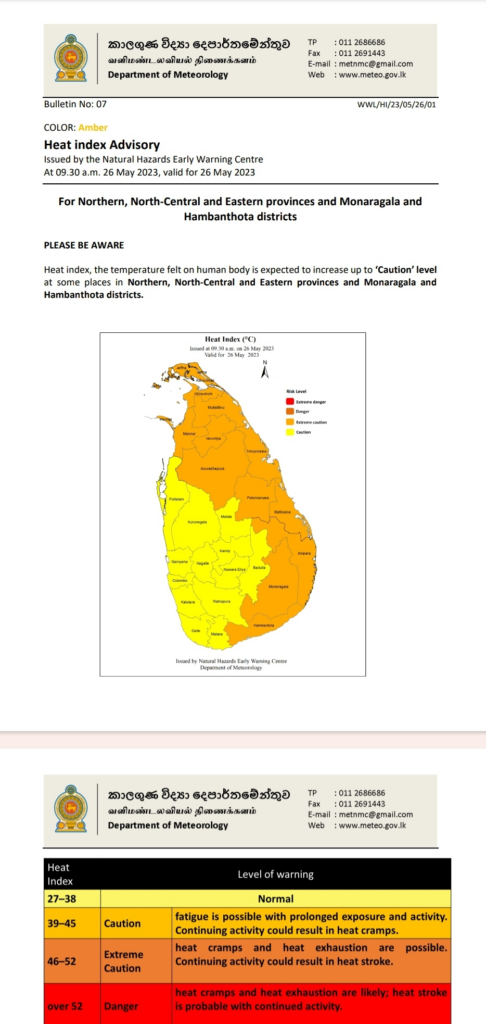
The Department of Meteorology has issued a weather advisory indicating the possibility of showers in certain provinces and districts across Sri Lanka. According to the department, Western, Sabaragamuwa, Central, and North-Western provinces, as well as Galle and Matara districts, can expect a few showers. In addition, parts of Eastern and Uva provinces may experience showers or thundershowers in the evening or at night.
With the anticipated weather conditions, the general public is advised to take necessary precautions to minimize potential damages caused by temporary localized strong winds and lightning during thundershowers. It is important to stay vigilant and be prepared for any unforeseen circumstances.
Moving on to the sea areas, the department forecasts showers at a few places off the coast extending from Colombo to Matara via Galle. The prevailing winds in the sea area around the island will be south-westerly, with a speed of 20-30 kmph. However, there is a possibility of the wind speed increasing up to 40-45 kmph at times in the sea areas off the coast extending from Puttalam to Trincomalee via Mannar and Kankesanturai, as well as from Matara to Pottuvil via Hambantota.
In light of the weather conditions at sea, the sea areas off the coast extending from Puttalam to Trincomalee via Mannar and Kankesanturai, as well as from Matara to Pottuvil via Hambantota, are expected to be rough at times. On the other hand, the remaining sea areas around the island will experience moderate conditions.
During thundershowers, it is important to note that temporarily strong gusty winds and very rough seas may occur. Those planning to engage in maritime activities should exercise caution and stay updated on the latest weather forecasts and warnings.
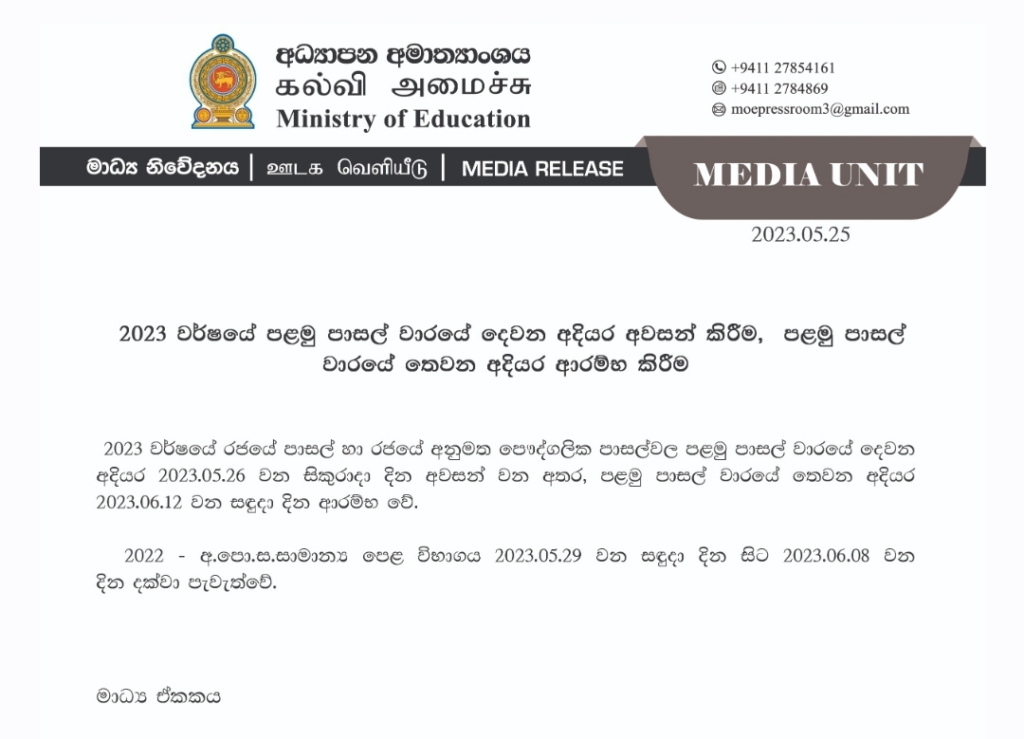
In an official statement released by the Education Ministry, it has been confirmed that Phase 2 of the first term in schools is set to conclude on Friday, May 26. The ministry has also announced that Phase 3 is scheduled to commence on June 12, allowing students and educators to transition into the next stage of the academic year.
With the school year progressing steadily, students and their parents are preparing for the upcoming 2022 General Certificate of Education Ordinary Level (GCE O/L) examination. The Ministry of Education has declared that this year’s GCE O/L exam will take place from May 29 to June 08, providing a ten-day window for students to showcase their knowledge and skills.
The GCE O/L exam is a significant milestone in the education system, as it determines the academic progress and future paths for many students. This highly anticipated examination evaluates students’ understanding and proficiency in various subjects, offering them a chance to secure favorable results that can shape their future educational and career prospects.
Preparations for the GCE O/L exam have been underway for several months, with students diligently studying and revising their subjects. Teachers and educational institutions have also been providing guidance and support to ensure students are well-prepared for the challenging assessments.
The Education Ministry emphasizes the importance of proper exam preparation and encourages students to utilize the remaining time effectively. It advises students to focus on revising key concepts, practicing past papers, and seeking assistance from teachers when needed.