Home Blog Page 1733

National New Paddy Harvest festival held under President’s patronage

0

Colombo (LNW): The National New Paddy Harvest Festival, known as the ‘Aluth Sahal Mangalya’, was held at the historic Jaya Sri Maha Bodhiya in Anuradhapura Yesterday (02), under the patronage of President Ranil Wickremesinghe. This festival is a longstanding tradition where the first harvested paddy of the Maha season is offered to the Jaya Sri Maha Bodhiya. The event was organized for the 56th time by the Ministry of Agriculture and the Department of Agrarian Services, under the guidance of the Chief Incumbent of the Atamasthana, Venerable Pallegema Hemarathana Thera.

Many farmers from different parts of the country attended the traditional ceremony with the hope of receiving blessings from nature and the Triple Gem. Their wish was for timely showers, bountiful harvests, and a prosperous economy for the country and the nation.

After the traditional ceremony, the President paid his respects to the sacred Sri Maha Bodhiya and received blessings. The procession followed the ancient traditions and began near the Anuradhapura Lion Pillar before entering the Sri Maha Bodhiya premises through the Walimaluwa.

It is a traditional custom for the Atamasthanadipati Ven. Pallegama Hemarathana Thera to fill the golden offertory bowl with fresh rice from various regions of the country, accompanied by the chanting of Seth Pirith by the Maha Sangha. During this year’s ceremony, President Ranil Wickremesinghe also participated in the filling of the golden bowl with rice.

That is an interesting and significant cultural practice for the offering of pure bee’s honey and ghee which is a way of showing respect and gratitude to the sacred Jaya Sri Maha Bodhiya, which is considered one of the most revered Buddhist relics in Sri Lanka. It also reflects the importance of nature and the traditional agricultural practices that are deeply ingrained in Sri Lankan culture.

Mr. Chinthana Wilegoda, Chairman of the Traditional Rice Farmers’ Protection Organization, presented President Wickremesinghe with a bundle of rice pods that corresponded to his age. The President then distributed region-specific seeds and rice varieties to farmers from all nine provinces. Additionally, the President received a digital copy of the 56th National ‘Aluth Sahal Mangalya’ commemorative edition.

The Atamasthanadhipathi, Nuwara Kalaviya Chief Sanghanayake Ven. Pallegama Hemarathana Thera delivering a special exhortation said;

The farmers have expressed their grievances about the inadequate prices they are receiving for their crops. We are empathetic to the challenges faced by farmers.

A substantial amount of funding has been allocated by the government towards supporting the agriculture industry and farmers. It is imperative to address the issues faced by farmers in order to advance the country as a whole. Providing effective solutions to farmers’ problems has the potential to resolve many of the issues plaguing the nation.

There is a need to modernize agriculture and promote sustainable practices by equipping farmers with modern knowledge and techniques. The current president possesses the necessary leadership qualities to drive this initiative forward. This endeavour transcends politics and is a crucial step towards progress for the entire nation.

Minister of Agriculture Mahinda Amaraweera also expressed his views;

Upon assuming office, the President inherited a situation where farmers were protesting on the streets, indicating the gravity of the issues they faced. The President took charge in such circumstances. When the responsibility of the Ministry of Agriculture was entrusted to me by the President, he instructed to ensure the timely supply of fertilizer to farmers to enhance crop yield for both the Yala and Maha seasons.

President Ranil Wickremesinghe had forewarned about an impending global food crisis. Consequently, he held discussions with the Indian Government to secure the required fertilizer for the Maha season. It was only due to his personal intervention that we were able to obtain the necessary fertilizer from India.

As a result of his efforts, we were successful in providing the necessary urea fertilizer for the Maha season, and we even distributed the stock received from the Chinese Government to farmers, free of charge. This enabled us to achieve our target harvest during the Maha season, and we were able to produce 3.3 million metric tons of rice. In gratitude for this success, we offer our gratitude at the Sacred Sri Maha Bodhiya. Moreover, we have been advised by the President to reach out to farmers and provide them with relief instead of requiring them to come to our offices.

We are currently developing a QR code system for farmers to provide them with relevant allowances and subsidies seamlessly. Additionally, we have already discussed reducing the price of herbicides by 10% in the future. We are also exploring the possibility of introducing a third season for cultivation, in addition to the current Yala and Maha seasons. The third season has already commenced in the Hambantota district, where it is being cultivated as an alternative crop, rather than paddy. We encourage farmers from other districts to apply for this third season as well.

We are also planning to incorporate modern technology into agriculture. Our goal is to transition crops that traditionally required 2.5 acres to grow to a more modern, efficient system that can be achieved in just half an acre of land.

We have successfully promoted the cultivation of sour bananas as an export crop, and we are currently exporting one container of sour bananas every Saturday. We aim to increase this export volume to two containers by next month.

The President has allocated a total of 56,000 million rupees towards the development of the agriculture industry. This presents an opportunity to modernize the industry and introduce new technologies. In the past, we used to rely on credit to obtain fertilizer, but the President has taken steps to pay off this debt. With these efforts, we aim to establish agriculture as a major economic foundation for our country. We are all committed to achieving this goal.

Chancellor of the Rajarata University, Ruwanweli Chaityaramadhipathi Venerable Ethalavetunu Weve Gnanathilaka Thera, The Maha Sangha, including the Chief incumbent of the Lankarama Viharaya Venerable Ralapanawe Dhammajothi, Agriculture Minister Mahinda Amaraweera, Minister of Ports and Shipping Nimal Siripala de Silva, State Minister of Finance Shehan Semasinghe, Member of Parliament SM Chandrasena, Senior Advisor to the President on National Security and Chief of Staff to the President, Sagala Ratnayake, Governor of North Central Province Mahipala Herath and other officials attended this event.

Major political switch to take place in Parliament on April 04?

0

By: Staff Writer

Colombo (LNW): A major political switch is set to take place in Parliament on April 04, 2023, as six MPs of the Opposition have agreed to sit on the Ruling Party bench, and several Ruling Party MPs deprived of trust are to unplug themselves as ‘independent’, following weeks of speculation in the arena amidst the growing political turmoil stemmed by public opinion, sources said.

MPs prepping themselves for pacting with the Ruling Party are believed to be Dr. Rajitha Senaratne, Kumara Welgama, A.H.M. Fowzie and three others, and the Ruling Party MPs who wish to serve ‘independent’ are believed to be joining the Samagi Jana Balawegaya (SJB), the main Opposition Party, thereafter, according to political sources.

These Ruling Party MPs have decided to withdraw from the government due to their disillusion over not being granted ministerial posts, the sources added.

LNW earlier predicted the possibility of MPs Senaratne and Welgama pledging their allegiance to the Ruling Party, however, these claims could not be substantiated upon our efforts to contact them over the phone.

Fowzie, who entered the Chambers following the stepping down of Opposition MP Mujibur Rahuman, may not be subject to criticism for joining the Ruling Party at all, given that this will most likely be his last term in Parliament, political analysts opined.

Nelum Yaya CSR: School bags donated to children of low-income families in Wattala

0

By: Isuru Parakrama

Wattala (LNW): 100 school bags were donated to children of low-income families at Ratnapala Vidyalaya, Thelangapatha, Wattala and 90 school bags were donated to children of low-income families at Don Bosco College, Hekitta, Wattala today (02), as part of the ‘Suwethi Daruwan’ corporate social responsibility (CSR) initiative undertaken by Nelum Yaya Foundation.

Nelum Yaya Foundation thanked Mr. Mahendra Gunawardena, Vice-Principal of Ratnapala Vidyalaya, and Mr. Amith, Principal of Don Bosco College, for their support in making the event a success.

The donation was funded by Chief Executive Officer of the Colombo International Container Terminals Jack Huang and the Dinesh Weerakkody Foundation.

If you are interested in contributing to ‘Suwethi Daruwan’ CSR project by Nelum Yaya Foundation, contact us via [email protected].

Sri Lanka massive sum Rs.100mn to kick off digital policy planning

0

By: Staff Writer

Colombo (LNW): In an effort to keep up with the regional peers in technological development, Sri Lanka will allocate Rs 100 million, starting this year, to help transition towards a digital economy.

President Ranil Wickremesinghe announced that plans are afoot to allocate Rs.100 million to kick off the planning of a digital policy for the country.

This will be done by integrating universities and other research institutes, he said. In 2024, an allocation of Rs.1 billion will be made to conduct research that is centered on the fast-booming and evolving artificial intelligence (AI).

President Wickremesinghe shared his plans for the country’s digitalization agenda while addressing the launch of the DIGIECON 2030 project on Thursday.

DIGIECON 2023 was conceptualized and launched with the aim of ensuring the government remains focused on transforming the island nation into a “true digital economy”.

The programme will set up a platform for 50 or more innovative, small and medium start-ups in various fields to access global investments and markets. The Technology Ministry will coordinate and implement the project with the support of key stakeholders as Sri Lanka remains committed to embracing digital technologies and innovative solutions to drive sustainable economic growth while improving the country’s competitiveness in the global market.

Pointing out there is no time to waste, Wickremesinghe stressed cooperation with the neighbouring states is essential and it would be beneficial for Sri Lanka to work together with South India, due to its fast development.

“A highly competitive economy can be created through a green economy as well as a digital economy … new technologies and innovative solutions must be embraced to be globally competitive and create sustainable economic growth,” he said.

Through the DIGIECON 2030 initiative, Sri Lanka will take steps to build a favourable business environment for investment by providing government commitment and direction to facilitate a digital ecosystem for all stakeholders.

COYLE urges the government to engage business leaders in policy making process

0

By: Staff Writer

Colombo (LNW): The Chamber of Young Lankan Entrepreneurs (COYLE) has urged the Government to engage business leaders in the policy making process to ensure fair, sustainable and economically sound decisions.

This call was made during its 24th Anniversary Celebrations held recently. The event was attended by the Chief Guest, Prime Minister Dinesh Gunawardena

The Chamber of Young Lankan Entrepreneurs (COYLE) comprises more than 116 prominent individuals who serve as chairmen and controlling shareholders of some of the most influential companies in Sri Lanka.

It has over 500 member organisations and is affiliated with nearly 50 business chambers in the country.

The organisation is managed and controlled by young entrepreneurs but also boasts a number of senior and respected business leaders who joined the organisation during its formative years to help shape COYLE into what it is today.

The Chamber actively promotes entrepreneurship, the development of rural communities, and thought leadership.

In adherence to the organisation’s strongly held principles and as a mandatory service to the community, COYLE engages in countless CSR initiatives through its member companies around the country.

The Chamber provides leadership, learning and development for its members and stakeholders, and over the years, it has grown into a vehicle for business growth in Sri Lanka via its many local and global networks.

The past year was an exceptionally challenging one for all parties in the Sri Lankan economy.

Remarking on this, the COYLE Outgoing Chairman Dimuth Chankama Silva, stated during his address: “This year was the greatest test of our mettle. Even diamonds are born out of pressure. This year gave us the opportunity to shine through pressures from all directions.

He expressed the belief that the government authorities are alive and kicking enduring that businesses are growing and are conquering international markets and territories, and COYLE has grown in leaps and bounds.”

A notable emphasis was given to the introduction of the COYLE theme for the year 2023/24, Evolution: Resilience, Agility, and Transformation.

The Incoming Chairman Rasith Wickramasingha, stated: “Evolution is to upscale capability, enhance skills and increase creativity, innovate at a time of chaos, and re-imagine a new business environment. Evolution requires change – change in mindset, attitude, self-awareness and acumen of the surrounding environment as well as culture.”

Monetary Manipulations by CB in Q1 2023 – Are we driven to systemic risks?

0

Economy Forward: The Central Bank (CB) introduced a new monetary policy model with standard policy interest rates (SDFR and SLFR) added with restricted standing facilities (taking overnight deposits and overnight lending) (OMO) from mid January 2023.

This article is to highlight outcomes of the new policy model during the first quarter 2023 covering monetary operations and market developments through a short graphical presentation. However, an analysis of micro perspective behind such developments is not the purpose of this article.

The article reveals the prevalence of monetary manipulations that could cause systemic triggers in the event the authorities delay the policy response.

Monetary Operations

  • Standing operations and liquidity level fluctuated in an unusual volatility.
  • Money printing through the direct purchase of Treasury bills by the CB rose significantly to provide monetary liquidity to the economy through fiscal operations.
  • Policy rates were raised by 1% to 15.5%-16.5% on March 3 by following the IMF advice blindly without any macroeconomic justification.
  • Although policy rates continue to increase due to grave concerns over hyper-inflation broad-based across the economy above 50%, Treasury bill weekly auction yield rates were brought down artificially against prevailing market conditions arising from continuously rising funding requirement and heightened risks of domestic debt restructuring anticipated. The CB’s direct purchases, post-auction private placements and insider captive funding have been used to suppress and reduce yield rates outside general market conditions.

Overnight Money Market

  • Although new OMO restrictions were introduced with the motive to bring down market interest rates through increased market activity, a different market outcome is observed.
  • Although market volume rose in the second of of February, it has come down back to low levels towards the end of March.
  • Further, money market rates stood around upper bound of policy rates without showing any sign of decline predicted by the CB.
  • Overall, monetary operations and money market developments are not aligned on the motive of the new monetary policy model.  

Treasury bill Market

  • Post-auction private placements offered at auction weighted average without limit have been used, not only to fill the deficit but also to raise funds above the announced amount due to chronic shortage of funds.
  • 91D bills and post-auction private placements (bill maturities not disclosed) have been the major funding categories of funding. However, in March, 182D and 364M bill maturities also have gained importance along with private placements.

Foreign Exchange Market

  • In March, exchange rate has been unusually and unexpectedly volatile against prevailing fundamentals in the country’s crisis-hit foreign currency market prevailing since 2021.
  • The unusual degree of volatility and Rupee appreciation observed from the beginning of March is not supported by the CB’s foreign currency operations as reported. The improvement in net foreign purchase and official reserve in the quarter (information for March is not available) is still marginal and, therefore, market conditions behind such a cyclical change in the value of the Rupee are highly deceptive, given the country’s foreign currency crisis and the protracted delay in foreign debt restructuring despite ambitious public promises by the authorities.
  • It is astonishing to hear the CB stating that the collapse of the US dollar in Sri Lanka was prevented by the CB through its purchase of about 308 mn of dollars at the dawn of March.
  • Further, forex purchases and foreign reserve are seen highly temporary as they are operated largely on recently introduced currency swap auctions, which is the return to old swap game in a new clothe.
  • The joint press release of the Treasury and the CB dated 30 March also accepts continued difficulties in foreign currency as noted below although the authorities’ purpose of telling this to the public is highly questionable, despite the God-given IMF macroeconomic rescue policy package.

“Despite the ambitious fiscal consolidation efforts, Sri Lanka’s public debt trajectory is set to remain unsustainable in the absence of a comprehensive debt treatment. Sri Lanka is also facing a significant external financing gap over the IMF program period. This financing gap will have to be covered through new external funding and external debt service relief.”

  • As such, sources of bridging the external financing gap and gaining debt service relief due to chronic debt restructuring issues and international distrust in Sri Lanka are highly uncertain. Therefore, sustaining the forced currency appreciation or any exchange rate stability is seen very weak.

Concluding Remarks

  • Developments in monetary operations, money market and foreign exchange market in the first quarter 2023 show highly irregular movements that cannot be supported by the standard tight monetary policy stance pursued by the CB since beginning 2022. Therefore, such irregularities could be outcomes of the CB’s undisclosed interventions outside the standard monetary policy.
  • Market stability is the bread and butter sought by regulatory and supervisory authorities around the world for the financial stability. Therefore, unusual levels of volatilities and uncertainties in the money and foreign exchange markets are indicative of systemic risks of contagious liquidity distress, given the country’s real and financial sector problems. This could especially be exacerbated by the banking turmoil spread in advanced market economies beginning March consequent to significant interest rate risk on bank deposits and liquid assets in government securities caused by the red hot interest rate policy of the central banks.
  • Therefore, monetary, regulatory and supervisory and fiscal authorities need to be of heightened alert and preparedness to counter any such liquidity issues before they pose systemic problems.
  • However, the current stance of monetary and fiscal policies pursued om IMF requirements is highly inappropriate for forestalling possible triggers of any such systemic risks.

(This article is released in the interest of participating in the professional dialogue to find out solutions to present economic crisis confronted by the general public consequent to the global Corona pandemic, subsequent economic disruptions and shocks both local and global and policy failures.)

P Samarasiri

Former Deputy Governor, Central Bank of Sri Lanka

(Former Director of Bank Supervision, Assistant Governor, Secretary to the Monetary Board and Compliance Officer of the Central Bank, Former Chairman of the Sri Lanka Accounting and Auditing Standards Board and Credit Information Bureau, Former Chairman and Vice Chairman of the Institute of Bankers of Sri Lanka, Former Member of the Securities and Exchange Commission and Insurance Regulatory Commission and the Author of 10 Economics and Banking Books and a large number of articles publish. 

The author holds BA Hons in Economics from University of Colombo, MA in Economics from University of Kansas, USA, and international training exposures in economic management and financial system regulation)

Economy Forward: https://economyforward.blogspot.com/2023/04/monetary-manipulations-in-q1-2023-are.html

Advisory to follow hygienic measures amidst extremely hot weather

0

By: Isuru Parakrama

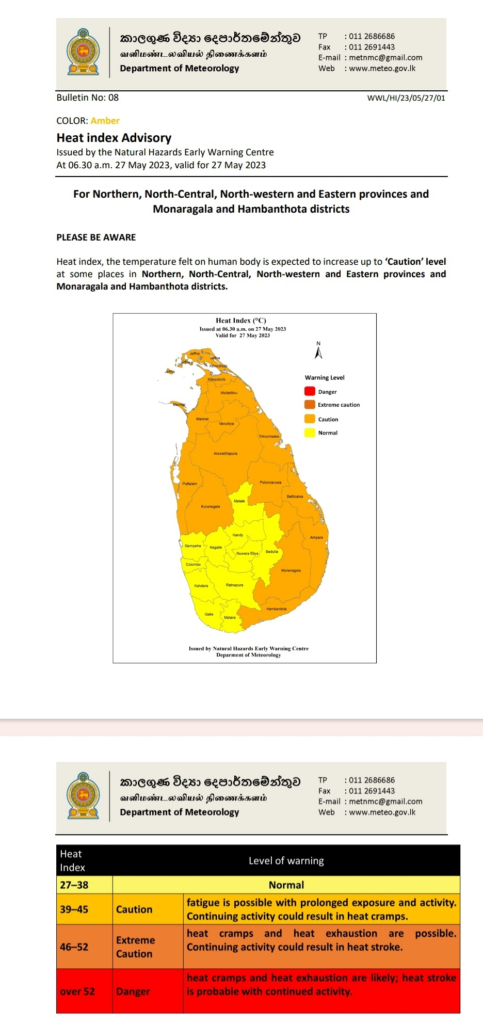
Colombo (LNW): The Health Department has urged the citizens of Sri Lanka to follow hygienic measures amidst the ongoing extremely hot weather.

In an advisory issued to the public, the Health Department has urged the public to stay hygienic and hydrated against the heat waves spreading across the island, suggesting that the consumption of water and foods that have cooling properties is recommended.

Drinking adequate volumes of water to prevent dehydration and the consumption of fruits such as watermelon are recommended to beat the ongoing hot weather, and those walking or working outdoors in extreme sunlight, especially children, are strongly advised to take precautions, Consultant Dr. Renuka Jayatissa of the Medical Research Institute said.

She emphasised that risk groups such as elderly individuals, children, pregnant women, and those working outdoors, are strongly advised that extra precautions be taken to avoid exposure to the heat and prevent any heat-related illnesses.

Extraordinary gazette issued amending rules on women attorneys’ attire

0

By: Isuru Parakrama

Colombo (LNW): An extraordinary gazette has been issued declaring an amendment to the rules pertaining to women judges and women attorneys-at-law.

The amendments are in compliance with the Extraordinary Gazette No. 2325/44 issued on March 30, 2023.

Accordingly:

(1) The attire of women Attorneys-at-Law shall be as follows:
(a) Saree and jacket in white, black, off-white, grey or mauve; or
(b) Black trouser with white blouse and black coat and shoes; or
(c) Black skirt with white blouse and black coat and shoes.

(2)
(a) The length of the trouser, referred to in paragraph (b) of sub-rule (1) shall be to the ankle.
(b) The length of the skirt referred to in paragraph (c) of sub-rule (1) shall fall below the knee when seated.
(c) The blouse referred to in paragraphs (b) and (c) of sub-rule (1) shall be high necked and long sleeved.

Government of India Scholarships for Sri Lankan students

0

        Government of India has been extending scholarships for the children of estate workers for G.C.E. Advanced Level, Undergraduate courses and Vocational/Technical education in Government Technical Colleges in Sri Lanka. Students who have passed G.C.E. Ordinary Level (with minimum 6 credit passes) or Advanced Level examination and aged below 25 years are eligible to apply for this scholarship. 

2.     High Commission of India now invites applications for the award of these scholarships. Application forms could be downloaded from the website – www.hcicolombo.gov.in – or obtained physically from the High Commission (No.36-38, Galle Road, Colombo-03) and the Assistant High Commission of India (01A, Mahamaya Mawatha, P.O. Box 47, Kandy). 

3.     Applicants are requested to submit the completed application forms along with photocopies of birth certificate, result sheet of G.C.E ‘O’ Level or ‘A’ Level, latest salary slip of parents and Estate Superintendent’s certificate regarding parent’s occupation. Duly completed forms may be submitted physically or by post to ‘Honorary Secretary, CEWET c/o High Commission of India, P.O. Box 882, Colombo-03’ before 29 April 2023.

***

Colombo

31 March 2023

Govt introduces ‘defence 2030’to upgrade the status of security forces

0

By: Staff Writer

Colombo (LNW): The cash-strapped nation is planning to reduce the military strength to 100,000 by 2030-end from its current strength of 200,783. The strength would be limited to 135,000 by next year, the Defence Ministry said.

The overall aim of the strategic blueprint is to broach a technically and tactically sound and well-balanced defence force by the year 2030 in order to meet upcoming security challenges,” the statement quoting the state minister of defence Pramitha Bandara Tennakoon said.

The strength of the military and sustainable economic development are two sides of a coin, which stay together, but never talk to each other in open. Military spending is basically the state borne expenditure, which indirectly stimulates and opens avenues for economic growth by way of assuring national and human security.

State Minister of Defence Hon. Premitha Bandara Thennakoon raising his concerns into the status quo mentioned that despite the approved cadre of the Army, which is now 200,783, it will be reduced to 135,000 by 2024 and it has been projected to right size the strength to 100,000 by 2030.

The overall aim of the strategic blueprint is to broach a technically and tactically sound and well-balanced defence force by the year 2030 in order to meet upcoming security challenges on a par with the National Security dimensions of the country.

Sri Lanka, which is facing its worst economic crisis since 1948, ran out of forex reserve and was unable to manage its key imports, including fuel, fertilizers and medicines, leading to serpentine queues. For health and education, the 2023 budget has allocated over 300 billion rupees each.

After the end of Liberation Tigers of Tamil Eelam (LTTE) conflict in 2009, the strength had been halved from around 400,000. But the current strength of the Sri Lankan military of 200,000 is also termed as expensive.

Sri Lanka will drastically slash its military, the Ministry of Defence has announced, as the country tries to cut costs of state owned institutions including ministries in the face of its worst economic crisis in decades.

The bankrupt nation will cuttsil the number of army personnel by a third to 135,000 by next year and 100,000 by 2030, the state minister of defence said recently as the government works to overhaul its finances.

“Military spending is basically state-borne expenditure which indirectly stimulates and opens avenues for economic growth by way of assuring national and human security,” Premitha Bandara Thennakoon said in a statement.

The aim of the move is to create a “technically and tactically sound and well-balanced” defence force by 2030, Thennakoon said.

The island nation of 22 million people is reeling from months of food and fuel shortages and spiraling inflation. The government cut back on expenditures after the country slid into a deep economic crisis last year when its foreign exchange reserves dried up.