Home Blog Page 1748

Domestic debt restructuring and banking sector stability

0

The restructuring of our sovereign debt is primarily driven by the GFN (Gross financing needs), the forward Sovereign Debt Perimeter, the forward Debt Service to GDP and other factors that dominate the IMF’s DSA (Debt sustainability assessment) and is a critical component of the IMF’s EFF. The benefits to Sri Lanka in achieving these DSA metrics have been clearly spelt out and understood and the EFF is the enabler to restarting Sri Lanka’s growth and poverty alleviation trajectory as well as its macroeconomic and banking/financial system stability. The enabler of these metrics is the IMF. They will work closely with the GOSL MoF/Treasury towards a credible composite sovereign debt restructuring and structural macroeconomic stability whilst keeping the country’s MoF/Treasury afloat (as opposed to sovereign bankruptcy) with the EFF and multilateral funding expectations being met. 

 External sovereign debt 

The optics of the external sovereign debt restructuring debate is dominated by that of the commercial debt of which the larger component is that of ISBs (International Sovereign Bonds). ISBs are mostly held by international funds and global banks. Local institutions and banks licensed to deal in foreign currency hold these ISBs.

  • The large/foreign institutional ISB holders for the time being, are amenable to a restructuring and/or re-profiling and/or a haircut on the principal in return for a similar treatment of the domestic sovereign debt. As to why they take this position is varied and opaque, though one intelligent guess is that most current holders for the being have acquired these bonds at a discount at the time Sri Lanka’s sovereign rating was continuously sliding in late 2020 and early 2021. They’d rather recover the acquisition plus holding cost than lose the entire investment, albeit even at the discounted acquisition price.
  • The fly-in-the ointment here is their demand for a similar treatment to be imposed on domestic sovereign debt.
  • The rest of the external sovereign debt is that of bilateral debt and multilateral debt – any restructuring of which has to be largely political and diplomatic in approach and in resolution. What these creditors have asked in return for any restructured debt agreement, is unknown at best though it can be safely assumed that any concessions extracted from Sri Lanka would be more geopolitically strategic than financial. 

Domestic sovereign debt

DDR (Domestic debt restructuring) is all about sovereign domestic LKR debt – debt owed by the GOSL to any individual or institution, whether financial or otherwise. The envisaged DDR does NOT include debt owed by parties other than the Sovereign, to any individual or institution, whether financial or otherwise.

  • The DDR is driven by the MoF/Treasury who is the Creditor, and who for multiple reasons, is labouring under the weight of an inability to meet its principal repayment commitment and possibly its interest servicing commitments.
  • Without a DDR there will be no ISB debt restructuring, and without these two, the extent of the multilateral and bilateral debt restructuring will be so onerous as to fail. 
  • A failed composite debt restructuring will collapse the balance of the EFF, not to mention the deep and long scars Sri Lanka will be left with and the heavy burden of bankruptcy. 

The fallout of such a sovereign bankruptcy on Sri Lanka and its banks (in international trade) is that Sri Lanka will become a COD (cash on delivery) country in international trade, with future generations scarred beyond recovery the consequences of which would be high outward migration and resource contraction and a growing output decline and eventual collapse. 

 Key holders of domestic sovereign debt

  • Domestic Sovereign debt to the EPF, ETF and the other retirement funds could be restructured so as to ensure there is a minimal drop in returns below the 2021 levels and can be achieved with a mix of coupon cuts with re-profiling and Capital haircuts. 

    Most such GSec holdings are acquired in the primary market and held to maturity.
  • Domestic Sovereign debt to banks, financial institutions, insurance funds and individuals would also have to be restructured so as to ensure there is a minimal drop in returns below the 2021 levels and can be achieved with a mix of coupon cuts with re-profiling and Capital haircuts. 

Such GSec holdings however are acquired in the primary and secondary market and classified as held to maturity or Trading or Available for Sale (AFS).

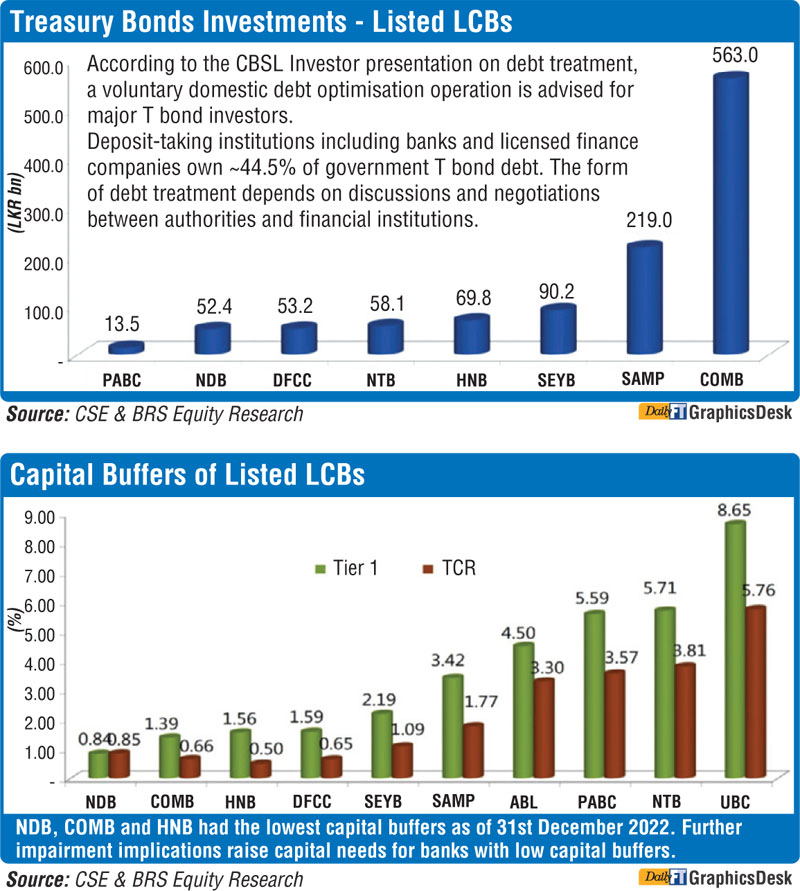
A MoF/Treasury driven DDR of sovereign debt to banks, financial institutions, insurance funds and individuals would result in an asset impairment and charge to capital. 
 No need for knee jerk reaction 

 A rumour floated by interested parties in the media and gaining traction and causing trepidation among the general public is that the banks would request for and get from the CBSL, approval to effect similar haircuts on their Public FDs. The ostensible reason put forward by the banks is that the statutory liquidity ratios need to be held stable by simultaneous and equitable cuts in both assets and the liabilities in their balance sheets. Central Bank Governor Nandalal Weerasinghe however said Sri Lanka’s public bank deposits and stability of the banking system will be safeguarded in any reorganisation of domestic debt. 

The FDs are the smaller proportion of the liabilities in the banks liquidity ratios, but carry a disproportionately high propensity for social upheaval and a bank run, possibly even a collapse of a smaller bank. The higher proportion of liabilities in the liquidity ratios are interbank borrowings – both local and foreign and carry a high propensity to disrupt the interbank market and invite retaliation from the foreign correspondent banks. 

Either is not a pleasant prospect.

  • It is the MoF/Treasury who is the principal sovereign debtor and it is the Secretary to the MoF/Treasury who should be taking the lead and ownership in dealing with and negotiating with the banks and FIs on the DDR – not the CBSL who is the banking regulator, who may incline towards a degree of bias and even sympathy with the banks and FIs they regulate and the banking system whose systemic stability they are responsible for. 

The banks should be approaching the regulator for counsel on how to stabilise their balance sheet with a fait accompli DDR imposed by the sovereign creditor, i.e. the MoF/Treasury.

  • The FD holders or even the interbank creditors in the recent bank failures of Silvergate Bank, Signature Bank, Silicon Valley Bank (SVB) and even Credit Suisse were not subject to cuts by the regulators concerned. The pain was borne by the AT1 Bond holders and/or the CET1 holders. 

A negative impact to the banks and FIs capital is a given in a DDR. Sovereign debt crises the world over bear testimony to this. The better managed banks and FIs, with adequate capital over the regulatory/Basel III buffers, will absorb this impact, albeit emerging with slimmer buffers to go forward. Others will slip below. Both cases may necessitate regulatory holds on profit distributions, increases to senior management emoluments, capital expenditure, etc.

 Options for banks and FIs

  • There is however, the clear and painless option of a possible regulatory forbearance on capital, liquidity and leverage ratios, even those defined by Basel III. 

The CBSL as implementing agent for Basel III on behalf of the Bank for International Settlements, can do so for an agreed timeframe. 

  • There are also other perfectly credible options for banks and FIs to take. Capital augmentation with Regulator forbearance on the single voting shareholder limit is one such. Another is an issue of contingent convertible bonds or CoCos, to be redeemed when the CT1 level is restored. Another, though against-the-wall option is to convert any FD and other liability cuts into voting shares subject to regulatory limits on voting equity.  A run on a bank generally means funds move from a riskier bank to a safer bank and more so if there is a general perception that the BOD and Management of a bank has not done their job effectively. The Financial Sector globally has already seen 4 major banks collapse this year. Signature Bank, Silicon Valley Bank, First Republic Bank and Credit Suisse. Not one depositor in these banks lost a cent. Those who lost out were the shareholders. 
  • UBS first offered $ 0.27 per share of CS and after a weekend of negotiating they increased it to $ 0.81 per share and that too was paid as an all share offer (no cash) as 1.00 UBS share for 22.48 CS shares. 12 months ago this stock was trading at circa $6.00 and the Saudi National Bank invested $ 1.5 billion in Nov 2022 at circa $ 4.00 per share for a stake of 10%. Signature Bank and Silicon Valley Bank shareholders lost everything when the FDIC took it over and are now looking to sell it to First Citizen Bank and Flagstaff Bank. HSBC UK paid just GBP 1.00 for the UK part of SVBs business. All these steps were taken by the regulators without any cost to the government or the taxpayers. There is ample evidence that if the regulators do the right thing, depositors, taxpayers, etc. can be safeguarded and the banking sector need not go into a crisis. The President needs to take a leaf out of Theodore Roosevelt’s book, adopting the former US President’s mantra to “speak softly and carry a big stick” to get the banking reforms through. 

 References: 

https://www.imf.org/en/Videos/view?vid=6286173458001

Source: DailyFT

PHIs warn spread of dengue in Gampaha getting out of control

0

By: Isuru Parakrama

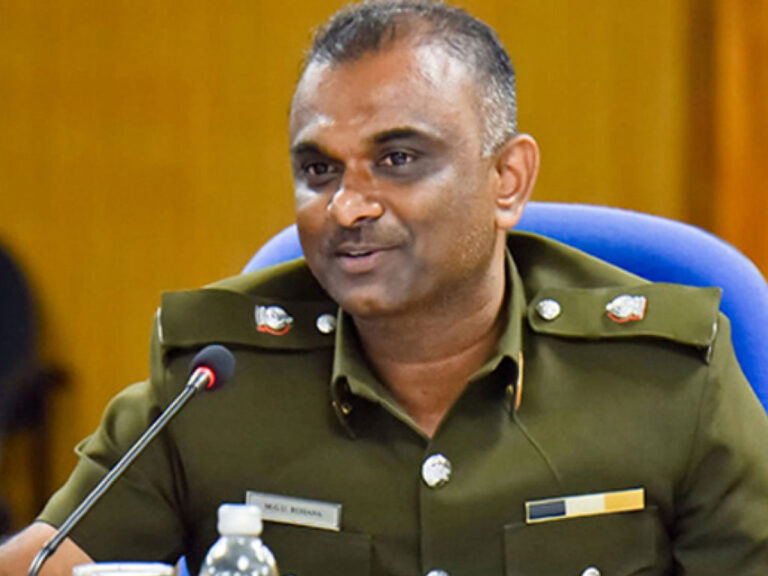
Colombo (LNW): In the vast spreading of dengue across the country, the situation in the Gampaha district is getting out of control, warned the Public Health Inspectors Association.

The daily count of positive cases reported from Colombo and Gampaha districts is increasing and according to the statistics, the dengue infection is getting out of control in the Gampaha district, revealed Union Chief Upul Rohana, speaking to media.

The situation has occurred due to the inefficiency of the National Dengue Control Unit and provincial officers, Rohana claimed, alleging that they have failed to analyse data and take appropriate action at the correct time.

The PHI Chief urged the authorities to deploy officers and members of the public to conduct dengue prevention programmes to contain the spread of the disease.

Harsha Supports Welfare Gazette with Some Concerns and Calls for Completion of ‘Prabashwara’ Project

0

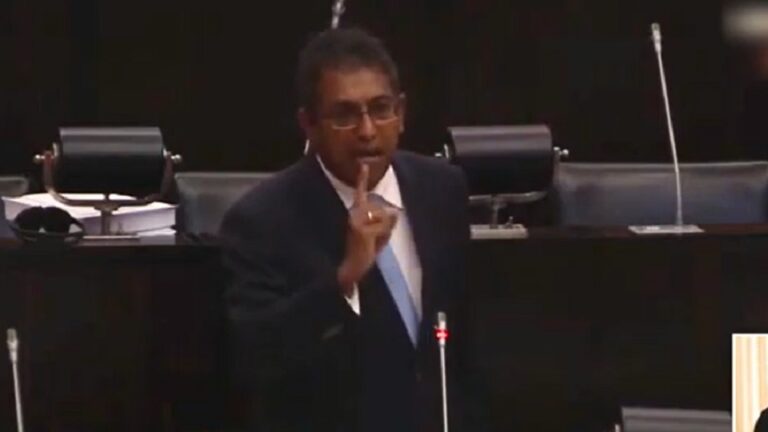
During a recent parliamentary session, Harsha de Silva expressed his support for the new welfare gazette while raising some concerns about certain aspects of the bill. He started by commending the government for changing the term “disabled” to “differently-abled” in the gazette and urged other government institutions to follow suit.

De Silva also praised the government’s decision to use independent graduates to conduct the poverty survey, as he believes it will provide impartial data. He highlighted a study by UNICEF that found the Samurdhi benefits to be inequitable, with an exclusion error of 58%. Additionally, he raised concerns about the politicization and lack of regulation of Samurdhi banks.

Although President Wickramasinghe has expressed his intention to bring the Samurdhi Department under the Central Bank back in 2018, it never happened thus, de Silva urged the government to take action on this matter.

In response to calls from MPs to bring people above the poverty line, de Silva suggested the government complete the ‘Prabashwara’ project in Dambulla, a 5000MT temperature and humidity-controlled warehouse, which is almost 90% completed. He believes this will have a positive impact on rural farmers and help lift them out of poverty. He also noted that the Indian High Commission, which initially funded the project, has expressed its willingness to provide additional funds if necessary.

However, de Silva did express some concerns about the new welfare gazette, particularly regarding the distribution of funds and the lack of a clear system for measuring whether individuals have come above the poverty line. Nonetheless, he remains supportive of the bill overall.

Norochcholai Unit 3 to be shut down for 100 days

0

By: Isuru Parakrama

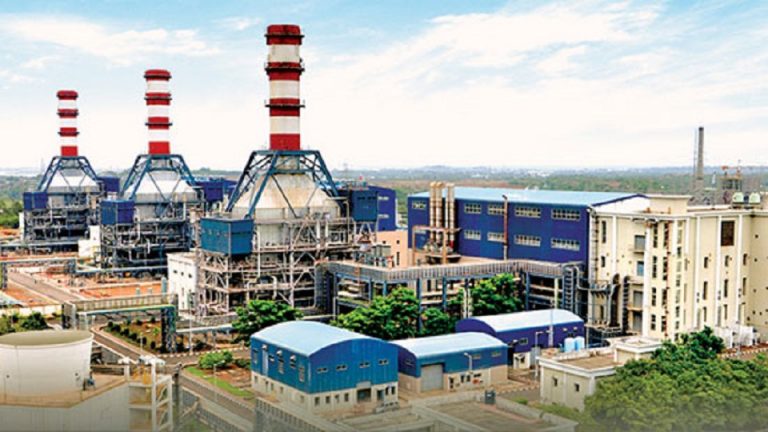
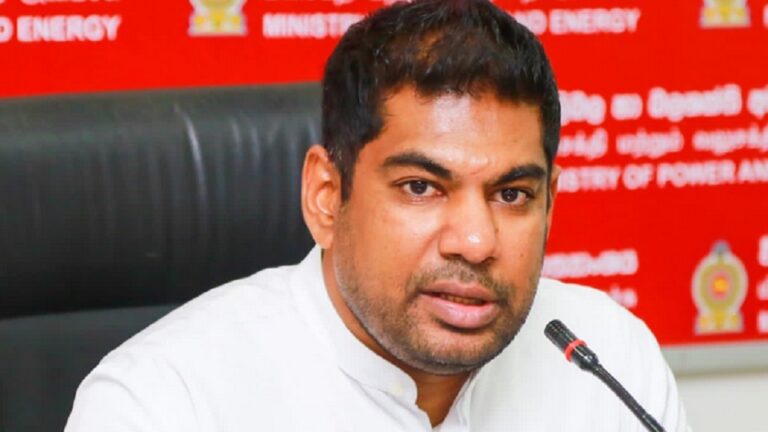
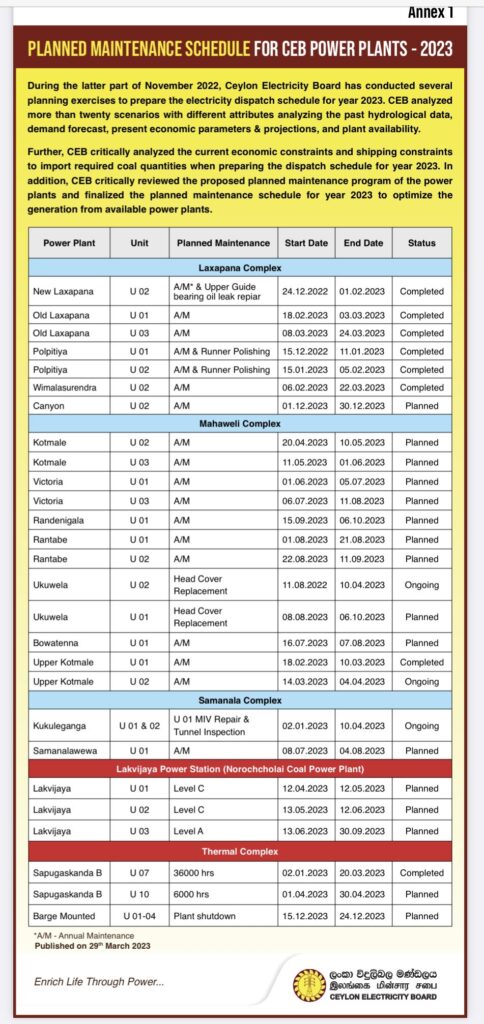
Colombo (LNW): The Unit 3 of the Norochcholai Coal Power Plant will be shut down from June 3, 2023 for a period of 100 days due to scheduled major overhaul maintenance, announced Power and Energy Minister Kanchana Wijesekara.

He added that power generation will be managed without any power cuts through other thermal power plants.

Wijesekara further noted that the 30th cargo of coal is currently being unloaded at the Plant, and the full coal requirement of the Ceylon Electricity Board (CEB), thereby, will be completed.

No blackouts or power cuts will occur due to the shortage of coal, he assured.

Contempt of religion: President asks CID to probe Pastor Jerome Fernando

0

By: Staff Writer

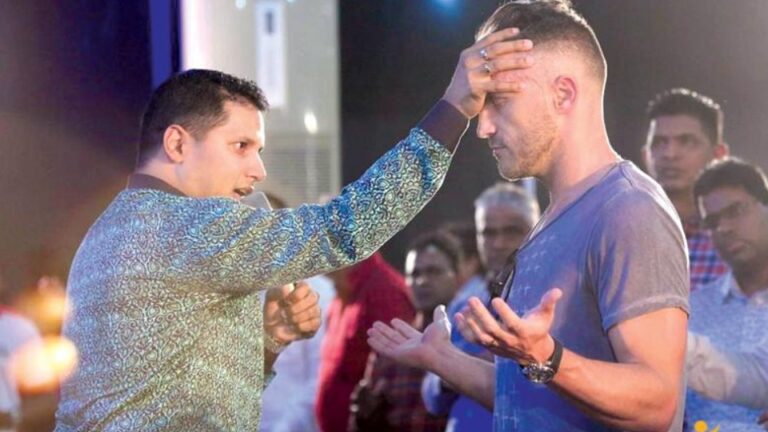
Colombo (LNW): President Ranil Wickremesinghe has reportedly informed the Criminal Investigation Department (CID) to launch an immediate probe into Pastor Jerme Fernando, who recently has driven himself into hot soup by making a public statement allegedly insulting Lord Buddha.

The Head of the National Security raised concerns with the President over Pastor Fernando’s comments against Buddhism, Islam and Hinduism, stressing that such ideology could lead to communal tensions in the country, a report by Daily Mirror said.

President Wickremesinghe responded by saying that he would not allow any individual to destabilise the country and stressed that anyone instigating religious disharmony should be probed and stern actions should follow.

Pastor Jerome Fernando, who calls himself the Prophet of God, is a leading advocate for the Glorious Church in Colombo, Sri Lanka, and was recently subject to controversy over a video surfacing on Social Media revealing him make a comment allegedly insulting Lord Buddha and Buddhism.

Parties concerned on Pastor Fernando’s comments are of the view that he is undertaking an activity of a bigger project behind the curtain, paving the way for publicly disowned political leaders to make a comeback, simply by instigating religious disharmony in the same manner to which certain Buddhist monks and extremist groups not very long ago resorted.

Power and Energy Minister announces two updates on electricity

0

Colombo (LNW):CEB proposal for the July 1st Electricity tariff revision has been submitted to the PUCSL this afternoon. CEB has submitted the proposal according to the Govt policy decisions & tariff filling requirements to adjust the tariffs biannually on January 1st & July 1st every year. CEB has taken into consideration the actual generation data, actual price of inputs, generation mix & forecast for 2023 while giving the maximum benefit of adjustments to low consumption users.

The above remark has been made by Power and Energy Minister Kanchana Wijesekara.

He added: “With the 30th Cargo of Coal currently unloading at Norochcholai, the full coal requirement of CEB for this season will be completed. There will be No Black Outs or Power Cuts as speculated earlier by CEB unions & media reports due to Coal shortages.

Three governors removed

0

By: Isuru Parakrama

Colombo (LNW): Three governors have been removed by President Ranil Wickremesinghe today (15).

Accordingly, the following governors have been removed:

  • Jeevan Thiagarajah – Northern Governor
  • Anuradha Yahampath – Eastern Governor
  • Admiral of the Fleet Wasantha Karannagoda – Wayamba Governor

In replacement, new governors will be appointed by next Wednesday (17), announced the President’s Media Division.

SriLankan Airlines operates without any external funding in the last two years

0

By: Staff Writer

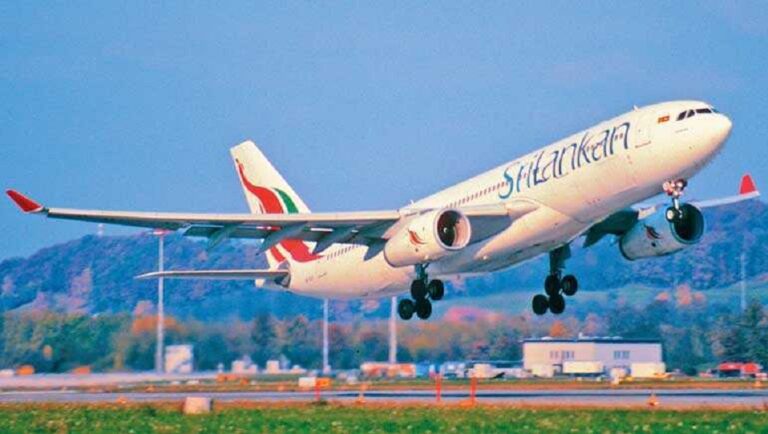
Colombo (LNW): SriLankan Airlines says it did not receive any outside funding in the last two years.The airline also said it suffered a foreign exchange loss of LKR142.6 billion resulting from the revaluation of net foreign currency liabilities due to the sudden depreciation of the Sri Lankan rupee exchange rate in March 2022.

The group, in fact, made an operating profit according to the audited financial statement and before the occurrence of exchange losses, amounting to LKR1.7 billion in the year.

This is a significant achievement considering the issues faced by airlines worldwide during that period owing to the Pandemic, SriLankan Airlines said in a statement.

SriLankan Airlines presented its unaudited dollar financial statements for the latest financial year that ended in March 2023 at the recent COPE meeting in the Parliament.

During the recently completed fiscal year, the airline generated a passenger and cargo revenue of USD994 million and an operating profit of USD53 million.

The operating profit at group level was USD104 million. The group, however, incurred financing costs of USD101 million, resulting in a profit of USD3 million.

These figures may vary slightly during the finalization of year-end accounts, but essentially the airline has broken even for the first time in over a decade.s the Chairman of SriLankan Airlines stated during the recent COPE meeting, the airline has received no funding in the last two years, and continues to operate using its own cashflows.

The airline maintains operating margins in line with the best industry standards. And it is optimistic that these will be stronger in the year ahead as the country moves forward from the challenges of 2022.

As discussed at the COPE meeting, the biggest challenge yet is the country’s situation and extremely high financing costs

Although 2022 represented a year of solid recovery from the COVID-19 pandemic for the aviation industry, airlines are still facing annual losses. For instance, the Sri Lankan national carrier SriLankan Airlines reported a loss of $525 million in the year to March 2023.

Undeniably, the demand for air travel in 2022 increased to unexpected levels. Although some airlines have managed to jump on the opportunity and recoup part or all the losses suffered during the COVID-19 pandemic, some others still have to deal with negative financial results.

In December 2022, the airline failed to repay interests covering a timespan of five years on loans obtained from local financial institutions.

Notably, the Sri Lankan National Audit Office (NAO) stated the airline received $200 million in 2016/2017 and loan facilities amounting to $80.5 million from two different state banks to address short-term financial needs.

As of March 31st, 2021, the total amount due by the SriLankan carrier amounted to $196 million. Additionally, during the financial year 2021/2022, the airline secured another loan of $75 million.

SL and HRB submit joint status letter in HR Bank Vs SL Govt. case

0

By: Staff Writer

Colombo (LNW): Plaintiff Hamilton Reserve Bank Ltd. (HRB) and the defendant Government of Sri Lanka submitted a joint status letter on Friday to the Southern District Court of New York outlining the schedule in response to the order US District Judge L. Denise Cote issued on 20 April.

THE Court has ordered the Sri Lankan Government and its sovereign bondholder Hamilton Reserve Bank (HRB) to submit a joint status letter by 12 May 2023.

The decision by US District Judge Denise Cote follows a conference held involving the two parties on 20 April.

The Government in early April in its answers to HRB’s Amended Complaint, denied almost all the allegations.

Via its attorneys Clifford Chance US LLP, the Government said the Plaintiff HRB’s claim is barred, in whole or in part, by reason of Sri Lanka’s sovereign immunity.

Furthermore the Plaintiff’s claim is barred, in whole or in part, because Plaintiff lacks standing to sue and Plaintiff’s claim is barred, in whole or in part, and/or should be stayed, on the grounds of international comity.

HRB owns over $ 250 million in principal amount of the $ 1 billion worth International Sovereign Bonds (ISBs) issued in 2012. The Bonds matured on 25 July 2022.

Hamilton alleged that as a result of Sri Lanka’s default, it is owed $ 250.19 million in principle and $ 7.349 million in accrued interest (before accounting for pre-and post-judgement interest).

HRB, represented by Bleichmar Fonti and Auld LLP and Jenner and Block LLP, initiated this action on 21 June 2022 after which on 21 September Sri Lanka filed a motion to dismiss the complaint.

According to this schedule, jointly signed by the plaintiff’s lawyers Bleichmar Fonti and Auld LLP and the defendant’s lawyers Clifford Chance US LLP both parties are required to complete the discovery before 20 June, the summary judgement motions by 26 June, summary judgement opposition and cross-motions to stay by 17 July, and the summary judgement replies by 31 July this year.

Opposition to cross-motion to stay is due on or before 14 August followed by the cross-motion to stay reply due on or before 31 August, 2023.

The lawyers for the plaintiff and the defendant jointly stipulated a protective order to the Court regarding the discovery material, which includes information of any kind produced or disclosed in the course designated as confidential, limiting access and use by parties not related to the case. Judge Cote so ordered the stipulation.

Sri Lanka in mid-April announced a moratorium on foreign debt repayments, including the Bonds and since then has made no payments on the Bonds. The Government of Sri Lanka filed a motion in September 2022 to dismiss on the grounds that the plaintiff lacks contractual standing.

Exchange rates at commercial banks today

0

By: Isuru Parakrama

Colombo (LNW): The Sri Lankan Rupee continues to remain stable against the US Dollar at a number of leading commercial banks, in comparison to the week earlier.

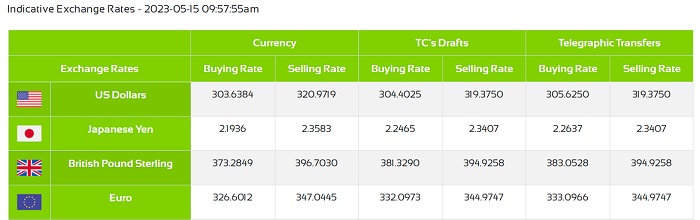
The People’s Bank’s exchange rates reveal the buying rate and the selling rate of the US Dollar remains unchanged at Rs. 303.63 and Rs. 320.97, respectively.

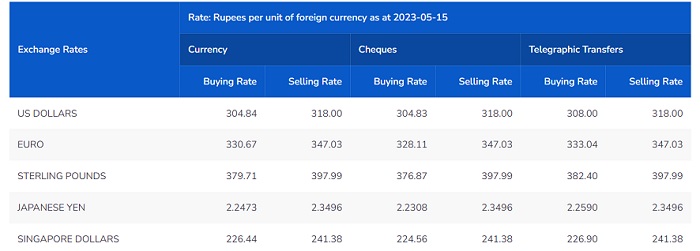
At Commercial Bank, a similar situation follows, as the buying rate and the selling rate of the US Dollar remains unchanged at Rs. 304.84 and Rs. 318, respectively.

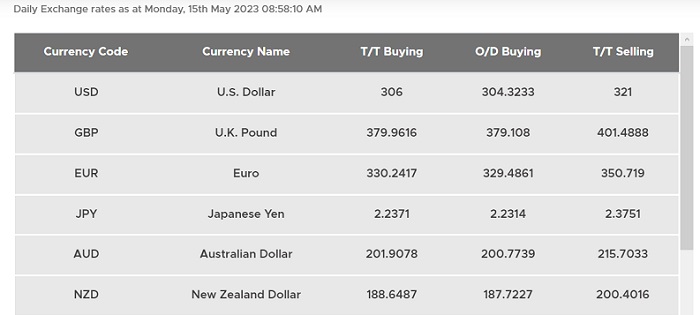
At Sampath Bank, the buying and selling rates of the US Dollar remains unchanged at Rs. 306 and Rs. 321, respectively.