President Ranil Wickremasinghe says the foundation for a strong new economy has already been formulated: asserts country is successfully completing the difficult stage required to get support from the IMF.
President Ranil Wickremesinghe says the corrupt political factionalism that deceives the people and makes them poor forever, should be changed: also says that is the “system change” the youth of the country have been demanding for a long period.
President Ranil Wickremesinghe calls on all Sri Lankans at home and abroad to devote themselves and unite as children of one mother to make Sri Lanka one of the most developed countries in the world by 2048.
SLPP Economic expert & Minister Dr Bandula Gunawardena says Sri Lanka will fall into a “bottomless economic, social and political abyss” unless Govt increases taxes, imposes controls on imports and cuts expenditure: also says there’s “no other option” than agreeing to the IMF conditions.
China’s Foreign Ministry Spokeswoman Mao Ning, in a landmark statement, says multilateral lenders like the IMF & World Bank must restructure their loans to developing countries like Sri Lanka and Zambia that are struggling to repay: on 27th March 2021, at a UN Finance Ministers Sessions, Sri Lanka’s former State Minister of Finance Ajith Nivard Cabraal had also called on the multi-lateral organisations like the IMF & World Bank to provide a “debt moratorium” to emerging nations.
UNICEF says 7 mn people in SL are in need of humanitarian assistance due to the economic crisis: also says essential services for children such as health, nutrition & education have been severely impacted by shortages of medicine, food insecurity, lack of fuel and long power cuts.
Several suspects who were arrested yesterday over the attack on the protestors who were near the Elphinstone Theatre in Maradana, remanded until 17th February: 4 activists, who were produced before court, granted bail.
Prominent crypto-currency advocate and billionaire Tim Draper’s proposal to promote the widespread adoption of Bitcoin in Sri Lanka, not well received at meetings with President Ranil Wickremesinghe and CB Governor Nandalal Weerasinghe.
Sri Lanka Customs Spokesman Sudattha Silva says bringing gold-plated credit cards and capsules that contain gold gel are the newest ways of smuggling gold into the country: also says Customs officials are now employing technology to detect gold of more than 22 carats.
Deputy Director of the National Hospital Dr Rukshan Bellana alleges he is under threat subsequent to the exposure of what he called a “narcotics mafia” operating in Govt Hospitals: previously, Dr Bellana had to be rescued by Police when a group of minor staff laid siege to his office.
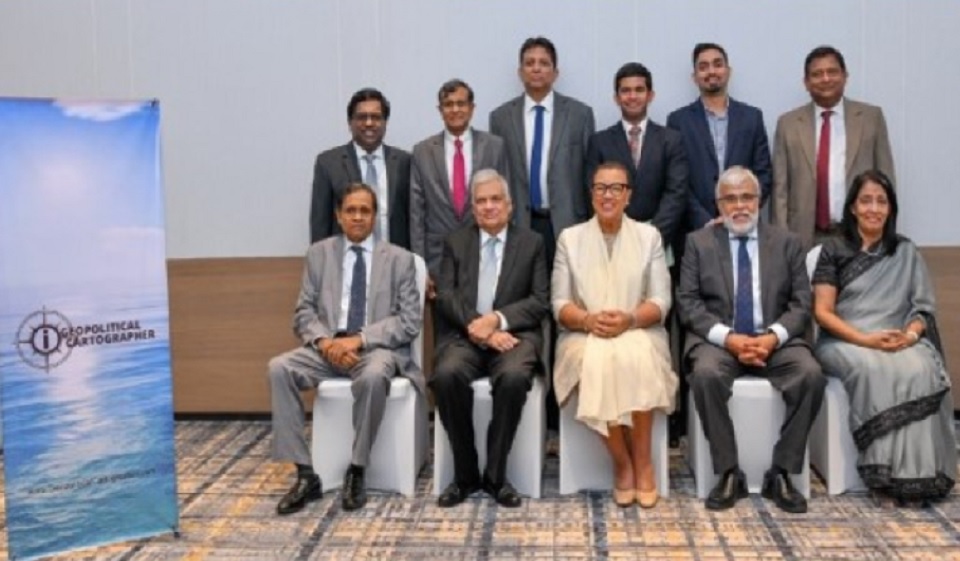
Colombo (LNW): As Sri Lanka continues to feel the weight of political and economic pressure, Secretary General of the Commonwealth Patricia Scotland said she wants every Sri Lankan to know that they are not alone.
“I know that Sri Lanka continues to feel the weight of political and economic pressure. The pressure can be hard to bear. It can be destabilising, isolating, and frightening, and I am here because I want every Sri Lankan to know that you are not alone. You are part of this special precious Commonwealth family,” said the Commonwealth Secretary-General addressing the Inaugural Lecture for Geopolitical Cartographers.
The Geopolitical Cartographer was held on the theme of “The role of the Commonwealth in an Era of ‘Polycrisis’ “under the patronage of President Ranil Wickremesinghe, two days ago (03) at the Colombo City Centre.
Speaking further the Secretary-General said as a family we have responsibility for one another. A duty to each other, a shared love and a shared journey and you are not alone like the challenges you face.
‘I travel all around the commonwealth and the wider world and whilst every country and its direct experience and circumstances are different, they are similar challenges everywhere and you may feel that you are living in a country under pressure, but the reality is that we are all living in a world under pressure. All of us are tightly bound by a tangled knot of crisis-spanning global systems. A world living with the social political and economic consequences of COVID-19,’ she said.
Colombo (LNW): Several spells of showers will occur in Eastern and Uva provinces and in Hambantota and Polonnaruwa districts, and showers or thundershowers will occur at several places in Western, Sabaragamuwa and Central provinces and in Galle, Matara and Kurunegala districts during the afternoon or night, the Department of Meteorology said in a statement today (05).
A few showers may occur in the coastal areas of western province during the morning too.
General public is kindly requested to take adequate precautions to minimise damages caused by temporary localised strong winds and lightning during thundershowers
Marine Weather:
Condition of Rain:
Showers or thundershowers will occur at times in sea areas off the coast extending from Hambantota to Trincomalee via Pottuvil. Showers or thundershowers may occur at several places in the other sea areas around the Island.
Winds:
Winds will be north-easterly and wind speed will be (25-35) kmph. Wind speed may increase up to (40-45) kmph at times off the coast extending from Chilaw to Kankasanthurai via Mannar and in sea areas off the coast extending from Hambantota to Pottuvil.
State of Sea:
The sea areas off the coast extending from Chilaw to Kankasanthurai via Mannar and from Hambantota to Pottuvil will be fairly rough at times. The other sea areas around the Island will be moderate.Temporarily strong gusty winds and very rough seas can be expected during thundershowers.
Colombo (LNW): As Sri Lanka is to celebrate its 75th anniversary of Independence on the 4th of February, the general reaction of the people around the country this year is one of despondency with serious criticisms about the failure of governance in the country.
The need for thinking through some of the more difficult problems relating to the rule of law and human rights has been a long felt need of all parties concerned over the situation that has been developing in Sri Lanka which has become more difficult due to the current economic collapse, political crisis, and the serious threat posed to the administration of the justice system in Sri Lanka with the serious undermining of the Policing and criminal justice system, and the ever increasing abuse of the law for the suppression of the freedoms of assembly, association, and expression, particularly through the abuse of arrest and detention, the denial of the right to a fair trial, and in general, the disregard for the due process of the law.
SCFR case decision on the security failures
In a recent judgement, seven Judges of the Supreme Court found that the former President of Sri Lanka (Maithripala Sirisena) and a few former high ranking State officials including the Secretary to the Ministry of Defence (Hemasiri Fernando), the Inspector General of Police (Pujith Jayasundara), the Chief of National Intelligence (Sisira Mendis), and the Head of the State Intelligence Service (Nilantha Jayawardena) have failed in their obligations to guarantee security and protection for the people of Sri Lanka and that this has resulted in one of the most devastating security lapses which killed over 270 persons and injured an even much larger number in several bomb blasts directed particularly to places of worship on Easter Sunday of 2019. Observing this situation, the Supreme Court noted: “We must express our shock and dismay at the deplorable want of oversight and inaction that we have seen in the conduct of affairs pertaining to security, law and order, and Intelligence. There are glaring examples of a lack of strategic coordination, expertise and preparedness that need a critical examination as to the way forward. The failures that eventuated in the Easter Sunday attacks and the concomitant deaths and devastation have left behind an indelible blot on the security apparatus of the country and this country which is blessed by a multi-cultural and multi-religious polity cannot be left to the vagaries of these follies and made to suffer, leading to violence, fear, apprehension and uncertainty. These events must recede into oblivion but they remind us starkly of the necessity to effect legislative, structural and administrative changes.”(SC Fundamental Rights 163/2019).
To fulfil this destiny as envisaged by the Supreme Court in Sri Lanka for legislative, administrative, and structural changes, the Government of Sri Lanka and the people will have to find ways if Sri Lanka is to overcome the serious loss of confidence in the international financial markets where the country has been downgraded as it is in a state of default in the payment of its foreign debts. The crisis of governance and the crisis of the economy are thus bound together.
A historical ruts of the crisis
The popular criticism in the country is that no policies or plans have been presented by the Government or other political stakeholders to resolve multiple questions relating to this situation. The general expectation is that things are likely to get worst rather than to improve in the coming months.
Although the present situation is bewildering, the country’s collapse into this situation has a long history. Although the country became Independent in 1948 from the British rule, this Independence was nominal rather than substantial and real. From the colonial status, the country changed to an Independent status. The administrative and political structures that were created have not developed enough to ensure the protection and welfare of the people within a framework of rational governance. In fact, Sri Lanka has not evolved into a modern State at any time. The structure of governance which prevailed from around the 9th Century Anno Domini to the early part of the 19th Century, before the British took over the control of the country in 1815, was based on the strict segregation of the people on the basis of caste. In the majority Sinhala speaking community, the division was made as a relationship between the Kuleena (meaning those who had power and wealth) and the Kulaheena (meaning those who are powerless and had no dignity). A similar system prevailed under different titles in the Tamil community also. Thus, during this long period of several centuries, there was no idea of people with equal rights and equal opportunities.
Impact of over ten centuries of internal divisions
The two principles that the caste system stood for were: the complete prohibition on social mobility where people were kept prisoners of their own caste groups and any attempt to improve their living conditions was punishable with extremely serious punishments; and the associated second principle was the imposing of unequal and disproportionate punishments. This meant that if those who were considered as belonging to lower castes committed even a simple transgression, that person and even his or her family could be subjected to death along with the destruction of whatever belonged to them. Meanwhile, those who belonged to what was considered high caste could not be punished except even for graver crimes committed against underprivileged groups.
These two principles were the pillars on which the Sri Lankan society was organized during this long period. This long held practice created a habit of mind and social behaviour which in turn created a kind of ‘culture’ that remains even up to date. The introduction of some rationalistic administrative methodologies introduced by the British during their rule superficially made some changes to this situation but was unable to touch the core of the repressive culture which has taken root in the country. In the recent decades, even these limited modernizations introduced by the British have been subjected to great erosion. The return to a more repressive society which attempts to displace democracy, the rule of law and human rights is quite manifest in the present times.
Failure to develop state mechanism
All these factors have contributed to obstruct Sri Lanka’s development of its own State machinery on the basis of the people’s sovereignty although the Constitution itself has recognized that all power in the nation is derived on that principle. Instead of the people’s sovereignty, the absolute power of the chief Executive has been established through the same Constitution, i.e. the Constitution introduced in 1978. This Constitution is a major stumbling block for the creation of a State mechanism based on the principles of democracy, the rule of law, and human rights. A major task facing the Sri Lankan State and the people is to replace this Constitution with a constitution that asserts the sovereignty of people through the creation of State mechanisms functioning under the norms and standards of democracy. The security of the people will depend very much on the manner in which this problem is resolved in a positive manner in the immediate future.
A nation can be built only on the basis of solidarity that exists among the people on the basis of the equality of all the persons living in such a nation. The concept of equality, though recognized formally in the laws, has not been implemented in a manner that could bring about unity in all segments of the society. The poor feel that they are completely alienated within their own society. Even leading politicians themselves recognize that there is a loss of confidence in the Parliament itself due to the chasm between the representatives of the people and the people themselves. However, despite such a recognition, there has been no real attempt to resolve this problem and to restore the confidence in the State.
The result is divisions everywhere on the basis of many factors such as discrimination against the weaker sections of the society of all communities in terms of every aspect of life. The psychology of division exists because of caste based cultural practices which prevent convergence into a single nation. Discrimination against minorities also has the same effect and is a source of constant misunderstandings and conflicts while discrimination against females is also one mode of division in the country. These and other forms of failures to ensure equality among citizens prevent the emergence of consensus on all major issues confronting the country.
The alarming failures of the criminal justice system
One of the most alarming factors at the moment is the most visible weakening of the criminal justice system. There is widespread crimes such as murder, rape, theft and robbery, and above all, the rising of corruption to Himalayan proportions. The criminal investigation capacity and the quality of policing have degenerated to such an extent that even the Inspector General of Police has admitted the serious nature of this problem. Similarly, the prosecutor’s office functioning under the Attorney General’s Department has also been the subject of constant criticism. The Judiciary itself suffers from extremely chronic delays, creating problems for the litigants as well as the witnesses to the cases. Those who complain of being unable to get justice due to multiple causes even go on to say that they have lost confidence in the justice system. As a result of all these, there is a popular feeling of insecurity arising out of non-governance and mis-governance. Among the younger generations, there is large scale migration from Sri Lanka due mainly to severe unemployment.
Under these circumstances it is only natural that there is widespread discontent and protests everywhere. Unfortunately, instead of attempting to openly discuss with the people about their problems, the Government resorts to repression against them. Particularly, the younger generations who have shown a remarkable capacity for peaceful attempts to get attention to these problems, are being treated harshly by using illegal arrests, illegal detention, and harsh attacks on peaceful demonstrators.
In one recent case, even the Magistrate hearing it observed that the Police have misused the Prevention of Terrorism (Temporary Provisions) Act law without any justifiable grounds. Also, the media has come under severe attacks, in particular those who are engaged in social media networks.
An urgent need to act
The Independence Day brings to the mind of everyone that Sri Lanka requires the taking of urgent actions to begin to address these problems. The only manner through which this could be done is to allow the people to participate in bringing about a nationwide discourse on policies and plans to bring about solutions to economic, political, social, and cultural problems that are hindering the progress of the development of the country. It is only the critical mass that would be able to assist the people and the State to make the Independence real and to strengthen the solidarity of the entire nation on the basis of equality, democratic participation, the rule of law, and human rights. The duty of the State is to create the environment for such a critical mass to operate peacefully and constructively at this most crucial hour of the country’s history.
Colombo (LNW): The latest Corruption Perceptions Index (CPI) compiled by Transparency International (TI) was released today. The CPI scores 180 countries and territories around the world based on perceptions of public sector corruption. The scores reflect the views of experts and surveys from the business sector. The CPI is calculated using data from 13 external sources, including the World Bank, World Economic Forum, private risk and consulting companies and Think-Tanks. The CPI uses a scale from 0 to 100, whereby 100 is considered very clean and 0 is considered highly corrupt.
Sri Lanka’s score in the 2022 CPI stands at 36 out of 100, one point lower than the previous year, which was 37, and two points lower than from 2020 – 2017 and 2014, where the CPI score remained stagnated at 38. Sri Lanka ranks at 101 in 2022, along with Panama, Albania, Kazakhstan, Serbia, Ecuador, Peru and Thailand. Over the past 10 years Sri Lanka’s CPI score has remained relatively the same, from the highest being 40 in 2012 and the lowest being 36, which is the score this year and was the score in 2016. The top countries on the Index are Denmark (90), Finland (87) and New Zealand (87) while South Sudan (13), Syria (13) and Somalia (12) remain at the bottom of the CPI in 2022. Types of public sector corruption and related criteria captured in the CPI encompass bribery, diversion of public funds, effective prosecution of corruption cases, adequate legal frameworks, access to information, and legal protections for whistleblowers, journalists and investigators.
According to the Transparency International Secretariat in Germany, corruption levels remain at a standstill worldwide, with most of the world failing to fight corruption, illustrated by 95% of countries making little to no progress in the CPI since 2017. TI further notes that though governments have claimed they would tackle corruption, only few have taken concrete action, leading to pervasive corruption, coupled with crackdowns on civic space that have aggravated the situation.
Transparency International Sri Lanka (TISL) notes with grave concern that Sri Lanka too demonstrates the same lack of progress in terms of resisting corruption, coupled with suppression of civil society, culminating from a lack of political will to change the system, even amidst the crippling effects of kleptocracy on the country’s economy and on the quality of life of citizens. TISL urges the Government to recall how Sri Lankans of all walks of life came together in protest against those who were responsible for the bankruptcy of the nation, understanding the very close connection between corruption, poor governance, the country’s economy and their day to day lives. The International Monetary Fund (IMF) on which the Government is depending to resuscitate the fallen economy, also emphasized the need to reduce corruption vulnerabilities, by improving fiscal transparency, public financial management and a stronger anti-corruption legal framework.
While the Government is in critical need to attract foreign investments, tourism and other income generation methods along with debt restructuring, foreign aid and other support from the international community to be able to secure the essentials for the people, it is paramount that the trust in the Government, the legislature and the public sector be restored within and outside of Sri Lanka.
TISL also recalls the essential anti-corruption reforms that it urged the Government to implement to revive the economy, none of which stand implemented as at this day. TISL reiterates that strengthening the parliamentary oversight on public finance, ensuring transparency and accountability in public procurement, de-politicizing the public sector, auditing and reviewing the State-owned Enterprises and strengthening law enforcement are some examples of critical and urgent action that are necessary if Sri Lankans are to fight corruption and usher in a true system change. TISL notes that the only way to restore public trust would be for the government to fulfill these requirements in action rather than in words.
TISL also calls on all Sri Lankans to pioneer the cultural change that is essential for a systems change. TISL urges citizens to resist corruption and uphold personal integrity at all times, adopting a zero-tolerance policy to corruption in work places and businesses, fulfilling civic responsibilities, using the right to information, participating in governance, keep demanding critical reforms and voting differently and wisely at the upcoming elections.
Leading Korean Organic and Bio Company has expanded its largest organic fertilizer manufacturing plant in Pannala.
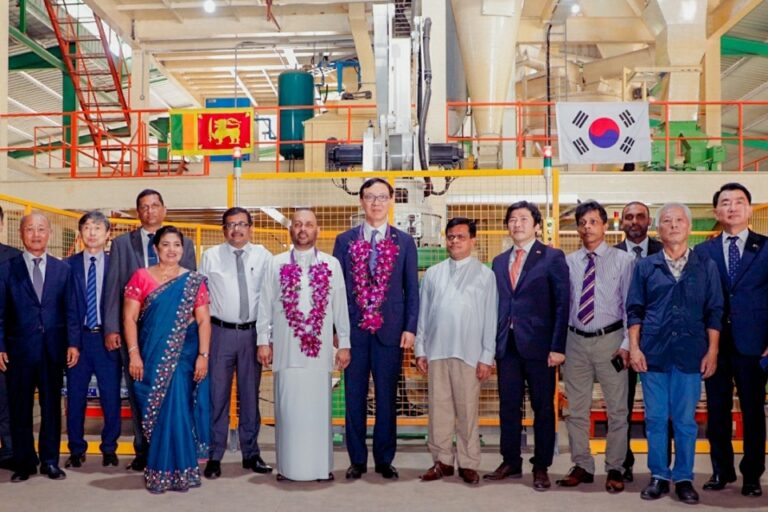
Korean Envoy Santhush Woonjin Jeong on Monday attended the inauguration ceremony of a Korean company in Sri Lanka, Hyosung Organic and Bio’s (Hyosung ONB) New Expansion Fertilizer Plant in Pannala.
To mark this remarkable occasion, Agriculture Minister Mahinda Amaraweera, State Minister of Agriculture Mohan Priyadarshana de Silva, Ministry of Agriculture Secretary Gunadasa Samarasinghe and Hyosung ONB Representative Moon Hyun Park, were present among other dignitaries.
At the inauguration ceremony, Korean Ambassador Santhush Woonjin Jeong congratulated on the new expansion fertilizer plant of Hyosung ONB and commended its contribution to the development of the agricultural sector in Sri Lanka.
“This is a great example of Korea’s state-of-the-art technology being used to realize Sri Lanka’s potential with its rich human capital.
The world is making environmentally conscious choices and the agricultural standards are set to produce chemical-free, sustainable food products.
Investment in innovation and technology is vital to transforming the agricultural sector.
“This plant uses fully automated state-of-the-art technology as well as a process and packaging system for an uninterrupted supply of organic fertilizer.
As Sri Lanka’s largest organic fertilizer manufacturing plant, I am sure that it will support the Sri Lankan people and its economy in achieving a future free of chemicals and a healthier nation.
“The Korean Government is now encouraging Korean companies to promote exports and investment cooperation with other countries including Sri Lanka by establishing and promoting a Task Force led by the President of Korea.”
Agriculture Minister Mahinda Amaraweera appreciated the efforts by Korean companies to uplift the Sri Lankan agricultural sector by establishing the first and biggest organic fertilizer manufacturing plant in Sri Lanka.
This invaluable investment will not only help the farmers to reap successful results but also strengthen the bilateral economic engagement.
Minister Amaraweera also commended the Korean Government’s development cooperation with Sri Lanka and the immeasurable support given to uplift the agriculture industry.
Hyosung ONB Representative Moon Hyun Park stated: “This plant in Sri Lanka is fully automated like the plant in Korea and the production capacity is 200 MT per day.
Many countries including Sri Lanka are recognizing the importance of switching from chemical fertilizers to organic fertilizers and are showing interest in organic fertilizers.
“The organic fertilizer subsidy system introduced by the Sri Lankan Government helped us immensely. I am hoping to reinvest all profits from fertilizer to develop the agricultural industry in Sri Lanka.”
Whilst enveloped in deep socio-economic crises caused by the successive inept and divisive political leadership in power, since the island country gained its independence from the British colonial rule, in February 1948, the preparations are afoot to celebrate the diamond jubilee of the existence of the country, as a free nation.
At the time Sri Lanka, then known as Ceylon, was granted independence with the dominion status, it was a prosperous country with a comparatively strong economy. The country was regarded as one destined to be a model amongst the nations gaining their freedom from the colonial masters, after the second world war. The trend was to decolonize the nations from the yoke of centuries of colonial rule of the European powers, some benign and some not so benign.
The grant of independence to Sri Lanka was hurried and ill-thought through. The governance of the independent Ceylon as envisaged was nothing but a change from the colonial rule to the neo-colonial rule of the Sinhala nation with a hardened Sinhala Buddhist chauvinism.
The Soulbury constitution which was the framework for the governance of Ceylon was most inappropriate as it failed to recognize the existence of the two distinct nations – the Sinhala nation and Tamil nation. It created a situation where the nations were reduced to the majority and minority communities. The Tamil nation was left at the mercy of the Sinhala nation who were handed over the gift of a perpetual supremacy simply on the basis of numbers. Even basic safeguards to protect the interest of the Tamil nation were not written into the constitution except for a confused clause preventing “the majority community” enjoying privileges which were not extended to the “minority communities”.
The Soulbury constitution which was largely a replica of the unwritten Westminster styled constitution totally distorted the socio-political realities of Ceylon. Soon after the independence the Sinhala Buddhist government of the day took steps to ensure that a well pronounced section of the Tamil nation, who were the backbone of the then economy of Ceylon lost their citizenship. This was aimed to reduce the representation of the Tamil nation in the governance of the newly independent nation.
This was the first step in their long journey to deprive the Tamil nation of their rightful place in the economy education, employment and the political life of the country. The introduction of the constitutions in 1972 and 1978 further marginalized the Tamil nation from the body politic of the Sinhala led unitary state. These took away even the basic safeguards provided by the Soulbury constitution. The current socio political crises of the nation is a result of these deeply sectarian approach of the Sinhala Buddhist led governments.
The Tamil nation reacted to this initially by entering into political dialogue. On realizing that the democratic concepts hardly had an impact on the thought process of the Sinhala nation, by then, well intoxicated with the political power gained over the decades, took to arms as the last resort to prevent the decimation of the Tamil nation. The sixth amendment to the 1978 constitution took away even the breathing space for the Tamil nation to express its political will. The main justification for the armed struggle is the sixth amendment. If the parliament ceases to be forum where else the long oppressed Tamil nation can voice its political expression?
The international community is well aware of the brutal reaction of the Sinhala nation to the legitimate expression of the political will of the people of the Tamil nation for us to repeat those here. Suffice is it to say that every armed struggle is not an act of terrorism.
The post war oppression continues unabated. The state aided colonization continues to distort the demography of the traditional Tamil homeland and the heavy presence of the armed forces takes away even the semblance of the life without fear.
The planned lobsided economic development over the decades has left the peoples of the Tamil nation the “poor cousins” of the Sinhala nation.
The war reparation, restoration of the civil society, and the accountability from the war crimes are foreign concepts to the Sri Lankan government.
Even the attempt to implement the watered-down Indo Sri Lanka accord in the form of the “13thAmendment” is now being vociferously objected to by the Buddhist clergy. Sadly, this is not a new phenomenon.
In nutshell, the democracy is practiced in Sri Lanka only in the breach and any hope of a internally evolved solution to the political crises in the island of Sri Lanka is fast disappearing, if not its has already disappeared.
The international community must not allow itself to be misled by the Sinhala nation any longer. The history of the island of Sri Lanka is too dire to be ignored by the civilized nations of the world.
The international community must realise that continuing to support Sri Lanka in its current form will not bring prosperity to the country. For the Sinhala nation the current crisis is socio economic but for the Tamil nation, it is an existential crisis.
Unwarranted Defence Expenditure – A Main cause to Sri Lanka’s Current Crisis
Among the several causes of Sri Lanka’s failure to secure its economic stability, the defence expenditure remains a major factor.
The cycles of violence culminated in anti-Tamil pogrom of July 1983 and then the genocidal war of three decades, the effect of which will not be easily erased from Tamil peoples’ memory for several generation to come.
Continued and the concerted military occupation of traditional Tamil homeland in the North & East make the return to normalcy impossible.
While the international community gallops to save Sri Lanka from its current crisis, it must take note of the following and lay stern conditions.
The historical data produced by reputable organizations prove that Sri Lanka’s defence spending has been in the increase. Macro Trends report provides that, Sri Lanka’s Budget Expenditure on Defence since 1960 have been as follows:
Period
Total US$ Billion
Average/ year US$ Billion
1960 to 1982
0.52
0.024
1983 to 2009
14.92
0.553
2010 to 2019 (Post war)
17.28
1.728
Total
32.72
The World bank reports provide that Sri Lanka has spent USD$ 34.3 billion on its defence up to 2020. This implies that Sri Lanka had spent USD$ 1.58 billion on defence in 2020 alone. The defence budget covering the post war period (US$ 17.28 Billion) is higher than that of civil war period (US$14.92 Billion).
It is also noteworthy to consider India’s former National Security Adviser Shivshankar Menon’s statement that Sri Lanka’s internal war which ended in May 2009 had cost the country around US$ 200 billion. This US$ 200 billion is enormous and appeared to have gone unaccounted from the Sri Lanka’s records.
Sri Lanka’s Military Sizes have been as follows:
Year
Total
1985
21,600
2009 (End of war)
223,000
2018
317,000
From the foregoing details, it is unequivocally evident that Sri Lanka has been spending significant amount of its budget in increasing the military presence in the island even after the end of the war in 2009.
The military size increase by 94,000; from 223,000 to 317,000; after the war ended in 2009 signifies the increased deployment of military personnel in Tamil homeland of North and East of the island. We consider that the economic crisis of USD$ 50.7 billion foreign debts could have been mitigated to a large extent if only Sri Lanka had not wasted its resources on defence expenditure.
It should also be noted that Sri Lanka has more military personnel than the United Kingdom. Does Sri Lanka need that numbers of military personnel, while it has no external or internal threats when compared to the UK, which obviously has more security concerns.
In the interim, we would urge the international community to take preliminary actions to compel Sri Lanka to end the heavy militarization of North and East of the island and also to demobilize the military as a step towards mitigating the surging national expenditure.
Will the international community impose strict conditions before it takes ad-hoc measures to save Sri Lanka?
Resettlement of Tamil People
If the country were to prosper, the Tamil people ought to be allowed to live in their own land with their legitimate political rights acknowledged.
The state aided colonization, depriving equitable socio economic development, the war and the embargos have forced Tamil people to flee to other destinations. An estimate of over 200,000 such Tamil people, who should be living in their own homes in the North and East, are internally displaced.
Additionally, the civil war has caused over a million of Tamil people to seek shelter in foreign countries and about 100,000 who fled to India, are still living as stateless people.
It is imperative that all these people have the freedom of returning to their own homes to live in peace and dignity.
The Way Forward
Having mentioned the foregoing facts and figures, the British Tamils Forum urges the following as the way forward to not only make Sri Lanka a conflict free region and a prosperous country.
Demilitarise the North East and demobilise the security forces in the island.
As the united voice of the elected Tamil representatives in the North East calling for a political solution based on the federal principles and the right to self-determination, we request an international arbitration process led by India, USA and a core group of countries to find a long term political settlement.
The “culture of impunity” must cease, and the perpetrators of atrocity crimes must be brought to justice under the international criminal prosecution mechanism.
Apply all available leverages including further sanctions, travel ban, asset freeze, etc. on civilian and military perpetrators.
Sri Lanka is to make use of 47 dunken abandoned shipwrecks in sea rich in marine life with aim of harnessing its potential to be steady magnets for dive tourism but some of those sunken vessels wrecks are being salvaged indiscriminately for scrap metal.
The announcement of a U.S. grant of $82,192 to document and conserve the Godawaya shipwreck and its artifacts.The grant to Sri Lanka’s Central Cultural Fund comes from the U.S. Ambassadors Fund for Cultural Preservation.
Documentation of the site and engagement with U.S. experts on Indo-Pacific trade routes and shipwrecks will increase global understanding trade in the Indo-Pacific and especially Sri Lanka’s role in this rich history
In this back drop the Ports, Shipping and Aviation Ministry has directed officials to maximize revenue generation from sunken and derelict vessels.
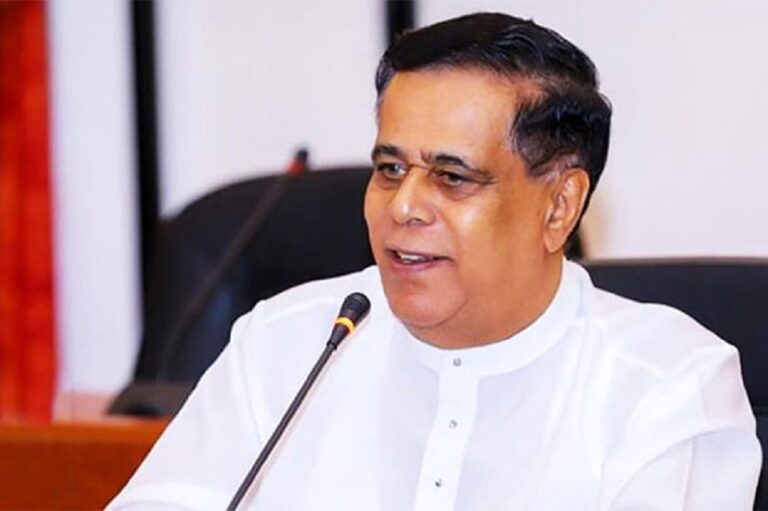
While holding a special discussion at the ministry, Minister Nimal Siripala de Silva said 47 such vessels have sunk or capsized in Sri Lanka’s territorial waters.
Therefore, the minister issued instructions to take maximum benefit from these vessels for the local economy and to preserve them in view of their archaeological importance if necessary.
“A large number of tourists are interested in exploring the sites of sunken vessels in local waters, which is also facilitated by a number of international ocean exploration and divining teams for the photography of the sites,” he said.
During the discussions, it was decided to salvage any vessels with no archaeological value at these sites and sell them for scrap and credit revenue to the government account.
“According to maritime law, if rights over a sunken ship were not presented within a period of one year, ownership of the ship would fall on the government that owned the oceanic territory,” he pointed out.
The Minister ordered relevant officials to look into six such vessels anchored at Colombo, Galle, and Trincomalee ports for more than six years and consider expediting the legal process to obtain the maximum revenue for Sri Lanka Ports Authority out of these abandoned vessels.
The Director General of the Marine Environment Protection Authority emphasized the importance of avoiding pollution to the marine environment during this process.
Sri Lanka’s star shipwreck that lies off Batticaloa at a depth of 42 metres is the HMS Hermes, the first ship in any navy to be designed and built as an aircraft carrier.
This was sunk by a Japanese air attack in April 1942 and placed Sri Lanka among other top Wreck Diving destinations. Tourism sources say about 30 divers will arrive in Sri Lanka to dive at this world famous shipwreck.
Other famous shipwrecks in Sri Lanka of interest to divers include Conch (Hikkaduwa), Earl of Shaftesbury (Hikkaduwa), SS Rangoon (Unawatuna), Colombo Cargo Wreck, Colombo Taprobane East Wreck, Colombo Barge and MV Cordiality (Pulmoddai).
Sri Lanka also has many ships sunk during the colonial era and a few even prior to that which are of enormous archaeological value. According to Sri Lankan law any ship older than 100 years cannot be salvaged considering its archaeological value.
04Feb’23 – A meaningful 75th Independence Day to my fellow Sri Lankans මා සහෘද ශ්රී ලාංකිකයන්ට අර්ථවත් 75 වැනි නිදහස් දිනයක් எனது சக இலங்கையர்களுக்கு அர்த்தமுள்ள 75வது சுதந்திர தினம்