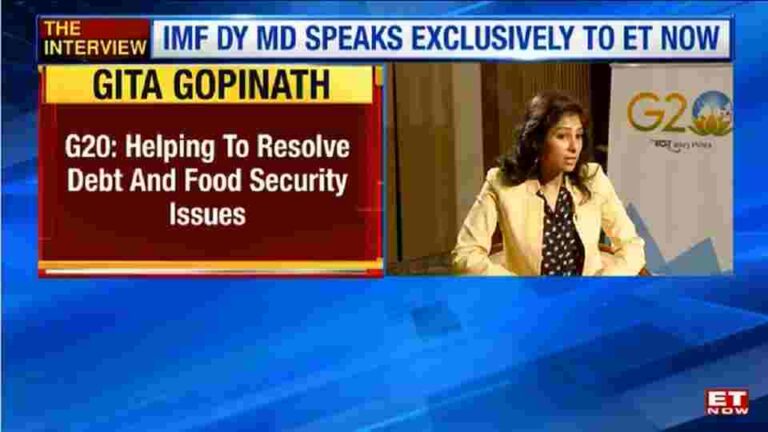
“Given the tough landscape, India certainly is doing relatively well and it has had a few quarters of 4-6% growth and that helps in terms of again closing the gap from the sharp contraction that happened in 2020 in terms of coming back to the pre pandemic path. We have seen private consumption recover well in India, investment doing well and we expect investment to be an important engine of growth going forward,” says Gita Gopinath, Dy MD, IMF
What are the challenges facing the global economy?
Indeed the world is going through a challenging period, there are many big issues that require global cooperation. If I were to just name some, one would be food and energy security the other is issues of debt. We are seeing what happened with the crypto landscape. If there is action to be taken on that front, it will require international coordination.
There are many issues that require countries coming and working together and which is why the G20 plays a very important role at this point. India having the presidency is really critical to this. India has been championing the Global South to make sure that sufficient financing is going to low income countries and that is going to be very critical looking ahead.
You already had a set of meetings and is there anything that you can share in terms of takeaways? A hot topic has been cooperation debt management, especially for low income countries, which were beaten by geopolitical tensions?
We have looked at the global outlook and the main challenges that the world faces. Again in the issue of food and energy security, there have been important steps that are being taken that have come out to work at the G20. This comes from Indonesia’s presidency but it will be taken over by India to ensure that there are no restrictions on exports of goods and food coming out of countries, minimising supply disruptions and finding a way to keep energy prices stable to avoid the tremendous volatility that we have seen around the world. All of that is important to deal with the cost of living crisis that we are seeing.
The second is on the debt front. About 60% of low income countries are either already in debt stress or in high risk of debt stress. The G20 produces the common framework to help countries resolve this debt problem and progress has been made with a couple of countries. But a lot more needs to be done and India is on the forefront of pushing for concrete actions to get much faster debt resolution for countries.
Sustainable finance is a big part of what we need in cooperation in terms of climate finance, again especially for the Global South. We are also making sure that technology transfers happen. These are all the issues which could not happen if we did not get all the relevant countries in the room to have these discussions.
What about crypto taxation? Every nation is trying to figure out what to do and we have had this whole crypto blowout. Is that on the agenda at all and your thoughts on that?
Absolutely, it is a key part of the agenda because every single country cannot deal with this problem on its own because the borders in that sense are porous. It is digital and can escape very easily and therefore there is a lot of action being taken on that front at the IMF. We are working very closely with India on coming up with principles on what regulations might look like but more importantly, in terms of what the consequences can be for the macro economy, how it affects cross border capital flows, the risks in monetary sovereignty and so on.
We are working on them and working closely with the FSB and the BIS and these other institutions that are very key to regulating crypto on the global landscape. This is the year when we expect to have substantial progress in this matter. I think this has been slow coming.
I think it is interesting you referred to it as a problem because the central bank in India definitely sees crypto as a problem. Is that a view you share because this is something that has divided people? There are crypto zealots who believe it is the next coming and those who think it is going to destroy the financial system, I am curious to know your own views?
The way I think about it is there is the technology that underlies a lot of these new financial instruments, the cryptography, the blockchain technology that underlies it, has the potential of solving some of the problems that we have grappled with including cross border payments and financial inclusion.
You can have smart contracts because if you tokenise money, you can have much more smart contracts that help in terms of issues of governance. There is a promise of technology but that said, the manifestation of that in the current form is seen with the meltdown in the markets. Without the regulation, it is like the wild west and very highly valued companies basically were not following the right practices and we have seen the meltdown that followed.
So farm all of that is being contained. Thankfully we have not seen spillovers to the broader economy from this meltdown but we cannot take that for granted and that is why we need to make sure that we have the right regulations in place.
Let me turn to the world economy. The last world economic outlook that the IMF put out did another downgrade of global growth to 2.7%. Your next numbers will be out early next year. Is it going to look worse? Is 2023 going to be worse than expected earlier?
It is still a little early to pin that down. Compared to October, the third quarter of this year for the US and Europe turned out to be better than expected for a few other countries too. So the global outlook was in some sense appraised on the upside but the fourth quarter high frequency data is in line with the slowing that we are projecting for next year and the country for which we have had the most significant deterioration in the outlook has been China.
Just in terms of the numbers that we are seeing and the high frequency has implications for what we will do with the numbers going forward. The reason we think next year is going to be worse than this year is because that is when we really see the consequences of all the monetary policy tightening that has happened around the world because as we know empirically it affects it with the lag and we will see that happening next year; but there is still a lot of uncertainty. I think the energy markets are still a source of a risk, we could see prices going up or down, there is a lot of volatility that can come in through that again China’s economy, how it performs is again a source of uncertainty but we will have numbers in January.
Crude has been cooling off recently largely on fears of a China slowdown. Is that a relief of any kind at all in terms of energy prices or do you see the situation worsening?
Energy prices are coming down because people expect a global recession and that is not the best way to bring prices down; being able to increase supply would be better way of bringing crude prices down but yes, for countries that are energy importers, the decline in prices will certainly help.
On the flip side – countries that are commodity exporters and there are several emerging and developing economies in that space – will now find themselves more exposed to global financial conditions and the tightening that we are seeing because what we are seeing recently that the countries that are oil exporters have been somewhat shielded while the , importers have been more affected by it, including when it comes to their currencies.
We are talking about a global recession as a given at this point?
No. In fact, our base line is for global growth to go down to 2.7%. If I want to think of something that looks like a global recession, you have to go significantly below that. There are rare circumstances when growth goes under 2% which is usually associated with a global financial crisis, the peak of the pandemic and so on. That is not our baseline and we certainly have downside scenarios where that might happen.
If I speak about the possibility of recession in America, is that a fear on the horizon?
Given the amount of monetary policy tightening that has happened and the fiscal policy tightening that has happened, we expect the growth in the US to slow some more and we expect unemployment to go up some. Now whether that would be in recessionary territory is yet to be determined.
The way we see it is we think that it is a pretty narrow path to avoid a recession in the US, given what we are seeing in terms of these fundamental drivers. But that said, if you look at the data, even up until now there is a lot of resiliency in private consumption and a lot of strength in the labour markets in the US. So we are going to hold on to see what happens in the next months.
Does it look grim for Europe?
Europe has been more directly impacted by Russia’s invasion of Ukraine and the consequences on gas prices. So, yes, they are much more negatively impacted. We have seen for instance visible divergence in how retail sales are looking in the US relative to Europe. The US is strong, the more recent data that came in for Europe was much weaker in line with the projection that we will have. About half the Euro countries have negative growth in the fourth quarter. So it is a tougher time for them.
Everyone is looking out for the Fed action. It will be the last this calendar year. What are you pencilling in? Do you think the Federal Reserve will ease up and broadly do you see central bankers continuing to hold the reins very tight?
On the positive side, they have had a second month of inflation coming down and surprisingly somewhat on the downside. This is particularly true for headline inflation. Core inflation in terms of the annual rate is still high at around 6%, though monthly that rate is coming down. So things are moving in the right direction but when inflation is still at 7% and core inflation is at 6%, well above the 2% target, I think the Fed will need to stay the course in terms of making sure that inflation comes back to its target.
Now it certainly helps that the dynamics are moving in the right direction which means that the pace of increasing interest rates will moderate relative to what we have seen in the last couple of rounds and then the question is how long do they hold on to that higher level. Given most projections that we see, it would take a while for it to come down.
A slew of agencies have recently released their India outlook. One has upgraded it and the others have downgraded, The ballpark seems to be between 6.8% and 7% of growth this year may be about 6.1% odd for the next year, how do you look at India relative to what is happening in the world, we know recession is off the table when it comes to India but do you think that this whole narrative that this is a bright spot relatively stands true?
The growth numbers for India that we put out in October was 6.8% for FY2022 and 6.1% for the next year. The data that we have seen since then are in line with those projections. In terms of its performance relative to other countries, India is certainly in a relative bright spot because for about a third of the countries, GDP is basically contracting either this year or next.
Given the tough landscape, India certainly is doing relatively well and it has had a few quarters of 4-6% growth and that helps in terms of again closing the gap from the sharp contraction that happened in 2020 in terms of coming back to the pre pandemic path. We have seen private consumption recover well in India, investment doing well and we expect investment to be an important engine of growth going forward.
Private consumption growth will probably slow down just because of what we saw this year was also coming out of the pandemic and the spending that came with it. So there are several things that are going well in India right now.
Broadly speaking, do you see inflation as a big red flag easing as well? We have had a relatively decent inflation print, the latest one has come in at 11-month low or at least the lowest this year so far. Do you see inflation easing up and monetary policy tightening beginning to pan out?
India’s headline inflation has now come within the RBI’s band but that said, an important reason for that is coming from food prices and we know that food prices are highly volatile. So, we should be a little careful before declaring success. The stickier components of inflation remain at the upper end of the range of 6% and we see that RBI has done well to raise interest rates by around 225 bps since the middle of this year. We will likely need more tightening though the exact magnitude and the pace should be data dependent.
Economic Times