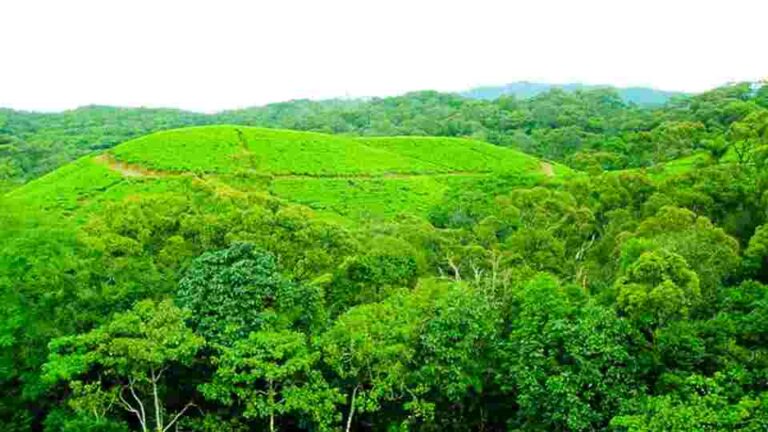
The Conservator General of Forests Mr. K.M.A Bandara said that the media reports implying that Sri Lanka’s forest cover has decreased to 16% are false.
He said this in response to a query made regarding the media report on the instructions of President’s Secretary Mr. Saman Ekanayake. The Presidential Secretariat had focussed its attention regarding these reports published in the media.
The assessment of forest cover is carried out every five years and the census conducted in 2020 is scheduled to be completed in June this year. According to the census conducted in 2015, the natural forests of Sri Lanka stood at 29.15% (1,912,970 hectares) of the total land extent.
The Conservator General of Forests also said that although there has been some reduction in the amount of forests due to various development activities and other human activities in the country, there has definitely been no decrease in the amount of forests up to 16% as stated in the media reports.
According to media reports, if the forest area in Sri Lanka is 16% of the total land extent, then the existing forest area in the country should be 1,040,000 hectares. This means that 872,970 hectares of forests should have been destroyed during the seven years from 2015, which is 124,710 hectares per year and 341 hectares of forest destruction per day.
He also said that the method used to assess the forests should have been described in the presentation of data on forests. Basic points such as the definition of forests, the method of estimating forest size, and the estimation of forest size should have been mentioned in the report. However, there is no source from which the relevant data was obtained in the media reports suggesting that the forest cover had decreased.
The Conservator General further stated that if there is widespread forest destruction, as reported in the media, it should have been observed by the Department of Forest, the Department of Wildlife Conservation, the Sri Lanka Police, and the Sri Lanka Air Force, which monitors forests from the air. However, such extensive forest destruction has not been reported to any of these institutions. He also stated that the Forest Department is updating forest maps and that no such forest destruction was observed during those activities.
The Supreme Court has issued notices to Monetary Board members of the Central Bank of Sri Lanka (CBSL) Sanjeewa Jayawardena and Rani Jayamaha, based on fundamental rights (FR) petitions filed against 39 persons including the previous administration.
The notices were issued as the said individuals failed to appear in Court. The petitions were called in before the Supreme Court Bench chaired by Chief Justice Jayantha Jayasuriya, and comprising Justices Buwaneka Aluvihare, Vijith Malalgoda, L.T.B. Dehideniya, and Murdu Fernando.
39 persons, including the former President, former Prime Minister, and former Finance Minister are cited as respondents to the case filed by the Transparency International Sri Lanka (TISL) former Chairman of the Ceylon Chamber of Commerce (CCC) Chandra Jayaratne, Dr. Mahim Mendis from the Open University of Sri Lanka (OUSL), and former National Swimming Champion Julian Bolling, on the allegation that these individuals are directly responsible for Sri Lanka’s unsustainable foreign debts, its hard default on forex dept repayments, and the economic meltdown.
The petitions will be called in again on March 20, 2023.
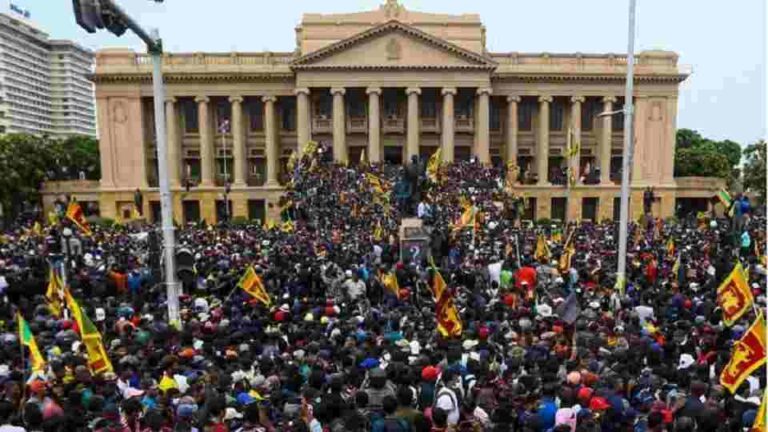
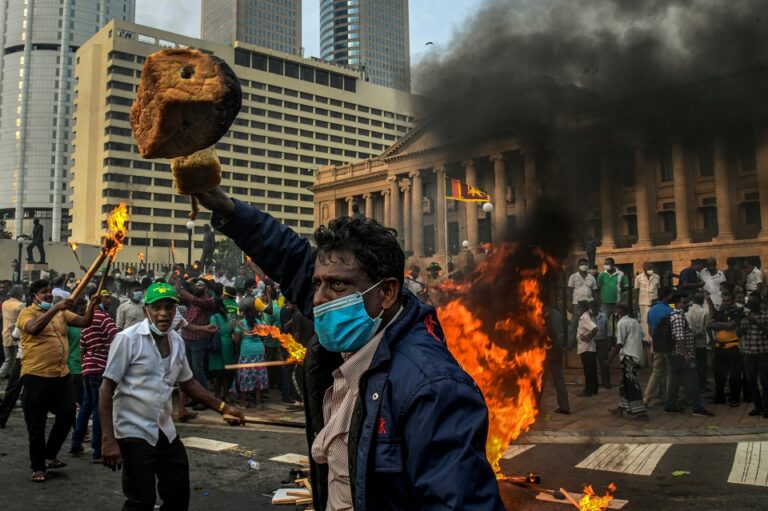
Long gone are the throngs of protesters who occupied an area around the president’s office for months during Sri Lanka’s worst economic crisis since independence.
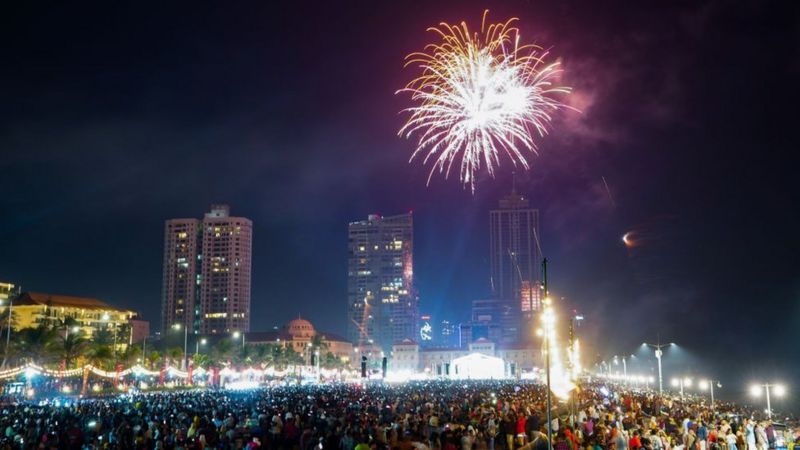
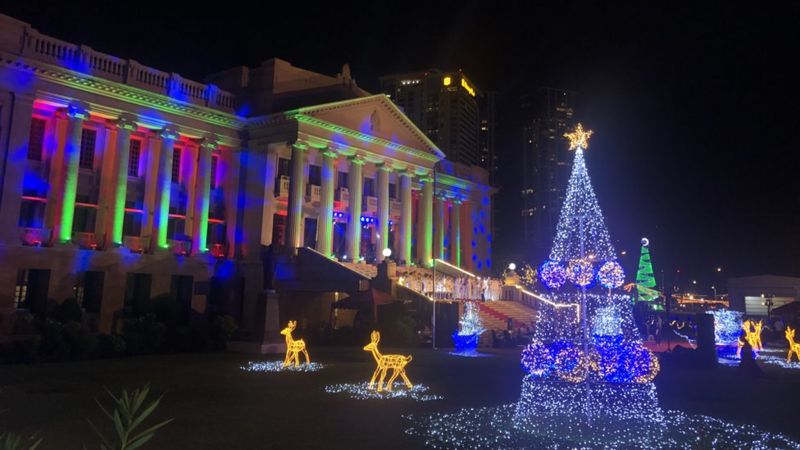
Instead a slew of carollers sang to the public from across the heavily-guarded fences of the Presidential Secretariat. Next to the building rose an 80 ft (24m) Christmas tree, the signature piece in a landscape dotted with décor, food stalls and musical shows. And as fireworks ushered in the new year, a massive crowd flocked to the oceanfront promenade known as Galle Face Green.
It was all part of a festive zone planned by the government as a year-end tourist attraction in the central business district of Colombo, Sri Lanka’s capital.
But for many locals, who used the site as their “ground zero” for Occupy-style protests from April to August and demanded their leaders resign, there is little to celebrate.
Thousands gathered at the former protest site to ring in the New Year
“It’s disgusting,” says Swasthika Arulingam. “It’s an indecent display of wealth that this country does not have, and of resources this country is denying to the weakest sectors of our population.”
The carnival lighting is particularly galling, she adds, given that the state-run electricity board has incurred a loss of 150bn Sri Lankan rupees (£344m) this year.
The prospect of extended daily blackouts looms again. Food staples, transport fees and children’s school supplies are increasingly unaffordable. And the new year brings with it steep tax hikes that will only compound the misery.
There is “a kind of pseudo-stability” right now, Ms Arulingam says, but residents are under tremendous stress as it grows harder to make a living.
Christmas carollers sing on the steps of the president’s office, which was occupied by protesters in July
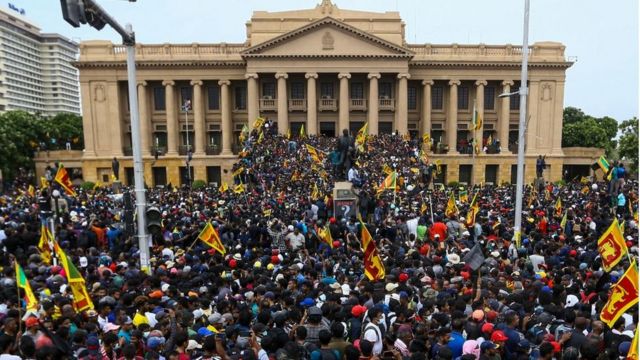
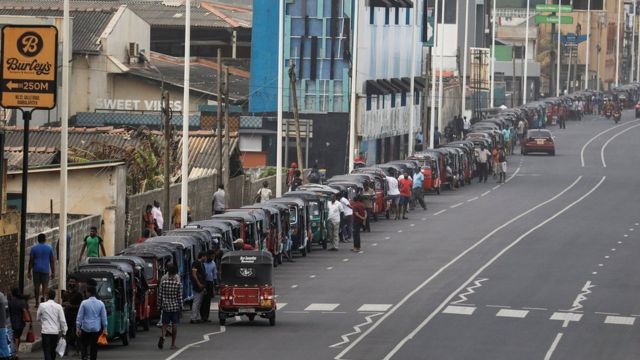
Through much of last year, Sri Lankans faced acute shortages of food, fuel and other basic supplies after a slew of government policies followed by the pandemic had depleted foreign reserves and left the country teetering on the edge of bankruptcy. Lengthy fuel queues and power outages sparked months of mass unrest, culminating in the storming and occupation of then-President Gotabaya Rajapaksa’s official workplace and residence in July, forcing him to flee the country.
Six months on, with more pain on the horizon, there have been calls for early elections. Mr Rajapaksa’s parliament-appointed replacement, Ranil Wickremesinghe, has largely demurred, but local government elections are expected to take place next month after a one-year delay.
Mr Wickremesinghe has also cracked down on the anti-government protest movement and its leaders, after vowing that he will not allow “fascists” to “tear up our constitution”.
“Any form of protest is controlled in Sri Lanka right now,” says Shreen Saroor, a local human rights campaigner. “He has kept his powers well intact to do what he needs to do and in case he needs to call on the military to control the country.”
Ms Saroor points to how Mr Wickremesing has retained the powers of executive presidency – he can deploy security forces, and issue detention orders under what is known as the Prevention of Terrorism Act (PTA).
Critics say the system, which heavily centralises power in the hands of the president, was bolstered by the Rajapaksas during their two decades in power, and lacks the appropriate checks and balances. Calls for abolishing it and reforming the constitution were a key demand in last year’s protests.
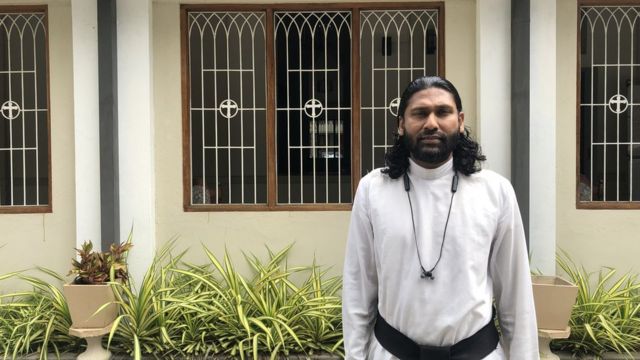
Father Jeewantha Peiris, a Catholic clergyman, is among the protest leaders who have been charged with various criminal offences, including assault and unlawful assembly, under PTA. He is fighting back in court against what he calls “baseless accusations”.
Image caption, The 2022 protests were a freedom struggle that united all Sri Lankans, says Father Jeewantha Peiris
Parliament “totally betrayed” the people when they voted in Mr Wickremesinghe as president, he says, referring to the former six-time prime minister as “another culprit who had been engaged with the corrupt system”.
“Apparently the crisis is now solved but, underneath, its real causes have not been treated,” he says. “Corruption is still taking place. Real issues like malnutrition and medicine shortages exist. Downtrodden people cannot face this inflation.”
The state is intimidating citizens like him, he alleged, but “unless they bring to account those who have committed economic injustices and violated human rights, this crisis will not be solved”.
Father Peiris is the parish priest to mostly Tamil-minority rubber estate workers in the village of Doloswala in the south-central Ratnapura district. He says successive governments have neglected Sri Lanka’s poorest and most vulnerable.
When the pandemic arrived, he claims, villagers fell ill in droves with no ability to socially distance inside their homes and no access to vaccines – and with schools shut, their children suffered with no prospect of remote learning.
“Mothers would come to my cottage and cry for their starving children,” he says. “As a priest working among them, I could not wait around and watch them in their daily misery.”
With his black locks and pristine white cassock, the parishioner was at the Galle Face Green protests every day. His message: the country needs a national movement for structural change.
He describes it as the first time Sri Lankans united, in a struggle for the greater good, irrespective of race, religion or ideology: “We had no divisions among us and we all felt we were victims.”
Image caption, Protesters broke into the president’s office on 9 July
Beginning on 9 April, daily demonstrations quickly grew into “GotaGoGama” – a word that combines the Sinhalese word for “village” with protesters’ demand for Mr Rajapaksa to step down as president.
Camped opposite the Presidential Secretariat, the little community spawned rallies, candlelight vigils, stage dramas and a huge library of donated books, all focused on broadening political literacy.
It commemorated atrocities from Sri Lanka’s past, held open forums about minority divisions and, when government-aligned thugs brutally laid siege to the site, grew even stronger.
But by July, as protesters grew increasingly restive over Mr Rajapaksa’s refusal to leave office, the crowds had grown larger and more uncontrollable.
In the days after the president’s home and office were stormed, as Mr Rajapaksa fled to the Maldives and finally resigned, security forces under the orders of his successor reclaimed the two buildings and raided the GotaGoGama protest camp, arresting demonstrators and dismantling their tents.
With many of its key figures now behind bars, facing legal action or under regular surveillance, the so-called “aragalaya” – or people’s struggle in Sinhala – has largely gone silent.
“It was a national movement, a vision of what Sri Lanka could be,” says Dr Paikiasothy Saravanamuttu, founder of the Centre for Policy Alternatives, but “the middle class has deserted it, the ordinary community groups have all deserted it”.
“[Mr Wickremesinghe] successfully changed the narrative to show there’s a good aragalaya and a bad aragalaya, and what we’re now lumped with is the bad aragalaya,” he says.
Image caption, Queues for fuel snaked along Colombo’s streets at the peak of the shortage in July
Dr Saravanamuttu argues that sections of the population, particularly older Sri Lankans, view Mr Wickremesinghe as the best possible option to salvage the cash-strapped economy, but he must adhere to a reasonable timetable for elections at the local and presidential level.
“The sooner we have some legitimacy, the better,” he adds. “But from Ranil’s point of view, he wants to be elected president of this country, so he’s not going to do anything that will register a huge rebuke against any government that he is heading.”
As Sri Lanka waits on a US$2.9bn (£2.4bn) IMF bailout and financing assurances from China and other bilateral creditors, its people will struggle for a while longer. Dr Saravanamuttu warns a fresh outbreak of mass protests is on the cards in the near future, particularly in areas outside of Colombo where people are poorer and will be hit harder by rising food costs and fuel shortages.
“People will come out, not because they want constitutional reform or they want impunity checked, but because they can’t survive,” he says. “And that might be more dangerous, because it will be spontaneous and it will have a them-versus-us dimension.”
For Buwanaka Perera, a 27-year old social media activist who helped organise the GotaGoGama protests, whatever comes next, the protest movement of 2022 has left a permanent mark.
“People stood up against monsters and gave them the finger,” he says.
“We managed to send Gotabaya home. If people could send him fleeing, and hiding in [army] camps and on islands, there’s no stepping back from that.”
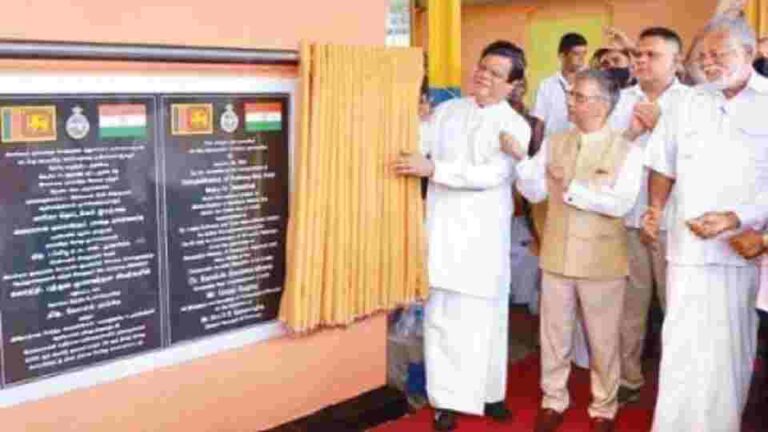
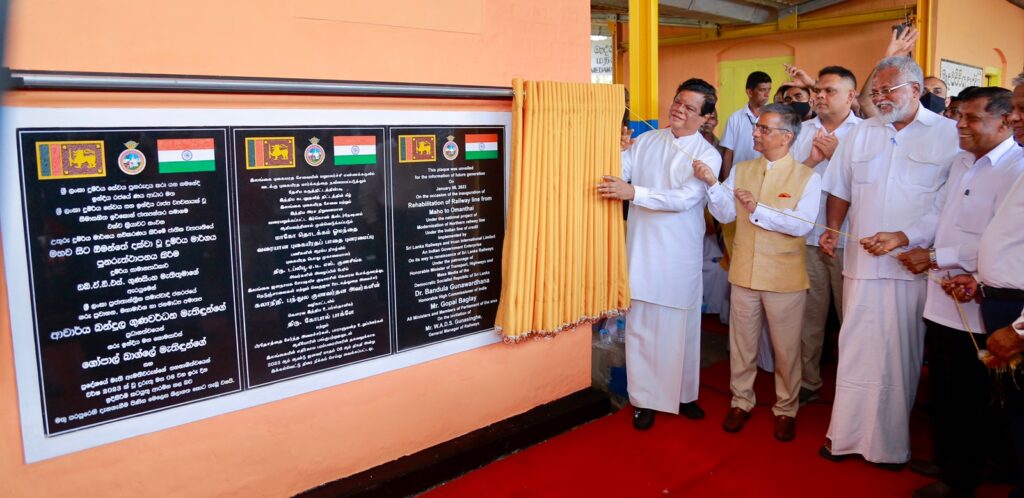
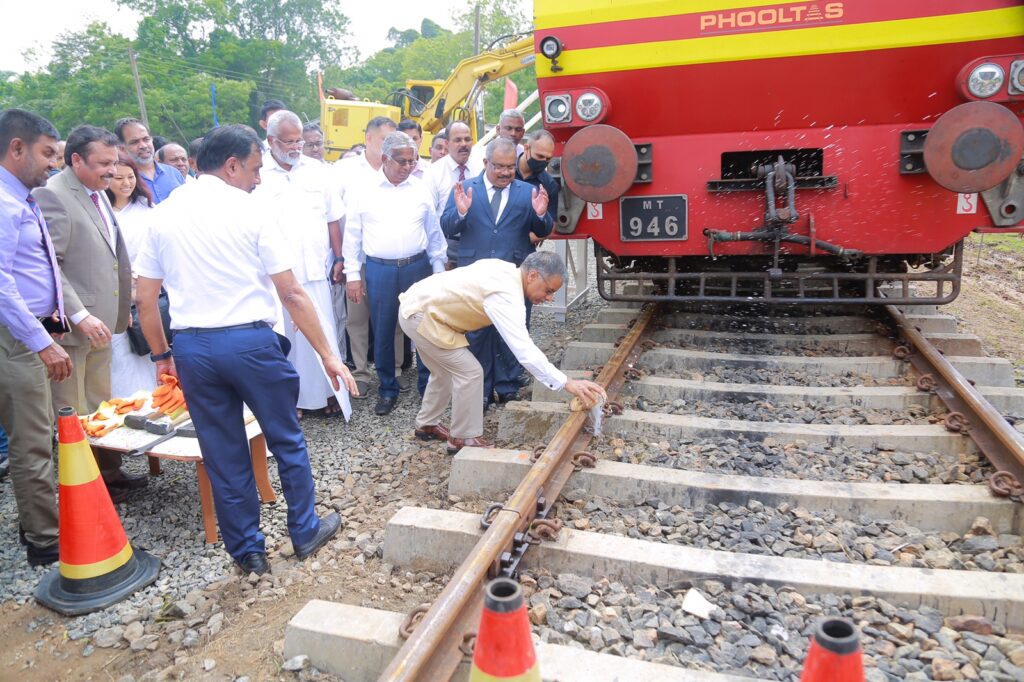
On January 08, 2023, Hon. Minister of Transport of Sri Lanka Dr. Bandula Gunawardane and High Commissioner of India to Sri Lanka H.E. Mr. Gopal Baglay ceremonially launched track rehabilitation work at Medawachchiya for upgradation of Railway Line including ancillary works from Maho to Omanthai (128Km) being undertaken by an Indian Public Sector company, IRCON, under an existing Indian Line of Credit (LOC) of USD 318 million at a cost of USD 91.27 million. Hon. Minister of Fisheries Mr. Douglas Devananda, Hon. State Minister of Finance Mr. Shehan Semasinghe, Hon. State Minister of Highways Mr. Sirapala Gamlath and senior officials from the Sri Lankan Ministry of Transport were present at the event.
2. In his remarks, Hon. Minister of Transport thanked India for the support extended to Sri Lanka, especially in the transport sector. Appreciating the work done by IRCON in Sri Lanka in the past few years, he called for greater Railway cooperation between the two countries.
3. The High Commissioner highlighted that India has executed projects of over USD 1 billion in the Railways sector under 5 Indian LOCs. In addition, projects of about USD 180 million are either ongoing or in pipeline under existing LOCs. He underscored the importance of modernization of Railways in enhancing mobility of goods and services in Sri Lanka thereby boosting economic activity. The High Commissioner also stressed the importance of strengthening connectivity internally as well as with India for enhancing pilgrimages, tourism, trade and economic benefits for the people of both countries. He stated that India will work with Sri Lanka to introduce green and sustainable transport solutions.
4. As a long-standing development partner of Sri Lanka, Government of India has executed several projects in Sri Lanka under its concessional loans and grant schemes. Of the different sectors of cooperation under these facilities, the upgradation and modernization of Sri Lankan Railways has been one of the priority areas. IRCON started its operations in Sri Lanka in March 2009 and has contributed towards modernization of Sri Lanka Railways by reconstructing the entire railway line network in Northern Province (253 Km) and upgradation of Southern line (115 km). It has also contributed to ensuring safety and reliability through a modern signaling & Telecommunication system on a 330 km stretch of Railway line.
5. India’s support to Sri Lanka under various LOCs has continued even after April 2022. Recently, 125 out of the 500 India-made Mahindra SUVs being supplied under an LoC were handed over to Sri Lanka Police. Similarly, 75 out of the 500 Ashok Leyland buses being supplied under an LoC were handed over to the Sri Lanka Transport Board last week.
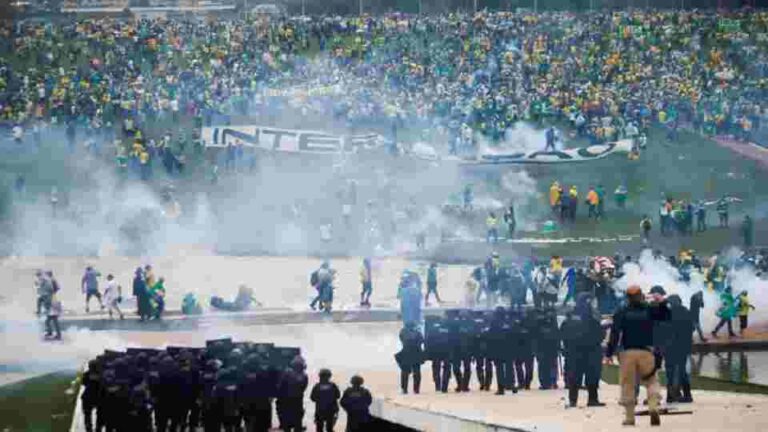
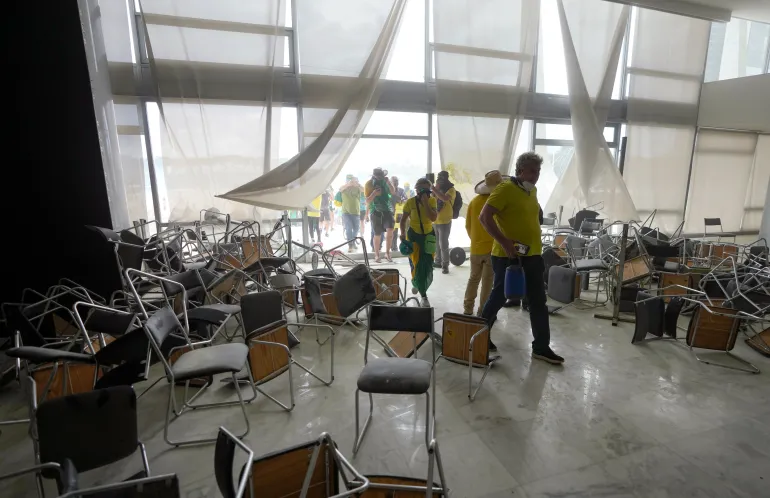
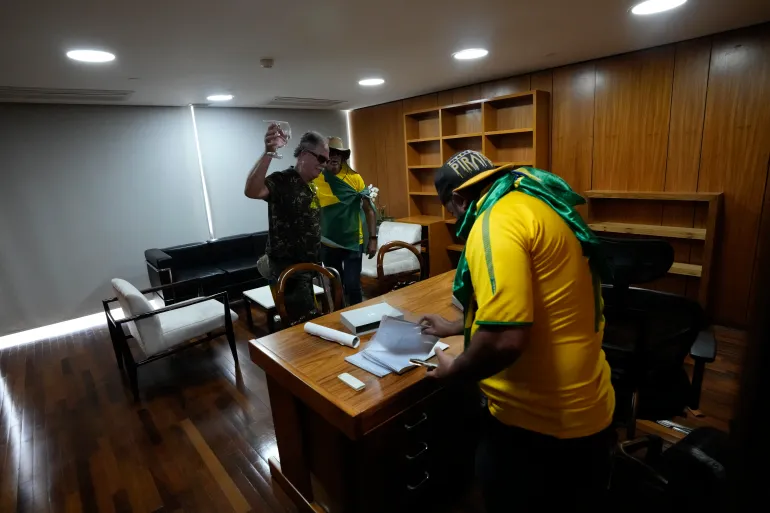
Videos on social media showed Bolsonaro supporters smashing windows and furniture in the National Congress and Supreme Court buildings on Sunday. They climbed onto the roof of the Congress building, where Brazil’s Senate and Chamber of Deputies conduct their legislative business, unfurling a banner that read “intervention” and an apparent appeal to Brazil’s military.
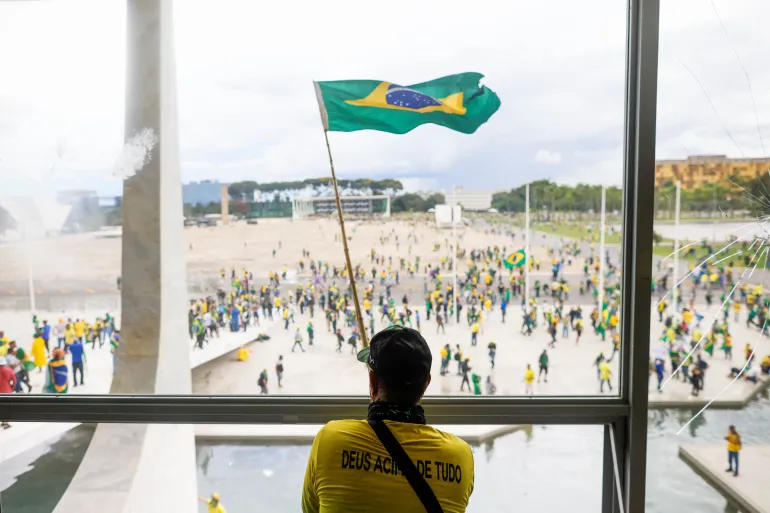
Images on TV channel Globo News also showed protesters roaming the presidential palace, many of them wearing green and yellow – the colours of the Brazilian flag, which have also come to symbolise the Bolsonaro government.
One social media video showed a crowd outside pulling a policeman from his horse and beating him to the ground.
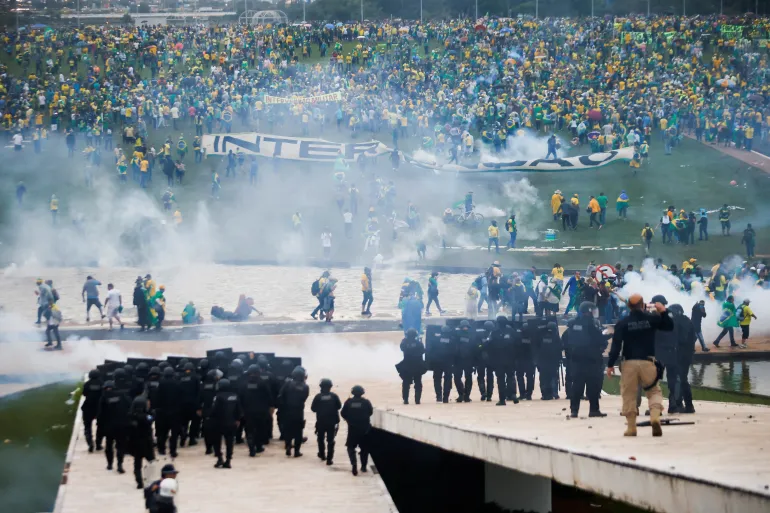
Security forces used tear gas in an effort to push back the demonstrators with local media estimating about 3,000 people were involved in the incident.
The siege, which lasted a little over three hours, comes just a week after the inauguration of Bolsonaro’s leftist rival, President Luiz Inácio Lula da Silva.
Responding to the invasion, Lula declared a federal security intervention in Brasilia that will remain in place until the end of the month.
In a press conference, he blamed Bolsonaro and complained about a lack of security in the capital, saying authorities had allowed “fascists” and “fanatics” to wreak havoc.
“These vandals, who we could call fanatical Nazis, fanatical Stalinists … fanatical fascists, did what has never been done in the history of this country,” said Lula, who was on an official trip to Sao Paulo state. “All these people who did this will be found and they will be punished.”
Bolsonaro, who has yet to concede defeat in the October 30 vote and is currently in the US state of Florida, has peddled the false claim that Brazil’s electronic voting system was prone to fraud, helping to fuel protests against Lula’s win.
Supporters have blocked roads, set vehicles on fire and gathered outside military buildings calling on the armed forces to intervene.
“This genocidist … is encouraging this via social media from Miami,” Lula said, referring to Bolsonaro. “Everybody knows there are various speeches of the ex-president encouraging this.”
Bolsonaro was silent for nearly six hours about the chaos in Brasilia before posting on Twitter that he “repudiates” Lula’s accusations against him.
The former president added that while peaceful demonstrations were part of democracy invading and damaging public buildings “crosses the line.” He did not attend Lula’s inauguration.
Reporting from Rio de Janeiro, Al Jazeera’s Monica Yanakiew noted that some Bolsonaro supporters had been camped out in Brasilia since the election.
“People from this camp and from other parts marched toward the square in Brasilia, called the Three Powers square, because in this same square you have Congress, the presidential palace, and the Supreme Court and they’ve entered the three buildings,” she said.
“They went inside the Supreme Court, which they consider to be their main enemy, because they say that the Supreme Court is biased, and recognised an election that they say is stolen,” Yanakiew said, noting that the incident occurred after Lula’s January 1 inauguration, when authorities were less likely to expect such a siege.
However, she added the “big question” remained as to why demonstrators were so easily able to overrun security forces during the incident, which took place when legislators, justices and other officials were not on the premises.
The storming recalled the January 6 invasion of the United States Capitol by supporters of former President Donald Trump, who like Bolsonaro’s supporters, also claimed without evidence that the 2020 US presidential election was “stolen”.
US President Joe Biden described the situation in Brazil as “outrageous” and that he looked forward to continuing to work with Lula.
“I condemn the assault on democracy and on the peaceful transfer of power in Brazil. Brazil’s democratic institutions have our full support and the will of the Brazilian people must not be undermined,” Biden said on Twitter.
Brazilian law professor Diego Amparo said that like Trump, Bolsonaro had for years fomented distrust in government institutions.
“It’s the kind of rhetoric that was seen not only in the election cycle, but throughout the whole presidency of Bolsonaro,” he told Al Jazeera. “So this moment is really the concrete symbol of several years of trying to discredit the political and judicial institutions in the country.”
He added that many local officials and members of the armed forces maintain ties with Bolsonaro, making it a “very complicated situation” for Lula and his government to navigate.
On Twitter, Brazil’s Justice Minister Flavio Dino said: “This absurd attempt to impose their will by force will not prevail.”
“The government of the Federal District has ensured there will be reinforcements. And the forces at our disposal are at work,” he said.
Chief Justice Rosa Weber and Justice Alexandre de Moraes pledged punishment for the “terrorists” who had attacked the country’s democratic institutions, while the heads of both houses of Congress denounced the attacks publicly.
Senate President Rodrigo Pacheco said he was in permanent contact with Brasilia’s Governor Ibaneis Rocha, and said that the entire police apparatus had been mobilised to control the situation.
Rocha later said on Twitter that more than 400 people had been arrested over the invasion. But the Brazilian police later revised the figure down to 300.
Rocha said those arrested “will pay for the crimes committed”.
“We continue working to identify all the others who participated in these terrorist acts this afternoon in the Federal District. We continue to work to restore order,” he tweeted.
Sri Lanka’s economy has been turned upside down by so called tools introduced by the Central Bank following the introduction of their toolsin 2020 in response to verbal attack levelled at CB top officials including former Governor W D Lakshman and Senior Deputy Governor Nandalal Weerasinghe by then President Gotabaya Rajapaksa on June 16 2020.
Sri Lanka’s Former President Gotabaya Rajapaksa has slammed central bank over not issuing 150 billion rupees of new money for banks to give loans to businesses hit by Coronavirus.
“The Central Bank had ignored the proposal made by the President to provide Rs. 150 billion to banks by accepting the outstanding due as collateral,” he had told central bank officials who were summoned to a meeting at the Presidential secretariat at that time..
“The Central Bank and the Treasury are entrusted with the responsibility of formulating the right monetary and fiscal policies that are instrumental in economic revival.”
He lambasted officials saying “You have several tools that can be used. Those tools have to be utilized. However, our Central Bank does not use a single tool. It just stays idle.”
“Foreign countries can run the economy. This is a money circulation process. This is a very simple tactic and this is a basic economic principle. But, what are you doing? He asked ,
Burning mid night oil, CB officials hurridly submitted a report with recommendations to the the then President who gave his consent to implement it.
That is how the country’s economy began its down turn from bad toworse several eminet experts pointed out. Adding that the people should be reminded about these facts.
Accordingly the Central Bank of Sri Lanka also deployed an array of monetary policy tools in 2020, while being one of the first central banks in the world to ease monetary policy citing the outbreak of COVID-19.
These policies, including unconventional measures, were executed at an extraordinary pace, size, and scope, aimed at injecting sufficient liquidity into the market and lowering borrowing costs, thus supporting financial markets and the recovery.
the Central Bank reduced its policy interest rates substantially by 2.50 percentage points during 2020, with a view to enhancing credit flows by lowering real interest rates, which in turn would support domestic investment, production and consumption in the economy.
Further, the Central Bank lowered the Bank Rate by 6.50 percentage points during the year to signal the availability of emergency funding for the financial sector at an affordable cost.
It lowered the Statutory Reserve Ratio (SRR) by a total of 3 percentage points, thereby directly injecting liquidity of around Rs. 180 billion to the market immediately, in 2020.
Open Market Operations (OMO) conducted by the Central Bank guided short term interest rates to remain at low levels while maintaining sufficient liquidity in the money market.
Further, the Central Bank provided urgent financial assistance to the Government, in order to support businesses and individuals affected by the pandemic, by purchasing Treasury bills from the primary market, totaling around Rs. 625 billion, on a net basis, during the year.
Some of the world’s most powerful hedge funds and other investors are holding up vital help for crisis-hit Sri Lanka by their hardline stance in debt-relief negotiations after the Asian country’s US $51 billion default last year, according to 182 economists and development experts from around the world.
In a statement released on Sunday 08 , the group said extensive debt restructuring was needed to give the economy a chance of recovery and that Sri Lanka would be a test case of the willingness of the international community to tackle a looming global debt crisis.
The group – including the Indian economist Jayati Ghosh, Thomas Piketty, the author of the bestselling book Capital, and Greece’s former finance minister Yannis Varoufakis – said private sector creditors such as investment companies and hedge funds were preventing a deal.
Private companies who lent at high interest rates are holding up vital debt relief for Sri Lanka, a group consisting of global economists and development experts said.
Debt Justice said that these private companies, who lent to corrupt politicians, must face consequences from their risky lending by cancelling Sri Lanka’s debt.
The experts say that private companies who lent at high interest rates to corrupt politicians must face consequences from their risky lending by cancelling debt.
Debt restructuring negotiations for Sri Lanka are now at a crucial stage. Much of the focus has been on the role of China in the debt talks, but 50 percent of Sri Lanka’s external debt payments are to private lenders, whereas only 14 percent are to China.
In the statement the experts say private creditors own almost 40 percent of Sri Lanka’s external debt stock, mostly in the form of International Sovereign Bonds, but higher interest rates mean that they receive over 50percent of external debt payments.
“Such lenders charged a premium to lend to Sri Lanka to cover their risks, which accrued them massive profits and contributed to Sri Lanka’s first ever default in April 2022. Lenders who benefited from higher returns because of the “risk premium” must be willing to take the consequences of that risk.”
The statement notes that debt negotiations in Sri Lanka are now at a crucial stage and all lenders—bilateral, multilateral, and private — must share the burden of restructuring.
However, the statement notes that Sri Lanka on its own cannot ensure this and it requires much greater international support.
“The Sri Lankan case will provide an important indicator of whether the world—and the international financial system in particular—is equipped to deal with the increasingly urgent questions of sovereign debt relief and sustainability; and to ensure a modicum of justice in international debt negotiations” the statement pointed out..
“It is therefore crucial not only for the people of Sri Lanka, but to restore any faith in a multilateral system that is already under fire for its lack of legitimacy and basic viability, it added.”
Sri Lanka is one of several countries which have defaulted on external debt, or are seeking a debt restructuring, since the Covid pandemic began.
Ghana suspended many of its external debt payments in December 2022, following Lebanon, Suriname, Ukraine and Zambia.
With global interest rates increasing and widespread recessions expected in 2023, many more countries could follow.
Debt Justice research has found that, for two-thirds of lower income countries with International Sovereign Bonds, interest rates are so high that they are probably unable to take out new loans from external private lenders, increasing the chance they will need to default on their existing debts.
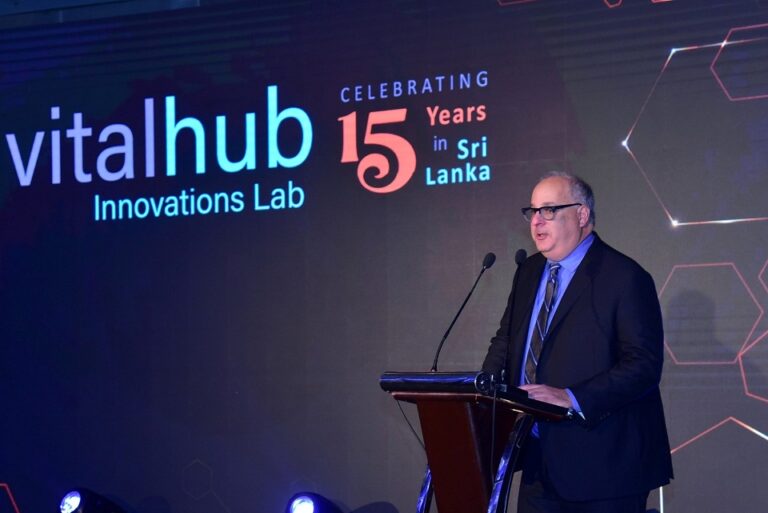
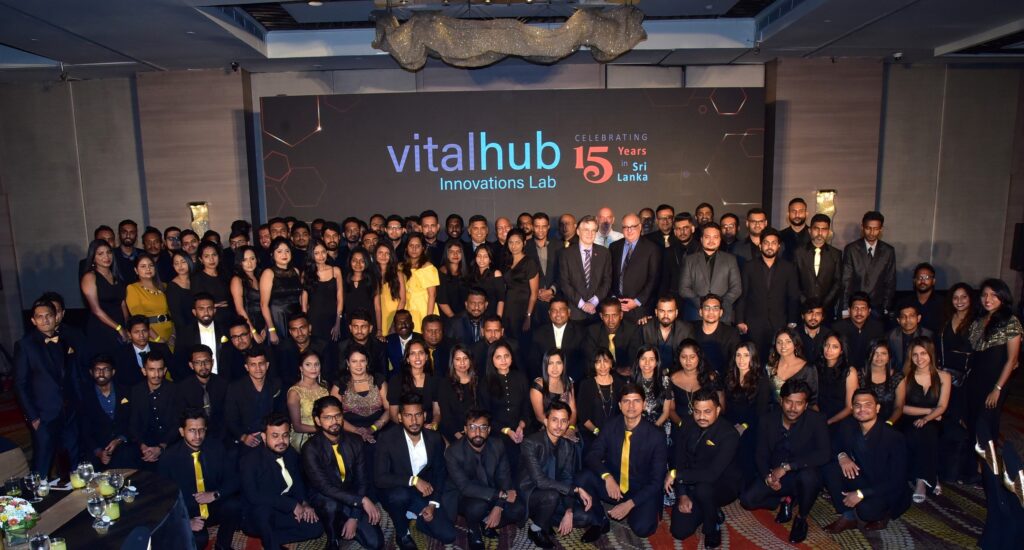
VitalHub Innovations Lab, the software development hub of Canadian-based VitalHub Corp., a leader in providing cutting edge technology solutions for healthcare organizations across Canada, USA, UK, Australia, New Zealand, Middle East and Europe, recently celebrated 15 years of enduring success, growth and resilience in Sri Lanka with a glamorous event held at Cinnamon Grand, Colombo. The event saw the participation of Dan Matlow, President and CEO of VitalHub Corp. and Vijit Coomara, EVP Product Development as chief guests including Daniel Bood, Acting High Commissioner/Counselor – Political and Trade and Abdul Majeed, Senior Trade Officer from the High Commission of Canada to Sri Lanka, and SLASSCOM Chairman Ashique Ali. ‘VitalHub has been a long-standing and well-respected member of the IT&BPM industry in Sri Lanka and have been supportive of the industry growth more so on the talent development throughout the country,’ said Ashique. ‘I was impressed to witness the key role VitalHub Innovation Lab in Sri Lanka play supporting the rapid global growth of the parent company VitalHub by bringing innovation, integration, and services to the healthcare sector they serve in many countries.’ Daniel Bood said ‘I was proud to be part of celebrations marking the 15th anniversary of VitalHub’s operations in Sri Lanka. As an ethically managed Canadian company consisting of talented individuals who produce high quality products that save lives, VitalHub is making the world a better place.’ Long-standing employees serving the company for 5, 10, and 15 years were facilitated with awards and recognitions, which speaks volumes for itself given the industry’s retention. ‘I couldn’t be prouder of what our talented team have achieved in the last 15 years, contributing immensely to VitalHub’s achievements. It’s been an incredible journey and we’re excited to take on the future,’ added Vijit Coomara – EVP Product Development. The celebratory event also featured various colorful performances of music, dances and also crowning a king and queen, with full of surprises and competitions among colleagues. This joyful evening was filled with unforgettable memories to reminisce. With over 300 employees engaged in engineering, product development, client support, acquisitions and mergers, operations, and business development, VitalHub Innovations Lab is only growing stronger, being.
constantly on the lookout for passionate individuals to be part of its fun, skilled and energetic workplace culture that champions creativity and support. Employees here are often referred to as change makers, and the very fabric of bringing innovative solutions and exploring new possibilities to take on the world of healthcare technology. Some of the benefits include hybrid work culture, CAD pegged salaries, funding for renewal power, internet allowances, among various others. Being in Sri Lanka for 15 years, we strive to Digitize Innovative Healthcare Solutions across the healthcare continuum. Headquartered in Canada, VitalHub develops and deploys information technology solutions for North American healthcare organizations. Our software development team uses the latest tools and techniques to ensure that our SaaS web / cloud-based software releases are innovative.
Amidst Sri Lanka’s worst economic crisis since independence, the UN recently revised its joint Humanitarian Needs and Priorities (HNP) Plan, appealing for more life-saving assistance to aid 3.4 million people.
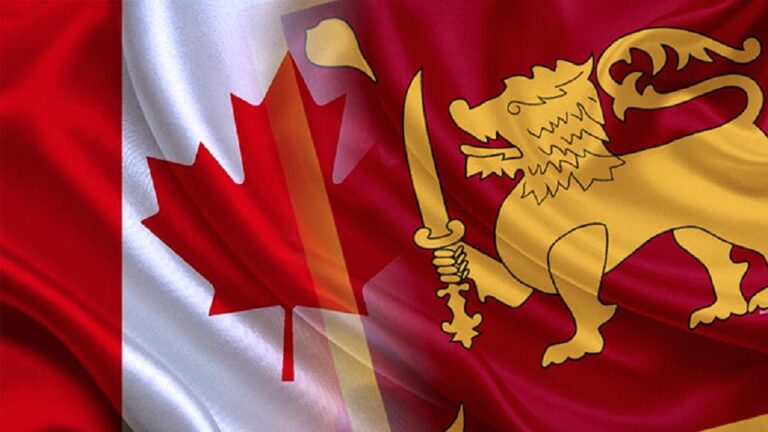
Canada has become the latest donor for UN humanitarian assistance for Sri Lanka poorest of the poor people countrywide.
It has provided US$ 3 million (approximately Rs 817 million) to help address the needs of the most vulnerable communities in Sri Lanka.
This contribution comes in response to the humanitarian appeals launched by the United Nations (UN) and the International Federation of Red Cross & Red Crescent Societies (IFRC).
It is expected to help address the needs of the most vulnerable communities in Sri Lanka, the Canadian High Commission in Colombo said in a press release.
It will be delivered through the UB and the IFRC, in collaboration with their local partners to support the provision of emergency food assistance, health and nutrition services, access to safe water and other essential services to those who need it the most.
In addition, Canada has provided ongoing international assistance projects to address immediate needs and help respond to the economic crisis in Sri Lanka, including the procurement of essential medical equipment and supplies.
The Canadian government has pledged to continue to stand with all Sri Lankans in these difficult times and to remain committed to supporting an inclusive, prosperous Sri Lanka.
Since June 2022, the UN team in Sri Lanka and NGOs have used the HNP to respond to the Government’s request for more support to alleviate the impact of the country’s debt and food crisis, and shortages of medicines.
Governments and donor agencies have helped the humanitarian community reach over one million of the country’s most vulnerable with cash, food, school meals, medicine, protection, and livelihood support.
“We are immensely appreciative of the solidarity the international community has shown with the people of Sri Lanka, including through their generous contributions to the HNP”, said UN Resident Coordinator in Sri Lanka, Hanaa Singer-Hamdy.
Aligned with appeals from other UN agencies, the HNP has raised $79 million for Sri Lanka through various countries and organizations).
The HNP revision, which extends the plan through 2022, requires $70 million in additional funds to reach a total of $149.7 million.
In response to the humanitarian community’s updated estimates on the number of people in need across all 25 of Sri Lanka’s districts, the extended appeal will improve nutrition for children, pregnant women, and breastfeeding mothers; secure safe drinking water; and protect vulnerable farming and fishing households.
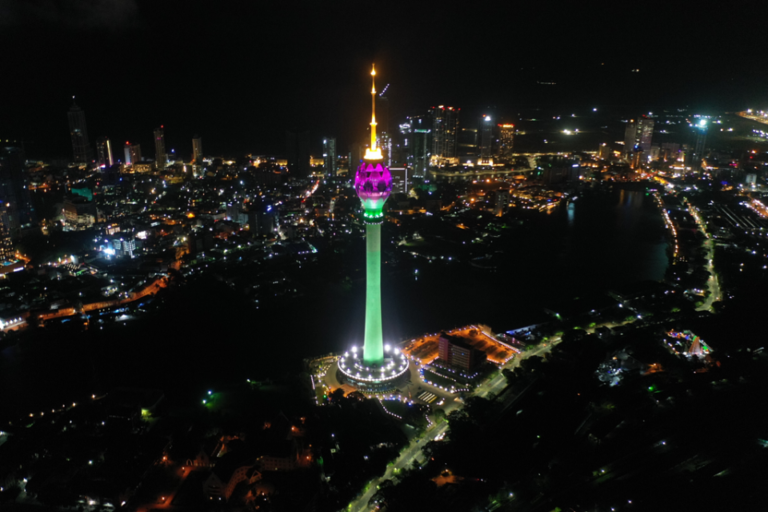
Colombo Lotus Tower project incurs Sri Lanka US$113 million in maintenance reportedly huge and annual revenue is estimated at present at around $8.2 million.
The opening of the Colombo Lotus Tower, South Asia’s tallest structure, to the public on September 152022, has revived focus on the nature of Chinese lending practices in Sri Lanka.
The mega scale project has generated a revenue of Rs. 268 million since September 15 2022, an official said.
Built at an estimated cost of $113 million, the Lotus Tower project was constructed on an $88 million loan from the EXIM Bank of China, with the Sri Lankan government bearing the balance costs.
Often portrayed as a symbol of the unproductive excessive spending of the Mahinda Rajapaksa regime, the tower project underscores the importance of transparency in development finance.
Work on the project commenced in 2012 and was plagued by delays. The Rajapaksa administration said that the purpose of the project was to improve Sri Lanka’s telecommunications infrastructure and provide leisure activities for the public.
In the first fortnight of its opening to the public, over 100,000 people visited the tower. The average daily income from ticket sales has been around $5,500 and the expected annual revenue is about $8.2 million.
The CEO of the newly-formed Colombo Lotus Tower Management Company Maj. General (retired) Prasad Samarasinghe said that the bulk of this revenue would come from entertainment ventures.
A Singaporean company called Go Bungy, which will be initiated in the second quarter of 2023 and it is expected that 130 jumps will take place per day. Around 17,000 tourists are expected this year for bungee jumping alone
The tower which is still not fully opened attracted half a million visitors within the first three months of its opening, the official said, adding that a plaque and a gift voucher were presented to the milestone visitor who had travelled from Matara.
The tower is now open to small boutiques by the Lake Edge. Selected bidders are currently being signed on for the retail and restaurant outlets, the official added.
The controversial telecommunication tower has attracted a bungee jumping offer, with a, the official said.
‘Among the 500,000 visitors to the Tower, there had been 4,083 foreign tourists, according to official data.
The main activities for now are the observation deck and a revolving restaurant, for which bids are still underway. Facilities were to be opened in the next two to three months, based on the tenders expected to be offered to shops and retailers, out of which many are still in the tendering procedure.
A statement from the President’s Media Division (PMD) said that the Colombo Lotus Tower Private Company is engaged in negotiations with 58 investment companies and has expressed interest in entering into agreements with 22 of them.
The tower, said to the tallest in South Asia, triggered controversy when Indian government raised concerns over its purpose as China was behind the construction amid concerns over spying, Sri Lanka government officials claimed.
The contract to build the $104.3 million tower – 80 percent of which was funded by Exim Bank of China – had been awarded in 2012 to China National Electronics Importers and Exporters Corporation (CEIEC) and Aerospace Long March International Trade Co. Ltd, (ALIT) by the Cabinet of ministers.
Former president Maithripalaa Sirisena after inaugurating the tower in 2019 alleged that ALIT had been misappropriating some Rs. 2 billion ($11 million) deposited with it by Sri Lanka’s state-run Telecommunication Regulatory Commission (TRC).