Home Blog Page 1942

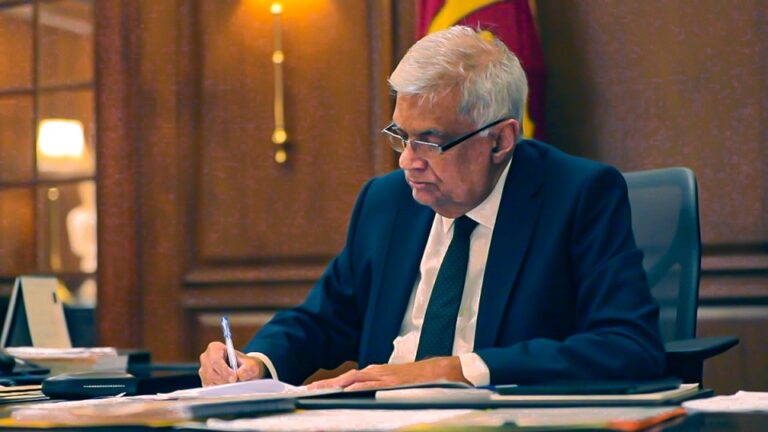
President says initial steps taken through Budget to strengthen Economy under a five-year plan

0

President Ranil Wickremesinghe stated that the measures to strengthen the economy under a five-year plan are envisaged in the budget proposal for 2023 which has the potential to bring about a transformative economic change within the period between 2023 and 2027.

The President made this observation during the District Development Progress Review Meeting held at the Vavuniya Town Hall yesterday (19).

The statement made by President Ranil Wickremesinghe is as follows;

“It is clear to us that the government’s program for food security has been implemented in Vavuniya, Mannar, and Mullaitivu Districts. Four officers from each Divisional Secretariat have been appointed for the implementation of the food security program.

The liquid milk industry would be developed in the Northern Province under Indian aid. Particularly, you were called on this occasion to raise awareness of the food shortage in the country and to discuss the implementation of the food security program. We hope to address the imminent food shortage issue in the country. It is planned to continue this program until the end of 2023. We will consider later if this program is required to continue. A global food shortage may be imminent and this food security program is important to protect Sri Lanka in the face of this imminent danger. Africa is already suffering from food shortages.

The country’s Maha season cultivation is successful and if other crops also achieved similar success, we can face the food shortage easily. Apart from that, we have to control malnutrition and protect the yield. We should take measures to minimize wastage during harvesting. We would strengthen the food storage process and supply them to customers. Vavuniya and Mannar Districts have a big responsibility in securing the available surplus food.

Several issues related to education and health in these districts were revealed during the discussions and we hope to provide solutions to address them soon. We have planned to work with the International Monetary Fund IMF) which would enable us to create considerable growth in the economy. We have to make massive changes in the export economy and move towards to a larger foreign exchange-earning economy.

I have presented proposals in the 2023 budget to achieve this end in which the North too have to play a pivotal role. One should remember not only Jaffna but Vanni too has a significant role in it.

We need to pay attention to a new energy economy of which the main region would be the Northern Province. We can earn a lot of foreign exchange through this project. There is an opportunity to earn foreign exchange by exporting food to the Middle East and Singapore. We would open opportunities for growing new crops including cinnamon.

Vanni has a great responsibility in animal husbandry which has a significant place in the five-year plan from 2023 to 2027.

We are studying the possibilities of transforming the Vavuniya Airport into an international airport and I require the support of the people of the North to realize it.”

The President also inquired from the Divisional Secretaries regarding the progress of the food security program in the Vavuniya District.

Fisheries Minister Douglas Devananda, Urban Development and Housing State Minister Tenuka Vidanagamage, Rural Development State Minister Kader Masthan, Parliamentarians Selvam Adaikalanathan, Rishad Bathuideen, Charles Nirmalanathan, Kulasingham Thileeban, Northern Province Governor Jeevan Jeevan Thiagarajah, Secretary to the President Saman Ekanayake, District secretaries to Vavuniya , Mullaitivu and Mannar districts and other government officials were present at the occasion.

Budget allocations to support SMEs: Ramesh Pathirana

0

The budget for the year 2023 had set aside an amount of 2 billion to fund and support the SME sector, said Minister of Industries and Chairman of the Ministerial Consultative Committee on industries Ramesh Pathirana said, acknowledging the concern raised by Leader of the Opposition Sajith Premadasa, over the Small and Medium Enterprises (SMEs) under the present context at the Committee meeting held.

The Committee was also of the view that a proper mechanism needs to be set out to asses SMEs to which assistance is to be granted in a methodically executed manner.

Furthermore, 19 Annual Reports which has been pending for a long period of time was presented before the Committee for its consideration and was approved.

The said reports were considered and approved at the first meeting of the Ministerial Consultative Committee on industries for the third session of the ninth Parliament held recently (16), chaired by Pathirana.

Furthermore, members also raised concerns over the Dolomite industry. It was stated that the lack of explosives and allowing imports affect the industry and small-scale entrepreneurs.

The Chair stated that the concern pertaining to explosives are being looked into and that the Ministry will look into the concern raised regarding allowing imports.

Many concerns on various industries from matters that arise challenging the development of the batik industry and the availability of raw material required for the industry, concerns pertaining to the national gem and Jewelry industry were also brought to attention by Members of Parliament at the Committee meeting held.

State Minister Prasanna Ranaweera, Janaka Wakkumbura, Chamara Sampath Dassanayake, MPs Rishad Bathiudeen, Buddhika Pathirana, Madhura Withanage, Nalaka Bandara Kottegoda, Sumith Udukumbura, Mohamad Muzammil, Sahan Pradeep Withana were present at the Committee meeting.

Adverse weather conditions may occur against coastal zone in island

0

The low-pressure area in the southeast Bay of Bengal and neighborhood moved west-northwestwards to Central parts of south Bay of Bengal and It is very likely to move West-northwestwards and gradually intensify into a depression during next 12 hours in Southwest Bay of Bengal and move west- northwestwards towards the coastal areas of Tamilnadu-Puducherry, said the Department of Meteorology in a statement today (20).

Strong winds about (40-50) kmph can be expected at times over the Northern, North-Central and Eastern provinces.

A few showers will occur in Northern, North-Central and Eastern provinces.

Mainly fair weather will prevail elsewhere over the country.

Marine Weather:

The low-pressure area in the southeast Bay of Bengal and neighborhood moved west-northwestwards to Central parts of south Bay of Bengal. It is very likely to move West-northwestwards and gradually intensify into a depression during next 12 hours in Southwest Bay of Bengal and move west- northwestwards towards the coastal areas of Tamilnadu-Puducherry. Therefore, Naval and fishing communities are advised not to venture into the deep and shallow sea areas off the coast extending from Kankasanturai to Batticaloa via Trincomalee and Southwest Bay of Bengal sea area for next 24 hours.
Condition of Rain:
Showers or thundershowers will occur at several places in the deep-sea areas off the coast extending from Kankasanturai to Batticaloa via Trincomalee.
Winds:
Winds will be northerly and speed will be (25-35) kmph. Wind speed may increase up to (50-60) kmph at times in the sea areas off the coast extending from Kankasanturai to Pottuvil via Trincomalee and Batticaloa. Wind speed may increase up to 45 kmph at times in the other sea areas around the island.
State of Sea:
The sea areas off the coast extending from Kankasanturai to Pottuvil via Trincomalee and Batticaloa will be rough at times. The other sea areas around the island will be fairly rough at times. There is a possibility that near shore sea areas off the coast extending from Kankasanturai to Pottuvil via Trincomalee and Batticaloa may experience surges due to the effect of swell waves, having (2.0-3.0) m height.

MIAP

Sri Lanka Original Narrative Summary: 20/11

0
  1. Sri Lanka Embassy in Beijing targets 1 mn Chinese tourists to visit Sri Lanka after the China travel restrictions are relaxed.
  2. IMF expresses concerns over Governments move to explore “debt-for-nature” swap of around USD 1 bn: fears it could lead to a possible deviation from on-going debt restructuring: in early April ’22, the Govt & CB had finalised plans to issue “Green Bonds” of USD 2 bn, but abandoned such plan after the “default” announcement by CB Governor Weerasinghe and Treasury Secretary Siriwardene.
  3. Pivithiru Hela Urumaya Leader and MP Udaya Gammanpila says CB Governor Weerasinghe is “addicted” to printing money and is on course to set a new record: proposes the Governor be sent for “rehabilitation”.
  4. Despite ongoing shortage, milk powder importers complain that inconsistent Govt policies relating to imports and failure to honour international agreements have led to almost 400 MT of milk powder being stuck at the Colombo Port.
  5. SJB MP Champika Ranawaka warns of Govt attempts to cover up a Budget deficit through the Budget 2023: says Govt has neglected the fact that the country is in a state of sovereign default.
  6. State Finance Minister Ranjith Siyambalapitiya says the CESS Tax proposed in the Budget 2023 will not be applicable to school text books & implements.
  7. Chinese Embassy in Colombo says a new consignment of 1,000 MT (100,000 packs) of rice donated by China to Sri Lankan island-wide schools has arrived at Colombo Port, and will be distributed soon.
  8. Opposition MP Ven. Athuraliye Rathana Thera says people will soon have to wait in queues for food due to shortages as they had previously waited for fuel and gas: also says Budget 2023 is an “inflated” budget, and won’t solve the current economic crisis.
  9. Ports Minister Nimal Siripala de Silva says Norwegian passenger liner “Vikingmas” with 700 tourists and 450 crew members which has just berthed at Colombo Port, is the first passenger ship to berth after the Covid pandemic.
  10. Deputy Secretary to the Treasury R M P Ratnayake says the Govt currently has no plans to introduce a “wealth tax”: asserts he is unaware whether Govt would pursue it in the future.

President wishes to see all citizens live as children of one mother

0

President Ranil Wickremesinghe said that he is ready to bring together all the people, Sinhala, Tamil, and Muslim in providing solutions to the Northern problem, adding that he wished for all the people of this country to live as children of one mother even by the 75th Independence Anniversary.

The President said this during the inauguration of the Presidential Secretariat Northern Province Coordination Sub-Office opening in Vavuniya today (19).

The President said that the people of the North as well as the South have been suffering for a long period of time due to various reasons, adding that steps would be taken to resolve their issues expeditiously.

The President presented housing deeds to 30 symbolically out of 120 recipients at the Vavunia District Public Servants’ Housing Scheme during his visit. In addition financial aid was presented to another 12 symbolically out of 96 claimants for property damage due to the war conflicts in the North.

In addition symbolizing the distribution of fertilizer to farmers in the Vavuniya district, the President distributed fertilizer to several farmers.

Further expressing his views, President Ranil Wickremesinghe said,

“The problems facing by the people of the North could be discussed at this office. MP Kader Masthan said that everything was done for the people of Jaffna only. So, we have opened an office in Vavuniya as well. An officer from the Presidential Secretariat will coordinate these matters. I believe that officers from the various ministries should come to this office and look into resolving the issues of the Northern people. All the issues facing by the people must be resolved.

We must provide solutions to the problems caused by terrorism and the problems of the Northern people. Muslims too have questions about their rights in Sri Lankan society. The upcountry people also have various problems. There is a social opinion that all these problems should be solved. So this is the best time to solve all these problems. These issues must be systematically resolved. I intend to discuss these matters with the Sinhala, Tamil, and Muslim communities. I intend to provide solutions to resolve these issues without dividing the country.

First, we must dispel the people’s mistrust. Once, we all start working together this mistrust will fade away.

People who suffered due to war will get solace. We have come a long way since 1983. We have also come a long way since 2009. It brings to mind a line from the National Anthem which states, “living as children of one mother”. My wish is that we can live as children of one mother at least by the 75th Independence Anniversary.”

Expressing views Fisheries minister Douglas Devananda said that in 2015, MP Sumanthiran promised to provide solutions for the issues of the Northern people. However, due to some reason, this promise was not fulfilled. Now, what is gone is gone.

Fisheries minister Douglas Devananda further said:

“Let’s take steps to resolve the problems facing by the Tamil people in the future. We are glad that the Tamil National Alliance is flexible in this manner. If we work in unity, I am certain we could resolve the issues facing by the Tamil people as well as the issues facing by the country.”

Expressing his views, MP Selvam Adaikkalanathan said,

“We are very happy about this historic occasion. I thank the President for establishing such an office regarding the development of the North. We believe that the problems of the Tamil people will be solved very quickly.”

MP M.A. Sumanthiran said, “The President has worked to provide solutions for the problems of the people of the North during his tenure as the Prime Minister. In 2015, as the Prime Minister, you worked to provide a solution to the problems of the people of the North. But due to certain shortcomings, we were unable to get it. Today you have become the president. Therefore, we are confident that the problems of the people of the North would be solved. While extending our support for your program, we urge you to resolve the issues facing by the Tamil people.”

Urban Development and Housing State Minister Tenuka Vidanagamage, Rural Development State Minister Kader Masthan, Members of Parliament Kulasingha Thileeban, Northern Province Governor Jeevan Thiagarajah, President’s Secretary Saman Ekanayake, Vavuniya District Secretary P.A. Sarathchandra, and several government officials were present on this occasion.

PMD

Forty recruits for foreign services in batches to be absorbed by July

0

The Ministerial Consultative Committee on Foreign Affairs disclosed that given that recruitment for foreign service has not been made since 2018, there is a deficiency in the foreign service sector. Thus, Ali Sabry, PC Minister of Foreign Affairs stated that it is intended to absorb forty recruits for foreign services, in batches by July.

The aforesaid was stated at the first meeting of the Ministerial Consultative Committee on Foreign Affairs held recently (10) under the chairmanship Ali Sabry, PC, Minister of Foreign Affairs when the Members present raised the concern of the quality of the recruits of Foreign Service and the current status of the examination.

Members present raised concerns that many Sri Lankans are seen on pavements near foreign embassy entrances from morning till noon. The Members were of the view that it is not a pleasant sight and therefore a proper mechanism should be established to avoid the situation. The Minister stated that discussions have been carried out regarding the matter and it will be looked into as soon as possible.

Furthermore, explaining the array of tasks performed by the Ministry, Hon. minister stated that apart from the daily tasks, the Ministry of Foreign Affairs is also involved in looking into various concerned raised by the UNHRC and ways to domestically face such international concerns. The Minister also stated that a lot of ground work is been done coordinating with foreign nations given the debt restructuring process.

Sabry explained the nature of services provided by the Foreign Ministry and highlighted during the weekend in its role in coordinating the efforts to rescue 303 Sri Lankan’s who were abandoned by traffickers in the middle of the sea. As well as providing consular assistance to cricketers Dhanushka Gunathilaka at the time of his arrest. Further he highlighted the Sri Lankan High Commission in London’s role during the world tourism forum to promote Sri Lanka globally.

Thus, many of the work carried out by the Ministry of Foreign Affairs sometimes does not get enough publicity due to its nature.

State Minister of Foreign Affairs Tharaka Balasuriya, State Ministers Lasantha Alagiyawanna, Shantha Bandara, Diana Gamage, Ashoka Priyantha, MP (Dr.) Kavinda Jayawardhana, Sudath Manjula, Sanjeeva Edirimanna, Wasantha Yapabandara, Chandima Weerakkody, Weerasumana Weerasinghe were present at the Committee meeting held.

SLPP Pradeshiya Sabha Member accused of drug smuggling arrested

0

A Sri Lanka Podujana Peramuna (SLPP) Ukuwela Pradeshiya Sabha member and two women accused of heroin smuggling have been arrested by the Matale Police.

2,500 mg of heroin have been recovered from the arrested Pradeshiya Sabha member and 2,500 mg from the arrested women.

The arrested SLPP Pradeshiya Sabha member was previously arrested on multiple occasions for various crimes, including child molestation, and is currently on bail.

The said SLPP Pradeshiya Sabha member is believed to be committing drug smuggling in hiding in Narikanda, Kaludewala, Matale, according to investigations.

MIAP

Proposals on law reforms related to economic stabilisation to be submitted in December

0

Chairman of the National Council Sub-Committee for Identifying Short- and Medium-Term Programs related to Economic Stabilisation, MP Patali Champika Ranawaka, said that proposals for the reform of laws related to the economic stabilisation of Sri Lanka will be presented to the country at the end of December.

The Committee Chief made this remark during the committee meeting held recently (15) to discuss the new laws related to the economic stabilisation of the country.

The chairman said that it is important to discuss whether there are shortcomings in the law among the reasons that led to the country’s economic bankruptcy, and to discuss the next steps to be taken.

The experts participated in the committee expressed their views on the reforms that should be made in the country’s legal system in order to obtain local and international support to create economic stability in the country.

The role of the Central Bank of Sri Lanka (CBSL), the role and accountability of the Treasury, the role and accountability of the Government of Sri Lanka (GOSL), the accountability of government officials, politicians and the business community dealing with them were discussed at the committee. Meanwhile, proposals were presented on the need for a large-scale anti-corruption process and the importance of implementing the law on assets and liabilities.

Officials of the Ministry of Justice said that 55 new laws and amendments to existing laws are currently underway. On the occasion, the senior lawyers pointed out that due to the Covid-19 pandemic, the number of cases pending in the courts is high, due to which the trials should be managed efficiently.

Minister Naseer Ahmed, MPs M. Rameswaran and Sagara Kariyawasam, officials representing relevant institutions including the Secretary to the Ministry of Justice, Deans of Law Faculties of Universities in Sri Lanka and experts in the field of law Sanjeeva Jayawardena, Sarath Jayamanna, Krishmal Varnasuriya, Maithri Gunaratne, Gunaratne Vanninayake and Shiral Lakthilaka were present on the occasion.

MIAP

SL’s strategic location should be made use of to enhance economic prospect: President

0

• Invites the private sector to play greater role

President Ranil Wickremesinghe said that the government is looking at removing the para-tariffs and the tariffs over five years, with a trade adjustment programme to help industries and manufacturers meet competition, adding that from the government side discussions have been initiated with the World Bank and the Asian Development Bank (ADB). He said that now it is up to the private sector to decide how they are going to relate to it. He said that the private sector would have to decide whether they are going to put up the red flag of protection and take the government on or if they are going to open up. 

The President said this addressing the Post Budget Forum 2023, ‘Hurdling towards Opportunities- beyond Challenges’ organized by the Colombo University MBA Alumni Association which was held at the Shangri La Hotel in Colombo today (18). 

The President, as a Colombo University Alumni, was the first to present a budget. He said that Sri Lanka’s strategic location should be made use of to enhance the country’s economic prospects. He called for the completion of the East terminal to promote the country as a logistics centre that can be expanded up to the North Port, which will be from Mutwal up to Ja-Ela. 

He added that if the country is to be brought out of the current predicament, not only the government, but the private sector and the people also have a big role to play. He said that the government should handle the task of providing for the people and focusing on the health, education, housing and welfare sectors. Running businesses, he said, should be handled by the private sector. President Wickremesinghe noted that the government cannot get involved in running businesses. 

Following is the full speech delivered by President Ranil Wickremesinghe at the Post Budget Forum 2023:

“The president of the Colombo University MBA Alumni Association, the Governor of the Central Bank, the Secretary to the Ministry of Finance, the Editor of the Financial Times, distinguished guests and friends. As a Colombo University Alumni, the first one to present a budget, it gives me great pleasure to be amongst the Colombo University Alumni in this discussion, you have organised for the 2023 budget. This is not a budget in the normal sense such as looking at proposals in which you have increased the price of cigarettes where they have reduced the price of something else and a few other statements of what they will do. If you look at it as such a budget, then you’re going on the wrong route.

 Unfortunately, many members of parliament and many outside have made that mistake. We are in the middle. As your opening statement said, we are in the middle of an unprecedented financial crisis, which many countries in the world have not faced. We went into this because we followed the wrong policies. We were thinking of policies not of practical results. When I took over as Minister of Finance, my first task was to stabilise the economy. The measures necessary have been contained in the August budget. 

The legislative process will also start. In addition to this, while we commit to a staff-level agreement, now we have to negotiate with our main bilateral creditors. We are again unique in that two of our creditors are not members of the Paris Club. We are negotiating at the moment both with India and with China. Once those negotiations are completed, and I believe it will be done successfully, then we have to talk to the private creditors and go back to the board. So that process is known and we are carrying it out. 

The results of the measures we took in August will be known in the first half of next year. We had to look beyond that. We had to then look at recovery. What is our economic recovery? What is the plan? What is the structure? What is the framework? We must have that in mind. 2023 is not only a year of stabilisation but also a start of the recovery programme. The stabilisation measures will be a four-year one, ending in 2026. By that time hopefully, our GDP will be back to what we were in 2019.  I still don’t know what will happen. However, how do we go beyond that? Are we satisfied with the system? Can we start borrowing again and getting into the same crisis in another ten years’ time?  The only difference is that we may go to the IMF before the crisis hits us. 

Are you going to be Asia’s version of Argentina? Are we going to make it, and this time succeed? My view was that we had to make it and we must succeed. What is the way to go? Many other systems that we have talked of have failed. Many articles are today being written in the newspapers about the old system. In the end of it, we failed. I looked at another example, which we did not follow from the institution that was there before the University of Colombo, the University College. 

The professor of economics was Professor M.J. Shenon, an Indian. In 1965, when we had a similar crisis, Mr Dudley Senanayake wanted him to give a report. It was a report on opening out, which, if we had implemented it, would have put us ahead of Singapore. But we didn’t. To look at the success stories, Prof. Erhard who opened up the German economy at its worst stage, and Lee Kuan Yew opened up the Singapore economy. Then Deng Xiaoping opened up the Chinese economy. So, let’s go ahead. We can’t be frightened. If you are frightened of competition, you’re not going to win. In this world, you must compete to win. If you don’t compete, you can’t win. And that’s what you have to remember. And what is there in my budget, all is contained in seven paragraphs. It runs through three pages. 

 Paragraph 3.21- I would like to define the new economy we will build as a social market economy or an open economic system with social protection. 3.22- In this new economy, we will focus on the three main aspects of an export-oriented competitive economy and an environmentally friendly green and blue economy. A digital economy. Creating such a new economic foundation is a challenging task. Such a new economy cannot be created merely by making changes in the tax system. New sources of revenue need to be found. New areas of economic activity must be identified. Extending o economic reform and restructuring need to be carried out. 3.24 – The creation of which will be twofold. 3.25 – The first will be economic reform, and reorganisation, while the second will focus on modernisation. 

Then Paragraph 3.29, we expect to achieve the following goals through the social market economy or the social security open economy we are creating. 

Economic growth of 7 to 8%. Increasing international trade as a percentage of GDP by more than 100%. 

Annual growth of USD 3 billion from new export from 2023 to 2032. Foreign Direct Investment of more than 3 billion USD in the next ten years. Creating an internationally competitive workforce with high skills in the next ten years. 

And the last comes in paragraph 3.37. The macro-fiscal framework. Our fiscal stabilisation programme envisages government revenue increasing to around 15% of GDP by 2025 from 8.3% of GDP by the end of 2021. The Government is targeting a primary surplus of more than 2% of GDP in 2025 and expects to improve from this level thereafter. 

We aim to reduce public sector debt from 110% of GDP at the end of 2021 to not more than 100% of GDP in the medium term. It is expected that inflation will be brought back under control in line with this. Interest rates are also expected to gradually reach a moderate level. Once macroeconomic confidence is re-established and foreign exchange reserves are replenished through foreign finances, the adverse pressure on the exchange rate is also expected to abate. 

With the implementation of a series of growth-enhancing structural reforms, the medium-term economic growth is expected to return towards 5% in the medium term and accelerate to a high level thereafter. This is all this economy is about, this is the framework. How are we going to implement it? We have made some proposals. We can all comment on it, good, and bad amendments. But the proposals by themselves are not sufficient. So this is not a normal economy. 

Look at the first proposal. A combined investment export agency. We’ll create that. But if you don’t remove any of the other laws, if you don’t do a fundamental restructuring of the economy, it will be as empty as I think today. And it’ll be another real estate agency, nothing more. So all these proposals are linked to it. Just that in light of what we are going to do. But first, study the framework. We have to make it in this world. There’s no other option. The Indian Ocean is becoming the geopolitical centre in the next two, three, or four decades. Only the countries that have strong economies will survive. 

Others can’t. This is not only a military conflict or a military competition, it’s also an economic competition. The whole world that was created in the 18 and 19th and 20th centuries, the European domination and Western domination is again shifting back to Asia. And you’re finding the rise of Asian countries China, India, and Japan. It is no secret. It’s how the US economy and the US will correlate to China, the Chinese economy and thirdly, the rest of us. 

So that is the political background, geopolitical background. We are not going to have nuclear bombs, but strong economies will survive. 

However, our strategic location is also a means of enhancing our economic prospects. Firstly our location says we should be a logistics centre with three good harbours and a small one in Kankasanthurai. We are not talking about it. We are just thinking about it. Last time when I was Prime Minister, I wanted to push it forward. We had an agreement on the East Terminal with Japan and India. We cancelled it. It is still lying there. The port is unable to run. We haven’t the money. As you know, our shipping trade is under threat. However, let us open up there and let’s go all out. Finish the East Terminal and promote ourselves as a logistics centre that we can expand next from there to the North Port, which will be from Mutwal up to Ja-Ela. 

We can then be the feeder port for Pakistan, India, and Bangladesh. We had the Hambantota port. When the Belt and Road are complete, the Hambantota Port will link to several Chinese ports, which have been built by Chinese companies in Africa and some of the other ports. Look at the opportunities we have. And now we are looking at the Trincomalee Port to work with India, which will service the Bay of Bengal. Those are new opportunities. We have to realise that the population of these regions will increase just from Pakistan onwards to Indonesia by about 400 or 500 million by 2050. Asia, the Middle East and Africa will have an even larger growth.

So we should use our ports. That’s the best asset we had from the time of the Anuradhapura Kingdom. From Manthai to Trincomalee, these are the ports we had. Then the Galle Port, the Colombo Port.   We have forgotten all about it. We looked inward and we forgot our ports. When a port comes up to Ja-Ela just four miles across and you link up to Katunayake and you have an air-sea hub there is immense potential in what we do.  

But that’s one area. Secondly, modernise your agriculture. We have neglected our agriculture. Its subsistence agriculture. Our tea which was the best in the world is now being overtaken by others. A completely modernised agriculture is easier said than done. We have to ensure the security of the land. So, therefore, we bring legislation where people who are given land will have the security of tenure. It cannot be taken away just by the government. There will have to be a process to be followed and a remedy in court, which is a guarantee you have for any land in Sri Lanka. It will be equal to any freehold land that you have. The government’s land acquisition law has to be changed. Those we will do. Then we had to build up a new system, not merely for large-scale agriculture, but also the smallholders.  

Everyone must own freehold land, and we will go ahead and do it. That is essential. If you don’t modernise your agriculture, where do you feed such a large number of people in the region and a large middle class?  Modernise it and let’s see how we go ahead. But as the world develops, population changes are going to have an impact. The population in Europe will reduce. There would be more money. But the markets will be smaller. The population will drop in China, Japan, and South Korea, and the next one will be in Africa. So let’s think of the future. So these are two of them, but there are so many other areas that we can develop.  We are looking at tourism. Why are we spending? Why are we reaching out to those who only spend $100 or $150? Why can’t we average $500 a night or $750?  By looking at a new programme to attract 2 million high-end tourists, it will be a completely new tourist industry. Go for them. We have to learn the lesson from the Maldives. We have to rescue the tourist industry, but that alone won’t do. Of the main areas that I discussed is maritime tourism, you have all the opportunities of yachting around the Jaffna islands.  

But more than that, we want to start from here and we have already discussed this with Singapore. We want to start cruises in the Bay of Bengal, which goes from Trincomalee or Colombo to the Andaman islands which can go across to Myanmar and Thailand, Andaman Sea, across to Malaysia and ends up in Singapore. Just imagine the immense potential. A large middle class from China, India, Pakistan, Bangladesh and Southeast Asia. Well, that has to be tapped. We have to move out. So we are now looking at new types of industries, nano-technology, and even manufacturing.  As far as manufacturing is concerned, we have to remember manufacturing is relocated to India, which is still a low-wage economy. We will not be a low-wage economy if these principles are followed, we will be a high-middle-income or a high-income economy.  

Our population profile suggests there will be more older people and fewer young people. Why don’t we start now with being semi-automated? Then go on to automation, to robotics. We might as well encourage it, for which we need a completely new system of education. I am criticised for not giving enough money for education this year. The fact is with COVID, the Education Ministry is still trying to recover from its impact. Even if you give more money, they will not be in a position to spend that money effectively. It’s much better to plan and give them more money from next year onwards. So we have got to think forward. The whole green economy. We are thinking of renewable energy, but beyond that, green hydrogen. That is possible. But if you look at it, you’ll find opportunities. This is something that the government is looking at.  

There is much more for you all. If it’s foreign employment, high-end, highly skilled persons should go out. Can we make the country a health centre? Regional Centre for Health Services. How do we develop the Port City as an offshore centre? So these are the issues you must look at and then see whether these proposals help. We’ve already started discussions with the World Bank. I’ve also discussed this with the ADB in Manilla. There would be other countries such as the US, China, and India, all are interested. From the government side, we are engaged in discussions. Now, how is the private sector going to relate to it? Are you putting up the flag of protection and taking the government on, or are you opening up?  

We are looking at removing the para-tariffs and the tariffs over five years, with a trade adjustment programme, to help industries and manufacturers meet that competition. But beyond that, the Singapore FTA will be in operation by early 2023. Then the FTA with India, Thailand, and China. But the long-term goal is by next year or the year after, to agree with the Regional Comprehensive Economic Partnership. That brings you to Southeast Asia and East Asia. And that’s not the end. Finally, we should look at being able to join the high standards that are set out in the comprehensive and progressive Trans-Pacific Partnership that raises the level of our economy in the next 10-12 years. That’s the only way that we can go. There’s no other way. And I know as the economy grows, the private sector will grow. We are handing over most other functions to the private sector. The government can’t get involved in running businesses. We got involved in running businesses and billions and trillions of rupees have been wasted which would have been better spent on education, health or housing. So we have to spend on education, we have to spend on health, we have to spend on housing. We have to spend on social welfare which has been neglected. We need money for those. As far as businesses are concerned, we should be able to give that to the private sector, both local and foreign. So that is the thinking behind it. They still ask, why are you selling profit-making enterprises, look at the SLT It’s making profits. If you ask the secretary of the Treasury, he will tell you what profits are made and how much more money we are to pump into the future. The money we haven’t got.  

We have to decide whether we want to strengthen the people or whether we want to take public money and strengthen the Insurance Corporation, Sri Lankan and Telecom. My priority is to look at the people and not these companies and buildings.   All of you who want to know why we are selling it, we are selling it so that we can put this money into the foreign exchange reserve and strengthen the rupee. I will tell you one thing. If I can sell more and put 7 billion back, I will do it. And tomorrow we will be back to normal. I don’t know if we have 7 billion, but if I can get 7 billion, I will do it. I have no hesitation about that. I want the people of this country to have a good life. And then it’s for the private sector now to deliver. Now we are putting the whole challenge on to the private sector and we have a big task which we are discussing. 

What do we do with the debt that the banks are carrying? The tourism sector, the construction sector, and more than that, the small and medium enterprise sector. We are giving our attention to it and we have to go ahead. We have over-relied on the construction sector of our economy. That doesn’t mean that we should abandon it. We should get it back. Some people want to know why we spend even this much on roads. But the simple reason we have to keep the people employed, minimise job losses. Secondly, we are not spending on all the roads. We are spending on things like the Central Expressway. When you finish the Central Expressway, look at the economic benefit. We’ve taken too long on it and should finish it. So this is part of the programme we have. I am not discussing the proposals, you can discuss them about the framework, whether it’s sufficient or insufficient. There would be more proposals coming next year. But first, look at the seven paragraphs which lay out the framework of the economy. How do we go there? You want to ask the question, can we make it? But how do we go there? So, I am open to the house and would like to listen to your proposals. And again, my thanks for inviting me.”

Secretary to the Ministry of Finance Mr. Mahinda Siriwardhena,  Central Bank Governor, Nandalal Weerasinghe, World Bank Country Director for Maldives, Nepal and Sri Lanka Mr Faris Hadad-Zervos, Country Director ADB Dr Chen Chen,  Executive Director of the Institute of Policy Studies of Sri Lanka Dr Dushni Weerakoon, Chief Executive Officer of Standard Chartered Bank Mr Bingumal Thewarathanthri, Chairman of the Ceylon Chamber of Commerce Vish Govindasamy and the Colombo University MBA Alumni Association President Chandima Samarasinghe were among the other panellists.

PMD

UNP MP Vajira Abeywardena accuses CBSL of committing conspiracy (VIDEO)

0

The move by the Central Bank of Sri Lanka (CBSL) to increase interest rates would be highly problematic for the country’s monetary regulator has no such authority to do so, argued United National Party (UNP) MP Vajira Abeywardena, joining the parliamentary debate on the 2023 Budget yesterday (18).

“The people rose due to a serious problem. In the midst of such a situation, how can one pronounce the country bankrupt? Neither the Finance Ministry nor the Central Bank has such authority. By April 08, the previous regime – whether it was right or wrong – did settle US $ 3 billion from a US $ 6.1 billion debt. By the time the bankruptcy was announced, only US $ 70 was to be paid. What authority does one have to violate the Constitution?” Abeywardena questioned.

The UNP Chairman went on:“See, look at the conspiracy in works today. How I see it, the President tries to wake the country up, but other sectors attempt to walk towards another path. See, now an interest of 30 – 32 per cent has been imposed. This MP said that he had obtained a debt for an interest of 7 – 8 per cent, am I right? Now, how can it be repaid? He said that a land will have to be sold. How do the little men live? The Budget Speech by Mr. Ranil Wickremesinghe read by me and the interest case are not complied with each other. No one has the authority to raise interest rates. The monetary power is possessed by Parliament. So, may we get together and act against it. No party differences are needed here.

“The Central Bank may be independent. An independent Central Bank cannot possess policies” Abeywardena went on, “The Central Bank should act in compliance with the policies of the Finance Ministry. Parliament has the power to control it. Parliament should impose a limit for a maximum interest rate. The public representatives’ houses cannot be allowed to be burnt down by various games based on certain parties’ will. Otherwise, their addresses shall also be disclosed.”

MIAP