Home Blog Page 1977

LITRO Chief says no gas shortage, stocks released to market as usual

0

Chairman of the state-run LITRO Gas Company Muditha Peiris said certain reports on a LP gas shortage being on the rise are false and that the Company is releasing gas stocks to the market as usual.

“We as the LITRO Gas Company are issuing stocks to the market as usual. There are enough stocks available at LITRO. Therefore, we haven’t even resorted to the assumption of the occurrence of a gas shortage. We say with responsibility that that there are enough gas stocks, quantitatively. There is no gas shortage, according to our knowledge,” Peiris said.

The LITRO Chief went on: “We are not sure if someone has deliberately created a shortage somewhere. That being said, we are not sure if the idea of a gas shortage is being planted at certain outlets if they posses no stocks. We uninterruptedly issue gas. Therefore, we are not sure if this was a staged shortage. Otherwise, we cannot accept that there is a gas shortage.”

MIAP

Landslide early warnings issued!

0

The National Building Research Organisation has issued early landslide warnings to several areas of the country. These areas are of Ratnapura, Kegalle and Nuwara Eliya Districts.

Accordingly people of following areas are advised to be vigilant amidst the risk of landslide occurrence;

Kuruwita, Nivithigala, Kalawana and Elapatha – Ratnapura District;

Deraniyagala, Dehiowita, Ruwanwella and Yatiyanthota – Kegalle District; and

Ambagamuwa and Nuwara Eliya – Nuwara Eliya District

These warnings are in effect till 7 pm tonight (31).

MIAP

Showery conditions expected to enhance due to low-level atmospheric disturbance: Met Dept

0

Due to a low-level atmospheric disturbance in the vicinity of Sri Lanka, showery condition is expected to enhance over the island, said the Department of Meteorology in a statement today (31).

Showers or thundershowers will occur at times in Northern, Eastern and North-central provinces. Showers or thundershowers will occur elsewhere during the afternoon or night.

Heavy showers about 100mm are likely at some places in Northern, Central and Sabaragamuwa provinces and in Galle and Matara districts.

General public is kindly requested to take adequate precautions to minimise damages caused by temporary localised strong winds and lightning during thundershowers.

Marine Weather:

Condition of Rain:
Showers or thundershowers will occur at times in the sea areas off the coast extending from Puttalam to Batticaloa via Mannar, Kankasanturai and Trincomalee. Showers or thundershowers will occur at several places in the other sea areas during the evening or night. 
Winds:
Winds will be north-easterly or variable in direction. Wind speed will be (20-30) kmph.  Wind speed may increase up to 50 kmph at times in the sea areas off the coast extending from Puttalam to Trincomalee via Kankasanturai and Mullaitivu.
State of Sea:
The sea areas off the coast extending from Puttalam to Trincomalee via Kankasanturai and Mullaitivu will be fairly rough at times. The other sea areas around the island will be slight. There is a higher chance of the occurrence of thundershowers in the sea areas off the coast extending from Batticaloa to Colombo via Trincomalee, Kankasanturai, and Puttalam due to the development of low-level atmospheric disturbance in the vicinity of Sri Lanka. Therefore, naval and fishing communities are requested to be vigilant during the activities in the aforementioned sea areas since there can be temporarily strong gusty winds and very rough seas during thundershowers.

Committee to seek how best to integrate the Tamils of Hill Country Origin into Society: President

0

The government will appoint a committee to seek how best to integrate the Tamils of Hill Country Origin further into the Sri Lankan Society, said President Ranil Wickremesinghe.

He said further that although some of the Tamils of Hill Country Origin had integrated successfully into the Sri Lankan society, some have failed and measures would be taken to assist them to do so.

President Ranil Wickremesinghe made these observations addressing at the occasion of accepting a consignment of medicines donated by the Pondicherry Union Territory and people of India on the request of Ceylon Worker’s Congress (CWC) at the Presidential Secretariat yesterday (30) morning.

The consignment of medicines was officially handed over to the President by Secretary General of the Ceylon Worker’s Congress (CWC) and MP Jeewan Thondaman in memory of the late Mr. Saumyamoorthi Thondaman who passed away 23 years ago on October 30th. The consignment of medicines was subsequently handed over to Health Minister Keheliya Rambukwella.

The President said that he would attend to ensure the development of schools in the plantation sector while the Ministry of Health would take over the hospitals in the plantation sector. He assured development in both these areas very soon.

Now the government is also encouraging building of houses and issuing lands to the people of Tamil origin in the Hill Country because they must have their own lands and a place to live in just like other groups in the hill country, the President added.

He said further, steps would be taken to review the plantation economy that could be affected by people leaving the plantation areas after being educated. As people are being educated, more and more are leaving the plantation sector. The government has to find jobs for them as well as for other Sinhalese and Muslims who leave their areas to settle elsewhere. So, the government has to look at the future of the groups that would continue to live in the plantation sector and on how to improve the plantation economy as they cannot be allowed to live in a subsistence level.

He said further that these issues would be gradually resolved in the coming years as the government resolves the whole ethnic problem in Sri Lanka.

He assured that the government would take further measures to ensure that Tamil people of Hill Country Origin would have the same facilities as other people in the country as realised and worked on under late President J R Jayawardena’s tenure.

He also requested all leaders of the Hill Country Tamils to join in this endeavour to ensure that all benefits of Sri Lankan citizenship is enjoyed by the people in the Hill Country of Tamil Origin.

The President also appreciated the service rendered by late Thondaman and said he was one of the most outstanding leaders of the 20th century in Sri Lanka as through nonviolence he achieved citizenship for all the people of Indian Origin who stayed back after the Srima-Shasthri Pact. The President said that he got citizenship for some people who should have gone under Srima-Shastri Pact but decided to stay back in Sri Lanka.

Secretary to the President Saman Ekanayake, a representative from the Indian High Commission, several members of CWC including Senthil Thondaman were present at the occasion.

PMD

Sri Lanka Original Narrative Summary: 31/10

0
  1. Sri Lankan, 26 years, dies in human stampede in Seoul, South Korea, while at a Halloween celebration: total dead reported at 151 and injured at 80.
  2. SJB MP and Chairman, COPF Dr. Harsha de Silva expresses concern that IMF proposals are not shared with his Committee under the “pretext of sensitive information”: Silva has been one of the strongest advocates for an IMF programme: it’s now 7 -1/2 months since Sri Lanka sought IMF assistance: but no funds received while tough burdens have been placed on people.
  3. All Island Poultry Farmers’ Assn Chairman Ajith Gunasekera says the industry is
    facing a shortage of raw materials for animal feed and difficulties in importing: poultry products likely to be in shortage from early next year.
  4. State Engineering Corporation estimates the building repairs at the President’s House damaged during the “Aragalaya” protests at Rs.364.8 million: damage to the furniture, historic paintings, fitness centre equipment, and vehicles, not included.
  5. Team of entomologists affiliated to the Medical Research Institute detects two more new mosquito species: Culex cincetellus and Culex near infula.
  6. Nephew of Wild Life Minister Mahinda Amaraweera arrested and produced before Tissamaharama Magistrate over incident of “driving off-track” in Yala Park in violation of Wildlife laws: suspect arrested for “being a party to violating the wildlife park laws”, although not driving a vehicle: released on two surety bails of Rs 500,000 each.
  7. Bangladesh’s Central Bank, Bangladesh Bank, directs all banks in that country to only resort to “cash” deals and provide no credit to Sri Lankan banks: analysts say that move is another consequence of the hurried and unauthorized “debt default” announced on 12th April 2022.
  8. President Ranil Wickremasinghe proposes Committee to look into ways of integrating Tamils of upcountry origin into society enabling them to enjoy the same status and privileges enjoyed by all others.
  9. TNA MP M A Sumanthiran says their leadership were told the European Union would assess the country’s human rights & political situation, and take into account the Govt’s promise to abolish the PTA, when Sri Lanka requests a further extension of GSP+.
  10. Parliament’s House Committee decides to increase MPs’ medical insurance by 500%, from Rs.200,000 to Rs.1 million: Speaker likely to forward proposal to Cabinet seeking approval.

‘He must be stopped’: emotions run high as Brazil’s voters go to polls

0

Jair Bolsonaro’s opponents look to momentous election to bring an end to far-right president’s ‘Brazilian catastrophe’

Tom Phillips in São Paulo and Constance Malleret in Rio de Janeiro

In his blistering political journals, the celebrated novelist Ricardo Lísias has excoriated the “Brazilian catastrophe” that has unfolded under its far-right president, Jair Bolsonaro. At nine minutes past eight on Sunday morning, the 47-year-old writer got his chance to help remove that catastrophe from power.

“He is a filthy, abhorrent person … He disgusts me,” Lísias said as he prepared to cast his vote for Brazil’s former president, Luiz Inácio Lula da Silva, at a university near his home in São Paulo.

“Bolsonaro is an unsurpassable historic mistake and he must be stopped,” Lísias said as the sun beat down on the tree-lined streets of Brazil’s largest city.

Lísias was far from the only person harbouring such feelings as 156 million Brazilians took part in a momentous election that will have profound implications for the future of one of the world’s biggest democracies, the Amazon rainforest and the climate emergency.

The Brazilian author Ricardo Lísias, wearing a Nina Simone T-shirt, stands on a pavement on a sunny day
The Brazilian author Ricardo Lísias: ‘Bolsonaro is an unsurpassable historic mistake and he must be stopped.’ Photograph: Tom Phillips/The Guardian

“I’ve never voted for Lula before. I never agreed with his ideas. But Bolsonaro is someone with whom I have absolutely nothing in common, not even as a human being,” said Marcelo Pessuto, a 37-year-old actuary who had also come to vote for Lula.

Pessuto called himself a centrist and said economically his ideas were closer to those of the pro-business Bolsonaro. However, the president’s homophobic, hate-filled rhetoric had convinced him that Bolsonaro had to go. “I don’t want to live in this kind of country … Sometimes we even think about leaving,” he said.

Gabriele Tissot Zappalá, a 23-year-old nursing technician, said Bolsonaro’s negligent and denialist handling of the Covid pandemic, which has killed nearly 700,000 Brazilians, had persuaded her to back Lula, the leftist Worker’s party (PT) candidate, who governed from 2003-11.

“I’ve never been a PT member, but I have chosen my side because I’m against Bolsonaro,” said Zappalá, who came to vote in a red T-shirt bearing the slogan “Anti-fascist Social Club”.

“Anyone is better than Bolsonaro,” agreed her father, Attilio, who had also voted for the 77-year-old former union leader.

Election eve polls suggested Lula has an advantage of between four and eight percentage points over his rival and is likely, but not certain, to prevail when the results are announced on Sunday evening.

Gabriele Tissot Zappalá, wearing a red T-shirt with the words 'Anti-fascist Social Club', smiles as she stands outside a Paulista University building
Gabriele Tissot Zappalá, a 23-year-old nursing technician, after voting for Lula in Sunday’s election. Photograph: Tom Phillips/The Guardian

Paulo Celso Pereira, an executive editor at the newspaper O Globo, predicted that Lula would clinch a narrow victory as a result of Bolsonaro’s high rejection rates, with about half of all voters spurning the far-right incumbent.

“The country is completely divided – almost straight down the middle. Half is against Bolsonaro and almost half is against Lula,” he said. “And I think it’s this ‘almost’ that will make the difference and that Lula will win.”

As he waited to vote, however, Lísias voiced unease over what might happen if “the worst president in Brazilian history” won a second four-year term. “I hope things work out and there’s change, but I feel a little apprehensive too. I’m not 100% certain what will happen,” he said.

Re-electing the pro-gun radical “would formalise this terror – this wild west-style life”. “Brazil would be sending a message: this is what we are and this is what we want,” said the author, whose Bolsonaro-era political journals refer to the president simply as “Death”.

Lísias had felt firsthand the impact of Bolsonaro’s internationally condemned coronavirus response, which saw him sabotage containment measures and promote quack cures such as hydroxychloroquine, with devastating consequences.

“I spent 20 days in hospital – 15 of them in ICU,” said the writer, whose latest book, A Perfect Pain, is a chronicle of his fight for survival.

He expressed perplexity that more than 51 million fellow citizens had backed Bolsonaro in the election’s recent first round, which Lula won by 6 million votes. “It’s terrifying. It’s astonishing … It’s a kind of blindness,” he said.

Many Brazilians disagree. As conservative voters turned out to back the incumbent in Barra da Tijuca, a pro-Bolsonaro stronghold in west Rio de Janeiro, they voiced enduring support and affection for the man supporters hail as the “mito” (legend).

“Bolsonaro is honest. He’s hard-working; he’s a man with values; he’s a man that I trust,” said Iolanda Dias, a 63-year-old psychologist.

Luiz Inacio Lula da Silva stands up through the opening in a car's roof to greets crowds of supporters
Brazil’s former president and presidential candidate Luiz Inacio Lula da Silva greets supporters after casting his vote. Photograph: Reuters

Santiago Santos, a 37-year-old driver, had voted for Lula 20 years ago when he made history after being elected Brazil’s first working-class leader. But the rampant corruption that tarnished the PT’s 14 years in power – and saw Lula jailed for nearly two years, before his conviction was quashed – meant he would never again support the leftist.Brazilians go to polls with Lula slight favourite to oust far-right Bolsonaro

“Lula’s been convicted. He’s an ex-con. Full stop,” Santos said as he prepared to vote for Bolsonaro on the east side of São Paulo. “These are facts.”

Santos denied Bolsonaro bore responsibility for hundreds of thousands of unnecessary Covid deaths, as Lula has claimed. “I lost my mum during the pandemic … and I don’t blame him,” he said.

Lísias begged to differ, comparing Bolsonaro’s “genocidal” handling of the pandemic to the former Yugoslav president Slobodan Milošević’s slaughter of thousands of innocent civilians. “In my opinion, he needs to be taken to the international criminal court.”

As voters streamed into the polling station, Lísias said South America’s most populous democracy faced a stark choice: embracing fascism or kickstarting a long and arduous process of reconstruction.

“We have seen so much suffering,” he said solemnly. “So much death.”

The Guardian

Diwali reflects one of the commonalities between India and SL: President

0

India and Sri Lanka are two sides of a coin. Both countries have their differences in culture and religion. However, there are commonalities. ‘Diwali’ is one of the commonalities that we all enjoy,” said President Ranil Wickremesinghe.

The President made these remarks while addressing the gathering at the Diwali celebrations organised by Colombo Expats Cultural Association (CECA) at the Kingsbury Hotel, Colombo, yesterday (29).

Diwali is an occasion that naturally brings everyone together to meet with family and friends.

The President commended CECA for organising such an event and he also appreciated their commitment and assistance towards Sri Lanka in a moment of darkness to light up the lives of underprivileged children during the pandemic and crisis situation.

H.E. the High Commissioner of India to Sri Lanka Gopal Baglay, First Lady Prof: Mithree Wickramasinghe, Mrs. Baglay, Senior Adviser to the President on National Security and President’s Chief of Staff Sagala Ratnayake, Secretary to the President Saman Ekanayake, President of CECA Capt. A. Banerjee and several other officials attended the event.

New policies formulated to introduce KPIs to measure performances of govt bodies

0

It was decided at the National Council Sub-Committee on Identifying Priorities in Formulating Short, Medium and Long Term Policies held last Wednesday (26) chaired by Ruling Party MP Namal Rajapaksa to introduce Key Performance Indicators (KPIs) to measure the performance of government institutions.

In order to streamline the government mechanism efficiently, the committee emphasised the need to prepare metrics to review the progress of government agencies and government officials.

Thus, it was decided to discuss this matter with all the other services including the administrative service in the next week and start formulating policies.

Officials representing the Ministry of Public Administration Home Affairs Provincial Councils and Local Government and Sri Lanka Administrative Service Association were present at this meeting.

State Minister Ashoka Priyantha, MPs Pavitra Vanniarachchi, Vajira Abeywardena and Sagara Kariyawasam also joined the event.

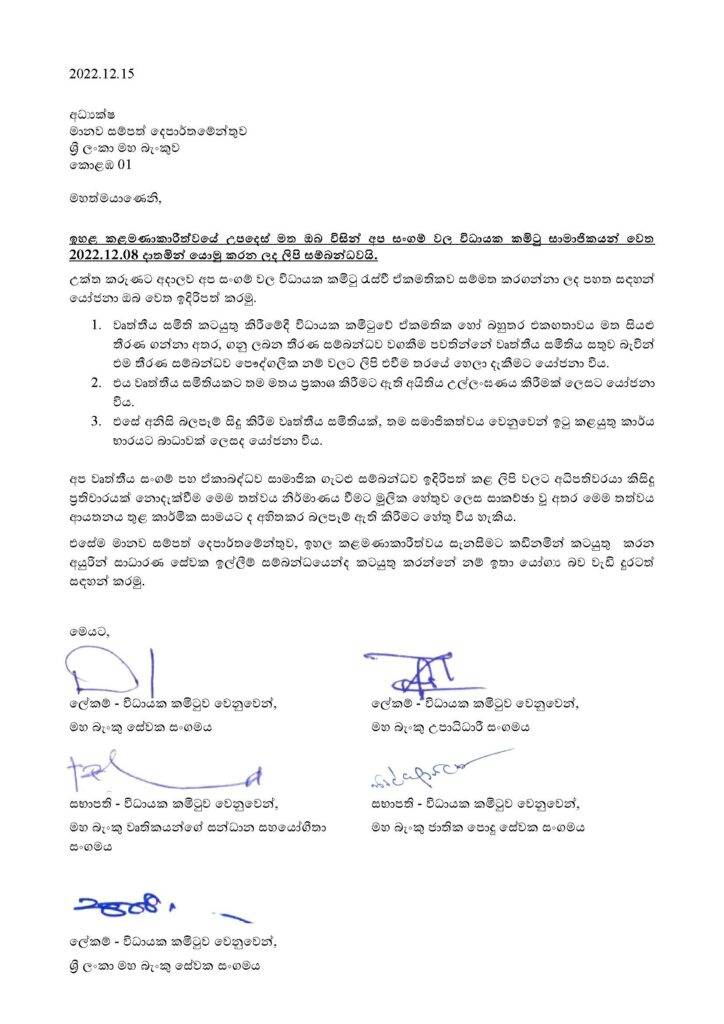
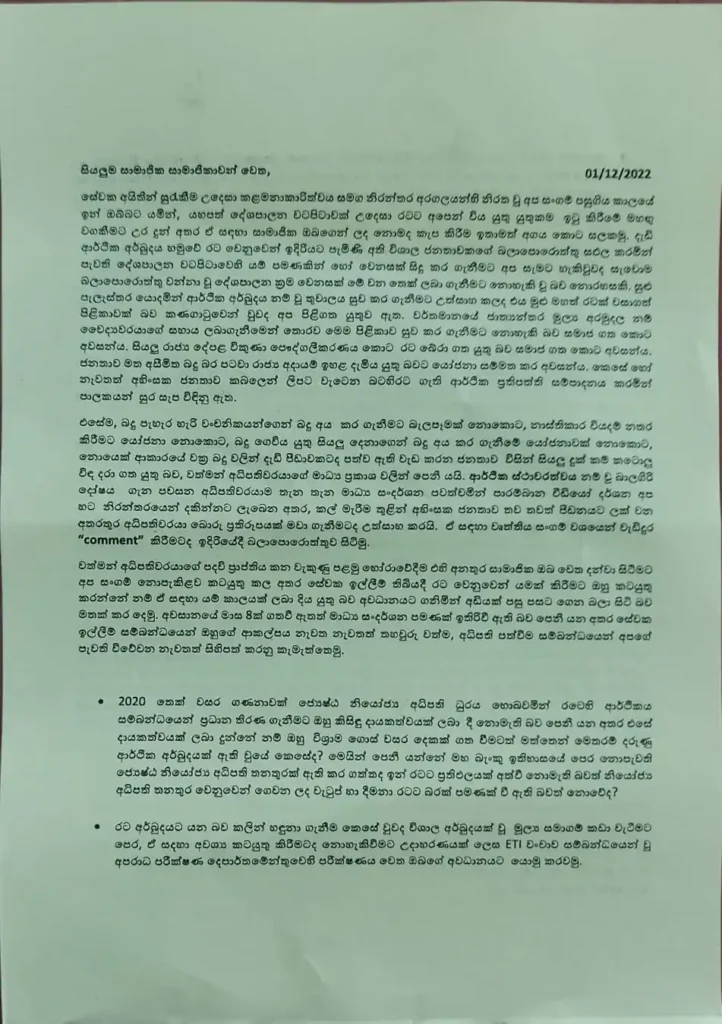
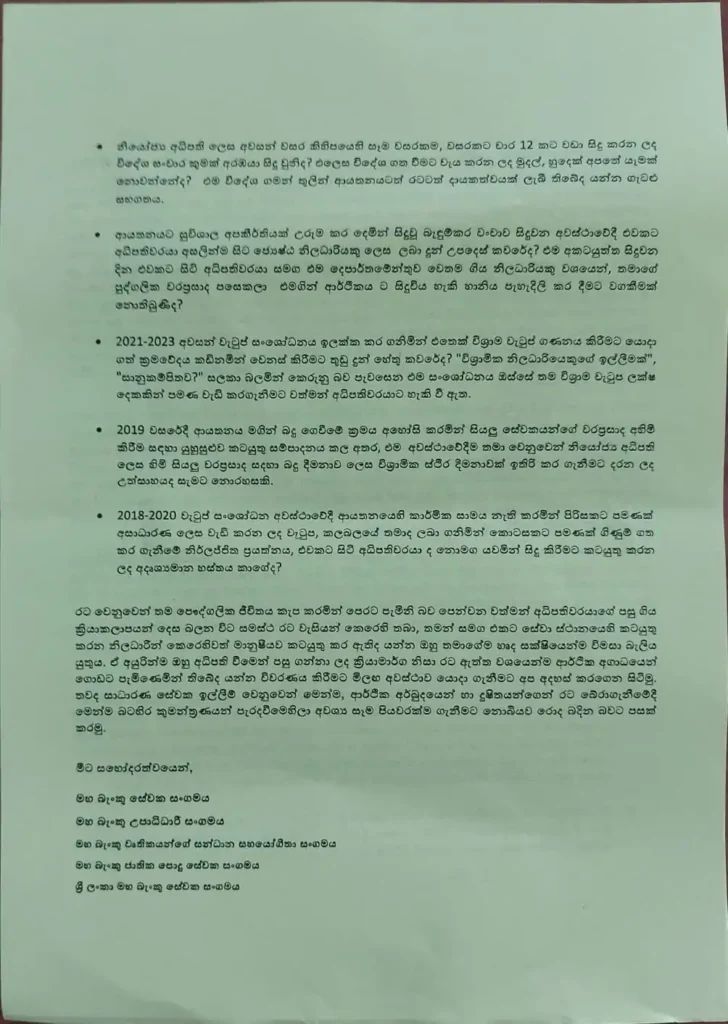
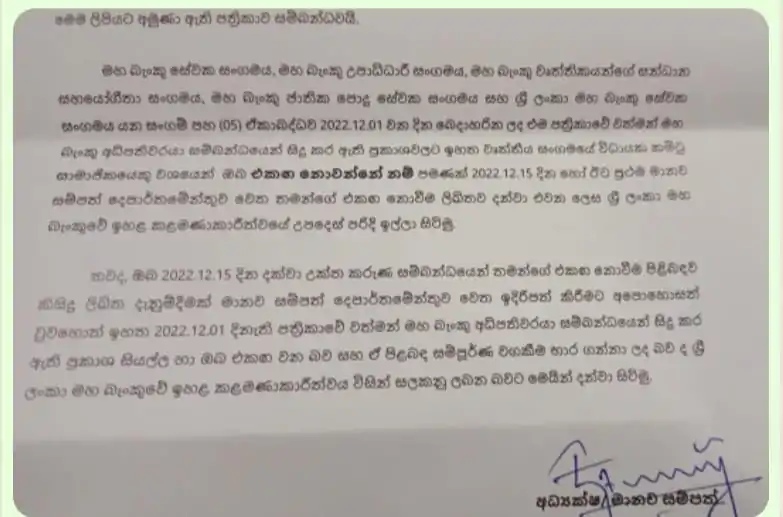
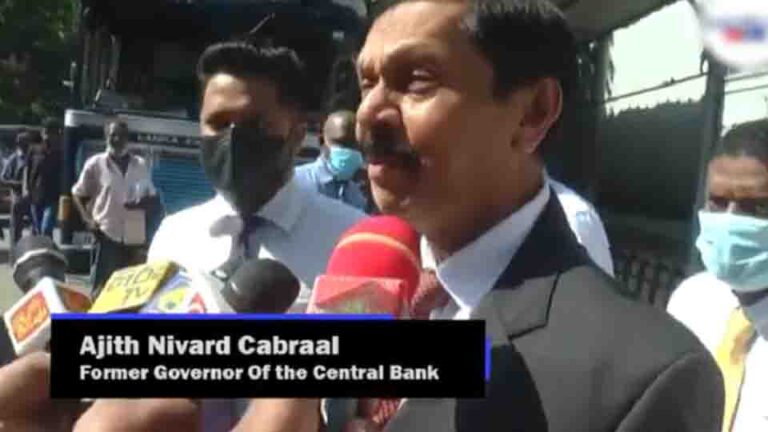
Why the incumbent CB Governor is not fit and proper for reappointment?

0

The six-year term of the CB Governor that commenced on July 1, 2016, is to expire on this June 30. The present Governor has been appointed on April 07 for the balance period due to resignation of the former Governor on April 4.

At the BBC interview held on last 17, the present Governor has stated that he would expect to serve in the next full six-year term, and he would not have accepted the present post if he were to leave after two months of service.

Meantime, a highly politicized social media campaign prevails forcing the President to appoint him for the new term of six years. They state the reason as the success of the Governor having already stabilized the economy during this difficult time. Some have even threatened to lead another round of social protest campaign if he is not reappointed. Bank depositors who have temporarily benefitted from the extraordinarily high interest rate policy of the Governor are also seen in the forefront of this social media campaign.

Therefore, this article is intended to establish that the present CB Governor is not a fit and proper person to be reappointed on the ground that his policy actions so far in fact have led the economy from the destabilization to the bankruptcy and involved in a number of statutory violations.

Non-conduct of the Fit and Proper Test on appointment of the Governor, Monetary Board Members and Executive Officers of the Central Bank

Appointment of persons as Directors, CEOs and Officers performing executive functions of licensed banks in Sri Lanka should be made only after obtaining the written approval of the Director of Bank Supervision in terms of the criteria laid down in the Banking Act for assessing the fitness and propriety of such persons. The specific reason for such a test is to ensure that banks which carry on business on money belonging to others (depositors and shareholders) are governed by persons of high integrity and honesty.

However, it is unacceptable that, although the business of the Central Bank covers the printing of public money, its circulation and regulation of banks as part of money circulation through deposits and credit, officers of the Central Bank are not subject to such fit and proper tests. It is noted that the Monetary Board in the middle of 2017 agreed to my proposal to adopt same Banking Act criteria for this purpose and, however, it has not been implemented so far.

John Exter who was the architect of the Central Bank in 1949 has stated in his report that the person appointed as the Governor should be a man of unquestionable integrity and responsibility.

Therefore, it is necessary that the Minister of Finance expeditiously implement such fit and proper criteria for appointment and removal of Central Bank officials. The appointment of persons with professional integrity and responsibility is especially important in response to unprofessional conduct of the CB Governor and Monetary Board Members seen recently before political committees of the Parliament. The criteria should ensure that no person charged with questionable conduct is appointed.

Disqualification of the Present Governor for Reappointment

The relevant evidence is presented below in 20 items to establish his disqualification. Some items are statutory violations that provide even for removal of the Governor or a Board Member on any occasion. The most of this evidence has already been published in detail in articles released by me in the blog, economydiscovery.com

1. The interest rate hike of historic 7% on April 8 to 13.5% and 14.5% causing the Government and private sector to bankruptcy in the current crisis

At the media briefing on that day, the Governor stated that such rate hikes were very easy tasks for the Monetary Board Members. In support, one of his monetarist colleagues even proposed further rates hike to 25%. The imprudence of this abrupt policy action on credit delivery in current circumstances is shown as below.

As Treasury bill rates rose by 9% to around 24% within two weeks, the Central Bank forced banks to push the deposit rates also up in that line. In contrast, the Governor later commented that the market rates overshot, and he would take actions to correct it. Therefore, it now appears that he uses various insider techniques to push down the Treasury bill rates through arranged EPF bids to auctions. 

This is seen by the subsequent reduction of yield rates to around 20%-22% level where long-term bill and bond auction rates have been brought down below the 3-month bill rate while the acceptance of 182-day and 364-day bills has significantly risen in contrast to the past trend of acceptance of almost all from the 92-day bills which is the normal market behaviour during times of rising inflation and interest rates.

The increased cost of rollover of the Government debt will cause further debt service problems and tax increases in the near-term. For example, after 7% rate hike, the Government has raised Rs. 816.7 bn through weekly auctions of Treasury bills alone at an average yield of 23.3% as compared to the pre-rate hike auction yield around 15%. Therefore, the near-term debt and tax burden will increase by this 8.3% additional cost of funds.

Such a rate hike violates the international standard of gradual rate hikes by 0.25%-0.50% at a time over a fairly long period of time to ensure that their macroeconomic impact is felt in an orderly fashion. However, this rate hike is second only to the rate hike of 15% to 25% on June 3 by the Central Bank of Ukraine to control inflation rising to 20%, despite the projected decline of the economy by 45% in the middle of Russian invasion since February 24.

Although such a high interest rate policy is cited for inflation control, the sources of Sri Lankan high inflation are the global Corona pandemic-caused supply chain disruptions and acute shortages of imports and nearly 80% increase in the exchange rate consequent to the failure of the Central Bank to manage its foreign currency reserve. 

Therefore, the fact that this inflation could not be controlled by the interest rates hikes even at further higher levels is the common knowledge. That is established by the continuous and faster rise in inflation, despite the rate hikes of 9% in total and significant monetary tightening so far since the mid of August 2021 where such monetary tightening has pushed both the borrowers and lenders towards bankruptcy.

Further, Monetary Law Act (MLA) provisions do not provide for the Monetary Board to conduct an exclusively inflation targeted monetary policy where the cost of living is only one factor to be considered in determination of the national monetary policy.

2. Default of Government Foreign Debt on April 12 by the Central Bank as the Public Debt Manager causing the country to international bankruptcy in violation of the Constitution

The default has been announced without the permission of the Parliament who controls the public finance in terms of the Constitution. As the national budget for 2022 covering debt and debt servicing had already been approved by the Parliament in November 2021, the default of foreign debt by the Central Bank as announced by the Governor along with the Secretary, Ministry of Finance, as a soft default is unlawful.

Further, the duty of the public debt management is at the hand of the Superintendent/Register of the Public Debt and, therefore, whether the Superintendent has taken lawful actions to manage and restructure debt within Sri Lankan laws inclusive of the Active Liability Management Act passed by the Parliament in 2018 has to be established in the Parliament before announcing such a debt default and calling for proposals from international firms for this purpose.

In May 2016, a US Treasury technical assistance programme for improvement of debt management inclusive of commissioning a secondary market electronic trading platform and drafting a consolidated debt law with a resident consultant initially for two years supported by visits of other subject experts  was received free. As the Central Bank team led by the present Governor at that time was dead against this consultancy for improvement of the auction system and transparency, the fate of the consultancy and trading platform is not known. The interim arrangement of the Bloomberg trading platform free of charge also has been abandoned. Finally, fondly private placements have been built in the bond auction system and it has now been extended to Treasury bill auctions too from the last auction held on June 22.

Therefore, the present Secretary to the Treasury being a Deputy Governor with a long Central Bank service until April 7 and the Governor being the Senior Deputy Governor until the end of 2020 who have actively engaged in debt management including the issuance of all Sovereign Bonds should know the due process before the default.

As one US investor in Sovereign Bonds has filed legal action in the US Southern District Court of New York against the Sri Lankan Government on June 21, relevant legal documents on decision-making on the default have to be filed in the Court to establish the due legal process. Therefore, this unlawful and arbitrary decision-making to default of foreign debt by two high-ranking government officials would not provide for any settlement in Court. This unlawfulness including discriminatory nature of the default has been stated in the Complaint in the above Court case too.

3. Forcible and imprudent action to increase deposit interest rates against banking business practices

As bank deposit interest rates did not rise in the quick phase of the Central Bank rate hike of 7%, it is learned that banks have been forced to raise deposit rates where a Monetary Board Order also was issued. This deposit interest policy has led the Governor to become highly popular among the depositors and it is learned that the policy was intended to mobilize their support for his re-appointment.

However, banks have confronted a sudden increase in the cost of intermediation as many depositors rushed to banks in ques to terminate their fixed deposits and reopen them at higher interest rates as much as 16%-18%. This together with resulting increase in lending rates have raised the systemic risk in the economy. Such undue focus on the deposit rates is a monetary policy violation in the present policy model. If the Governor wished to do so legally, the Monetary Board could have used MLA provisions to direct the banks on maximum deposit rates.

4. Outright rejection of a proposal to consider concessions on loan repayment to entrepreneurs affected by the present crisis.

The reason cited by the Governor for this rejection is the injustice to depositors as such concessions would have to be provided at costs to depositors. This is incorrect as such concessions involve in rescheduling and restructuring of loans. In such crisis situations, concessions are primarily required to bank borrowers and not to depositors. Therefore, this statement also has boosted his popularity among depositors.

5. Unlawful and fictitious guidance issued on 12 and 13 of May to determine the inter-bank spot exchange rate for the US Dollar in a range of Rs. 2.60 from the mid-point of Rs. 360

This immediately led to an artificial decline of the exchange rate by 3% and spread a social media news item commending the Governor for being able to strengthen the rupee.

Even general public knows that such a fixed exchange rate cannot be maintained without an active bank-based foreign exchange market and liquid foreign reserve with the Central Bank. Therefore, this guidance rate is same as the rate of Rs. 200 that prevailed up to March 7. Further, the MLA does not provide for such guidance rates or exchange rate control on the inter-bank foreign exchange trades.

However, the Governor has got the Central Bank Communication Department issue a press release on June 6 to mislead the general public by stating the benefits accrued from this guidance exchange rate such as stabilization of the formal foreign currency market, the increase in foreign remittances to the banking sector and the decline in the informal foreign exchange market including narrowing down the exchange rate margin. However, no supporting statistics have been provided so far.

6. The continuation of money printing at a higher and faster phase for lending to the Government in violation of the MLA

At his first media conference held on April 8, the Governor blamed the past two Governors for high inflationary pressures as the result of money printing based on modern monetary theory to support a home-grown growth model, despite his resistance as the Senior Deputy Governor at that time. Accordingly, he promised to cut down the Central Bank Treasury bills portfolio to reduce the money printing independently for controlling the inflation.

However, while the inflation is further rising, he has been increasing the money printing further not only by buying Treasury bills outside the weekly auctions but also by introducing a new unlawful system to issue Treasury bills to the Central Bank whenever the General Treasury requests additional funding for routine Treasury operations. Since April 8, the net printing of money under the first system amounts to Rs. 236.8 bn while the printing under the new system is Rs. 183.1 bn., altogether Rs. 420 bn or 32.1% of the total money printing on Treasury bills since January 2021 to date.

In such crisis situations, nothing is wrong with the Monetary Board printing money to safeguard the stability of the economy through open market operations and provisional advances to the Government as provided for in the MLA. However, the money printing to the extent and the manner stated above while inflation is galloping is in violations of the MLA as well as the professional and public promise given by the Governor on April 8.

7. Continuance of the unlawful standing deposit facility

The MLA does not provide for acceptance of deposits by the Central Bank on payment of interest. The instrument stipulated in the MLA is the open market operations on trade of government securities. This deposit facility encourages banks to mobilize deposits at lower rates from the public and redeposit the proceeds with the Central Bank overnight at higher rates to earn a risk-free profit. Therefore, banks’ intermediation role in the wider economy is largely disturbed. 

For example, the standing deposit facility rate at present is 13.5% whereas even bank fixed deposit rates are mostly around 11%-12%. Therefore, banks, while depositing their excess liquidity daily at the standing deposit facility, borrow interest free from the intraday liquidity facility (ILF) of the Central Bank available for payment purposes. 

Such ILF borrowing per day was about Rs. 208.5 bn in the year 2021, a significant increase from Rs. 66 bn. in 2020 (i.e., 216% increase). The Central Bank has printed nearly Rs. 12.4 bn to pay interest on standing deposits in 2020 and 2021.

8. Retention of the Central Bank profit in 2021 unlawfully without remitting to the Government

The calculation and distribution of profit of the Central Bank are stipulated in the MLA. However, the Monetary Board adopts a different method for this as unlawfully recommended by the present Governor in 2016 to satisfy the accounting professions in violation of both MLA and generally accepted central bank financial reporting standards. Accordingly, a distributable profit of Rs. 27 bn for the year 2021 has been retained in the capital of the Central Bank, despite dire funding problems confronted by the Government. The total profit calculated in terms of International Financial Reporting Standards for the year 2021 is about Rs. 158 bn where only Rs. 30 bn has been remitted to the Government. 

In addition to Rs. 27 bn reserved in capital funds, another Rs. 84 bn of unrealized profit also has been transferred to the Central Bank reserves. As such, it is questionable why the Central Bank needs such a huge reserve base in violation of the MLA. Further, the present Governor who submitted the Annual Report for 2021 to the Minister of Finance in terms of the MLA has not signed the Central Bank’s financial statements given in the Annual Report. Therefore, a question arises as to who accepts the responsibility of these financial statements.

9. Appeal for foreign currency donations in violation of the MLA

State institutions or their officials can accept or offer donations on accounts of the institution only if the relevant statutes provide for such donations. The MLA does not contain any provisions for such donations because they give effects to money printing and the country’s monetary conditions outside the monetary policy.

However, the Governor on April 12 appealed donations in foreign currency from Sri Lankans living abroad for the purpose of financing importation of essentials such as food, oil and medicine. Next day, this appeal was extended to all well-wishers abroad. He cites the reason for the appeal as hardships faced by people from the social, economic and financial distress due to the long-lasting impact the Covid-19 pandemic, global imbalances and macroeconomic imbalances of the country. However, the MLA provides only for monetary policy actions to deal with such adverse economic conditions where the donation is not an authorized policy action.

Further, the fact that the donations received on his appeal so far are only about US$ 82,440 shows that the Governor is not an internationally recognized person to receive foreign financial assistance to address the country’s present economic distress or the crisis. The protracted delay in receiving a so-called IMF bailout package is also a testimony to this.

However, the Governor has been unable to implement any monetary policy actions to promote much needed inflow of worker remittances at this stage. It is common knowledge that the significant reduction in worker remittances due to highly over-valued exchange rate kept by the Central Bank is a major reason for the acute foreign currency shortage in the country. 

In fact, he recently commented that it was the duty of the Sri Lankan workers abroad to send remittances to their relations and dependents through formal channels after paying tax in respective countries and, therefore, any grant of concessions from Sri Lankan taxpayers’ money to encourage remittances was not justified. It is reported that this also has led to further dissatisfaction among the Sri Lankan workers abroad and to increase remittances through informal channels at competitive exchange rates.

10. The Governor’s threat to the Government on May 11 to resign unless the political stability is restored in two weeks

This statement made at a media conference just after a month of his appointment is a highly irresponsible statement in times of the foreign currency crisis and economic instability of the country. However, the political instability referred to in his statement did not harm any functions of the Central Bank. The executive President and the Parliament were in operation whereas the resignation of the Prime Minister and Cabinet was only a temporary event in response to the heightened protests by various public groups.

However, he stated that any person would not be able to perform the duties of the Governor in such circumstances without political stability. Therefore, this alert could have destabilized not only the management of the Central Bank but also smooth operations of the banking system. The later revelation is that he made this statement to have political gains from the new Government pending in the political crisis.

11. The suspicious statement made to the COPE on May 25 that an IMF loan could not be received in April 2020 due to Government’s non-agreement to restructure debt as required by the IMF

It appears that the present Governor as the Senior Deputy Governor overseeing the dealings with the IMF at that time may have acted to prevent from receiving an IMF loan by arranging such a debt restructuring condition for Sri Lanka. This suspicion is raised based on several facts stated below.

First, the IMF granted nearly US$ 171 bn to 90 countries confronted with the Corona pandemic under its Rapid Financing Instrument and Rapid Credit Facility and relief on repayment of IMF loans to 31 countries. Among them were the countries with poorer debt profile and economic growth than Sri Lanka. On March 17, 2020, the IMF Managing Director informed through the Bloomberg media that the IMF would allocate US$ 50 bn worth funds to help member countries affected by the Pandemic without normal conditionality and ready to utilize its full lending capacity of US$ 1 trillion, if necessary, and requested member countries to apply credit facilities without delay. 

If the IMF had required debt sustainability and restructuring conditionality from those countries, many countries would not have received IMF facilities, given the global lockdowns and administrative difficulties that prevailed at that time to satisfy such inhuman conditionality.

Second, former Governor Coomaraswamy, now a member of the Advisory Panel on Debt to the President, stated recently that Sri Lanka could have secured an IMF facility in December 2020 if requested as there was no restructuring condition at that time. Further, the IMF observation on unsustainability of debt was issued only in annual Article IV Consultation Report issued on March 25, 2022.

Third, the present Governor has quite experience in securing IMF facilities as he was involved in securing the two largest facilities amounting to SDR 2,724.3 mn out of 16 facilities obtained so far since 1965. Further, he and the present Secretary to the Treasury being Alternate Executive Directors in the IMF had enough inside experience in the IMF to secure a new IMF facility supported by the sitting Alternate Executive Director released from the Central Bank at that time.

Fourth, the preset Governor visited the IMF World Bank Spring Meetings April 18-22 and has requested a facility from the IMF under Rapid Financing Instrument. He would not have made this request if a restructuring requirement had been effective on Rapid Financing Instrument.

12. Making allegations against former Central Bank Governors and high-ranking Government officials for the present economic crisis at the Parliamentary Committees

It is noted with concern that he also was involved in recommending and implementing monetary, exchange rate and reserve management policies, IMF dealings, Sovereign Bond issuances and fiscal advice to the Government for more than a decade until the end of 2020 whereas four Governors and Monetary Board since 2006 were guided by him on economic subjects. Therefore, he is also accountable to the current economic crisis if it has been caused by the failure of the relevant public officials.

Therefore, it is highly unprofessional for the post of the Governor to accuse other Governors and high-ranking officials who worked with him on his advice and cooperation to implement government/national policies loyal to the respective governments from time to time for decades. 

It noted that all those officials implemented those policies on the ground of circumstances and the set of information prevailing at those times within the statutory authority available with them as mostly assisted by the present Governor. Therefore, aiding and abetting present political leaders through such accusations ex-post to frame criminal charges unlawfully against high-ranking Government officials for the purpose of harassment, despite their public services for decades loyal to the respective governments is seen as a sheer act of dishonesty and irresponsibility.

It is noted here that the President on 16 June 2020 also alleged publicly the high-ranking officials including the present Governor as the Senior Deputy Governor of the Central Bank at that time at a meeting for not implementing suitable monetary policies to help the Government fight the global pandemic as done by central banks in other countries. Therefore, the Central Bank announced several major policies on the following day itself. It was later revealed that his resistance was attributable to the policy delay accused by the President. 

Later, he being the then Senior Deputy Governor led a social media campaign that the President’s accusation was a result of him being misled by some people, despite the fact that the Central Bank had implemented a number of policies. Subsequently, the Central Bank published a list of such pandemic related policy actions in its website. However, consequent to this matter, it happened for him to retire a few months before the due date. 

Therefore, it is surprised that same President invited same person for appointment to the post of the Governor and gave even the national security for him to travel from the airport to the Presidential Secretariat.

13. Proposal for an export economy without any monetary policy support plan

The Governor at a recent meeting with entrepreneurs stated that the present Sri Lankan economic crisis is a result of a long-standing import economy funded by debt and, therefore, the solution requires the transition to an export economy. However, this is not a new talk and, in fact, the Prime Minister also expressed this view a few days before based on his earlier work undertaken to promote the export sector of the economy. 

However, being the Central Bank Governor who has enough policy scope to promote an export economy, he has not announced any policy framework or market guidance in this regard so far. Therefore, he has just acted to confirm the view of the Prime Minister.

14. Accusation by the Governor that a key reason for the present economic crisis is the heavy dependence on Sovereign Bonds and unproductive utilization of funds by the Governments

It is noted here that he is also highly responsible for it as he also actively participated in decision-making on all 14 Sovereign Bond amounting to US$ 17,550 mn issued since 2007. Although the purpose of issuance of Sovereign Bonds was stated in prospectus as development funding, the actual purpose was to source funding to the foreign reserve of the Central Bank. Therefore, it is the Central Bank which initiated and handled Sovereign Bond issuances where no surveillance or follow up or any assessment on the utilization of Bond proceeds was taken up by the Central Bank as the Fiscal Agent and Manager of Public Debt.

With regard to 10 Bond issuances amounting to US$ 14,550 mn since 2012, he in the capacity of the Deputy Governor handled all decision-making including the marketing events by sitting with the Governors. Further, he made all important decisions including the amount and the rates on 6 Bond issuances amounting to US$ 12,050 during the period 2015-2019 where the Governors were largely the rubber stamps.

Therefore, it is surprised that he with that international caliber of economics could not foresee the systemic risks of habitual Bond issuances made without ensuring the productive utilization of funds as he now accuses. In addition, the arrangement of foreign currency swaps of billions of US Dollars to replenish the Central Bank’s foreign reserve for numerical targets not accorded to the macroeconomic strength of the country was also operated under his direct supervision.

Therefore, given his leading role in monetary and exchange policies of the Central Bank more than a decade, he is directly accountable for the current economic crisis as it has been primarily caused by the acute shortage of the Central Bank’s foreign reserve and unsustainable control of the exchange rate in violation of both  MLA provisions and basic economic principles.

15. Social media accusation on an attempt to remove the Governor as he has led evidence actively against Treasury bond issuances under investigation

As there is ongoing court proceeding on this subject, it is unlawful to spread such opinions. The relevant investigations also reveal his direct association with bond issuances although he appeared before the Bond Commission as an expert witness. Such information is not revealed here to respect the relevant court proceedings. Those who are interested in this subject may refer to the Bond Commission Report publicly available.

16. Making irresponsible statements at the BBC interview held on June 17

Under the subject of the Central Bank independence taken up by the BBC interviewer, the Governor stated that he awaited to serve the full term of 6 years beginning July 1 and he would not have accepted the Governor post if he were to serve two months and leave. Therefore, it appears that he has arranged this interview with the intension of preserving the reappointment by drawing concerns over Central Bank independence in the international context. The BBC is a good conduit for this intension.

As such, the Government will be in a difficult position to justify the discontinuation of the service of the present Governor in two and half months and, therefore, he expects that the Government would tend to reappoint him for the new term to uphold the Central Bank independence.

However, the MLA and the Exter Report do not recognize the Central Bank independence and accept the authority of the Government to appoint a Monetary Board which can co-operate and coordinate with the Government policies as the Central Bank also is an important public institution. Further, the notion of the Central Bank independence recognized in highly market-based developed countries is not followed in developing countries.

Further, although he stated that he did not come to leave in two months, on May 11 he threatened to step down from the post of the Governor unless the political stability was restored in two weeks. Therefore, his two months story is contradictory.

His statement made at the BBC interview that this crisis could not be solved in two months is not worth telling so publicly, but the fact that he has not laid down a firm monetary policy base for the resolution of the crisis in terms of the relevant statutes including the MLA is in the common knowledge.

Therefore, the President and Finance Minister have the opportunity to use the evidence presented in this article to establish that the present Governor is not a fit and proper person for reappointment for the new term of 6 years.

17. Disclosure of individual bidding information of primary dealers in respect of certain auctions of Treasury bills and bonds in violation of the provisions of the MLA

It appears that the Central Bank has done this first time with the intension of accusing the primary dealers in public in the case of auctions from which the Central Bank is not able to raise funds at yield rates preferred by it as reasonable. The reasons for the increase in bid yields in the market at present are the historic increase in the policy interest rates by 7% announced on April 8, acute shortage of funds due to tightening of the financial conditions by mopping up of the market liquidity and galloping inflation.

This is well established by a recent statement made by the Prime Minister that unloading of an oil ship was delayed due to the difficulty in finding Rupees even though dollar funding was arranged.

As the market participants have the right to speculate in response to prevailing and expected market conditions, such disclosure of individual bidding information is a violation of market principles as well. Further, such disclosure also has the potential of leading to various insider dealings in the market.

18. Attempt of the Central Bank to mop up the liquidity, despite the shortage of liquidity in the economy

This is seen from auctions announced on June 16, 20 and 24 for the outright sale of Treasury bills held in the Central Bank portfolio to mop up Rs. 65 bn. However, due to the acute shortage of liquidity in the market, only Rs. 3.3 bn could be mopped up at yield rates of 20.6% to 22% which has caused an undue loss to the Central Bank as the relevant Treasury bills had been purchased at lower yield rates at the time of issuance. In fact, a sale auction announced on June 24 for Rs. 15 bn has failed due to non-availability of bids.

Further, the inter-bank market volume has significantly gone down due to the shortage of the liquidity and the Central Bank on daily basis prints nearly Rs. 700-750 bn to lend funds to banks at the standing lending facility window.

Therefore, the rationale of such mopping up of liquidity at a time when the Government, banks and private sector confront an acute shortage of liquidity, despite the continuous money printing by the Central Bank, is questionable.

19. The IMF loan programme being dragged on with varying time targets

The present Governor managed to secure his dreamed post by convincing the President that has had the international links to obtain an IMF loan under Rapid Financing Instrument and to stabilize the economy at a time when everybody had started complaining on economic crisis partly as the failure of the Government to secure an IMF loan in early 2020. 

However, after getting appointed, he could only update his record on attending IMF World Bank Spring Meetings in April 18-24 as his request for Rapid Financing Instrument facility was not accepted by the IMF while debt restructuring condition to establish debt sustainability was imposed for consideration of a standard loan facility.

From time to time he has been giving early time targets such as three months for receiving the IMF loan. However, at the above-mentioned BBC interview, he declined to give a specific time frame for securing the loan and stated that the time frame would depend on bilateral talks whereas the progress in debt restructuring is necessary to seek the IMF Executive Board approval although staff level agreement could be reached early. Further, other Sri Lankan authorities have given different time targets whereas the IMF spokesmen have not yet indicated whether Sri Lanka would even receive an IMF facility.

As such, the IMF loan not received at this critical time may not be of significant help to resolve the foreign currency crisis if it is received after protracted delay. Although Sri Lanka has received 16 IMF programmes since 1965 with similar conditions for improvement of macroeconomic balance to prevent future BOP crises, the current crisis proves beyond doubts that Sri Lanka has not sustained any such long-term benefits of IMF programmes as envisaged. It is noted with concern that the present Governor was involved in the supervision of the implementation of the two largest IMF programmes amounting to SDR 2,724.4 received in 2009 and 2016.

However, at the above-mentioned BBC interview he stated that the country would not have confronted such a difficult crisis if an IMF loan programme had been secured earlier with a debt restructuring programme. This seems to be a political type of allegation. As the management of the exchange rate and foreign reserve of the Central Bank for about a decade has been under his direct supervision, he also would know that, given the huge foreign currency risk underlying the economy, an IMF loan around US$ 1-2 bn would not be capable of stabilizing the economy from the crisis primarily originated from global supply chain disruptions consequent to the Corona pandemic. He also commented at a recent meeting that, as done in 16 occasions in the past, the economy could be stabilized by securing an IMF loan at this time too, but that would not be sustainable.

Accordingly, he himself casts doubts on the effectiveness of the expected IMF loan and, therefore, further marketing of his IMF loan dream is not acceptable for securing a new term of the office by the present Governor.

20. On May 28, attending an uninvited meeting with the President together with a Monetary Board member to apprise the President of his performance

The President’s media notice issued on same day states as follows.

  • The Governor has apprised the President that he had been able to control the economic crisis in a short period and turned it to a favouable side.
  • The programme he has been carrying out with the assistance of the professionals of the Economic field through discussions with the financial institutions including the IMF and World Bank has achieved good progress.
  • Further, he has apprised the President of the policy framework adopted by him to control the inflation and strengthen the economy.

However, the facts prove that his meeting has mislead the President as the crisis has got worsened with a further rise in inflation and oil and gas ques leading to a further collapse of the economy, mainly consequent to his unjustified policy actions such as interest rates hike by 7%, default of foreign debt and fictitious exchange rate guidance, while the liquid foreign currency reserve of the Central Bank and the banking system has diminished a level close to zero and foreign remittances have further declined. 

While discussions with the financial institutions mentioned above are taken up not by him but by the Government, his claim that he works with the industry professionals not named is not appropriate as he has to work with the relevant officials of the Central Bank. As the IMF loan has not been finalized as yet, discussion with the IMF has not got adequate progress. The acute shortage of fuel has led to the closure of state institutions and schools for a number of days.

Although the Presidential media press release indicates the President’s full support for the independence in the continuation of the role of the Central Bank, the MLA does not recognize such independence for the Central Bank. Further, the President has no provisions in the MLA to ensure the success of international operations of the Governor and Monetary Board in which the President has full confidence as indicated in the press release.

Overall, the confidence expressed by the Governor before the President in the success of his present mode of operations to bring back the social and economic stability has no justifiable basis in terms of the evidence placed above. Therefore, it appears from the technical words used in the press release that the press release has been drafted with the assistance of the Governor.

How urgent is the appointment?

The social media highlights the need for urgent action to reappoint the present Governor to ensure that the Governor will be in office on July 1. However, all four instances from January 8, 2015, show that the respective Governors have assumed duties after several days or weeks from the date of the vacancy where the Central Bank has operated smoothly. In fact, the Central Bank operations at present are much simpler confining to print money for lending to the Government and banks on a daily basis as it has no operations on foreign reserve and exchange rate management. As such, any urgency or rush to make the appointment before June 30 is not warranted.

What is most important at this critical stage is to find a fit and proper person competent beyond any doubt to serve the statutory term of 6 years in office in order to ensure the policy continuity and management stability of the Central Bank, given the present status of policy failure, distress and instability of the Central Bank.

It is reminded of the media news regarding an unlawful and political attempt of the then President to appoint the present Governor, then Deputy Governor, towards the end of June 2016 for a six-year term and the informal intervention of the then Prime Minister, i.e., the present Prime Minister, that averted the President’s attempt due to disqualifications at that time. 

Therefore, it will be a historic national catastrophe if circumstances now prevail that same Prime Minister happens to recommend same person for the post of the Governor, despite additional disqualifications enumerated in this article. During his long tenure of service in the Central Bank until the end of 2020, I am not aware of any innovative policy actions he introduced to serve the public, other than passing files to the satisfaction of the line staff and the hierarchy, that can be considered for his reappointment at this time.

As the present economic crisis is the result of the acute failure of the Central Bank to maintain its foreign currency reserve and the stability of the exchange rate of the rupee in compliance with the provisions of the MLA, it is the historic public duty of the present President and Finance Minister to ensure that the person appointed as the Governor at this economic crisis time is a fit and proper person beyond any doubts to revive the economy towards the sustainable stability. 

Otherwise, the new Governor could well be the cause for the failure of the present Government as well as future Governments by destabilizing the economy and living standards of the general public as the removal of the Governor would not be an easy task in the event the new Governor is a person sick with the old monetarism and Central Bank independence.

Therefore, any consideration of other types of rhetoric based on social media or personal feelings regarding the prospective candidates is both unlawful but unpublic.

(This article is released in the interest of participating in the professional dialogue to find out solutions to enormous economic difficulties presently confronted by the general public consequent to the global Corona pandemic and subsequent disruptions and shocks.)

P Samarasiri

Former Deputy Governor, Central Bank of Sri Lanka

(Former Director of Bank Supervision, Assistant Governor, Secretary to the Monetary Board and Compliance Officer of the Central Bank, Former Chairman of the Sri Lanka Accounting and Auditing Standards Board and Credit Information Bureau, Former Chairman and Vice Chairman of the Institute of Bankers of Sri Lanka, Former Member of the Securities and Exchange Commission and Insurance Regulatory Commission and the Author of 10 Economics and Banking Books)

PMD joins with the ‘Community Kitchen’ Programme

0

The President Media Division (PMD) joined with the “Community Kitchen” concept, which was introduced to support the people who are affected by the food shortage.

The staff of the President Media Division joined with the “Community Kitchen” programme runs at the Rajagiriya Community Service Centre, two days ago (28), to provide nourishing meal they cooked to the needy. More than 400 needy people attended to have food.

The Welfare Association of the President Media Division provided financial assistance and the intention was to spread the “Community Kitchen Concept” at the public and private corporate level.

With the recent introduction of the multi-sectoral joint mechanism for empowering rural economic revitalisation centres to ensure food security and nutrition as per the concept of President Ranil Wickremesinghe, there was a wide discussion in the society about the Community Kitchen Concept.

The aim of the community kitchen concept is to prepare for the upcoming food crisis, as well as to prepare a nutritious meal as a group and support those who are suffering from food shortages.

Director General of President Media Division Dhanushka Ramanayake, Senior Assistant Secretary to the President Sudhira Nilanga Withana, Director Editorial Piyasena Disanayaka, Director of Photography Misha Gunawardena, President of the Welfare and Sports Association of President Media Division Deputy Director Deepti Pramita Adhikari, other Directors and the staff members attended the event.