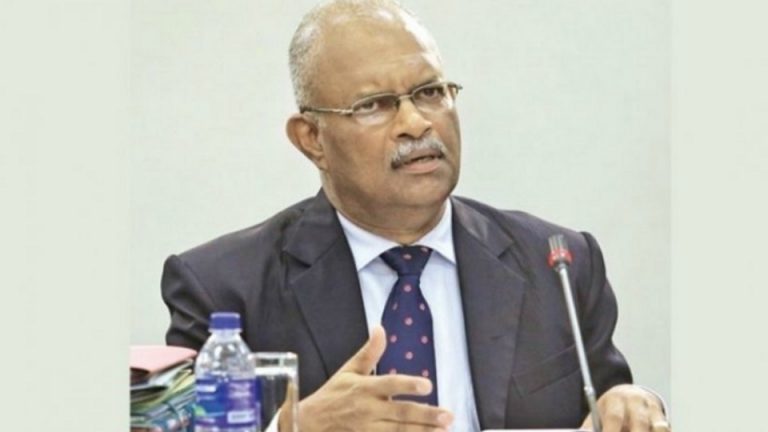
The Attorney General today (05) has pledged before the Court of Appeal that security officers will be deployed for the protection of former Director of the Criminal Investigation Department (CID), Shani Abeysekara.
The pledge was made as the petition filed by Abeysekara demanding that an order be made assuring security over the threats posed to him was taken up today.
Additional Solicitor General Rohantha Abeysuriya appearing for the Attorney General stated that two armed Police officers will be deployed for the safety of Mr. Abeysekara, in addition to another Police officer deployed for the safety of his residence.
Should Mr. Abeysekara decide to change his location of residence, arrangements can be made to provide him a safe place, the Additional Solicitor added.
The Paris Club creditor nations are proposing a 10-year moratorium on Sri Lankan debt and another 15 years of debt restructuring as a formula to resolve the current financial crisis in the Island nation.
The Paris Club has said that it is ready to start the debt treatment process of Sri Lanka following the conclusion of the Staff-Level Agreement with the International Monetary Fund (IMF), Hindustan Times reported.
The Paris Club in a statement also reiterated its willingness to coordinate with non-Paris Club official bilateral creditors to provide the necessary financing assurances in a timely manner and ensure fair burden sharing, as already proposed to the largest other official bilateral creditors.
“The Paris Club remains at the disposal of Sri Lanka authorities and non-Paris official bilateral creditors to further discuss the next steps of the debt treatment process,” it said.
The statement said Paris Club members welcome the SLA between the Sri Lankan Government and the IMF for a 48-month arrangement under the Extended Fund Facility worth $ 2.9 billion.
“This agreement represents an important step to restore macroeconomic stability and public debt sustainability,” the statement added.
While the Paris Club is still to formally reach out to India and China, two of Sri Lanka’s biggest creditors with Beijing holding near 50 per of external debt.
Sri Lanka government on its part is still to initiate a formal dialogue with China and India ,the chances of getting extended fund facility of USD 2.9 billion approved from IMF executive board this month range from very low to non-existent.
This means that Sri Lanka will have to wait for the March IMF meeting of the IMF before any aid is extended by the Bretton Woods institution.
While Sri Lanka owes some US4 800 million in structured debt to India, the Modi government has provided emergency aid to the tune of USD four billion to the Island nation to tide over its economic crisis.
China, Chinese Exim, and China Development Bank hold billions of US dollar debt with Sri Lanka with the total external debt of the Island nation touching nearly US$ 40 billion.
The Sri Lanka Government public debt has gone up from 115.3 per of the GDP in end-2021 to 143.7 per cent of the GDP in end June 2022. During 2022, the debt has increased further due to foreign exchange depreciation, deep recession and fiscal deficit with no signs of early revival.
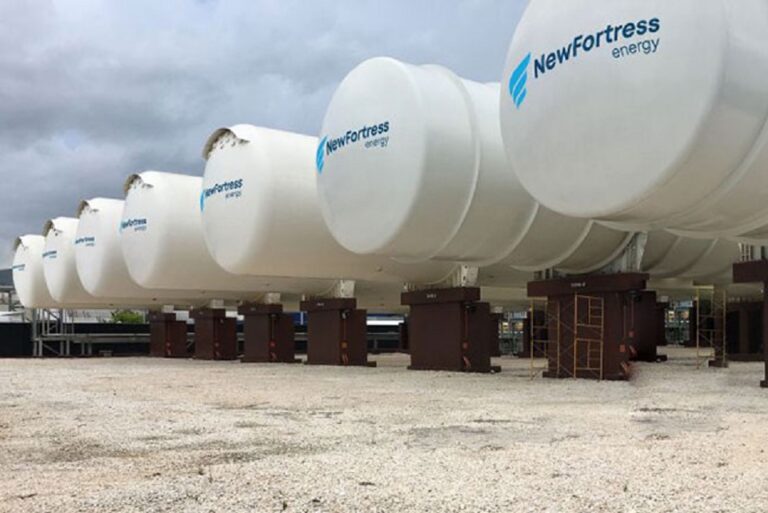
The controversial US $ 250 million Sri Lanka LNG power project deal with the US energy company the New Fortress Energy Inc.(NFE) has come in to the focus once again following the government’s urgency to review the project.
The possibility of resume the LNG project under the much delayed deal with NFE was discussed at a special meeting held under the patronage of President Ranil Wickremesinghe and Treasury Secretary Mahinda Siriwardana recently official sources said.
NFE and The Government of Sri Lanka executed a definitive agreement in September 2021 whereby NFE will invest in energy infrastructure in Sri Lanka and develop a new LNG Terminal off the coast of Colombo.
NFE said will have gas supply rights to the Kerawalapitya Power Complex and will initially provide GOSL an estimated 1.2 million gallons per day of LNG (~ 35,000 MMBtu) to supply both the currently operational 310 MW Yugadanavi Power Plant and an additional 350 MW (the Sobadanavi Power Plant) which is expected to commence operations in 2023.
The definitive agreement is subject to customary conditions, the statement said. “We are pleased that the Court has dismissed these petitions, as NFE can now proceed with our plans to deliver cleaner fuels and more reliable, affordable power to Sri Lanka,” said Wes Edens, Chairman and CEO of New Fortress Energy.
New Fortress Energy Inc. is a global energy infrastructure company founded to help accelerate the world’s transition to clean energy.
The company funds, builds and operates natural gas infrastructure and logistics to rapidly deliver fully integrated, turnkey energy solutions that enable economic growth, enhance environmental stewardship and transform local industries and communities
In September 2021, the Cabinet approved the share transfer of 300 MW of the Yugadanavi Power Plant to NFE. Accordingly, the Finance Ministry has agreed to transfer a total of 40% shares of the power plant owned by the Treasury to NFE together with the rights to supply natural gas to Sri Lanka.
In May, it was revealed that the information on the minimum required LNG had been sought from the Ceylon Electricity Board (CEB) to support the now defunct NFE committee to conclude the negotiations of the proposed Gas Supply Agreement and amendments to the existing project agreements of West Coast Power Ltd. with the CEB.
The information had been sought in a backdrop where the Government had officially announced its Renewable Energy (RE) target of 70% by 2030.
It was further revealed that the Government was trying to reach a ‘take or pay’ agreement with the US company by deciding the minimum required LNG in the next 10 years.
According to a senior treasury official the two committees appointed to evaluate the proposals were working on it and that there were several agreements to be finalized with the CEB.
However, no response had been received from those committees, he said, adding that it was the Department of Public Enterprises that was handling the matter.
The Sri Lankan Government is getting set to privatize the national carrier, Sri Lankan Airlines in a bid to restructure the debt-ridden airline, faced with unprecedented economic turmoil on a national scale, can no longer afford to fund the carrier.
Sri Lankan Airlines CEO Richard Nuttall said that Sri Lanka benefited from pent-up travel demand despite global headwinds and is open to privatization
“The airline is also carrying quite a lot of debt .So if privatization provides some funding that allows us to reduce some of that debt, that also helps our ongoing operations and reduces the debt burden and makes future growth a much more realistic option,” he said.
Despite privatization efforts, Sri Lankan Airlines Chairman Ashok Pathirage revealed plans to lease up to 11 aircraft of which the lease contracts are expiring over the next year.
The Cabinet of Ministers has approved to replace of around 9-11 aircraft that are going out as per the lease agreement, he claimed.
“Based on the age of the aircraft, cost and availability, we have to analyse carefully what is good for the airline and for the country,” he explained.
As per Pathirage, lease contracts of around four aircraft are due to expire early next year from a fleet of 24 total aircraft. SriLankan Airlines had 27 aircraft before the COVID-pandemic, but it has now reduced to 24.
A decision on whether to restructure subsidiaries of SriLankan Airlines or privatize the entire entity as a single entity would be made soon by a committee, Aviation Minister Nimal Siripala de Silva said.
SriLankan Airlines official had been summoned to the committee earlier this week. The Ministry of Aviation first proposed that 49 percent of the catering unit, and 49 percent of ground-handling – which had given over to SriLankan – be sold to settle its debt. Then 49 percent of SriLankan be sold.
“There are two schools of thought,” Minister de Silva said. “At the cabinet the matter was discussed and his Excellency the President has referred the matter to the Treasury.”
Catering and ground-handling are captive profitable businesses which may represent easy money for those who buy the firms, according to some observers.
Ground-handling, which is a separate business from airline operations, however also represents easy money for the airline and can potentially bring tax revenues to the state if spun off and taxed appropriately.
Meanwhile Minister de Silva said the Chairman and Board was summoned before a Treasury Committee which is looking in to the matter.
“And they are discussing what is the best way out,” he said. “We will be guided not by a political decision but by a professional decision that will be given. So I think in one or two weeks they will consider this and given us a professional opinion.”
Sri Lankan Airlines has about a billion US dollars of debt including a sovereign guaranteed debt, and arrears to state-run Ceylon Petroleum Corporation on fuel bought before 2019.
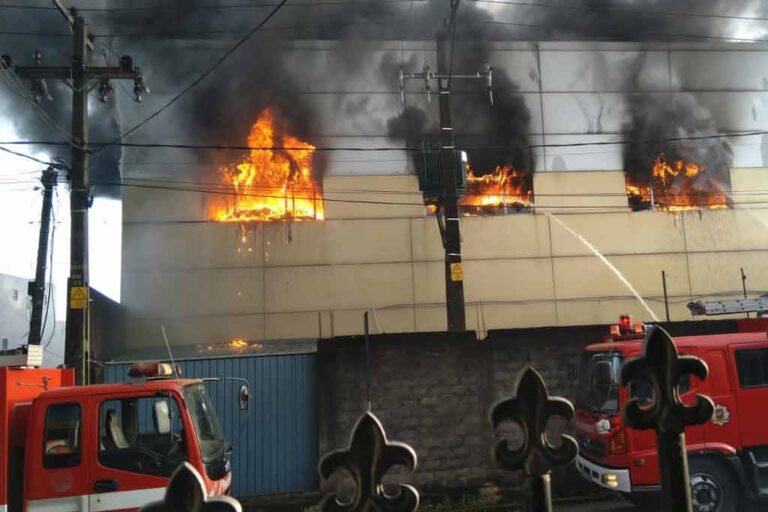
A fire has reportedly broken out in a building located on Waragoda Road, Galborella, Kelaniya this morning (05).
The upper floor of the building, which is used as a warehouse of a private company, was taken over by the blaze and was almost completely destroyed, according to reports.
Meanwhile, six vehicles of the fire brigade belonging to the Colombo Urban Council are currently trying to contain the blaze and the electricity of the area has been cut out, correspondents further revealed.
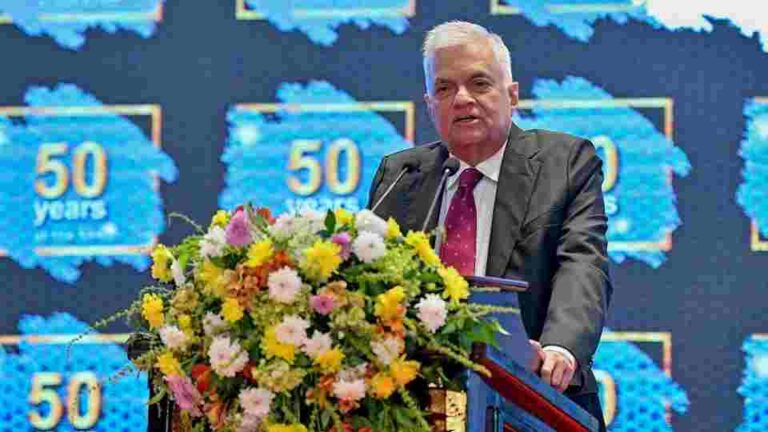
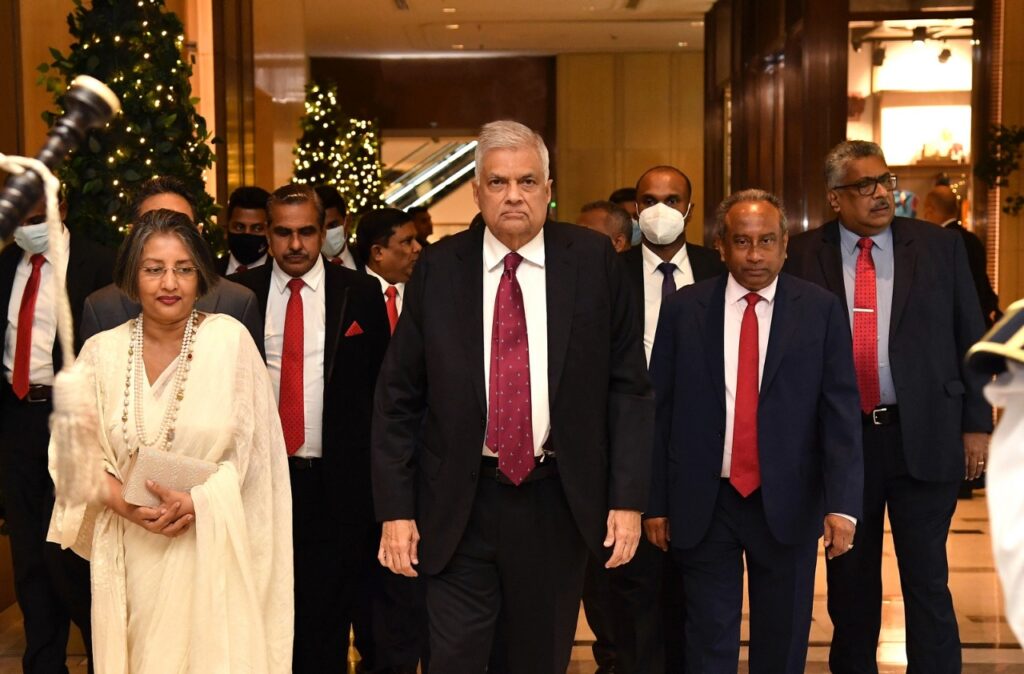
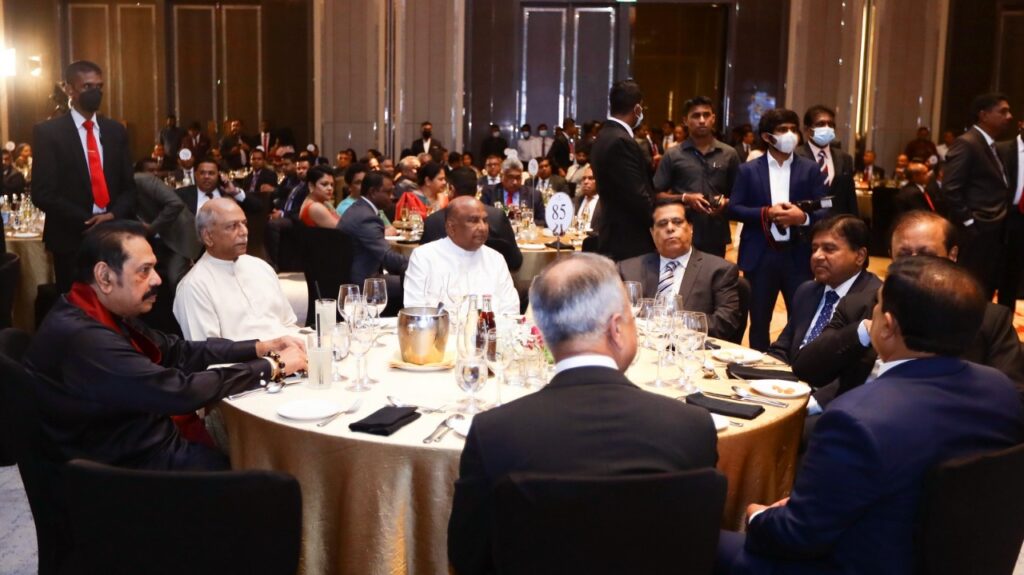
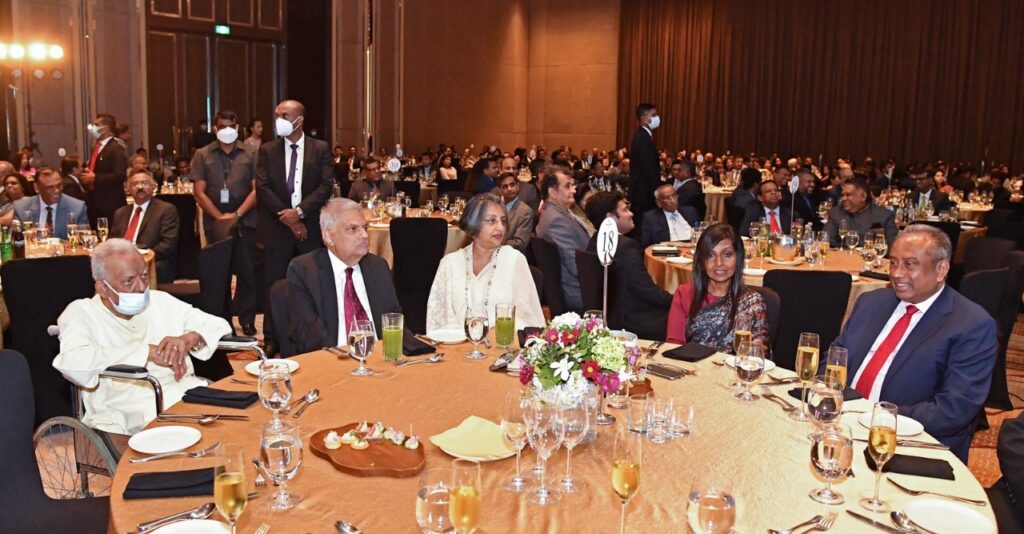
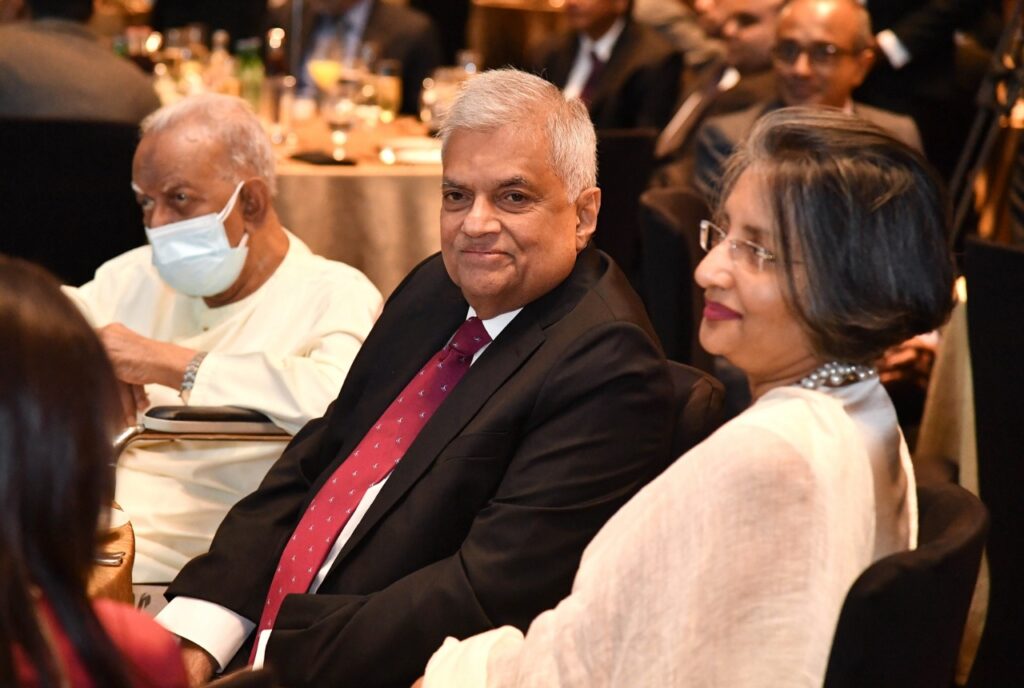
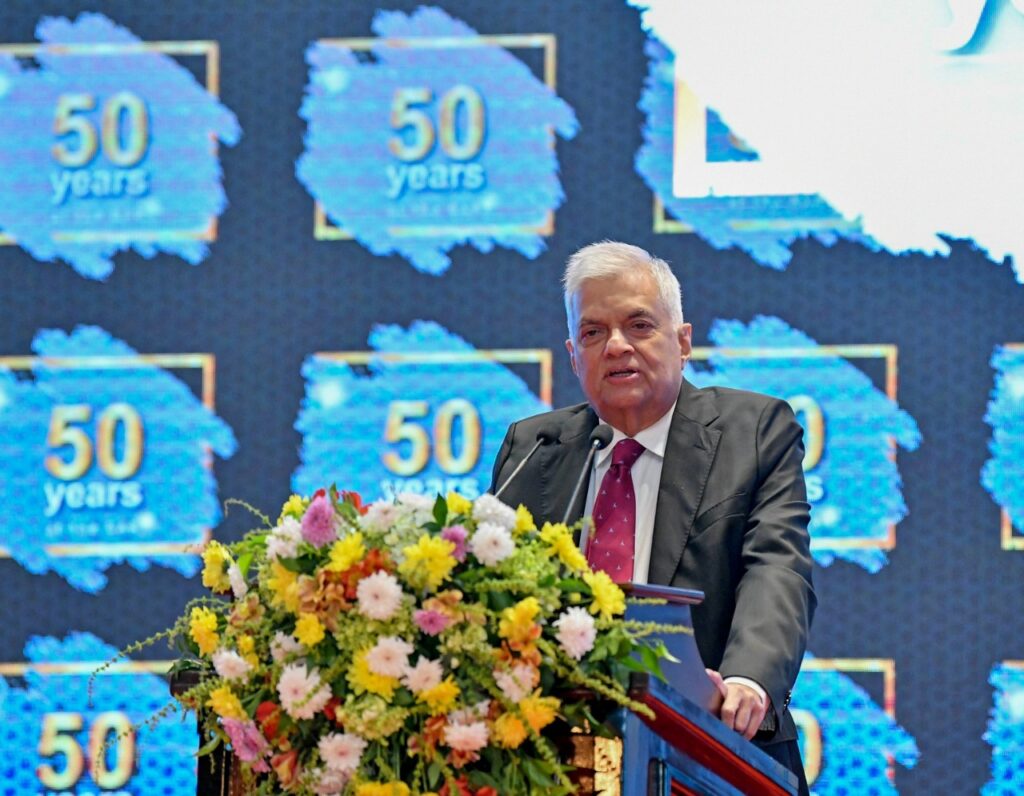
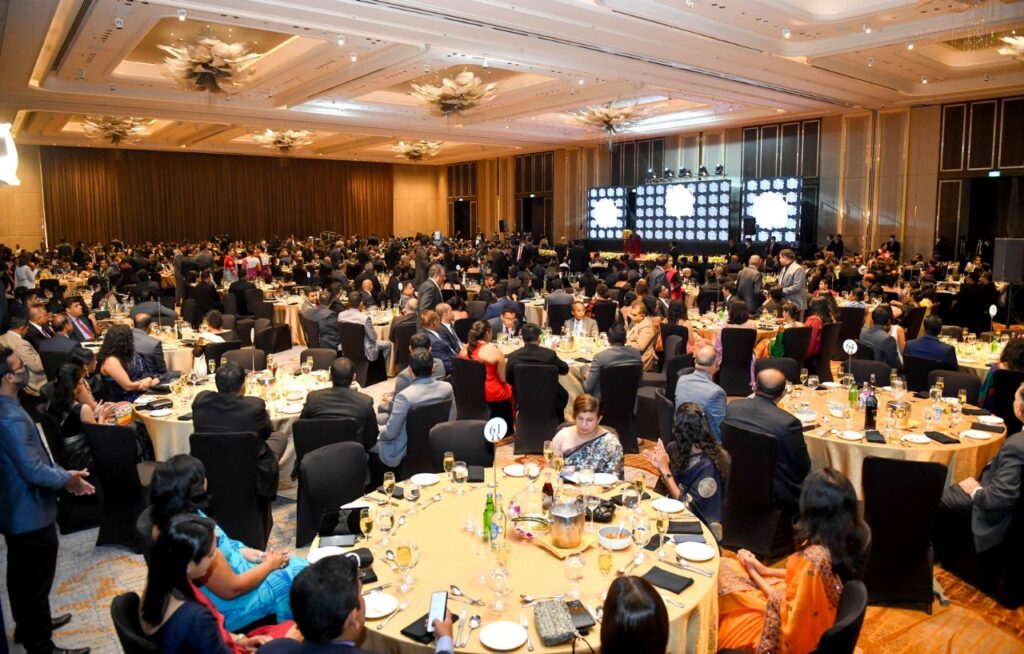
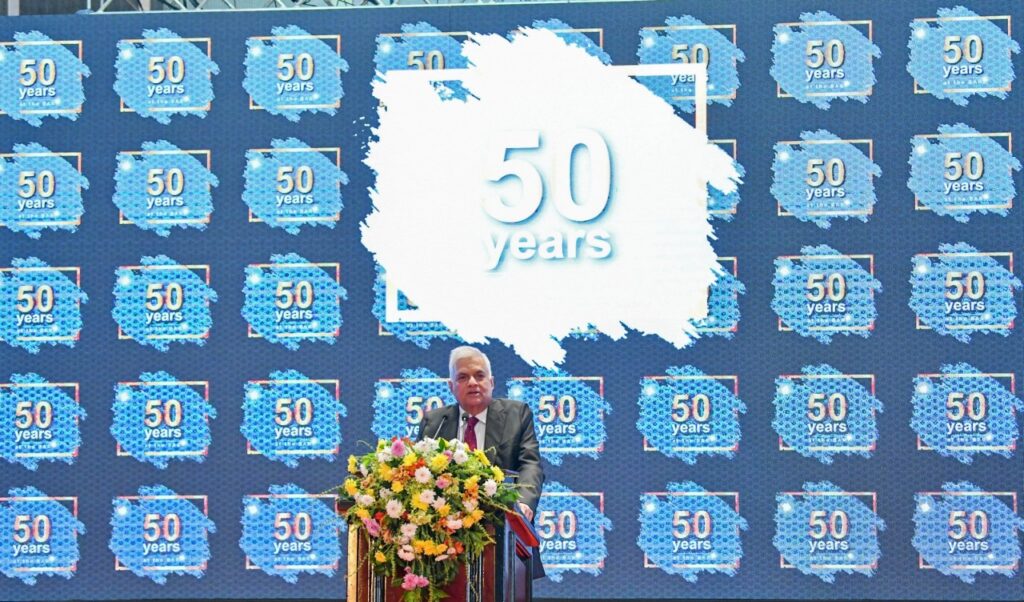
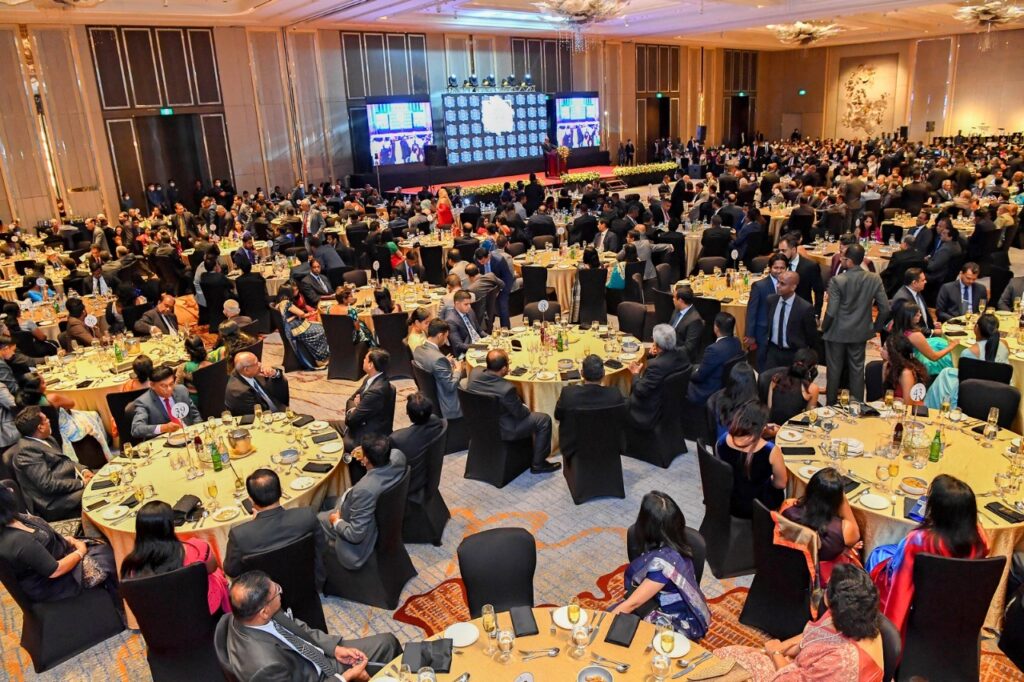
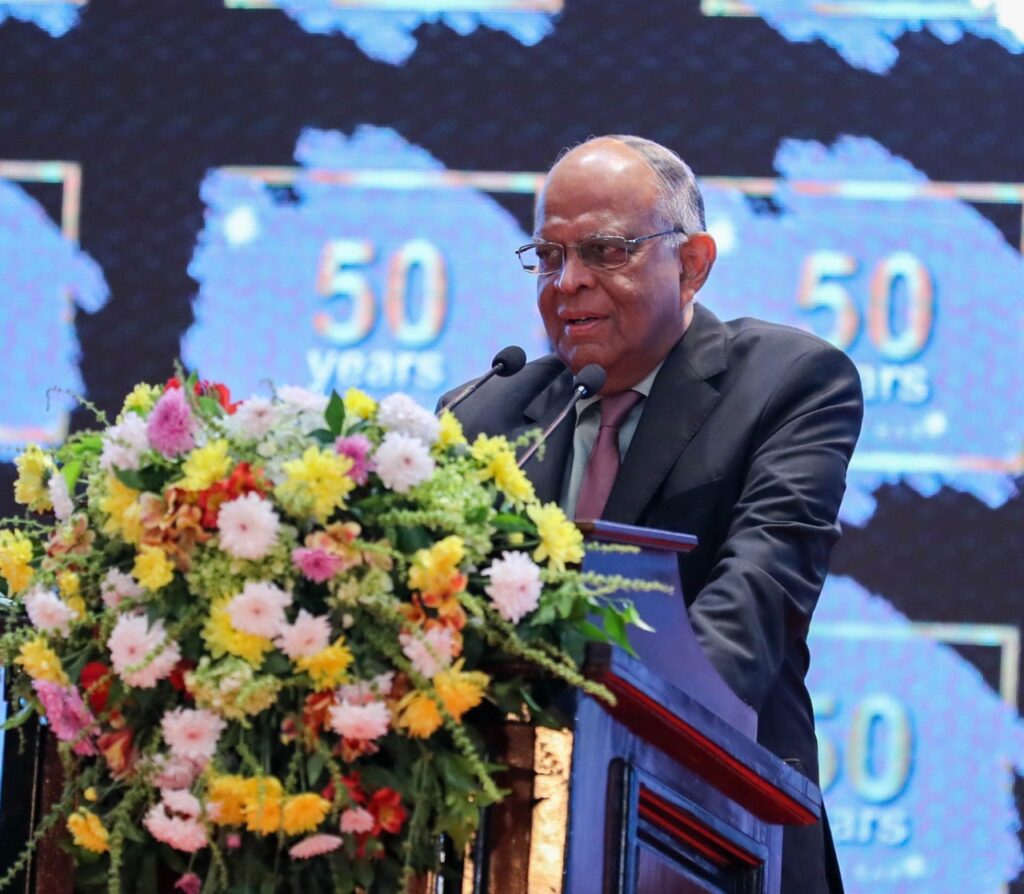
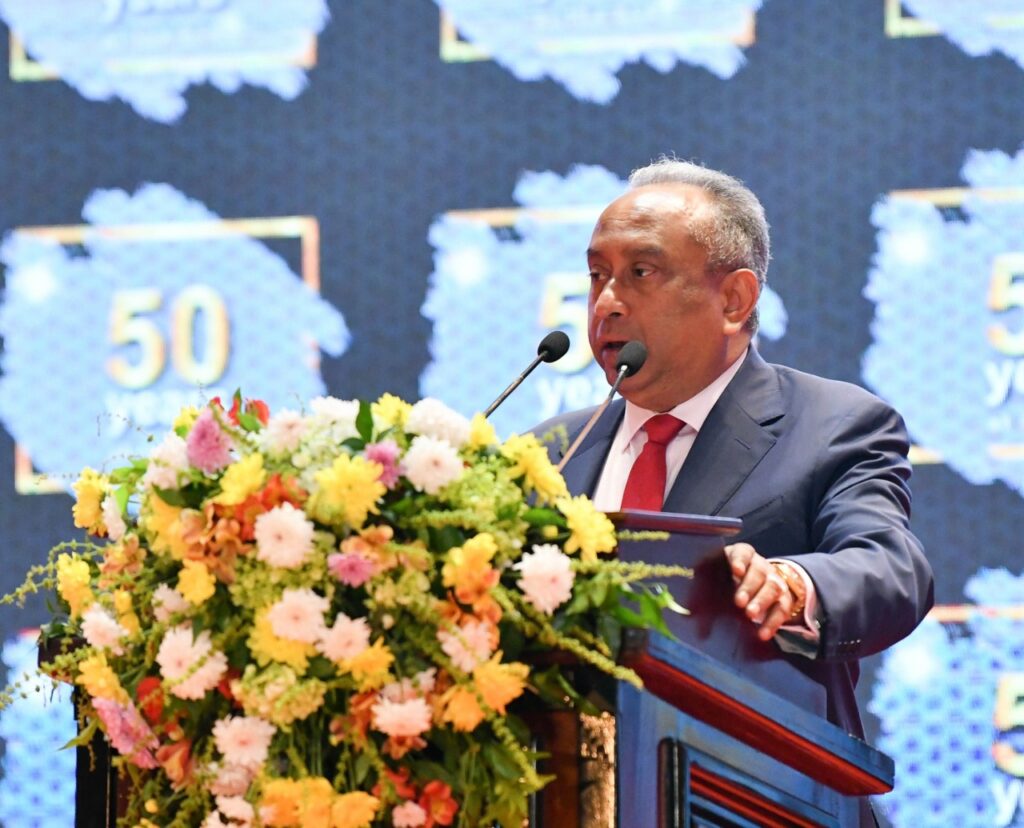
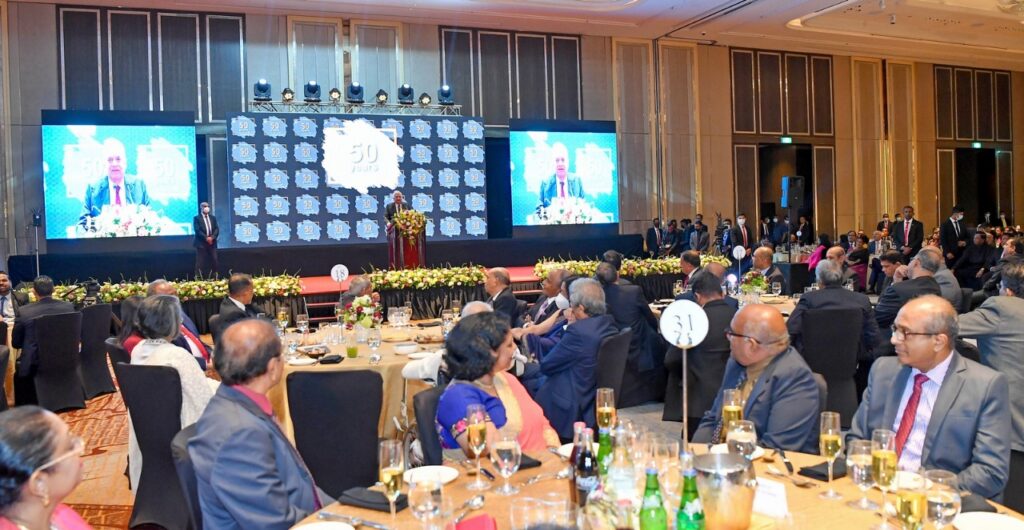
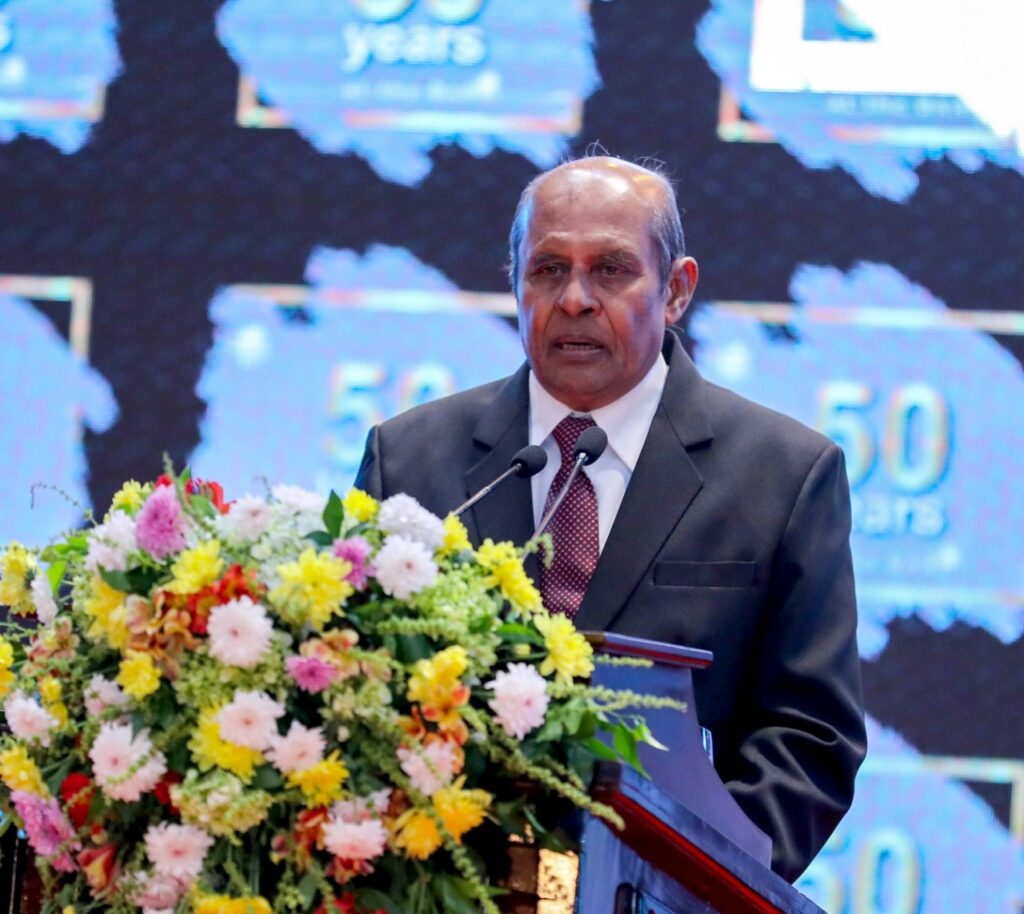
Felicitation ceremony organized by the learned community for President Ranil Wickremesinghe on his completion of 50 years at the Bar.
The ethnic, religious issues and other genuine concerns of the people could be put behind the past to prevent a break up of unity and integrity of the state by the 75th Independence Anniversary of the country. As discussed by the Members of Parliament, if the Attorneys-at-law in the country would assist in this process, this task could be achieved, said President Ranil Wickremesinghe.
He made this observation addressing the ceremony organized to felicitate President Ranil Wickremesinghe on completing 50 years at Bar, held at the Lotus Hall, Shangri-La Hotel, Colombo, yesterday evening (03).
He said further that it is not an easy task but neither is it an impossible task. He added that this task cannot be achieved merely through the efforts of the politicians, but the support of the lawyers is vital in this endeavor.
He said apart from the economic challenge, there is a greater challenge, where the younger generation is questioning the entire system. He added that now the country has the option of letting the wounds of the past heal or letting it grow further. The Parliamentarians have taken a decision to see how best to resolve the ethnic differences and work towards reconciliation, issues of religious differences and all the other genuine concerns of the people, without breaking up the integrity and unity of the state.
He also said that if all the Attorneys-at-law join hands, all the major problems could be put behind us and all communities could come together as children of one mother as the country celebrates its 75th Anniversary of Independence next year. He added that it would also give all the opportunity to understand and appreciate each other’s views and prepare a constitution which would enshrine the freedoms the people enjoy but also allow for constitutional governance.
President Ranil Wickremesinghe and First Lady Professor Maithree Wickramasinghe were received at this occasion by President’s Counsel Ronald Perera.
Addressing the gathering President’s Counsel Romesh de Silva said President Ranil Wickremesinghe has never worked for self-promotion but has always worked to strengthen Parliament.
President’s Counsel Romesh de Silva President’s Counsel Thilak Marapana and President’s Counsel Faiz Mustafa also spoke at the event. President’s Counsel Ronald Perera delivered the welcome speech and Attorney-at-Law Kushan de Alvis made the vote of thanks.
Speaker Mahinda Yapa Abeywardena, First Lady Senior Professor Mithree Wickramasinghe, Prime Minister Dinesh Gunawardena, former President Mahinda Rajapaksa , Chief Justice Jayantha Jayasuriya PC, UNP Chairman and Parliamentarian Wajira Abeywardena, Ports and Civil Aviation Minister Nimal Siripala de Silva, MP Anura Priyadarshana Yapa, MP Chandima Weerakkody, MP Udaya Gammanpila, MP M.A Sumanthiran, MP Lakshman Kiriella, Justice, Prisons Affairs and Constitutional Reforms Minister Wijeyadasa Rajapakshe, Secretary to the President Saman Ekanayake, President’s Senior Adviser on National Security and Chief of Presidential Staff Sagala Ratnayake, Senior advisor to President on Climate Change Ruwan Wijewardene, Presidential Adviser Akila Viraj Kariyawasam, Presidents Adviser Dr R. H. S. Samarathunga, President’s Adviser K P Dayaratne, UNP General Secretary Palitha Range Bandara, Navin Dissanayake and the President’s Private Secretary Sandra Perera also were present at the occasion.
Several spells of showers will occur in Northern, Eastern and North-Central provinces, and showers or thundershowers will occur elsewhere during the afternoon or night, said the Department of Meteorology in a statement today (05).
Fairly heavy showers above 75mm are likely at some places in Western and Sabaragamuwa provinces and in Kandy, Nuwara-Eliya, Galle and Matara districts.
General public is kindly requested to take adequate precautions to minimise damages caused by temporary localised strong winds and lightning during thundershowers.
Condition of Rain:
Showers or thundershowers will occur in several places in the sea areas off the coast extending from Batticaloa to Pottuvil. Showers or thundershowers will occur in the other sea areas around the island during the afternoon or night.
Winds:
Winds will be north-easterly and speed will be (25-35) kmph.
State of Sea:
The sea areas around the island will be slight to moderate. Temporarily strong gusty winds and very rough seas can be expected during thundershowers.
I felt very sorry for Wijewardena’s efforts made in his article titled “Who has printed the biggest quantity of money? Lakshman, Cabraal or Nandalal?” published in the Daily FT 29th November to lift Nandalal Weerasinghe to the esteem of HNS Karunatilake and AS Jayawardena in the hindsight of tribal monetary concepts. I felt that people should retire before reaching the old age that begins Parkinson to destabilize the brain and body punctuality which has potential of creating grave conflicts in the civil society management.
In his article, Wijewardena uses monetary concepts from John Law in early 18th century and monetary statistics of reserve money, money supply, money creation and lagged transmission used in 1950s-1980s with old definitions of money as a medium of exchange. However, modern central banks do not resort to these concepts to drive the monetary policy being another adamant line of state bureaucracy for public catastrophe although such statistics are regularly published for the use of academic research especially in universities as those concepts are still taught in principles of economics to beginners.
However, some central banks including Sri Lankan central bank still use tribal monetary concepts primary based on quantity theory of money in 1500s and lagged transmission effects of money on the economy and talks of the money and monetary policy like a rocket science. They are so mentally sickened that they do not have the mental space to understand modern electronic money and payment technology that have pushed the central banks and monetary policies to the corner of the economy driven by markets, other than big talks of monetary bureaucracy while funding the politicians. Therefore, they use these tribal concepts to protect their professions by misleading the public.
Therefore, this article provides modern facts to refute major thoughts expressed by Wijewardena in his article. Accordingly, my response is given under 11 categories of monetary thoughts presented by Wijewardena.
There had been three previous occasions when the deputy governors had spoken out. The first was in 1983 when Deputy Governor H.N.S. Karunatilake spoke out. The second was in 1989 when Deputy Governor A.S. Jayawardena spoke out. The third was when Deputy Governor Nandalal Weerasinghe spoke out in 2020. On all these three occasions, they were prematurely retired from the Bank. However, a remarkable feature was that all three of them made a comeback and became the governor of the bank later.
My Response
Wijewardena’s practice has been to use dead people as evidence so that the position cannot be verified. This thought hides the ground facts. First, only HNS Karunatilake was prematurely retired. His outspoken character was well known even before. Second, AS Jayawardena was on secondment basis in several high-ranking posts in the Government. He returned to the Central Bank in 1991 as the Senior Deputy Governor before being appointed as the Secretary to the Treasury with early retirement from the Central Bank with due remuneration.
However, Nandalal duly retired upon reaching the age of 60 with normal leave prior to retirement and accumulated personal leave along with a new pension calculation changed to capture the forthcoming salary increase to his personal benefit. Unless Wijewardena’s conspiracy of misleading AS Jayawardena to offer two grade promotions with no-pay leave counted in service to Nandalal to enable him to apply for Deputy Director post, he would have retired below the Deputy Director grade.
The comeback of all three relates to contemporary geopolitics and not rocket science specialty in monetary policy. The position of HNS Karunatilake has been presented by himself in his book “Fifty Years of Central Banking in Sri Lanka in Sri Lanka” (August 2020). Everybody knows that AS Jayawardena’s change in the seat from the Treasury Secretary to the Central Bank Governor was not a promotion.
Why Nandalal came back as the Governor is not a secret. It was the last, grave deception of the former President who could not manage people around him. Nandalal’s monetary policy with 7% interest rate hike at once and default of debt also contributed to the former President’s run a way. Nandalal was outspoken in 2020, not because of his monetary professionalism, but because of his firing anger at the denial of the Governor post to him by the new Government and the release of the media clip on the President’s meeting with the Central Bank officials on 16th June 2020. Nobody can find fault with the Government for appointing Professor Lakshman as the Governor and his Corona pandemic monetary policy, given his professional profile and contemporary monetary policy framework in the Central Bank and other countries. In fact, Wijewardena praised both the former Governors as abled persons at the time of their appointment.
In that context, Wijewardena’s attempt to lift Nandalal to the level of HNS Karunatilake and AS Jayawardena, who are two esteemed central bankers and public servants, is nothing but a sick mentality. If Wijewardena provides evidence for specific contribution of Nandalal to the Central Bank other than his leadership in all sovereign bonds that dragged the economy and public into catastrophe and willful default on same, the subject of his fitness and propriety can be discussed further. I also wonder why Wijewardena was not elevated to same esteem on the ground of him also being an outspoken Deputy Governor.
WAW Monetary Thought 2
There is an unwarranted public debate taking place in Sri Lanka today. That is, of the three Central Bank governors in the last three years, W.D. Lakshman, Ajith Nivard Cabraal, and Nandalal Weerasinghe, That is, of the three Central Bank governors in the last three years, W.D. Lakshman, Ajith Nivard Cabraal, and Nandalal Weerasinghe, who has printed the biggest quantity of money leading to the present galloping inflation recorded at about 70% per annum.
My Response
If this is unwarranted, why Wijewardena also writes contributing to same is not clear. He could have simply said so and advised his readers that the subject is a part of the laws and policies that are handled by the authorized officials as per their public mandates depending on contemporary circumstances and the information set. Everybody knows that present allegations and analyses are nothing but ex-post imaginations of people who never experienced real circumstances.
WAW Monetary Thought 3
Money is a mental thought and not a real asset – Money is simply a facilitator for people to acquire these real goods and services. Hence, money itself does not give us any pleasure, called utility in economics. Its utility is its ability to help us acquire these real goods and services which we can consume for pleasure. As such, money is simply a notion in our meds and can be called a mental thought.
My Response
Such philosophical thoughts do not serve money or monetary policy. Not only money, but all assets are also mental thoughts of value that change from time to time. People accept money because of its value believed. That is why many governments and people go after USD, despite the domestic legal tenders different from USD. Prices of goods and services and assets that determine the value of money also are mental thoughts as nobody knows the natural prices elaborated by Adam Smith.
However, modern money is not just a medium of exchange for real goods and services. Its functions of deferred payments and liquid store of wealth drive money in modern monetary societies. In fact, money is created on credit. Banking and monetary policy have evolved primarily on credit and liquid store functions of money. Therefore, Wijewardena’s interpretation of money is baseless.
WAW Monetary Thought 4
In a book he published in 1705 under the title Money and Trade Considered: with a Proposal for Supplying the Nation with Money, Law argued that money issue is an important monopoly being enjoyed by the king, and therefore, the king should supply money to facilitate international trade which was the source of prosperity at that time if a country was able to generate a trade surplus with other nations.
According to him, as long as money served this purpose, there was nothing wrong in increasing money supply liberally. Modern monetary theorists, without giving credit to John Law, have represented the same idea as guidance of policy by governments. For them, talking about an evil budget deficit is a myth. Governments should increase money freely and generate real economic growth.
The mistake which modern monetary theorists, Lakshman and Cabraal made, was that they thought money as a real good and not simply a facilitator. Hence, when you supply more money through the Government which runs a budget deficit, the welfare of the people will be greater. But when you consider money as a mental thought, more money means that you are in a bigger dream world believing everything that you dream. However, when you wake from the dream, you must face the harsh realities in the real world. That is what is happening to Sri Lankans today. They are suffering from both the exchange rate depreciation and high inflation. To his credit, Nandalal is not guilty of these evil utterances or activities.
My Response
As I mentioned earlier, Law’s concept is about tribal money. In present modern monetary societies, there are no tribal kings to supply money. Therefore, modern monetarists propose to use the modern role of money to serve the living standards through the fiscal front to ensure a fair distribution of benefits of money. It is same what is done by conventional monetarists also under cover because money printing and creation take place primarily on credit to the government.
During decades up to 2020, Sri Lankan central bank printed money easily about 70%-90% on the purchase of foreign proceeds of government foreign debt which is the prime cause of the present economic crisis. As foreign debt is now in default, the same central bank prints money on domestic credit (unlawful purchase of Treasury bills) to the government. If the present central bank Governor being a hero of Wijewardena is able to stop this printing, he will not have a monetary policy to live on. Even the majority of USD printing by the Fed is the credit to the US Government. This is common to all central banks. Therefore, tribal monetary economists must carefully read the policy approach of the so-called modern monetarists by leaving out their mental sickness because tribal economics does not have solutions to modern human problems.
Governor Lakshman and Cabraal never interpreted money as a real good. They all followed the monetary policy presently available in the central bank governance. That is what Nandalal also is doing now except for running after the IMF for unsustainable bailout after a constitutional violation of default of debt beyond his authority. The world he knows is only the IMF and foreign debt to build the foreign reserve. If so, why Nandalal is a free man is all about what Wijewardena alone thinks.
Present economic crisis in Sri Lanka is not because of supplying more money. Although exchange rate and prices/inflation are connected with monetary terms, nobody can establish that present currency depreciation and inflation are because of suppling excess money. When the Central Bank runs out of foreign reserves, it loses control over the exchange rate. When the Government prohibits imports because of the foreign reserve problem of the Central Bank, the supply of goods and services shrinks dramatically. This is the story behind hyper-inflation and economic contraction in Sri Lanka. As Wijewardena proposes, if the Central Bank had not printed money to fund the essential public services, we would not have a government and sovereign state today.
All these economic problems are here, not because of supplying of money in 2020-2021, but because the Central Bank did not practice monetary policy in decades as per the mandate given to it. Now, the very same people just like politicians find scapegoats behind money supply and fiscal deficit/debt which were managed by themselves in decades. Therefore, passing all blames to Governors Lakshman and Cabraal for not managing the money supply as Wijewardena thinks prudent and lifting Nandalal as the only national hero despite his evil carrier record in the central bank very well known by Wijewardena himself are nothing but malicious objects.
WAW Monetary Thought 5
There is the governance structure of the Central Bank which is not immediately visible to outsiders. In terms of the law, there is no such institution called the central bank. Instead, it is the Monetary Board which has been incorporated under the law. It is that Monetary Board which is responsible for conducting monetary policy – the work involved in decisions relating to money supply growth. The Governor is the Chairman of the Board, but he is not the board. There are four other board members, Secretary to the Ministry of Finance and three other outsiders competent in economics, finance, or banking. These four board members are expected to function independently according to their conscience, considering their duty by the people that they should protect the moneys held by them.
CB’s technical staff is not decision maker-Very often people question the role of the Central Bank’s technical staff, including deputy governors, in these evil activities. This question is also raised due to the ignorance of the above-mentioned governance structure of the Central Bank. The staff can make recommendations, but the Board can accept it, reject it, or modify it. The staff has no say about this. They may have made the correct recommendations, but if the Governor and the Board have rejected them, they are not responsible for the consequences of such policy actions. Unfortunately, within the present disclosure policy of the Central Bank, the staff cannot make its views known to the public.
My Response
His thoughts are not correct in law. First, the Central Bank is set up under the MLA and a large number of public duties have been mandated to it. The Governor has been empowered as its CEO for the direction, supervision and control of the operations of the Central Bank and its internal management and administration. That is why any Governor attracts enormous reverence in the Central Bank. One Governor used this general provision to block a Deputy Governor getting access to information under specific power given to Deputy Governors in the MLA. Therefore, almost all operations of the Central Bank are virtually run by the Governor whereas the Monetary Board does not have any idea of what those are. For example, open market operations and foreign currency operations including the exchange rate have been outside the purview of the Monetary Board.
Central Bank’s technical staff are public servants within the meaning of the Penal Code. Almost all have been assigned duties aligned to the powers and functions of the Central Bank. If their recommendations are based on facts, there is no reason for the Monetary Board to reject them provided that the Monetary Board understands them. In fact, they are employed by the Monetary Board to help it to discharge its duties and functions. However, these are not the recommendations made based on ricket science type economics whereas information on policy direction of the Monetary Board is not available with the technical staff.
Therefore, the contention of the technical staff that the Monetary Board did not implement their recommendations has no basis, especially when those reports are not publicly available to assess the true nature of contents of these recommendations. However, the technical staff come up with these reports as evidence to implicate decision-makers in judicial reviews as evidence of public servants matters. In fact, they even reproduce reports ex-post for this purpose. Therefore, what matters is not the validity of staff recommendations but their professional quality and integrity in making recommendations.
In fact, a part of the mandate of the Economic Research Department is to prepare data and conduct economic research for the information of the public in the subjects of money and banking and other economic subjects of general interest even though economists in the Research Department may not be prepared to do so. Therefore, the Central Bank cannot have a public disclosure policy to keep the technical staff closed from the public. They even leak reports to implicate higher ranking officers they dislike.
The description of the monetary policy as the work involved in decisions relating to money supply growth is also a tribal view. Modern monetary policies do not talk about money supply growth but involve a host of decisions to influence the economy. Sri Lankan central bank also does not talk about this in its monetary policy press releases. Anyway, there will be an eventual result of change or growth in money supply that was not decided by anybody. If the concept of money supply is not believed, it has no use other than the value of statistical information.
WAW Monetary Thought 6
Any increase in this stock is ‘money printing’ and any decline is ‘money burning’. This stock stood at Rs. 7,624 billion as at the end of 2019 when Lakshman became the Governor. By end-September 2021 when he resigned from the governorship, it had ballooned to Rs. 10,488 billion indicating an increase of Rs. 2,864 billion or 38%. When Cabraal resigned as Governor in early April 2022, M2b stood at Rs. 11,575 billion, recording an increase of Rs. 1,087 billion or 10% during his tenure. Nandalal became the Governor in April 2022 and, according to the data released by the Central Bank, M2b at end-September 2022 amounted to Rs. 12,051 billion. During that period, M2b has increased by Rs. 476 or 4%. In terms of these numbers, Nandalal has the lowest record of money printing, but that conclusion is misleading as explained below.
My Response
This is a meaningless presentation as money supply numbers are not differentiated between the Governors for comment because money supply is neither a voluntary act of the Governor nor a variable controllable by central banks at their wish. Nearly 94% of Sri Lankan money supply M2b is bank deposits decided by the public and banks over the time. Even the currency component 6% cannot be decided by the Central Bank. Therefore, Wijewardena has to depart from tribal monetary concepts if he wishes to be a modern monetary economist.
Further, these monetary statistics are not audited for the consistency of calculation methods. As banks use marked-to-market accounting, the numbers involved in money supply and its sources are largely results dependent on accounting hypotheses. For example, currency depreciation in March and April (nearly 70% increase in exchange rate) had a large book-keeping valuation effect on foreign currency assets and liabilities captured in money supply without any fresh liquidity injected into the economy. Therefore, present money supply statistics are not representative of true macroeconomic developments.
The term “money printing” is not used for increase in the money stock/money supply in the monetary literature. It is specifically used to measure the increase in production of money by central banks.
WAW Monetary Thought 7
This argument is erroneous and demonstrative of the critics’ poor literacy of monetary theory. First, money is not what the Central Bank lends the Government. It is the total money liquidity in the hands of the people enabling them to buy baskets of real goods and services. That stock of money, known as money supply, has been defined by the central bank as currency issued by the central bank and held by the public, demand deposits held by the public in commercial banks, time and savings deposits of the public held in commercial banks, and a half of the non-resident foreign currency deposits of the public with commercial banks. For ease of presentation, this money stock is coded as M2b.
The monetary liquidity that enables spending in the economy is the financial flow across the economy. There is no single estimate accepted for this. So called M2b is only one estimate used in Sri Lanka to measure the liquidity available through the banking system. M1, M2 and M4 are other estimates. Therefore, the use of M2b to measure the total money supply is not correct. The accounting of half of the non-resident foreign currency deposits is highly arbitrary and recent excessive depreciation of the currency has an artificial valuation effect on M2b.
Whatever the estimate of monetary liquidity, its major source is the credit to the government by the central bank and banks. This is common even in developed countries. Further, central banks nowadays do not track or target the money supply. Therefore, money supply related monetary theory is the poor monetary literacy of Wijewardena.
WAW Monetary Thought 8
Money is needed for conducting economic activities and, therefore, not all money supply increases are evil, as believed by many. If money is not there in adequate amounts, we cannot conduct the transaction of real goods and services smoothly. Imagine a situation where you get into a bus, and you do not have enough liquid cash to pay your bus fare. You may have a Rolls Royce at home, but that Rolls Royce will not help you to pay your bus fare at that point of time. The chances are that, to your embarrassment, you may be thrown out of the bus unceremoniously. Hence, it is the job of the Central Bank to allow money supply to go up or go down as needed by the expansion of the economy. The bigger the production in the economy, bigger the quantity of money needed by it to exchange all those goods and services.
Accordingly, there is a safe method of supplying money to an economy by a central bank. That is, if it keeps the money supply growth equal to the growth in the real economy, it can keep the price level changes – known as inflation when it happens over a period – at a zero level. Therefore, permitting money supply to grow at the same rate as the real growth in the economy is not an evil activity. For instance, if the real economy grows at 10%, the central bank can allow the money supply to grow at 10% without compromising the price levels. But it will become evil if it allows money supply to grow higher than the real economic growth continuously and consistently causing people to suffer through inflation. When inflation is set in, its undesirable consequence is the depreciation of the exchange rate. The Central Bank should avoid both by keeping money supply growths within the limits.
My Response
This is again quantity theory based tribal money concept. Central banks nowadays do not have the luxury of controlling money supply to suit the real economy as described above as none of them is rocket science. Therefore, the talk of keeping the growth of money supply equal to the growth of real economy is kindergarten monetary teaching. Central banks have no means to know the growth of real economy, growth of money supply and inflation until several months are passed. Therefore, monetary policy decisions are merely bureaucratic hypotheses for the future which never materialize because the growth of real economy, growth of money supply and inflation are outcomes of various dynamic factors and unknown shocks. Further, proxies used for all three are highly controversial.
It is surprising that Wijewardena is not aware that all banks in the present civilized world have given up monetary targeting framework that was used in the past in line with his version of tribal monetary theory. Further, the new habit of central banks is to target an average rate of inflation over a long horizon, known as inflation targeting monetary policy, which is also wrong if Wijewardena’s monetary theory is correct. Anyhow, modern central banks do not use money supply statistics to drive any approach of monetary policy.
Talk of keeping the money supply growth to control exchange rate is also not practical because many central banks have now given up the exchange rate from the monetary policy ambit. Central banks in many developing countries attempt to control the exchange rate by holding an artificial foreign reserve and have exposed the countries unreasonably to currency crises. Sri Lankan Economic crisis is just that. If Wijewardena’s thought is correct, acute problems of inflation and currency depreciation confronted by many countries as well as US currency appreciation at present are due to failure to control money supply.
The Rolls Royce story is a highly exaggerated one which does not have any practicability in modern monetary societies.
WAW Monetary Thought 9
Now let’s examine the Central Bank’s holding of Treasury bills as equivalent to its money printing. This is another half-truth relating to the subject. Central banks throughout the world, by the mere ability to issue currency, are able to acquire assets simply by making a book entry. Those assets can be lending to the government, lending to commercial banks, lending to the staff as welfare loans, or the acquisition of fixed assets like buildings, computer systems, etc. When it does so, it adds to its assets and creates a liability in the form of new currency issued or crediting the accounts of the government or the commercial banks, or simply reduction in the capital if the transaction involved amounts to losses.
All these asset acquisitions are new money creations. Therefore, they are called new reserve money creation by the central bank. Such reserve money, once released to the economy either through the government or through commercial banks, is used by commercial banks to create further deposits and credit. Such deposits held by the public as well as the currency originally issued by the central bank together make the money supply of the country. The present conditions in the financial system in Sri Lanka allow commercial banks to create this final money 8 times more than the reserve money created by the Central Bank within about 18-24 months. Accordingly, if the Central Bank lends Rs. 1 to the Government, it will ultimately create another Rs. 8 within the country’s banking system.
Hence, the money supply increases that we observe today are the result of the reserve money created by the Central Bank some two years ago. This is known as the multiple money creation process and the overall reserve money level functions as the seed money creation by the Central Bank. Hence, if any governor is guilty of the so-called evil activities, it is according to the reserve money his administration has created and not just the lending to the Government or commercial banks.
My Response
This is again a classroom lesson to beginners of old version monetary theory, known as money multiplier model, practiced by central banks until 1980s. Reserve money is an estimate for money printing by the central bank whereas money supply is a concept for money held by the public. It is an old concept that banks create money which is captured in money supply from reserve money they receive.
This version is not accepted now. In fact, money is created by bank lending through book entries where banks will finance such lending through the daily liability management. Borrowing from the central bank is one source of securitization mobilized after lending decision is made where such borrowing from the central bank is only a purchase of government debt by the central bank in the secondary market.
Therefore, deposits are created from lending and not vice versa, but both are two sides of the same coin. It is fact that money in modern monetary societies is credit-based because there are no kings to issue money as they wish to fund his spending and gifts. What Wijewardena presents is the old version of money creation through lending out of deposits of currency received through printing of money by kings. He has forgotten how private bank notes served as money prior to establishment of state moneys and central banks.
The 8 times referred to by Wijewardena is known as the money multiplier in the old model. It is just arithmetic result of dividing the money supply by the reserve money on the hypothesis that money supply is creatable only on reserve money. This number frequently changes in relation to the numerator and denominator. Therefore, it does not have any value for monetary policy other than producing a dump forecast for money supply by assuming the money multiplier being constant. This is what central banks did in so-called monetary targeting frameworks where central banks attempted to control reserve money to move money supply at its targets. However, none of them are controllable in present monetary economies with electronic money and payments systems.
Reserve money also is a meaningless concept understood only by central bank staff who calculate it. It is highly unreliable as central banks can have insider monetary dealings purposely arranged to fix the month-end figures to tell the world that money printing is under control or target. In fact, money printing depends on the demand of the public and government for central bank liabilities. Therefore, central banks in developed countries no longer use reserve money numbers for making monetary policy decisions.
However, they pay attention to the size of the central bank balance sheet and its distribution. For example, more than 50% of the Fed balance sheet is medium and long-term Treasuries (whereas total Treasuries accounting for 64% of the Fed balance sheet) and this helps the financial system to manage the liquidity risk connected with maturity transformation. In contrast, the balance sheet of Sri Lankan central bank at present is driven by short-term credit to the government up to one year (maturity profile is not disclosed) (nearly 76% of the balance sheet) which reflects considerable risks to the financial stability.
However, until resent times, its balance sheet ran 70% to 90% by foreign reserve made out of government foreign debt that led to the present economic crisis. If not for the purchase of Treasury bills lawfully or unlawfully by the central bank, the country’s monetary system also could have collapsed by now. Therefore, irrespective of rhetoric of money printing, the central bank has no option but to purchase of Treasury bills to meet the currency demand of the economy. However, doing it at sky-rocketed interest rates is a grave risk to both economic stability and financial stability of the country. If Nandalal had followed Wijewardena’s advice to raise policy interest rates to 25%, both financial system and economy would have been collapsed by now and Nandalal would have run a way back to his foreign residence.
Anyhow, government debt is the prime source of money printing in all countries. In fact, central banks manipulate the yield curve to influence interest rates structure in the economy. Both Wijewardena and Nandalal testified at the Bond Commission that private placement of Treasury bonds in trillions for several years was used as a powerful instrument to control interest rates to suit the requirements of monetary policy. The Central Bank Annual Report 2016 also lamented the non-availability of private/direct placement of bonds to control the back-end of the yield curve. However, this instrument was both unlawful and uneconomic.
The time of 18-24 months indicated by Wijewardena is his own tribal economic view. If all transactions take place through currency, it will take several months for any new currency to give its income multiplier effects to the economy. The same concept is used for presentation of the economic effects of money supply too. This kind of lagged effects of money is the case in tribal times with transactions in physical currency. Although people undertake Ph.D. dissertations to figure out the extent of the lag time known as monetary policy transmission mechanism through sophisticated statistical models, nobody has got an answer. Any policy or any activity has a lagged time. It is not only applicable for money.
However, in modern monetary economies with electronic money, credit and payment systems, the spending has become faster. Present credit systems are such that spending takes place well before money. In informal credit systems prevailing among traders, spending take place without monetary liabilities of the banking system. Currency notes are used in their lifetime until they are demonetized. In that context, the lifetime of currency including replacement currency is the transmission time which is not just 18-24 months.
The nature of currency is to change hands until it is removed from the circulation. New currency issues take place on daily basis and nobody knows amounts of money created by currency issues of each day as they all work together. Therefore, 18-24 months’ time is not a sensible concept. Therefore, talk on the money multiplier model of money supply and lagged effects is nothing but monetary nonsense.
WAW Monetary Thought 10
During 2010 to 2014, the reserve money level on average amounted to Rs. 470 billion per annum. Reflecting on the increased bank financing for budgetary funding, during 2015 to 2019, reserve money on average shot up to Rs. 872 billion per annum and this growth has been an unwarranted one. This is because commercial banks will create Rs. 8 by using every rupee created by the Central Bank as reserve money leading to a total money stock of some Rs. 7 trillion, up by some Rs. 3 trillion from the level of the previous administration. Hence, money supply increases that we observe today are the handiwork of those who ran the Central Bank in the past.
To add fuel to fire, Lakshman allowed the reserve money base to shoot up to Rs. 1,306 billion by the end of 2021. During the first 11-month period of 2022, reserve money base has increased marginally to Rs. 1,379 billion. Consequently, today’s reserve money base will cause money supply to increase in another 18 to 24 months but marginally from the current levels since it has been only a marginal increase.
However, things will be different if the Monetary Board led by Nandalal Weerasinghe accommodates President Ranil Wickremesinghe’s demand for Rs. 1 trillion from the Central Bank to pay salaries to public servants in the next six-month period. This will be a real possibility since his budget 2023 is a very fragile one with a massive total Government expenditure of Rs. 7.9 trillion officially but Rs. 11.7 trillion when missing items are also added and poor prospect of raising revenue from taxes and the sale of Government assets. If this Rs. 1 trillion is accommodated, reserve money rising to Rs. 2.4 trillion will make a monetary explosion by 2025.
My Response
This is again an exaggeration based on tribal monetary concepts as I already established above. The number crunching is nothing but a political approach of economics because monetary numbers are not presented in this manner in monetary economics. Nandalal or any new Governor will have no option but to follow what Wijewardena predicts for monetary financing unless the new Government raises another round of foreign borrowing to fund the Government. Such foreign currency proceeds will fuel reserve money and money supply.
In that context, the brave option available to the central bank is to retire its Treasury bills portfolio and let the country’s monetary system again to be run by foreign currency reserve so that the central bank can stay relax as before. If that is possible, further existence of the central bank cannot be established. The Treasury can do both functions better.
WAW Monetary Thought 11
Money creation is a process – What this means is that money printing as perceived by the general public is a process of which the consequences of what is done today are known only with a time lag of some 18 to 24 months. That is why I said at the beginning we should not hasten to brand this governor is eviler and that governor is a saint. The initial reserve money expansion orchestrated by Lakshman and Cabraal has not run its full course as yet.
My Response
As I already presented, this is again a tribal money-based view thought in classroom monetary economics. Money creation is not a process set or controlled by anybody in the economy. It is another economic activity like production and utilization of goods and services to uplift living standards. The value added involved in creation of monetary services is counted in the GDP. Therefore, talk of a money creation process that should be run by a set of divine-like persons like Wijewardena and Nandalal in their thoughts separated from the economy is nothing but a result of mental sickness that requires modern medical treatment.
Overall Comment
The attempt of Wijewardena is to paint central banking and monetary policy as rocket sciences and form a group of followers to protect the present position of Nandalal by falling behind tribal monetary concepts. What Nandalal does through its social media network is nothing but talking of the use of same tribal monetary concepts to recover the economy from the present crisis.
I find these acts no different from some people still worshiping the sun, moon, trees, stones and statues despite modern science and technology and human brain.
Therefore, now is the high time for the country leaders to take risks of changing governance systems to ensure that modern knowledge and brain are used to find solutions to human problems because tribal beliefs will not help. It is not just change of heads but the change of systems that selects heads with modern knowledge and brain capable of solving human problems in accountable manner.
It is no secret that the present economic crisis in Sri Lanka is a monetary system crisis. Therefore, the country’s monetary system needs an urgent change from tribal monetary concepts to modern monetary concepts.
The causes and events behind hyper-inflation, economic contraction and bankruptcy of the general public in Sri Lanka are well known. All relate to supply side bottlenecks. However, the new set of monetary authorities who believe in tribal monetary concepts blames excessive money printing for all those problems and, therefore, they ask for public powers of tribal kings to control money as they wish. This will be the next economic catastrophe likely to be confronted by the general public unless the country leaders changes the monetary governance system as proposed.
It is highlighted that the monetary policy is also a bureaucratic price control system supported by money printing. In modern market mechanism, all price controls are ad-hoc bureaucracies that cause unwarranted risks to economies and living standards.
Therefore, state supervisory authorities must advise central bank economists to get innovated by leaving out tribal monetary concepts before they become extinct in the next half century in virtual monetary societies.
(This article is released in the interest of participating in the professional dialogue to find out solutions to present economic crisis confronted by the general public consequent to the global Corona pandemic, subsequent economic disruptions and shocks both local and global and policy failures.)
P Samarasiri
Former Deputy Governor, Central Bank of Sri Lanka
(Former Director of Bank Supervision, Assistant Governor, Secretary to the Monetary Board and Compliance Officer of the Central Bank, Former Chairman of the Sri Lanka Accounting and Auditing Standards Board and Credit Information Bureau, Former Chairman and Vice Chairman of the Institute of Bankers of Sri Lanka, Former Member of the Securities and Exchange Commission and Insurance Regulatory Commission and the Author of 10 Economics and Banking Books and a large number of articles publish.
The author holds BA Hons in Economics from University of Colombo, MA in Economics from University of Kansas, USA, and international training exposures in economic management and financial system regulation)
Sri Lanka’s new tourism administration headed by Minister Harin Fernando has resurrected the socio-economic crisis battered hospitality industry with the untiring efforts of Tourism Development led by veteran tourism administrator Priyantha Fernando along with private stake holders, several travel trade analysts said.
The tourism authority had planned for 1.6 million foreign visitors in 2023. Priyantha Fernando said the authority is up to the challenge, but aggressive promotions must be carried out immediately
Sri Lanka Tourism Development Authority is in the process of revising up its 2023 tourist arrival target after President Ranil Wickremesinghe’s interim budget aimed at much than higher expected arrival target in 2023.
It had earlier planned to attract 3 million tourists with a revenue of US$7 billion by 2027.
However, in the interim budget for 2022 presented by President Ranil Wickremesinghe has set a target of welcoming 2.5 million travelers by the end of 2023.
“Following the President’s interim budget proposal, the authority has to change these targets. We need to carry out aggressive work because the president wants to attract 2.5 million travelers by end next year with more high spenders,” Priyantha Fernando, the Chairman of Sri Lanka Tourism Development Authority said.
In the interim budget, President has proposed to allocate Rs. 300 million rupees to set up a special five-member committee to identify new tourist destinations in the island and to improve related facilities inorder to attract the 2.5 million travelers and high-end spenders.
As Sri Lanka is regaining a long awaited revival in its thrice-battered tourism industry, the country posted the earnings from the hospitality sector over US$ 100 million in November.
In November, Sri Lanka earned US$ 107.5 million from tourism trade, first time since April when the country last saw over US$ 100 million from the trade.
This brings the cumulative 11-month income from the trade to US$ 1,129.4 million, compared to US$ 273.6 million in the corresponding period in 2021 when the industry was severely hit by the Covid-19 pandemic.
For the November 22 period, tourist arrivals totaled 19,979. The last time weekly tourist arrivals crossed the 19,000 mark was in the first week of April, when tensions from the economic and political crisis were building up in the island nation.
The growth in tourist arrivals witnessed in November is due to the increase in the number of international airlines flying to Colombo.
Further, for the first time since the outbreak of the Covid-19 pandemic, Sri Lanka has been able to attract 4,000 tourists with the arrivals of three luxury cruise ships.
On November 18, luxury cruise ship Viking Mars arrived at the Colombo Port, bringing in 900 tourists. Earlier this week, super luxury cruise ship Mein Schiff 5 arrived in Sri Lanka with about 3,000 passengers.
The highest tourist arrivals was from the Russian Federation, which accounted for 23 percent of the total arrivals for the month of November.
India ranks as the second largest source market, contributing to 17 percent of the arrivals. Germany replaces the UK as the third largest tourist traffic generator for Sri Lanka, accounting for 9 percent of the arrivals. The UK dropped to the fourth position while ranking fifth is Australia.
India’s Hindustan Times report states Paris Club Creditor Nations are to propose a 10 year debt moratorium on Sri Lankan debt together with a debt restructuring over 15 years: no mention of reaction by China and India which are amongst Sri Lanka’s largest bi-lateral lenders.
Cabinet-Appointed Committee on Power Sector Reforms recommends the division of Ceylon Electricity Board into 15 companies: also asks Govt to avoid accepting unsolicited proposals.
Testicle trafficking racket uncovered at a private hospital in Borella where previously a kidney trading racket was exposed: the illegal operation said to be run by a broker named “Bhai”: Colombo Crimes Division informs Colombo Additional Magistrate Ranjindra Jayasuriya that an investigation has been launched.
Sri Lankan, 45, reportedly charged by Australian Police for stabbing his 44 year old wife, a mother of three children, to death at their home in Melbourne.
Former CB Deputy Governor P Samarasiri debunks Central Bank’s new effort to justify “money printing” under Governor Weerasinghe by showing that “reserve money increase” has been modest, while ignoring the increase in the T-Bill holdings of the CB: points out many technical faults in that theory: says the effort is like returning to “tribal” monetary concepts.
Central Bank says exporters have hoarded about USD 3,000 mn in earnings overseas last year, without repatriating: says export earnings were USD 1,450 mn in October 2022, of which USD 1,199 mn were in respect of merchandise, but only USD 326mn was converted: also says earnings from tourism in November 2022 was USD 107mn with total earnings from tourism from January to November 2022 being USD 1,129mn.
Labour and Foreign Employment Minister Manusha Nanayakkara says steps being taken to ban 400 employment agencies for failing to provide the required information regarding those who went overseas on tourist visas for employment.
Top Health Ministry Official says state sector medical practitioners who are leaving their jobs without officially informing the Health Ministry cannot be blacklisted as stated by the Health Minister: however, if they have received foreign training under a bond, they will have to pay the money spent on their training.
Opposition Leader Sajith Premadasa claims the SJB led by him is the only political force able to rebuild the country.
State Tourism Minister Diana Gamage says liquor outlets should be kept open 24×7 if the country wants to boost tourism: laments bars are closed at 11pm and foreigners in hotels are unable to get alcohol thereafter.