- Opposition political parties agree to take “all possible measures within the constitutional framework” to defeat the Government’s alleged efforts to postpone the Local Government elections.
- President Ranil Wickremesinghe says immediate measures are being taken to create an investment-friendly environment in Sri Lanka: also says laws will be re-enacted to encourage foreign investments.
- CB Governor Weerasinghe says there’s no alternative other than IMF; after 7 months of seeking IMF assistance, no funds received yet from anyone: staff level agreement not disclosed: massive taxes imposed: interest rates, “money printing” and inflation up to astronomical levels: debt defaulted: projects stopped: growth down to minus 8 4%.
- Renewable Energy Developers, Apparel Exporters and Motor Traders warn of serious setbacks if corporate taxes are increased to 30% from 14%: Ceylon Chamber of Commerce has however been clamouring for tax increases since 2020.
- Foreign Affairs State Minister Tharaka Balasuriya says Kazakhstan is keen to set up an oil refinery and bunkering facility in Hambantota.
- President’s Office says “Itukama Covid-19 Fund” (chaired by CB Governor Dr Weerasinghe) has been wound up: remaining funds transferred to the President’s Fund.
- ASPI falls 1.7% to a 7-week low of 8737 points: turnover also slumps to its lowest since the last week of August: analysts say economic uncertainties loom over new tax hikes: tax hikes attributed to impending IMF programme.
- Private Bus Associations to launch countrywide bus strike from 25th October: say they are unable to pay the leasing installments due to increase in interest rates: also object to the seizing of buses due to non-payment of leases.
- Director General of Sports gives an undertaking to Court of Appeal that elections for the Sri Lanka Football Federation will be held within 69 days.
- Sri Lanka win ICC Men’s T20 World Cup – First Round Group “A” match against Netherlands, by 16 runs: qualify for Super-12 stage: SL -162/6: NED – 146/9.
SRI LANKA ORIGINAL NARRATIVE SUMMARY: 21/10
President says that he will create an investment-friendly environment and create economic stability
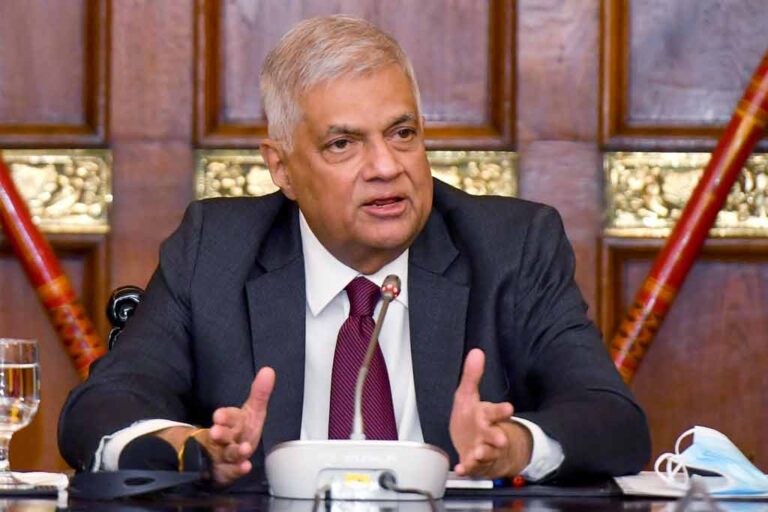
President Ranil Wickramasinghe stated that he will create an investment-friendly environment and create economic stability in Sri Lanka.
The President mentioned this while attending the opening ceremony of Havelock City, Mireka Tower yesterday (20) morning.
The president also said that the legal system introduced by the Greater Colombo Economic Commission for investment will be reactivated and a more active legal system will be introduced instead of the existing inefficient process.
Colombo Mayor Mrs. Rosy Senanayake and Havelock City Limited Chairman Ajith Jayaratne and Director Mrs. Milred Tao attended the event.
Foreign Minister discusses US – SL bilateral ties with Assistant Secretary of State for South and Central Asian Affairs
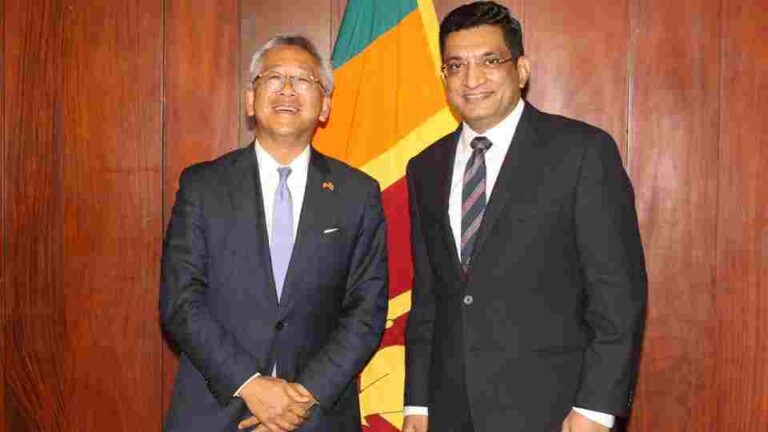
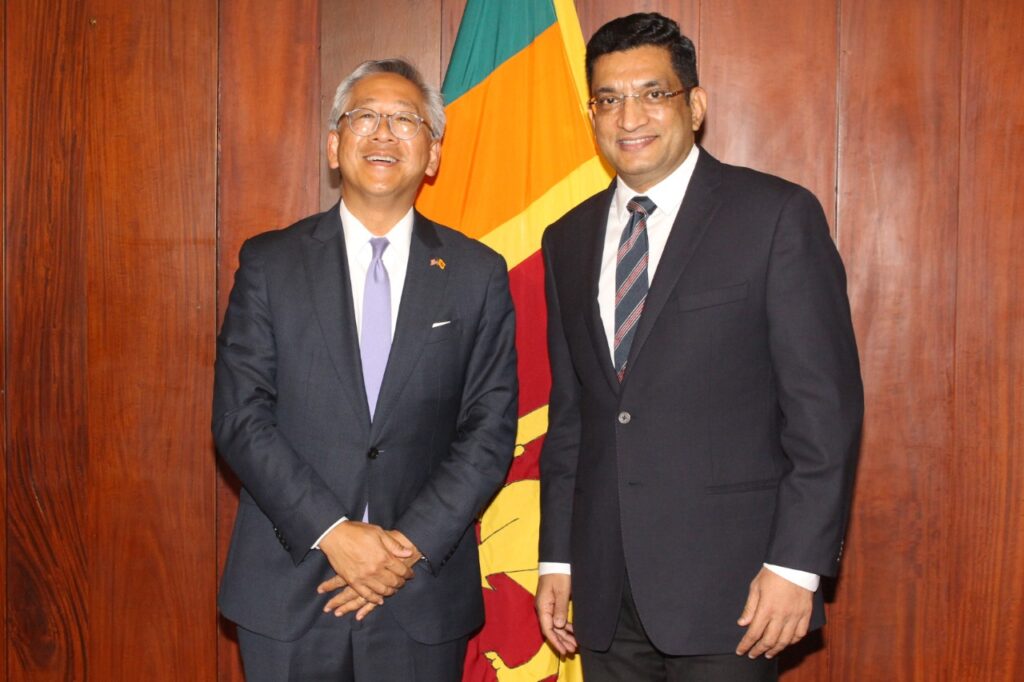
Foreign Minister Ali Sabry discusses U.S – Sri Lanka bilateral relations with the Assistant Secretary of State for South and Central Asian Affairs Donald Lu
Foreign Minister Ali Sabry met the U.S Assistant Secretary of State for South and Central Asian Affairs Ambassador Donald Lu at the Ministry of Foreign Affairs on Wednesday, 19 October, 2022.
Referring to the Foreign Minister’s meeting with the Secretary of State Antony Blinken on the sidelines of the 29th ASEAN Regional Forum (ARF) on 04 August, 2022 in Cambodia and several high-level visits from the U.S. to Sri Lanka in recent times to support the Government’s efforts to address the present economic challenges, Foreign Minister Sabry welcomed the continued U.S. assistance to overcome those challenges.
Foreign Minister Sabry and Ambassador Lu discussed the multifaceted aspects of the U.S – Sri Lanka bilateral relations, including the recent developments and IMF debt restructuring negotiations.
Ambassador Lu was accompanied by the Ambassador of the U.S. to Sri Lanka Julie Chung and senior officials from the U.S Embassy in Colombo. Foreign Secretary Aruni Wijewardane and Senior officials of the Ministry of Foreign Affairs were associated with the Foreign Minister at the meeting.
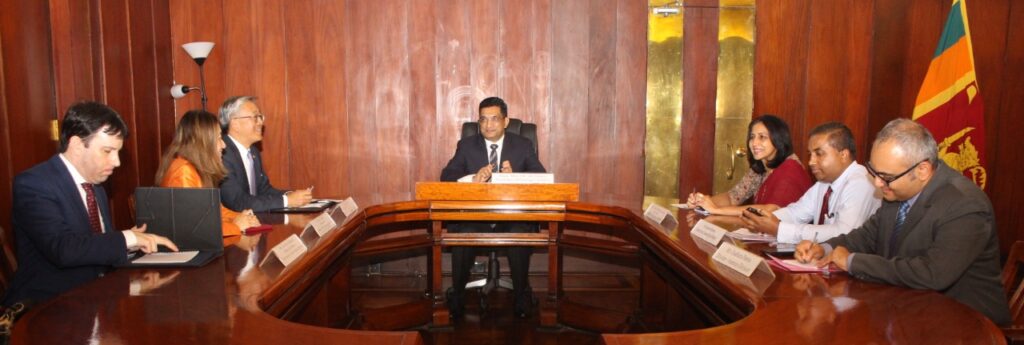
Ambassador Lu also called on President Ranil Wickremesinghe and met Secretary of Defence, General Kamal Gunaratne (Retd).
Ministry of Foreign Affairs
Colombo
20 October, 2022
His Majesty Sultan of Oman receives Credentials of Ambassador of Sri Lanka
The newly appointed Ambassador Extraordinary and Plenipotentiary of Sri Lanka to the Sultanate of Oman, A.L Sabarullah Khan presented his Letter of Credence to His Majesty Sultan Haitham bin Tarik, Sultan of the Sultanate of Oman on 18 October 2022 at Al Barakah Palace, Muscat.
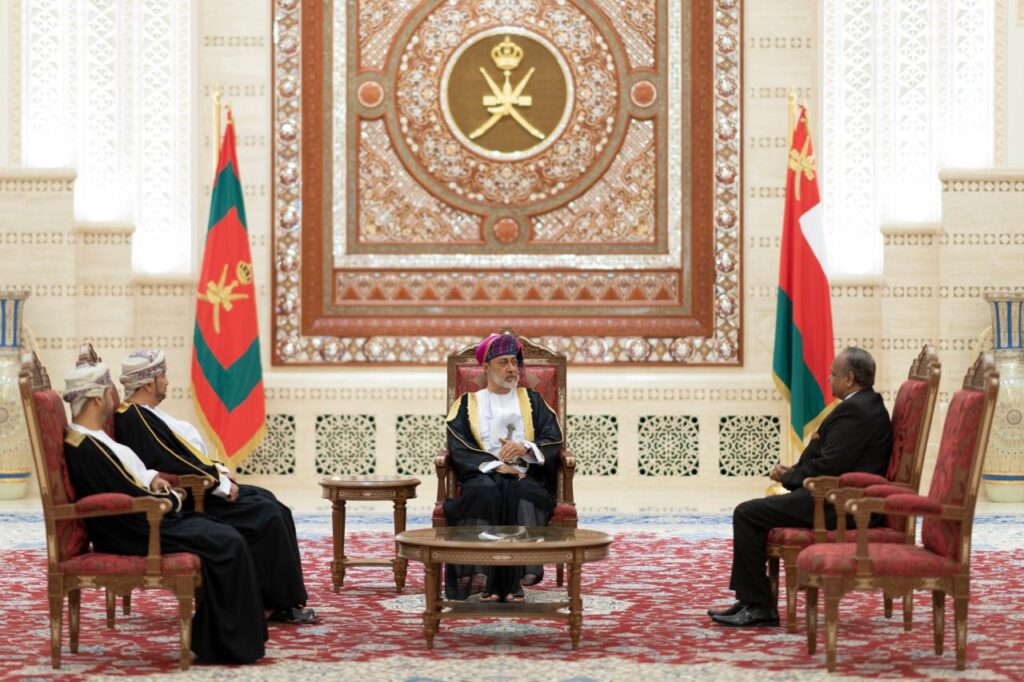
During the audience with His Majesty the Sultan immediately after the presentation of the credentials, the Ambassador conveyed greetings of the President of Sri Lanka. While referring to the cordial relations between Sri Lanka and Oman, the Ambassador extended his gratitude for the continuous support of the Government of Oman to Sri Lanka including recent donation of medical items and affirmed to exert his utmost efforts in promoting the bilateral relations in multiple domains in a manner that serves the joint interests of both the countries.
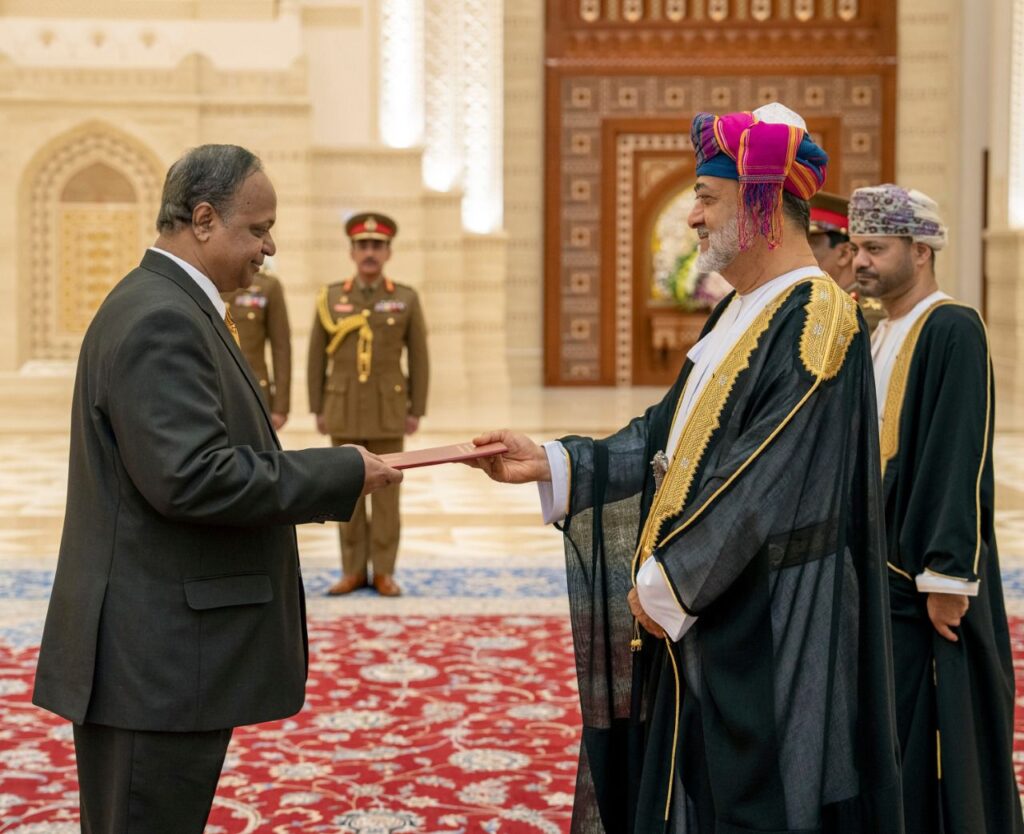
His Majesty the Sultan welcomed the Ambassador, expressing his thanks for the greetings and best wishes of the President of Sri Lanka.
The ceremony was attended by the Minister of Diwan of Royal Court, Foreign Minister, the Head of the Royal Protocols, the Commander of the Royal Guard of Oman and the Military Aides to His Majesty the Sultan. Ambassador was accompanied by Dilini Abeysekara, Counsellor of the Embassy and his Daughter.
Ambassador Sabarullah Khan is a career diplomat who joined the Sri Lanka Foreign Service in 1994. He earlier served in the Sri Lanka Missions in Amman, Bangkok, New Delhi, Riyadh, Jeddah, Abu Dhabi, Chennai and New York in various capacities. He last served as the High Commissioner of Sri Lanka to Nigeria. In the Foreign Ministry, he served in the Consular, Protocol, Economic Affairs and Political Affairs desks and last held the position of Additional Secretary.
Embassy of Sri Lanka
Muscat
20 October, 2022
Courtesy call by Ambassador Shobini Gunasekera on the Secretary (Minister) of Foreign Affairs of the Philippines
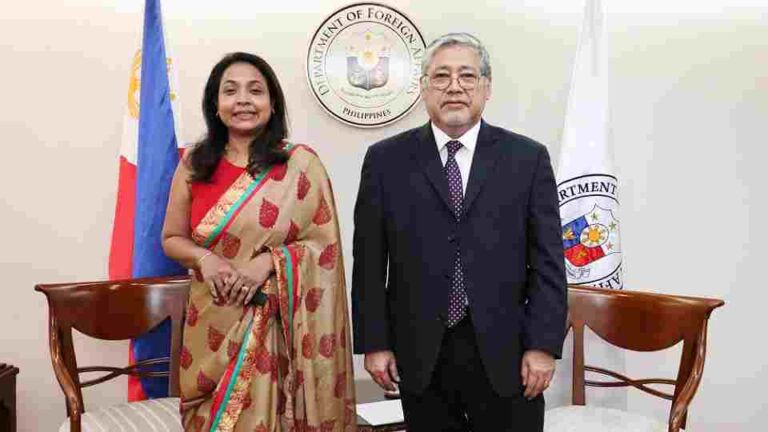
Sri Lanka Ambassador to the Philippines, Shobini Gunasekera, paid a courtesy call on, Secretary (Minister) of Foreign Affairs of the Philippines Enrique A. Manalo, at the Office of the Secretary in the Department of Foreign Affairs (DFA).
Ambassador Gunasekera congratulated Secretary Manalo on his recent appointment and handed over the felicitation letter from Minister of Foreign Affairs of Sri Lanka Ali Sabry and the Policy Statement by President of Sri Lanka Ranil Wickremesinghe, at the inauguration of the Third Session of the 9th Parliament of Sri Lanka. She apprised on the current political and economic developments in Sri Lanka as well as the current bilateral trade between the two countries; the working visit to Manila of President Ranil Wickremesinghe, for the 55th Annual Meeting of the ADB Board of Governors held in September 2022; and the goodwill visit of the Sri Lanka Navy Offshore Patrol Vessel (OPV) P627 held from 12 to 16 October 2022.
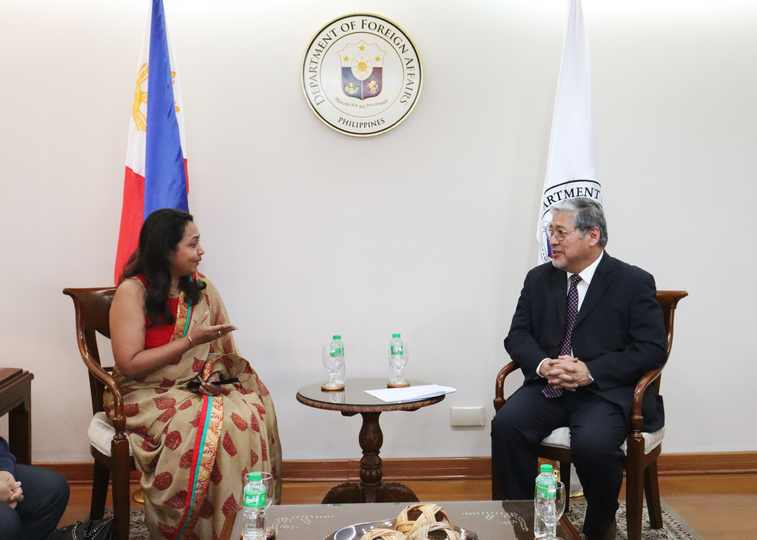
She also highlighted the Embassy’s current initiatives in the Philippines particularly the opportunities in the ICT, relating to the e-commerce for MSME’s and skills development sectors for better employability of Sri Lankan workforce. Further, she expressed appreciation for the active engagement of the DFA-Technical Cooperation Council of the Philippines (DFA-TCCP) on technical cooperation and capacity building training programs conducted on a virtual platform for Sri Lankan stakeholders on gender mainstreaming, tourism services and hospitality management, and Palay Check System cum Rice and Rice Based Technologies.
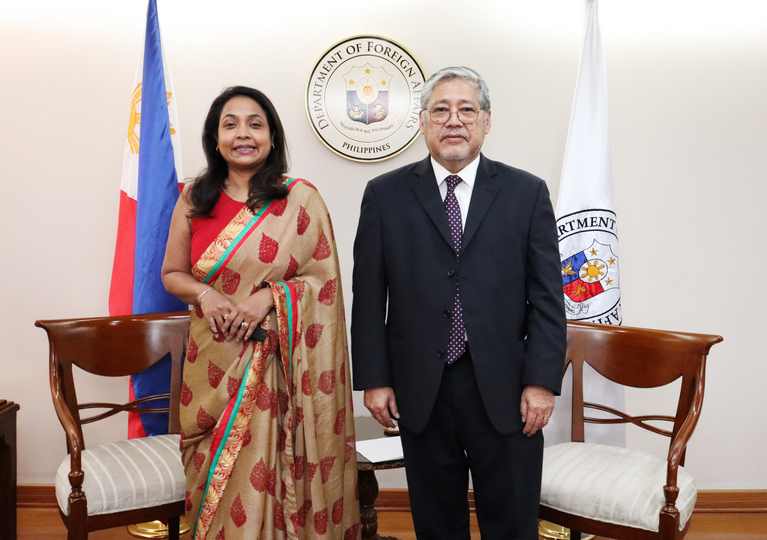
Foreign Affairs Secretary Manalo expressed full bilateral support of the Philippines in further advancing political and economic ties with Sri Lanka. He also proposed that the 3rd round of Political Consultations could be arranged either towards late this year or early next year.
Secretary Manalo is the second career diplomat to be appointed as Secretary of Foreign Affairs of the Philippines since Ambassador Delia Domingo-Albert in 2004. He conducted both the 1st and 2nd round of Political Consultations between Sri Lanka and the Philippines in 2016 and 2018.
Embassy of Sri Lanka
Manila
18 October, 2022
Buddhist Associations in Indonesia donate medicines And medical devices to Sri Lanka
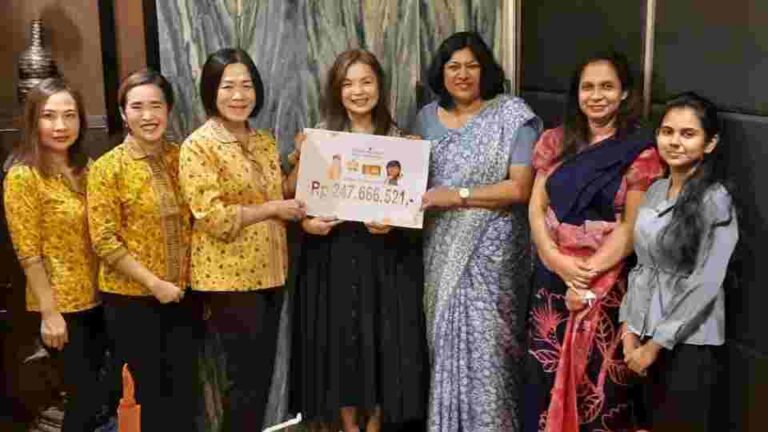
The Buddhist Associations of Indonesia namely Indonesian Buddhists’ Representatives Association (WALUBI), Indonesian Theravada Buddhist Council (MAGABUDHI), Women Theravada Buddhist Group (WANDANI) and Theravada Youth Buddhist Association (PATRIA) donated medicines and medical equipment with a total value of USD 19,296.11 to the people of Sri Lanka in June and August 2022. The Embassy dispatched the above medicines to Sri Lanka in coordination with the Ministry of Foreign Affairs, Ministry of Health, Sri Lankan Airlines and Expolanka.
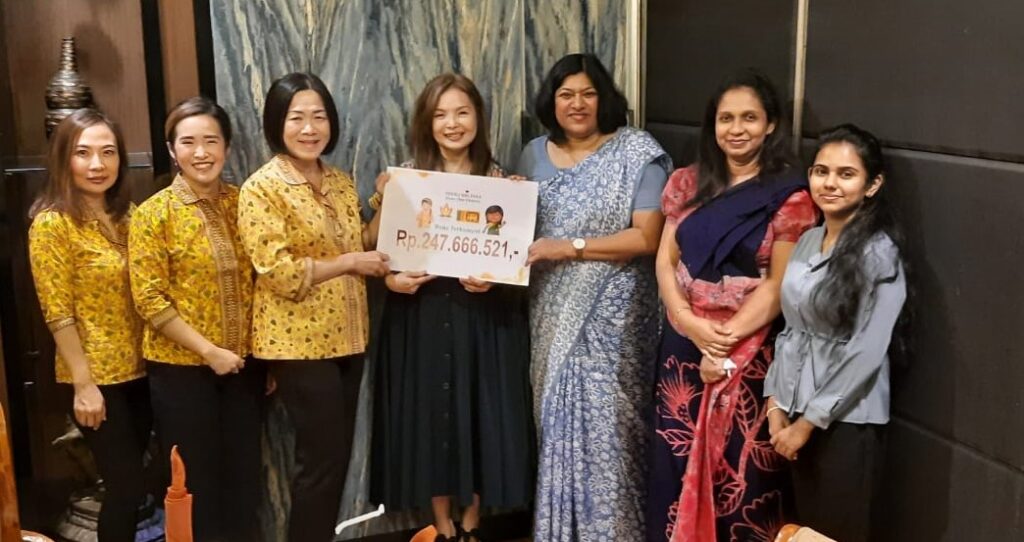
The donation was officially handed over to the Ambassador of Sri Lanka to Indonesia and ASEAN Yasoja Gunasekera at the Embassy premises. Accepting the donation, Ambassador Yasoja Gunasekera extended gratitude and sincere thanks to the Buddhist Associations of Indonesia for the generous gesture which is much needed for the people of Sri Lanka at this difficult time.
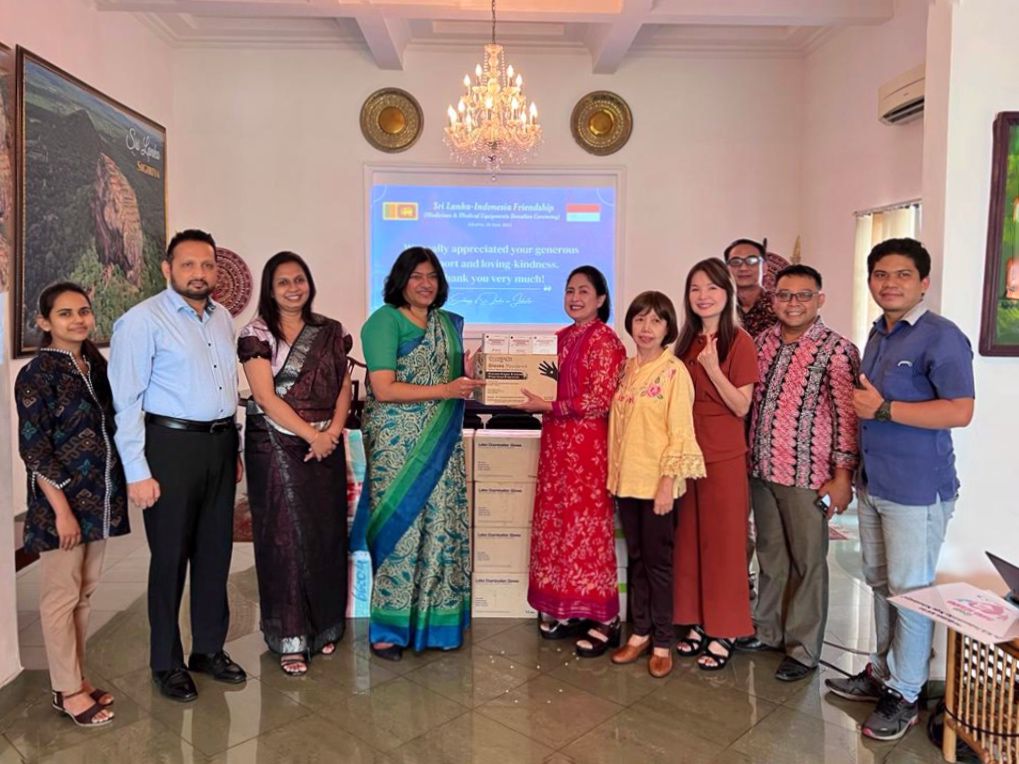
The Buddhist Associations of Indonesia is also in the process of coordinating with the National Cancer Institute (Apeksha Hospital) to donate medicines and medical devices which are specifically needed by the above hospital.
Embassy of Sri Lanka
Jakarta
20 October, 2022
Bribery charges against Minister Nimal Siripala De Silva dropped
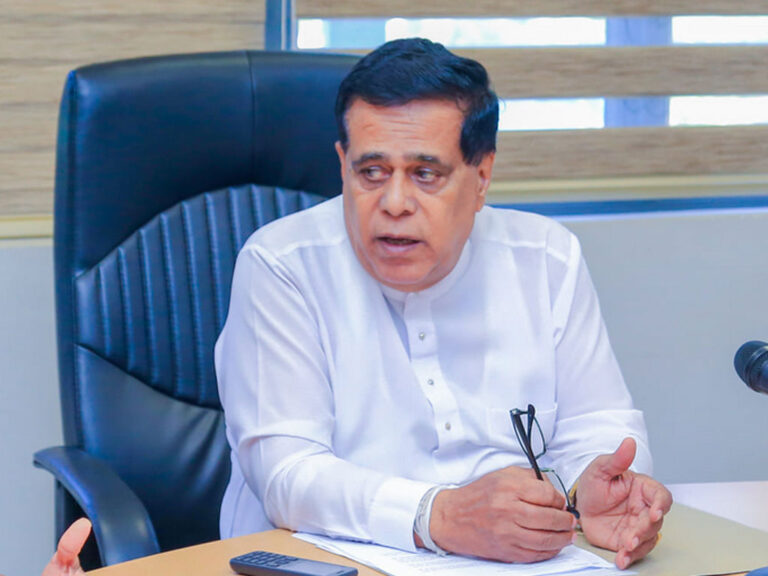
The Commission to Investigate Allegations of Bribery or Corruption (CIABOC) has dropped the charges against Minister Nimal Siripala De Silva in connection with the allegation of seeking bribes from Japanese contractor Taise which was hired for the constructions at the Airport, due to unsubstantiated evidence.
Earlier, the Three-member Committee appointed by the President to probe the case also concluded that there are not enough evidence to substantiate the allegations.
MIAP
Ex President Rajapaksa’s ‘Itukama’ Fund shut down!

The ‘Itukama Covid-19 Health and Social Security Fund’ opened by former President Gotabaya Rajapaksa will be closed as approved by the Cabinet.
Accordingly, the official bank account (Acc. No. 85737373) for the fund operated at the Corporate Branch of the Bank of Ceylon (BOC) will be closed from October 18, 2022, Fund Secretary Dr. Tharaka Liyanapathirana said.
Dr. Liyanapathirana urged all donors and philanthropists not to credit the account nor send cheques and money to the Presidential Secretariat for crediting the account.
The ‘Itukama Covid-19 Health and Social Security Fund’ received a sum of Rs. 2.2 billion (Rs. 2,207,164,785.58) and as of October 18, 2022, a balance of Rs. 216 million (Rs. 216,877,431.05) is in the account. The balance, accordingly, has been credited to the President’s Fund and will be allocated for surgery and medical treatment for those seeking medical assistance through the President’s Fund.
MIAP
Child with Empty Lunchbox: Malnutrition triggered by Economic Crisis
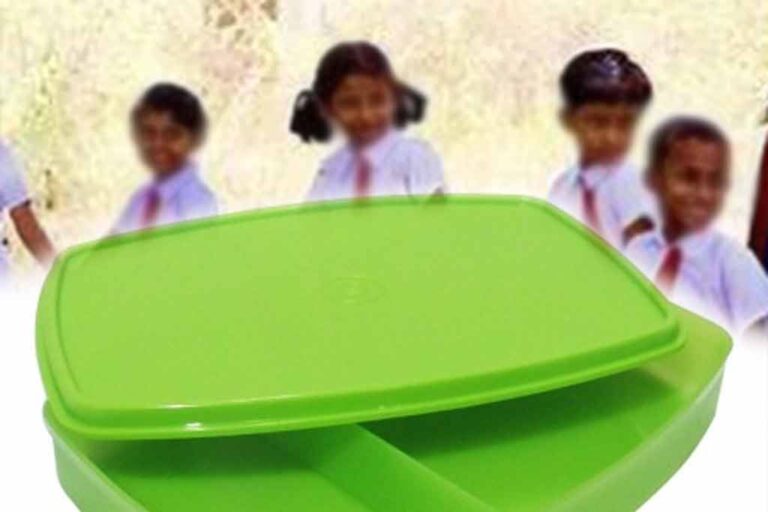
As Sri Lanka is suffering from its worst economic meltdown since independence, the depths into which the recession goes unravel tales of the children of Sri Lanka who take no part of the misdeeds of those held accountable for this hardship and suffer from malnutrition, and we learned three heartbreaking stories of this nature to prove it.
The Child with Empty Lunchbox
Last week, in a faraway area in the country, a school teacher tells her students to open their lunch boxes at lunch time. One student, who brought an empty lunch box, opens his and his companions make fun of him. The children of the classroom – bless their hearts – who laughed at him may have no knowledge of the circumstances which led to his friend’s empty lunch box, but the child from thereon remains at home telling his parents that he cannot go to school anymore.
The Tale of Three Teachers and Six Hungry Pre-School Students
Three teachers of a pre-school in Kegalle attend to their students this week to check on their affordability to bring food for lunch. “Who brought only ‘Pol Sambal and Rice’ for lunch?” the teachers ask. Out of thirty students in the class, six raise their hands. The three teachers then make a collection, buy six ‘Parippu Wade’ from a nearby shop and distribute them among the six. Our collective witnesses the entire event as our correspondent, who visited the pre-school for an official matter, was present at the scene.
The Tuk-Tuk Driver who bought ‘Egg Roti’ for Children
The third sequence follows a Three Wheeler Driver, a benevolent spirit having the heart to feel the hunger of children, who bought ‘Egg Roti’ for three school students he transported, and we quote his experience by his own words;
“On Wednesday eve, I have a hire to run to take a kid to his tuition class. When I take that kid back home, I also drive other children living in the same bloc home. When I dropped that kid yesterday, I was given 500 rupees. There were three more children in my Wheeler, so I bought Egg Roti for those three kids. Coming back home, I told what happened and my daughter said, ‘Oh dad, what you did was so great. One of them lives in a family who can hardly afford to live. They don’t even have proper food to eat, nor do they have money to travel by bus. That kid too is fond of having something to eat from a shop once in a while.’”
The three stories come in in the backdrop of staggeringly fearful statistics disclosing child malnutrition in Sri Lanka, a fact that came to spotlight about three months ago and is denied by the authorities in cold blood.
The authorities’ denial of this simple truth was well established over the last period, and to elaborate one, Hambantota District MP Ajith Rajapaksa told the reporters after learning a recent story about child malnutrition in Suriyawewa area that there is ‘no such malnutrition’ among the children of Hambantota District and that his comments can be backed by what he described as a ‘personal investigation’ into the allegations. Being a Rajapaksa, the Ruling Party MP may have spoken for his own children and for those of other Rajapaksas he is loyal to. Contradictory to his comments about child malnutrition being ‘non-existent’ in Sri Lanka, we learn the complete opposite.
To elaborate another, the dialogue on the hunger of Sri Lankan children was well concealed when the story of a student of a school in Colombo eating the portion of food reserved for the Lord Buddha, or commonly known as the ‘Buddha Pooja’, surfaced and the authorities denied it, later laying the ‘sin’ of eating food reserved for holy purposes on the top of it in a bid to divert the conversation to elsewhere.
The authorities’ denial on child malnutrition was established in a third row, rather brainlessly, when the story of a school student bringing solid albumens of coconut for lunch was surfaced and the health authorities responded saying that coconut albumen is a very nutritious food for intake.
The misdeeds carried out by greedy politicians and backed by the state leading to this great economic disaster shall never be put on the account of the children of this country, nor shall they be placed in the aftermath to suffer.
The existence of a state does not merely stand for the land itself, for it represents the people living on it, breathing its air, and depending on its harvest and production. The future of a country is its children and them having to suffer from malnutrition would be the ultimate horror one such state has to witness. Sri Lanka at present is driving itself towards the same and yet distant fate.
On the other hand, children are their parents’ jewels in the eye, and the meanings of such sentiments’ are beyond the phrases of literature scrolls, and root themselves to the ground reality of the physical world. Therefore, a parent having to fill their child’s lunchbox with only ‘Pol Sambal’ and ‘Rice’, or albumen of coconut, or even leave them with empty lunchboxes decodes the unaffordability of the citizens of Sri Lanka in its worst phase.
There are sharp discussions about Sri Lanka’s economic crisis in the political arena, where the Ruling Party goes on saying that the people have to bear the burden for a little longer, while the parties of the Opposition go on saying on stages that they should be given power to save the people from the recession. On the other side, a trend is being grown that the 225 MPs of Parliament should be rejected.
Nevertheless, children of the country shall not be left to starve or suffer from malnutrition while political parties grapple against each other for power. We do not believe that an initiation in this regard requires the gaining of the governing power.
Therefore, we as the ‘Nelumyaya Foundation’ have planned a programme to distribute eggs and milk packets / yogurt twice a week for children living in low-income households of the country. Its first phase will begin in Kegalle next week.
This article is part of an islandwide advocacy campaign to raise awareness among the public while seeking the support of local and international comrades who wish to contribute.
May we reiterate, that Sri Lanka is our people. The future of Sri Lanka is its children. Let us not allow the future of Sri Lanka to suffer from malnutrition. Let us unite for this common purpose!
*English Article adapted by original feature ‘හිස් කෑම පෙට්ටියක් රැගෙන ආ දරුවෙක් ….’ (His Kema Pettiyak Regena Aa Daruwek…) published on 20.10.2022.
Chinese consul-general defends actions after being seen pulling protester’s hair in Manchester
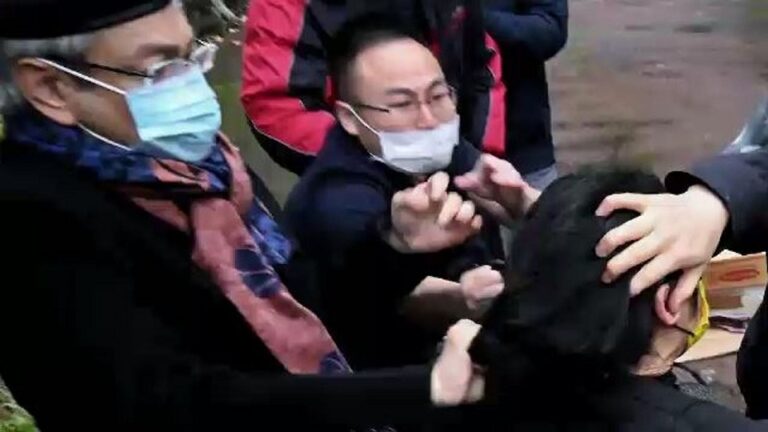
The Chinese consul-general accused of attacking a protester has denied the claims and said his alleged victim was “abusing my country, my leader”.
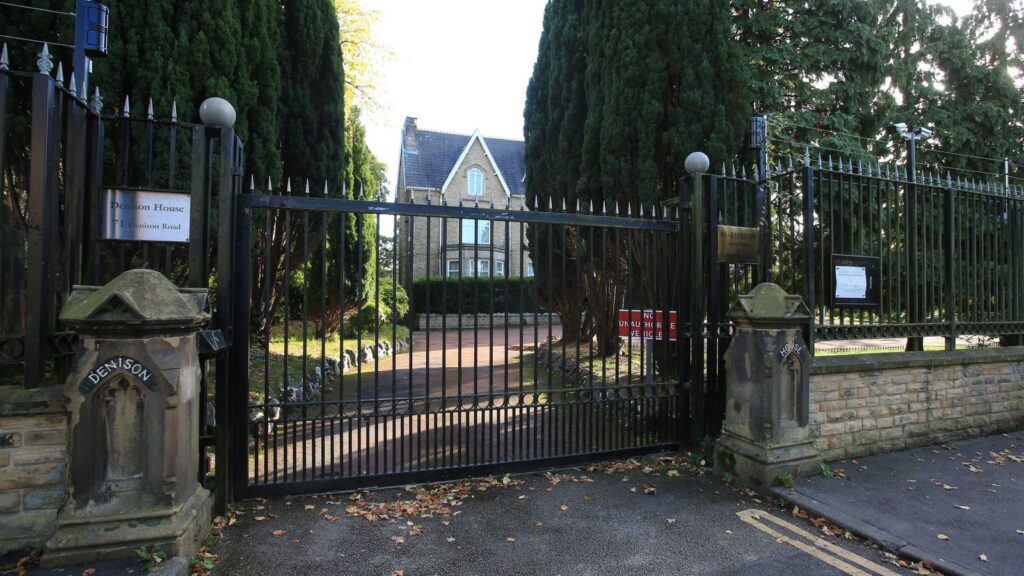
Senior diplomat Zheng Xiyuan was pictured pulling Bob Chan’s hair before yanking him into the Chinese consulate in Manchester.
Mr Zheng told Sky News that it was his “duty” and he was at the demonstration “peacefully”.
What happened outside and on the grounds of the consulate is now the centre of a diplomatic incident.
The pro-democracy protest by Hong Kongers started off peacefully but banners and posters, which the Chinese say they found deeply offensive, were torn down by officials including the consul-general.
That led to a violent clash which saw Bob Chan apparently dragged into the consulate grounds and beaten by its staff – leaving him with cuts and bruises all over his body.
But these claims have been refuted by Mr Zheng, who said: “I didn’t beat anybody. I didn’t let my people beat anybody. The fact is, the so-called protesters beat my people.”
However, when asked about the hair-pulling incident, he said: “He (Bob Chan) was abusing my country, my leader, I think it’s my duty.”
Mr Zheng added: “I think it’s an emergency situation – that guy threatened my colleague’s life, and we tried to control the situation. I wanted to separate him from my colleagues – that’s a very critical point.”
‘They used very rude words – unacceptable’
Asked why the peaceful demonstration turned violent, Mr Zheng claimed it was because of the “rude banners” that had been put on display.
In a letter sent to Greater Manchester Police, he stated the banners featured a “volume of deeply offensive imagery and slogans”, including a picture of the Chinese president Xi Jinping with a noose around his neck.
“I think the most serious reason for this incident is because they used very rude banners. They used very rude words, unacceptable. Everybody never accepts these kinds of words,” Mr Zheng told Sky News.
“It’s not right to put such banners close to my gate. After I advised them to remove very politely, they refused.”
‘I was under attack’
In his letter, the consul-general also said he was disappointed police didn’t do more to help and claimed one of the protesters grabbed a member of his staff “by the neck and refused to let go” during the ensuing scuffle.
“I was under attack by the protesters and my colleagues were under attack and at that time, we didn’t receive any protection from the policeman, so we had to do something to protect ourselves,” Mr Zheng said.
He added some of his staff were injured during the incident, with video footage showing a man allegedly from the consulate being kicked by protesters whilst on the floor.
“It’s a very serious harassment for me, the consulate and China,” he added.
Protester was ‘kicked and punched’
The protester at the centre of the controversy, Bob Chan, fled Hong Kong to the UK for his safety last March, but explained how he thought he was going to die during the incident.
“I held onto the gate where I was kicked and punched. I could not hold on for long and was eventually pulled into the grounds of the consulate,” he said.
“I’m shocked and hurt by this unprovoked attack. I’m shocked because I never thought something like this could happen in the UK.”
But it did happen here, and it’s now an issue on the agenda of the foreign secretary, James Cleverly.
It’ll be down to police to decide if any criminal justice action is needed – and for the government to determine whether there are diplomatic consequences
SkyNews
Senior diplomat Zheng Xiyuan was pictured pulling Bob Chan’s hair before yanking him into the Chinese consulate in Manchester https://t.co/BotKV4AWw0
— Sky News (@SkyNews) October 20, 2022