Home Blog Page 2075

Tax structure must be changed to boost revenue, govt expenditure must meet goal within accurate time-frame: Opposition Leader

0

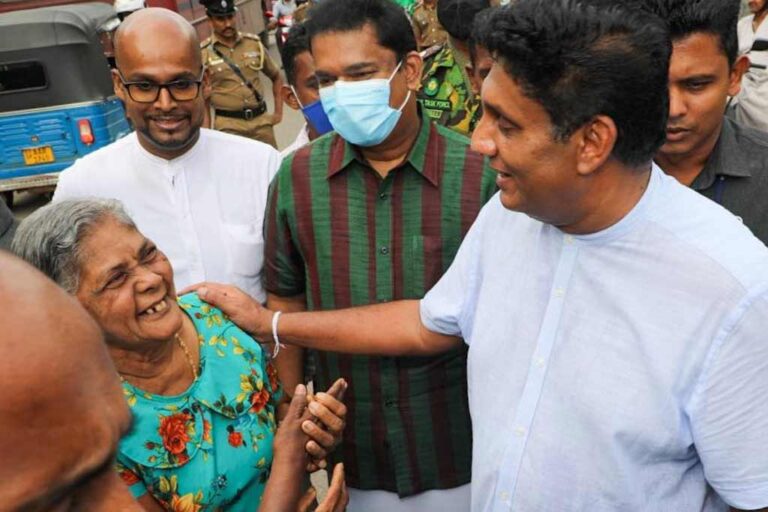
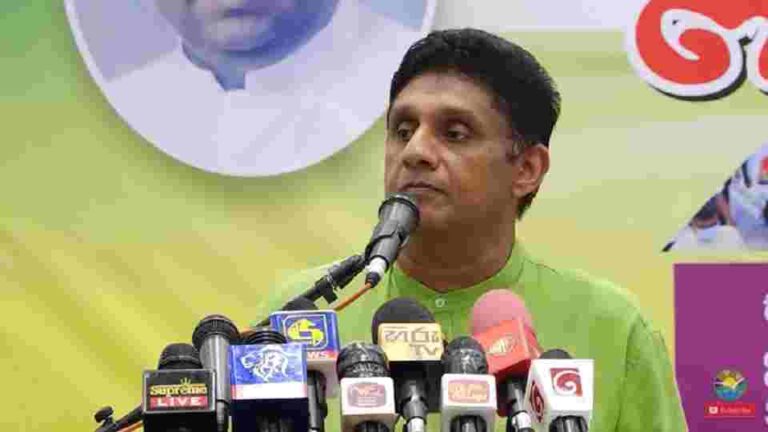
The tax structure of Sri Lanka must be changed to boost the revenue and the expenditure borne by the government must meet an accurate time-frame, said Leader of the Opposition Sajith Premadasa, addressing the Samagi Jana Balawegaya (SJB) Authority Board meeting in Yatinuwara yesterday (08) organised by Electoral Organiser Gemunu Abhayasundara.

Despite the party governing the country, any government should be held accountable for the curbing of the pressure and intolerance borne by the people, he noted, alleging that the current government, on the other hand, has no programme for social security but a programme for the security of the Rajapaksa family and the distribution of ministries.

The National Council chaired by Namal Rajapaksa, who is a member of the family responsible for the bankrupt status of the Sri Lanka, being entrusted with the planning for policy making towards the rebuilding of the country is but another attempt to fool the people, Premadasa pointed out.

The government denies disclosing any information pertaining to the negotiations with the International Monetary Fund (IMF) and the IMF’s prime concern would be the debt restructuring programme, he added.

The SJB would be ready to extend support, should the government act in genuineness to obtain US $ 2.9 billion for Sri Lanka without deceiving the people, the Opposition Leader further noted.

MIAP

Sri Lanka Original Narrative Summary: 09/10

0
  1. Former President and leader of the SLPP Mahinda Rajapaksa makes public address for the first time since resigning as PM: assures support to President Ranil Wickremesinghe.
  2. Estimates from economists and maritime law experts said to suggest that Sri Lanka can claim over USD 1 billion in compensation for maritime pollution caused by MV X-Press Pearl: President Wickremesinghe says when Government receives the compensation, it will fortify Central Bank’s reserves.
  3. President Ranil Wickremasinghe says Sri Lanka will impose deposit rate caps in a bid to bring down interest rates: also says price controls on consumer goods is also planned: CB Governor Dr Nandalal Weerasinghe says he is not aware of the move.
  4. CB Governor Dr Nandalal Weerasinghe says economy stabilized: suggests sharp economic recovery in 2023: official data shows inflation at near 70%: growth @ minus 8.5%: T-Bill interest >32%: money printing @ Rs.3.4 bn per day (previously Rs.2.2 bn): Rupee @ 3rd highest depn in the world: fuel rationed: & infrastructure projects stopped.
  5. Oil supplier BB Energy threatens to cancel fuel supply contract if Sri Lankan authorities fail to make balance payment: further exacerbates crippling fuel crisis in the country.
  6. PM Dinesh Gunawardena says Sri Lanka will fulfill pledges made to the UNHRC: confirms steps are being taken to release the remaining LTTE detainees: also says the abrogation of the Prevention of Terrorism Act has also reached the final stage.
  7. Former Foreign Minister Professor G L Peiris says Sri Lanka lost support at the UNHRC because it did not keep its word on the pledges made earlier: points out that even Qatar, UAE, Indonesia and Malaysia abstained from voting.
  8. SLPP National List MP Gevindu Cumaratunga says the postponement of the 2-day
    debate and vote on the proposed 22nd Amendment to the Constitution, would further erode public confidence in the Parliamentary system.
  9. Cabinet to consider proposal for Sri Lanka to revert from a middle-income country to a low-income country: intention to obtain concessionary funding from the World Bank.
  10. Health Ministry says expiry date of 31st October 2022 on the stock of Pfizer vaccines is drawing closer: also says nearly 7 million doses remain unused: urges public to get their respective first or second booster doses before the vaccines expire.

Sri Lanka still favourite destination for tourists despite challenges

0

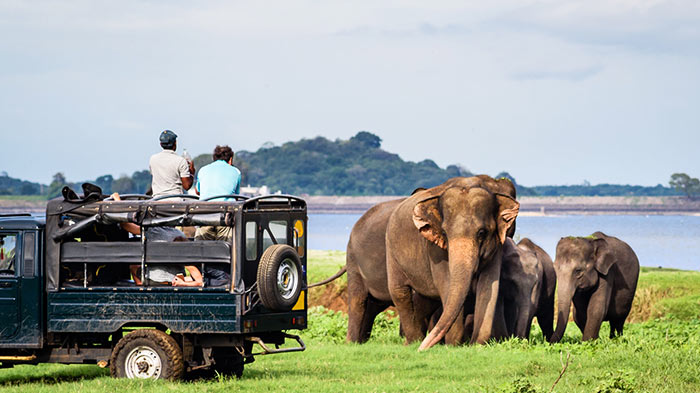
Sri Lanka faces hardships in the current economic context; however, the island nation has been successful in braving through the challenges and remaining a favourite destination among travelers across the world.

Sri Lanka maintained its rank as a sought-after spot for tourists and ranks among the top 10 friendliest countries in the world.

Conde Nast Traveler Readers’ Choice Awards 2022 ranked Sri Lanka as the ninth friendliest country in the world. The rank is offered based on public voting from travelers and holidaymakers.

“They say you can travel the world and you’ll never find anywhere as welcoming as home but we don’t quite think that’s true. From the ever-beaming people of Sri Lanka to the famously open-armed population of New Zealand, our planet is home to some seriously friendly countries,” said Conde Nast Traveler in its description of Sri Lanka in its announcement.

“For Indians, Sri Lanka is an international destination at domestic prices,” says Tourism Ministry sources adding that now especially, with an exchange rate favourable for them, it makes for a very affordable getaway.

Sri Lanka was poised to be one of the world’s best holiday destinations, thanks to the diversity of accessible experiences on offer, combined with affordability and traditional hospitality, once the civil war ended.

However, the country, for which tourism is an important income generator, suffered a major setback with the Easter bombings in 2019, followed by two years of pandemic restrictions. Then, this month, the cancellations began again.

“From children to the elderly, the people of Sri Lanka are known for their love of visitors and genuine desire to help. On the south coast, set sail on a whale-watching expedition in Mirissa, shop the colourful boutiques of the fort city of Galle or shack up at the uber-luxe Cape Weligama hotel, occupying a cliff next to the ocean.

“Make the climb up to the Tea District, where precarious winding roads will lead you into the heart of the country’s tea plantations or towards the centre, climb Sigiriya Rock for views far and wide,” it went on to state.

Sri Lanka was ranked below Belize and above the Philippines. French Polynesia, Colombia, and New Zealand were listed as the top three friendliest countries.

While the people of Sri Lanka are facing hardships, due to the ongoing economic turbulence, the tourism sector has ensured international travelers are cushioned against any impact. Line agencies and tourism stakeholders continue to take active steps to deliver the true Sri Lankan holiday experience.

As the island nation is braving through challenges, just as many other nations, due to the global economic conditions, Sri Lanka tourism is determined to stand stall and is confident in moving towards revival in the coming month.

SJB takes over Hambantota Co-operative Society dominated by Rajapaksas!

0

The Samagi Jana Balawegaya (SJB) has secured a tremendous victory at the election held at the Various Services Co-operative Society in Hambantota, securing 335 votes from the 483 votes cast.

Accordingly, nine members representing the SJB won the election, overthrowing all nine members representing the Sri Lanka Podujana Peramuna (SLPP), making the event the first time in which a society dominated by the Rajapaksas was overthrown.

Almost every co-operatives election held throughout the country so far was won by the SJB, at a percentage of over 98 per cent.

MIAP

Electricity tariffs: Relief for faith-based establishments

0

A relief will be provided for electricity tariffs charged from faith-based establishments, revealed Chairman of the Public Utilities Commission of Sri Lanka (PUCSL) Janaka Ratnayake.

Accordingly, faith-based establishments consuming more than 180 power units on a monthly basis will be shifted from the ‘charity’ category to the ‘common work’ category, thereby reducing the charge from Rs. 65 to Rs. 35 per unit, he noted.

The revision will be considered effective from August 10, 2022.

Nevertheless, religious establishments consuming less than 180 power units are bound to pay their bills the usual, Ratnayake further added.

MIAP

Government to amend some archaic laws to support diverse industries

0

State Finance Minister Ranjith Siyambalapitiya revealed the government will amend some of the archaic laws necessary to support diverse industries in the economy.

“We are going to introduce several new laws to control the liquor industry. When I visited the Excise Department the other day, I came to know that our existing laws are still the same as they were made 60 to 70 years ago to nab sugarcane.

Now the Excise officials have to argue with those who deal with e-money and therefore new regulations will be introduced to amend those archaic laws,” State Finance Minister Ranjith Siyambalapitiya said.

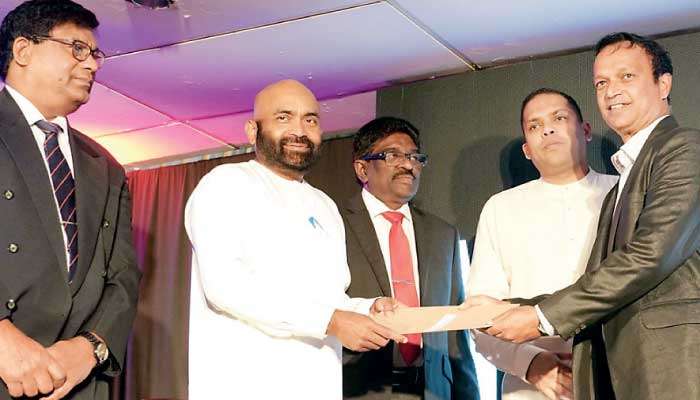
He made these remarks at a ceremony to issue soft liquor licence for establishments registered with the Sri Lanka Tourism Development Authority (SLTDA) at the Tourism Ministry yesterday.

State Finance Minister revealed that of the total reserves of $ 1.8 billion, only $ 300 million can be utilized for all essential imports, emphasizing the need to develop the tourism industry to boost foreign exchange inflows.

“We must extend certain incentives to develop the tourism industry, but that does not mean it is used to promote the use of alcohol,” he stressed.

On 13 June, the Cabinet Ministers approved to issue soft liquor licenses for the sale of beer and wine to all establishments registered with the SLTDA, as a measure to boost the tourism sector. The proposal to this effect submitted by President Ranil Wickremesinghe in his capacity as the Finance, Economic Stability and National Policies Minister was approved by the Cabinet Ministers.

Tourism Minister Harin Fernando said it was necessary to amend some of the archaic laws in catering to the diverse lifestyles of tourists as well as to put an end to the misuse of authoritative powers vested among certain law enforcement agencies.

“By allowing soft liquor does not mean we undermine the culture of our country, but rather accommodating our guests. This will help promote tourism and improve foreign exchange income for the country as well as all tourism stakeholders. This license also prevents certain law enforcement agency officials harassing the tourist establishments unnecessarily,” he explained.

Fernando also said this will also provide a level playing field for the stakeholders to draw crowds rather than limiting one restaurant or hotel to draw crowds and create additional employment opportunities.

The fee for the soft liquor license is Rs. 25,000 and it is required to be renewed annually.

Accordingly, all SLTDA registered star-class hotels, boutique hotels, boutique villas, eco-friendly rest houses, historic hotels, tourist hotels, tourist guest houses, tourist hostels, tourist bungalows, camp sites, historic bungalows, historic residences, tourist restaurants, food courts and tourist apartments will be allowed to sell soft liquor subject to conditions with effect from 28 July.

CB SL still to evaluate the impact of high interest rates on banks

0

The Central Bank of Sri Lanka (CBSL) continues maintaining its increased high interest rates without compelling the government to implement economic reforms as soon as possible with the aim of minimizing their impact on the country’s production sector.

High interest rates usually have a negative impact on the stock market. Those who have a deep understanding of managing banks will know this very well.

The impact of these high borrowing rates will be seen in a few months. Meanwhile the Government is struggling to pay for imports of essential goods, including fuel, essential food and medicine. The high interest rates have had a huge impact on consumption and investment.

The Central Bank is still to evaluate the impact of high interest on the banking sector although its head,Nandalal Weerasinghe is talking big about it claiming high interest rates are aimed at controlling inflation.

Deputy Governor of the bank Yvette Fernando told journalists at the Monetary policy review media briefing last Thursday that currently because of the moratorium in place the Central Bank has not had a proper assessment of the banking system.

The central bank plans on conducting a diagnostic study on the big banks and if there is a requirement of capital, that they would have to re-capitalize.

The board of the Central Bank has permitted major banks to use their capital buffers and also to stagger impacts to the balance sheets because of interest rate changes.

The bank pledged to continue monitoring the changes in interest rates in order to prevent it from affecting the banking system

The financial sector has to be managed carefully given high exposures to the public sector Ms Fernando disclosed .

The necessary macroeconomic adjustments may initially adversely affect growth and poverty, but will correct the macroeconomic imbalances, help regain access to international financial markets, and build the foundation for sustainable growth. Mitigating the impacts on the poor and vulnerable remain critical during the adjustment.

Reductions in poverty will require an expansion of employment in industry and services and a recovery in the real value of incomes.

On the upside, a credible reform program supported by financing from international partners could enhance confidence and attract fresh capital inflows, she added.

However, several eminnt economists said , for a developing economy, the interest rates should be kept low, as taking loans at 20-25% will push businesses to maintain higher profit margins, which Sri Lanka is experiencing now.

They noted that reforms should be implemented with the aim of minimizing the impact of higher interest rates on the production sector of the country.

Moreover, based on the financial results of local banks for the second quarter of 2022, interest expenses of leading private banks grew by 25-50% for the first half of 2022 compared to the same period in 2021, while the State-owned Bank of Ceylon saw interest expenses increase by 65%.

In the update of the International Monetary Fund’s (IMF) World Economic Outlook, it asked central banks worldwide to raise interest rates, warning that the global economy is nearing a recession, as it forecasts the economy to slow down to 3.2% in 2022 and 2.9% in 2023, with major economies such as the US, China, and Europe stalling.

Motor traders cry foul over using used electric cars in Sri Lanka

0

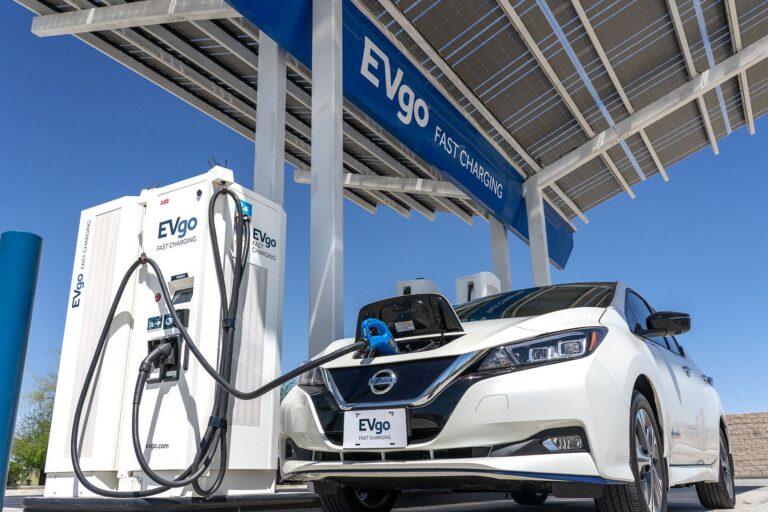
The Ceylon Motor Traders Association (CMTA), the most senior automotive association in South Asia, have raised serious concerns about the importation of used Electric Vehicles to Sri Lanka. In order to minimize the negative impact to the consumer, environment, society, and the economy, it is imperative that the country imports EVs which are directly shipped by the manufacturer with the recommendation for this tropical climate.

EVs built for colder climates may not be suitable for tropical regions as they might not have the required HV battery cooling systems.

The CMTA further warns that EVs purchased and imported through importers who are not the agents for the respective brand, might not come with a proper warranty cover to protect the consumer.

Used EVs that are shipped over to Sri Lanka may have HV batteries which could have damages that is not visible externally. Manufacturers’ warranties are a minimum of 5 years for passenger cars and 3 years for two-wheelers, in order to protect the consumer’s interest.

Another one of the CMTA’s biggest concerns is the disposal High Voltage (HV) batteries, as it can be extremely hazardous to both the environment and ground water systems,

if not disposed of properly. Therefore, the CMTA recommends that EV importers should be signed up with a battery recycling/ re-exporting company Due to the impact that improper disposing of HV batteries and other components may cause, it is also important to establish a legal framework to prosecute people who do so.

It is important to note that the landed cost of an HV battery could vary from Rs.5 million upwards for most EVs, or approximately 50% of the CIF value of the vehicle.

It is therefore imperative that any EVs imported into the country must be imported within 6 months of manufacture, as it would negate the negative impacts HV batteries might have.

Charaka Perera, Chairman of the CMTA said, ‘It is imperative that we encourage the importation of Brand New EVs directly from the manufacturer as opposed to used ones.

Vehicle electrification will bode very well for Sri Lanka, and we must ensure that the necessary steps are taken to ensure these vehicles are imported properly and that they do not pose environmental or economic threat to the country.”

The CMTA is the only association in the country that has access to global manufacturers of EVs and represents them in Sri Lanka and urges the public to educate themselves of all aspects prior to purchasing an EV.

Such awareness will enable them from facing issues which were faced by consumers who bought certain EV models during the heavy influx of EVs in 2014. Additionally, CMTA has entered strategic partnerships with Sri Lanka Insurance Corporation (SLIC), HNB Leasing, and SLT-Mobitel as Annual Corporate Partners of CMTA for planned future initiatives

Sri Lanka Imports in August record a four-month high

0

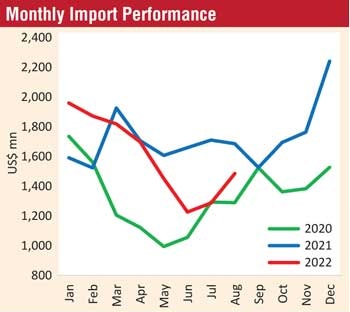
Sri Lanka Imports in August have hit a four-month high and marked the fourth consecutive monthly gain despite restrictions and the forex crisis

As per Central Bank data imports in August amounted to $ 1.48 billion highest since the April figure of $ 1.7 billion.

Imports have also grown month-on-month since May. In July imports were $ 1.28 billion, $ 1.24 billion in June and $ 1.45 billion in May.

However, year-on-year, August imports were down by 12% and CBSL said it was the sixth consecutive month dip year-on-year.

CBSL said in August a decline in expenditure was observed in investment goods and non-food consumer goods, while an increase was recorded in imports of intermediate goods and food and beverages.

Import expenditure on a cumulative basis from January to August amounted to $ 12,801 million, which is a decline of 4.6% (y-o-y).

Considering the need to prioritize essential imports amidst a shortage of forex liquidity, the Government tightened import restriction measures on non-urgent imports during August, which, however, were partially relaxed in September.

“Import expenditure is showing a tendency to increase on a month-on-month basis, since bottoming out in June 2022, which prompted the Government to further tighten import restrictions in August 2022 in order to preserve forex for essential imports, although some of which were relaxed in September 2022,” CBSL said.

Expenditure on the importation of consumer goods declined by 28.7% in August, compared to August 2021, driven by a decline in expenditure on non-food consumer goods despite an increase in expenditure on food and beverages.

The decline in import expenditure on non-food consumer goods was observed in all subcategories, with a notable drop in imports of medical and pharmaceuticals (mainly, vaccines), telecommunication devices (mainly, mobile telephones) and home appliances (mainly, televisions).

In contrast, expenditure on the importation of food and beverages increased by 17.2% in August (y-o-y), with a substantial share of the increase being contributed by the imports of cereals and milling industry products (primarily, rice), and sugar.

However, expenditure on dairy products (mainly, milk powder), seafood (mainly, dried and fresh fish), oils and fats (mainly, coconut oil), vegetables (mainly, big onions) and fruits declined in August, compared to August 2021.

Expenditure on the importation of intermediate goods increased by 2.6% in August, compared to August 2021, mainly driven by fuel, textiles and textile articles (mainly, fabrics) and fertilizer (mainly, urea).

Further, import expenditure on chemical products; diamonds and precious stones and metals (primarily, industrial diamonds); paper and paperboard and articles thereof; and rubber and articles thereof also recorded an increase during August, compared to August 2021.

Meanwhile, many other types of intermediate goods recorded a notable decline, including base metals (mainly, iron and steel), wheat and maize, agricultural inputs (mainly, animal fodder), vehicle and machinery parts, etc.

However, import expenditure on fuel, which consists of crude oil, refined petroleum and coal, increased by 10.2% (y-o-y) to $ 389 million in August, and the increase was attributed to higher average import prices despite lower import volumes of crude oil and refined petroleum. The average import price of crude oil was $ 114.71 per barrel in August, compared to $ 74.88 per barrel in August 2021.
IMF compels Sri Lanka to comply with all of its applicable policies

0

The International Monetary Fund (IMF) is waiting for Sri Lanka to comply with all the applicable IMF policies before further steps can be taken.

an emailed response to Daily Mirror, Peter Breuer, Senior Mission Chief for Sri Lanka and Masahiro Nozaki, Mission Chief for Sri Lanka, said that on 1st September 1 the IMF reached a staff-level agreement (SLA) with Sri Lanka on a 48-month arrangement under the Extended Fund Facility of about US$2.9 billion.

“The SLA is ad-referendum i.e., subject to IMF Management and IMF Executive Board approval. Once all applicable IMF policies are complied with (including taking prior actions and restoring debt sustainability consistent with program parameters),

IMF management recommends to the IMF Executive Board to approve an IMF arrangement. Once the IMF arrangement is approved, the member will receive financing under in tranches subject to the IMF Executive Board’s regular review of the member’s policy implementation,” the IMF said.

The IMF also said that according to the IMF policies, the Memorandum of Economic and Financial Policies (MEFP), which describes the proposed policy measures in the SLA in detail, will be published shortly after the Board approval of the EFF arrangement.

Peter Breuer and Masahiro Nozaki said that in the interest of transparency, the IMF issued a press release on September 1, and held a press conference on the same day, to disseminate key elements of the SLA.

The Sri Lankan authorities disseminated further details in a presentation to creditors on September 23.

ri Lanka has decided to send a delegation for the annual summit of the International Monetary Fund and the World Bank.

The 2022 Annual Meetings of the International Monetary Fund (IMF) and the World Bank Group (WBG) will take place in person from Monday, October 10, through Sunday, October 16 in the IMF and World Bank Group headquarters, in Washington DC.

Sri Lanka’s delegation will be led by Acting Finance Minister Shehan Semasinghe.

He said the Governor of the Central Bank of Sri Lanka, the Finance Secretary and several others will accompany him.

The Acting Finance Minister said that the 2022 Annual Meetings of the International Monetary Fund (IMF) and the World Bank Group (WBG) will be of paramount importance for Sri Lanka to restructure its debt, and also obtain financial assistance from the IMF.

The recent IMF agreement requires debt restructuring with all external and private creditors.

Although the country is eyeing a December 2022 deadline for the bailout, the debt relief measures throw this timeline into doubt. Japan has been endowed with the responsibility of holding talks with Sri Lanka’s major bilateral creditors such as India and China.

However, the diplomatic coldness between India and China, along with China’s hidden loans and Belt and Road Initiative (BRI) ambitions in Sri Lanka, might dampen the debt restructuring process.