Home Blog Page 2308

China becomes wild card in Sri Lanka’s debt crisis

0

Sri Lanka’s struggle is extreme, but it reflects conditions across dozens of countries from South Pacific islands through some of the poorest in Asia and Africa that have signed onto Chinese President Xi Jinping’s Belt and Road Initiative. The total debt of poor countries is rising, raising risks others might run into trouble.

Sri Lanka and other poor Asian countries welcome Chinese financing. The Asian Development Bank says the region needs to invest $1.7 trillion a year in infrastructure to keep economies growing. But some, including Sri Lankan critics of their government’s spending, say Chinese-led projects cost too much or do too little for their economies.

China ranks third among Sri Lanka’s creditors after Japan and the ADB and accounts for 10% of the debt, but Xi’s government has an outsize potential to disrupt a settlement.

Beijing promised to “play a positive role” in talks with the International Monetary Fund on a possible emergency loan. China offered to lend more but balked at joining a process that might cut Sri Lanka’s debt, possibly for fear other Belt and Road borrowers that owe tens of billions of dollars will demand the same relief.

“If China gives a concession to Sri Lanka, it will have to give the same concession to other borrowers,” said economist W.A. Wijewardena, a former deputy governor of the Sri Lankan central bank. “They didn’t want to get into that trouble.”

If China tries to avoid debt cuts, that might disrupt the IMF talks or prompt private sector creditors to hold out for more money, experts say.https://d-3324089996994657915.ampproject.net/2205051832000/frame.html

Lack of cooperation by Beijing “would complicate Sri Lanka’s debt recovery journey,” said Aditi Mittal of Verisk Maplecroft, a consulting firm, in an email.

The United States, Japan, the European Union and other governments also lend, but on a smaller scale. Many Belt and Road countries attract little nongovernment financing because they are deemed too risky or lack a legal framework for investment in infrastructure.

Some governments have run into smaller crises. Truck drivers in Kenya protested after their government imposed a fuel tax to pay for a Chinese-built railway the drivers complained would compete with them.

Others have canceled or scaled back projects. Malaysia scrapped a planned railway in 2019 as too expensive. Thailand renegotiated a high-speed railway following protests that too little work went to Thai companies.

China has restructured some debt. Ethiopia persuaded Beijing in 2018 to forgive some interest and stretch out repayment of a 10-year loan for a $4 billion railway to 30 years. That reduced annual payments but added two more decades of interest charges.

Chinese officials say Belt and Road projects are business ventures, not aid. Most lending is on commercial terms. Details often are secret.

Belt and Road rankles Washington, Moscow, Tokyo, New Delhi and other governments that grumble Beijing, the biggest trading partner for all of its neighbors, is trying to expand its influence and undercut theirs.

Opposition figures say while Sri Lanka needs China to reduce its debt, blame lies with leaders who built unrealistic projects that cannot pay for themselves while they failed to invest in economic development.

Foreign loans “built highways, airports and convention halls in the jungles which didn’t give any returns” in foreign currency, said a lawmaker, Kabir Hashim. “Now we don’t have the dollars to pay them back the dollar loans.”

Critics cite a Chinese-built port in Hambantota in the southeast as a prime example of official recklessness.

It was built in the hometown of then-President Mahinda Rajapaksa and paid for with $1.1 billion in Chinese loans despite the plan having been rejected by an expert panel.

Its promoters said Hambantota, on busy Indian Ocean shipping routes, would ease the burden on Sri Lanka’s main port in Colombo. But it failed to generate foreign revenue.

Beijing bailed out the port in 2017 by having a state-owned company, China Merchants Group, buy a 99-year lease for $1.1 billion. That includes land for an industrial park.

The deal gave Sri Lanka cash to repay Chinese banks but prompted accusations official bungling gave a foreign government control over part of the country.

Chinese loans also paid for an international airport near Hambantota. Few airlines use it.

The crisis reignited accusations Beijing used a “debt trap” to gain influence over the country.

“They knew we had no capacity to repay,” said a legislator, Wijeyadasa Rajapakshe.

“We must convince China to forgo at least part of the loans,” said Rajapakshe. “Ordinary poor people, without one meal per day, are paying this debt now.”

Sri Lanka owes $7 billion this year to Chinese banks and other lenders but suspended payment April 13 while it talks with the IMF. The government also owes $25 billion, or about half its total, to private sector bond investors.

A restructuring agreement with China or Japan would be a “positive signal” for a recovery, wrote Mittal.

In a written response to questions, the Chinese foreign ministry said Beijing is ready to “play a positive role in easing Sri Lanka’s debt burden” but gave no indication whether the amount owed might be reduced.

“China is willing to support relevant financial institutions to negotiate with Sri Lanka,” the ministry said.

In April, then-opposition leader Ranil Wickremesinghe told broadcaster Republic TV that China offered a $1 billion loan instead of reducing Sri Lanka’s debt. That would allow the government to make payments, but the total owed would rise.

Wickremesinghe took over as prime minister on May 12 after Majapaksa, who in an earlier role as president built the Hambantota port, resigned.

Chinese Ambassador Qi Zhenhong told reporters April 25 that negotiating with the IMF would interfere with Beijing’s loan offer. The IMF usually requires a borrower to work out a deal with all creditors to reduce debts.

China has avoided joining the London Club of government lenders, the forum for negotiating debt cuts.

The central bank governor warned that China and other creditors must accept the same terms.

“It is not fair to treat one creditor differently to others,” said Nandalal Weerasinghe. “Then the others won’t come onboard.”

Even if Beijing balks, Sri Lanka can’t afford to alienate China, its biggest potential lender and investor, said Wijewardena.

“Sri Lanka is not in a position to say no,” he said.

ABC NEWS
Shrink the country’s economy by 25% – Patali

0

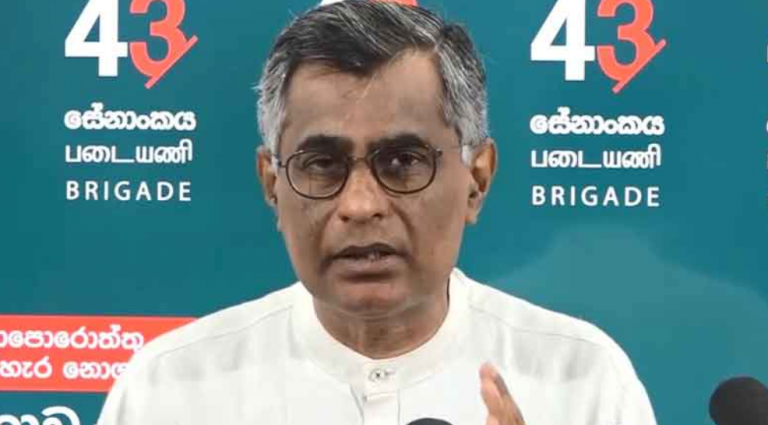
Samagi Jana Balawegaya MP Patali Champika Ranawaka says that if the allies do not help us, we should shrink the country’s economy by 25% and prepare a plan to face this economic crisis.

“Sri Lanka declared a sovereign bankruptcy yesterday (19). Accordingly, it will be difficult for us to borrow from the international market again for another decade. China has already expressed its strong opposition to our non-repayment of their bilateral loans. Therefore, the oil and gas queues will not stop as soon as we think. Hundreds of thousands of people are expected to lose their jobs in the next few months. We are entering a terrible age in which infants and adults are dying of health problems.

What is the solution? Good political stability must be established first. If the so-called allies do not help us, we have one thing to do. Let us forget the growth of the economy and shrink the economy as much as possible. My suggestion is that we should shrink consumer demand by 25% and move forward on this journey. For that, we need to present facts openly to the people.”

Champika Ranawaka stated this addressing a media briefing held by the 43 Division yesterday (20).

Sajith meets representatives of the World Food Program to discuss the food crisis in Sri Lanka

0

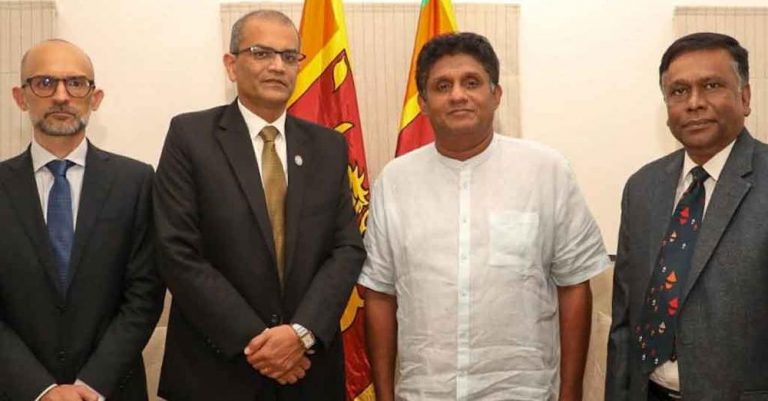
A meeting between a delegation led by Andrea Berardo, Deputy Director of the United Nations World Food Program in Sri Lanka, and Leader of the Opposition Sajith Premadasa was held at the Office of the Leader of the Opposition on the 19th. Abdul Rahim Siddique, Country Director, World Food Program, Sri Lanka; Vimalendra Sharan, Permanent Representative to the United Nations Food and Agriculture Organization in Sri Lanka and the Maldives were also present.

The current food crisis and food security were discussed at length, including the need to keep the food consumed clean and free from any form of poisoning or infection, free from germs, etc. The food crisis facing Sri Lanka these days was also highlighted.

India  sends US $16 m worth of essential food to Sri Lanka 

0

As Sri Lanka is reeling under a severe economic crisis that triggered political turmoil, India came forward with humanitarian assistance to the island nation, official sources said. 

 India’s High Commission to Sri Lanka, Gopal Baglay remarked that India’s support for Sri Lanka has been significant as both countries share good relations in terms of culture and geographical aspects. 

.The Indian diplomat went on to say that focus has been on support for currency by extending credit for fuel and food, energy security, and encouraging Indian investment in the island nation as part of discussions with the Sri Lankan government for post-COVID economic recovery.

A large humanitarian grant assistance consignment worth over Rs. 2 billion from the people of India is scheduled to reach Colombo soon 

The consignment, which consists of 9,000 MT of rice, 50 MT of milk powder and more than 25 MT of drugs and other medical supplies, will be handed over by High Commissioner Gopal Baglay to the senior leadership of the Government of Sri Lanka. 

The consignment was flagged off from Chennai port by Tamil Nadu Chief Minister Thiru M.K. Stalin on 18 May. 

This is the first incoming consignment under a larger commitment of 40,000 MT of rice, 500 MT of milk powder and medicines by the Government of Tamil Nadu. This commitment translates to over Rs. 5.5 billion. 

The incoming consignment shall be distributed among beneficiaries across the country including Northern, Eastern, Central and Western Provinces by the Government of Sri Lanka. 

These beneficiaries cover diverse sections of the society. The assistance from people of India complements multi-pronged efforts undertaken by the Government of India by standing with their brethren in Sri Lanka. 

Several private and social organisations from India have sent assistance to Sri Lanka to meet various urgent requirements. 

This outpouring of support for Sri Lanka among common Indians is apart from the economic assistance by the Government of India which has been to the tune of around $ 3.5 billion since January this year. In addition, medicines, dry rations etc. have also been sent by the Government of India on grant basis.

Sri lankan foreign missions become white elephants 

0

Sri lankan foreign missions in several countries have become white elephants spending local tax payers money for  much needed foreign exchange lavishly without bringing any benefits to the island nation , internal audit report revealed.     

The  Sri Lankan Ministry of Foreign Affairs has initiated action to temporarily close down the Sri Lanka Embassy in Oslo, the Kingdom of Norway; the Sri Lanka Embassy in Baghdad, the Republic of Iraq; and the Sri Lanka Consulate General in Sydney, the Commonwealth of Australia; with effect from 30 April 2022.

The decision with regard to the temporary closure of the two Missions and Post was taken by the Government of Sri Lanka following careful deliberation. 

It is part of a general restructuring of Sri Lanka’s diplomatic representation overseas, undertaken by the Foreign Ministry in the context of the current economic situation and foreign currency constraints faced by the country. 

Massive expenditure has been recorded at Sri Lanka’s 63 foreign missions and at the Foreign Ministry in Colombo in the first four months of this year even as the country faced its worst-ever economic crisis leading to the government being unable to pay for basics to provide for its citizens.

The Prime Minister’s Office expressed concern with senior officials when they sat to discuss further cost-cutting measures and were questioned why these expenses were not slashed immediately.

According to statistics available, in the first four months of this year, a whopping US13.7 million dollars had been spent on maintenance and salaries in the 63 Sri Lankan missions overseas, which had been recruiting huge numbers of staff.

Sources said that these missions recruited 439 people from their respective countries and 852 people had been sent from Sri Lanka to these missions.

The matter which is now being examined by the Prime Minister himself, has led to serious queries as to why such massive expenditure was ignored when the government was running out of money even to purchase a shipment of fuel.

In addition to the foreign missions, a total sum of Rs.359.8 million had been splurged by the Foreign Ministry in Colombo in the first four months of this year with a staff of 643 people employed.

A detailed report on the Ministry’s expenses has now been sought. Sources said that out of the 63 missions, steps were taken only to shut three missions overseas amid the economic turmoil but discussions are now ongoing to slash the staff and bring down the maintenance in the existing missions.

A detailed probe has commenced over the massive expenditure by the individual missions and Foreign Ministry in Colombo

Japan Provides US$ 1.5 Million Emergency Aid to Sri Lanka

0

The new Sri Lanka administration led by PrimeMinister Ranil Wickremasinghe with 44 years experience in local politics and close relations with friendly countries is making every diplomatic move to gain Japanese assistance to  overcome the social economic crisis.

Mr Wickremasinghe will be  making use of Sri lanka’s friendly relations with Japan spanning over 70 years..

Japan- Sri Lanka bilateral relations further strengthened  following the then Sri Lankan Finance Minister J.R. Jayewardene’s statement on September 06, 1951, at the San Francisco Peace Conference which brought peace and prosperity for Japan.

Responding to new Sri Lankan Premier’s appeal  emergency assistance Japan has expressed commitment to extend whatever support to Sri Lanka requires to overcome the current economic crisis.

Official Sources said the Government of Japan has in principle agreed to grant fresh financial assistance whilst a private Japanese foundation has committed to invest 500 billion yen (approximately $ 4 billion) as well.  

Japan is also giving essential medicines to Sri Lanka through UNICEF to meet the urgent needs of the most vulnerable population as the country grapples with shortages due to an economic crisis.

The Japanse contribution of US$ 1.5 million will enable UNICEF to procure medicines for over 1.2 million people, among them 53,000 pregnant mothers and nearly 122,000 children in immediate need. The medicines will be distributed to health facilities across Sri Lanka in coordination with the Ministry of Health

Charge d’ Affaires ad interim of Japan to Sri Lanka Mr. Katsuki Kotaro said, “It is our great honour that Japan will be providing USD 1.5 million emergency grant assistance to the people of Sri Lanka to procure most urgently needed 25 types of medicines within the next two months through UNICEF.

He said “We believe that this will help improve access to essential life-saving medical services especially for pregnant women and children, who are most likely to be affected by the economic crisis.”

The economic crisis and the subsequent foreign currency shortage have left Sri Lanka struggling to import essential goods, including fuel, gas for cooking and medicines.

Essential services in the health sector are heavily impacted by the crisis, affecting both patients and health workers. The Ministry of Health has identified a list of essential drugs that will be of out of stock in the next two months, including for children and pregnant women.

“It’s a race against time given the acute need for these life-saving medicines by the most vulnerable, especially children and pregnant women. The swift contribution by the Government of Japan is commendable. UNICEF will use its vast expertise to rapidly procure and deliver the medicines to where they are needed most,” said Christian Skoog, Representative, UNICEF Sri Lanka

The current crisis is aggravating what was already a tough situation for many children in Sri Lanka due to poverty and COVID-19. Contributions from the Government of Japan are crucial to meet the growing needs of children, including in nutrition, Water, Sanitation and Hygiene (WASH), education, and protection services, not only in the immediate but also the long term.

Notorious SLTDA Chairwoman Kimarli Fernando webs new Tourism Minister!

0

Kimarli Fernando, the Chairwoman of the Sri Lanka Tourism Development Authority (SLTDA) aka the notorious daughter-in-law of the Dilmah mogul has once again proven to be the worst head in a state-run body in her latest act at the Office of the newly sworn in Tourism and Land Minister, Harin Fernando.

Following the SJB MP’s shocking swearing in as a Cabinet Minister in the current regime, Fernando the SLTDA Chairwoman made an unannounced visit to her new political authority on the date (May 20) itself.

Kimarli, who is unanimously condemned by the business community of Sri Lanka and more recently the Ceylon Chamber of Commerce over her notorious conduct of misusing public funds in her nepotism whilst being an accused for contempt of court, was seen to have lingered in the ministerial office for no reason, depicting no embarrassment over her uninvited arrival.   

The SLTDA Chairwoman made everyone in the Ministry uncomfortable by her unannounced visit without a reason and unwillingness to leave, our correspondent revealed.

Harin Fernando the new Tourism and Land Minister told her he would like to have a discussion with her on Monday after talking to his new team. Kimarli, however, was seen still in her presence unwilling to leave the building, demonstrating a rather unprofessional behaviour towards her political authority.

Given her history of unlawful land acquisition and being politically privileged, Kimarli Fernando never saw herself as a person committing unpleasantries but someone craving for advantage of the moment. Her unpleasantness as a public servant has always been seen by those outside and more accurately, those oppressed due to her unlawful conducts.

Nonetheless, we hesitate to believe that Kimarli should be despised by those around her at this gravity. Notwithstanding her scandals, as the daughter of G.C. Wickramasinghe, one of the best and most reputed former directors of Aitken Spence, Fernando should be given a chance to cleanse herself and still be truthful to her title as the SLTDA Chairwoman.

Kimarli should act professional now, without scarring her father’s name, without abusing the privilege of being a woman, and without insulting all the women who hold top positions in the state-run bodies of the country.

Her era of lawlessness and power abuse including the acquisition of a land rich of biodiversity, one worth millions of rupees and owning a tiger-sightseeing rock, to serve her nepotism must end at some point.

Dear Honourable Minister Harin Fernando, you should also be cautious of people like Kimarli who abuse power upon being bestowed a government title. It will be healthy to keep your title as the new Tourism and Land Minister in the long run as well.

Previous report:

http://128.199.126.103/archives/9756/no-confidence-motion-against-sltda-chief-kimarli-fernando/

Sri Lanka Missions abroad generate Rs.3,221 million in the year 2021

0

The attention of the Ministry of Foreign Affairs is drawn to a news article published on 20 May 2022 on expenses pertaining to the Ministry of Foreign Affairs.

Since the onset of the COVID-19 global pandemic, the Foreign Ministry has undertaken numerous measures to reduce expenditures. These measures include a drastic reduction in and suspension of some entitled allowances of the staff of Sri Lanka’s overseas missions. As a result, the Foreign Ministry saved Rs.1,314 million from its annual budgetary allocations for the year 2021.

While continuing such steps, further action has been taken to curtail expenditure by not incurring any capital expenditures, transferring 40 officers working in overseas missions to Sri Lanka without replacements, implementing a plan of action for the temporary closure of selected missions, among other measures. Furthermore, all Heads of Mission overseas as well as the Heads of Division at the Foreign Ministry have been instructed to further curtail expenditures in line with the Ministry of Finance, National Budget Circular No. 3/2022 of 26 April 2022 and relevant Foreign Ministry instructions.

During the first four months of the year 2022, USD 10.2 million has been spent on maintenance and salaries in Sri Lanka Missions abroad. The Ministry wishes to also state that Sri Lanka Missions abroad have generated Rs.3,221 million revenue during the year 2021, while the Consular Affairs Division of the Foreign Ministry has earned Rs. 675 million by extending consular services.

The Ministry wishes to state that the maintenance of diplomatic representations abroad in order to, inter alia, provide services to Sri Lankans and nationals in host countries, and the conduct of foreign relations, comprise an essential and integral component of Sri Lanka’s representations abroad.

The Ministry of Foreign Affairs will coordinate with the Prime Minister’s Office to explore additional avenues to further reduce expenditure.

Quad Leaders: Spotlight Rights, Democracy in Asia

0

US, Japan, India, Australia Should Address Crises Across Region 

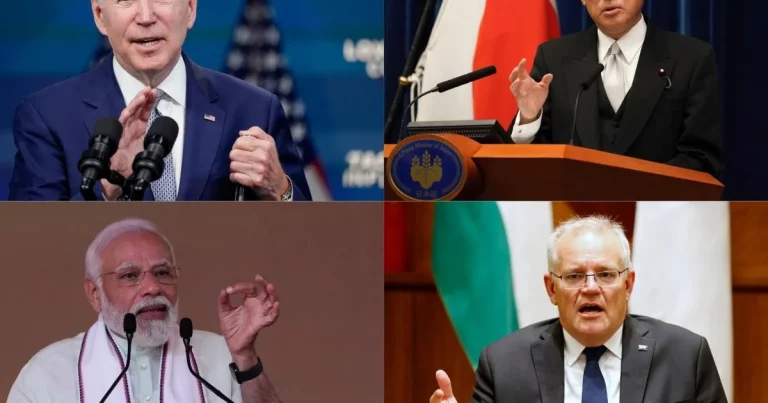
(Tokyo, May 19, 2022) – Leaders of the United StatesJapanIndia, and Australia should reach agreements on new measures to address human rights crises and democratic backsliding in Asia, Human Rights Watch said today. The Quad, a security alliance of the leaders of the four countries, is meeting in Tokyo on May 22, 2022.

“The Quad needs to place Asia’s massive human rights and humanitarian crises at the heart of its discussions and decisions,” said John Sifton, Asia advocacy director at Human Rights Watch. “Although each has vastly different causes and features, the human rights crises in Afghanistan, Myanmar, North Korea, and Sri Lanka should all be high on the security agenda.”

A central purpose of the Quad alliance is to counter the rising authoritarian influence of the Chinese government in Asia. To advance that goal, the Quad needs to better promote human rights institutions, democratic governance, and the rule of law domestically and regionally, Human Rights Watch said. Quad leaders should reach common positions on addressing major human rights crises in the region and speak publicly on specific concerns.

On Myanmar, Quad leaders need to move beyond relying on the Association of Southeast Asian Nations (ASEAN) and its failed “five point consensus.” Quad leaders, along with like-minded ASEAN members MalaysiaIndonesia, and Singapore, should agree on a stronger, coordinated effort to steer the Myanmar junta toward reform, including by increasing restrictions on its foreign currency revenues and weapons purchases.

Like-minded countries should develop a clear, time-bound approach to pressure the junta to end its abuses. The approach should include imposing and better enforcing new sanctions on oil and gas revenues, as well as on human rights abusers and military entities. Quad countries should support a United Nations Security Council resolution imposing a global arms embargo on Myanmar, which purchases large amounts of weapons from both China and Russia.

On Afghanistan, Quad leaders should agree to coordinate with other governments to press the Taliban to abandon their restrictive and abusive policies and practices, including bans on women’s secondary schooling and restrictions on women’s travelemployment, and dress. Japan, India, and Australia should urge the US to reach an agreement with Taliban authorities about restrictions in place on the Afghanistan Central Bank and on World Bank-administered assistance for education and health. These restrictions are severely exacerbating the country’s economic situation and are driving its humanitarian crisis.

On North Korea, Quad leaders should agree to integrate human rights issues into diplomatic approaches and support including human rights benchmarks in any future negotiations with Kim Jong Un and the North Korean government. They should also discuss outreach to the government to offer assistance to address the gravely deteriorating economic and humanitarian situation and the new Covid-19 outbreak.

On Sri Lanka, Quad leaders should recognize that the roots of the country’s current economic and political crisis lie in longstanding corruption and a lack of transparency, and that the route to stability and economic recovery depends on increasing respect for human rights, strengthening the rule of law, and ensuring accountability. The Quad should support economic programs, including from the International Monetary Fund (IMF), that seek to protect the most vulnerable from the worst effects of the economic crisis, while promoting political reforms to better protect fundamental rights and seek justice for past abuses.

Quad leaders should recognize that their credibility to speak on human rights abuses also requires addressing the many deficiencies in their own records. Human Rights Watch has extensively raised serious human rights issues for decades with the governments of the US, Japan, India, and Australia.

“The Quad should recognize that working to improve the human rights of people in Asia is consistent with addressing the authoritarianism of the Chinese government,” Sifton said. “Genuine security in the region depends on people in Asia being able to fully exercise their fundamental human rights and democratic freedoms.”

Sri Lanka inflation to remain elevated

0

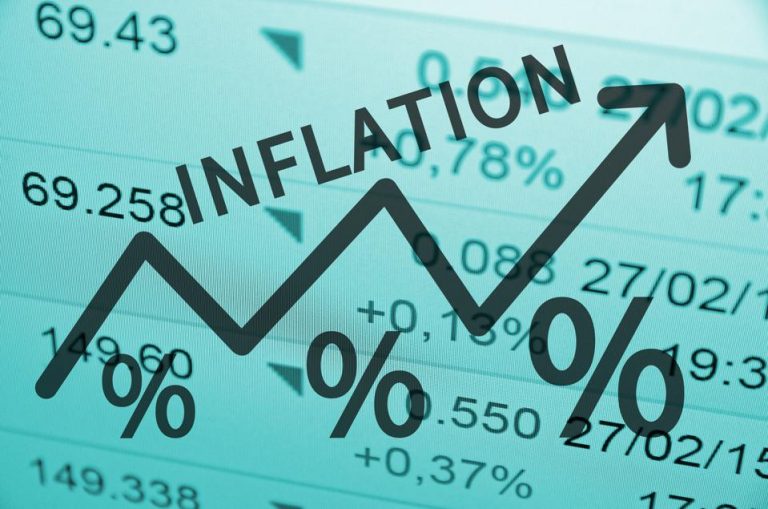
Inflation is projected to remain elevated in the coming months before moderating thereafter, the Central Bank of Sri Lanka said.

The bank said that headline inflation is projected to remain escalated in the near term on account of domestic supply shortages, increased global commodity prices, the effects of the large depreciation of the Sri Lanka rupee against the US dollar thus far during the year, along with the impact of aggregate demand pressures.

However, inflation is expected to moderate thereafter reflecting the impact of corrective policy measures of the Central Bank and the expected improvements in both domestic and global supply conditions.

Moreover, it is envisaged that the recent tightening of monetary conditions and the strengthening of monetary policy communication will help anchor inflation expectations of the public in the period ahead.

The Central Bank also said that the near term outlook of the tourism sector is likely to remain unfavourable due to both global and domestic factors.

Meanwhile, gross official reserves as of end April 2022 were provisionally estimated at US dollars 1.8 billion, including the swap facility from the People’s Bank of China equivalent to around US dollars 1.5 billion, which is subject to conditionalities on usability.

The Central Bank and the Government have commenced technical level discussions with the International Monetary Fund aimed at working towards a programme to address the macroeconomic challenges faced by the economy, while expeditious arrangements are being made to commence the external debt restructuring process.

Meanwhile, negotiations have already begun with bilateral and multilateral partners to obtain bridging finance in order to secure foreign exchange required to finance imports of essential goods and strengthen the social safety net programmes.