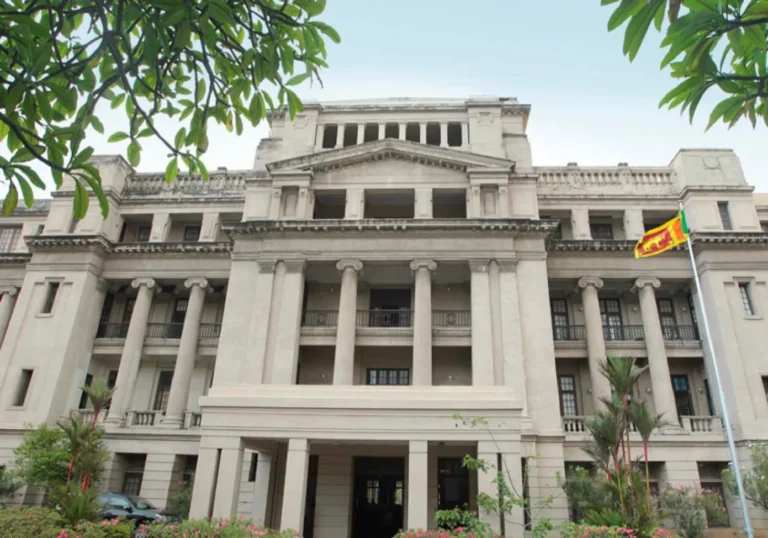
October 07, Colombo (LNW): Judges currently facing suspension in Sri Lanka will now receive only a portion of their regular salaries, with several standard allowances withheld, following a recent directive issued by the Judicial Service Commission (JSC).
The decision, which marks a tightening of policy regarding judicial officers under disciplinary review, was formally communicated via a circular dispatched to all High Court Judges by Prasanna Alwis, Secretary to the JSC.
This development comes in the wake of several suspensions involving judges who are the subject of ongoing inquiries into misconduct and other allegations.
The Judicial Service Commission has clarified that while these judges will still receive partial salaries during their suspension period, most discretionary financial benefits are to be suspended. The matter was discussed extensively during a recent meeting of the Audit and Management Committee of the Ministry of Justice and National Integration, where the terms of financial entitlements for suspended judicial officers were reviewed.
Following the deliberations, the committee resolved that only a limited set of allowances would be paid in addition to the reduced salaries. These include the professional allowance, personal allowance, cost of living adjustment, and language proficiency allowance.
Meanwhile, a broad range of other benefits—typically provided to sitting judges—have been explicitly withdrawn for the duration of the suspension. These include the telephone, vehicle, driver, book, housing or rent, fuel, and appeal-related allowances.
Suspended Judges to Receive Reduced Pay and Stripped Allowances Under New Judicial Commission Directive
Hundreds Taken into Custody in Sweeping Island-Wide Police Crackdown Across Sri Lanka
October 07, Colombo (LNW): Sri Lankan law enforcement launched a sweeping operation across the island yesterday (06), leading to the arrest of over 700 individuals suspected of various offences, including drug-related crimes, illegal alcohol distribution, and broader criminal activity.
According to the Police Media Division, the large-scale operation, conducted over a 24-hour period on 6 October, saw 28,476 individuals subjected to checks at various locations nationwide.
Officers carried out targeted inspections in both urban and rural areas as part of a continuing crackdown on organised crime, illicit substances, and threats to public safety.
Among those arrested were 13 individuals believed to have direct ties to criminal operations, while 409 persons with outstanding arrest warrants were also taken into custody.
Police confirmed that several of these suspects had evaded capture for months, and some are linked to ongoing investigations into organised criminal networks.
Traffic enforcement also featured prominently in the operation. Nineteen individuals were apprehended for driving under the influence, while 20 others were charged with reckless driving.
In addition, authorities flagged 3,483 traffic violations ranging from driving without valid documentation to dangerous manoeuvring and disobeying road rules.
“Usually Late” No More: SriLankan Airlines Finally Catches Its Flight
October 07, Colombo (LNW): SriLankan Airlines, the national carrier of Sri Lanka, has long been associated with the flight code prefix “UL”. Unfortunately, for an extended period, this designation became the subject of ridicule, earning the airline the unflattering moniker “Usually Late” due to frequent delays and cancellations. In 2024, the airline continued to experience widespread disruptions to its flight schedules, further cementing this negative reputation.
However, the situation has undergone a marked transformation. Multiple sources confirm that SriLankan Airlines is now operating its services punctually, with flights consistently taking off and landing on schedule. This represents a significant shift from the airline’s previous operational record.
This turnaround is largely attributed to the new management team, led by Chairman Sarath Ganegoda, who assumed responsibility under the current government. Within the span of a year, the administration has succeeded in removing the long-standing stigma of unreliability that plagued the national carrier.
Punctuality is a cornerstone of success for any international airline, as passengers and airport partners alike require reliability. Chronic delays not only inconvenience passengers but also place a strain on foreign airport operations and coordination with other airlines.
SriLankan Airlines’ recent improvements are, therefore, a point of national satisfaction and an important development for the country’s aviation and tourism sectors.
According to employees of SriLankan Airlines, the company is now operating as a true corporate entity—free from political interference and governed by professional management principles.
“This is exactly how a company should function. There is no political meddling. Now everyone can see how it is gradually recovering as an institution,” one employee noted.
Under successive past governments, the airline reportedly suffered from political appointments and mismanagement, most notably during the tenure of former President Mahinda Rajapaksa, who appointed his brother-in-law as Chairman. These decisions led to a substantial misuse of public funds and left the airline on the brink of collapse.
At its lowest point, the management was forced to consider two drastic options: either sell the airline or shut it down. However, given the airline’s heavy debt burden, a sale was deemed impractical.
With the change in government, the appointment of Mr Ganegoda and his new team has injected renewed hope into the airline’s future. The administration has successfully reintroduced private sector efficiency into the operation of the national carrier, helping to restore its credibility and performance.
It is important for the media not only to criticise failures but also to acknowledge progress and commend effective leadership. In this case, credit is due to the new management of SriLankan Airlines and the current government for steering the airline back towards operational excellence.
As a nation with ambitious plans to expand its tourism industry, a reliable national airline is of critical importance. SriLankan Airlines serves as the first point of contact for many international visitors and plays a vital role in shaping their initial impression of the country. The fact that this responsibility is now being fulfilled with professionalism and care by the airline’s pilots, flight crew, engineering teams, and ground staff is a source of national pride.
Showers, thundershowers to occur at most places of island (Oct 07)
October 07, Colombo (LNW): Showers or thundershowers will occur at most places of the island after 1.00 p.m., the Department of Meteorology said in its daily weather forecast today (07).
Fairly heavy falls above 50 mm are likely at some places in Northern, North-central, Eastern, Central and Uva provinces.
Showers or thundershowers may occur in Western province and in Galle, Matara, Puttalam, Jaffna and Trincomalee districts in the morning too.
The general public is kindly requested to take adequate precautions to minimise damages caused by lightning and temporary localised strong winds during thundershowers.
Marine Weather:
Condition of Rain:
Showers or thundershowers may occur at several places in the sea areas around the island.
Winds:
Winds will be south-westerly or variable and wind speed will be (25-35) kmph.
State of Sea:
The sea areas around the island can be slight to moderate.
Temporarily strong gusty winds and very rough seas can be expected during thundershowers.
32 Police OICs Reassigned Across Sri Lanka
October 06, Colombo (LNW): A significant reshuffle within the Sri Lanka Police has seen 32 Officers-in-Charge (OICs) transferred and appointed to new roles, with the changes taking effect immediately.
The reassignments were approved by the National Police Commission and sanctioned by Inspector General of Police, Attorney-at-Law Priyantha Weerasooriya.
The move, announced by Police Headquarters, involves the transfer of 26 Chief Inspectors of Police and six Inspectors of Police.
The transfers are as follows:
Chief Police Inspector B.M.H. Somasiri – from the post of OIC of Bingiriya Police to Kurunegala Division for general duties;
Chief Police Inspector M.I.M.A. Wickramaratne – from Kuliyapitiya Division to the post of OIC of Bingiriya Police;
Chief Police Inspector W.P.A. Vidanapathirana – from the post of Inspector of Police, Kayts Headquarters to Kebitigollewa Division for general duties;
Chief Police Inspector L.A. Ajith Kumara – from the post of OIC of Wellawa Police to the post of Inspector of Police, Kayts Headquarters;
Police Inspector W.D.J.S. Prabath – from the post of OIC of Kapugollawa Police to the post of OIC of Wellawa Police;
Police Inspector R.D.P.S. Rajapaksa – from Anuradhapura Division to perform the duties of the post of OIC of Kapugollawa Police;
Police Inspector S.K. Gamage – from the post of OIC of Kesbewa Police to Puttalam Division for general duties;
Chief Police Inspector K. P. Kalansuriya – from Mount Lavinia Division to perform the duties of OIC of Kesbewa Police;
Chief Police Inspector E.A.D.D. Somajith – from the post of OIC of Arachchikattuwa to Kegalle Division for general duties;
Police Inspector N.U.W.K. Nelumdeniya – from the Police Legal Division to perform the duties of the post of OIC of Arachchikattuwa;
Chief Police Inspector K.A.D. Roshantha – from the post of OIC of Police performing duties in Kosgama to Gampaha Division for general duties;
Chief Police Inspector G.P.S. Weerasinghe – from the Apprentice Recruitment Division to the post of OIC of Kosgama Police;
Police Inspector H.M. Kumarasinghe – from the post of OIC of Police in Dombagahawela to the post of OIC of Police in Galauda;
Police Inspector R.D.A.D.K. Yalkumbura – from the post of OIC of Police in Galauda to the post of OIC of Police in Dombagahawela;
Chief Police Inspector W.W.A.S.R. Piyasena – from the post of OIC of Police in Moragoda to perform general duties in Ratnapura Division;
Chief Police Inspector B.L.T.S. Pingno – from the post of OIC of Ichchankulam Police to the post of OIC of Moragoda Police;
Chief Police Inspector S.S.P. Weerasinghe – from the Service Training Division to perform the duties of the OIC of Ichchankulam Police;
Chief Police Inspector K.W.C.N. Abenarayana – from the post of OIC of Delf Police to Kegalle Division for general duties;
Chief Police Inspector O.A.U. Jayashantha – from the Mannar Division to perform the duties of the OIC of Delf Police;
Chief Police Inspector B.C. Rohan – from the Police Academy Division to perform the duties of the OIC of the Police Academy Division;
Chief Police Inspector P.M.C.J.B. Palihena – from the post of Inspector of Police, Jaffna Headquarters to Ratnapura Division for general duties;
Chief Police Inspector R.M.P. Seneviratne – from the post of Inspector of Police, Chavakachcheri Headquarters to the post of Inspector of Police of Jaffna Headquarters;
Chief Police Inspector M. Koneswaran – from Negombo Division to the post of Inspector of Police, Vavakachcheri Headquarters;
Chief Police Inspector G.P.H.H. Silva – from the post of OIC, Wakkare to Matale Division for general duties;
Chief Police Inspector G.R.Y.D. Madduma Bandara – from the post of OIC, Seeduwa Police to perform the duties of OIC of Wakare Police;
Chief Police Inspector P. Weerasinghe – from Gampaha Division to perform the duties of the post of OIC of Seeduwa Police;
Chief Police Inspector M. S. Najim – from Trincomalee Division to perform the duties of the post of Inspector of Police, Kilinochchi;
Chief Police Inspector W.K.R. Wijesinghe – from the post of Inspector of Police, Kalutara South to Ratnapura Division for general duties;
Chief Police Inspector A.M.N.I. Gunasekara – from the post of OIC of Puliyankulam Police to the post of Inspector of Police, Kalutara South Headquarters;
Chief Police Inspector S.M.L.R. Bandara – from the post of OIC of Valachchena Police to the post of Inspector of Police, Matara Headquarters;
Chief Police Inspector J.P.S. Sampath Kumara – from the post of OIC of Public Order Management Division to the post of OIC of Valachchenai Police;
Chief Police Inspector Ravindra Kumara – from the Public Order Management Division to perform the duties of the OIC of the Public Order Management Division.
New Government Green-Lights Commercial 5G Rollout Across Sri Lanka
By: Staff Writer
October 06, Colombo (LNW): In a bold move to accelerate the nation’s digital transformation, the new government yesterday formally issued the Final Assignment Notice (NoA) for the 2025 5G spectrum auction, officially opening the way for commercial 5G services to enter Sri Lanka’s telecommunications landscape.
The notice was unveiled at a high-profile media briefing hosted by the Information and Communication Technology Agency (ICTA), with key officials from the Ministry of Digital Economy, the Telecommunications Regulatory Commission of Sri Lanka (TRCSL), and the 5G Auction Committee in attendance.
Deputy Minister Eng. Eranga Weeraratne, Acting Secretary Waruna Sri Dhanapala, TRCSL Director General Air Vice Marshal (Rtd.) Bandula Herath, Auction Committee Chairman Dr. Sulakshana Jayawardena, and TRCSL Director Shantha Gunanananda were among the speakers.
Deputy Minister Weeraratne emphasized that the spectrum assignment marks a critical foundation for expanding “next-generation telecommunication and ICT services.” He argued that 5G technology will be central to innovation, economic growth, and industrial transformation. He cited agriculture and apparel manufacturing as areas where smart sensors and automation could significantly raise productivity and reduce waste.
TRCSL Director General Herath traced the journey to this milestone, recalling that the regulatory and technical groundwork began as far back as 2017. Between 2017 and 2020, TRCSL focused on developing spectrum policy and regulation; from 2020 to 2022, consultations with the World Bank, the International Telecommunication Union (ITU), and GSMA were held to identify the optimal frequency bands.
He explained that after this comprehensive evolution, the final assignment notice is now being issued in 2025. He added that once the auction is completed expected within two months—Sri Lankans will begin to enjoy 5G-enabled services.
Dr. Jayawardena, chairman of the 5G Auction Committee, outlined that the auction period will span 40 days, with all procedural documents already published on the TRCSL website. He pledged that the auction would be conducted with “high transparency.”
TRCSL Director Gunanananda added a social dimension, noting that 5G would help bridge the digital divide by enhancing access to education and economic opportunities in rural and urban communities alike. He observed that the COVID-19 pandemic underscored how essential reliable internet connectivity has become.
Observers view the government’s step as a strong signal of commitment to digital modernization. The tracking of the assignment notice follows earlier public consultations: in December 2024, TRCSL had invited stakeholder feedback on the draft Notice of Assignment covering the 3,500 MHz and 27 GHz bands.
Once the auction concludes, telecommunications operators will bid for spectrum rights, after which commercial 5G deployment could begin in earnest potentially in selected urban centres initially, then expanding outward. Analysts expect that 5G’s ultra-low latency and high throughput capabilities will enable innovations in telemedicine, smart cities, precision agriculture, Industry 4.0, immersive media, and more.
In short, the issuance of the Final Assignment Notice is not just a regulatory formality it is a turning point that signals Sri Lanka is poised to leap into a new era of connectivity. The government will now look to ensure that rollout is efficient, equitable, and catalyses sustained economic growth across all sectors and regions.
China Funding Likely to resume for Delayed Expressway Project
By: Staff Writer
October 06, Colombo (LNW): Funding from China’s Export-Import (Exim) Bank for Sri Lanka’s long-delayed Central Expressway Project (CEP) is expected to resume by September or October, marking a potential breakthrough for one of the country’s most ambitious infrastructure ventures.
Road Development Authority (RDA) Chairman T. Paskaran confirmed that discussions with the Chinese lender are progressing, following a suspension triggered by Sri Lanka’s 2022 economic crisis. “Negotiations with the donor are currently ongoing, and there is a strong likelihood that funding could resume by September or October,” Paskaran said.
The funding freeze was the main reason for the project’s prolonged delays. Paskaran added that, in case of further setbacks in foreign disbursements, the Government is prepared to mobilise domestic funds as a contingency to ensure continuity.
However, concerns have emerged from Parliament’s Committee on Public Finance (CoPF) over the incomplete negotiations with both the contractor, Metallurgical Corporation of China (MCC), and China Exim Bank. Committee Chairman Dr. Harsha de Silva revealed that discussions on the contractor’s claims and revised loan conditions for the reduced USD 500 million facility remain unfinished.
In a post on X, de Silva questioned the decision to alter the previous 15-year fixed loan rate of 2.5% to a variable rate ranging between 2.5% and 3.5%. “We were puzzled why the Highways Ministry wants to switch from a fixed rate to a variable rate,” he said, adding that the CoPF urged a fair and balanced arrangement that equally shares future interest rate movements between both parties.
Despite financing uncertainties, the Government has taken steps to advance construction. The Cabinet of Ministers recently approved the award of the Central Expressway Phase 3 spanning the vital Mirigama to Kurunegala stretch to Maga Engineering (Pvt) Ltd., following a competitive bidding process that selected the lowest responsive bidder.
The appointment of Maga Engineering represents a strategic shift toward involving reputable local firms in large-scale projects, with an emphasis on transparency and cost efficiency. Officials hope the move will curb cost overruns and accelerate completion timelines, crucial to meeting Sri Lanka’s infrastructure goals.
Once completed, the Central Expressway is expected to serve as a critical transport artery linking Colombo to the central provinces, easing congestion on the A1 and A6 routes and reducing travel times significantly.
Analysts view the Cabinet’s decision and renewed funding talks as a hopeful step in reviving a project long mired in financial and administrative delays, signalling a renewed commitment to deliver long-promised connectivity and economic growth.
Sri Lanka’s PPP Gamble Risks Becoming a Fiscal Time Bomb
By: Staff Writer
October 06, Colombo (LNW): Sri Lanka is increasingly turning to Public-Private Partnerships (PPPs) to rebuild its crumbling infrastructure and attract foreign investment. Yet, beneath the celebratory rhetoric lies a dangerous undercurrent, a legacy of opaque deals, cost overruns, and hidden fiscal burdens that threaten to undermine the very recovery PPPs are meant to fuel.
The Finance Ministry’s Fiscal Strategy Statement 2026 openly concedes that PPPs pose “significant fiscal risks,” especially when governments extend guarantees or assume contingent liabilities.
When such projects underperform or fail, the financial fallout often lands squarely on taxpayers a pattern analysts warn Sri Lanka can no longer afford amid its fragile post-crisis recovery.
Successive governments have pinned hopes on PPPs across key sectors such as energy, ports, and water management. However, many projects have been bogged down by renegotiations, cost escalations, and an absence of central oversight. The result is a patchwork of ventures plagued by opacity and inconsistency.
The energy sector remains the most striking example. Two 350 MW LNG power plants in Kerawalapitiya essential for energy security have already incurred an additional US$ 73 million due to contractual revisions.
Similarly, the 50 MW Trincomalee solar project, backed by a sovereign guarantee, remains incomplete, with half of the Ceylon Electricity Board’s equity still pending.
Meanwhile, large-scale solar ventures in Poonakary, Siyambalanduwa, and Hambantota are progressing with private backing. Yet, experts caution that without robust fiscal safeguards, these deals could leave the Treasury exposed to new debt obligations.
Infrastructure partnerships tell a similar story. The US$ 700 million West Container Terminal-I at Colombo Port is finally operational, but other initiatives have stalled.
The proposed US$ 4.2 billion Galle Port remains mired in procurement delays, while the US$ 150 million South Asia Logistics Hub only recently secured a tender. Analysts say bureaucratic inertia and investor uncertainty continue to erode momentum.
In water management, the Rs. 3.3 billion Non-Revenue Water reduction project in Galle aims to reduce losses by 2025 through private participation. Yet, officials warn that poor contract design or performance failures could trigger costly compensation claims.
Despite the growing fiscal exposure, Sri Lanka lacks a central PPP registry or independent monitoring body. Past unsolicited proposals and hidden guarantees have burdened the Treasury with undisclosed liabilities. In response, the Finance Ministry is preparing a PPP Bill that will establish a National PPP Agency, enforce competitive bidding, and create a contingent liabilities register.
While PPPs may be one of Sri Lanka’s few remaining tools to fund infrastructure amid borrowing limits, weak oversight and political meddling could transform them from a growth catalyst into what officials now describe as a looming “fiscal time bomb.”
Bloated Public Sector, Costly Energy Dragging Sri Lanka Down: World Bank
By: Staff Writer
October 06, Colombo (LNW): The World Bank has issued a stark warning to Sri Lanka, urging immediate and comprehensive reforms in the energy sector, public administration, and public-private partnerships (PPPs), as the country’s inefficiencies and bloated cost structure continue to undermine competitiveness and fiscal stability.
During a high-level meeting with parliamentary oversight committees on 25 September, a World Bank delegation led by Country Manager Gevorg Sargsyan cautioned that Sri Lanka’s current trajectory was unsustainable without deep structural reforms.
The discussions, held with the Committee on Public Finance (CoPF), Public Enterprises (CoPE), Public Accounts (CoPA), and the Committee on Ways and Means, focused on urgent measures needed to restore economic discipline and attract investment.
Officials highlighted that Sri Lanka’s energy prices remain among the highest in South Asia — nearly double those of regional peers such as India and Bangladesh primarily due to poor pricing policies, political interference, and inefficiencies in state-run utilities.
The World Bank stressed the necessity of market-based pricing, improved investment management, and greater private participation to ensure affordability and supply reliability. The current pricing distortions, it warned, are eroding industrial competitiveness and discouraging foreign investment.
A major concern raised was the excessive size of the public sector. Sri Lanka employs over 1.5 million government workers nearly 13 of its labor force one of the highest ratios in Asia. Yet, productivity remains dismal. Many state agencies operate with overlapping functions and little accountability.
Despite low wage levels, the overall wage bill consumes almost half of government recurrent expenditure, crowding out spending on health, education, and capital projects. The World Bank recommended “rightsizing” the bureaucracy through rationalization, skill-based recruitment, and performance-based evaluations.
The delegation also called for reforms in the Public-Private Partnership (PPP) framework, emphasizing that PPPs, if designed transparently, could deliver infrastructure and services without resorting to wholesale privatization.
However, Sri Lanka’s recent PPP record has been marred by allegations of corruption, opaque tendering, and politically driven decision-making particularly in transport and renewable energy projects. The World Bank urged stronger regulatory oversight and independent evaluation mechanisms to restore investor confidence.
Committee Chairs including Dr. Harsha de Silva, Dr. Nishantha Samaraweera, and Kabir Hashim acknowledged the need for urgent reform, pledging to strengthen oversight in revenue collection, employment creation, and public accountability.
As Sri Lanka seeks recovery under IMF-backed reforms, the World Bank’s message was clear: without tackling energy inefficiencies, an overstaffed public sector, and corrupt PPP structures, the country risks trapping itself in a cycle of stagnation and fiscal distress.
EXCLUSIVE: April 2026 Election Rumours Spark Scramble
October 06, Colombo (LNW): Whispers of a provincial council election in April 2026 have sparked a political chain reaction. Still, the Election Commission is pouring cold water on the timeline, even as the opposition begins strategising for a contest that may not materialise.
While rumours suggest the government is eyeing an April date ahead of the New Year celebrations, an Election Commission official told LNW on condition of anonymity that holding elections under the current system by that deadline would be “difficult.” The challenge centres on unresolved delimitation issues, the redrawing of electoral boundaries, that must be addressed before implementing the new framework.
The government has remained conspicuously silent on the matter. Sources close to the JVP confirmed that no definitive decision has been made, leaving political parties and voters in a state of uncertainty.
Yet the opposition isn’t waiting for clarity. A prominent figure from the previous administration has already approached two respected individuals to serve as chief minister candidates for the Western and Southern provinces, signalling confidence that elections are inevitable.
The disconnect is stark, while the Election Commission grapples with technical hurdles and the government stays mum, opposition forces are treating the contest as a foregone conclusion. Provincial councils have been without elected representatives for years, making any movement toward elections politically significant, if logistically uncertain.