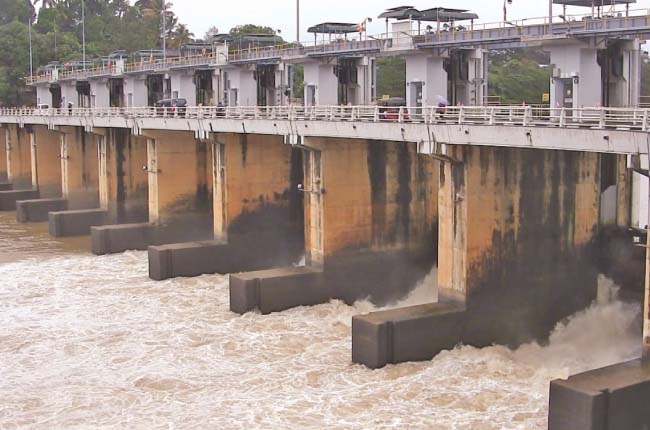
November 18, Colombo (LNW): The Irrigation Department has confirmed that two spillway gates at the Deduru Oya Reservoir have been lifted by around a foot each, increasing downstream discharge to roughly 1,400 cubic feet of water per second as the region continues to face unrelenting rainfall.
Elsewhere, engineers at the Polgolla Mahaweli Dam reported that six of its sluice gates were raised earlier today, each by about 18 inches. This controlled release is sending an estimated 9,000 cubic feet of water per second towards the Victoria Reservoir, easing pressure on the Polgolla basin after several days of unsettled weather.
Officials are advising communities living along the downstream stretch of the Mahaweli River to remain vigilant, particularly those who rely on the river for transport, fishing, or daily chores. With water levels expected to fluctuate throughout the day, local disaster-management teams have been placed on alert and residents urged to keep a close eye on official safety updates.
Reservoir Gates Opened as Persistent Rain Swells Water Levels
Customs Confirms Release of Detained BYD Vehicles as Court Reviews Progress
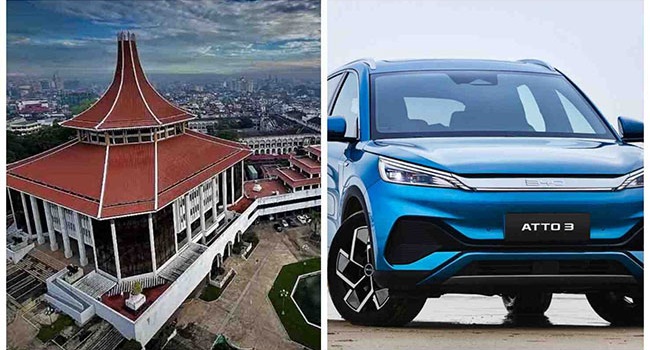
November 18, Colombo (LNW): Sri Lanka Customs has notified the Court of Appeal that all previously detained BYD vehicles have now been handed over to the importers, following the arrangement reached during the earlier hearing.
Deputy Solicitor General Chaya Sri Nammuni, representing Customs, conveyed this to the bench as several writ applications filed by John Keells CG Auto (Pvt) Ltd came up before Court of Appeal President Justice Rohantha Abeysuriya and Justice K. Priyantha Fernando. The dispute centres on the motor specifications of several BYD models, which led to their temporary detention.
The cases were listed primarily to confirm that Customs had honoured its earlier undertaking to release the vehicles. According to counsel, the process has now been completed, aside from a small number of units retained for technical examination.
The Court also instructed all parties to submit written arguments on 18 November concerning an intervention request lodged by the Vehicle Importers Association, which seeks to join the proceedings. A ruling on that application is expected on November 28.
Earlier, on 11 November, the Court directed Customs to expedite the clearance of 625 BYD vehicles, subject to bank and corporate guarantees. Customs subsequently agreed to release a variety of models—such as the Atto range, Dolphin variants, and the Sealion 7—under the stipulated guarantee conditions. The bench was informed that only six vehicles remain in custody to allow further testing of their motor capacity.
President’s Counsel Farzana Jameel appeared for the petitioners, while Senior Additional Solicitor General Sumathi Dharmawardena, PC, together with Deputy Solicitor General Nammuni, represented Sri Lanka Customs.
Chief Prelate Demands Accountability After Controversial Temple Incident
November 18, Colombo (LNW): The Chief Prelate of the Sri Lanka Amarapura Maha Nikaya, the Most Venerable Karagoda Uyangoda Maithri Murthy Thero, has written to the President expressing grave concern over an incident in Trincomalee, where police officers reportedly removed a Buddha statue from the grounds of a long-established temple.
In his letter, the Chief Prelate emphasises that the Sri Sambuddha Jayanthi Bodhiraja Viharaya—founded in 1951—has been formally registered with the Department of Buddhist Affairs and recognised as part of the Amarapura Maha Nikaya. He notes that the land on which the temple stands was officially granted to the institution in 2014, confirming its legal status and long-standing presence in the area.
Despite this, the letter states that the temple’s resident monks have faced continued intimidation and pressure, causing widespread concern among both the Sangha and the broader Buddhist community. The Chief Prelate strongly denounces the events said to have taken place on Sunday (16), describing them as entirely unacceptable.
He further questions the authority under which the police acted, particularly regarding the removal of the statue and the alleged assault on monks—an altercation which left the Chief Incumbent injured and requiring hospital treatment. Such conduct, he argues, constitutes a clear breach of Article 09 of the Constitution.
The letter urges the President to intervene without delay, calling for an immediate halt to any plans to demolish structures within the temple grounds. It also requests that all relevant agencies be instructed to ensure the protection of the temple, its property, and the monks residing there, amid rising unease among the faithful.
Authorities Issue Landslide Warnings to Eight Districts

November 18, Colombo (LNW): Residents in several parts of the country have been urged to remain on high alert after continuous downpours triggered early warnings of potential landslides across a number of districts.
The National Building Research Organisation announced that its advisories would remain in force from 7.00 p.m. Monday (17) until 7.00 p.m. Tuesday (18), cautioning that saturated soil conditions could worsen if the unsettled weather persists.
Enhanced, level-two alerts have been issued for communities within the Haldummulla administrative area in Badulla and the Aranayaka division in Kegalle, where officials say the terrain is especially vulnerable following days of relentless rain.
In addition, level-one notices have been extended to pockets across eight districts, with authorities advising residents to monitor official updates closely and be prepared to relocate should conditions deteriorate.
Doctors’ Union Presses On with Industrial Action as Talks Drag On

November 18, Colombo (LNW): The Government Medical Officers’ Association signalled that its industrial action would carry on through today (18), insisting that authorities have yet to offer a meaningful response to the issues the union has raised.
A group of senior representatives from the association had travelled to the Presidential Secretariat earlier in the day for what was expected to be a decisive round of discussion.
The talks, held under the direct supervision of President Anura Kumara Dissanayake, brought together several high-ranking figures from the union in an effort to break the stalemate.
However, participants close to the negotiations suggested that progress remained sluggish, with both sides attempting to narrow gaps on long-standing concerns such as staffing shortages and stalled professional allowances.
Low pressure area continues to persist: Several provinces to witness heavy falls about 100 mm (Nov 18)

November 18, Colombo (LNW): The low pressure area over the island continues to persist and cloudy skies can be expected over most parts of the island.
Showers or thundershowers will occur at times in Northern, North-central, Eastern, Southern and Uva provinces.
Showers or thundershowers will occur at several places in the other areas of the island after 1.00 p.m.
Heavy falls about 100 mm are likely at some places in Western, Sabaragamuwa, Northwestern, Southern and Uva provinces and in Kandy and Nuwara-Eliya districts.
Misty conditions can be expected at some places in Sabaragamuwa, Central, Uva and Southern provinces during the early hours of the morning.
The general public is kindly requested to take adequate precautions to minimise damages caused by temporary localised strong winds and lightning during thundershowers.
Marine Weather:
Condition of Rain:
Showers or thundershowers will occur at several places in sea areas around the island.
Winds:
Winds will be north-easterly and speed will be (20-30) kmph. Wind speed can increase up to 40 kmph at times in the sea areas off the coast extending from Kankasanthurai to Galle via Mannar, Puttalam and Colombo.
State of Sea:
The sea areas off the coast extending from Kankasanthurai to Galle via Mannar, Puttalam and Colombo will be moderate at times. The other sea areas around the island will be slight.
Temporarily strong gusty winds and very rough seas can be expected during thundershowers.
Proposed Public Prosecution Office Sparks Legal Independence Concerns

By: Staff Writer
November 17, Colombo (LNW): The government’s proposal to establish a separate Office of the Director of Public Prosecutions (DPP) has sparked significant opposition from within the Attorney General’s Department, raising questions about its potential impact on judicial efficiency and the department’s operational integrity.
At a special general meeting on November 14, 2025, the Legal Officers’ Association of the Attorney General’s Department formally adopted a resolution opposing the move. While the association expressed support for initiatives aimed at improving independence, transparency, and efficiency, it strongly rejected the creation of a separate prosecutorial office.
The proposed DPP office is intended to segregate the prosecutorial function from the broader Attorney General’s Department, with the stated goal of enhancing the independence and impartiality of criminal prosecutions and expediting the administration of justice. Proponents argue that a standalone office would allow prosecutors to operate free from administrative constraints and bureaucratic delays.
However, the association contends that no empirical evidence or rigorous analysis has been presented to demonstrate that such separation would achieve these objectives. Members cautioned that a fragmented structure could instead undermine the department’s independence, dilute professional standards, and introduce operational inefficiencies.
“Independence and transparency must not be limited solely to prosecutions; they must encompass all functions of the Attorney General’s Department, including civil litigation and advisory roles,” the resolution emphasized. By carving out only the prosecutorial arm, critics argue, the government risks creating a dual structure where internal coordination breaks down, and the department’s holistic capacity to advise the state is weakened.
Legal experts suggest that such a separation could also have broader implications for the judiciary. A divided prosecution service may lead to inconsistent legal interpretations, delays in case preparation, and potential conflicts between the newly formed DPP office and the Attorney General’s Department. These challenges could inadvertently slow the criminal justice process rather than accelerate it, contradicting the reform’s intended purpose.
The association described the move as “unreasonable, arbitrary, devoid of any rational basis or merit, and ultimately counterproductive,” while reaffirming its willingness to support internal reforms aimed at strengthening departmental efficiency and accountability.
Observers note that a careful balance must be maintained between enhancing prosecutorial independence and preserving the unified strength of the Attorney General’s Department. Separating the two could create parallel hierarchies, increase administrative costs, and complicate coordination with law enforcement and the courts, factors that may weaken overall judicial effectiveness.
As the debate continues, the government faces a critical choice: implement structural reform without sufficient empirical justification, risking operational disruption, or pursue internal reforms within the Attorney General’s Department that enhance independence and efficiency while maintaining its established professional standards.
Sri Lanka’s Vehicle Surge Signals Deepening Economic Distortions

By: Staff Writer
November 17, Colombo (LNW): Sri Lanka’s vehicle market long distorted by import bans, erratic tax policies and unstable macroeconomic conditions has entered another turbulent phase, with official data showing a sharp slowdown in car and SUV registrations in October despite an unusual nine-month buying frenzy driven by pent-up demand and policy uncertainty.
According to a fresh analysis of vehicle registry data by Colombo-based brokerage J B Securities, total registrations—including motorbikes fell to 47,685 units in October 2025, down from 48,708 in September, signalling the first broad cooling after months of abnormal activity across segments.
Car and SUV momentum breaks after September’s spike
Motor cars, which hit a post-crisis high of 3,934 units in September, slipped to 3,612 units in October. SUV and crossover registrations saw a sharper contraction from 5,813 units in September to 5,075 in October.
This follows an extraordinary September spike where combined car and SUV numbers surged to 9,756 units, compared to 6,137 units just a month earlier. Industry analysts attribute the surge to aggressive front-loading by dealers anticipating tighter customs scrutiny, possible tax revisions, and delays in valuation processes.
Before the 2020–2022 economic crisis—triggered by a mix of inflationary open-market operations, excessive rate cuts and import controls—Sri Lanka routinely recorded 5,000–7,000 monthly registrations for cars and SUVs. October’s dip suggests the September peak was a temporary distortion rather than a sustained recovery.
BYD plunge highlights regulatory uncertainty
One of the most dramatic shifts was seen in electric vehicle (EV) registrations. Chinese EV giant BYD, which recorded 1,531 units in September, collapsed to 531 units in October after Sri Lanka Customs detained several shipments over a dispute on motor classifications. Analysts warn that such disruptions undermine investor confidence at a time when Sri Lanka is promoting EV adoption.
Meanwhile, emerging Chinese brand BAW gained traction, with its entry-level E-7 model registering 263 units, becoming one of the best performers in its category.
Commercial vehicles show mixed but rising trend
Commercial vehicle registrations presented a more complex picture. Vans climbed from 551 to 716 units, mini-trucks ballooned from 14 to 200, and medium trucks increased from 148 to 209. Heavy trucks also rose slightly to 227 units. Bus registrations declined to 107, though still higher than the August total of 66.
Agricultural vehicles recorded strong growth. Large tractor registrations surged to 1,031, up from 701, led by TAFE. Hand tractors rose from 85 to 128, with Vietnamese brand Vikyno topping the category with 52 units.
Three-wheelers and motorbikes stabilise near pre-crisis norms
Three-wheeler registrations fell to 2,541 units, down from 3,015, yet remained above August levels. Before the economic crisis, Sri Lanka routinely recorded around 10,000 units per month, showing that demand remains depressed. Motorbike registrations Sri Lanka’s most stable category stood at 32,768 units, near pre-crisis levels.
A distorted market with real economic consequences
Economists warn that the erratic swings in vehicle imports highlight deeper structural weaknesses, policy inconsistency, heavy reliance on import taxes, and ongoing foreign exchange pressures. Without a coherent long-term import and taxation strategy, they caution, the vehicle market will continue to swing abruptly between scarcity and unsustainable surges, with significant macroeconom
Secret Defence Deals Erode NPP’s Transparency Pledge and Non-Aligned Credibility
By: Staff Writer
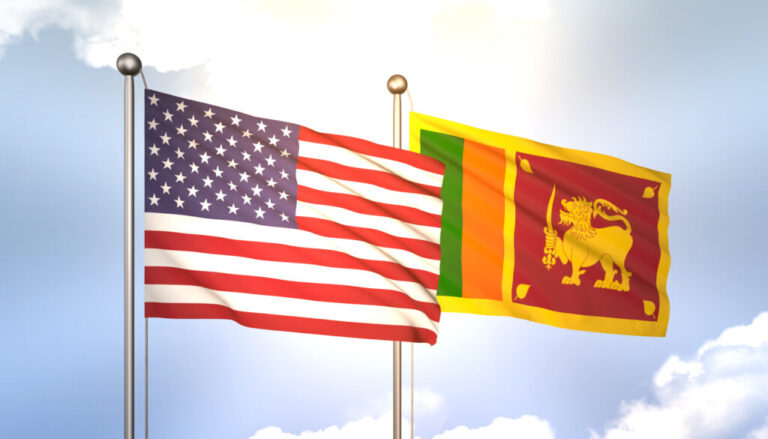
November 17, Colombo (LNW): The JVP -led National People’s Power (NPP) government is under intensifying scrutiny after signing yet another undisclosed defence cooperation agreement this time with the United States marking the second or possibly third defence pact the government has quietly concluded since coming to power.
The latest agreement, signed at the Ministry of Defence between U.S. Ambassador Julie Chung, Brigadier General Trenton Gibson of the Montana National Guard, and Sri Lanka’s Defence Secretary Air Vice Marshal Sampath Thuiya Kontha, expands collaboration under the U.S. State Partnership Program (SPP).
While presented as a routine training and capacity-building MoU, what has alarmed political observers and foreign policy analysts is the silence surrounding the deal. No Cabinet-approved public disclosure, no parliamentary briefing, and no release of the text have accompanied the signing mirroring the secrecy surrounding the NPP government’s earlier defence MoUs with India and Japan, both of which were also concluded with minimal public knowledge.
A Pattern of Secretive Defence Diplomacy
Only months earlier, Colombo quietly entered two separate defence cooperation frameworks with India and Japan, each involving training support, maritime security coordination, and technology-sharing. None of these agreements were debated in Parliament or explained to the public beforehand.
Taken together, these back-to-back security pacts across three major Indo-Pacific powers signal a strategic shift in Sri Lanka’s foreign and defence policy—yet one occurring without public mandate or transparency.
For a government that, while in opposition, vehemently mobilized against SOFA, ACSA, MCC, and other foreign security arrangements, the abrupt embrace of multiple defence agreements has left many questioning whether the NPP has abandoned its ideological roots.
Non-Alignment at Risk
Analysts warn that the secrecy and frequency of these deals compromise Sri Lanka’s long-standing non-aligned posture. Entering separate defence cooperation frameworks with the U.S., India, and Japanthree countries deeply embedded in Indo-Pacific strategic competition risks projecting Sri Lanka as taking sides in a region already defined by great-power rivalry.
Both China and India, historically sensitive to external military influence in the Indian Ocean, may interpret Sri Lanka’s actions as a quiet pivot toward foreign security dependence.
The risk is not the agreements themselves, which many countries routinely sign, but the lack of disclosure, which creates suspicion about hidden operational clauses, intelligence-sharing obligations, or structural defence commitments.
Transparency Promises in Tatters
The NPP came to power promising radical transparency, open governance, and public accountability. Yet senior MPs within the coalition admit privately that they had no prior knowledge of any of the three defence MoUs until after they were signed.
Deputy Minister Major General Jayasekara hailed the new U.S. MoU as “an important milestone,” but the government has yet to explain why these agreements signed consecutively with three powerful nations were withheld from public debate.
Credibility Crisis for the NPP
The contradiction between the NPP’s past protests against foreign military agreements and its current pattern of secretive defence diplomacy has triggered the government’s most serious credibility challenge to date.
Unless the full texts of all three agreements are released immediately, the NPP risks being seen as a government that publicly champions sovereignty while privately surrendering transparency.
Government Turns Its Back on Millions of Migrant Workers
By: Staff Writer
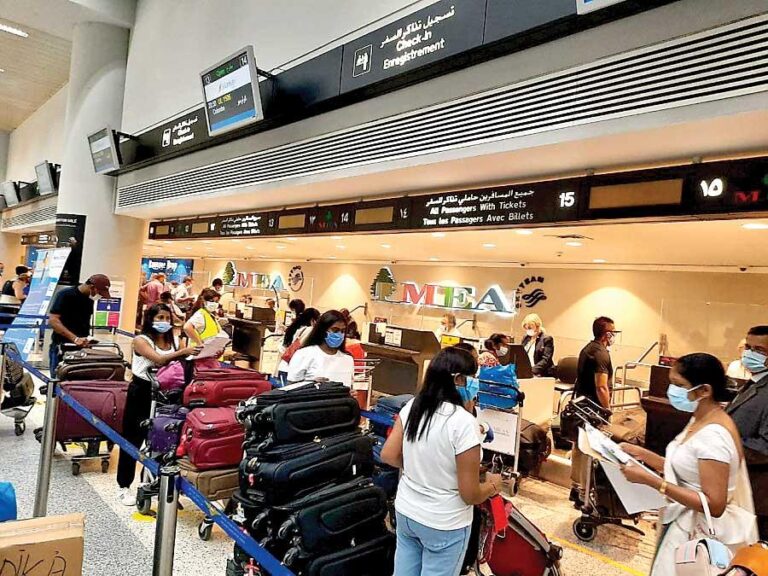
November 17, Colombo (LNW): Sri Lanka’s much-touted commitment to protecting migrant workers, long hailed as the backbone of the nation’s economy, has come under severe criticism as the 2026 Budget exposes a series of broken promises, misleading allocations, and new restrictions that directly burden the country’s 2.3 million overseas workers.
The government announced with fanfare that it would introduce a pension scheme for migrant workers.
However, the Budget allocates only Rs. 2 billion for this programme. With 1.8 million officially registered migrant workers and another estimated 500,000 unregistered, the math reveals a harsh truth.
Even ignoring the unregistered group, dividing Rs. 2 billion among 1.8 million workers amounts to just Rs. 1,100 per person. Critics ask what meaningful pension benefit can possibly be offered with such a meagre allocation.
Observers note that in Sri Lanka’s 76-year post-independence history, no government has misled migrant workers in such a blatant manner. Previously, authorities promised that migrant workers would be granted voting rights through Sri Lankan embassies in their host countries.
But the new Budget appears to have quietly abandoned this pledge, raising accusations that migrant workers are being used merely as political props.
The administration’s own election manifesto pledged strong state intervention to resolve wage disparities and hardships faced by overseas workers. Yet, just one year later, that promise appears forgotten.
The latest Budget makes no mention of any plan to address severe wage issues, exploitation, or unfair treatment conditions that thousands of Sri Lankan domestic workers attached to embassies abroad reportedly continue to face without any formal mechanism for redress.
Adding to the frustration, while the Budget claims to expand tax concessions for migrant workers, the Customs Department under the authority of the President has issued a new circular banning migrant workers from bringing back commonly used household electronics such as televisions, washing machines, refrigerators, and basic kitchen appliances.
These items, often accumulated after years of hardship, are among the few rewards migrant workers look forward to taking home.
This restriction disproportionately impacts Sri Lankans working in the Middle East, who often endure extreme conditions for years to support their families. For many, returning home with the appliances they used abroad is a symbolic milestone of their sacrifice and financial struggle.
Some employers even gift these appliances to workers out of appreciation. Now, under the new regulation, not a single such item can be brought into the country.
Critics argue that instead of supporting migrant workers, the government is “suffocating them without killing them.” They warn that while previous administrations including that of President Ranil Wickremesinghe granted even vehicle import permits for high remittance earners, the current government has reversed course, offering nothing but hollow pledges.
Ultimately, the 2026 Budget has sparked outrage among migrant workers and advocacy groups, who say it drags overseas workers from the frying pan straight into the fire—turning hope into betrayal, and promises into pain.