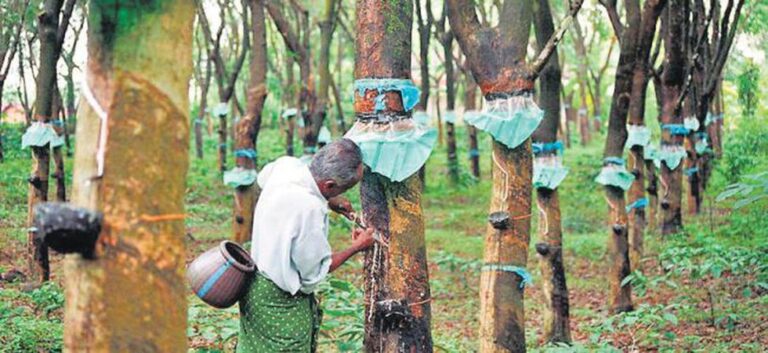
October 19, Colombo (LNW): Sri Lanka has embarked on an ambitious nationwide initiative to digitally map all rubber cultivation areas using cutting-edge Geographic Information System (GIS) technology.
The effort, jointly spearheaded by the Rubber Development Department and the Department of Survey, aims to ensure the country’s rubber industry meets emerging international environmental standards—particularly new European Union regulations targeting deforestation.
With global scrutiny increasing over the environmental impact of agricultural supply chains, the European Union has introduced strict import controls to curb the trade of goods linked to deforestation.
Under these rules, exporters of rubber and rubber-based materials must now demonstrate that their products are not sourced from ecologically sensitive or illegally cleared land. Accurate mapping and transparent data are essential to proving such compliance.
In response, Sri Lanka’s rubber authorities have initiated a detailed mapping programme that will geolocate every smallholder rubber plantation across the country. The Ministry of Plantations and Community Infrastructure confirmed that the data collection process is expected to be completed by 2025, creating a comprehensive digital inventory of rubber-growing regions.
Once a rubber holding is verified and mapped, the Rubber Development Department will issue a unique QR code to the registered farmer, at no cost. This digital tag will serve as a proof of origin, linking each batch of rubber to a verified location.
Farmers will be expected to present this QR code to buyers or intermediaries during transactions, helping to streamline supply chain traceability and support exporters in fulfilling EU requirements.
Officials have stressed the importance of cooperation from small-scale estate owners during the field verification stage. When teams from the Survey Department and the Rubber Development Department arrive to conduct site assessments, landowners will need to be present and prepared with relevant documentation.
This includes the rubber planting licence, land deeds, and detailed land plans—all of which are necessary for accurate geotagging and official recognition.
Authorities believe that this modernisation of rubber land registration will not only enhance environmental accountability but also strengthen Sri Lanka’s competitiveness in the global rubber market, particularly at a time when sustainable sourcing is becoming a decisive factor in trade negotiations.
Sri Lanka Launches National Mapping Project to Certify Rubber Lands Using GIS Technology
Sri Lanka Moves to Pursue Athletes Who Vanished After 2022 Commonwealth Games

October 19, Colombo (LNW): Sri Lankan authorities have begun legal proceedings to track down a group of athletes and officials who failed to return home after participating in the 2022 Commonwealth Games in Birmingham. The government is now preparing to issue international arrest warrants through Interpol, a court in Colombo was informed on Friday.
The Chief Magistrate’s Court has imposed overseas travel restrictions on ten individuals suspected of remaining illegally in the United Kingdom after disappearing from the Games Village. According to the Offences Prevention Unit of the Sports Ministry, their unauthorised stay has led to an estimated financial loss of approximately LKR 50 million — roughly USD 150,000 — due to state-funded travel and accommodation costs.
Police Inspector Supun Vidanage, who is heading the inquiry, told the court that a total of 177 people formed Sri Lanka’s official delegation to the Games, including 116 athletes and over 60 support staff. Among them were representatives in boxing, judo, wrestling, and volleyball. Following the conclusion of the event, nine athletes, a team official, and a sports photographer reportedly went missing.
“These individuals left the Games Village during or shortly after the event and failed to return as scheduled,” Vidanage stated, adding that the next step involves securing domestic arrest warrants before moving to request Interpol red notices for their capture and extradition.
He stressed that formal court action is a necessary precursor to international cooperation through Interpol. Once warrants are issued locally, authorities will move forward with engaging global law enforcement channels.
The 2022 Commonwealth Games were held from late July to mid-August, during a period of deep economic and political instability in Sri Lanka. The nation had, by that time, declared itself bankrupt following a sovereign debt default and widespread public protests. Despite these challenges, Sri Lanka managed to secure a silver and a bronze medal, placing 31st in the final medal tally.
Legal proceedings are being carried out under the Prevention of Offences Relating to Sports Act, a legislative framework introduced in 2019 to address misconduct and corruption within the realm of sport.
The law enables the state to pursue those who violate agreements or cause undue financial or reputational harm to national sporting institutions.
Re-scrutinised Grade 5 Scholarship Exam Results Now Available Online
October 19, Colombo (LNW): Revised results for the 2025 Grade 5 Scholarship Examination have now been made accessible to the public, following a thorough re-evaluation process carried out by the Department of Examinations.
Parents and guardians wishing to check the updated scores can do so by visiting the department’s official websites—http://www.doenets.lk and http://www.results.exams.gov.lk.
To retrieve the results, users must enter the appropriate index number associated with the student.
This re-scrutiny was initiated after the initial results, released on September 04, 2025, prompted a number of appeals and queries regarding marking accuracy. The examination itself took place earlier in the year on August 10, with thousands of students across the country sitting for this highly competitive national assessment, which plays a crucial role in determining eligibility for scholarships and placement in prestigious schools.
Officials from the Department of Examinations have emphasised that the updated results reflect the most accurate and fair assessment of candidates’ performances. The re-marking process was conducted with heightened scrutiny to ensure full transparency and integrity.
Those seeking further information or clarification are encouraged to contact the department directly. Assistance is available via the 1911 hotline, or through the School Examinations Organisation and Results Branch at the following numbers: 011 2784208, 011 2784537, and 011 2785922. Queries may also be submitted via fax to 011 2784422.
Prime Minister Concludes High-Level Diplomatic Mission to India
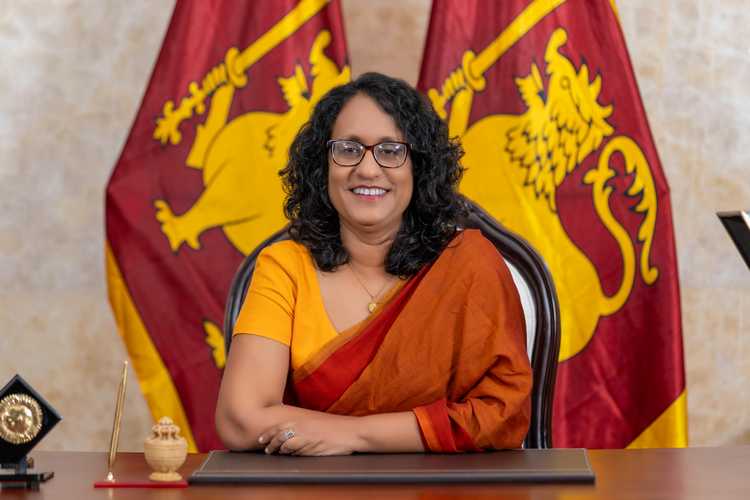
October 19, Colombo (LNW): Prime Minister Dr Harini Amarasuriya has concluded a multi-day official visit to India and returned to Sri Lanka, touching down at Bandaranaike International Airport in Katunayake late on the evening of October 18.
The Prime Minister embarked on the diplomatic mission on October 16 with the primary aim of deepening cooperation and enhancing bilateral ties between Sri Lanka and India—two nations bound by longstanding cultural, economic, and political ties.
The visit came at a critical juncture, as both countries continue to explore new avenues for regional collaboration and mutual development.
During her stay in New Delhi, Dr Amarasuriya engaged in a series of high-level meetings, most notably with Indian Prime Minister Narendra Modi. The two leaders are reported to have held wide-ranging discussions, covering trade, regional security, energy cooperation, and climate resilience. Sources close to the delegation suggest that both parties expressed a strong commitment to building upon existing agreements while exploring new frameworks for strategic partnership.
In addition to governmental engagements, Dr Amarasuriya also played a prominent role in the NDTV World Summit—an influential policy and media forum co-hosted by NDTV and the Chintan Research Foundation. As the keynote speaker, she addressed an audience comprising global policymakers, academics, and business leaders, highlighting the importance of regional solidarity, sustainable development, and digital inclusivity in the Global South.
Afternoon showers, thundershowers expected: Misty conditions likely to occur (Oct 19)

October 19, Colombo (LNW): Showers or thundershowers will occur at most parts of the island after 1.00 p.m., the Department of Meteorology said in its daily weather forecast today (19).
A few showers may occur in Southern province and in Colombo and Kaluthara districts in the morning too.
Misty conditions can be expected at some places in Sabaragamuwa, Central and Uva provinces during the morning.
The general public is kindly requested to take adequate precautions to minimise damages caused by lightning and temporary localised strong winds during thundershowers.
Marine Weather:
Condition of Rain:
Showers will occur in the sea areas off the coast extending from Colombo to Pottuvil via Galle and Hambantota.
Showers or thundershowers may occur at several places in the sea areas off the coast extending from Kankasanthurai to Pottuvil via Trincomalee and Batticaloa during the evening or night.
Winds:
Winds will be south-westerly or variable and wind speed will be (25-35) kmph.
Wind speed can increase up to 45 kmph at times in the sea areas off the coast extending from Matara to Pottuvil via Hambantota.
State of Sea:
The sea areas off the coast extending from Matara to Pottuvil via Hambantota will be moderate at times.
The other sea areas around the island will be slight.
Temporarily strong gusty winds and very rough seas can be expected during thundershowers.
DP Education Celebrates Its 6th Anniversary: Six Years of Transforming Sri Lanka’s Education Landscape

Sri Lanka’s leading online education platform, DP Education, celebrates its 6th anniversary today (October 18).
DP Education is a massive social initiative launched by the Dhammika and Priscilla Perera Foundation, funded by the country’s leading entrepreneur and philanthropist Dhammika Perera and his wife Priscilla Perera.
From preschool to Advanced Level, the platform offers students across the island the opportunity to study a wide range of essential subjects completely free of charge, taught by the best teachers in Sri Lanka through online learning.
The platform also covers Pirivena (monastic) education syllabi and focuses on vocational education. One of its most notable programs, DP Education IT Campus, aims to raise computer literacy among Sri Lankan youth and create a large number of employment opportunities in the information technology sector.
In addition, DP Education operates a language school that provides pathways to local and international employment opportunities. Students can learn multiple languages — including English, Japanese, and Italian — up to internationally recognized examination standards.
Beyond this, DP Education continues to implement numerous annual initiatives designed to elevate Sri Lanka’s education system to a global standard and make education more accessible and engaging for children across the nation.
Recognized both locally and internationally, DP Education marks its 6th anniversary as a proud milestone in its educational journey.
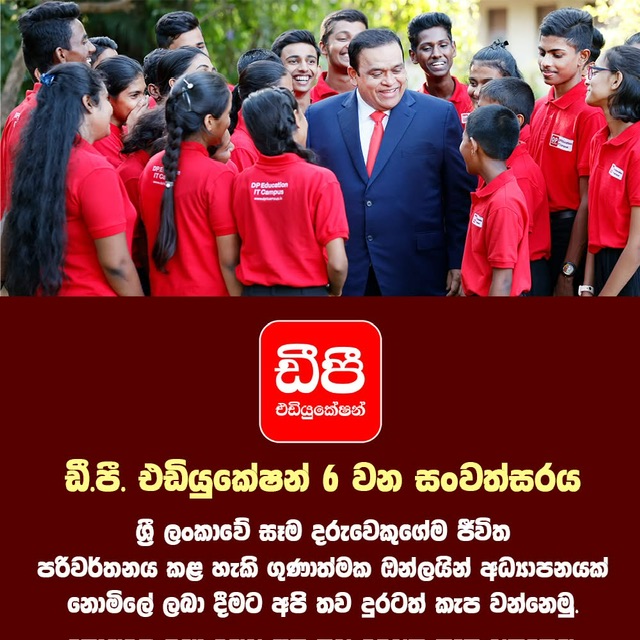
Below is a statement from Dhammika Perera, Co-Chairman of DP Education, marking this special occasion:
“As we celebrate six years of our educational mission today, we take great pride in the path we have traveled — providing quality education to every student in Sri Lanka.
When we began this initiative in 2019 with the vision of offering free, high-quality education equally to every child in Sri Lanka, we aimed to transform lives. By 2025, DP Education has become a powerful nationwide movement achieving that very goal.
This anniversary, marking our launch on October 18, 2019, is not just a reminder of our accomplishments, but a reaffirmation of our unwavering vision — to continue building a future generation equipped with knowledge and skills to lead the world.
Our strategic plan for the next five years (2025–2030) will further strengthen this mission.”
To learn more about the 2025–2030 strategic plan, visit:
https://drive.google.com/file/d/1oaYQozq5HZWsMRkS0W0lFQqlcJYwtI5P/view
Colombo Charts Bold Course to Become Blue Economy Hub

Sri Lanka is charting a new course for its post-crisis economic recovery this time, turning to the ocean. With a sweeping Blue Economy Vision 2030, the Government aims to transform the island into South Asia’s premier destination for ocean-based investment, capitalising on its strategic maritime position and rich marine resources.
Delivering the keynote at Marine Summit: Voyage Sri Lanka 2025 in Colombo, Labour and Economic Development Deputy Minister Dr. Anil Jayantha Fernando described the plan as a “bold, forward-looking vision” to unlock untapped potential in five key sectors: sustainable fisheries and aquaculture, marine biotechnology and pharmaceuticals, port development and maritime logistics, marine tourism and recreation, and offshore and renewable energy services.
“The oceans surrounding us are not just a resource they are the foundation of our future prosperity,” Dr. Fernando said, calling the initiative a cornerstone of Sri Lanka’s 2030 development agenda.
The strategy emphasizes both economic and environmental sustainability. Policy reforms are being implemented to streamline investor approvals, expand port and coastal infrastructure, and offer tax incentives for marine industries. The Government is also aligning these initiatives with the UN’s Sustainable Development Goal 14, “Life below Water,” to ensure long-term ecosystem balance.
Sri Lanka’s geographic position, straddling major East-West shipping routes, gives it a natural edge. With the expansion of the Colombo Port and the development of Hambantota and Trincomalee harbours, the country hopes to become a key logistics, bunkering, and ship-repair hub in the Indian Ocean.
“We sit at the crossroads of a trillion-dollar trade corridor,” Dr. Fernando said, underscoring the island’s potential to attract global maritime traffic and investment.
Beyond logistics, the plan highlights marine biotechnology and pharmaceuticals — areas where Sri Lanka’s marine biodiversity could support high-value industries such as bio-based medicine and cosmetics. Meanwhile, eco-tourism, diving, and coastal recreation will be integrated into the broader tourism strategy to diversify the sector.
Dr. Fernando also stressed the importance of environmental governance and skilled human capital. With an exclusive economic zone (EEZ) over seven times its landmass and a growing pool of maritime professionals, Sri Lanka aims to leverage both natural and human resources to secure long-term competitiveness.
The summit, organised by the Export Development Board (EDB), brought together global experts and investors, including representatives from the Asian Development Bank (ADB), International Maritime Organisation (IMO), and United Nations Development Programme (UNDP).
EDB Chairman Mangala Wijesinghe said the initiative marks a “turning point” for Sri Lanka’s marine economy. “By fostering innovation, sustainability, and international partnerships, we can make Sri Lanka the beating heart of South Asia’s Blue Economy,” he noted.
As the island nation rebuilds its economy, the Blue Economy Vision may be the compass that guides Sri Lanka toward a sustainable and globally competitive maritime future.
TRI Calls for Climate-Smart Farming, GI Branding in Sri Lanka Tea Sector
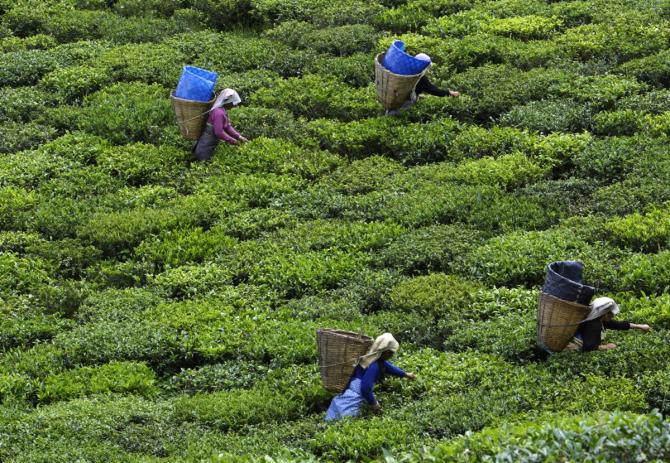
Sri Lanka’s tea industry, the lifeblood of its rural economy and a global symbol of national pride, is facing a defining moment. The Tea Research Institute (TRI) has called for sweeping reforms—blending climate adaptation with Geographical Indication (GI) certification—to safeguard the future of Ceylon Tea amid mounting environmental and market challenges.
Speaking at the “Perspectives on Geographical Indications in Sri Lanka” forum in Colombo, TRI Deputy Director of Research (Production) Dr. Shyamantha Bandara said the industry must urgently shift toward climate-smart and sustainable cultivation models. He warned that Sri Lanka, ranked among the world’s most climate-vulnerable nations, is already witnessing yield declines caused by erratic rainfall and rising temperatures.
“With nearly one million livelihoods tied to the tea sector, our future depends on innovation,” Dr. Bandara noted. Sri Lanka’s tea production, which reached about 262 million kilograms in 2024, must rise to 400 million kilograms to sustain export growth. However, he cautioned that achieving this goal requires modernised cultivation systems, advanced technology, and better soil and water management.
To adapt, the TRI is promoting shade management, improved irrigation systems, and intercropping methods such as tea-and-coconut cultivation. Dr. Bandara highlighted the potential of micro-irrigation a system successfully used in other tea-producing countries—to reduce water stress and ensure yield stability. He added that such methods should align with GI standards to strengthen sustainability credentials and market differentiation.
GI certification, which legally protects products linked to specific regions, has become a crucial strategy for global competitiveness. Following the success of Ceylon Cinnamon’s European Union (EU) GI recognition, the Tea Board and its French partners are working to secure similar protection for Ceylon Tea. “GI certification enhances traceability, prevents mislabelling, and ensures authenticity critical for maintaining trust in international markets,” Dr. Bandara explained.
He also pointed out that Sri Lanka’s tea production costs are among the highest globally, leaving limited room for price competition. Instead, the country must leverage quality and heritage through GI certification to justify premium pricing and strengthen its international reputation.
Dr. Bandara further called for institutional coordination to modernise certification frameworks and integrate digital traceability tools to meet global standards. “We must view GI as a bridge between our producers and global consumers, enhancing transparency and market access,” he said.
The Colombo forum, co-organised by the Sri Lanka Tea Board, the French Agricultural Research Centre for International Development (CIRAD), and the Institute of Policy Studies (IPS), concluded the Ceylon Tea GI project supported by the French Agency for Development.
As climate pressures intensify, the TRI’s message is clear: without urgent innovation and GI-backed sustainability, Sri Lanka’s world-famous tea risks losing its competitive edge in an increasingly uncertain global market.
Sri Lanka Weighs Risks and Rewards of INR Bond Move

India’s latest proposal to allow Sri Lankan entities to issue bonds in Indian Rupees (INR) marks a bold shift in regional financial diplomacy one that could redefine Sri Lanka’s access to credit while also raising questions over economic sovereignty and long-term fiscal risk.
Announced by Indian Deputy High Commissioner to Sri Lanka Dr. Satyanjal Pandey at the ‘Bridging Borders II’ dialogue in Colombo, the move aims to enable both government and private sector entities in Sri Lanka to raise capital through INR-denominated bonds. Dr. Pandey described it as a “long-term vision” built on “deepening trust” between the two neighbours.
The proposal’s appeal is clear. Issuing INR bonds would give Sri Lanka and its corporates access to a wider investor base in India the world’s fastest-growing major economy while reducing dependence on costly dollar borrowings. With the rupee gaining regional prominence and India’s bond market offering high liquidity, the initiative could help Colombo diversify funding channels, lower borrowing costs, and mitigate exchange rate risks that have plagued the country’s external debt.
Yet, beneath the optimism lie considerable complexities. India’s own capital account is not fully convertible, meaning cross-border issuance in INR would require significant regulatory reforms by the Reserve Bank of India. Dr. Pandey acknowledged these “steep challenges,” including potential rupee volatility and compliance constraints under India’s external commercial borrowing rules.
Critics in Colombo also warn that greater financial alignment with India may deepen dependency and limit policy autonomy. With nearly 65% of Sri Lanka’s trade already tied to India, further financial integration could make the economy more susceptible to rupee-driven shocks. Moreover, if rupee depreciation occurs, Sri Lankan issuers could face repayment risks similar to those triggered by dollar fluctuations in the past.
Still, the timing is strategic. Sri Lanka’s economy, emerging from its worst crisis in decades, has begun to stabilize recording 5% growth in 2024 and regaining modest investor confidence after successful debt restructuring. The IMF has repeatedly urged Colombo to broaden funding options while maintaining fiscal discipline, and the INR bond route could serve that purpose.
Dr. Pandey also hinted at broader regional implications, suggesting that India’s regulators consider allowing INR bond financing for sustainable and infrastructure projects across South Asia. He pointed to the GIFT City model where DFCC Bank has already raised US$8 million as a proof of concept.
As policymakers weigh the opportunity, the initiative stands as both a promise and a test: whether Sri Lanka can harness India’s growing financial clout to rebuild stability, without surrendering too much of its own economic independence.
IMF Stresses Fiscal Discipline Vital for Sri Lanka’s Recovery
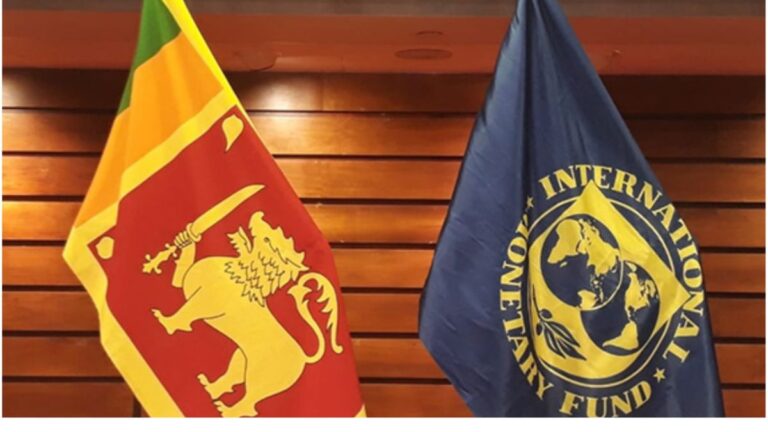
Sri Lanka’s economic recovery, while encouraging on paper, remains on a precarious footing as the International Monetary Fund (IMF) renews its call for deeper fiscal discipline and urgent State-owned enterprise (SOE) reforms. Despite visible progress under the Extended Fund Facility (EFF), the country continues to walk a fine line between stabilisation and slippage.
At the IMF’s latest Regional Economic Outlook briefing, Asia-Pacific Department Director Krishna Srinivasan and Deputy Director Thomas Helbling painted a cautiously optimistic picture. They noted that the economy, after contracting sharply in 2022, rebounded with a robust 5% GDP growth in 2024 and is projected to expand by around 4.2% in 2025. However, Sri Lanka’s potential growth remains capped at roughly 3%, signalling that without structural change, the recovery could quickly lose steam.
Helbling stressed that fiscal consolidation curbing the budget deficit and ensuring SOE viability—is central to sustaining this recovery. “Ensuring the financial viability of SOEs and mitigating fiscal risks will be crucial for sustaining these benefits,” he warned. The IMF’s advice comes amid mounting fiscal pressures: public debt remains above 120% of GDP, while interest payments consume nearly 40% of government revenue.
SOE reform remains one of the most politically and economically challenging fronts. Many state enterprises, including those in energy, transport, and utilities, continue to post significant losses, costing the Treasury billions each year. The IMF noted that reforms in cost-recovery pricing—particularly in electricity and fuel are ongoing, but warned that delays could reverse recent gains in macroeconomic stability.
Srinivasan commended Sri Lanka for making “significant progress compared to a few years ago,” but cautioned that the hardest part lies ahead. “The country has already done the difficult part by continuing with reforms, you will continue to see the benefits,” he said.
The Fund also emphasized the need for stronger institutional frameworks particularly in public investment management and fiscal transparency to prevent the re-emergence of governance weaknesses that contributed to the 2022 crisis.
As the Government faces growing social pressures from rising living costs and calls for increased public spending, maintaining fiscal restraint poses a political challenge. Any deviation from the IMF’s reform roadmap could risk disbursement delays or renewed market instability.
For now, the IMF remains supportive but firm: Sri Lanka’s fragile recovery hinges on consistent reform execution, disciplined budgeting, and political resolve. Without these, the country’s hard-won macroeconomic stability could once again be at risk