Home Blog Page 33

How Sunil Handunnetti Became a Political Joke

0


By Adolf

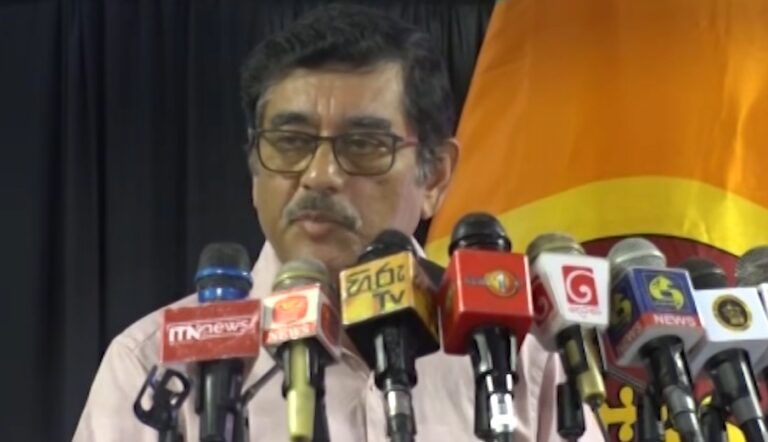
Sunil Handunnetti’s political journey is one of the most puzzling reversals in recent Sri Lankan politics. There was a time—not too long ago—when Sunil was widely respected across party lines, admired even by those who disagreed with him ideologically. During his tenure as Chairman of the Committee on Public Enterprises (COPE), he earned a reputation as a diligent, fearless parliamentarian who took his responsibilities seriously. In that role, he exposed waste, excesses, and blatant mismanagement across several state-owned enterprises. His work put immense pressure on SOEs to present their accounts on time and adhere to basic standards of financial discipline.

For many Sri Lankans, Sunil Handunnetti symbolized the rare possibility of principled politics. He often overshadowed even the more prominent figures of his party, including Anura Kumara Dissanayake. His investigative style, command over facts, and unrelenting pursuit of accountability made him a household name. When he lost his parliamentary seat in the 2020 General Election, many attributed the defeat to political maneuvering by the Rajapaksa camp, suggesting that his boldness in exposing corruption had made him a target. Public sentiment at the time leaned towards sympathy; people felt a genuinely capable parliamentarian had been unfairly ousted.


Five Years Later

Fast forward five years, and the contrast could not be more striking. Sunil Handunnetti’s performance at a prestigious platform like the Economic Forum left the country stunned, but for all the wrong reasons. His lack of preparation, poor articulation, confused arguments, and especially his struggle with English communication did irreversible damage to his credibility. Recently Sunil Handunnetti, as the Industries Minister, made a bizarre statement in claiming Sri Lanka won a Nobel prize for tea, a significant slip-up that was widely criticized.In an era when public expectations are higher and political leaders are under constant scrutiny, such a performance was not merely an embarrassment—it became a turning point in how he was perceived.


Political Joker

Within days, he became the target of ridicule on social media and in political circles. Memes circulated rapidly. Critics began comparing him to A.J. Ranasinghe, the former State Minister under President Premadasa who became known more for theatrics and comedic blunders than governance. The comparison, unthinkable a decade ago, reflects just how far Sunil’s stature has fallen. Today, every public appearance risks becoming another round of mockery. When he speaks, people brace for a gaffe; when he pauses, they expect a blunder. The transformation from a respected watchdog of public finance to a figure of political amusement has been swift and savage.

This episode should concern the JVP/NPP leadership. A movement that campaigned heavily on competence, discipline, and a promise to do things differently cannot afford leaders who appear unprepared or unserious. Even President Anura Kumara Dissanayake has begun facing growing criticism on social media for inconsistency, tone-deaf remarks, and ill-timed jokes. If the NPP fails to get its act together, they risk sliding down the same credibility trap that consumed the Gotabaya administration—rising to power with massive public trust, only to lose it through poor performance and communication failures. The public is closely evaluating how the government handles the ongoing cyclone disaster, and already accusations of incompetence are emerging. Sajith Premadasa telling the government to “hand over and go” reflects a growing narrative that the administration is losing control of public confidence. Sunil Handunnetti’s fall from grace is not just about one man. It is a warning to the entire government: competence is not optional, and credibility once lost is almost impossible to regain.

Sony International Issues Cease and Desist Notice on Sri Lankan Broadcaster

0

November 29, Colombo (LNW): Sony International has recently taken legal action in Sri Lanka by issuing a cease and desist letter to a local television channel over alleged intellectual property (IP) rights violations.

Sony International sent a formal legal notice, specifically a cease and desist letter, to a Sri Lankan television broadcaster.

Sony alleges that the channel is infringing upon its intellectual property rights through the production and transmission of a specific, unnamed programme. The show is reportedly a local adaptation of the “Who Wants to Be a Millionaire” format, which Sony Pictures Television has already licensed exclusively to a different Sri Lankan channel.

The notice demands the immediate termination of the disputed programme’s production and broadcast.

Consequences of Non-Compliance: Sony has warned that failure to comply with the demand will lead to the initiation of formal legal proceedings without further notice, including claims for substantial financial damages.

As of late November 2025, the local channel’s management is reportedly reviewing the notice and facing a potential crisis due to the significant investment already made in the programme – including head-hunting a leading broadcaster from a competitor channel, to head the new program which is at the epi centre of the Sony Cease and Desist notice

In the past, Sony Pictures has been involved in past disputes with Sri Lanka Cricket (SLC) regarding the transparency of media rights bidding processes.

In a separate commercial development, Sony LIV (Sony’s digital platform) recently partnered with Dialog Axiata PLC to offer content streaming services in Sri Lanka.

The State Banks: Is Financial Gain the Only Requirement?

0

By: Faraz Shauketaly

Sri Lanka’s two state banks recently published their financials. It wasn’t compelling reading, but it certainly stirred up a few questions – and honestly, they are all the Big Questions.

D B Wijetunga as Finance Minister, wanted to privatise the State Banks; Trade Unionist Rusiripala Tennekoon asked him why. A shocked Minister said, ‘because they are bankrupt’. The Trade Unionist wasn’t throwing the towel in, instead asking, ‘Who owns the banks?’. Minister Wijethunga must’ve thought he was dealing with a nincompoop. He responded, ‘the government’. And then it was time for Rusiripala to play the final card, “Is the government bankrupt?”. Of course, not they were not.

The long, tall and short was that the government caved in – writing an almost famous letter to Rusiripala, addressing him as ‘Dear President’. Minister was quite correct; he was writing to the President of the Trade Union! The letter assured the Trade Unions that there would be no sell-off, the workers’ rights would be intact and inter-alia that the banks would be recipients of even more capital.

Over thirty years later the two banks show a modest financial gain. Scrutiny of their results shows that the Bank of Ceylon had invested 64% in government bills and bonds and invested in state owned enterprises. Peoples’ Bank had just under 60%.

Investing in bills and bonds are very low risk and consequently rather mediocre returns. You get what you paid for. The higher the risk, the greater the gain. The downside is the opposite.

The Bank of Ceylon invested 64% on such a mixed portfolio – bills, bonds and investing in SOE’s. The Peoples’ Bank was slightly lower at 59%. In essence what this meant was the two state banks had very little to stir the economies in areas out of the Colombo City. With such a large amount swimming with the political masters, only a small percentage was available to help develop key areas of the economy – like farming for instance.

Sri Lanka is comfortable it appears, in its current economic size of approximately USD 99 Billion. It is by and large a trading economy. We would aver that to grow the economy one must expect to be somewhat committed and dynamic – and have a vision. That vision should be aiming at an economy at least USD 150 Billion in size. The way forward may well be a shift towards a production economy.

Like him or hate him, President Mahinda Rajapaksa did help the infrastructure with his roads and highways investments. He is no more in active politics and has no say in the decision-making process of this administration – in short it is up to the government of the day to muster the expertise and hire professionals who will be committed to the political direction. That direction must be towards a production economy.

The State Banks investments in government ‘stock’ is way too high. The banks are presently and have been used as de-facto mini treasuries. The banks must be able to reduce the level of reliance (investment) in bills, bonds and in State Owned Enterprises. Afterall there are very few SOE’s that turn around a profit, many are instead a constant drain on the government. In effect a burden on an already burdened people.

Instead, the State Banks must increase their exposure in the farming heartlands, working with professionals who would guide, assist and educate the farming heartland on quite how they can be successful – and that capital is available. Professionals must be deployed to attract foreign investments into the country. Any conceivable red tape must be dismantled and thrown in the nearest bin. Much of the rules and regulations in place enables corruption and capital flight. Corruption or large-scale ones at that appears to be rather moot now. Is this the calm before the storm?

Until Sri Lanka makes a committed decision to secure themselves an economy at or around the USD 140 – 150 billion mark, the country will merely trundle along; the State Banks must stop being in effect, ‘mini-treasuries’ and instead play a far more dynamic role in helping grow the economy.

The wish list is long and fraught with obstacles. But then no one ever said democracy is easy.

Police Launch Special Unit to Manage Flood and Storm Response

0

November 29, Colombo (LNW): In response to the recent extreme weather affecting the country, Sri Lanka Police have established an IGP Special Operations Unit to coordinate disaster response and provide timely information to the public. The severe conditions, including heavy rain, floods, strong winds, and landslides, have forced evacuations in several vulnerable regions.

The new unit, operating directly under the Inspector General of Police, is based at Police Headquarters and is tasked with ensuring rapid, coordinated action across the island. Local police stations have organised teams equipped with boats, diving gear, and other emergency resources to respond quickly to incidents in their areas.

Sri Lanka Police are working closely with the Tri-Forces and the Disaster Management Centre to support relief efforts, assist in evacuations, and maintain security in affected communities. Members of the public requiring assistance or wishing to report emergencies are encouraged to contact the IGP Special Operations Unit via dedicated landline and WhatsApp numbers, which have been made available for immediate use.

Western Province Warned of Possible Water Cuts as Kelani River Continues to Rise

0

November 29, Colombo (LNW): The National Water Supply and Drainage Board (NWSDB) has cautioned that the Western Province could face interruptions to its water supply if rising levels of the Kelani River force the Ambatale pumping station to cease operations.

Officials say the situation is being monitored closely as floodwaters continue to edge towards critical thresholds.

Engineer Chandana Bandara, the Board’s Chairman, advised residents to prepare for the possibility of temporary shortages. He recommended that households store extra water in advance, noting that conditions could change rapidly if the river swells further.

Cyclone ‘Ditwah’ Nearing Indian Coast as Sri Lanka Braces for Strong Winds and Heavy Rain

0

November 29, Colombo (LNW): The weather authorities have reported that Cyclonic Storm Ditwah was tracking just northwest of Trincomalee late on the night of November 28, positioned close to latitude 9.0°N and longitude 80.8°E. At the time of observation, the system was situated roughly 70 kilometres offshore and continuing to intensify.

Forecast models suggest the cyclone is expected to drift north–northwest, heading towards the Tamil Nadu coastline in India by 30 November. Although the system is moving away from Sri Lanka, its outer bands are still influencing local weather conditions, prompting officials to urge the public to follow updates from the Department of Meteorology closely.

Despite the lingering effects of the storm, meteorologists anticipate a noticeable reduction in widespread rainfall by tomorrow. However, intermittent showers and thunderstorms are still expected across the Northern, North-Central, Central, and North-Western provinces, with isolated areas potentially receiving more than 100 mm of rain.

Sabaragamuwa and the Western Province, along with Galle and Matara, may also see spells of rain or thunderstorms, with some locations likely to experience rainfall in excess of 50 mm. Other regions across the island could also witness scattered showers as conditions fluctuate.

In addition to the rain, strong winds remain a significant concern. Gusts of 60–70 km/h, occasionally strengthening to nearly 90 km/h, are possible in many parts of the country as the cyclone continues its passage.

Authorities have encouraged residents to take all necessary precautions, particularly in areas prone to flooding, falling trees, or structural damage, as the island weathers the storm’s trailing impact.

Officials Urge Residents Near Kelani River to Evacuate as Flood Threat Intensifies

0

November 29, Colombo (LNW): Deputy Minister Chathuranga Abeysinghe has raised fresh concerns over the number of families still choosing to remain in homes along the Kelani River, particularly in areas such as Kaduwela, Colombo, and Kolonnawa, despite the growing threat of severe flooding.

He cautioned that once the river begins to spill over further, evacuation becomes far more dangerous and at times impossible, stressing the importance of moving to safer ground without delay.

Authorities expect water levels to surge unpredictably throughout the night, prompting renewed calls for public cooperation. Several neighbourhoods in Kotte have also been identified as being at heightened risk, with officials warning residents to stay vigilant.

In response to the developing situation, the Kotte Divisional Secretariat has set up a dedicated Disaster Management Operations Centre, while seven temporary shelters have been prepared to accommodate those displaced.

These include community halls and schools in Obeysekarapura, Moragasmulla, Bandaranaikepura, and Rajagiriya. Police have been stationed at each site to maintain security and support orderly evacuations.

Grama Niladhari officers and local council members are working closely with relief teams to distribute meals, medical supplies, and other essentials to families already relocated. Discussions held earlier today brought together government and opposition figures, along with community leaders, to review the response strategy. Participants collectively agreed that the Divisional Secretariat would oversee the release of necessary funds, with the Municipal Council stepping in to meet additional costs.

The meeting was attended by Mayor Arosha Atapattu, MP Harsha de Silva, and representatives from across the political spectrum, who emphasised the need for unified action as the situation continues to evolve.

Flooding and Power Outages Trigger Major Telecom Disruptions Nationwide

0

November 29, Colombo (LNW): Telecommunications across several regions have been thrown into disarray after crucial fibre-optic lines were reportedly damaged in areas such as Kadugannawa and Wattala, the Digital Ministry confirmed.

The disruption has resulted in patchy or completely unavailable mobile and internet services in numerous districts, complicating communication at a time when many residents rely heavily on digital updates.

Officials say the situation has been worsened by widespread power cuts and persistent flooding, which have affected backup systems and made certain relay points inaccessible. Some communities have been left virtually cut off, with only limited connectivity available in higher-lying or less-affected areas.

Teams from the Ministry and major telecom providers are currently working under difficult and often hazardous conditions to mend the damaged infrastructure. Rising water levels, debris, and restricted access to key sites have slowed progress, though emergency crews are prioritising the most severely impacted zones.

Authorities have appealed to the public to remain understanding while repairs continue, stressing that full services will be restored as soon as weather and safety conditions permit.

Main Line Railway Services Suspended Amid Adverse Weather

0

November 29, Colombo (LNW): Railway authorities have suspended all scheduled Main Line services this morning after floodwaters swept across several stretches of track, particularly in the Daraluwa and Gampaha areas. The overnight deluge caused water levels to surge unexpectedly, leaving parts of the line submerged and posing a significant safety risk.

Engineering crews have already been sent to the affected locations to evaluate the damage and prepare for restoration work once conditions improve. However, officials caution that clearance can only begin when the water starts to drain away, and further disruptions are possible if rainfall continues.

Passengers have been urged to seek alternative means of travel until further notice, with the Railways Department emphasising that services will resume only after the tracks are inspected and declared secure for operation.

Thousands Moved to Safety as Kelani River Swells to Dangerous Levels

0

November 29, Colombo (LNW): Authorities in Colombo have relocated more than 6,000 residents to designated shelters this morning as the Kelani Ganga continues to rise, heightening the threat of widespread flooding across the district.

The Colombo District Secretary confirmed that over 1,200 families had been moved by 9 a.m., with officials working through the night to establish additional safe centres.

Latest situation reports indicate that nearly 100,000 people from more than 25,000 households have been affected in some way by the worsening conditions, with several low-lying communities already experiencing water encroachment.

Emergency services have urged the public to remain alert as conditions are expected to fluctuate throughout the day.

The Irrigation Department has warned that the river is edging closer to a critical stage. Water levels at the Nagalagam Street gauge reached approximately 6.4 feet earlier today—already classified as a major flood threshold.

Engineers say that if the river climbs beyond the 7-foot mark, the situation could escalate rapidly, prompting more evacuations and possible disruptions to essential services. Authorities are monitoring the river around the clock while urging residents in vulnerable areas to be prepared for sudden advisories.