August 11, Colombo (LNW): Several spells of light showers will occur in the Western, North-western and Sabaragamuwa provinces and in Nuwara-Eliya, Kandy, Galle and Matara districts, the Department of Meteorology said in its daily weather forecast today (11).
Showers or thundershowers may occur at a few places in Uva province and in Ampara and Batticaloa districts after 2.00 p.m.
The general public is kindly requested to take adequate precautions to minimise damages caused by temporary localised strong winds and lightning during thundershowers.
Marine Weather:
Condition of Rain: Showers are likely at a few places in the sea areas off the coast extending from Puttalam to Matara via Colombo and Galle.
Winds: Winds will be south-westerly and wind speed will be (30-40) kmph.
Wind speed can increase up to (50-55) kmph at times in the sea areas off the coast extending from Kalpitiya to Mullaittivu via Mannar and Kankasanthurai, and from Matara to Pottuvil via Hambantota.
State of Sea: The sea areas off the coast extending from Kalpitiya to Mullaittivu via Mannar and Kankasanthurai, and from Matara to Pottuvil via Hambantota may be rough at times.
August 10, Colombo (LNW): Sri Lanka has exceeded key fiscal benchmarks under its International Monetary Fund (IMF) program for June 2025, with robust tax revenue and restrained spending driving a much larger-than-expected primary budget surplus. However, analysts caution that recent monetary policy moves could undermine the country’s ability to sustain reserve accumulation and meet future targets.
Record Primary Surplus
The central government’s primary balance — revenue minus expenditure excluding interest payments — reached a surplus of Rs. 859 billion by June, far surpassing the IMF’s target of Rs. 130 billion. Such a large surplus reflects both strong tax collections and lower-than-expected capital spending.
While a primary surplus is rare in economies with low inflation and interest rates, in IMF-backed stabilization programs it becomes necessary as interest costs rise sharply following monetary tightening to restore currency stability. In Sri Lanka’s case, the adjustment has largely come from curbing non-interest spending, an area directly controlled by the government.
Observers note that past external debt problems partly stemmed from non-priority capital projects, such as large-scale government buildings, which contributed little to economic resilience. Moving forward, critical infrastructure maintenance — particularly rural roads — and investment in the electricity grid to handle renewable energy integration remain key priorities.
Strong Revenue Performance
Tax revenue up to June totaled Rs. 2,152 billion, well above the Rs. 1,650 billion IMF floor. The next test will be tougher: the September target is Rs. 2,750 billion, and the year-end goal is Rs. 4,350 billion.
A significant share of Sri Lanka’s fiscal intake comes from taxes on imported vehicles, which carry levies of over 200–300 percent. However, when the central bank lowers interest rates while injecting liquidity, import controls often restrict vehicle inflows to protect the balance of payments. This can erode revenue and force further monetary expansion, creating what some critics describe as a “cascading policy error” — higher deficits, more money printing, and renewed exchange rate pressures.
Reserve Risks and Monetary Policy
While Sri Lanka outperformed its March reserve accumulation target, part of the reported gross reserves stem from dollar-rupee swaps — short-term arrangements that create contingent liabilities and do not count toward IMF reserve metrics. Without a cap on the central bank’s domestic assets in the revised program, some analysts warn of a risk of missing reserve targets, especially if debt repayment needs rise.
Recent history has shown that premature rate cuts, particularly during strong credit growth and slow reserve build-up, have preceded currency instability — as in 2012, 2015–16, 2018, and 2019–22. Critics argue that maintaining a higher interest rate “buffer” is essential to sustain reserve accumulation under a stable exchange rate, even if it temporarily restrains growth.
For now, Sri Lanka’s fiscal overperformance provides a cushion in its IMF program. But with tougher revenue targets ahead and monetary easing already under way, policymakers face the challenge of balancing growth ambitions with the discipline needed to safeguard reserves and ensure debt sustainability.
August 10, Colombo (LNW): Visitors to Sri Lanka’s national parks can now purchase entry permits online, following the launch of a new digital ticketing system by the Department of Wildlife Conservation (DWC). The move aims to eliminate long queues and delays that have frustrated tourists, particularly during peak seasons.
The system went live today on the DWC’s official website, allowing both local and foreign visitors to check availability, reserve dates, and make secure online payments. Once booked, visitors receive a QR-coded permit, which can be scanned at park entrances for faster entry.
Kaudulla Delays Trigger Action
The launch follows heavy criticism yesterday, when large crowds at Kaudulla National Park endured long waits to buy tickets. Many tourists reported missing their scheduled safaris, while others abandoned plans altogether due to the delays. Kaudulla, famous for its elephant gatherings, sees peak visitation from July to September, making smooth entry vital.
DWC officials said the online system will help manage visitor flow by capping bookings to each park’s daily capacity and allowing tourists to plan trips in advance. It will also provide real-time data to improve staffing and resource allocation.
Rising Tourist Pressure
Sri Lanka’s national parks have experienced a surge in popularity in the past decade. In 2018 alone, over 1.1 million foreign and 1.6 million local tourists visited parks such as Yala, Udawalawe, Horton Plains, and Kaudulla, generating more than USD 11 million in tourism revenue.
However, overcrowding remains a significant concern. Studies show that 65% of all visits are concentrated in just four parks, leading to congestion, environmental damage, and negative visitor experiences. For example, Yala has been reported to host over 400 safari jeeps in a single day, causing traffic jams inside the reserve and disturbing wildlife.
Issues Beyond Ticketing
While online booking is expected to solve queuing problems, other challenges persist. Some parks, including Minneriya, still require visitors to collect physical tickets despite prior reservations. Inconsistent processes, poor waste management, and unethical practices—such as tour operators taking guests to areas outside park boundaries—have also been reported.
Tourism experts stress that technology alone will not resolve systemic issues. “E-ticketing is an important step, but sustainable visitor management, environmental protection, and service quality must go hand in hand,” said Dr. Perera, a wildlife tourism researcher.
How the System Works
Visitors can log on to the DWC website, select their preferred park and date, and pay via card. Once the park reaches capacity, booking automatically closes. The permit can be downloaded, reprinted, or confirmed by SMS before arrival, eliminating the need to wait at on-site counters.
Next Steps
Authorities plan to extend the system to all major national parks and integrate it with mobile payment platforms. The DWC is also reviewing visitor caps and park infrastructure to balance tourism growth with conservation.
For now, the online platform offers a welcome relief to travellers eager to explore Sri Lanka’s renowned wildlife without the frustration of ticket queues.
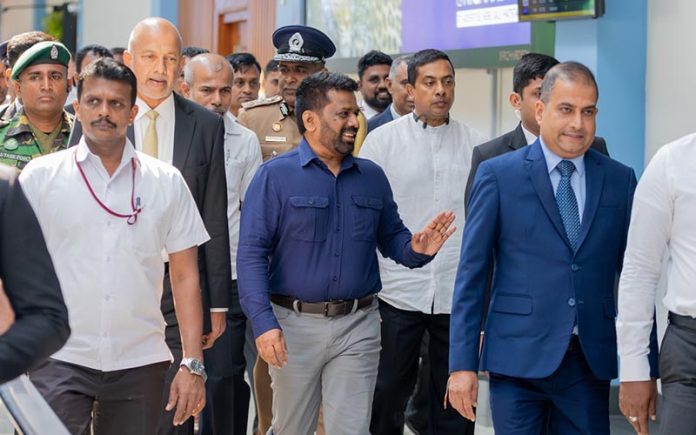
August 10, Colombo (LNW): President Anura Kumara Dissanayake is set to undertake two important overseas visits next month, reflecting Sri Lanka’s renewed diplomatic outreach and efforts to strengthen international partnerships.
The President will first travel to the United States to participate in the United Nations General Assembly (UNGA) in New York, before proceeding to Japan for a state visit and participation in a global expo.
According to Foreign Minister Vijitha Herath, the President is scheduled to depart for New York on September 23. During his visit, he is expected to deliver his inaugural address to the UN General Assembly on September 24, where he will outline his administration’s overarching policy framework—including key stances on foreign affairs, climate cooperation, and sustainable development.
In addition to his speech, President Dissanayake will engage in a series of bilateral meetings with heads of state and senior officials from various countries, aimed at fostering new avenues of cooperation.
Following his engagements in the United States, the President will travel to Osaka, Japan, on September 27 to attend Expo 2025. During the event, Sri Lanka will host a special segment titled “Sri Lanka Day,” intended to highlight the island’s rich cultural heritage, vibrant tourism sector, and diverse trade and investment potential.
The occasion will serve as a platform to promote Sri Lanka’s economic priorities and showcase the country’s attractiveness as a regional hub.
President Dissanayake’s official state visit to Japan will commence on September 28, following an invitation extended by Japanese Prime Minister Shigeru Ishiba. The visit is expected to include high-level discussions focused on economic cooperation, regional security, and technological collaboration, as well as renewed commitments in development assistance and infrastructure partnerships.
August 10, Colombo (LNW): Sri Lanka Customs has reported a record-breaking surge in revenue in 2025, even as it accelerates anti-corruption reforms and grapples with fresh misconduct allegations.
By August 1, the department had amassed Rs. 1,227 billion, with July alone contributing a historic Rs. 231 billion—driven largely by taxes on over 28,000 imported vehicles. This performance surpasses the annual revenue target of Rs. 2,115 billion by Rs. 116 billion
These fiscal gains come at a pivotal moment for Sri Lanka Customs, which is rolling out a sweeping reform programme aligned with the National Anti-Corruption Action Plan (NACAP) 2025–2029. Key measures include establishing an Internal Affairs Unit to investigate corruption complaints, embracing digitalised systems to minimize manual interventions and bringing in risk-based assessments to channel up to 80% of shipments through expedited “green lanes”.
Draft legislation empowering Customs with full control over goods entering and exiting Special Economic Zones (SEZs) is expected by end-October 2025
Transparency is also being enhanced through a new quarterly reporting mechanism, starting Q2 2025, where Customs will publish progress on digitisation and automation via the finance ministry’s website.
Trade unions have thrown their weight behind the reforms, signaling a collaborative shift in the department’s integrity culture.
Nevertheless, the department is under scrutiny for alleged malfeasance. Investigations by CIABOC (the Commission to Investigate Allegations of Bribery or Corruption) have been launched into fraudulent vehicle registrations and unauthorised container clearances. Among the probes is a case involving undervalued duties on ten BYD vehicles, and the suspected release of 312 containers without proper inspection?
In addition, CIABOC has seized 12 more illegally registered vehicles, following earlier seizures totaling 15, which had cost the government roughly Rs. 597 million
Sri Lanka Customs has publicly denied suggestions of impropriety surrounding the release of 323 containers in January 2025, stating the contents were industrial raw materials cleared under established risk-management protocols. A post-clearance audit overseen by a committee appointed by the Finance Ministry and the CID is currently underway.
Customs has achieved impressive revenue growth, exceeding targets through reforms and digitisation. But concurrent allegations—ranging from suspicious container releases to fraud in vehicle registration—highlight the urgency of the integrity measures being enacted. The department’s ability to sustain its financial gains hinges critically on the effective implementation of NACAP directives and transparency-enhancing tools.
August 10, Colombo (LNW): Sri Lanka should urgently develop a policy framework to promote the export of old and classic vehicles, turning a growing global demand into a revenue stream that can both revitalise the country’s automotive sector and reduce the burden of high import taxes on new vehicles, industry experts say.
Sajeev Kshathriya Rajaputhra, General Secretary of the Global Federation of Sri Lankan Business Council (GFSLBC), said exporting old vehicles at competitive prices could allow the government to use profits to lower taxes on new imports, phasing out outdated models and modernising the nation’s vehicle fleet.
“Currently, a 300% tax is imposed on imported vehicles, and the domestic resale market inflates prices to more than three times their original cost,” Rajaputhra noted. “If exporters were given permits allowing them to offset losses against duties on their next import, it would create a sustainable cycle—old vehicles go out, new vehicles come in.”
He pointed out that Sri Lanka, along with Ethiopia, is one of the few countries where a car can sell for more than its purchase price even after years of use, due to artificially inflated values. Over time, these vehicles deteriorate into scrap metal. “The price should reflect the true worth of a vehicle, not an artificially created premium,” he said.
The GFSLBC has proposed three steps to the government: granting it a clear mandate, establishing a global branch, and ensuring direct access to the President’s Secretariat to strengthen public-private collaboration. Rajaputhra stressed that Sri Lankan entrepreneurs abroad have the expertise to help drive economic growth if the government engages with them.
While old vehicle exports could help modernise the local market, experts say Sri Lanka is also missing a lucrative opportunity in the booming global trade of classic cars and motorcycles. Once seen as luxury toys for the wealthy, these vehicles have become high-performing investment assets in the US and Europe, outperforming bank deposits, art, coins, stamps, and even major stock indexes over the past decade.
A pioneer in the vintage car market explained that collectors and investors alike are drawn to the sector’s unique mix of aesthetic appeal and financial returns. “Classic cars are an investment you can enjoy while also using them as a currency hedge—they can be sold in markets offering the highest returns,” he said. Motorcycles, he added, have even greater export flexibility as they avoid left- or right-hand-drive restrictions and are easier to transport.
Condition plays a decisive role in value: well-maintained original vehicles can command a 50% premium over poorly restored ones. With restoration costs high, export markets pay top dollar for authentic, running-condition classics.Industry advocates believe Sri Lanka could develop both old and classic vehicle exports into a niche economic sector, bringing in foreign exchange, creating jobs, and giving local investors a foothold in a lucrative global market—while simultaneously refreshing the country’s aging vehicle fleet and easing the tax burden on new imports.
August 10, Colombo (LNW): Sri Lanka’s private sector credit expanded by an unprecedented Rs. 221 billion in June 2025, the highest monthly increase on record, according to official data. The surge, driven by a rebound in private investment, improved fiscal discipline, and the impact of a recent policy rate cut, has sparked optimism for stronger economic activity — but also renewed caution over potential financial stability risks.
The June expansion surpassed the previous record of Rs. 193 billion in December 2024. While December’s credit jump was largely due to short-term import financing that later reversed, analysts note that the latest rise reflects longer-term investment credit, which tends to sustain import demand and can strain foreign reserves if funded through central bank liquidity instead of real deposits.
Private Sector Leads Borrowing Boom
During the first half of 2025, private borrowings totaled Rs. 700 billion — outpacing central government borrowings (Rs. 178.4 billion) by a staggering Rs. 521 billion. In June alone, the government borrowed Rs. 98.3 billion from banks, reversing a Rs. 53 billion repayment in May, while state enterprises recorded a net repayment of Rs. 1.2 billion. The Central Bank also contracted its own credit by Rs. 51 billion.
The Central Bank’s deflationary stance and a stable exchange rate have been credited with creating a predictable environment for investment. Prices — including for construction materials — have remained stable or declined, boosting disposable incomes and enabling salary increases to be channeled into productive activity. Analysts note that, if the government maintains fiscal restraint and avoids non-priority capital spending, this stability could strengthen tax revenues and reduce budget deficits.
Warnings over ‘Late-Cycle’ Cuts
However, concerns have emerged over the recent policy rate reduction. Economists warn that similar late-cycle cuts in 2012, 2016, 2018, and 2019 — implemented amid a private credit upswing — ultimately triggered balance of payments stress, currency depreciation, increased foreign borrowing, and, in the lead-up to 2022, sovereign default.
June’s rate cut came at a time when banks were raising deposit rates, a move that could have moderated consumption while providing deposit-funded credit for imports. Instead, central bank liquidity injections — including swaps with domestic banks, where past-accumulated dollars are used as collateral — have supported rupee credit expansion. Analysts caution that such measures create contingent liabilities for the Central Bank and may erode net foreign assets if they reduce the Bank’s capacity to purchase dollars outright.
Balancing Growth and Stability
While the credit surge reflects a revival in domestic investment and consumption, analysts stress that this momentum is sustainable only if monetary and fiscal policy remain disciplined. Over-accommodation — described by some as the “dreaded” phase of economic cycles — risks undermining stability, repeating the policy errors that have led to past currency crises.
Bond sales, some argue, offer a safer tool for liquidity management, as interest costs can be rolled over without immediate cashflow strain, unlike private credit expansion funded by excess liquidity. The challenge now lies in ensuring that Sri Lanka’s record credit growth fuels long-term productivity — rather than another cycle of debt, reserve depletion, and economic instability.
August 10, Colombo (LNW): Sri Lanka’s gross official foreign reserves rose by 64 million US dollars in July 2025 to 6.14 billion dollars, Central Bank data show, marking a modest gain after months of stagnation.
However, concerns are mounting that recent interest rate cuts could undermine reserve accumulation and debt repayment capacity.
The latest figure remains below the 6.47 billion dollars recorded in October 2025. For the past nine months, the Central Bank has struggled to expand reserves, hampered by policy decisions and debt servicing obligations.
In late 2024, the bank’s strategy of injecting liquidity to maintain a single policy rate disrupted the interbank money market and contributed to foreign currency shortages.
At current interest rate levels, the Central Bank has been able to collect some dollars from the banking system, helped by halting inflationary open market operations. Still, a significant share of inflows is committed to external obligations.
The bank must supply foreign currency to the Finance Ministry for sovereign debt and interest payments, while also servicing its own liabilities—around 75 million dollars monthly to India—and repaying IMF loans from past crises.
Analysts warn these commitments leave little room for an independent monetary policy. Cutting rates to target inflation without considering reserve sustainability could edge the country closer to another sovereign default, they caution.
Reserve stability in recent months has partly relied on buy-sell swap arrangements, which provide short-term support but carry foreign exchange risk.
The Central Bank maintains that the rupee operates under a flexible exchange rate, yet depreciation pressures from rate cuts and liquidity injections could magnify losses.
Market swaps allow banks to issue loans without boosting rupee deposits, keeping deposit rates artificially low. According to economic analyst Bellwether, this could weaken the financial system’s ability to sustainably fund lending or government security purchases.
While gross reserves may appear steady under these swaps, net foreign reserves could decline—a reversal of the steady improvement seen even after October 2025, when rate cuts and open market operations slowed reserve growth.
In July, for instance, the Central Bank purchased 81 million dollars from the market under the current policy framework. However, nearly the entire amount—75 million dollars—was allocated to repay India before any funds could be directed to government debt servicing.
Economists have criticised the continued reliance on “flexible inflation targeting” and the belief that rates can be cut solely on the basis of past inflation trends.
They argue that such policies, coupled with currency depreciation and excess liquidity, contradict classical economic principles and risk long-term stability.
Sri Lanka’s exchange controls further complicate monetary management, creating “anchor conflicts” that intensify as economic growth and private credit rebound.
Analysts say the country’s high private savings rate could make exchange rate stability, reserve accumulation, and debt repayment far easier—if Parliament imposes tighter constitutional and operational constraints on discretionary monetary policy.
For now, the July reserve uptick offers limited comfort, with underlying vulnerabilities suggesting that without structural reforms, the improvement may prove short-lived.
August 10, Colombo (LNW): Residents in several areas of the Gampaha District are advised to prepare for a scheduled disruption to their water supply, as the National Water Supply and Drainage Board (NWSDB) has announced a 10-hour water cut set to take place tomorrow (11).
The temporary suspension of water services is due to essential maintenance work being carried out on the main transmission pipeline that connects Nittambuwa to Minuwangoda.
This pipeline is a crucial component of the Gampaha–Attanagalla–Minuwangoda Integrated Water Supply Scheme, and the maintenance is part of routine efforts to ensure its continued efficiency and safety.
According to the NWSDB, the water cut will be in effect from 10:00 a.m. until 8:00 p.m. and will impact a wide range of areas across the district. Key affected localities include Attanagalla, Pasyala, Bataliya, Ranpokunagama, and Nittambuwa.
Several smaller towns and residential zones within the network will also experience interruptions, including Kandahena, Mapagolla, Kongasdeniya, Pinnagollawatta, Kolawatta, Gorakadeniya, the Ranpokunagama Housing Scheme, Urapola, Dikkanda, Meevitigammana, Maimbula, Mathalana, Haggalla, Alawala, Kalalpitiya, and Ellamulla.
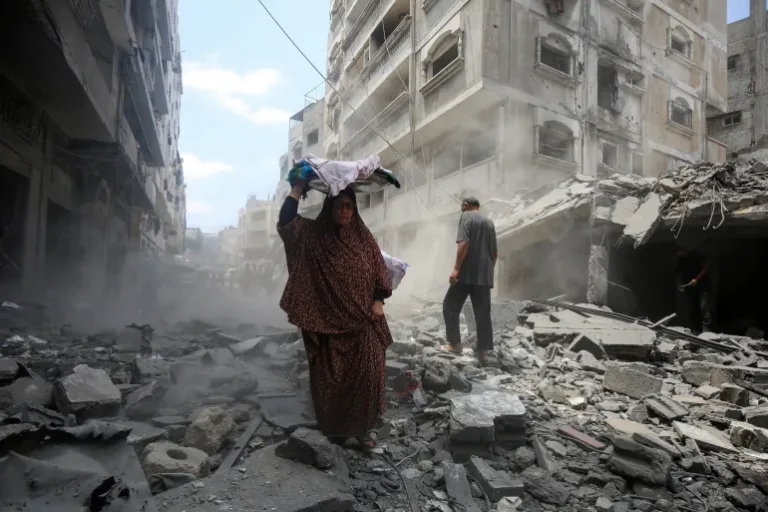
August 10, Colombo (LNW): Sri Lanka has voiced strong concern over Israel’s decision to intensify its military operations by taking control of Gaza City, warning that such action will only deepen the crisis in the region and worsen the already dire humanitarian conditions for civilians trapped in the conflict.
In an official statement issued by the Ministry of Foreign Affairs, Foreign Employment and Tourism, the government cautioned that the move could inflame tensions further and exacerbate instability across the Palestinian territories. The statement underscored the urgent need for restraint and renewed calls for an immediate ceasefire, reiterating Sri Lanka’s support for a negotiated settlement to the long-standing conflict.
The response follows the Israeli security cabinet’s recent approval of a plan to seize Gaza City, a decision that has provoked widespread condemnation from several nations and international organisations. Critics argue the move risks escalating the violence, further displacing civilians, and undermining the path toward a political solution.
Opposition Leader Sajith Premadasa also weighed in on the development, warning that Israel’s occupation of Gaza City would have lasting consequences beyond the immediate battlefield. In a statement posted on X, Premadasa said, “If Israel takes Gaza, it’s not just about land—it will shatter the trust that has kept alive the hope for a two-state solution. Countries that once stood united on this principle will begin to drift apart. And once that trust is broken, peace will become nearly impossible.”
His remarks echo growing global concern that a military-first approach could derail decades of diplomatic effort aimed at securing a viable, lasting peace between Israelis and Palestinians. With civilian casualties mounting and prospects for dialogue diminishing, Sri Lanka joined a chorus of voices urging both restraint and a return to negotiations grounded in international law and mutual recognition.