April 21, Colombo (LNW): Sri Lanka’s foreign reserve position experienced a significant uplift in March 2025, marking a notable improvement in the island’s external finances.
This development follows the receipt of a key disbursement from the International Monetary Fund (IMF), alongside the Central Bank’s active intervention in the domestic currency market.
New figures reveal that the country’s gross official reserves climbed by US$ 431 million during March, elevating the overall total to approximately US$ 6.52 billion.
A major share of this increase stemmed from the arrival of the fourth instalment under the IMF’s Extended Fund Facility—a financial support arrangement designed to stabilise Sri Lanka’s economy in the wake of its severe debt crisis.
The tranche, valued at around US$ 334 million, forms part of a broader US$ 2.9 billion stabilisation package expected to extend through to 2027.
In tandem with IMF support, the Central Bank of Sri Lanka (CBSL) continued its focused effort to strengthen reserves through foreign currency absorption. Over the course of March, the Bank acquired a significant US$ 401.9 million from domestic banking sources without engaging in any parallel sales, a strategy intended to carefully manage the appreciation trajectory of the Sri Lankan Rupee.
This is a sharp rise compared to the net acquisition of just US$ 70.3 million recorded in February. Altogether, foreign currency purchases for the first quarter of 2025 have amounted to US$ 484.5 million.
Authorities have clarified that such monetary operations are part of a calibrated strategy to shield the rupee from appreciating too rapidly, which could disrupt the competitiveness of Sri Lankan exports and remittances.
Despite the Central Bank’s efforts, the rupee has experienced a mild depreciation of 2 per cent against the US dollar since the beginning of the year.
As of April 17, the currency held steady at an average exchange rate of Rs. 298.71 to the dollar, unchanged from the previous week but notably stronger than the Rs. 300.24 observed in April 2024.
The recent improvement in reserve accumulation also reflects broader macroeconomic dynamics. Overseas remittances have surged to their second-highest monthly level in recent history, providing a welcome buffer to the country’s foreign exchange position.
At the same time, tourist inflows have remained strong, bolstered by renewed interest in Sri Lanka’s travel sector and improved international perception of the island’s post-crisis stability.
Meanwhile, export performance, though challenged by fluctuating global trade conditions and the threat of new tariff regimes from key partners like the United States, has remained largely resilient. Revenue from other services, particularly in sectors such as logistics, IT, and professional consulting, has further supported the external account.
Whilst near-term headwinds remain—including the prospect of tightening external credit markets and persistent fiscal vulnerabilities—Sri Lanka’s ability to build up its foreign currency reserves in early 2025 signals cautious optimism.
April 21, Colombo (LNW): At the close of 2024, Sri Lanka’s Employees’ Trust Fund (ETF) saw a notable rise in its financial standing, despite a strikingly low rate of active participation amongst its members.
Data released by the Central Bank of Sri Lanka (CBSL) reveal that of the 16.3 million member accounts registered under the ETF, only 2.3 million—just 14.11 per cent—were actively maintained during the year.
This low engagement rate did little to stifle the fund’s overall performance, which saw strong year-on-year expansion across several key indicators.
The ETF’s total asset base grew by 12.7 per cent, ending the year with a value of Rs. 591.3 billion.
The increase in contributions and returns suggests that whilst few members are actively engaging with their accounts, the fund’s long-term investments continue to yield considerable returns.
One of the most prominent signs of this upward trajectory was the increase in employer participation. The number of contributing employers rose from 74,927 in 2023 to 80,008 by the end of 2024, indicating a steady, if moderate, formalisation of employment and adherence to mandatory contributions.
Total member balances also expanded in step, growing by 11.9 per cent year-on-year to reach Rs. 564.3 billion. Contributions for the year totalled Rs. 42.0 billion, marking a 12.9 per cent rise.
However, the total amount disbursed to members in the form of superannuation benefits fell by 12.7 per cent, with only Rs. 33.4 billion paid out—raising questions about accessibility, awareness, or procedural hurdles that may limit withdrawals.
From an investment perspective, the fund remained heavily reliant on government securities, which accounted for an overwhelming 94.7 per cent of the total investment portfolio.
By the end of 2024, investments in government instruments stood at Rs. 550.5 billion, having increased by 14.7 per cent over the year. Overall, ETF investments grew to Rs. 581.1 billion, up 12.8 per cent from the previous year.
Despite the structural issues suggested by the dormancy of most accounts, the fund posted an 11.9 per cent return on investment for its members in 2024—an encouraging figure for the long-term health of the trust and for the value it offers to contributors.
Nevertheless, concerns remain regarding the disconnect between account activity and fund performance. Analysts argue that the high volume of inactive accounts reflects deeper systemic issues, such as job instability, gaps in enforcement, or insufficient financial literacy amongst workers regarding their retirement savings.
With only a fraction of the fund’s members actively engaged, questions are being raised about whether the fund’s growth is truly reflective of wider social security inclusion or merely the result of a small segment of compliant employers and account holders.
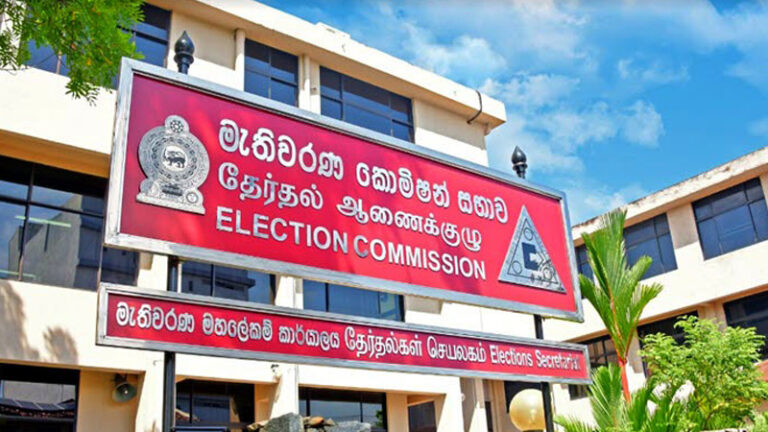
April 21, Colombo (LNW): Election-related grievances surged dramatically on April 19, with authorities registering 162 new complaints—marking the highest single-day figure recorded since the campaign period commenced on March 20.
The complaints, logged by 4.30 pm, reflect a mounting atmosphere of political unrest and intensifying contestation ahead of Sri Lanka’s Local Government elections.
A total of 1,874 complaints have been formally documented within the past month, according to figures released by the Election Commission.
These include a wide range of alleged legal violations, underscoring deepening concerns around the integrity and conduct of the electoral process at grassroots level.
The complaints have been channelled through two principal mechanisms established for monitoring and response. Of the overall tally, 145 cases were received by the National Centre for Election Complaint Management—tasked with centralised oversight of electoral irregularities—while a much larger share, 1,720 complaints, were reported at district-level centres across the island, reflecting the geographical spread of tensions.
Though most complaints relate to breaches of election laws—ranging from misuse of state resources and unauthorised propaganda to procedural violations—nine incidents of physical violence have also been reported, raising alarms about deteriorating conditions in the pre-election environment.
Election monitoring groups have expressed particular concern that such developments could escalate further as polling day nears.
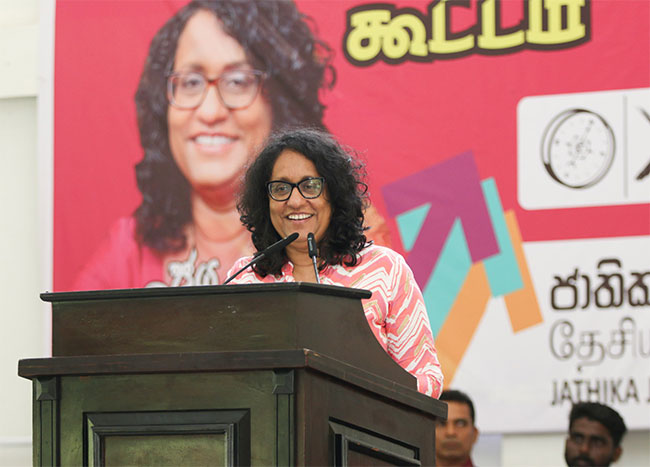
April 21, Colombo (LNW): Prime Minister Dr Harini Amarasuriya unveiled plans to introduce far-reaching reforms intended to eliminate longstanding disparities between schools nationwide.
The initiative, earmarked for implementation in 2026, will serve as a central pillar of the government’s broader vision for educational transformation.
Speaking at a public meeting held at the Irattaperiyakulam Town Hall in the Vanni District, the Prime Minister outlined her government’s commitment to reshaping the educational landscape in a way that prioritises equality, inclusion, and long-term empowerment.
The event drew a large audience, including local parliamentarians and members of the National People’s Power (NPP) movement, which leads the current administration.
A cornerstone of the proposed reform is a commitment to guarantee all children across the country access to thirteen uninterrupted years of education. The move is designed to close the gap between urban and rural schools, and between students of differing socio-economic backgrounds.
The Prime Minister emphasised that the new system will depart from a rigid, examination-heavy structure, making way for a curriculum that fosters broader development and cultivates essential life skills.
Dr Amarasuriya highlighted that the upcoming national budget has earmarked the largest-ever allocation for education in Sri Lanka’s post-independence history. This investment, she stated, reflects the government’s understanding that a meaningful transformation of the sector requires changes at every level—from pedagogy and curriculum design to infrastructure and teacher training.
To support this transition, the Prime Minister announced plans to revamp the country’s teacher education institutions. Particular attention is being paid to the improvement of teacher training standards and the upgrade of physical infrastructure at training colleges.
As part of this effort, a Sinhala-medium teacher training college in Vavuniya District, which had been dormant for several years, is to be rehabilitated and reopened using newly allocated budgetary funds.
Dr Amarasuriya stressed that the reform programme is not just an administrative undertaking, but a moral obligation to future generations. She explained that the vision underpinning the project is to build an education system capable of equipping students not only with academic knowledge but with resilience, critical thinking, and a strong ethical foundation.
The objective, she said, is to ensure that education becomes a force for empowerment rather than exclusion.
The public meeting also saw the participation of Deputy Minister of Co-operative Development Upali Samarasinghe, along with Vavuniya District MPs S. Thilakanathan and M. Jegatheeswaran. Several NPP candidates for local government seats and members of the public were present to hear first-hand about the government’s ambitions for the education sector.
April 21, Colombo (LNW): A profound gesture of recognition has come from the Vatican, as 167 Sri Lankan Catholics who perished in the coordinated Easter Sunday bombings of 2019 have been formally honoured as martyrs.
The announcement was made by the Archbishop of Colombo, His Eminence Cardinal Malcolm Ranjith, during a poignant ceremony held to mark six years since the devastating attacks.
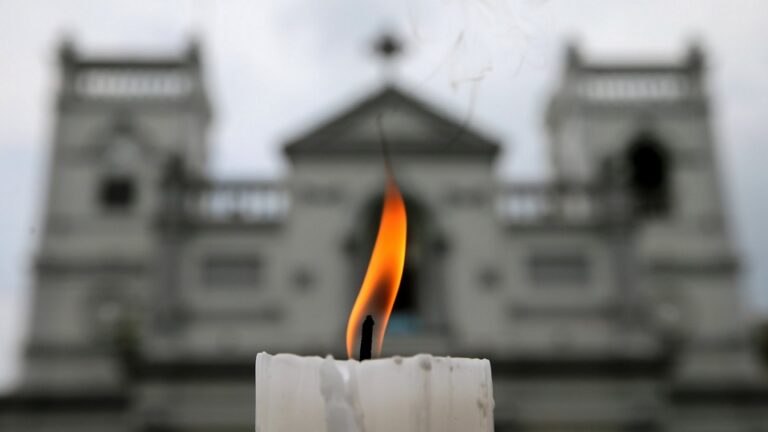
The victims, who died during services at St. Anthony’s Shrine in Kochchikade and St. Sebastian’s Church in Katuwapitiya, have now been officially inscribed in the Catalogue of the Witnesses of the Faith by the Dicastery for the Causes of Saints—a body within the Roman Curia responsible for the canonisation process and recognising those who have died for their beliefs.
The acknowledgment designates the deceased as Heroes of Faith, a deeply meaningful designation within the Catholic tradition that highlights both the brutality of the event and the spiritual endurance of those who were targeted.
This declaration comes as Sri Lanka continues to grapple with the aftermath of one of its darkest days, when multiple suicide bombings on April 21, 2019 claimed the lives of more than 260 people and injured hundreds more across several locations, including churches and luxury hotels.
The attacks, orchestrated by a local Islamist extremist group with alleged international links, sent shockwaves through the nation and provoked a global outcry.
Speaking at the memorial mass held at St. Anthony’s Shrine—one of the two churches directly affected by the blasts—Cardinal Ranjith said the Vatican’s recognition is not only a spiritual tribute but also a call to the wider world to remember the victims not merely as casualties, but as individuals who died upholding their faith in the face of senseless violence.
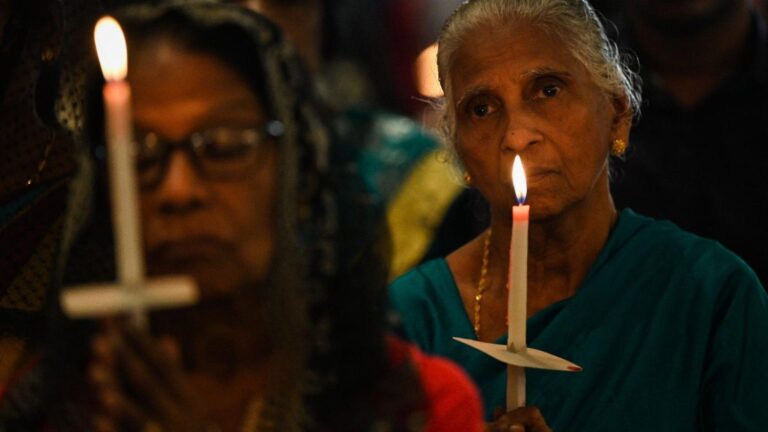
The Archbishop presided over the solemn service, attended by grieving families, members of the clergy, and a wide cross-section of the public. As prayers were offered and candles lit, there was a prevailing atmosphere of reflection, reverence, and quiet resilience.
Mourners were not only honouring those who died but also renewing their calls for truth, accountability, and justice—demands that have echoed for years amid widespread criticism of investigative delays and political inertia.
Cardinal Ranjith has remained a vocal critic of successive governments for what he describes as an inadequate response to the tragedy and an apparent reluctance to pursue justice for those affected.
On numerous occasions, he has insisted that the true masterminds behind the attacks remain unidentified and that the pursuit of justice has been clouded by political interference and bureaucratic apathy.
The Vatican’s recognition, therefore, carries not only spiritual significance but also a symbolic reminder of the global Church’s solidarity with Sri Lanka’s Christian community.
By acknowledging the victims as martyrs, the Holy See reinforces a narrative of faith enduring in the face of terror—an affirmation many survivors and relatives have clung to amid a continuing struggle for closure.
April 21, Colombo (LNW): Six years have passed since the morning of April 21, 2019, when Sri Lanka was shaken to its core by a series of coordinated bombings that tore through churches and luxury hotels, claiming the lives of over 260 innocent people and injuring over 500 more.
As the country marks the sixth anniversary of the Easter Sunday attacks, memories remain painfully vivid, and the call for justice continues to echo across communities, transcending religious and ethnic boundaries.
The attacks, which targeted Catholic worshippers celebrating Easter Mass and foreign guests at high-end Colombo hotels, were carried out by a group of Islamist extremists affiliated with a local militant outfit.
Their actions shattered a decade of relative peace following the end of Sri Lanka’s brutal civil war in 2009. For many, it felt like history had cruelly repeated itself, replacing the hope of reconciliation with fear, uncertainty, and grief.
Time, whilst offering some solace, has not dulled the pain for the families who lost their loved ones in the carnage. Parents who lost children, spouses robbed of their partners, and survivors bearing both physical and psychological scars continue to navigate a world that changed forever in the space of a few minutes.
The wounds inflicted that day run deep, etched not only into personal lives but also into the collective conscience of the nation.
Every year since 2019, solemn memorials have been held in the affected churches—St. Sebastian’s Church in Negombo, St. Anthony’s Shrine in Kochchikade, and Zion Church in Batticaloa—where survivors, families of victims, and members of the clergy come together in prayer and remembrance.
The sight of flickering candles, photographs of the departed, and tearful tributes are stark reminders of what was lost. Though some survivors have found ways to rebuild, the scars of that dark morning are permanent.
Beyond the personal tragedies, questions surrounding accountability, justice, and prevention remain largely unanswered. Investigations and commissions were launched with promises of transparency and reform, yet many families and citizens feel betrayed by the lack of concrete outcomes.
Key findings have been mired in political wrangling, bureaucratic delays, and a perceived absence of will to prosecute those responsible for negligence. The perceived inaction has bred frustration, with victims’ families questioning whether the lessons of that day have truly been learned.
Religious leaders, particularly within the Catholic Church, have persistently called for justice and truth, demanding clarity about the lapses in intelligence that allowed the attacks to unfold despite prior warnings.
The Archbishop of Colombo, His Eminence Cardinal Malcolm Ranjith, a vocal advocate for accountability, has been unwavering in his calls for answers, representing not only his congregation but a broader national yearning for closure and truth.
Despite the pain, moments of unity have emerged. In the aftermath of the attacks, communities of all faiths and backgrounds stood together in solidarity. Buddhists, Hindus, Muslims, and Christians lit candles and held vigils side by side, determined not to let violence divide them.
It was a powerful statement against extremism—that Sri Lanka’s mosaic of faiths and ethnicities could coexist, even amidst profound sorrow.
This sixth anniversary is a poignant time for reflection—not only to remember the innocent lives lost but also to ask what kind of society Sri Lanka wishes to become.
“Are the lessons of Easter Sunday being translated into policies that safeguard pluralism, social cohesion, and security? Has the tragedy become a catalyst for change, or has it faded into the routine of political cycles?“
For many Sri Lankans, the memory of Easter Sunday remains not just a national tragedy, but a personal marker of grief, resilience, and unresolved pain. The need to remember is not merely ceremonial—it is essential to honour the victims, to demand justice, and to ensure that such horror is never repeated. Only through sustained reflection and honest reckoning can the country move towards healing.
As church bells ring once more across the island on this solemn day, they do so not only in mourning but as a call to conscience. Six years on, Sri Lanka stands at a crossroads—still bearing the weight of its sorrow, still demanding the truth, and still striving, however haltingly, toward peace.
April 21, Colombo (LNW): Showers or thundershowers will occur at several places in most parts of the island during the afternoon or night, the Department of Meteorology said in its daily weather forecast today (21).
Fairly heavy falls about 75 mm are likely at some places in Central, Sabaragamuwa and Uva provinces and in Hambantota, Ampara and Polonnaruwa districts.
Showers or thundershowers will occur in Western and Northern provinces and in Galle, Matara and Puttalam districts in the morning too.
The general public is kindly requested to take adequate precautions to minimise damages caused by temporary localised strong winds and lightning during thundershowers.
Misty conditions can be expected at some places in Central, Sabaragamuwa and Uva provinces and in Ampara district during the morning.
Marine Weather:
Condition of Rain:
Showers or thundershowers may occur at a few places in the sea areas off the coast extending from Puttalam to Matara via Colombo and Galle. Showers or thundershowers may occur at a few places in the other sea areas around the island during the evening or night.
Winds:
Winds will be south-westerly and wind speed will be (25-35)kmph. Wind speed can increase up to 45 kmph at times in the sea areas off the coast extending from Puttalam to Kankasanthurai via Mannar.
State of Sea:
The sea areas off the coasts extending fromPuttalam to Kankasanthurai via Mannar can be fairly rough at times. The other sea areas around the island can be slight to moderate. Temporarily strong gusty winds and very rough seas can be expected during thundershowers.
Johnnie Walker has unveiled Blue Label Ultra, a limited edition, first-of-its-kind, boundary-breaking innovation. Weighing just 180 grams, Johnnie Walker Blue Label Ultra is touted as the world’s lightest (70 cl) Scotch whisky glass bottle.
Johnnie Walker has unveiled Blue Label Ultra, a limited edition, first-of-its-kind, boundary-breaking innovation. Weighing just 180 grams, Johnnie Walker Blue Label Ultra is touted as the world’s lightest (70 cl) Scotch whisky glass bottle. Using new, patented glass technology developed by Diageo’s design team, this lighter and lower-carbon bottle embodies the future of luxury packaging, fusing sustainability with exceptional craftsmanship.
Born from a five-year journey in glass innovation, this milestone proves that premium packaging can be both luxurious and eco-conscious. In the course of its research, the brand has been granted a patent to encourage further progress in the industry. In a first for Diageo, a licence for the open-sourced patent will be offered on a royalty-free basis to anyone in the world who wishes to share in these discoveries.
Each bottle is filled with a specially blended liquid by Emma Walker, the Master Blender at Johnnie Walker, featuring whisky from legendary distilleries such as Oban, Brora, and Royal Lochnagar, as well as select ‘ghost whiskies’ from now-closed distilleries. The result is a unique liquid boasting the essence of fresh red berries, sweet vanilla, wood spice, toffee, and warming wood smoke.
To celebrate this milestone, Johnnie Walker has partnered with leading North American-based artists, designers, and the Corning Museum of Glass to further explore the future of design and sustainable innovation. These artists will create bespoke pieces inspired by the innovative glass technology behind Blue Label Ultra, extending the bottle’s spirit of craftsmanship into the broader world of design. Whether through drinking vessels, artistic interpretations, or groundbreaking applications, these commissioned works push the boundaries of lightweight glass, all in the name of progress.
Showcased designers include Amber Cowan, Objects of Common Interest, and Scott Newlin, each recognised for their distinctive contributions to contemporary design and material exploration. During NYCxDesign in May, the commissioned works will be unveiled at an exclusive exhibition hosted at the Cristina Grajales Gallery, a space dedicated to showcasing cutting-edge contemporary design.
“Johnnie Walker Blue Label Ultra was born out of a vision for the future of luxury, one that embraces lighter, sustainable, and innovative design without compromising craftsmanship,” said Jeremy Lindley, Global Design Director at Diageo. “Through our work with leading designers, we’re extending this philosophy beyond whisky packaging, collaborating with some of the most exciting designers to explore new creative frontiers.”
“With Blue Label Ultra, we are pushing the boundaries of design in the world of luxury, with Johnnie Walker at the intersection of artistry and sustainable packaging design,” said Jesse Damashek, SVP of Whisky at Diageo. “This release is a bold step forward, combining an extraordinary new blend with our most innovative bottle yet. Through many of our innovations with Johnnie Walker, it has remained a priority that we celebrate and collaborate with leading progressive creators around the globe.”
With only 888 bottles ever produced, the Johnnie Walker Blue Label Ultra release is an extraordinarily rare expression of whisky craftsmanship. Johnnie Walker Blue Label Ultra will launch in the North American market on May 1, with an SRP of $1,250.
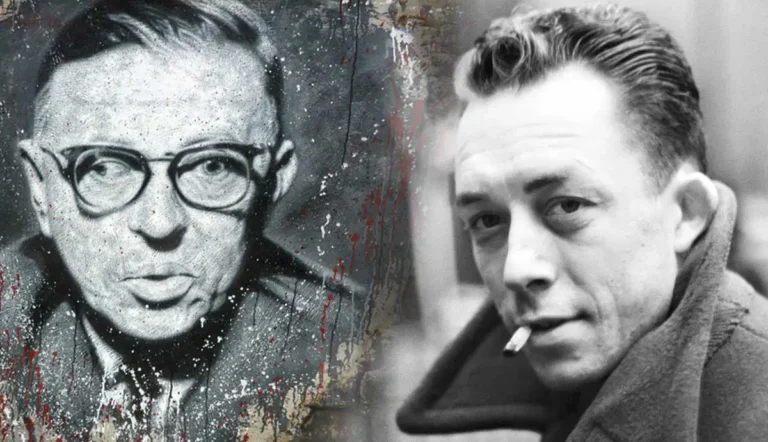
Existentialists Jean-Paul Sartre and Albert Camus were once friends, but differences between them ultimately ended their friendship.
Life in Europe in the first half of the twentieth century was unstable; wars, economic crises, a pandemic—it was hard not to feel humanity was facing one “existential crisis” after another. One philosophical response to this historical context was the philosophy of existentialism. There were shared themes explored by “existentialists,” but also important differences between them all. Jean-Paul Sartre and Albert Camus were no exception to this as the two began as friends examining similar inquiries, but they would eventually be led to different philosophical positions.
What Is Existentialism?
Photo of a sculpture by Alberto Giacometti, by Rino Porrovecchio, 2008. Source: Creative Commons
Existentialism is best understood not as a philosophical movement or tradition, per se, but rather as a group of thinkers approaching shared inquiries, particularly about human existence. While related inquiries date at least as far back as the Hellenistic philosophy of Stoicism, existentialism, as an exploration of a group of shared themes, is generally dated to begin in the nineteenth century with Søren Kierkegaard and Friedrich Nietzsche. All of these thinkers are united around exploring who we are and how we should live in response to the turbulent and seemingly foreboding forces of change sweeping Europe, which was especially during the time of Sartre and Camus in the first half of the twentieth century.
Biography of Jean-Paul Sartre
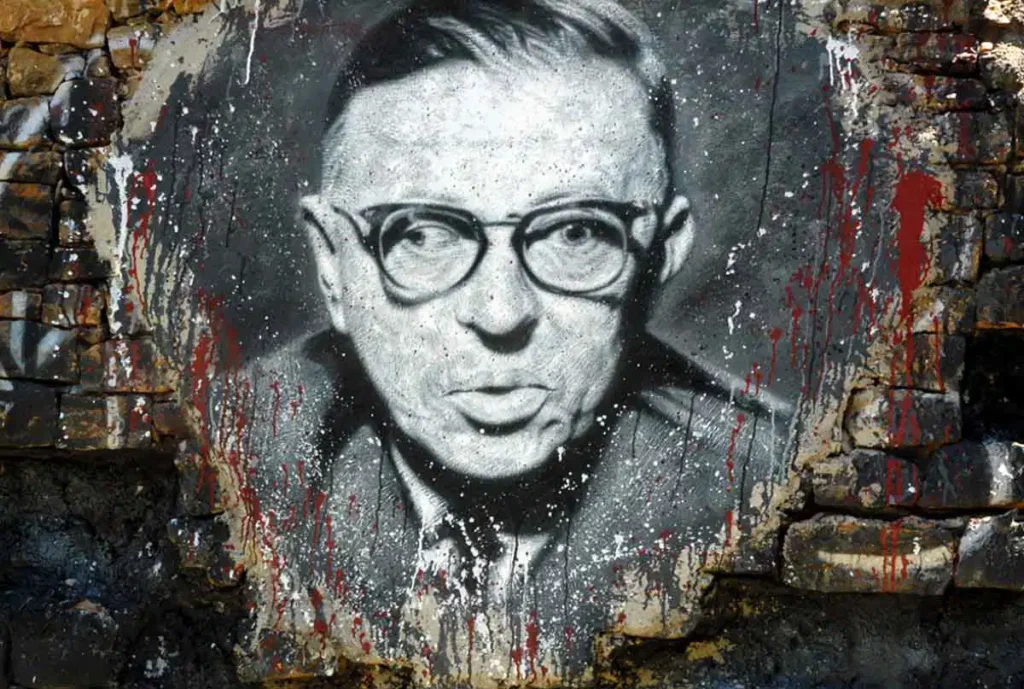
Painting of Jean-Paul Sartre, photo by Thierry Ehrmann, 2008. Source: Creative Commons
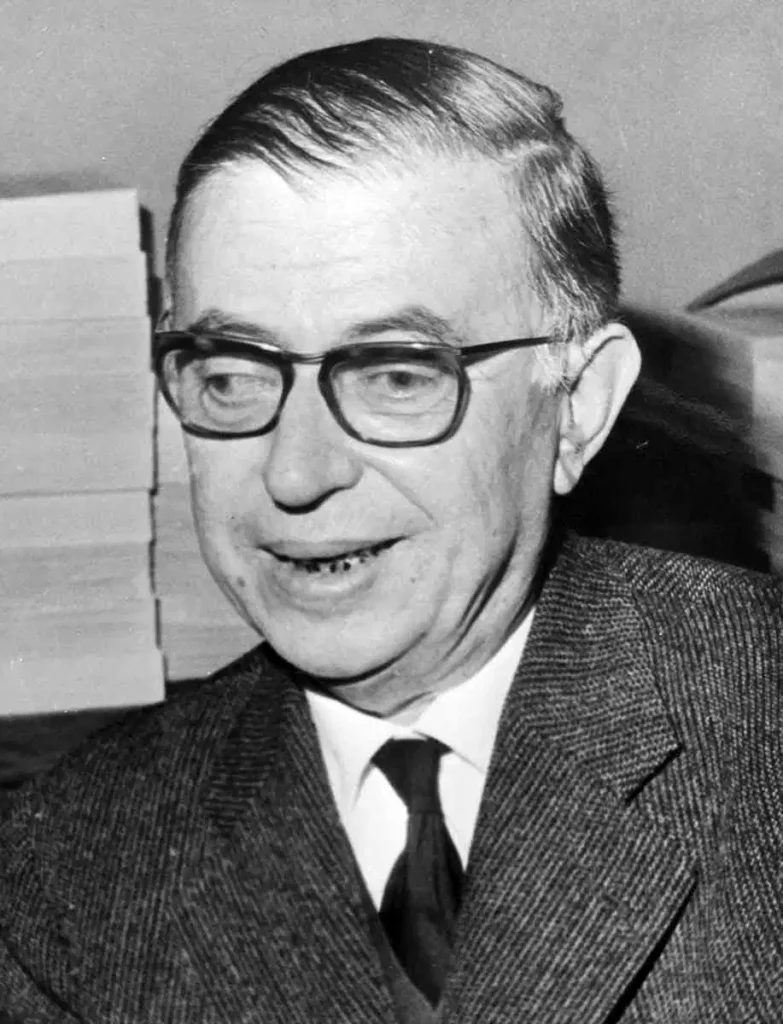
Jean-Paul Sartre was born in Paris and lived from 1905 to 1980. He described his childhood as “suffocating,” feeling quite alone with books upon spending a lot of time at home, being raised by his mother and grandparents upon the death of his father. But he would go on to pursue the study of philosophy, receiving his degree from the prestigious École Normale Supériore in Paris. He also studied in Germany, where he discovered the phenomenology of Husserl and Heidegger, which had a big impact on his subsequent philosophy.
During World War II, Sartre was captured by the Germans, and he relates that this was another time he had a deep exposure to Heidegger. Upon his return to Paris as a citizen, having pleaded poor health, he eventually joined the resistance movement—this is when he first met Albert Camus, as they initially shared political ideals, but they would eventually experience a great rupture that would lead to the end of their friendship.
Biography of Albert Camus
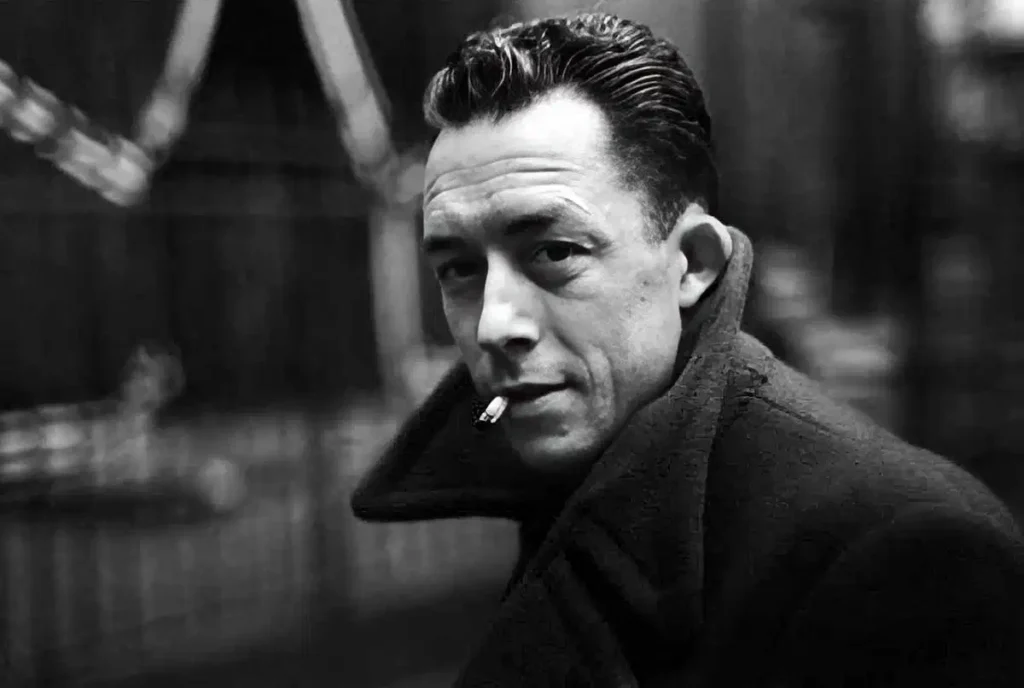
Photo of Albert Camus smoking, uploaded by DietrichLiao, 2008. Source: Creative Commons
Albert Camus was born in Algeria and died in France. He lived from 1913 to 1960. Both Sartre and Camus took on many roles in their writings; novelists, essayists, and playwrights, to mention some. Camus was raised in a poor working-class family, as opposed to the more middle-class lifestyle that Sarte experienced. They did share, however, being raised by their mothers and grandmothers upon the deaths of their fathers.
As an adult, Camus had a reputation as a womanizer; though he did not believe in marriage, he did marry twice, but he was known to commit adultery—in fact, it is believed that one of his wives attempted to commit suicide as a result of the consequent turmoil this caused her.
Growing up in French-occupied Algeria was a very different experience for Camus compared to Sartre, and this is part of what led to opposing political views—the main source of their disagreement. Sartre would come to advocate for communism as the ideal form of government and solution to the problems of his time, whereas Camus would be all the opposite as a staunch anti-communist.
Similarities Between Sartre and Camus
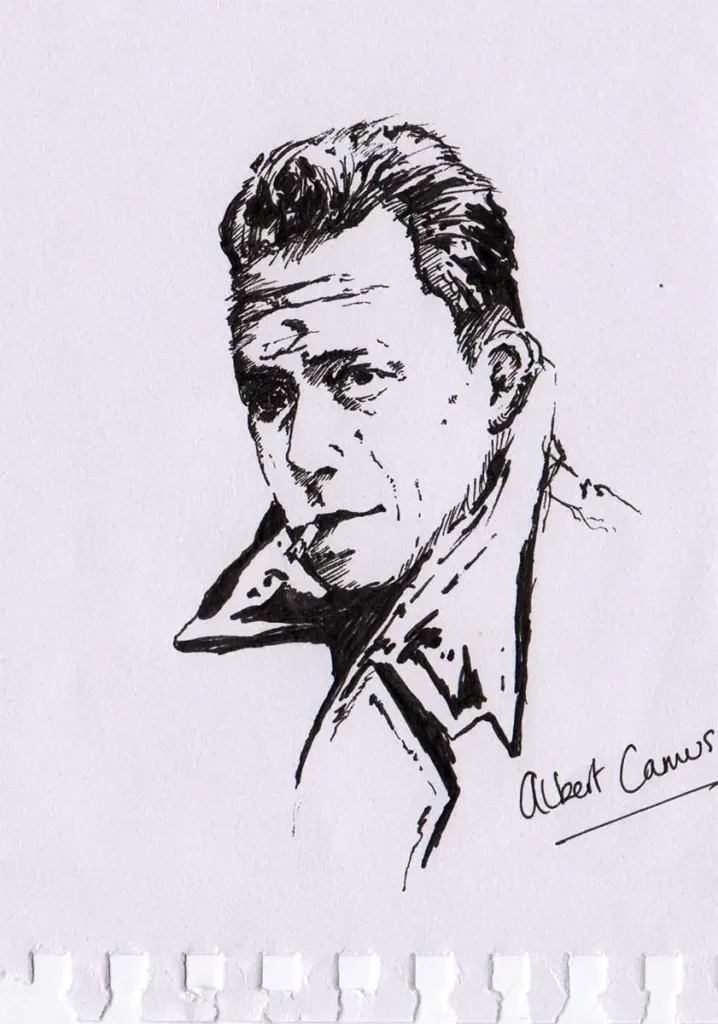
Drawing of Albert Camus, uploaded by SPDP, 2010. Source: Creative Commons
As with the others labeled “existentialists,” in his philosophy, Albert Camus was concerned with the lived situation of human beings. The direction he would take from here, however, was to focus on why it is absurd; thus, some consider his philosophy to be a “philosophy of the absurd” rather than “existentialism,” along with some other key reasons.
Atheism, Absurdity, and Nothingness
Image of “Nighthawks” by Edward Hopper, Bert Kaufmann, 2008. Source: Creative Commons
Both Sartre and Camus were atheists, which was an important foundation for their subsequent views. Both agreed that this gave human beings radical freedom. However, as we can see, Camus was not nearly as antagonistic toward religion as Sartre was. They both shared a relational view of human existence; that is, our existence is fundamentally lived through our relations with others. This can lead to a feeling of self-alienation that can be highly problematic. But as we will see, they differed on what the results of this were. Sartre argued that this is how human beings understand “nothingness,” whereas, for Camus, it is how humans introduce absurdity into the world.
For Sartre, “nothingness” is the gap introduced by our subjective consciousnesses to the objects in the world. This is what makes us radically free because it opens up a world of possibilities for seeing this distinction between the subjective and the objective. Our consciousness introduces nothingness into the world via the realization of possibilities because it is how we can see that there are things in the world and things that are not yet possible to be some time in the future. This is also manifested in how we relate to others; we see others as objects because we cannot directly experience their subjectivity, but we assume that they, too, have this subjectivity that introduces nothingness, possibility, and thus radical freedom into their lived situation.
For Camus, rather than nothingness, he argues that humans bring absurdity into the world when open to these possibilities; when human beings confront the world without any God to provide a deterministic reasoning and path, all that we are left with is a reality of the absurd. Life has no origins as a gift from divinity and, thus, is empty. It seems meaningless as there is no real point to anything we do, so to go on living is essentially “absurd.” We relate to the world and others via this absurdity.
Liberation Through Pessimism
Photo of Sartre from 1965, by an unknown photographer. Source: Wikimedia Commons
While these views may both initially sound pessimistic, they are ultimately both meant to be liberating through their shared emphasis on radical freedom; there is no fixed essence to what it means to be human, and we are ultimately each free to create whatever kind of meaning and thus life we want. “Existence precedes essence,” Sartre famously declared. And for Camus, despite the absurdity of our human existence, there is also something very fulfilling about living with that reality—as in his famous example of Sisyphus, as the myth went, destined through punishment to eternally roll a boulder up a hill, only for it to fall back down for him to start all over, yet he still finds something meaningful in the way that he accepts his life as it is lived.
Differences Between Sartre and Camus
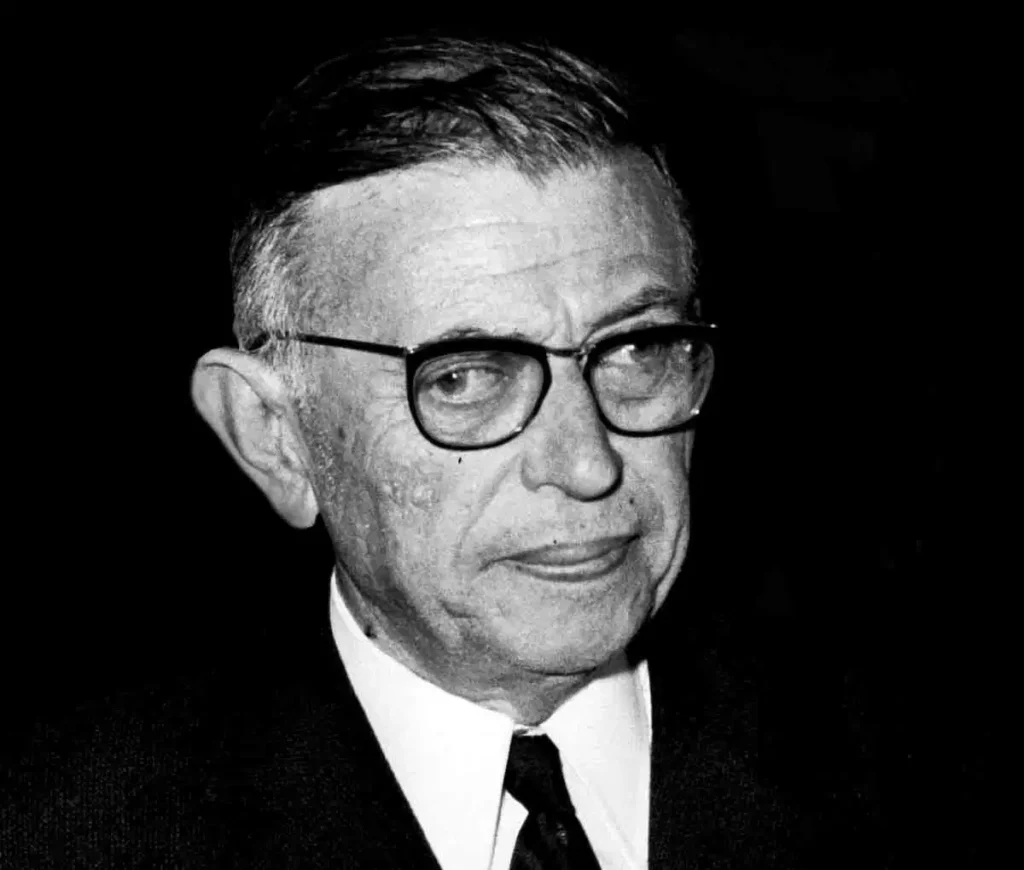
Photo of Sartre, by Moshe Milner, 1967. Source: Wikimedia Commons
While Sartre permitted the label “existentialist,” Camus did not; as noted, his was more categorized as a “philosophy of the absurd.” Thus, there was an important rift between their philosophies, but it was especially in their political views that they diverged. While such a tense break naturally had many moments that led up to it, some particularly key events created this rupture.
One of these was Camus’s publication of The Rebel where he explored his view that we should focus on the present and emphasize non-violence and open dialogue, rather than some utopian future as advocated for by Sartre. As a communist, Sartre sought to combine existentialism and Marxism, which he somewhat contradictorily saw as not deterministic but rather what best expressed the communal lived situation of humans at the time.
Sartre understood humans to be radically free, which conflicts with the Marxist teleological vision of a determined future. He shared the Marxist view that individuals were being stifled and suffocated; society limited what their natural, complete freedom was. As a group, then, capitalism results in “us” and “them” as oppressed “objects” and oppressing “subjects” respectively. However, as we are truly free, we can also come together as a group to revolt against this and liberate collectively—“nobody is free unless all are free,” Sartre declared.
Importance of Sartre and Camus in the History of Philosophy
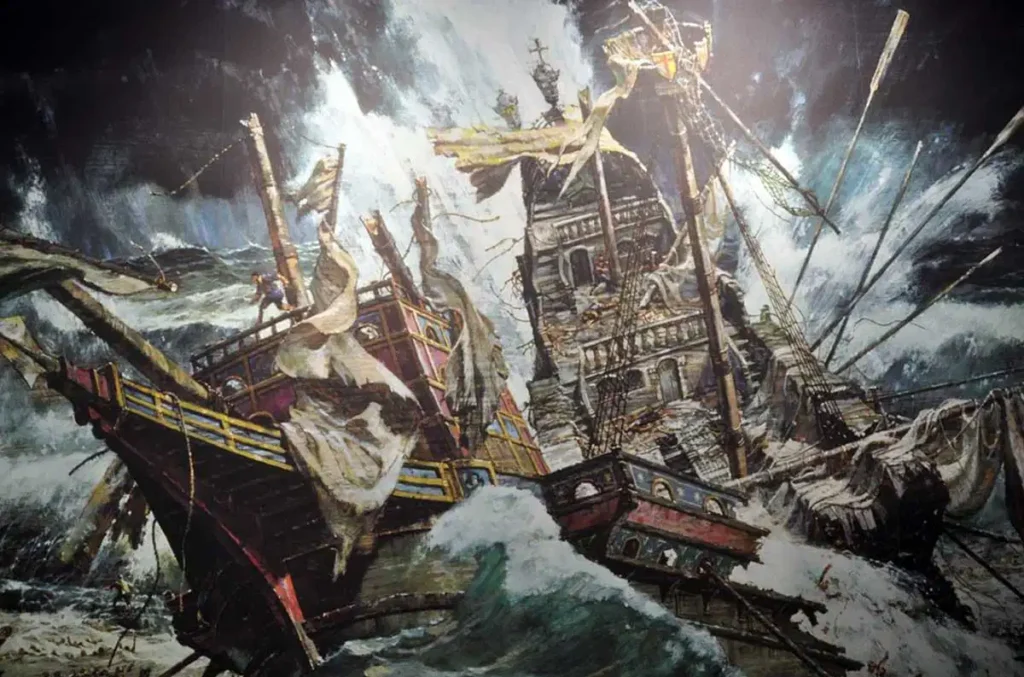
“Treasures from the Girona,” by Kenneth Riley, 1969. Source: Wikimedia Commons
Despite these key differences between Sartre and Camus, among others, and despite the general critiques that can be raised against them both, they made important contributions to the long conversation that is the history of philosophy.
When Sartre died in 1980, there were said to be over 50,000 people who attended his funeral procession. Regardless of one’s level of familiarity with philosophy, many have heard the name “Jean-Paul Sartre.” In 1964 he was awarded the Nobel Prize for Literature, but he refused it; consistent with his non-traditional views, as a writer he said he did not want to “be an institution.”
Albert Camus did, conversely, accept the Nobel Prize for Literature prior in 1957—he was the youngest French writer to ever be bestowed that honor. Camus died in 1960 in a car accident, which was also eerily related to his view on the seemingly meaningless nature of the human lived situation and experience. Our freedom is something very paradoxical for Camus; it seems to be an illusion, but seeing this also is somewhat liberating, bringing freedom back in the way we respond to this. We must live life in the moment as fully as we can, for we never know when death will come—just as lived by Camus.
It is generally critiqued that existentialism is too unanalytic and too focused on emotions and the darker side of the human experience. However, the existentialists were reacting against the modern condition that they saw as relying too heavily on science, arguing instead that science cannot fully understand the human experience. Science, they argued, dehumanized our lived situation by turning us into objects, which the existentialists wanted to overturn. What cannot be denied is the profound influence existentialist thought had on more than just subsequent philosophies but also psychology, literature, and art.
Marnie Binder (PhD Humankind and Thought in History)
April 20, Colombo (LNW): SriLankan Airlines has formally opened a bold front in its dealings with European aerospace giant Airbus, seeking a multi-faceted compensation package that could include a return of over US$ 23 million in pre-delivery payments and the free delivery of up to four state-of-the-art A330neo aircraft.
The move marks a dramatic turn in a relationship long plagued by controversy, unfulfilled agreements, and allegations of corruption.
The Colombo-based carrier’s demand for financial redress centres on its troubled acquisition of Airbus A330-300s and A350-900s, a procurement announced in 2013 that never fully materialised. Whilst six A330-300s were eventually delivered—mostly through the intervention of third-party lessors—the A350-900 component of the order failed to come to fruition.
The airline now argues that this incomplete arrangement, coupled with mismanagement and alleged irregularities during the initial negotiation process, justifies extensive reparations.
At the heart of SriLankan Airlines’ assertive stance is its new Chairman, who is reportedly spearheading a push to recoup losses from what he has described as an unjust and compromised procurement process.
The carrier is not only demanding reimbursement of US$ 23.3 million in earlier payments but also expects Airbus to provide a fleet of A330neo aircraft without charge—an extraordinary request in a highly competitive global market.
In total, the compensation being sought exceeds US$ 200 million, a figure that has reverberated throughout the aviation sector. Industry insiders note that whilst aircraft manufacturers occasionally offer rebates or financial adjustments to preserve relationships, such high-stake demands—particularly those involving the no-cost provision of wide-body jets—are rare.
The airline’s aggressive push for redress is deeply rooted in a broader effort to distance itself from a legacy of political interference and questionable dealings. Previous investigations into SriLankan Airlines revealed a culture of financial misconduct, including instances where senior figures allegedly accepted kickbacks in return for purchasing aircraft at significantly inflated prices, bypassing the bulk discounts typically afforded to major carriers.
These historical burdens continue to shape the airline’s present-day struggles. The CEO position remains vacant, and internal leadership instability has become a hallmark of the organisation.
Moreover, the company’s deteriorating operational capacity has coincided with broader national political unrest, adding further strain to an airline already grappling with structural inefficiencies and mounting debt.
In parallel with its negotiations with Airbus, SriLankan Airlines is also pursuing discussions with Rolls-Royce, the engine manufacturer implicated in the original procurement saga.
The airline suggests that engine-related shortcomings contributed to the underperformance of the previous fleet, and it is now exploring avenues for restitution on that front as well.
Airbus, for its part, has remained tight-lipped on the ongoing deliberations. The manufacturer is said to be weighing its options carefully, conscious of both reputational risks and the precedent any concession might set.
Whilst Airbus has, in the past, been entangled in legal disputes with other airlines over similar allegations, SriLankan’s demands—particularly the insistence on free aircraft—could test the boundaries of customary industry settlement norms.
As SriLankan Airlines attempts to rehabilitate its image and restructure its operations, securing meaningful compensation from its former suppliers is seen as essential to rebuilding both finances and credibility.
However, with deep scars from years of mismanagement and a history of politically driven decision-making, the path to resolution may yet prove arduous.





/spiritz/media/media_files/2025/04/19/IE7MjlDt5BZUQrukseOC.png) To celebrate this milestone, Johnnie Walker has partnered with leading North American-based artists, designers, and the Corning Museum of Glass to further explore the future of design and sustainable innovation. These artists will create bespoke pieces inspired by the innovative glass technology behind Blue Label Ultra, extending the bottle’s spirit of craftsmanship into the broader world of design. Whether through drinking vessels, artistic interpretations, or groundbreaking applications, these commissioned works push the boundaries of lightweight glass, all in the name of progress.
To celebrate this milestone, Johnnie Walker has partnered with leading North American-based artists, designers, and the Corning Museum of Glass to further explore the future of design and sustainable innovation. These artists will create bespoke pieces inspired by the innovative glass technology behind Blue Label Ultra, extending the bottle’s spirit of craftsmanship into the broader world of design. Whether through drinking vessels, artistic interpretations, or groundbreaking applications, these commissioned works push the boundaries of lightweight glass, all in the name of progress.