March 01, Colombo (LNW): The Embassy of Sri Lanka in Saudi Arabia has called on Sri Lankan citizens living in the Kingdom to exercise heightened vigilance as tensions continue to unfold across parts of the Middle East.
In a public advisory released this week, the mission encouraged nationals to remain calm but alert, and to depend exclusively on verified announcements issued by Saudi authorities and official diplomatic channels. The Embassy cautioned against being misled by speculation or unconfirmed reports circulating on social media.
Sri Lankans have been strongly urged to comply fully with any directives or security guidance issued by the Government of Saudi Arabia. They are also advised to stay in close contact with the Sri Lankan diplomatic offices in the country, including the Consulate General of Sri Lanka in Jeddah, should the need arise.
The notice further recommends avoiding travel to locations where security alerts are in force and discourages the sharing of unverified information that could create unnecessary alarm within the community. Citizens have been reminded to keep passports, residency permits and other identification documents readily accessible at all times in case of emergency checks or travel requirements.
To strengthen support services, the Embassy has activated round-the-clock emergency hotlines. Assistance can be sought by calling +966 54 947 7567 or +966 56 982 2700. For WhatsApp or IMO communication, individuals may contact +966 56 975 3380. Queries may also be directed via email to [email protected].
The mission reiterated its commitment to safeguarding the welfare of Sri Lankans in Saudi Arabia and stated that it will continue to monitor developments closely while issuing further updates as necessary.
Sri Lankan Mission in Riyadh Issues Safety Advisory to Nationals
Islandwide Drive Launched to Strengthen Fight Against Narcotics
March 01, Colombo (LNW): A week-long nationwide campaign aimed at tackling drug abuse and trafficking begins today (01), marking a renewed push by the Government to confront the country’s growing narcotics problem.
Branded as “National Drug Prevention Week”, the initiative runs alongside the broader “A Nation United” programme, a coordinated effort designed to eliminate the influence of illegal drugs from communities across the island.
The move to dedicate a special week to prevention and awareness was endorsed by the National Operations Council overseeing the flagship campaign.
In line with Public Administration Circular 29/2025, the Ministry of Public Administration, Provincial Councils, and Local Government has formally instructed state institutions to observe the week with targeted activities and outreach programmes.
Authorities say the campaign is not limited to enforcement alone. While law enforcement agencies will continue crackdowns on trafficking networks and illegal distribution, a strong emphasis will also be placed on rehabilitation and reintegration of those struggling with addiction. Officials stress that prevention, education and early intervention remain central to long-term success.
Throughout the week, government offices, schools and affiliated institutions will host seminars, workshops and awareness sessions. Teachers and students are among the key focus groups, with tailored educational materials being introduced to highlight the health, social and legal consequences of drug use.
Public messaging will also extend beyond classrooms and offices. Awareness material is set to be displayed on buses, three-wheelers and school transport vehicles, ensuring the campaign reaches commuters and local communities. Organisers say this multi-pronged approach is intended to spark open discussion and encourage families to engage more actively in prevention efforts.
Officials expressed confidence that sustained public engagement, combined with firm legal action and accessible rehabilitation services, will strengthen the country’s resolve to overcome the narcotics threat and build safer communities.
Government Sets Up Round-the-Clock Support Centre for Sri Lankans Amid Middle East Crisis
March 01, Colombo (LNW): Ministry of Foreign Affairs, Foreign Employment and Tourism has announced that it is keeping a close watch on the wellbeing of Sri Lankan citizens living in parts of the Middle East affected by the current escalation of hostilities.
In a statement issued yesterday, the Ministry said it is maintaining constant contact with Sri Lanka’s diplomatic missions across the region to assess developments and provide timely assistance where required. Officials noted that embassies and consulates have been instructed to remain on heightened alert and to extend all necessary support to nationals.
Sri Lankans residing in the impacted countries have been strongly advised to adhere strictly to directives issued by local authorities, including any security or movement restrictions. They have also been encouraged to remain in regular contact with the nearest Sri Lankan Embassy or High Commission and to register their details if they have not already done so.
To strengthen its response, the Ministry has activated a 24-hour Emergency Operations Centre at the Sri Lanka Bureau of Foreign Employment. The centre will coordinate assistance, gather information, and respond to urgent requests from families both overseas and in Sri Lanka.
Those requiring immediate help may reach officials via WhatsApp or Imo on +94 71 980 2822 or by calling the dedicated hotline 1989. The Ministry reassured the public that contingency plans are in place and said further updates would be issued as the situation evolves.
No Disruption to Fuel Imports Despite Middle East Unrest: CEYPETCO Chief
March 01, Colombo (LNW): Ceylon Petroleum Corporation (CEYPETCO) has assured the public that fuel consignments scheduled for April and May will arrive as planned, dismissing fears of shortages stemming from the escalating tensions in the Middle East.
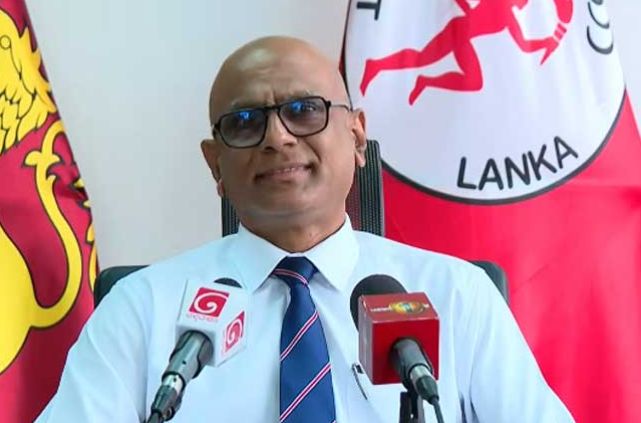
Speaking at a briefing in Colombo, CEYPETCO Chairman D. J. Rajakaruna emphasised that Sri Lanka’s petroleum imports are sourced outside the present conflict-affected zone. He clarified that upcoming shipments are due from India and Singapore, and therefore remain unaffected by the regional instability.
He urged motorists not to panic, stressing that there is no justification for long queues at filling stations. “We wish to make this clear in a responsible manner. There is no need for unnecessary rush or hoarding,” he said.
Although fuel distribution had not initially been scheduled for today (01), the CEYPETCO moved swiftly to resume islandwide deliveries after noticing an unexpected spike in demand. Staff were recalled to duty to manage the situation, and fuel releases have now recommenced. The Chairman further confirmed that supplies will continue uninterrupted tomorrow (02), despite the Poya public holiday.
In a bid to curb hoarding and potential black-market activity, the CEYPETCO has instructed all filling stations not to dispense fuel into cans, barrels or other bulk containers. Rajakaruna warned that strict legal action would be taken against individuals attempting to purchase fuel in large quantities for resale.
The corporation reiterated that adequate stocks are available and appealed to the public to remain calm, assuring that contingency measures are in place to maintain steady distribution across the country.
SriLankan Airlines Grounds Middle East Services Amid Escalating Regional Tensions
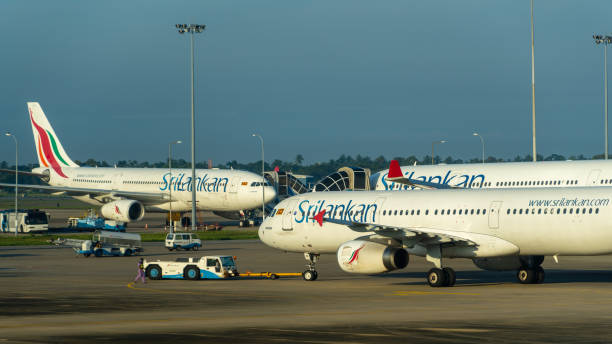
March 01, Colombo (LNW): SriLankan Airlines has suspended all flights to and from several Middle Eastern destinations scheduled for today (01), citing heightened security concerns as tensions continue to intensify across the region.
The decision follows a similar suspension yesterday, when the carrier halted departures from Colombo to key Gulf cities after a sharp escalation in hostilities involving Iran, the United States and Israel. With airspace uncertainty and safety risks mounting, the airline confirmed that operations to affected destinations would remain paused until conditions stabilise.
Today’s cancellations impact services between Colombo and Dubai, Doha, Dammam, Riyadh and Kuwait, with both outbound and inbound sectors withdrawn. The airline stated that the precautionary measure was taken solely in the interest of safeguarding passengers, crew and aircraft.
A spokesperson noted that the situation is being closely monitored in coordination with international aviation authorities and regional partners. “The safety and wellbeing of our passengers and staff remain our highest priority,” the airline said, adding that further updates would be issued as developments unfold.
Passengers booked on the disrupted flights are advised to seek rebooking or refund options through the airline’s Global Contact Centre by dialling 1979 within Sri Lanka or +94 11 777 1979 from overseas. Assistance is also available via WhatsApp on +94 74 444 1979 (chat only), through authorised travel agents, or by visiting the airline’s official website.
Travellers have been urged to remain patient as operational adjustments continue, with the airline assuring customers that every effort is being made to minimise inconvenience during this volatile period.
Will the US–Israeli Strike on Iran Shake Sri Lanka’s Fragile Recovery?
LISTEN TO STORY
WATCH STORY
By: Isuru Parakrama
March 01, Colombo (LNW): The dramatic escalation of tensions between the United States, Israel and Iran — culminating in coordinated strikes on Iranian nuclear and missile facilities — may appear geographically distant from Sri Lanka.
Yet the consequences could reach Colombo’s shores with uncomfortable speed.
The strikes, reportedly carried out under the code names “Operation Epic Fury” by Washington and “Roaring Lion” by Tel Aviv, targeted assets in Tehran, Isfahan and Qom. Amid confirmed reports that Iran’s Supreme Leader has been killed, Tehran responded with missile and drone attacks on US bases and Gulf infrastructure.
The immediate fallout was the effective paralysis of the Strait of Hormuz — the narrow maritime artery through which roughly 20 per cent of global oil supplies pass.
Brent crude surged more than seven per cent, climbing above US$ 90 per barrel. For Sri Lanka, still nursing the wounds of its 2022 economic collapse, that spike is not just a statistic — it is a warning.
Fuel: The First Shockwave
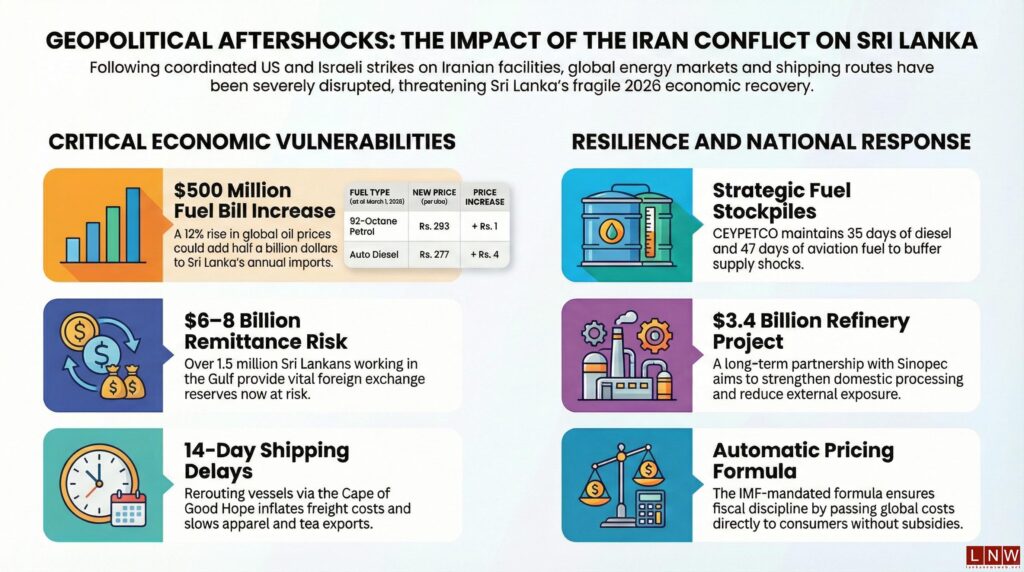
Sri Lanka imports around US$ 2.47 billion worth of refined petroleum annually, making it the country’s single largest import category. Although Colombo does not rely directly on Iranian crude, its suppliers — India, Singapore, the UAE and Malaysia — are deeply integrated into global supply chains vulnerable to disruptions in Hormuz.
The Ceylon Petroleum Corporation (CEYPETCO) confirms that the country holds approximately 37 days of fuel reserves — 35 days for diesel and 47 days for aviation fuel. These stocks are sourced from India, Singapore, Malaysia, South Korea, Russia, Oman and Saudi Arabia, with some shipments rerouted through alternative channels such as the Fujairah pipelines.
Despite the immediate fuel price revision effective from midnight yesterday (February 28), officials insist there is no cause for panic buying, and police have been deployed to monitor filling stations amid growing public anxiety. Yet if the Strait remains closed beyond a month, Sri Lanka could face refinery shutdown risks and escalating war-risk insurance premiums on incoming shipments.
Fuel prices have already inched upward. From March 01, 2026, auto diesel rose by Rs. 4 to Rs. 277 per litre, while 92-octane petrol increased by Rs. 1 to Rs. 293. Analysts suggest that a sustained global spike could necessitate hikes of Rs. 10 to 15 per litre. Under the IMF-mandated automatic pricing formula, such increases will be passed directly to consumers, avoiding subsidies but straining households.
A 12 per cent rise in global oil prices alone could add an estimated US$ 500 million annually to the national fuel bill — currently around US$ 4.5 billion. For a country carefully rebuilding foreign exchange reserves, that is a heavy burden.
Inflation, Growth and the IMF Tightrope
Inflation, which had stabilised to 1.6 per cent headline and 3.7 per cent core by February 2026, could once again flare up. Higher transport and electricity costs — with tariffs potentially rising by 11 to 18 per cent — risk eroding consumer purchasing power and business confidence.
A weakening rupee would compound the challenge. Increased import costs and a drain on foreign reserves could complicate Sri Lanka’s commitments under its IMF programme, jeopardising future tranches and growth targets painstakingly negotiated after the debt crisis.
Exports Under Pressure
Sri Lanka’s export sector is equally exposed. Tea shipments to Iran and the UAE — important Middle Eastern markets — are reportedly facing order freezes as regional currencies come under pressure. For smallholders, a sudden collapse in demand could mean a painful drop in prices.
Shipping disruptions are another concern. With risks around both Hormuz and the Suez Canal, vessels are rerouting via the Cape of Good Hope, adding 10 to 14 days to journeys and inflating freight costs. Apparel and rubber exporters, already operating on thin margins, may find contracts squeezed.
Infrastructure projects could also stall if bitumen supplies from the UAE are disrupted, slowing road construction and related development initiatives.
Remittances: A Silent Vulnerability
Perhaps the most delicate exposure lies in the Gulf. Over 1.5 million Sri Lankans — roughly seven per cent of the population — work in the Middle East, sending home between US$ 6 and 8 billion annually. These remittances have been vital in stabilising the rupee and replenishing reserves.
A prolonged conflict could trigger hiring freezes, economic contraction or even evacuations reminiscent of the 1990 Gulf War. A sudden return of workers would not only slash foreign inflows but also swell youth unemployment and create humanitarian strains.
Tourism at Risk
Tourism, another pillar of recovery, depends heavily on Gulf aviation hubs such as Dubai and Doha. Around 60 per cent of Western visitors transit through these centres. Flight suspensions by major regional carriers could result in cancellations and reduced arrivals.
Moreover, travellers from Saudi Arabia and the UAE — a growing segment — may opt to stay home amid regional uncertainty. Even if Sri Lanka remains geographically removed from the conflict, global perceptions of instability can be swift and unforgiving.
Government Response: Discipline Over Relief
The government’s strategy hinges on fiscal discipline. It is relying on diversified import sources, adequate stockpiles and the IMF-driven pricing formula rather than price controls or subsidies. Long-term plans include finalising a US$ 3.4 billion refinery project with Sinopec to strengthen domestic processing capacity and reduce exposure to external shocks.
Yet the uncomfortable truth remains: Sri Lanka’s recovery is intertwined with global stability. A war thousands of kilometres away has the power to test the island’s resilience once more.
The question is not whether Sri Lanka is directly involved in the US–Israeli confrontation with Iran. It is whether the country, still balancing on the edge of economic rehabilitation, can withstand another external storm without being blown off course.

Fuel Prices Raised From Midnight as Ceypetco Revises Rates
March 01, Colombo (LNW): Ceylon Petroleum Corporation (CEYPETCO) announced an upward revision of several fuel prices, with the new rates coming into force from midnight yesterday (28).
Under the latest adjustment, the price of Auto Diesel has risen by Rs. 4 per litre, bringing it to Rs. 281. Super Diesel has seen a sharper increase of Rs. 6 per litre and will now retail at Rs. 329.
Petrol 92 Octane has also been marginally increased by Rs. 1 per litre, taking the new price to Rs. 293.
However, the corporation confirmed that there will be no change to the prices of Kerosene and Petrol 95 Octane. These will remain at Rs. 182 and Rs. 340 per litre respectively.
The revised fuel prices are as follows:
Auto Diesel – Rs. 281 (up Rs. 4)
Super Diesel – Rs. 329 (up Rs. 6)
Petrol 92 Octane – Rs. 293 (up Rs. 1)
Kerosene – Rs. 182 (unchanged)
Petrol 95 Octane – Rs. 340 (unchanged)
Meanwhile, Lanka IOC has also aligned its prices with the revised rates announced by Ceypetco. The changes by both suppliers will take effect simultaneously from midnight.
President’s Counsel Kuvera de Zoysa Announces Candidature for BASL Presidency 2027/2028
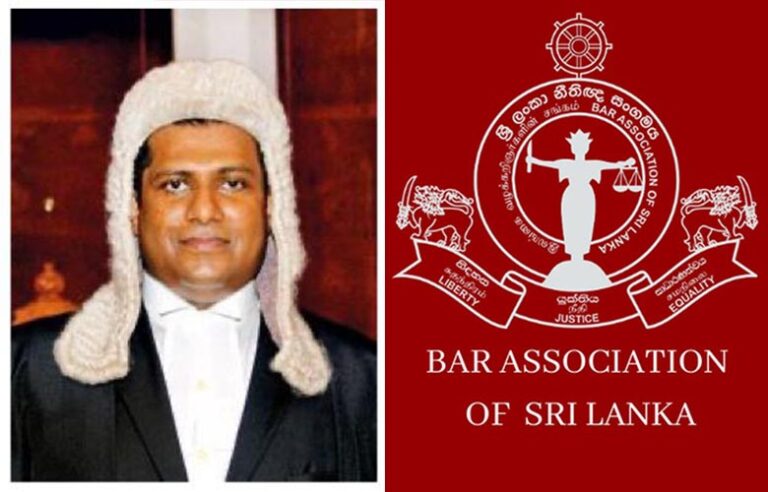
Colombo, Sri Lanka – 26 February 2026: President’s Counsel Kuvera de Zoysa has announced his candidature for the post of President of the Bar Association of Sri Lanka (BASL) for the term 2027/2028.
Amid significant challenges facing the legal profession in Sri Lanka, a broad consensus among Senior and Junior members of the BASL has highlighted the need for strong and unifying leadership.
In recent days, numerous eminent Senior practitioners including several past Presidents of the BASL and fellow President’s Counsel have approached Mr. Kuvera de Zoysa, PC, urging him to submit his nomination for the post of President of the BASL. This call has been reinforced by practitioners from Colombo and outstation Bar Associations, including formal written requests from respected Senior members.
After careful consideration and in response to this widespread inclusive appeal, Mr. Kuvera de Zoysa, PC, has decided to submit his nomination.
His candidature has received strong endorsements from the following past Presidents of the BASL including Dr. Romesh de Silva, PC, Mr. Ikram Mohamed, PC, Mr. W. Dayaratne, PC, Mr. Geoffrey Alagaratnam, PC, Dr. Wijeyadasa Rajapakshe, PC, Mr. Kalinga Indatissa, PC, Mr. U. R. De Silva, PC, Mr. Saliya Pieris, PC and further endorsed by several prominent Senior President’s Counsel, including Dr. K. Kanag-Isvaran and Dr. Faiz Musthapha, along with numerous practitioners nationwide.
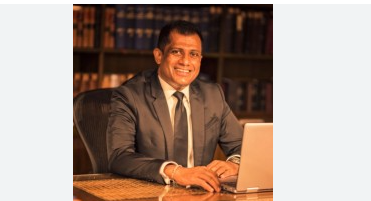
With more than 30 years of experience as a leading practitioner in Commercial and Civil Law, Mr. Kuvera de Zoysa’s dedication to the profession is reflected in his extensive contributions to the Bar.
These include serving as:
• Chairman of the National Law Conference (2014 and 2015)
• Chairman of the National Law Week and the Social and Welfare Committee (2017)
• Chairman of the Junior Bar Committee (2018–2019), representing over 8,000 Junior members
Resource person in BASL continuing legal education programmes on Civil Procedure, Intellectual Property Law, Commercial Litigation, Arbitration, and Company Law.
Mr. Kuvera de Zoysa said: “I am deeply honoured by the confidence shown by my colleagues across the Bar. I am committed to uniting the profession, addressing our shared challenges, and safeguarding the independence, dignity, and nobility of the legal profession in Sri Lanka.”
Mainly fair weather to prevail across Island (Mar 01)
March 01, Colombo (LNW): Mainly fair weather will prevail over the most parts of the island, the Department of Meteorology said today (01).
Misty conditions can be expected at several places in the island during the early hours of the morning.
Marine Weather:
Condition of Rain:
Mainly fair weather will prevail over the sea areas around the island.
Winds:
Winds will be variable in direction and wind speed will be (20-30) kmph.
State of Sea:
Sea areas around the island will be slight.
Iran’s Supreme Leader Ayatollah Ali Khamenei killed in US-Israeli air strikes: State Media
LISTEN TO STORY
WATCH STORY
By: Isuru Parakrama
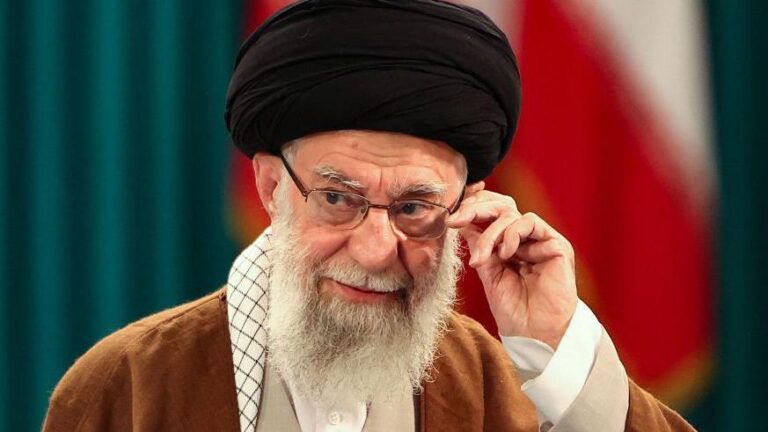
March 01, World (LNW): Ayatollah Ali Khamenei, Iran’s Supreme Leader, has been killed in US-Israeli air strikes on Tehran, according to Iranian state media.
He was reportedly targeted in his office on Saturday morning in what officials describe as one of the most significant escalations in decades of hostility between Iran and its adversaries.
The 86-year-old cleric, who had led the Islamic Republic since 1989, was the country’s highest authority, overseeing its armed forces, judiciary and key political decisions. His death marks a profound turning point for Iran’s leadership and the wider Middle East.
International sources disclose that approximately 40 senior Iranian officials were killed in the coordinated air raids. Earlier, Israel said it had identified and killed seven high-ranking officials in targeted strikes, though it did not immediately confirm whether Khamenei had been among them.
US President Donald Trump described Khamenei as “one of the most evil people in History” and urged the Iranian public to “take back their Country”. In a statement, he said the strikes were aimed at weakening what he called “a regime that has terrorised its own people and destabilised the region for decades”.
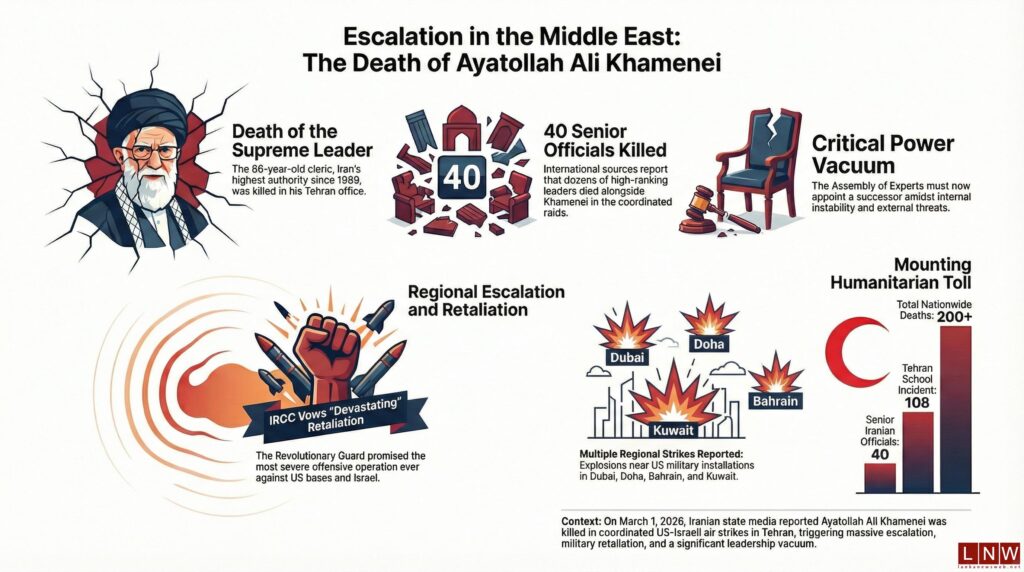
Iran’s Islamic Revolutionary Guard Corps (IRGC) vowed swift and severe retaliation. In a statement carried by state media, the IRGC promised to unleash “the most devastating offensive operation” ever against US bases and Israel, raising fears of a broader regional conflict.
Retaliatory strikes were reported earlier in Dubai, Doha, Bahrain and Kuwait — locations that host US military installations or are close allies of Washington. Initial reports suggest explosions were heard near strategic sites, although the full extent of the damage remains unclear.
Meanwhile, the humanitarian toll inside Iran continues to mount. The Iranian Red Crescent says more than 200 people have been killed nationwide in the latest wave of attacks. Iranian authorities say at least 108 of those victims died when US and Israeli strikes hit a girls’ school in Tehran, an allegation that has not yet been independently verified.
The killing of Khamenei leaves a significant power vacuum at the apex of Iran’s political system. Under the country’s constitution, the Assembly of Experts is responsible for appointing a successor, but analysts warn that the sudden loss of such a dominant figure could trigger internal instability at a moment of acute external threat.
World leaders have called for restraint, warning that the spiralling violence risks engulfing the region in a prolonged and unpredictable conflict.