March 02, Colombo (LNW): The Sri Lankan government has announced a temporary extension of visa validity for foreign nationals who remain in the country due to ongoing flight disruptions linked to tensions in the Middle East.
Cabinet Spokesperson and Minister Dr. Nalinda Jayatissa confirmed that affected visitors will be granted an additional two weeks to remain in Sri Lanka without facing penalties or legal complications. The decision comes as several international carriers continue to adjust or suspend routes through parts of the Middle East, leaving some travellers unable to depart as originally planned.
Speaking at a media briefing held at the Government Information Department, the Minister stressed that the extension would be provided automatically to those impacted and that no administrative fees would be imposed. He described the move as a humanitarian measure intended to ease uncertainty and financial strain for tourists and business travellers caught up in circumstances beyond their control.
Officials indicated that immigration authorities have been instructed to implement the extension promptly, ensuring that visitors can regularise their stay without the need for lengthy procedures. The government has also advised affected individuals to remain in contact with their respective airlines and diplomatic missions while alternative travel arrangements are being finalised.
Sri Lanka Grants Free Visa Extension to Stranded Foreign Nationals Amid Regional Airspace Disruptions
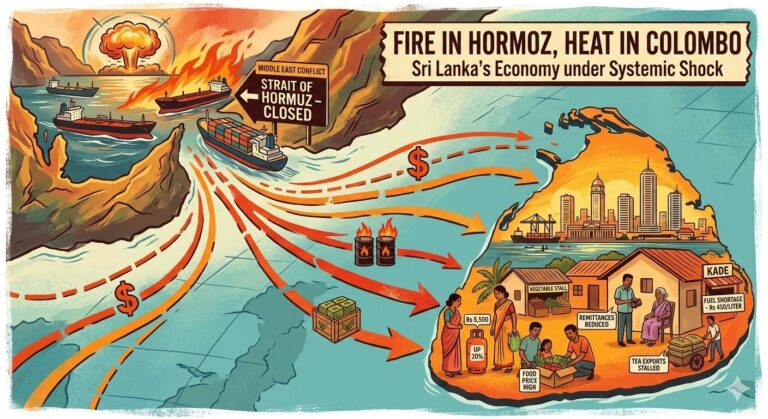
Sri Lanka is a small, import dependent economy, “fire in the Strait of Hormuz will burn households in Colombo”
Written by: Panduka Keerthinanda
The escalation of military conflict in the Middle East and the subsequent closure of the Strait of Hormuz represent a systemic shock to the global economy with profound implications for Sri Lanka. As a vital maritime chokepoint handling approximately 20% of the world’s oil supply and a significant portion of liquefied natural gas (LNG), the disruption of shipping through this narrow passage threatens to destabilise energy markets, inflate commodity prices, and disrupt the livelihoods of millions of Sri Lankan migrant workers in the Gulf region. This paper examines the multifaceted impact of the Hormuz closure on Sri Lanka’s economy, drawing on recent developments in February-March 2026 and analysing the transmission mechanisms through which this geopolitical crisis affects the island nation’s energy security, trade balance, remittance flows, and overall economic stability. It argues that while Sri Lanka has achieved some insulation from direct supply disruptions through diversified sourcing, the indirect effects particularly through global price spikes and labour market contractions pose significant risks to a recovery still in its fragile phase.
For Sri Lanka, this was not a distant fire but a direct threat to the fuel, food, and family incomes of 22 million people. The nation had only just begun breathing after the suffocating economic crisis of 2022, having secured an IMF Extended Fund Facility, stabilized inflation at 1.6% in February 2026, and watched foreign reserves inch toward $4.5 billion . The flames in the Middle East threatened to blow those hard-won gains apart.
The Hormuz closure affects Sri Lanka, structured around four key areas: energy security and fuel prices, trade and exports, remittances and migrant labour, and the broader macroeconomic implications. It draws on official statements, economic data, and expert analysis from the period June 2025 to March 2026, tracing how warnings issued months earlier have materialized into tangible economic pressures.
The Strait of Hormuz connects the Persian Gulf to the Arabian Sea and the Indian Ocean beyond. At its narrowest point, it is just 33 kilometres wide, yet through this chokepoint passes approximately one-fifth of global oil consumption. The US Energy Information Administration estimates that roughly 14.2 million barrels of crude oil and 5.9 million barrels of refined petroleum products traverse the Strait daily .
For Sri Lanka, located approximately 2,500 nautical miles from the Strait, the geographical distance offers no protection from the economic shockwaves. As a small, open economy heavily dependent on imports for energy, food, and industrial inputs, and equally dependent on exports to Middle Eastern markets and remittances from Gulf-based workers, the island nation finds itself acutely vulnerable to disruptions in this critical artery.
Sri Lanka imports nearly 100% of its fuel requirements, making it one of the most energy-import-dependent nations in South Asia. The state-owned Ceylon Petroleum Corporation (CPC) and the Sapugaskanda refinery, the country’s only refinery, process crude oil primarily sourced from the Middle East. In recent years, Sri Lanka has diversified its sources for refined products, increasingly relying on India, Singapore, and Malaysia to reduce freight costs and mitigate geopolitical risks .
However, it will inevitably create immense pressure on other international ports and alternative supply channels, leading to a significant increase in global oil prices. That is the primary concern for Sri Lanka .
The impact extends far beyond the fuel pump. When diesel prices rise, transport costs for everything from vegetables moving from Dambulla to Colombo to garments moving from factories to ports increase proportionally. Manufacturing costs rise as industrial users face higher energy bills. Electricity tariffs, already a politically sensitive issue, come under pressure as thermal power generation becomes more expensive. The proposed tariff reductions for households suddenly appear jeopardised .
Tea is Sri Lanka’s most critical agricultural export, and the Middle East has long been its most important market. Iran, Iraq, and the UAE are among the top buyers of Ceylon tea, particularly the low-grown varieties prized in the region for their strong flavour. Approximately 25% of total tea exports are destined for West Asia .
The Iran-Sri Lanka “tea for oil” barter agreement, established during the foreign exchange crisis, allowed Sri Lanka to settle oil debts through tea exports. This arrangement was widely viewed as beneficial, easing pressure on the balance of payments while stimulating demand for Ceylon tea in other markets as well . The current conflict places this agreement in jeopardy.
The immediate impact has been severe. The Iranian Rial has plummeted, and Middle Eastern buyers face banking hurdles and currency instability that have frozen new orders . If the Middle Eastern market contracts significantly, thousands of smallholder tea farmers in southern Sri Lanka will face collapsing prices, as no immediate alternative market exists capable of absorbing these specific tea grades in similar volumes .
The closure of the Strait of Hormuz affects shipping far beyond the Gulf itself. Major transhipment hubs in the UAE Jebel Ali Port in Dubai and Khalifa Port in Abu Dhabi have lost access to vessels and cargo, creating a ripple effect across the Indian Ocean .
For Sri Lankan exporters, the impact is twofold. First, freight costs have risen sharply as “war risk premiums” are added to insurance for ships passing through the region, and as longer alternative routes increase voyage times. The Ceylon Chamber of Commerce reported freight cost increases of approximately 15% in early 2025, with further increases anticipated . Second, transit times for Sri Lankan apparel and rubber exports to European and US markets have extended by 10 to 14 days as ships reroute around the Cape of Good Hope to avoid the conflict zone . These delays, combined with higher costs, make Sri Lankan products less competitive globally.
The impact on imports extends beyond oil. Sri Lanka imports significant quantities of bitumen for road construction, petroleum-based industrial chemicals, and manufactured goods from the Gulf region. Disruptions to these supply chains threaten to stall infrastructure projects and increase costs across the economy .
Moreover, the general increase in shipping costs affects every imported product, from food and pharmaceuticals to machinery and raw materials. As Ven. Prof. Vijithapure Wimalarathana Thera noted, these rising costs create “Cost-Push Inflation” a situation where increased production and transportation costs are passed through to consumers, creating inflationary pressure even in the absence of domestic demand growth .
For decades, the Middle East has been the safety valve for Sri Lankan unemployment. Approximately 1.5 million Sri Lankans currently work in Gulf Cooperation Council (GCC) countries, representing nearly 7% of the island’s population . The Sri Lanka Bureau of Foreign Employment data indicates that approximately 80% of annual departures for foreign employment are to Middle Eastern countries, making the region the single largest destination for Sri Lankan migrant workers .
These workers are concentrated in construction, hospitality, domestic service, and retail sectors across Saudi Arabia, UAE, Kuwait, Qatar, and other Gulf states. Their remittances form the lifeblood of the Sri Lankan economy.The escalating conflict poses a systemic threat to this remittance economy. If the conflict widens to include direct strikes on Gulf infrastructure as seen in the February 2026 attacks near Dubai and Kuwait airports the primary concern for workers shifts from sending money to saving lives . A full-scale regional conflict would likely lead to hiring freezes as private sector projects stall and Gulf governments divert budgets toward defence and emergency readiness.
The most severe risk is mass evacuation. Should the conflict necessitate repatriation of Sri Lankan citizens similar to the 1990 Gulf War crisis when approximately 100,000 Sri Lankans were evacuated from Kuwait and Iraq the economic consequences would be catastrophic. Sri Lanka would face a double-edged crisis: the sudden loss of billions in remittances and the immediate need to absorb hundreds of thousands of returning workers into an economy ill-equipped to employ them .
Many returnees possess specialized skills in construction, hospitality, and services that the current Sri Lankan economy cannot absorb. The cost of repatriation alone would strain state resources, while the permanent severing of monthly cash flows would destabilize the rupee against the US dollar.
A 10% drop in remittances could reduce foreign exchange reserves by approximately $600 million a significant blow for a nation with reserves of $4.5 billion . Even a 5% reduction in remittance flows would ripple through countless households reliant on these monthly transfers for basic consumption.
However, this recovery remains fragile. The debt-to-GDP ratio stood at 126% in 2022. Poverty rates doubled between 2019 and 2024, reaching 24.5%, with food insecurity affecting 23.7% of households . Non-performing loans in the banking sector remain elevated, and the fiscal space for stimulus or subsidies is severely constrained by IMF programme conditions.
The Hormuz closure threatens this delicate equilibrium through multiple channels. On the current account, higher oil prices increase the import bill oil already constitutes approximately 30% of total imports . Reduced tea exports to Middle Eastern markets decrease export earnings. Potential declines in remittances reduce the services surplus that has helped offset merchandise trade deficits.
On the capital account, investor sentiment toward emerging markets typically deteriorates during geopolitical crises, potentially complicating Sri Lanka’s access to international capital markets. The government’s ability to maintain its IMF programme targets while absorbing these shocks will be tested.
The closure of the Strait of Hormuz represents a systemic shock to the global economy, and for Sri Lanka, it arrives at a particularly inopportune moment.The nation has made remarkable progress since the 2022 crisis, stabilising inflation, rebuilding reserves, and restoring growth. However, that recovery remains fragile, and the transmission mechanisms from Hormuz to Colombo through energy prices, trade disruption, and remittance contraction threaten to undo hard-won gains.
The impact will not be uniform. Some sectors, such as tea smallholders and migrant-sending households, face immediate and severe pressure. Others, like the Port of Colombo, may see increased activity even as broader economic conditions deteriorate. The government’s policy responses, constrained by fiscal limitations and IMF commitments, will determine whether the shock becomes a crisis or merely a setback.
The flames in the Middle East are not a distant fire. They are a direct threat to the fuel, food, and family incomes of 22 million Sri Lankans. Navigating this crisis will require all the diplomatic skill, economic management, and social solidarity the nation can muster. The path forward lies in diversification of energy sources, export markets, migrant destinations, and economic structures and in protecting the most vulnerable while building resilience for the future.
Courtesy: Daily Mirror
It won’t be easy going forward, friends – this is now a world where AI is even used to launch attacks.

By: Puli
March 02, LNW (Colombo): Despite a decision announced just hours earlier by Donald Trump to sever all ties with the company and its artificial intelligence tools, reports claim that the United States military used Anthropic’s AI model, Claude, during operations targeting Iran.
Claude AI is a powerful artificial intelligence chatbot and large language model (LLM) developed by Anthropic. It is known for its advanced reasoning, coding, and writing capabilities, and is designed to analyze long documents and handle complex tasks across web, desktop, and mobile platforms.
Foreign media reported that Claude was utilized during a large-scale joint US–Israel strike on Iran that began on Saturday. At a time when AI technologies are already deeply integrated into military operations, the situation also highlights the complexity of removing powerful AI tools from active operational systems once they have been embedded.
According to reports, US military commanders have used such AI tools not only for intelligence purposes but also to assist in target selection and battlefield simulations.
Just hours before the Iran strike began, on Friday, Trump reportedly ordered all federal agencies to immediately halt the use of Claude. In a post on Truth Social, he criticized Anthropic as “a radical left AI company run by people who don’t understand the real world.”
The controversy reportedly intensified earlier in January when the US military was said to have used Claude in operations related to capturing Venezuelan President Nicolás Maduro. Trump objected to this, citing Anthropic’s usage policies, which prohibit the use of Claude for violent purposes, weapons development, or surveillance activities.
How the US–Israeli Assault on Iran Could Reshape Global Security and the World Economy
LISTEN TO STORY
WATCH STORY
By: Isuru Parakrama
March 02, World (LNW): The dramatic escalation of hostilities between United States–Israel forces and Iran since 28 February 2026 marks one of the most perilous geopolitical ruptures in decades. What began as coordinated “pre-emptive” airstrikes has rapidly evolved into a multi-theatre confrontation with profound implications for global security, diplomatic stability and economic resilience.
Approximately 200 fighter jets were deployed in initial operations targeting more than 500 Iranian missile sites, air defence systems and nuclear facilities. Among those reportedly killed was Iran’s Supreme Leader, Ali Khamenei, alongside around 40 senior officials.
The announcement by Donald Trump confirming direct American involvement — and framing the strikes as an opportunity for regime change — signalled that Washington’s objectives extend well beyond deterrence.
Israeli forces under Prime Minister Benjamin Netanyahu have simultaneously intensified operations, with the Israel Defense Forces striking command centres and air defences in Tehran. US actions reportedly expanded to more than 1,000 targets, including naval assets. This scale of destruction indicates a campaign designed not merely to degrade capabilities but to dismantle the Islamic Republic’s strategic infrastructure.
Tehran’s response has been swift and regionally expansive. Missile and drone barrages have targeted Israel and American installations across Qatar, Bahrain, Kuwait, United Arab Emirates, Jordan, Iraq and Saudi Arabia. The involvement of Iran-backed Hezbollah, which launched rockets from Lebanon, further widens the theatre of conflict.
Israel’s retaliatory strikes on Beirut and evacuation orders affecting dozens of Lebanese villages underscore the risk of a fully fledged northern front.
At sea, the vulnerability of the Strait of Hormuz — through which roughly a fifth of global oil supplies transit — has already sent tremors through energy markets. Iran’s threats to disrupt shipping lanes, coupled with warnings from the Houthis in the Red Sea, create the prospect of sustained maritime instability.
Insurance premiums for shipping are likely to surge, freight routes may be rerouted, and oil prices could spike sharply if tanker traffic is impeded.
The conflict’s trajectory now hinges on three overlapping dynamics.
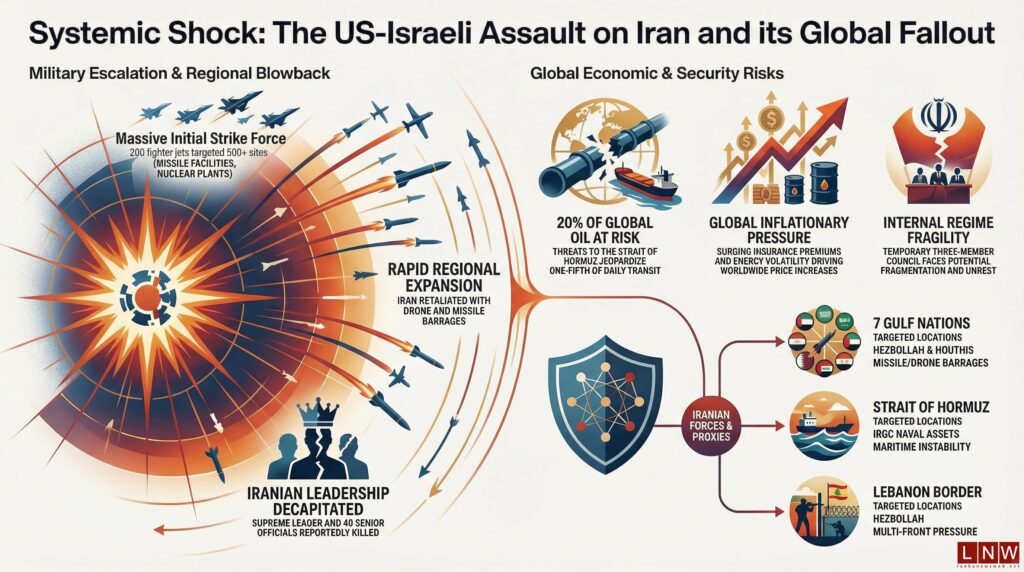
First, regime durability in Tehran. Following Khamenei’s death, Iran reportedly established a temporary three-member leadership council. Should internal fragmentation intensify, the power vacuum may embolden hardliners within the Islamic Revolutionary Guard Corps to consolidate authority.
Conversely, prolonged instability could generate domestic unrest, especially amid reported civilian casualties exceeding 200 deaths and hundreds of injuries across multiple provinces. Either scenario carries risk: authoritarian retrenchment would sustain hostilities, while state fragility could unleash uncontrolled militia activity.
Second, the risk of proxy proliferation. Washington has demanded an end to Iranian support for groups such as Hamas and regional militias. Yet these actors may perceive escalation as existential. If they intensify asymmetric operations, Israel could face sustained multi-front pressure. In turn, further Israeli or American strikes might draw additional regional actors into the fray.
Third, the global diplomatic response. The United Nations and several world leaders have called for de-escalation, warning of a slide towards wider war. However, the declared aim of regime change from Washington reduces the space for negotiated compromise.
President Trump’s assertion that objectives could be achieved within a month suggests an expectation of rapid collapse in Tehran — a projection that may underestimate Iran’s capacity for protracted resistance.
Economically, the ramifications are likely to be severe even absent further escalation. Energy market volatility will feed inflationary pressures worldwide, particularly in import-dependent economies. Financial markets may react with risk aversion, strengthening safe-haven currencies and driving capital flight from emerging markets.
Should Gulf infrastructure be directly targeted, global liquefied natural gas supplies could also be disrupted, compounding Europe and Asia’s energy vulnerabilities.
From a security standpoint, the most dangerous trajectory would involve miscalculation: a mass-casualty strike on US personnel, direct Israeli hits on Iranian leadership figures beyond the initial assault, or accidental engagement with another major power’s assets. In such a scenario, containment would become increasingly elusive.
Yet there remains a narrow path towards managed de-escalation. Back-channel diplomacy, possibly mediated by non-aligned states, could explore limited ceasefires tied to inspections or phased sanctions relief. The challenge is that both sides have publicly framed the confrontation in existential terms.
As matters stand, the conflict has already shifted from a bilateral showdown to a systemic shock. Its trajectory will determine not only the future of Iran’s political order but the stability of global energy markets, the credibility of international law, and the fragile architecture of Middle Eastern peace. The coming weeks may well define the geopolitical landscape of the next decade.

Government Moves Swiftly to Safeguard Tourists and Overseas Workers Amid Regional Tensions
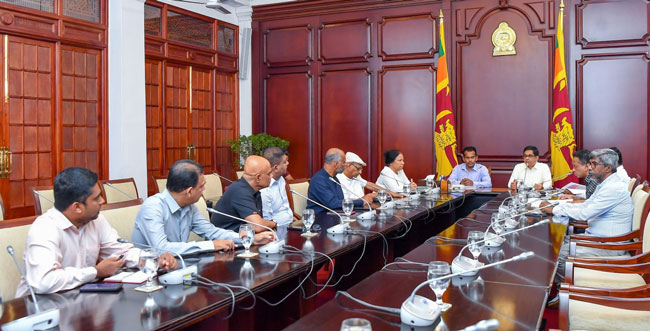
March 02, Colombo (LNW): In response to mounting instability across parts of the Middle East and the Gulf, the Government of Sri Lanka has unveiled a comprehensive package of measures aimed at protecting foreign visitors currently on the island, while also strengthening support for Sri Lankan migrant workers abroad.
The decisions were reached at a high-level meeting convened yesterday (01) at the Presidential Secretariat, chaired by Deputy Minister of Tourism Ruwan Ranasinghe and Secretary to the President Dr Nandika Sanath Kumanayake. According to the President’s Media Division, the discussions focused on immediate interventions and contingency planning in light of the evolving regional security situation.
Temporary Visa Relief for Visitors
Recognising the uncertainty faced by many travellers due to disrupted flight routes and the temporary closure of airspace in several Middle Eastern countries, the Government has approved a complimentary 14-day extension of tourist visas for those presently in Sri Lanka. Officials noted that the move is intended to ease logistical and financial pressures on visitors whose onward travel plans have been affected.
Furthermore, an urgent action framework is being developed in collaboration with foreign missions through the Ministry of Foreign Affairs. This initiative aims to coordinate accommodation, consular assistance, and safety measures for tourists, ensuring that their stay remains secure and well-managed.
Authorities are also engaging with international airlines to identify alternative flight corridors, enabling stranded tourists to return home via revised routes. At the same time, discussions are under way with industry stakeholders to guarantee that prospective travellers can continue to reach Sri Lanka with minimal disruption.
Round-the-Clock Support Services
To reinforce these efforts, a series of 24-hour operational centres have been activated across key State institutions.
The Sri Lanka Tourism Development Authority has set up a dedicated unit to address concerns raised by tourists. Assistance is available through its 1912 hotline, with officials assuring prompt attention to accommodation, transport and safety-related matters.
Meanwhile, the Sri Lanka Bureau of Foreign Employment has launched a special operations centre to support Sri Lankan migrant workers overseas. The Bureau’s 1989 hotline has been designated for families seeking information or workers requiring urgent assistance.
In parallel, the Ministry of Foreign Affairs has instructed Sri Lankan diplomatic missions across the Middle East and Gulf region to remain on heightened alert. Working in tandem with the Bureau of Foreign Employment, these missions have established an integrated response mechanism to address emergencies swiftly and safeguard the welfare of Sri Lankan nationals abroad.
Officials at the meeting underscored that domestic transport services remain fully operational and contingency arrangements are in place should conditions shift. The Government has affirmed its readiness to take further decisions as necessary, emphasising that both visitor safety and the well-being of Sri Lankans overseas remain top priorities.
Mainly dry weather to prevail across SL (Mar 02)

March 02, Colombo (LNW): Mainly dry weather will prevail in the most parts of the island, the Department of Meteorology said today (02).
Misty conditions can be expected at some places in Western, Sabaragamuwa, Central, Southern and North-western provinces and in Anuradhapura and Vavuniya districts during the early hours of the morning.
Marine Weather:
Condition of Rain:
Mainly fair weather will prevail over the sea areas around the island.
Winds:
Winds will be variable in direction and wind speed will be (20-30) kmph.
State of Sea:
Sea areas around the island will be slight.
Tariff Battles, Union Threats Deepen Power Crisis
By: Staff Writer
March 01, Colombo (LNW): Sri Lanka’s electricity sector is bracing for turbulence as tensions escalate over restructuring, tariff hikes and alleged irregularities in Energy Ministry tender processes. At the heart of the storm is the Ceylon Electricity Board (CEB), whose reform programme now faces financial, regulatory and labour headwinds.
The immediate trigger is a Rs. 8.8 billion funding shortfall linked to a voluntary retirement scheme for over 2,000 employees. Although Cabinet approved recovering the cost through revised tariffs, the Public Utilities Commission of Sri Lanka has rejected the proposal, arguing that consumers cannot be burdened with restructuring expenses.
This regulatory pushback has intensified friction between the Energy Ministry and oversight authorities. It also places the Government in a fiscal bind, as the power sector overhaul forms a key pillar of Sri Lanka’s agreement with the International Monetary Fund.
Beyond the VRS controversy lies a deeper concern: rising electricity tariffs. Consumers have already absorbed steep increases in recent years, contributing to higher production costs, inflationary pressure and reduced competitiveness. Further hikes to plug financial gaps could dampen industrial output and slow economic recovery.
Trade unions have seized on the uncertainty, warning of strike action if job security and compensation guarantees are not met. A work stoppage within the power utility would have immediate consequences, including the risk of island-wide blackouts at a time when demand remains volatile.
Adding to the strain are allegations of irregularities in Energy Ministry tender processes. Critics claim procurement decisions lack transparency, raising suspicions of malpractice and corruption that could inflate project costs and erode public trust. While official investigations remain opaque, the perception of mismanagement compounds anxiety over tariff justifications.
Economists caution that persistent governance concerns in the energy sector could deter foreign investment. Reliable and competitively priced electricity is critical for export industries and emerging sectors such as IT and manufacturing. Uncertainty over supply stability and regulatory direction threatens to undermine investor confidence.
The Energy Ministry has floated a proposal to offset VRS payments against future tariff-based revenue streams, effectively asking the Government to bridge the immediate financing gap. Yet this solution depends on stable policy execution and regulatory consensus both currently fragile.
As Sri Lanka attempts to modernise its power sector, the interplay between fiscal reform, labour relations and governance transparency will determine whether restructuring yields efficiency gains or deepens instability. With unions on edge and tariff debates intensifying, the country faces not only a funding crisis but a broader test of institutional credibility in safeguarding energy security and economic revival.
No Reports of Sri Lankan Casualties in Israel Amid Escalating Missile Strikes
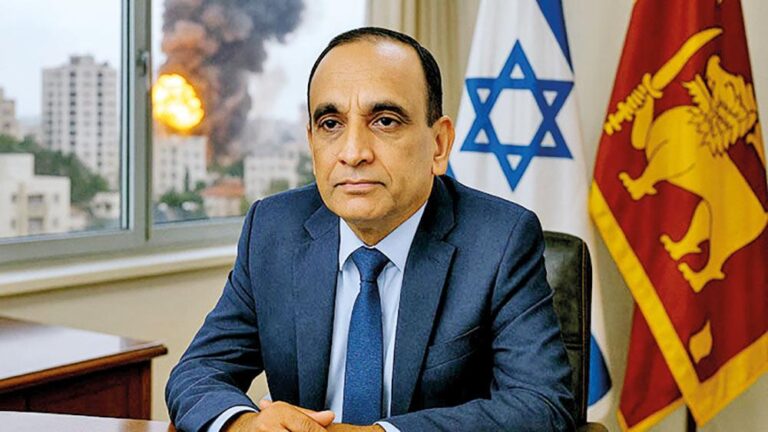
March 01, Colombo (LNW): Sri Lanka’s envoy in Tel Aviv has confirmed that no Sri Lankan nationals have been reported injured following the latest wave of hostilities between Israel and Iran.
Speaking to local media, Nimal Bandara, Sri Lanka’s Ambassador to Israel, said the diplomatic mission has been in close contact with community leaders and individuals across the country and has so far received no information indicating harm to Sri Lankans.
The reassurance comes after Iran launched missile attacks targeting Israel in retaliation for a joint operation by the United States and Israel. In response to the heightened threat, Israeli authorities imposed sweeping emergency measures. Public gatherings were prohibited, schools and many workplaces were temporarily closed, and certain hospital patients were transferred to underground facilities as a precaution.
Israel’s Defence Minister, Israel Katz, declared a nationwide state of emergency, cautioning citizens about the possibility of further missile and drone strikes. The Israeli military has instructed residents to adhere strictly to safety advisories and avoid unnecessary travel to ensure that emergency services can operate without obstruction.
Ambassador Bandara noted that the situation remains tense but expressed hope that stability could be restored within the next couple of days if hostilities subside. He added that the Sri Lankan Embassy continues to disseminate safety guidance and real-time updates to nationals through official communication channels.
With Ben Gurion Airport currently closed, Sri Lankans planning to depart Israel — as well as those intending to travel there — have been advised to defer their journeys until further notice. The Embassy said it stands ready to provide assistance and urged Sri Lankans to remain vigilant, follow local authority directives and maintain regular contact with the mission during this uncertain period.
European-Regulated Investment Vehicle Launched to Channel Global Capital into Sri Lanka
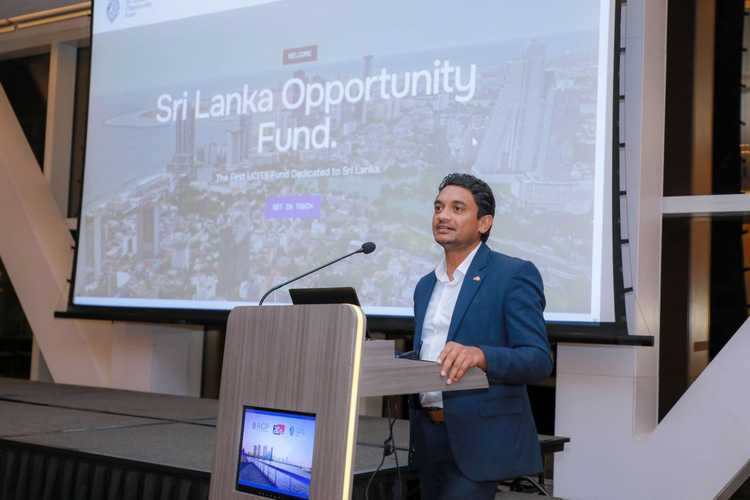
March 01, Colombo (LNW): Sri Lanka has unveiled a new internationally compliant investment vehicle aimed at drawing long-term foreign capital into its financial markets, marking a notable development in the country’s post-recovery economic strategy.
The Sri Lanka Opportunity Fund was formally introduced on February 25, 2026 as the nation’s first fund established under Europe’s UCITS regulatory regime — a framework widely recognised for stringent oversight, investor safeguards and high standards of transparency. The structure enables daily liquidity, offering overseas investors both flexibility and regulatory reassurance.
The fund is overseen by ACP Asset Management in partnership with ACP Corum, and is designed to provide foreign institutional and retail investors with regulated exposure to Sri Lankan equities and fixed-income securities. By operating within a European compliance structure, the initiative seeks to position Sri Lanka as a more accessible and credible frontier market destination.
Its portfolio strategy centres on listed companies on the Colombo Stock Exchange, with emphasis on banking, consumer-driven businesses and export-oriented sectors. In addition, the fund allocates capital to Sri Lankan sovereign bonds and selected high-grade corporate debt instruments denominated in both US dollars and Sri Lankan rupees. At least 30 per cent of its holdings are maintained in liquid assets to facilitate daily redemptions.
The vehicle attracted an initial subscription of 20 million US dollars at launch, with a further 30 million dollars pledged by prospective investors — an early signal of confidence in Sri Lanka’s stabilising macroeconomic outlook.
Deputy Minister Chathuranga Abeysinghe described the initiative as a milestone for the country’s capital markets, noting that adherence to European regulatory standards enhances credibility and transparency. He added that such structures are vital for restoring investor trust and broadening participation in Sri Lanka’s financial sector.
Market analysts suggest the fund could contribute to increased liquidity and depth at the Colombo bourse, while also supporting the Government’s broader objective of sustainable, investment-led growth.
Committee to Draft National Medical Education Policy: Premier
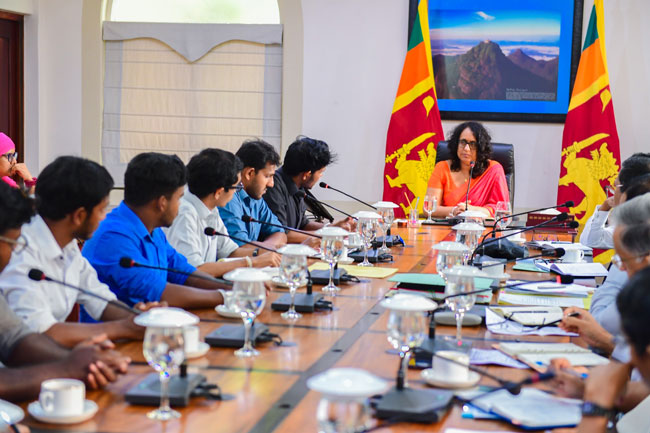
March 01, Colombo (LNW): Prime Minister Dr Harini Amarasuriya has announced plans to establish a special committee tasked with drawing up a comprehensive national policy on medical education, following appeals from student representatives who have long called for clearer direction and reform in the sector.
The proposal emerged during a meeting held on February 27 at Temple Trees with members of the Medical Faculty Students’ Action Committee. According to the Prime Minister’s Office, the discussion centred on long-standing concerns within state universities, including internship placements, accommodation shortages and transport challenges faced by medical undergraduates and recent graduates.
Dr Amarasuriya invited student unions and other stakeholders to submit written proposals and recommendations, assuring them that the policy would be shaped through consultation rather than imposed unilaterally.
She stressed that safeguarding academic freedom and students’ right to express their views would remain a priority, adding that further dialogue would be held with university Vice-Chancellors in the coming weeks.
Representatives from the Ministry of Health acknowledged that delays in assigning internship training posts have largely stemmed from accommodation constraints at teaching hospitals.
They indicated that approval has been sought to designate five additional hospitals for internship training, a move expected to ease bottlenecks and expand opportunities for newly qualified doctors.
Meanwhile, officials from the Ministry of Education, Higher Education and Vocational Education confirmed that funding has already been earmarked for new hostel facilities at several universities, including Wayamba, Sabaragamuwa and Moratuwa. Construction is expected to commence once land allocation formalities are finalised.
Transport difficulties affecting trainees attached to the Kurunegala and Kuliyapitiya faculties were also raised. Authorities said discussions would be initiated with the Sri Lanka Transport Board to explore dedicated services or revised schedules to support medical trainees.
Officials further clarified that no decision has been taken to halt post-intern appointments and that efforts are under way to upgrade infrastructure within medical faculties islandwide.
The meeting was attended by senior government officials, university administrators and representatives of the students’ committee, marking what participants described as a constructive step towards long-term reform in Sri Lanka’s medical education system.