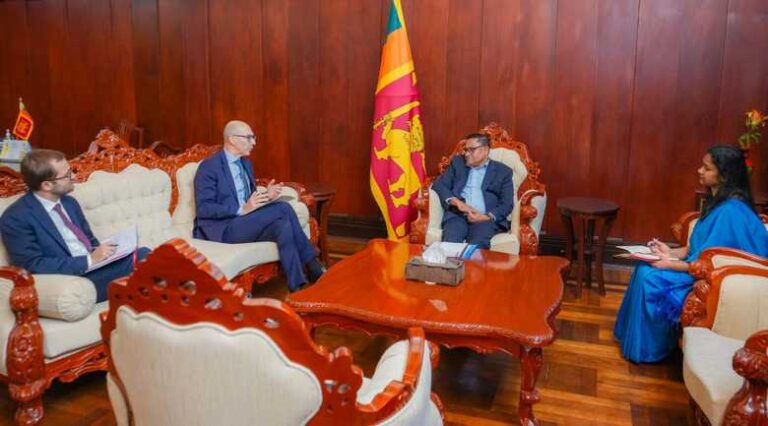
August 26, Colombo (LNW): Sri Lankan Foreign Minister Ali Sabry met today (26) with Nacho Sánchez Amor, Chief Observer of the EU Election Observation Mission (EOM) and Member of the European Parliament, at the Foreign Ministry.
The meeting focused on ensuring full government cooperation for a transparent and independent observation process during the upcoming presidential election.
The EU, responding to an invitation from Sri Lanka’s Election Commission, has decided to deploy an EOM for the presidential election scheduled for 21 September 2024.
The EU’s longstanding involvement in monitoring Sri Lankan elections—this being their seventh mission—underscores its commitment to democratic processes in the country.
Minister Sabry reaffirmed the government’s readiness to facilitate the mission’s work throughout the election period, ensuring impartial access and transparency.
The mission is expected to provide critical insights into the electoral process, helping to enhance credibility and fairness.
Nacho Sánchez Amor was appointed Chief Observer by Josep Borrell, High Representative of the EU for Foreign Affairs and Security Policy, reflecting the EU’s continuous engagement and partnership with Sri Lanka.
August 26, Colombo (LNW): A coalition of Sri Lankan trade associations is urging the government to lower water tariffs for industrial users to alleviate financial burdens on local industries. T
he group, which includes prominent organizations like the Joint Apparel Association Forum (JAAF), the Federation of Chambers of Commerce and Industry in Sri Lanka (FCCISL), the European Chamber of Commerce in Sri Lanka (ECCSL), and the Exporters Association of Sri Lanka (EASL), is advocating for a fair pricing system that reflects the actual cost of utilities.
Recently, the Sri Lankan government announced a new pricing formula aimed at reducing water tariffs. Cabinet Spokesman and Minister of Transport, Highways, and Mass Media Bandula Gunawardana revealed that a 7% reduction in water tariffs for domestic users would be implemented starting 23 August.
Additionally, a gazette was published that includes a 4.5% reduction for government hospitals and a 6.3% reduction for places of religious significance. These changes, initiated by Water Supply and Estate Infrastructure Development Minister Jeevan Thondaman, took effect on 21 August.
However, the trade associations expressed concern that these reductions did not extend to industrial tariffs. They argue that water is a crucial component in the operations of Sri Lankan industries and that high tariffs could harm competitiveness and deter investment, particularly in sectors such as manufacturing.
JAAF Secretary General Yohan Lawrence emphasized the importance of a progressive approach to water tariffs to support economic recovery and maintain global competitiveness.
The new pricing formula, developed in agreement with the International Monetary Fund (IMF), is designed to reflect the actual cost of water supply. Following recent reductions in fuel and electricity tariffs, there is growing pressure to further adjust water tariffs, particularly for industrial users.
Despite the reductions in domestic tariffs, industrial water tariffs have remained unchanged. For instance, the tariff for water supplied to Board of Investment (BOI) zones rose from Rs. 65 to Rs. 85 in 2022 and was further increased to Rs. 150 per unit in 2023.
The trade associations argue that, given the recent reductions in electricity and fuel costs, there is a strong case for revisiting and lowering industrial water tariffs as well.
The existing water charges were implemented by the National Water Supply and Drainage Board starting 1 August 2023, following the approved tariff policy and formula.
The trade associations believe that reducing water tariffs for industrial users is essential to support economic recovery and ensure that essential services remain affordable for all Sri Lankans.
August 26, Colombo (LNW): Sri Lanka continues to grapple with its longstanding budget deficit, a challenge that has plagued successive governments due to poor financial management. Recent findings from Verité Research highlight that the country is set to miss its budget revenue targets for the 33rd consecutive year, continuing a pattern of borrowing to cover deficits.
Despite an ambitious goal in the 2024 Budget to increase revenue by 42% from the previous year, Verité Research predicts a more modest outcome, with a 14% shortfall compared to the government’s optimistic projections.
This aligns closely with the International Monetary Fund’s (IMF) forecasts, underscoring the difficulties in achieving significant revenue growth.
The government’s estimates also show a significant rise in total expenditure for 2024, with interest payments accounting for 66% of the increased allocations. However, budget deficits have consistently exceeded the prescribed limits, including the proposed deficit for 2024, which stands at 7.6% of GDP.
In the first half of 2024, Sri Lanka’s budget deficit decreased by 52% to 515.7 billion rupees, while revenues increased by 42% to 1,860.6 billion rupees.
Tax revenues saw a 43% increase, while non-tax revenues grew by 30%. Current spending, aided by stable exchange rates and lower interest rates due to effective monetary policy, decreased by 5% to 2,218.4 billion rupees.
However, the prospect of wage hikes for state workers threatens to push current spending higher unless there is a reduction in the public sector workforce.
Capital spending increased by 5% to 344 billion rupees, slightly higher than the previous year’s 234.1 billion rupees. As foreign aid projects resume with the completion of bilateral debt restructuring, capital spending is expected to rise further.
The overall budget deficit decreased to 598.7 billion rupees, or about 1.9% of the projected GDP for the year. This figure does not account for state bank recapitalization, for which 450 billion rupees have been allocated. Domestic borrowings also saw a significant decline to 515 billion rupees, compared to 1,218 billion rupees in the previous year, while net foreign borrowings increased slightly.
Interest costs decreased by 10% to 1,142.1 billion rupees, as nominal rates began to fall due to the reduced deficit and decreased demand for credit from state enterprises and the private sector. The overall budget deficit is now lower than the interest bill, with the primary account of the budget showing a surplus of 543 billion rupees.
Sri Lanka’s budget issues have roots in historical economic policies, including the collapse of the US dollar in 1971 and subsequent attempts to target money supply without a clean float. The country’s current high inflation target, which often triggers currency crises, is based on the flawed doctrine of a trade-off between inflation and growth.
Analysts warn that this flawed monetary framework could destabilize the system once private credit recovers, potentially leading to a default on restructured debt.
August 26, Colombo (LNW): The Sri Lankan Rupee indicates slight appreciation against the US Dollar today (26) in comparison to last week, as per the official exchange rates released by the Central Bank of Sri Lanka (CBSL).
Accordingly, the buying price of the US Dollar has dropped to Rs. 295.37 from Rs. 296.55, and the selling price to Rs. 304.64 from Rs. 305.80.
President Ranil Wickremesinghe warns against altering Sri Lanka’s IMF agreement, stating that the terms are non-negotiable: emphasises the importance of the agreement, which ensures about US$700 million every six months from major financial institutions, crucial for stabilising the economy: cautions that changes could lead to halted IMF funding and a lengthy renegotiation process, risking economic instability.
SJB Presidential Candidate and Opposition Leader Sajith Premadasa says for the first time in the 76 years of democratic history, the Samagi Jana Balawegaya (SJB) remains as an opposition party that added value to the school system in Sri Lanka through ‘Sakwala’ and ‘Husma’ initiatives, amounting close to Rs. 1 billion: asserts he has the best, strongest and smartest team to work with.
Anura Kumara Dissanayake, presidential candidate for the National People’s Power (NPP), launches his manifesto titled “A Thriving Nation, A Beautiful Life” in Colombo: The event, attended by party members and dignitaries, emphasises the manifesto as a binding social contract: NPP MP (Dr.) Harini Amarasuriya stresses the party’s commitment to adhering to the manifesto’s values and policies.
The Election Commission reports nearly 1,000 complaints regarding the upcoming presidential election as of 26 August: Of the 925 complaints received since 31 July, 901 involve alleged election law violations, one concerns violence, and 23 are miscellaneous: The surge in complaints has alarmed the Commission, while election monitoring bodies, including PAFFREL, have recorded about 250 issues, reflecting growing concerns over election fairness and transparency ahead of the 21 September vote.
The Ministry of Education announces the third term for government and recognised schools begins today (26), following the end of the second term on August 16: This term will run until November 22 and is crucial for students preparing for year-end exams: Teachers are urged to complete the curriculum and focus on revision, with schools balancing academic and extracurricular activities: The Ministry stresses adherence to the academic calendar and maintaining standards.
Sri Lanka Customs, led by Director General Sarath Nonis, is set to surpass Rs 1 trillion in revenue shortly: At the Spices and Allied Products Producers and Traders Association AGM, Nonis highlighted the importance of export earnings for economic recovery and urged exporters to focus on value-added goods: Customs aims for Rs 1.5 trillion in revenue this year and is enhancing trade efficiency and market penetration, particularly in the European spice market.
Australia’s United Petroleum plans to invest US$ 20-30 million in Sri Lanka to establish a food manufacturing plant for its ‘Pie Face’ brand, producing pies and convenience foods: Set to begin in early 2025, the facility will be located in a Board of Investment zone and aims to export 80% of production to key markets: Additionally, UPL will invest in 50 new fuel stations and convenience centres across Sri Lanka.
The Postal Department will receive a crucial shipment of registered postal ballot papers today (26) for the 2024 Presidential Election: Distribution of polling cards starts on 3 September, with 8 September set aside for broader distribution: All postal staff leave is suspended until the election’s end to ensure smooth operations: Postal voting will occur on 4, 5, and 6 September, with additional days on 11 and 12 September. Out of 736,589 postal vote applications, 712,321 are eligible.
Renowned Sri Lankan filmmaker Sugathapala Senarath Yapa passes away at 89: Celebrated for his visionary contributions to Sinhala cinema, Yapa directed iconic films such as “Hanthane Kathawa,” “Pembara Madhu,” and “Induta Mal Mitak”: His works are acclaimed for their profound social themes and artistic storytelling, significantly impacting the nation’s cinematic heritage.
Sri Lanka Cricket captain Dhananjaya de Silva attributes the first Test loss to England at Old Trafford to mistakes in the first innings, acknowledging missed opportunities and the need for better execution: Despite individual efforts, including Kamindu Mendis’ century, the team faltered under England’s disciplined bowling: Dinesh Chandimal praises Kamindu and hints this could be his final England tour after battling a recurring thumb injury.
August 26, Colombo (LNW): The National Election Commission has released the official schedule for the upcoming election of the Elpitiya Pradeshiya Sabha.
Candidates interested in participating will be able to submit their deposits from 26 August to 11 September 2024.
Nominations for the election will be accepted from 09 to 12 September.
All submissions will be processed at the Galle District Secretariat, as specified by the Returning Officer for the Elpitiya Pradeshiya Sabha.
The term of the Elpitiya Pradeshiya Sabha, which began in November 2019, officially concluded on 06 March 2024 following the repeated failure of the budget proposal.
This persistent budget defeat led to the appointment of a Special Commissioner, as stipulated by the Local Council Act.
Additionally, Prime Minister Dinesh Gunawardena issued a special gazette extending the term of the Elpitiya Pradeshiya Sabha members until 04 November 2024.
This extension allows for a smooth transition and preparation for the upcoming election.
August 26, Colombo (LNW): The Sri Lankan Rupee (LKR) indicates slight appreciation against the US Dollar today (26) in comparison to last week, as per leading commercial banks in the country.
At Peoples Bank, the buying price of the US Dollar has dropped to Rs. 294.68 from Rs. 295.67, and the selling price to Rs. 305.26 from Rs. 206.27.
At Commercial Bank, the buying price of the US Dollar has dropped to Rs. 294.19 from Rs. 295.43, and the selling price to Rs. 304 from Rs. 305.25.
At Sampath Bank, the buying price of the US Dollar has dropped to Rs. 295.50 from Rs. 296.50, and the selling price to Rs. 304.50 from Rs. 305.50.
August 25, Colombo (LNW): The Ministry of Agriculture and Plantation Industries has reinstated its fertiliser subsidy programme to alleviate costs for tea growers in Sri Lanka.
This initiative, aimed at reducing financial pressures on tea cultivators, involves lowering the prices of five essential types of fertiliser produced by the State Fertiliser Company.
Under this new scheme, the cost of a 50kg bag of tea fertiliser has been slashed by Rs. 4,000, providing significant relief to tea planters nationwide.
The fertiliser types affected by this price reduction include T 200, T 750, U 709, U 834, and T 65.
Minister of Agriculture and Plantation Industries, Mahinda Amaraweera, announced that the programme will be funded with an investment of Rs. 2.4 billion from the Sri Lanka Tea Board, with no government funds being used.
This substantial financial commitment reflects the government’s dedication to supporting the tea industry and stabilising its input costs.
August 26, Colombo (LNW): President Ranil Wickremesinghe has issued a strong caution against any attempt to alter Sri Lanka’s agreement with the International Monetary Fund (IMF), emphasising that the terms are not open for renegotiation.
The President highlighted the significance of the agreement, noting that it secures approximately US$ 700 million every six months from the IMF, Asian Development Bank, and World Bank, which is crucial for stabilising the nation’s finances until January next year.
Drawing comparisons with Greece’s economic crisis, Wickremesinghe underscored the potential dangers of deviating from the current programme, which was established to prevent Sri Lanka from sliding back into economic turmoil.
He expressed particular concern over proposals from the Samagi Jana Balawegaya (SJB) and Janatha Vimukthi Peramuna (JVP) to reconsider the arrangement, warning that any modifications could lead to the suspension of IMF funding in the coming year.
The President explained that restarting negotiations with the IMF would be a lengthy process, potentially taking up to three months, followed by a six-week waiting period for approval from the IMF Board of Directors.
Given the precarious state of the economy, Wickremesinghe argued that it would be unwise for Sri Lanka to endure such a delay in financial support.
The President made these remarks during a United National Party (UNP) meeting held yesterday (25) at the party headquarters, Sirikotha, in Colombo.
August 26, Colombo (LNW): Anura Kumara Dissanayake, the presidential candidate for the National People’s Power (NPP), has officially launched his election manifesto in Colombo, outlining his vision for the nation.
The manifesto, titled “A Thriving Nation, A Beautiful Life,” was unveiled at an event attended by party members, religious leaders, and other dignitaries.
During the ceremony, NPP parliamentarian Harini Amarasuriya highlighted the stark contrast between typical political promises and the NPP’s approach.
She expressed that many parties often disregard their manifestos once in power, but emphasised that the NPP’s manifesto represents a binding social contract between the party and the people.
According to Amarasuriya, this contract is not just a collection of promises but a commitment to governing in alignment with the values and policies set out within the manifesto.
The manifesto is seen as a roadmap for transforming the country, reflecting the party’s intention to remain true to its pledges if entrusted with leadership.