Home Blog Page 869

Significant Increase in Income Tax Registrations with TIN Implementation for 2023/2024

0

October 19, Colombo (LNW) The implementation of the Taxpayer Identification Number (TIN) and Individual Registration Programme for Income Tax has resulted in a substantial increase in income tax registration files for the 2023/2024 tax year, as compared to the previous year. Inland Revenue Commissioner General Sepalika Chandrasekara announced that the number of income tax reports submitted for the 2022/2023 assessment year was 333,313, but this figure has surged by 868,009 during 2023/2024.

The expansion of income tax registration has targeted various groups, with increased focus on businessmen, professionals, and individuals who own assets. Those registered are required to submit their income reports through the online system. Payment slips have also been mailed to taxpayers for use if any payment is due.

Chandrasekara noted that individuals who are registered for income tax but do not have sufficient income or profits due to reasons like business closures or lack of income sources can request deactivation of their registration. This process requires submission of supporting documents to the nearest inland revenue office.

As per the tax regulations, individuals earning more than Rs. 100,000 per month or Rs. 1.2 million annually are required to pay income tax.

CBSL Directs Banks to Establish Business Revival Units for Struggling Enterprises

0

October 19, Colombo (LNW) The Central Bank of Sri Lanka (CBSL) has issued a directive to all banks to establish dedicated business revival units aimed at helping customers revive failed businesses. These units offer a range of services, including financial grants, reduced loan interest rates, and extended loan repayment periods to support business recovery.

It was noted that some banks had already set up such units prior to the CBSL’s directive. These existing units are now being upgraded to enhance their efficiency and provide more customer-friendly services. New systems are being implemented to further improve the effectiveness of these units.

The CBSL has also reduced its policy interest rates on several occasions, emphasizing the responsibility of banks to pass on the benefits of these reductions to their customers. CBSL Governor Dr. Nandalal Weerasinghe has urged banks to use the lower policy interest rates to reduce loan interest rates, providing relief to businesses and encouraging economic recovery.

In response to the CBSL’s directive, many banks have already begun offering loans at lower interest rates. For instance, Russell Fonseka, Chief Executive Officer and General Manager of the Bank of Ceylon (BOC), confirmed that BOC currently operates 11 such business revival centres across provincial levels, with one additional centre located at the BOC headquarters in Colombo.

CEB Clarifies Stance on Competitive Diesel Procurement for Electricity Generation

0

October 19, Colombo (LNW) The Ceylon Electricity Board (CEB) clarified that its new management has not made any decisions against competitive procurement of diesel for electricity generation. In a statement released yesterday, W.F.M. Fernando, CEB’s Additional General Manager of Corporate Strategy, emphasized that the CEB has never utilized competitive bidding for diesel procurement, even under previous management.

Fernando reiterated the CEB’s commitment to maintaining competitive procedures in all business operations. The statement outlined that three types of fuel—Heavy Fuel Oil (HFO), Naphtha, and Diesel—are used for electricity generation. HFO and Naphtha, both byproducts of the Ceylon Petroleum Corporation (CPC) refinery, are acquired from CPC at mutually agreed prices, as no other viable suppliers exist. However, diesel can be procured competitively due to the availability of multiple suppliers, including new market entrants.

The CEB’s statement reaffirmed that no diesel for electricity generation has ever been procured through competitive bidding, including during the previous management’s tenure. The current management has not deviated from this practice. Fernando also pointed out that diesel is not considered an economically viable option for electricity generation, particularly in light of Sri Lanka’s commitment to reducing emissions and transitioning to cleaner energy sources.

Diesel power plants are only used to meet peak demand or when larger power plants are undergoing maintenance. As a result, the use of diesel for electricity generation is kept to a minimum. Up to September 30, 2024, only 1.1 percent of Sri Lanka’s electricity was generated using diesel, according to the statement.

Sri Lanka Original Narrative Summary: 19/10

0
  1. The Ministry of Defense has been petitioned in the Court of Appeal, seeking to overturn a directive that requires individuals holding firearms for personal protection under licensed permits to return them. The petition was filed by H.D. Navinthaka de Silva, CEO of Avenra Hotel Group, who argues that the decision poses a significant risk to his safety.
  2. The All Ceylon Egg Traders’ Association has called on the government to introduce a pricing formula to stabilize the price of eggs in the market. The Secretary of the association Anura Marasinghe stated that it costs less than Rs. 25 to produce an egg, making it feasible to sell them at a price of Rs. 35 per egg.
  3. Two elephants killed in fuel train collision: Investigation launched on train’s speed. The incident, which occurred early yesterday, tragically resulted in the death of two wild elephants and left another seriously injured. The train, en route to Batticaloa, was transporting fuel when it struck the elephants, causing the derailment.
  4. Minister of Transport, Highways, Ports, and Civil Aviation, Vijitha Herath, has directed officials to ensure vehicle revenue licenses issued in the Western Province are seamlessly connected with other provinces. The Ministry of Highways, Ports, and Civil Aviation confirmed this in an official statement.
  5. The Ceylon Electricity Board (CEB) has clarified that no new decision has been taken against competitive procurement of diesel. Issuing a statement, the CEB said that recent articles in media on competitive procurement had misinterpreted the word fuel. The CEB pointed out that it uses three types of petroleum fuels, which are Heavy Fuel Oil, Naphtha, and Diesel, to generate electricity.
  6. The Inland Revenue Department announced that the number of people required to pay taxes this year has increased by 160 percent compared to last year. The Inland Revenue Department has reported a significant rise in the number of taxpayers for the assessment year 2023/2024.
  7. Minister of Buddha Sasana, Religious and Cultural Affairs, National Integration, Social Security and Mass Media Vijitha Herath emphasized the need for the National Film Corporation to adapt to contemporary times, compete with private entities, and progress accordingly.
  8. Senior Professor Kapila Senevirathne has been appointed as the Chairman of the University Grants Commission (UGC).
  9. The Pre-Election Budgetary Position Report 2024 released by the Ministry of Finance says that the undisbursed balance of multilateral foreign financing from already committed loans stood at USD 1,696 million, expected to be utilized over the next 3-5 years. As of the end of August 2024, Sri Lanka has secured foreign financing agreements totaling USD 398.7 million with various development partners and lending agencies.
  10. Sri Lanka has made a winning start in the SAFF Women’s Championship-2024 today, defeating the Maldives. Sri Lanka edged Maldives, one goal to nil, in the first match of the Group B played at the Dashrath Stadium at Tripureshwar.

Sri Lanka’s Debt Relief Falls Short of Expectations amid New Bond Structure

0

October 19, Colombo (LNW) Sri Lanka, which entered a crucial debt restructuring agreement in September 2024, initially aimed for a 30% reduction in the net present value (NPV) of its debt under the ‘IMF baseline scenario.’ 

However, recent findings by Verité Research indicate that the country is likely to achieve a much lower reduction of 19.8%.

Based on official data, Verité’s analysis positions Sri Lanka in the fifth-highest (second-to-lowest) debt relief category, estimating a 19.8% reduction in NPV terms at a 5% discount rate, rather than the anticipated 30% reduction from the baseline scenario. 

The core issue lies in Sri Lanka’s arrangement with international bondholders, which includes a Macro-Linked Bond (MLB) that ties debt relief levels to the country’s future economic performance, particularly its GDP growth.

Verité Research warns that the current growth projections used by the Sri Lankan government are overly optimistic. 

The agreement indicates Sri Lanka expects to be in the third-highest debt relief scenario (baseline), but with the debt relief terms for official creditors undisclosed, there is a risk that the country could receive less than 20% in NPV reduction from these creditors as well.

The debt restructuring deal also introduces a Governance-Linked Bond (GLB), which restructures a portion of the $1,722 million in Plain Vanilla Bonds to include a future coupon step-down, offering a greater debt reduction than the alternative. 

This GLB option, initially proposed in April based on Verité Research’s recommendations, ties a decrease in bond coupon rates to specific governance actions, providing a potential upside for Sri Lanka if implemented.

The GLB instrument is seen as an opportunity for the Government of Sri Lanka (GoSL) to lower debt servicing costs while simultaneously enhancing governance and confidence in its future debt management strategies. 

The April proposal initially suggested structuring $0.5 to $1 billion of the Plain Vanilla Bonds as GLB with a 50-basis point coupon step-down by 2028, linked to three governance actions. 

The September Agreement has since expanded this flexibility, allowing GoSL to increase the amount of Plain Vanilla Bonds structured as GLB and the extent of the coupon step-down.The political environment has become more conducive to adopting the GLB structure, especially following the 

Tea Production Sees Significant Growth despite Challenges both Locally and Globally   

0

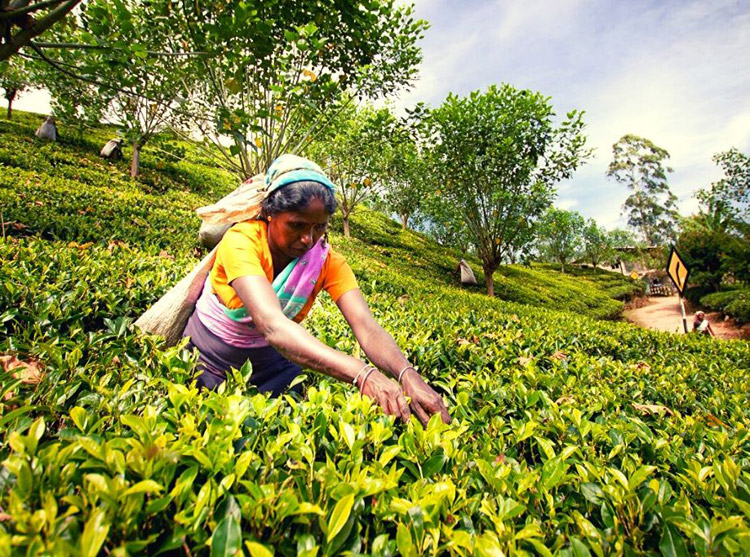
October 19, Colombo (LNW) Sri Lanka’s tea producers have been badly hit by previous government’s order to increase wages by 70%, although the industry recorded froth this year.

The US $1.3 billion industry produces popular Ceylon Tea and employs about 615,000 workers. The island annually exports about 95% of the 250 million kilos of tea it produces.

The previous government has ordered worker salaries be increased to 1,700 rupees ($5.66) per day from 1,000 rupeesa nd later revise dto Rs.1350 , which the industry says will increase tea production costs by 45%.

Sri Lanka’s tea crop has experienced a notable increase in production, despite facing adverse weather and other challenges.

 According to preliminary data from the Sri Lanka Tea Board, tea production in September reached a seven-year peak of 24.13 million kilos, marking a substantial 27.7% rise compared to last year’s figure of 18.9 million kilos.

During the first nine months of 2024, the tea crop saw a modest increase of 1.79% compared to the same period in 2022, indicating a gradual recovery following adverse policy impacts. Analysis by Forbes and Walker Research showed consistent growth across all elevations in September when compared to the same period in 2023.

High-grown tea production rose by 10.57% year-on-year to 4.59 million kilos, while medium-elevation tea increased by 38.04% to 4.10 million kilos. Low-grown tea also showed a significant rise of 31.75%, reaching 15.29 million kilos. However, green tea production fell by 6.82% year-on-year to 189,695 kilos, despite a slight improvement of 8.33% from September 2022.

 According to Asia Siyaka Commodities PLC, the low-grown tea figure for this year is the highest since 2017. The cumulative tea production for January to September 2024 totaled 196.22 million kilos, an increase of 2.73 million kilos compared to the same period last year.

 In a broader comparison, Forbes and Walker Research indicated that while most tea segments showed growth in 2024, high-grown and green tea production faced a decline. High-grown tea dropped by 8.43% year-on-year to 40.53 million kilos, while green tea saw a slight decrease of 1.07% to 1.68 million kilos.

 Industry growers have noted a significant rise in production costs, driven by increased prices for fertilizers, electricity, labor, and packaging. Despite these challenges, the Sri Lanka Tea Board reported that the total national production for 2023 was 256.04 million kilos, a modest increase from 251.84 million kilos in 2022.

 The tea industry aims to maintain production levels above 250 million kilos this year, as it continues to recover from previous lows and strives for stability.

SL MSMEs Urge Swift Reforms in Financing Relief to Secure Sector’s Survival

0

October 19, Colombo (LNW) Sri Lanka’s micro, small, and medium enterprises (MSMEs) have urged the newly formed government to initiate critical reforms in MSME financing within the next 60 days, emphasizing the need for interest waivers to support struggling businesses.

The call for action comes as the temporary relief from the suspension of parate execution is set to expire on December 15, threatening the stability of many MSMEs.

 The Ceylon Federation of MSMEs, led by President Mahendra Perera, has appealed for the waiver of accumulated interest on loans taken from 2019 to 2024 to alleviate the financial pressure on these enterprises.

Perera emphasized that MSMEs should be granted long-term repayment options with interest rates capped at 10%, and suggested that total interest payments should not exceed 50% of the original loan amount.

The federation estimates that MSMEs currently owe around Rs. 250 billion, with 60% of these loans classified as non-performing, and the interest amounting to approximately Rs. 60-70 billion. 

Perera also recommended amending the outdated 33-year-old parate execution law, proposing its temporary suspension for a year, and suggested returning auctioned properties to original owners to facilitate debt repayment.

In addition, the federation’s Vice President, S.N. Raghvan, highlighted the need for a comprehensive overhaul in MSME financing. He argued that although banks have recorded high profits recently, MSMEs’ contribution to the country’s GDP has declined sharply, indicating a dire need for financial reforms.

Raghvan proposed utilizing the Employees’ Provident Fund (EPF) and Employees’ Trust Fund (ETF) to secure loans for MSMEs, similar to measures taken during the domestic debt restructuring process. He stressed the urgency of implementing these changes within the next 60 days to ensure MSMEs are prepared for the country’s external debt repayments set to begin in 2028.

He concluded that a robust and well-supported MSME sector is crucial to prevent future economic challenges, urging the government to lay the groundwork for long-term financial stability in the sector.

Looking ahead to Sri Lanka’s external debt repayments beginning in 2028, Raghvan asserted the need for a strong MSME sector to avoid another default. 

“When we reach 2028, the MSMEs need to be stronger and prepared to handle the payments we have agreed to start repaying. Give them the platform and financial support they need, so they can be ready for what’s ahead,” he said.

Finance Ministry Denies Reports of Tax Increases on Imported Goods

0

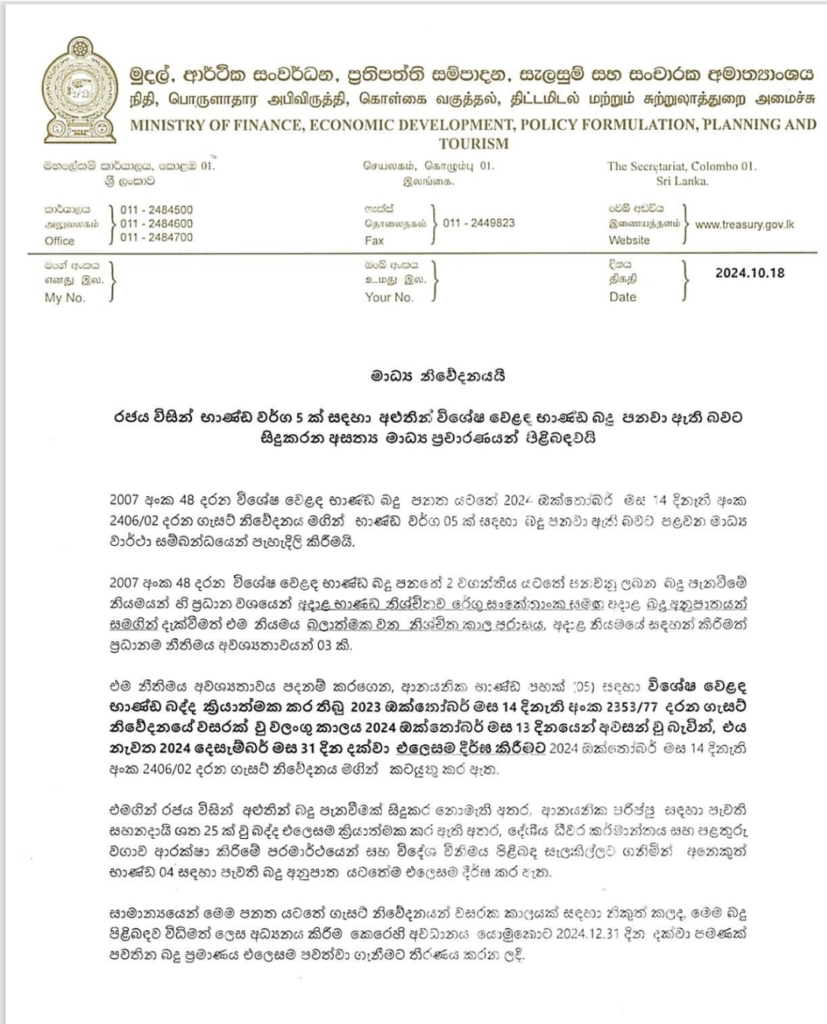
October 19, Colombo (LNW): The Ministry of Finance has clarified that recent reports about increased taxes on several imported goods are inaccurate. This clarification follows rumors that taxes on certain imported items were raised, effective from October 14 to December 31, 2024.

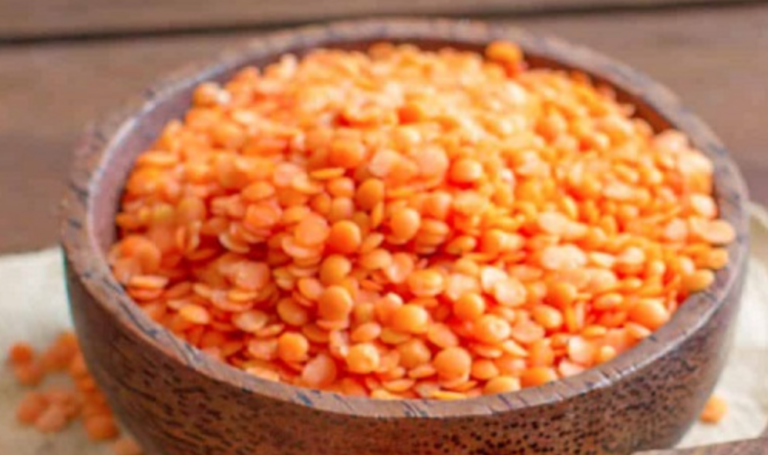
According to the Ministry, the confusion arose after the previous gazette on the special commodity levy expired on October 13, prompting a routine renewal of the gazette on October 14, 2024. The Ministry confirmed that the concessionary tax on imported lentils, which remains at 25 cents, has not been altered, along with tax rates for four other products.

This extension aims to support local industries, such as fishing and fruit cultivation, while also addressing foreign exchange concerns.

Businessman Petitions Court to Overturn Ministry of Defense Firearms Directive

0

October 19, Colombo (LNW): H.D. Navinthaka de Silva, CEO of Avenra Hotel Group, has filed a petition with the Court of Appeal, challenging a recent directive from the Ministry of Defense that mandates individuals holding licensed firearms for personal protection to surrender them. The petition, filed through attorney Sanath Wijayawardena, names the Secretary of the Ministry of Defense, the Director of the State Intelligence Service, and the Acting Inspector General of Police as respondents.

De Silva, who obtained the licensed firearms around 2012 or 2013 due to personal threats, argues that the decision significantly endangers his safety. He further noted that his business, including his hotels, suffered substantial damage during recent political unrest, heightening his security concerns.

The petitioner claims that the announcement made by the Secretary of Defense on October 7, calling for the return of personal protection firearms, places him at greater risk as a businessman. Despite appealing against the directive, de Silva has yet to receive a satisfactory response.

The petition requests the Court of Appeal to issue a writ order invalidating the Ministry’s directive. Additionally, de Silva seeks an interim injunction to suspend the order’s implementation until the case is fully heard and a final decision is reached.

PAFFREL Recommends Appointment of Financial Managers for Election Candidates

0

October 19, Colombo (LNW)The People’s Action for Free and Fair Election (PAFFREL) has urged candidates running for the general election to appoint a dedicated individual to manage their income and expense reports. PAFFREL Executive Director Rohana Hettiarachchi highlighted the importance of this step to avoid the challenges faced by some candidates during the last presidential election when submitting financial reports.

Hettiarachchi stressed that appointing a separate financial manager right after the election could help minimize difficulties and ensure smoother submission of financial documentation. He emphasized the need for candidates to be mindful of this issue to avoid any complications.

His remarks came in response to a media inquiry yesterday .