
August 17, Colombo (LNW): While ruins of monasteries where monks resided and palaces where kings lived have been discovered across various parts of Sri Lanka, recent archaeological excavations around the Yapahuwa Kingdom have uncovered rare evidence of an ancient city inhabited by the general public.
Following the collapse of the Polonnaruwa Kingdom due to the invasion of South Indian ruler Kalinga Magha, rulers and citizens migrated toward the southwestern region of Sri Lanka. Seeking security, the isolated rock fortress of Yapahuwa was chosen as the sanctuary for the Sacred Tooth Relic and the royal seat of the king.
Bringing these elements together, Yapahuwa became the fourth kingdom of Sri Lanka, famously known worldwide for its iconic staircase and lion sculptures.
Under the guidance and leadership of Professor Mangala Katugampala, new excavation work was initiated at the Yapahuwa Kingdom by the Central Cultural Fund. A key highlight of this archaeological investigation is the use of modern non-invasive technologies, including LiDAR and Ground Penetrating Radar (GPR), to explore beneath the surface without causing damage.
Professor Mangala Katugampala, leading the excavation team, shared his insights:
“We are currently in the area identified as the outer city of the Yapahuwa Kingdom. Based on research conducted between 1904 and 1909, H.C.P. Bell created a map in which this specific area was designated as a paddy field. That was all we knew when we arrived here.
Our goal was to uncover the 13th-century archaeological landscape of the outer city. In doing so, we discovered a unique underground clay pipe system that has never been found anywhere else in Sri Lanka.”
Three underground pipe systems were discovered within a single structure, running parallel to one another in the same direction.
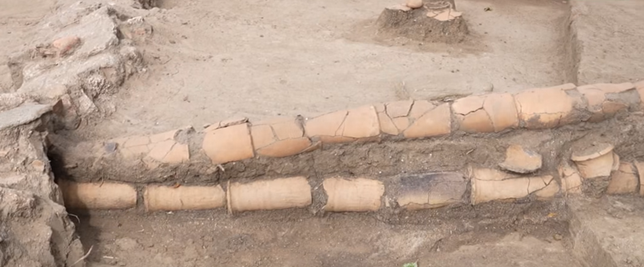
Elaborating on the discovery, the professor explained that clay pipes—designed with one end wider and the other narrower—were joined together, attempting to convey liquid outward. Furthermore, another pipe system runs parallel directly underneath, designed to transport substances from the outside inward using pressure.
While foreign coins had been found at Yapahuwa on previous occasions, the current excavations have revealed key discoveries that could offer new interpretations of Sri Lanka’s history:
- Local Coin Production: Copper nuggets formed by melting copper and pouring it into molds, early stages of hammered coins, and several completed copper coins were uncovered.
- Daily Life Artifacts: Clay lamps, clay pots, fragments of Chinese porcelain, metal nails, and various clay artifacts were found.
Researchers emphasise that these items were not used by monks; rather than serving a religious function, they offer clear evidence of urban characteristics and human activity during that era.
Ongoing excavations and research are expected to uncover many more unknown facts about the Yapahuwa Kingdom in the near future.
