
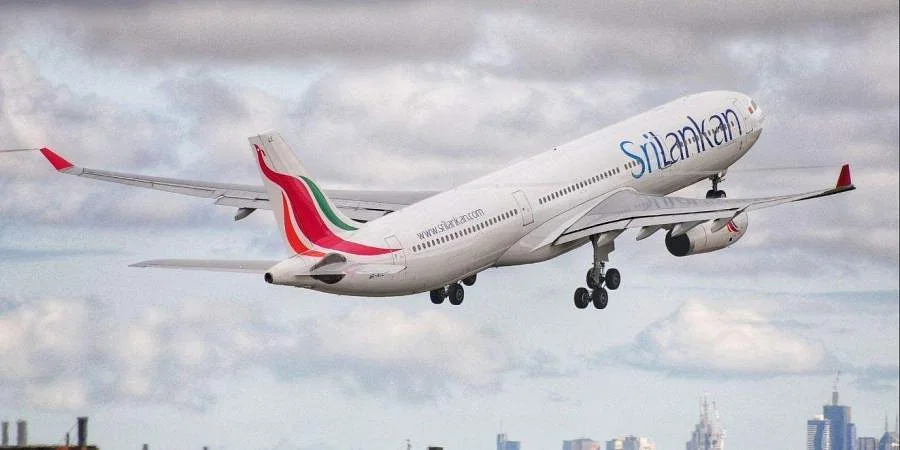
November 08, Colombo (LNW): SriLankan Airlines is once again under intense financial pressure, with escalating operating expenses, mounting debt and external economic uncertainties threatening its long-term financial stability. The national carrier, which was profitable in 2008, has accumulated losses exceeding Rs. 630 billion over the years, leaving the Government facing an increasingly difficult task of managing its financial obligations.
The latest assessment by the Ministry of Finance paints a concerning picture of the airline’s financial position, with the ongoing conflict in the Middle East, instability across West Asia and surging international fuel prices adding to its existing difficulties.
According to the Ministry’s Mid-Year Fiscal Position Report, SriLankan Airlines recorded a loss before tax of Rs. 35.6 billion during the first quarter of the 2026/27 financial year.
Unaudited management accounts submitted to the Ministry show that the airline’s revenue increased to Rs. 82.8 billion during the period, compared with Rs. 62.6 billion in the corresponding quarter of the previous financial year.
However, the improvement in earnings was overshadowed by a substantial escalation in expenditure. Total costs climbed by 40.4 per cent, from Rs. 67.8 billion to Rs. 95.2 billion, reflecting the growing financial strain on the airline.
The Ministry identified the sharp rise in aviation fuel prices as a major contributor to the deterioration, with fuel expenditure increasing by 93 per cent amid the conflict in the Middle East.
The combination of higher fuel bills and foreign exchange-related costs resulted in an estimated operating loss of Rs. 12.5 billion for the three-month period.
Beyond these immediate pressures, the report points to a number of longstanding problems that continue to undermine the airline’s financial health. These include inadequate liquidity, expensive aircraft maintenance, structural inefficiencies and a considerable debt burden.
The Government has meanwhile been compelled to provide financial assistance to keep the airline’s operations and financing requirements on track.
Following the restructuring of a US$175 million loan, a revised banking liability amounting to US$126.5 million was incorporated into the Government’s debt stock on 20 March. An additional US$30 million was also extended to address the airline’s immediate financing needs.
The latest financial difficulties, however, represent only the most recent chapter in a prolonged history of losses that has attracted considerable public attention and controversy.
In 2008, when the Government assumed control of SriLankan Airlines, the company had reported an annual profit of Rs. 4,899 million. Its subsequent financial performance took a markedly different direction, with the airline recording losses in the years that followed.
The circumstances surrounding the Government’s takeover also became controversial following reports that a senior political figure had sought to delay a scheduled London-Colombo flight to accommodate his return to Sri Lanka. The airline reportedly declined the request, and the incident subsequently became part of the wider debate surrounding political involvement in its affairs.
The airline’s financial records reveal the extent of the deterioration over the years. Losses stood at Rs. 9,996 million in 2009, before falling to Rs. 6,034 million in 2010 and Rs. 202 million in 2011.
The situation subsequently worsened, with losses increasing to Rs. 17,208 million in 2012, Rs. 26,857 million in 2013 and Rs. 31,365 million in 2014.
The downward trend continued in later years. SriLankan Airlines reported losses of Rs. 41,700 million in 2019, Rs. 44,139 million in 2020 and Rs. 49,704 million in 2021.
Its financial position suffered an especially severe setback in 2022, when losses reached Rs. 163,583 million. A further loss of Rs. 71,306 million was recorded in 2023, contributing to the accumulated losses now estimated to exceed Rs. 630 billion.
Apart from its financial performance, the airline has repeatedly faced scrutiny over management appointments, governance and alleged irregularities involving major commercial decisions.
One of the controversial appointments following the 2008 takeover was that of Nishantha Wickremesinghe, who became Chairman of the airline. He is the brother of Shiranthi Rajapaksa, the wife of former President Mahinda Rajapaksa.
His period at the helm subsequently attracted allegations concerning the handling of airline resources and financial transactions. Legal proceedings relating to alleged financial losses during that period are also under way.
Kapila Chandrasena, who assumed the position of Chief Executive Officer in July 2011, was another senior official whose tenure came under scrutiny.
Concerns regarding his conduct and alleged financial irregularities were raised in the J.C. Weliamuna report and various audit findings. He lost his position following the change of Government in 2015.
However, Chandrasena returned to the airline in a senior capacity during the 52-day Government formed on 26 October 2018, when Mahinda Rajapaksa became Prime Minister again. The decision to reinstate him attracted criticism in view of the allegations and questions previously raised about his tenure.
The controversial Airbus aircraft procurement agreement also became a major focus of investigations into the airline’s financial affairs. Allegations concerning payments and possible improper financial dealings emerged during related court proceedings.
Among the matters raised in court was an alleged payment of Rs. 100 million to Namal Rajapaksa. The allegations remain subject to the relevant legal proceedings and should be considered in that context.
The airline’s prolonged financial deterioration has therefore extended beyond the impact of international economic conditions, raising broader questions about corporate governance, management accountability and the effectiveness of successive attempts to restore its financial position.
Although the latest downturn has been aggravated by external developments, particularly the sharp increase in fuel costs and geopolitical uncertainty, the Ministry of Finance’s findings indicate that deeper structural problems remain unresolved.
The continuing need for Government assistance also highlights the wider implications of the airline’s difficulties. Financial support extended to the national carrier adds to the State’s fiscal responsibilities, potentially placing an additional burden on public resources.
With accumulated losses exceeding Rs. 630 billion, the challenge facing SriLankan Airlines is no longer simply one of overcoming a difficult financial year. It is about establishing a sustainable business model, restoring confidence in its management and reducing its dependence on public funds.
Whether the national carrier can reverse decades of financial setbacks will depend on its ability to address longstanding weaknesses while navigating an increasingly uncertain global aviation industry.