Home Blog Page 123

After X-Press Pearl: Why Sri Lanka Cannot Rely on Port Discretion to Prevent Maritime Disasters

0

By: Staff Writer

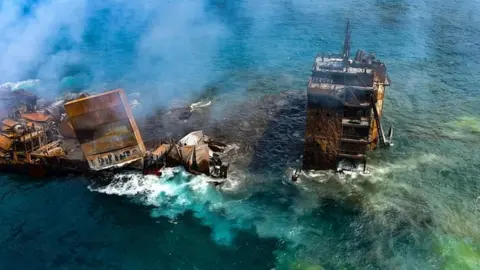
January 10, Colombo (LNW): When the MV X-Press Pearl burned and sank off Sri Lanka’s western coast in 2021, the disaster unfolded slowly enough for the world to watch — and yet quickly enough to become irreversible. What began as a manageable shipboard hazard evolved into one of the most severe environmental incidents in Sri Lanka’s maritime history, contaminating coastal waters, crippling fisheries and exposing deep weaknesses in how maritime emergencies are handled long before a vessel reaches port.

At the heart of the tragedy lies an uncomfortable truth: global shipping still operates in a system where ports may choose whether to help a vessel in difficulty, even when refusing assistance carries foreseeable environmental consequences for another country.


A System Built on Choice, Not Obligation

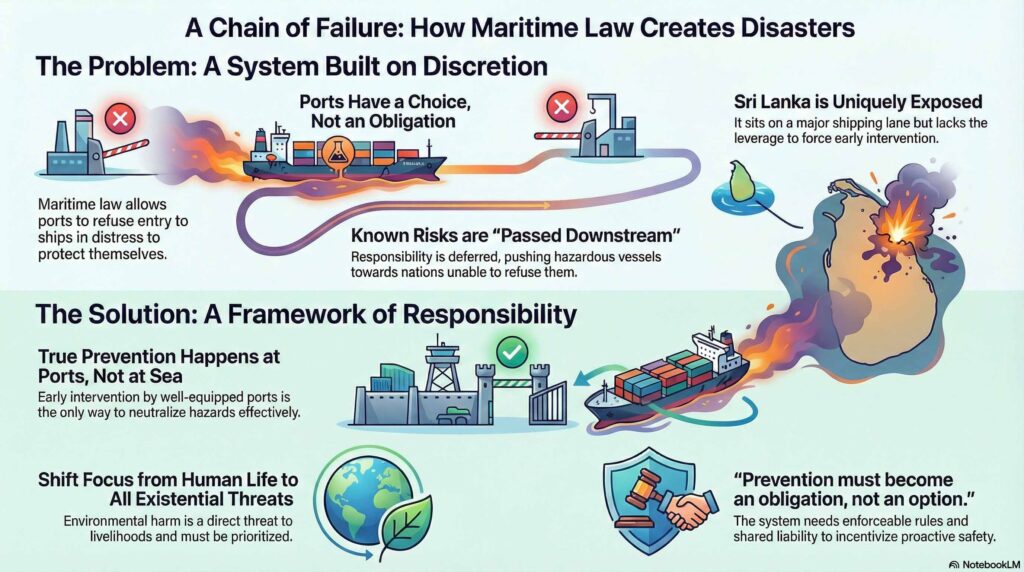
Modern maritime law is surprisingly vague when it comes to compelling action before disaster strikes. While shipmasters have clear duties to protect life and report dangers, ports and coastal states retain wide discretion in deciding whether to accept a vessel experiencing technical or cargo-related distress. The logic is understandable: allowing a damaged ship into port may expose infrastructure, workers and nearby populations to risk.

But the X-Press Pearl demonstrated the darker side of this discretion. A hazardous chemical leak was identified well before the ship reached Sri Lankan waters. Yet at each stage of its journey, responsibility was deferred rather than resolved. By the time the vessel was anchored off Colombo, Sri Lanka had inherited a crisis it neither created nor could safely contain.

This is not a failure of goodwill. It is a failure of structure.


Why Sri Lanka Is Uniquely Exposed

Sri Lanka’s geography places it directly along one of the world’s busiest shipping corridors. Thousands of vessels pass close to its coastline every year, many carrying hazardous or chemically sensitive cargo. Yet unlike major industrial maritime states, Sri Lanka lacks both the legal leverage and specialised infrastructure to force early intervention when risks first emerge elsewhere.

The X-Press Pearl did not arrive as an unforeseen emergency. It arrived as a known problem that had been pushed downstream — geographically and legally — until it became someone else’s disaster. For Sri Lanka, this exposes a systemic imbalance: coastal states bear the environmental cost of inaction, while upstream ports face little consequence for refusing assistance.


The Cost of Waiting Until Pollution Occurs

Most maritime emergency frameworks prioritise immediate threats to human life. This is both logical and humane. But pollution risks are treated as secondary — something to be managed once containment has failed. The X-Press Pearl reversed this assumption. There was no mass casualty event, yet the long-term damage to ecosystems, livelihoods and public trust has been profound.

Sri Lanka’s experience highlights a critical flaw in current thinking: environmental harm is not an abstract future risk. For coastal communities, it is an existential threat. Fishing bans, contaminated beaches and long-term ecological uncertainty carry social and economic consequences that rival those of conventional maritime disasters.


Ports as Gatekeepers of Prevention

The uncomfortable lesson of X-Press Pearl is that prevention in maritime disasters does not happen at sea — it happens at ports. Decisions taken days or weeks earlier, in different jurisdictions, shape whether a hazard is neutralised quietly or allowed to escalate into catastrophe.

Yet ports are currently incentivised to refuse risk. There is no binding obligation to accept a vessel in distress, no shared liability mechanism, and no guarantee that helping today will not become tomorrow’s legal burden. As a result, rational self-protection often outweighs collective environmental responsibility.

For Sri Lanka, this is a dangerous equilibrium. The country sits at the receiving end of maritime risk, without corresponding influence over upstream decisions.


Moving Beyond Reaction Towards Responsibility

The legacy of X-Press Pearl should not be confined to compensation battles and clean-up assessments. It should force a rethinking of how risk is distributed across the global shipping system. Coastal states like Sri Lanka cannot continue to absorb the consequences of a framework that allows hazards to be passed along until geography makes refusal impossible.

This does not mean ports must open their gates indiscriminately. It means the international community must develop enforceable mechanisms that reward early intervention, share liability fairly and treat environmental prevention as seriously as loss of life. Without this shift, disasters will continue to migrate towards the most exposed coastlines.


A Lesson Written on Sri Lanka’s Shore

The X-Press Pearl did not fail because no one acted. It failed because everyone acted too late, within a system that permits delay without consequence. For Sri Lanka, the lesson is stark: relying on discretion, goodwill and voluntary guidelines is not enough in an era of hazardous global trade.

Unless prevention becomes an obligation rather than an option, the next maritime disaster will not be a question of if, but where — and history suggests it will once again be on the shores least equipped to refuse it.
Sri Lanka’s Garment Industry Set to Soar under New UK Trade Rules

0

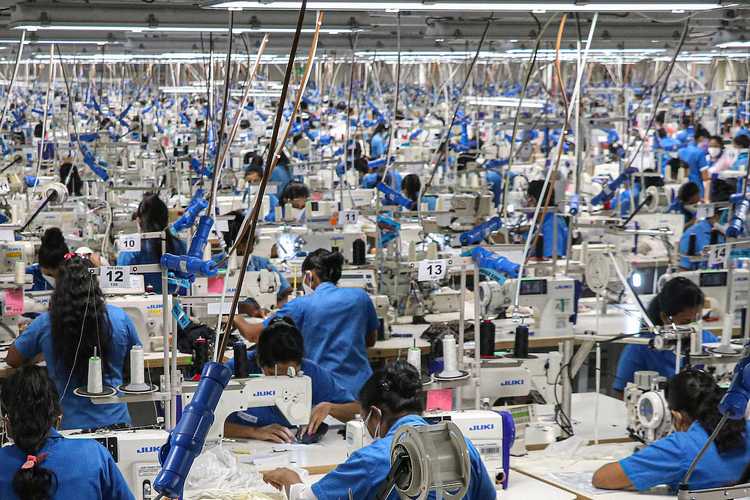
A technical change in trade rules rarely makes headlines. But the UK’s overhaul of its Developing Countries Trading Scheme may prove to be a turning point for Sri Lanka’s export-driven economy particularly its powerful garment sector.

At the centre of the reform is a simple but transformative shift: Sri Lankan garment manufacturers can now import all their inputs from any country and still export finished products to the UK tariff-free. This removes long-standing constraints that limited sourcing options and inflated production costs.

For years, Sri Lanka’s apparel sector despite its reputation for ethical manufacturing and quality has been squeezed by stricter origin rules than many regional competitors. Manufacturers often paid more for fabric or delayed production to comply with sourcing requirements. The new rules effectively dismantle those barriers.

Industry leaders say the timing is critical. Global apparel markets are under pressure from rising costs, volatile demand, and geopolitical disruptions. The ability to pivot quickly between suppliers could mean the difference between securing orders and losing them.

The reforms extend beyond clothing. The creation of an 18-country Asia Regional Cumulation Group opens new possibilities for exporters in food processing, rubber products, and light manufacturing. Inputs sourced from regional partners will now qualify for preferential access to the UK, potentially lowering costs across multiple sectors.

Council for Business with Britain President Mark Surgenor described the changes as an opportunity that extends well beyond apparel. While garments stand to gain the most immediately, he emphasised the importance of wider uptake, noting that many eligible exporters still fail to utilise zero-tariff access due to lack of awareness or administrative complexity.

Government lobbying played a role in securing the reforms. The changes respond to sustained requests from Sri Lanka and industry bodies such as the Joint Apparel Association Forum, which has long argued that restrictive origin rules undermined competitiveness rather than encouraging local value addition.

Still, the benefits are not automatic. Exporters must understand the revised compliance framework, restructure contracts, and reassure buyers that quality and sustainability standards will remain intact. There is also concern that over-reliance on imported inputs could weaken domestic backward linkages if not managed carefully.

However for an economy seeking export-led recovery, the opportunity is significant. With the UK market now more accessible than at any point in recent history, Sri Lanka’s ability to convert regulatory reform into real growth will be closely watched—by competitors, investors, and workers alike.

Sri Lanka’s Export Push: Ad Hoc Drive or Calculated Boost? Critics Weigh In

0

Sri Lanka Expo 2026 is a Major Export Showcase The Expo will be held from June 18 to 21 but Critics Say the Government’s Export Drive Lacks Strategic Depth.

As Expo Sri Lanka 2026 nears  a four-day showcase expected to bring together 750 exporters and 1,500 international buyers, investors and media  questions are emerging about whether the event reflects a genuinely strategic export push or simply an ad hoc effort to project economic recovery.

Organized by the Export Development Board (EDB) and ministry partners, the Expo aims to spotlight Sri Lanka as an investment hub, promote products across 24 industry categories, and accelerate the country’s march toward a $36 billion export target by 2030. The event’s agenda includes investor forums, thematic pavilions on innovation and sustainability, and even cultural showcases.

The concept is compelling but critics argue the broader export strategy behind these efforts remains murky. While the government has referenced frameworks like a National Export Strategy process initiated in 2025 involving consultations with industry stakeholders, there is no widely publicized, fully implemented strategy detailing sector priorities, regulatory reforms, or actionable timelines.

Exporters and trade analysts say that without a clear playbook, the country risks repeating past cycles where ambition outpaced implementation. Underlying constraints  from unpredictable trade regulation to customs inefficiencies  have long hampered Sri Lanka’s export competitiveness.

For firms eyeing foreign markets, consistency and clarity matter. Events like Expo 2026 can generate leads, but sustained export growth requires systemic reform: simplified trade logistics, streamlined compliance, and targeted support for emerging sectors such as technology, processed food and lifestyle products.

Additionally, Sri Lanka’s economy is still recovering from climate shocks and slow global demand. Export-led growth could help bridge balance-of-payments gaps, but only if policy and implementation mechanisms are aligned. Critics warn that a “scattergun” approach where high-profile expos are not backed by enduring policy measures  could deliver short-lived wins without long-term structural change.

Local exporters point out that participation in global expos and networking forums should be embedded within a comprehensive trade policy that prioritizes high-growth markets and sectors, fosters innovation, and resolves persistent operational barriers.

Supporters of Expo 2026 argue the event can be a catalyst that bringing buyers and sellers together on Sri Lankan soil could unlock deals and partnerships that elevate Sri Lanka’s global trade profile. Complementary incentives like accommodation support and airline discounts aim to enhance buyer participation.

But for meaningful export transformation, Sri Lanka not only needs marquee events but policy depth, consistency, and performance-oriented governance structures. Otherwise, Expo 2026 risks being remembered as a headline moment rather than a turning point in the nation’s export trajectory

Saudi Market Surge Lifts Sri Lanka’s Export Momentum

0

Sri Lanka’s economic engagement with Saudi Arabia gathered strong momentum in 2025, delivering measurable gains in exports, trade volumes, tourism, and overseas employment at a time when the island nation is prioritising external sector recovery.

Exports from Sri Lanka to Saudi Arabia rose by 19 percent between January and September 2025, compared with the same period in 2024, while total bilateral trade expanded by 9 percent, reflecting deepening commercial ties between the two economies. The growth was driven by a coordinated trade-promotion strategy led by the Sri Lankan Embassy in Riyadh in partnership with multiple state institutions.

“This double-digit export growth in 2025 is an outstanding achievement and reflects sustained, well-coordinated efforts to position Sri Lankan products competitively in the Saudi market,” Sri Lanka’s Ambassador to Saudi Arabia Ameer Ajwad said, noting that trade exhibitions and business matchmaking played a key role.

Saudi Arabia remains a major destination for Sri Lankan tea, spices, fruits, vegetables, coconut-based products, processed foods including frozen seafood, construction materials, and consumer goods. In parallel, Sri Lanka continues to import energy and other essential commodities from the Kingdom, underlining the strategic importance of the trade relationship.

Private-sector engagement intensified in 2025, with ten Sri Lankan business delegations visiting Saudi Arabia across sectors such as food and beverages, agriculture, construction materials, tourism, furniture, and manpower services. The launch of Ceylon Biscuits Ltd. products in the Saudi market further strengthened Sri Lanka’s branded export presence.

A landmark institutional development was the creation of the first Saudi Sri Lanka Joint Business Council, launched in November 2025, aimed at facilitating structured dialogue, investment flows, and private-sector partnerships. Tourism and manpower roadshows, held after multi-year gaps, reopened key channels for foreign exchange inflows and employment opportunities.

Together, these initiatives signal a more strategic and diversified partnership that supports Sri Lanka’s export earnings, employment generation, and long-term economic engagement with the Middle East.

India’s Disaster Diplomacy: Aid, Rupees, and Regional Influence

0

India has moved swiftly to position itself as Sri Lanka’s most reliable first responder following the island’s recent cyclone and flood catastrophe. New Delhi has committed a substantial USD 450 million recovery package, of which nearly USD 350 million will be disbursed in Indian rupees, blending humanitarian concern with strategic regional engagement.

Indian High Commissioner to Sri Lanka, Santosh Jha, announced that USD 100 million of the assistance will be provided as outright grants, easing Colombo’s burden at a time when fiscal space remains constrained.

The remaining support will be delivered through a multi-pronged reconstruction program targeting sectors hardest hit by the disaster. These include damaged roads, railways and bridges, housing reconstruction, agriculture, health and education infrastructure, and improved disaster preparedness mechanisms.

One of the most visible components of India’s intervention is infrastructure rehabilitation. Nearly USD 30 million has been earmarked to rebuild cyclone-damaged bridges, while Indian assistance will also extend to restoring rail connectivity.

Sri Lankan officials estimate rail reconstruction costs could exceed USD 330 million, with the upcountry lines suffering the worst damage. India has pledged to immediately reconstruct the Northern Railway line at an estimated cost of USD 5 million.

Notably, the Northern Railway was originally built by India’s state-owned engineering firm IRCON, using welded rails and reinforced foundations capable of supporting train speeds of up to 100 kilometers per hour. This stands in sharp contrast to Sri Lanka’s aging rail network elsewhere, where deteriorated tracks force trains to crawl at 20 kmph to avoid derailments.

India’s decision to denominate most of the aid package in Indian rupees reflects both pragmatism and precedent. Sri Lanka can readily use rupee-denominated funds as long as Indian suppliers accept payments in that currency. This mechanism mirrors Japan’s long-standing yen loan model and China’s yuan-based financing in Sri Lanka, underscoring how disaster assistance increasingly intersects with monetary diplomacy.

The aid rollout will be overseen through a joint monitoring mechanism involving multiple Sri Lankan ministries and India’s High Commission, with the first coordination meeting already held in late December. This structured oversight aims to ensure speed, transparency, and political visibility.

Beyond humanitarian relief, India’s response reinforces its role as Sri Lanka’s closest economic and strategic partner at a time when regional competition for influence remains intense. While the immediate objective is recovery from cyclone devastation, the broader implication is clear: disaster diplomacy has become a central pillar of India’s neighborhood-first strategy.

Sri Lanka Records Drop in Average Tourist Spending in 2025 Despite Higher Arrivals

0

Sri Lanka recorded a decline in average tourist spending in 2025, even as visitor arrivals rose sharply, according to official data released by the Central Bank.

Tourist arrivals increased to 2,362,521 in 2025 from 2,053,465 in 2024, reflecting a year-on-year growth of 15.1 percent. However, total tourism earnings rose only marginally to USD 3,219.2 million in 2025, compared to USD 3,168.6 million the previous year—an increase of just 1.6 percent.

Based on these figures, the average spending per tourist declined to approximately USD 1,363 in 2025, down from about USD 1,544 in 2024. This represents a reduction of nearly USD 181 per visitor, or a year-on-year decline of around 11.7 percent.

The data indicate that while Sri Lanka successfully attracted a larger number of tourists in 2025, visitor spending did not grow in proportion to arrivals.

Tourism analysts suggest the decline in per-capita spending may be attributed to shorter average stays, shifts in the composition of source markets, or an increase in arrivals from more price-sensitive segments. They note that the trend highlights the need for Sri Lanka to focus not only on increasing tourist numbers, but also on promoting higher-value tourism to strengthen foreign exchange earnings.

Trump Reiterates Push for U.S. Control of Greenland Despite International Opposition

0

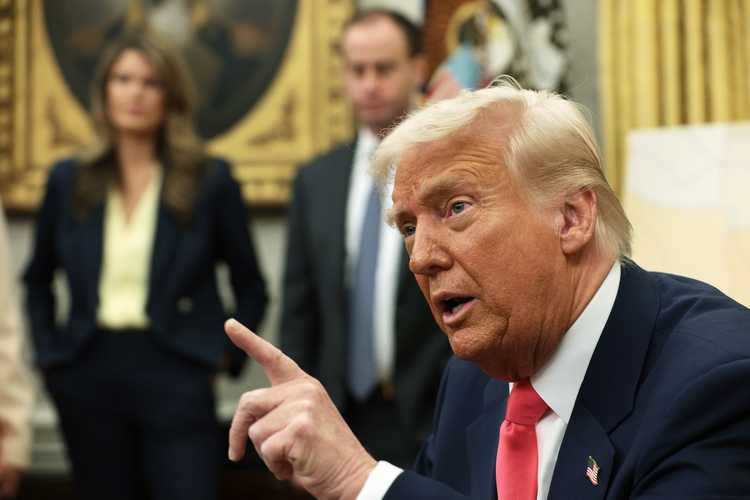
US President Donald Trump on Friday renewed his push for American control of Greenland, stating bluntly that the United States would act “whether they like it or not,” citing national security concerns.

Speaking to reporters while hosting oil executives at the White House for discussions on investments in Venezuela, Trump said that if the US does not take action, rival powers such as Russia or China could move in.

“Because if we don’t do it, Russia or China will take over Greenland, and we’re not going to have Russia or China as a neighbor,” he said.

Trump has repeatedly expressed his desire to acquire Greenland, an autonomous territory within the Kingdom of Denmark, either through purchase or by military means. His remarks have drawn strong opposition from Greenland, Denmark, and several European allies.

Greenland’s head of representation to the United States, Jacob Isbosethsen, reiterated this position on Thursday after a closed-door meeting with members of Congress.

“Greenland is not for sale. Our Prime Minister Jens-Frederik Nielsen and our Foreign Minister Vivian Motzfeldt have made it very clear. Our country belongs to the Greenlandic people,” he told journalists.

When asked how much money might persuade Greenland to agree, Trump said he was “not talking about money yet,” adding that while he preferred an “easy” deal, the US would act “the hard way” if necessary.

Lawmakers from both major US parties have also expressed skepticism about Trump’s ambitions. Senator Roger Wicker, the top Republican on the Senate Armed Services Committee, said there was no willingness from Denmark or Greenland to negotiate any transfer of sovereignty.

Similarly, Democratic Senator Jeanne Shaheen, chair of the Senate Foreign Relations Committee, stressed that Greenland, Denmark, and the United States are long-standing allies who share common values and cooperate closely.

House Speaker Mike Johnson, a key Trump ally, dismissed suggestions that military force would be used, saying Congress was not seriously considering such an option.

However, Vice President JD Vance defended the administration’s interest in Greenland, urging European leaders to take Trump’s words seriously. He emphasized Greenland’s strategic importance, particularly for missile defense, and warned of growing interest in the region from “hostile adversaries.”

Meanwhile, US Secretary of State Marco Rubio is expected to meet next week with counterparts from Denmark and Greenland, following their request for urgent talks on the issue.

Government Does Not Protect Individuals Based on Status – Prime Minister

0

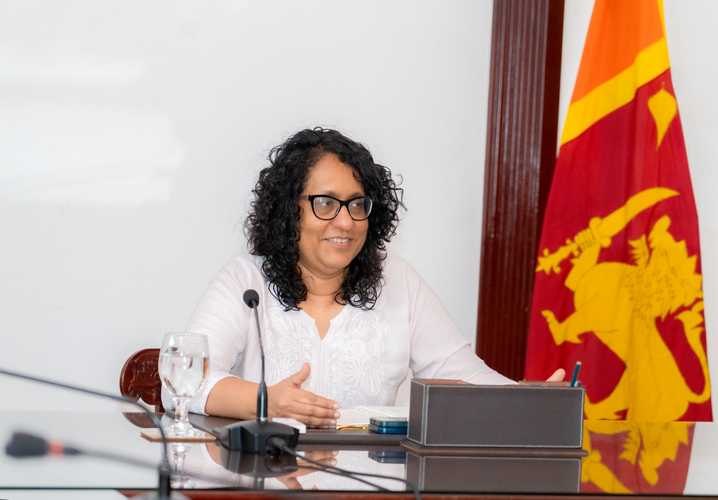
Prime Minister Dr. Harini Amarasuriya stated in Parliament that the Government does not act to protect any individual based on their status, stressing that this is clearly reflected in the judicial processes currently underway.

She made these remarks in response to a question raised by Samagi Jana Balawegaya (SJB) MP Ajith P. Perera, according to the Prime Minister’s Media Division.

The Prime Minister said that in line with the policy framework “A Thriving Nation, A Beautiful Life” presented by President Anura Kumara Dissanayake as the National People’s Power presidential candidate at the 2024 Presidential Election, the Government is committed to upholding the rule of law and maintaining an independent judiciary.

Accordingly, steps are being taken to review cases that were previously withdrawn by the Bribery Commission and the Attorney General’s Department, and to re-file cases where appropriate. She noted that during the period from 2019 to 2024, a total of 102 cases had been withdrawn. Of these, action has been taken to re-file 65 cases, while a decision has been made not to re-file 34 cases. A further three cases are still under consideration.

Referring to the ongoing judicial process, the Prime Minister said it is evident that the Government is not acting to protect anyone, as legal proceedings are currently underway against several individuals, including those who are in Parliament as well as those outside it.

She added that certain incidents dating back 15 to 20 years are now being re-investigated and prosecutions initiated accordingly, noting that such legal processes inevitably require time.

Emphasizing that decisions are not made based on the status or position of individuals, the Prime Minister said all necessary actions are being taken strictly in accordance with the evidence available in each case. She reiterated that the Government will not protect anyone under any circumstances.

She further remarked that it is “laughable” for those who had protected one another under previous governments to now question the integrity of the judicial process when it is being carried out properly, the statement added.

Foreign Minister Bids Farewell to Outgoing US Ambassador Julie Chung

0

Sri Lanka’s Minister of Foreign Affairs, Foreign Employment and Tourism, Vijitha Herath, today received a farewell call from the outgoing United States Ambassador to Sri Lanka, Julie Chung, who is set to conclude her four-year tenure in Colombo.

In a post on social media platform ‘X’, Minister Herath said he expressed his appreciation for Ambassador Chung’s indefatigable efforts to strengthen bilateral relations between Sri Lanka and the United States during her tenure from 2022 to 2026.

He also conveyed special thanks for her swift coordination of assistance from US authorities in the aftermath of Cyclone Ditwah, which affected several parts of the country.

“I wish her the very best in her next assignment,” the Minister stated.

Ambassador Julie Chung is expected to depart Colombo on January 16, marking the conclusion of her service as the United States’ top diplomat in Sri Lanka. She assumed duties as Ambassador in February 2022 and served for nearly four years.

WEATHER FORECAST FOR 10 JANUARY 2026

0

The deep depression over the southwest Bay of Bengal was located about 100 km north-northeast of Trincomalee at 4:00 a.m. on 10 January 2026. It is moving northwestwards and is likely to weaken into a depression by around 5:30 a.m. today. It is very likely to cross the Sri Lanka coast between Trincomalee and Jaffna around noon.

Cloudy skies can be expected over the Northern half of the island.

Showers or thundershowers will occur at times in Northern province and in Puttalam, Anuradhapura and Trincomalee districts. Heavy falls above 100 mm are likely at some places in the Northern province.

Several spells of showers may occur in the Kurunegala, Polonnaruwa and Matale districts.
Showers or thundershowers may occur at a few places elsewhere during evening or night.

Very strong winds about (50-60) kmph and gusting up to 70 kmph can be expected at times over Northern province. Strong winds about (40-50) kmph can be expected at times over North-western province and in Matale, Trincomalee and Nuwara-Eliya districts.

The general public is kindly requested to take adequate precautions to minimize damages caused by temporary localized strong winds and lightning during thundershowers.