Home Blog Page 1260

ADB grants US$200 million for economic stabilization efforts in Sri Lanka.

0

By: Staff Writer

Colombo (LNW): The Asian Development Bank (ADB) has approved the eligibility of Sri Lanka to access concessional financing.

The availability of concessional assistance, offered at low interest rates, broadens Sri Lanka’s options to bridge its urgent development financing needs to restore economic stability and deliver essential services, particularly to the poor and vulnerable.

Eligibility for concessional resources among the developing member countries of ADB is based on gross national income per capita and creditworthiness.

ADB’s decision was considered based on a request from the Government of Sri Lanka in view of the severe and unprecedented economic crisis that has reversed hard-won development gains.

The Asian Development Bank (ADB) has sanctioned a US$ 200 million concessional loan for Sri Lanka to help stabilize the country’s finance sector following the sovereign debt and economic crises that started in April 2022 after it suspended its external debt payments.

The Financial Sector Stability and Reforms Program comprises two subprograms of USD 200 million each.

In a statement, the ADB said subprogram targets short-term stabilization and crisis management measures that were implemented in 2023, while subprogram 2 is planned to be implemented in 2024 and focuses on structural reforms and long-term actions to restore growth in the banking sector.

The program will help strengthen the stability and governance of the country’s banking sector; improve the banking sector’s asset quality; and deepen sustainable and inclusive finance, particularly for women-led micro, small, and medium-sized enterprises.

According to the International Monetary Fund’s (IMF) latest review, Sri Lanka’s economy is showing tentative signs of stabilization, although a full economic recovery is not yet assured, the statement reads.

“The program’s overarching development objective is fully aligned with the country’s strategy of maintaining finance sector stability, while ensuring that banks are well-positioned for eventual recovery,” said ADB Country Director for Sri Lanka Takafumi Kadono.

“The expected development outcome is a stable financial system providing access to affordable finance for businesses in various sectors of the economy.”

The program is a follow-on assistance from ADB’s crisis response under the special policy-based loan that was approved for Sri Lanka in May 2023. It is aligned with the fourth pillar of the IMF’s Extended Fund Facility provided to Sri Lanka to help the country regain financial stability.

The program is also in line with the government’s reform agenda, including strengthening the operational independence of the Central Bank of Sri Lanka (CBSL) and its designation as the country’s macroprudential authority.

In designing this subprogram 1 loan, ADB has maintained close coordination and collaboration with the IMF to design targeted regulatory reforms for the banking sector—including the asset quality review—and with the World Bank on strengthening the deposit insurance scheme.

The loan is accompanied by a US$ 1 million grant from ADB’s Technical Assistance Special Fund to provide advisory, knowledge, and institutional capacity building for Sri Lanka’s Ministry of Finance and CBSL.

SriLankan Airlines flies double daily to Mumbai.

0

By: Staff Writer

Colombo (LNW): SriLankan Airlines has introduced double daily flights between Colombo and Mumbai, multiplying the convenience for passengers travelling to and from India’s financial and entertainment capital.

The new double daily service to Mumbai will not only give a 50% boost to SriLankan’s capacity on its Mumbai route, but will also strengthen the airline’s already vast network in India.

Flights UL 142 and UL 144 will depart daily from Mumbai to Colombo at 3:10hrs and 20:45hrs, respectively.

Flights UL 141 and UL 143 from Colombo to Mumbai will depart at 23:45hrs and 17:10hrs, respectively.

Passengers travelling out of Mumbai on SriLankan Airlines will now have the advantage of more flight options to Colombo and convenient connections via Colombo to popular destinations in the Far East, Europe and Australia including Singapore, Kuala Lumpur, Bangkok, London, Frankfurt, Paris, Melbourne and Sydney.

Worldwide Sales and Distribution Head Dimuthu Tennakoon said: “The Indian market has been incredibly important to SriLankan Airlines since the get-go, and with India fast becoming one of the world’s largest outbound travel markets, we are only happy to expand our operations in one of India’s most celebrated cities and make travel between Mumbai and Colombo extra seamless.

Our frequency increase comes on the heels of Sri Lanka announcing free visa for Indian visitors and we hope that these positive developments will encourage more travellers from Mumbai to stop by Sri Lanka.”

India is the only country with nine cities featured in SriLankan Airlines’ network. This includes Delhi, Bangalore, Hyderabad, Kochi, Trivandrum, Chennai, Trichy and Madurai in addition to Mumbai, to which altogether SriLankan operates close to 100 flights every week.

Given the geographic and cultural proximity of the two countries, most Indians are likely to find a welcoming familiarity in Sri Lanka not found elsewhere, and SriLankan Airlines is the best bet for Indians who want to experience the best of both worlds onboard.

Customers will be able to savour mouth-watering Indian vegetarian and non-vegetarian cuisine while enjoying the warmth and friendliness that embody the essence of Sri Lanka and its national carrier.

SriLankan Airlines’ outstanding service in the region was recently recognised at the South Asian Travel Awards (SATA) in Bangalore, India, where the airline was crowned the Leading International Airline – South Asia and Leading Airline Class – Business Class.

Sectoral Oversight Committee Paves the Way for Plastic Reduction and Recycling

0

Under the guidance of Parliamentarian Ajith Mannapperuma, the Sectoral Oversight Committee (SOC) on Environment, Natural Resources, and Sustainable Development recently convened to address pressing concerns regarding the reduction of plastic and polythene usage, along with strategies for enhancing recycling processes in Sri Lanka.

Representatives from key government bodies—the Environment Ministry, Central Environment Authority, Sri Lanka Customs, and Agricultural Development Department—were summoned before the committee for deliberations.

A substantial portion of the meeting was dedicated to discussing the detrimental environmental impact of lunch sheets commonly used in the country and the adverse effects of phthalates, identified as carcinogens, on human health. Consequently, the SOC on Environment, Natural Resources, and Sustainable Development has recommended to the Central Environment Authority a phased ban on lunch sheets, allowing a six-month grace period to phase them out and introduce viable alternatives. Officials emphasized that no other country in the world uses lunch sheets, underscoring their significance in urging against their use.

Furthermore, proposed amendments to the Environment Act were thoroughly reviewed by the committee. Specific measures were suggested to curtail the use of polythene and plastic.

A notable recommendation involves assigning responsibility for the collection of plastic bottles for recycling to their producers and distributors. Officials highlighted plans to implement a system, potentially utilizing QR codes and new technology, to track the collection and inclusion of plastic bottles in the recycling process. The committee stressed the importance of incentivizing the return of empty bottles to enhance the efficiency of recycling efforts.

Additionally, the committee chair instructed officials to compile a report identifying single-use plastic equipment and materials currently imported into Sri Lanka. This report aims to scrutinize and enumerate these items, fostering a better understanding of the landscape. Members of Parliament Jayantha Ketagoda, Dr. Thilak Rajapakshe, Waruna Liyanage, alongside representatives from the Environment Ministry, Central Environment Authority, and Sri Lanka Customs, were all present during this pivotal committee session.

Kelaniya University Faculties to Reopen Following Campus Closure

0

The Kelaniya University Vice Chancellor has outlined plans for the phased reopening of faculties after the recent temporary closure earlier this week.

As per the latest announcement, the Faculties of Science, Computer Technology, and Management Studies are set to resume classes on December 11 (Monday), while the Faculty of Social Sciences and Humanities is slated to reopen on December 18.

The decision to temporarily close down all faculties, excluding the Faculty of Medicine, was initiated last Monday (4) in response to an alleged assault on a security officer by a group of university students. Students were promptly instructed to vacate their hostels by 8:00 am on Tuesday (5).

The closure was imposed by the Kelaniya University Administration Authority following reports of the security officer’s purported abduction and assault while he was asleep in the break room. Subsequently, he was found tied to the entrance gate at the student center.

Expressing concern over the incident, the Vice Chancellor emphasized its disruptive impact on the peaceful campus environment shared by students and non-academic staff members. The administration pledged to take disciplinary measures against those found responsible for the disruption.

In the aftermath of the assault, non-academic staff members staged a protest, seeking assurances regarding their safety on campus. In connection to the alleged incident, four students have been suspended as of December 5 pending further investigation.

The university administration is actively addressing the situation to restore normalcy and ensure a safe and conducive environment for all members of the Kelaniya University community.

Sri Lanka’s ‘Temple to Temple Diplomacy’ Forges Cultural Bonds Across ASEAN Nations and South Korea

0

The Sri Lankan Foreign Ministry, in collaboration with its missions in ASEAN countries and South Korea, alongside the Department of Buddhist Affairs, has unveiled the ‘Temple to Temple Diplomacy Programme.’ This groundbreaking initiative, conceived by State Minister of Foreign Affairs Tharaka Balasuriya under the guidance of President Ranil Wickremesinghe and Foreign Minister Ali Sabry, aims to bridge connections between temples and religious communities in Sri Lanka and ASEAN nations. Its mission: fostering mutual understanding, cultural exchanges, and economic ties.

This unique programme facilitates a range of activities including visits by Buddhist monks between countries, platforms for interfaith dialogue and cultural interchange, and avenues for collaborative projects.

Recently, a significant step was marked with a media conference featuring a Vietnamese delegation, a part of the ‘Temple to Temple Diplomacy Programme.’ The event, attended by Foreign Minister Ali Sabry, State Minister Tharaka Balasuriya, and representatives from both Sri Lanka and Vietnam, highlighted the collaborative efforts in promoting religious and cultural diplomacy.

In its initial phase, selected Buddhist monks from Sri Lanka have received invitations from various temples in Indonesia, Malaysia, Myanmar, South Korea, and Vietnam, courtesy of Sri Lanka’s missions abroad. This exchange aims to lay the groundwork for reciprocal visits by monks from these countries to Sri Lankan temples in the forthcoming phases.

As part of this initiative, a group of Sri Lankan monks has already visited several countries, while foreign monks are anticipated to embark on visits to Sri Lankan temples in the subsequent phases. The successful completion of the first phase in Vietnam has seen reciprocal gestures, with Vietnamese monks and travel agents currently in Sri Lanka for a Buddhist pilgrimage tour, nurturing cultural and religious diplomacy between the two nations.

This ambitious programme has six primary objectives, including connecting Sri Lankan temples with ASEAN counterparts, promoting cultural and religious diversity understanding, fostering interfaith dialogue, encouraging joint initiatives for peace and harmony, enhancing diplomatic ties, and boosting sustainable tourism and economic cooperation between nations.

Notably, the initiative operates without government funding, as host temples provide accommodation and other necessities for visiting monks. Nearly 50 temples in ASEAN nations have expressed interest in hosting Sri Lankan monks under this programme, selected by the All Island Buddha Sasana Council of Sri Lanka based on their potential contributions.

Looking ahead, the Foreign Ministry plans to expand the programme to Singapore, Japan, Thailand, and Cambodia in its next phase, building upon the successful visits to South Korea, Indonesia, and Vietnam.

With several visits already completed and more planned, the ‘Temple to Temple Diplomacy Programme’ stands poised to deepen cultural ties and foster people-to-people connections between Sri Lanka and its partner nations, notably Vietnam, in the forthcoming stages.

Sri Lanka Introduces ‘Digital Government Forms’ for Remote Access to Services

0

Sri Lanka has taken a significant leap in modernizing government services by rolling out ‘digital government forms,’ a pioneering solution allowing citizens to complete necessary paperwork and access services online from the comfort of their homes.

The initiative, led by the Sri Lanka Information and Communication Technology Agency (ICTA), enables individuals to utilize this digital platform using devices like computers, mobile phones, and tablets from any location.

Initially launched in 2022 across nine government institutions as a pilot project, this innovation has drastically reduced the need for citizens to physically visit government offices, streamlining the process of obtaining, filling, and submitting forms.

By facilitating remote access to government services, this transformation promises considerable time and cost savings for the public. The move is geared toward fostering citizen-centric services, ensuring the security of sensitive data, and preventing exposure of personal information while enhancing the efficiency and effectiveness of public sector services.

The shift toward digital forms not only streamlines service provision but also champions environmental sustainability by reducing paper usage. Additionally, it alleviates the administrative burden associated with managing, safeguarding, and storing physical documents within public services.

Moreover, this digitalization effort enhances data accuracy by directly sourcing necessary citizen information, affirming its reliability and authenticity. This groundbreaking advancement marks a significant stride in leveraging technology to improve government-citizen interactions while upholding data security and efficiency.

Pirapaharan’s daughter Dr. Thuvaraka said “We have never been against the Sinhalese, nor are they our enemies”

0

 S. V. Kirubaharan, France

November 27th marks the annual Tamil’s Heroes’ day / Tamil’s martyrs’ day. This year, the daughter of the leader of the Liberation Tigers of Tamil Eelam – LTTE, Dr Thuvaraka Pirapaharan, one of Pirapaharan’s family members whom the government claimed were killed in the battle in Mullivaghzhal in May 2009 – made a Heroes’ day speech.

In her speech she said: “I would like to also make a statement to the Sinhala people. We have never been against the Sinhala people. Nor are the Sinhala people our enemies.” Her speech was telecast around the globe by the TV channel ‘tamiloli.net’.

She started by saying, “My beloved and esteemed people of Tamil Eelam, today we mark Great Heroes’ Day”.

She continued, explaining the significance of the day: “I consider it a great privilege that time has provided me the opportunity to make an appearance on this sacred day when we commemorate in the temples of our hearts the defenders of our nation who laid down their precious lives to achieve the eminent goal of our external right to self-determination”.

With emotional expression, she said: “I had never anticipated such an opportunity would arise in my lifetime. I am making this appearance after surmounting numerous dangers, obstacles, challenges and betrayals. At the same time, I have inexorable faith that time would one day provide me the opportunity to return to my homeland, Tamil Eelam, where I can live with my people and serve them”.

Thuvaraka said, “Sri Lanka, which lacked the will to confront us on its own, rallied powerful nations behind it. Whenever Sri Lanka was on the verge of defeat, it bowed down to alien forces and powerful nations and sought their support. Our national liberation movement was proscribed in many countries, and our resources were frozen. All supply routes to our homeland were shut down. On every occasion that our national liberation movement weakened the Sri Lankan military machinery; powerful nations intervened and resuscitated it. This was the reason why the armed struggle spearheaded independently by our national liberation movement in the corner of the world, and depending solely on the support of our people, was silenced in Mullivaikal”.

She continued to say, “Yet, our struggle for political independence is far from over. The political conditions that led to the emergence of our aspiration for Tamil Eelam remain very much alive today. Sri Lanka has embarked on full-scale Sinhala-Buddhisation programmes in our homeland and encourages the disorientation of our culture, thereby making it difficult for our people to safeguard our language, cultural values and religious ways of living.

Past fourteen years

To make matters worse, the Tamil hereditary land is the only region on the island where Sri Lanka has imposed total military rule. Our homeland has been deprived of all freedoms and human rights. Sri Lanka has deprived our people of the rule of law and constantly imposes satanic rule in the form of counter-terrorism and emergency laws. Our people live on the island with their voices silenced”.

She recalled that “On the other hand, the powerful nations that promised our people and made them believe during the armed conflict that if the armed struggles came to an end our people will be able to realise their aspirations through political means have not delivered a constructive political solution. Neither the UN, which filed reports within the past fourteen years that the atrocities inflicted against the Tamil people in the island are war crimes and crimes against humanity, nor the powerful nations that passed resolutions at the UN Human Rights Council, have taken steps to deliver remedial justice to the Tamil nation that became a victim of genocide”.

“These are the reasons why our struggle for political independence continues to remain alive. Our men and women, who rallied in their tens of thousands under the leadership of my father, our National Leader, Hon. Velupillai Pirapaharan, demonstrated that the Eelam Tamils are a nation. It was our Great Heroes who sacrificed their lives in the national liberation war who made this possible. Our Great Heroes have transcended time. Let those great, revered ones be honoured in eternity in the temples of our conscience”.

Political struggle to realise our aspirations

She recalled the duties of Tamils and said, “Although the armed struggle has come to an end, our political struggle to realise our aspirations and achieve national independence continues to remain alive because of our people, political leaders, and cadres and activists who served in our national liberation movement, both in our homeland and abroad. Under these circumstances, it would be meaningless to differentiate Tamils as the people and the Tigers. Our political struggle has evolved to the stage where the people and the Tigers have become one entity”.

Thuvaraka insisted on the duties of the Tamils, saying, “Yet, we must move our political struggle forward more effectively and achieve our political rights. Every Tamil, both in our homeland and abroad, has the duty to transcend party differences and differences between various organisations and work in unity and efficacy to realise the political aspirations of the nation of Tamil Eelam and deliver justice to our loved ones who were subjected to genocide. We may have differences of opinion, despite the differences, when it comes to the subject of our people’s political rights, we all must proceed along the same path in unity”.

She included the humanitarian situation saying, “At the same time, the wealthy sections of our nation have the duty to uplift our people at home living below the poverty line and build the lives of our former cadres who selflessly fought in the past. In particular, this duty falls on Tamils living abroad”.

She thanked everyone, saying, “I thank our loved ones and political leaders in our mother Tamil Nadu, and the global Tamil Diaspora for acting as our voice and their unwavering support for many years. I also extend my hand of love to the non-Tamils in India and other parts of our world who voice for and support us. I have inexorable faith that the people of Tamil Nadu and the Global Tamil Diaspora will stand by our people and voice for them so that they would be able to achieve their rights”.

Our goal is of high esteem, and the cost borne by our Great Heroes, the sacrifices made by our nation and the losses we sustained were numerous. These will never go to waste. I urge you all to come together as a people united by our goal so that we would be able to achieve our goal”.

Struggle through political means.

She emphasised the struggle through political means, saying, “In accordance with the norms of the current global order, we will continue our struggle through just and political means. Out of all struggles, a political struggle is the most difficult one. Patience, faith and resilience in our goal are the foundations of this form of struggle. I am not ignorant of this.

I have an inexorable belief that only the creation of an independent state would ensure the sovereignty and the right to self-determination of our nation. You all know very well that this is also the stance of our National Leader. I have resolute faith that time will one day generate the conditions to establish the state which will respect democratic norms, the rule of law, civil liberties and human rights and which will allow our people to preserve, protect and develop their language, culture, their religious ways of living and economic resources in our motherland”.

She reiterated the willingness to explore any political solutions that the international community may present to pave the way for the people to live in the homeland as a nation exercising the right to self-determination.

At this point, she wholeheartedly said she would also like to make a statement to the Sinhalese. “We have never been against the Sinhalese. Nor are the Sinhalese our enemies. You are aware that we have never acted against them. I am aware that innocent Sinhalese were turned against the Tamil people by selfish politicians and the racist state machinery that planted malicious ideas in their minds. I therefore have faith that you will recognise the moral rights of our people and our just struggle”.

She concluded her speech by saying, “Our National Leader always says, “Our paths may change to reach our goal.”The sacrifices made by our Great Heroes and our people who lost their lives will bear witness to the truth and guide our nation. We will continue our journey on this path of truth and realise our goal one day.

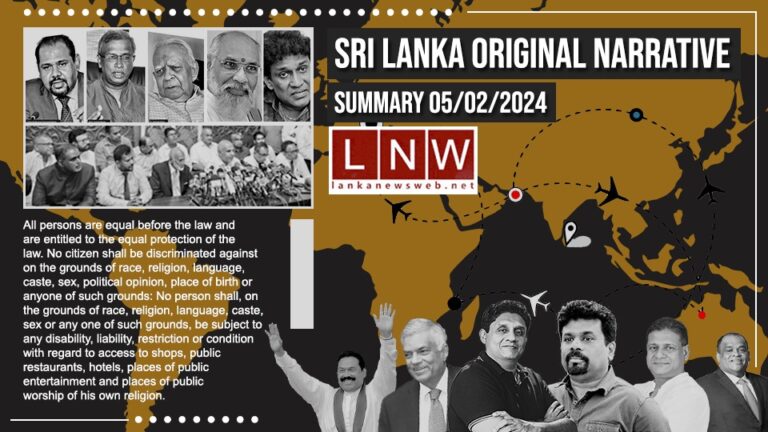
Sri Lanka Original Narrative Summary: 09/12

0
  1. President’s Media Division announces that the Global Tamil Forum & “prominent Buddhist Monastics” had met President Ranil Wickremesinghe & presented a “Joint Himalayan Declaration promoting a pluralistic Sri Lanka that prioritizes community well-being, learning from historical mistakes, stressing the importance of accountability measures”.
  2. President Ranil Wickremesinghe says his idea is to hold the Presidential election next year followed by Parliamentary elections and then the PC elections; also says these elections will enable the people to look at amending or drafting a new constitution.
  3. Asian Development Bank approves a USD 200 mn loan to SL “to help stabilize the country’s finance sector”: analysts point out that recent loans by the World Bank and ADB are merely for budget support (meaning consumption), and not for any capital project as done previously.
  4. Former Public Utilities Commission Chairman Janaka Ratnayake (“JR”) announces his Presidential candidature for 2024: emphasises the necessity for a systemic change grounded in a paradigm shift to rebuild SL: reveals his current efforts in establishing the foundation to guide SL onto a positive trajectory and reconstruct it in the days ahead: asserts that one must assume the role of the 1st citizen to transform & revive the nation.
  5. CID informs Fort Magistrate’s Court that the Defence Ministry has extended the detention orders issued under the PTA for notorious drug dealers Nadun Chinthaka alias ‘Harak Kata’ and Salindu Malshika alias ‘Kudu Salindu,’ for another 90 days.
  6. Ministry of Finance revises the opening & closing times of liquor shops and bars: Foreign liquor wine shops (FL4) – 8am to 10pm: Tourist board-approved hotels with FL7 and FL8 licenses (Hotels with 3 stars and above) – 10am to 2am: all other hotels – 10am to 12am.
  7. Treasury Secretary Mahinda Siriwardena says relevant departments have been provided instructions for collecting taxes & tax file increases: asserts it’s a combination of policy & administration that would generate the expected revenue & it’s not a single effort: now concedes that issues can’t be resolved overnight.
  8. Attorney General informs Supreme Court that the Constitutional Council headed by the Speaker has decided not to proceed with its earlier decision to call for a report from the Chief Justice seeking information about the “performance of a judge” nominated for promotion to the Supreme Court: the AG’s remarks were in response to a Fundamental Rights petition seeking the suspension of a decision taken by the Constitutional Council.
  9. Govt initiates the establishment of an Interim “Secretariat for Truth and Reconciliation Mechanism”: the move said to be a “step towards transitional justice and post-conflict reconciliation”: the proposed Commission is expected to be established through an Act of Parliament.
  10. SL expected to lose an estimated USD 22mn (approximately Rs.7bn) in direct & indirect income following the International Cricket Council’s decision to shift the Under-19 World Cup from Sri Lanka to South Africa: the 16-team tournament was originally scheduled from Jan 13 to Feb 4 across 5 venues in Colombo but the turmoil in SL Cricket had apparently led to this ICC decision.

Tradlanka Agricultural Enterprises wins 3 awards at ’31st NCE Awards’

0

Tradlanka Agricultural Enterprises was awarded 2 Gold Awards & 1 Silver Award for National Export Excellence by the National Chamber of Exporters of Sri Lanka last night(09) Award Ceremony.

The Award Ceremony was held at Shangrila Hotel, Colombo.

Minister Ali Sabry Praises President Wickremesinghe’s Foreign Policy and Economic Strategies

0

In a recent press conference themed ‘Collective Path to a Stable Country’ at the Presidential Media Centre, Foreign Affairs Minister Ali Sabry lauded President Ranil Wickremesinghe for steering Sri Lanka’s foreign relations towards a policy of non-alignment, emphasizing unity while fostering relationships with global nations.

Minister Sabry credited President Wickremesinghe’s decisions for positively impacting Sri Lanka’s foreign relations, citing the nation’s successful non-aligned policy and its ability to secure International Monetary Fund (IMF) support by extending friendship without bias.

Acknowledging diplomatic challenges, Minister Sabry highlighted how strategic decisions have redirected strained relations, particularly in the Muslim world and Japan, onto a constructive trajectory, affirming the commitment to amicable ties while safeguarding national unity.

Discussing debt restructuring intricacies, Sabry elaborated on an independent mechanism developed due to Sri Lanka’s unique position. Collaborative efforts with influential nations outside the Paris Club, including India, China, and Japan, have paved the way for a viable restructuring plan.

Sabry revealed commitments from involved countries for Sri Lanka’s debt restructuring, foreseeing an advantageous process compared to others. The imminent IMF discussion on the 12th is poised to signal international acknowledgment of Sri Lanka’s economic progress, potentially resulting in disbursement of the second tranche.

Highlighting the nation’s path towards financial independence, Sabry noted ongoing governmental efforts to steer away from bankruptcy. Strategic reduction in debt payments positions Sri Lanka for an economic advantage of US$17 billion, with plans to attract new investors for economic growth.

Looking ahead, Minister Sabry expressed confidence in the government’s roadmap, aiming for significant economic strides by the first quarter of the next year. This aligns with President Wickremesinghe’s broader vision for sustainable economic development, signaling a promising trajectory for Sri Lanka under his leadership.