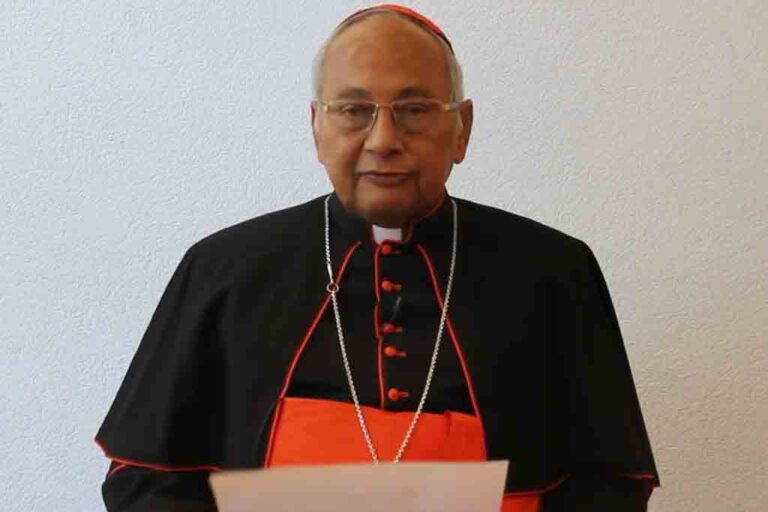
February 05, Colombo (LNW): His Eminence Malcolm Cardinal Ranjith, the Archbishop of Colombo, has issued a compelling call for a change in leadership in Sri Lanka, drawing a parallel with Singapore’s successful approach after gaining independence.
Cardinal Ranjith emphasized the unity and well-being prioritized by Singapore’s leaders, contrasting it with the divisive strategies based on language and religion employed by Sri Lankan leadership. He applauded Singapore’s robust legal system and commitment to discipline, highlighting perceived shortcomings in law and order in Sri Lanka.
Expressing concern about the government’s alleged self-serving agendas and prioritization of personal gain over national welfare, the Cardinal questioned the legitimacy of celebrating independence amid economic and political turmoil. He suggested that the current leadership celebrates their own freedom, not that of the suffering people.
Cardinal Ranjith urged the nation to liberate itself from what he termed the oppressive ruling class, advocating for the election of leaders who genuinely love and respect the country’s diverse population.
He stated, “I honestly believe that we should drive out these corrupt leaders and bring in new leadership who love the country and respect the religions and culture of our country.
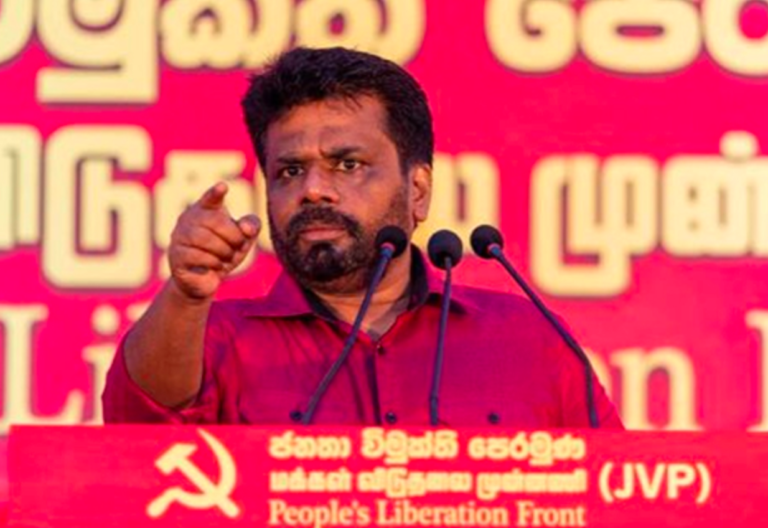
February 05, Colombo (LNW): A delegation from the Janatha Vimukthi Peramuna (JVP), a Marxist–Leninist communist party known for leading an anti-India campaign in 1987-90 against the Indo-Lanka Accord, is set to embark on an official visit to India starting Monday (05 Feb.).
According to a statement from the party, the JVP delegation, representing the largest party under the National People’s Power (NPP) coalition, will leave Colombo for India on an official invitation from the Indian government.
The JVP delegation includes party leader Anura Kumara Dissanayake, senior legislator Vijitha Herath, Secretary Nihal Abeysinghe, and executive committee member Prof Anil Jayantha.
The Indo-Sri Lanka Peace Accord, signed in Colombo on July 29, 1987, aimed to resolve the Sri Lankan Civil War by implementing the Thirteenth Amendment to the Constitution of Sri Lanka. The JVP played a prominent role in leading an anti-India campaign during this period.
Despite its history, recent surveys indicate that the NPP, led by the JVP, has gained significant public support, particularly in anti-corruption perceptions, in the post-economic crisis phase since 2022. Anura Kumara Dissanayake has already declared his candidacy for the upcoming presidential election later this year.
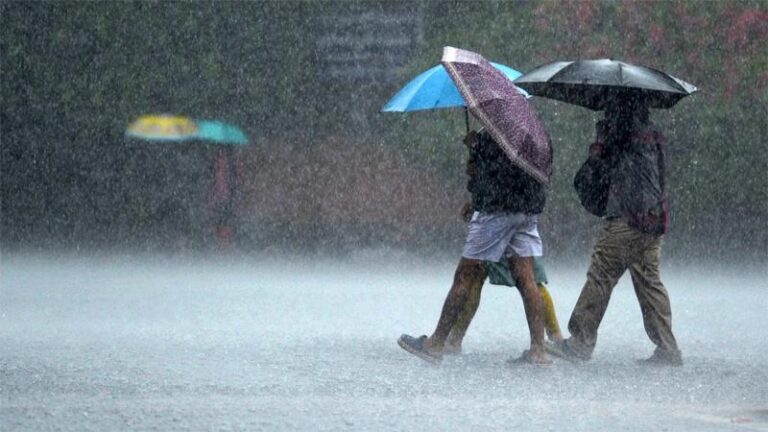
February 05, Colombo (LNW): Several spells of showers will occur in Eastern and Uva provinces and in Polonnaruwa and Matale districts.
A few showers may occur in Anuradhapura and Hambantota districts.
Showers or thundershowers will occur atseveral places in Western, Sabaragamuwa and North-western provinces and in Kandy, Nuwara-Eliya, Galle and Matara districts after 2.00 p.m.
Misty conditions can be expected at some places in Central and Sabaragamuwa provinces and in Galle and Matara districts during the morning.
The public is kindly requested to take adequate precautions to minimize damages caused by temporary localized strong winds and lightning during thundershowers.
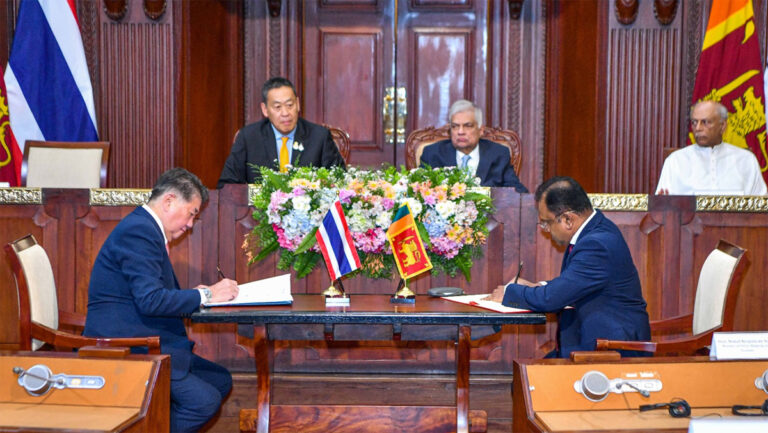
February 04, Colombo (LNW): In Sri Lanka’s pursuit of transforming into a high-income country by 2048 involving trade negotiations with countries like Thailand, the Sri Lanka Thailand Free Trade Agreement (SLTFTA), was signed, during the visit of Thai Prime Minister Srettha Thavisin and his delegation of business dignitaries yesterday (03) at the Presidential Secretariat in Colombo.
This move aims to enhance market opportunities, with negotiations covering various aspects such as Trade in Goods, Investment, Customs Procedure, and Intellectual Property Rights.
Thailand, the 37th exporting destination of Sri Lanka, holds significant economic importance, with a GDP of USD 495 billion in 2022 and is one of the largest outward investors in ASEAN. Thailand has brought over USD 92 Million worth of FDI to Sri Lanka during the period from 2005 to 2022.
In 2018, it was anticipated tripling the existing bilateral trade value (USD 550 Mn) to USD 1.5 Billion within four years. One of the main objectives of entering into a Free Trade Agreement (FTA) with Thailand is to enhance market opportunities for Sri Lanka with possible expansion.
The SLTFTA, having undergone extensive negotiations, has received legal clearance and is set to further strengthen economic ties between the two nations.
In a related development, the Governments of Sri Lanka and Thailand signed a new Bilateral Air Services Agreement, providing for liberalized services between the two countries. The agreement, which supersedes the 1950 agreement, reflects the commitment to enhance aviation relations and regulatory frameworks.
On behalf of Sri Lanka, the Minister of Ports, Shipping, and Aviation, Mr. Nimal Siripala de Silva, signed the agreement, while representing Thailand, Mr. Jakkapong Sangmanee, Deputy Minister of Foreign Affairs, signed the document.
Meanwhile, the Gem and Jewellery Research and Training Institute (GJRTI) of Sri Lanka and the Gem and Jewellery Institute of Thailand (GIT) solidified their commitment to enhance bilateral cooperation by signing a Memorandum of Understanding (MOU) which also took place at the Presidential Secretariat.
Representing Sri Lanka, Mr. B.G.R.W. Gamlath, Director General (Actg) of the Gem and Jewellery Research and Training Institute (GJRTI), and representing Thailand, Mr. Sumed Prasongpongchai, Director of the Gem and Jewellery Institute, signed the Memorandum of Understanding on behalf of the two countries.
The Gem and Jewellery industry, deeply rooted in Sri Lanka’s history, has flourished due to its production of high-quality gems, positioning the country uniquely in the global market.
Thailand, currently holding a distinctive position in the international Gem and Jewellery industry, recognizes the importance of collaboration.
With the shared goal of developing and promoting the industry in both nations, the MOU focuses on information exchange, scientific and technical research, and training activities.
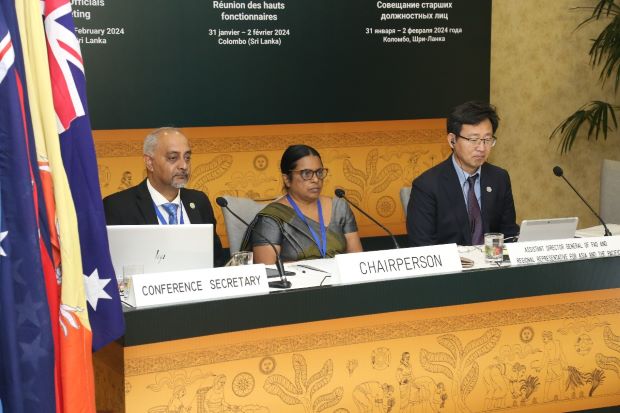
February 04, Colombo (LNW): A major multilateral conference opened yesterday in Colombo which aims to transform the Asia-Pacific region’s agrifood systems, after multiple human and economic crises have set back progress to achieving the Sustainable Development Goals, particularly those to end hunger and poverty and reduce inequalities (SDGs 2, 1, 10).
FAO’s 37th session of the Regional Conference for Asia and the Pacific (#APRC37) marks a major international, multilateral milestone in an effort to reform agrifood systems across the Asia-Pacific region, after years of pandemic, climate emergencies, volatile markets and economies that have negatively affected millions of producers, farmers, fishers, pastoralists and consumers.
The #APRC37 is convened by FAO’s Regional Office for Asia and the Pacific and hosted by the Government of Sri Lanka. The two-part conference began today, with a Senior Officials meeting which will conclude Friday, 1 February. A Ministerial session, with Ministers arriving from across the vast region, will follow on 19-22 February, also in Colombo.
The stakes are high, but there’s little time to lose. The stakes to end hunger, poverty and inequality in the world’s largest region is higher now than any time in recent decades.
“We are currently going through a period of convergent crises. The long term and deep socio-economic impacts of the pandemic on food security and livelihoods have become obvious.
But these are being accentuated by conflicts, the effects of climate change, environmental pollution, multiple hazards and risks, including trans-boundary pests and diseases and loss of biodiversity which are particularly affecting agricultural production,” said FAO Regional Representative Assistant Director-General Jong-Jin Kim in opening remarks.
The latest Asia and the Pacific Regional Overview of Food Security and Nutrition, published in December 2023, shows that nearly 371 million people are undernourished in this region and this represents half of the world’s undernourished. Nearly 24% of the population suffer from moderate or severe food insecurity with women tending to be more food insecure than men.
Stunting among children under five years of age, with a prevalence of 23.4%, continues to be a public health problem in the region despite the declining trend from 2000.
In recent years, the average cost of a healthy diet in the region has risen to $ 4.15 per person per day on purchasing power parity basis. Almost 45% of the Asia-Pacific population, or 1.9 billion people, cannot afford a healthy diet.
Delegates at the APRC heard that FAO is encouraging the mobilisation of investment, external and internal, to end hunger and achieve SDG2.
FAO is also assisting countries to promote tailored investment plans for poverty reduction including social protection; fighting food loss and waste and conserving water; building adaptive capacities and collectively responding to specific needs of the Small Island Developing States (SIDS), Landlocked Developing Countries and Least Developed Countries.
February 04, Colombo (LNW): Thailand expressed willingness to explore potential collaborations in Sri Lanka’s growing hospitality industry, covering food and beverages, hotel supplies and skills development through cooperation between academies and hospitality institutes.
This was highlighted by visiting Prime Minister of Thailand Srettha Thavisin when he addressed a business forum in Colombo yesterday.
Emphasizing the cultural and religious bonds between the nations, he mentioned Thai Airways International’s resumption of daily flights between Bangkok and Colombo commencing from the 31st of March.
The Prime Minister encouraged more Thai companies to invest in Sri Lanka’s infrastructure, manufacturing and energy sectors.
He also urged increased tourism, suggesting Thai companies capitalize on Sri Lanka’s infrastructure projects and tourist advantages in markets like India, UAE, and the EU, president’s media division said.
In terms of maritime connectivity, he identified Sri Lanka as a crucial partner in Thailand’s ambition to become a logistics hub in Southeast Asia, citing a land bridge project to connect the Andaman Sea with the Gulf of Thailand.
Additionally, he welcomed Indonesia’s high-crystal ocean project in the coming years.
The Prime Minister assured that Thailand is open for business year-round, inviting collaboration to foster economic growth and move into an exciting future, according to the PMD.
In a significant development, President Ranil Wickremesinghe addressed the Thailand-Sri Lanka Business Forum at the Kingsbury Hotel, highlighting the auspicious timing of the event. The President announced the signing of a ground-breaking free trade agreement (FTA) between Sri Lanka and Thailand, marking the second FTA with an ASEAN country.
President Wickremesinghe emphasized the historic trade relationship between the two nations, which predates even the Sukhothai Kingdom.
He urged a revival of this connection, considering the strategic positions of Sri Lanka in the Indian Ocean and Thailand in the Asia Pacific.
The President also acknowledged the cultural ties, including shared traditions like the Ramayana and Theravada Buddhism, the President’s Media Division (PMD) said in a statement.
President Wickremesinghe welcomed Thailand’s Prime Minister and expressed enthusiasm for the proposed land bridge of Krah Canal, connecting Sri Lankan ports to the Asia Pacific.
He highlighted the potential for regional logistics centres and discussed collaborative efforts in renewable energy, agriculture modernization, and fisheries development.
The President lauded the commitment to commercial Durian cultivation, with the Prime Minister offering assistance to modernize agriculture.
Tourism also took centre stage, with plans to provide land and historic buildings for development in strategic areas. President Wickremesinghe concluded by urging both nations to seize the opportunities presented and work collaboratively for mutual benefit, the statement mentioned.
February 04, Colombo (LNW): Even after Covid-19 pandemic hit in 2020, tearing the heart out of the island’s lucrative export earnings, the Sri Lankan trade deficit – the gap between its imports and exports; last year – has dropped significantly due to lowering of imports substantially
Ranil Wickremesinghe, who took over the presidency after the discredited and reviled Gotabaya Rajapaksa fled the country in July 2022, has been clear that Sri Lanka’s road to recovery will have to involve addressing the imbalance at source, and, in particular, driving up exports.
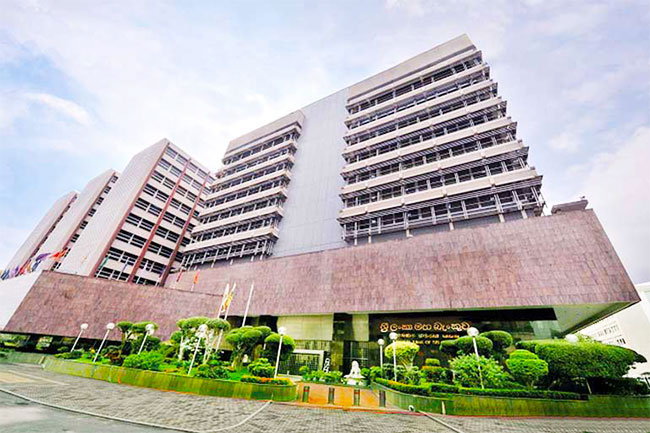
The Central Bank of Sri Lanka (CBSL) says that the cumulative deficit in Sri Lanka’s trade account narrowed to USD 4.9 billion from USD 5.2 billion within last year, the lowest recorded since 2010.
However, the CBSL also stated that the country’s trade deficit widened in December 2023 compared to the trade deficit recorded a year earlier.
The Central Bank made those disclosures while presenting its latest reports on the performance of the external sector of the country’s economy.
In December, Sri Lanka’s merchandise exports revenue declined by 6.2% to USD 1 billion from a year earlier, due to a decline in earnings from industrial exports and mineral exports, while an increase was recorded in agricultural exports in December 2023.
The Central Bank said cumulative export earnings during the period from January to December also declined by 9.1% compared to 2022, to USD 11.91 billion.
Meanwhile, expenditure on merchandise imports increased to USD 1.48 billion in December 2023, compared to USD 1.42 billion in the same month in 2022.
The year-on-year increase in imports were mainly led by imports of investment goods and consumer goods amidst the relaxation of import restrictions.
A Central Bank report said the cumulative import expenditure in 2023 declined by 8.1% to USD 16.8 billion over the corresponding period of 2022.
Meanwhile, workers’ remittance increased notably to USD 570 million in December 2023 compared to USD 537 million in November 2023. The same figure in December a year earlier stood USD 476 million.
As a whole, Workers’ remittances in 2023 amounted to USD 5.97 billion, compared to USD 3.789 billion in 2022, recording a year-on-year growth of 57.5%.
Total Departures for foreign employment in 2023 were recorded at 297,656. The same figure in 2022 was recorded at 311,056.
Earnings from tourism in November 2023 stood at USD 205 million while in December last year earnings were estimated at USD 269 million, marking a stark increase from USD 127 million earned through tourism in December 2022.
In aggregate, earnings from tourism in 2023 amounted to USD 2.068 billion, compared to USD 1.136 billion in 2022, recording a year on year growth of 82%.
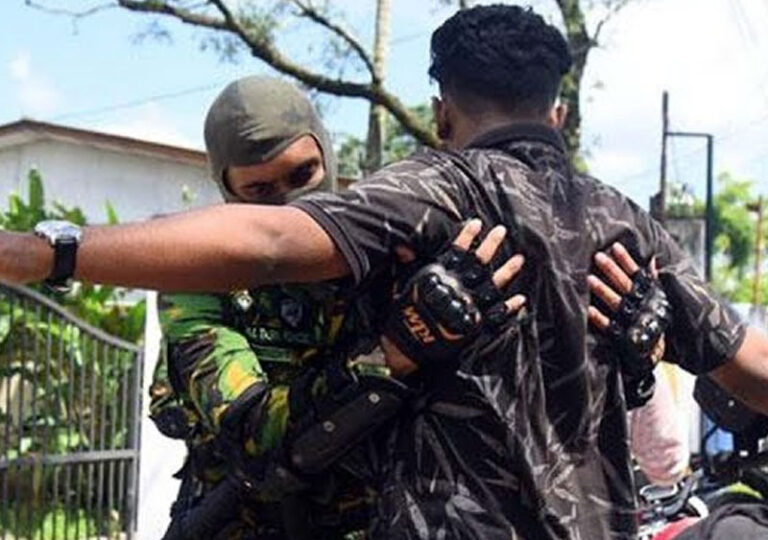
February 04, Colombo (LNW): In a coordinated effort within a 24-hour timeframe culminating at 12:30 a.m. today (04), security forces personnel have apprehended a total of 660 individuals as part of the nationwide anti-drug initiative ‘Yukthiya’.
The arrests comprise 552 suspects detained on narcotics-related charges, with one individual directed to rehabilitation, and 108 others identified as wanted criminal suspects.
Additionally, three individuals listed as registered suspects by the Police Narcotics Bureau and the Police Special Task Force were also apprehended during this special operation.
The seized narcotics during this period include 152g of heroin, 134g of crystal methamphetamine (‘ICE’), 4.15kg of cannabis, 775 cannabis plants, and 192,826 narcotic pills, the Ministry of Public Security said.
The ongoing ‘Yukthiya’ operation underscores the commitment of the security forces to curb illicit drug activities and maintain public safety across the country.
February 04, Colombo (LNW): In commemoration of the 76th Independence Day, President Ranil Wickremesinghe, in his capacity as the Commander-in-Chief of the Armed Forces, has approved promotions for a total of 211 officers from the Sri Lanka Army (Regular and Volunteer Force) and 1,239 Other Ranks of the Army (Regular Force and Volunteer Force).
The promotions, based on the recommendations of the Ministry of Defence and Army Commander Lieutenant General Vikum Liyanage, encompass various ranks within the armed forces.
Notably, two Brigadiers have been elevated to the rank of Major General, followed by the promotion of 12 Colonels to Brigadier, 13 Lieutenant Colonels to Colonel, and 17 Majors to Lieutenant Colonel, among others in the officers’ category.
In the Other Ranks category, advancements include the promotion of 49 Warrant Officers – II to Warrant Officer – I, 111 Staff Sergeants to Warrant Officer – II, 135 Sergeants to Staff Sergeant, 170 Corporals to Sergeant, 364 Lance Corporals to Corporal, and 330 Privates to Lance Corporal (Regular Force and Volunteer Force).
Two distinguished Senior Brigadiers, Major General P.N. Godellawatta and Major General U.L.J.S Perera, have been conferred the two-star General rank in the Army as part of these promotions.
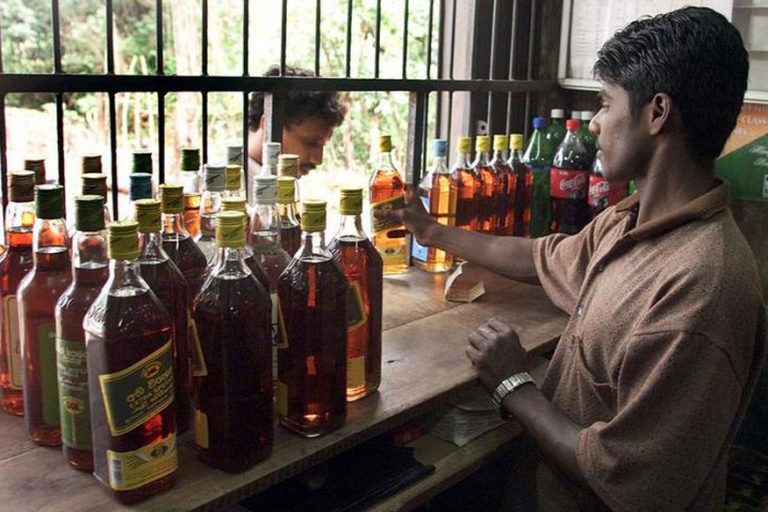
February 04, Colombo (LNW): The Ministry of Finance has announced revisions to the Annual Excise Licence fees, effective from 01 February, impacting various establishments, including taverns and liquor retail outlets.
Key adjustments include maintaining the Rs. 25 million fee for new taverns, while reducing the Annual Tavern Licence fee from Rs. 2.5 million to Rs. 2 million.
The changes aim to streamline licensing costs for existing taverns.
Furthermore, the licence fee for the bottling of coconut toddy has been adjusted from Rs. 10 million to Rs. 1.5 million, and for palmyra toddy, it has been reduced to Rs. 500,000.
In a similar vein, the licence fee for manufacturing vinegar has been decreased from Rs. 2.5 million to Rs. 500,000.
The Retail Licence for Liquor in Municipal Areas has seen a reduction from Rs. 15 million to Rs. 1 million, and in Urban Council areas, the fee has been adjusted from Rs. 12.5 million to Rs. 800,000.
For all other areas, the licence fee has been reduced from Rs. 10 million to Rs. 600,000.
These revisions align with the government’s efforts to strike a balance between industry interests and regulatory objectives while ensuring that licensing fees remain reasonable and conducive to the smooth operation of businesses in the specified sectors.