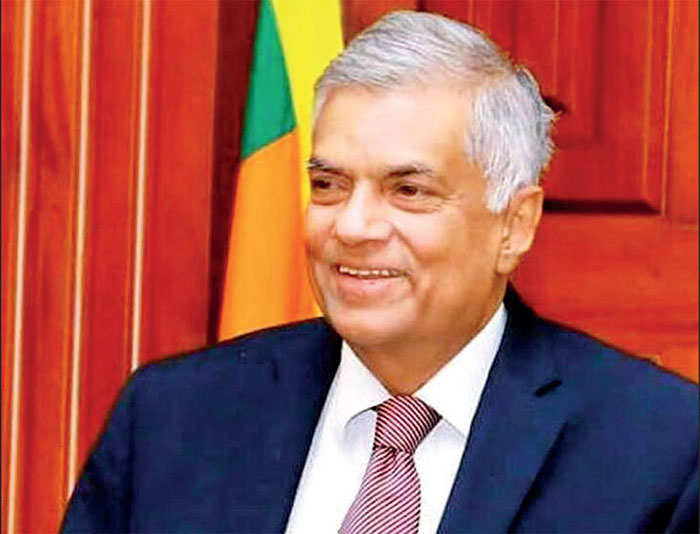
President Ranil Wickremesinghe today (06) left for Egypt, to attend the Climate Change Summit held in the country.
Accordingly, the President left the country from Katunayake Bandaranaike International Airport today at 02.50 am for Dubai, and from thereon for Egypt.
During his visit, the President is expected to meet with his Egyptian counterpart and many other leaders of the state.
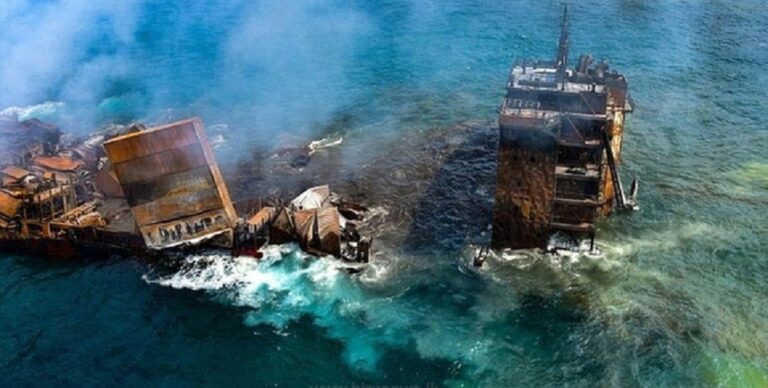
Sri Lanka is to go before the International Court of Arbitration in Singapore to recover a massive sum of money as compensation for damages caused by the destruction of the MV X-Press Pearl cargo ship in the island nation’s territorial waters.
The sheer scale of the disaster should be reason enough to “fight to get proper compensation for the country,” said Dan Malaka Gunasekera, an expert in maritime law.
He cited compensation claims filed by other countries over similar incidents to estimate that Sri Lanka should be able to secure between US$5 billion and $7 billion and Sri Lanka has to recover damages amounting to billions of dollars he added.
The latest payment brings the total paid by the ship’s insurer to $7.85 million. Sri Lanka received $3.6 million in July 2021, shortly after the June 2 sinking that was caused by a fire on board the Singapore-flagged X-Press Pearl, and another $1.75 million in January this year.
These payments are mainly to reimburse the government for the cost of the emergency response operations and for direct damages and cleanup
The inevitable legal battles could be strenuous, as Sri Lanka needs to secure these claims according to international maritime law, which means filing these claims early, Gunasekera said.
The Centre for Environmental Justice (CEJ), a local advocacy group, plans to file three lawsuits in the X-Press Pearl case.
“Sri Lanka has not ratified certain conventions which would have helped the island to mount compensation claims for maritime disasters of this kind and of this magnitude,” said e, a prominent environmental lawyer.
President Ranil Wickramasinghe has instructed Justice Minister Wijeyadasa Rajapakshe to take steps to file a case against the relevant shipping company before the International Court of Arbitration in Singapore to get compensation for the damages caused by the destruction of the MV X-Press Pearl cargo ship..
The Singapore-registered MV X-Press Pearl container ship carrying a hazardous chemical cargo caught fire on 20 May 2021 while at anchorage 9.5 nm off Colombo Harbor due to a chemical leak in a container and burned for 13 days before the fire was put out on 2nd June. The ship along with its hazardous cargo sank afterwards.
Nearly a year and a half after the sinking of the cargo ship, Sri Lanka is still trying to claim compensation for the environmental damage created by the ship’s fire.
The world is currently experiencing a moment of transition. This comes after the certainties and stability of the ‘end of history’ — the period spanning the fall of the Berlin Wall and the Global Financial Crisis.
By Krishantha Prasad Cooray
We are witnessing many changes. We have seen the rise of China and to a lesser extent, India. The world is beginning to recover from the Covid-19 pandemic. The crisis in Ukraine has generated uncertainties regarding the global energy and food situations. We have seen the end of cheap credit and also the resurgence of populism, nationalism, parochialism, extremism and fundamentalism across the world, which among other things also reflect uncertainty and anxiety.
It is in such a tense world that Malaysia is set to determine her destiny and her place in a rapidly changing world. In such a moment it is imperative that the implications of global, economic and political processes for South-East Asia in general and Malaysia in particular are examined, assessed and responded to.
It is not all bad news. Opportunity typically is a quieter twin of crises. We should recall, for example, that there are always favourable tailwinds.
For example, China joining the WTO in the early 2000s enabled it to compete far more effectively in global markets. Twenty years later China’s dominant role in the global economy simply cannot be denied or dismissed. Of course this situation made it harder for Malaysia to avoid the middle-income trap and attract further investment in manufacturing.
Now, however, with rising labour costs and in a context of geopolitical tensions, Malaysia has been provided with yet another opportunity to complete its transformation from a Third World nation to first.
This opportunity is particularly evident in electronics. After nearly two decades, Malaysia has returned to its previous place at the high table of electronics exports. In 2004, 4.2% of world electronics exports originated from Malaysia, but following a dip thereafter, Malaysia once again accounts for more than 4% of the world’s electronics exports.
This opportunity is not only being harnessed by Malaysia. Other ASEAN countries are also exploiting the situation effectively, which in turn also creates greater opportunities for Malaysia to trade and develop. Southeast Asia as a whole is poised for growth. The World Bank estimates that growth this year will be 5.8%. Malaysia is excellently poised to benefit, provided that the lessons from past successes and failures, of its own and of others, are duly learnt.
When Malaysia opened up to ideas, immigration and capital; when Malaysia chose merit and equality; when Malaysia tolerated not impunity and corruption and, most of all, when Malaysia united behind a common purpose for all Malaysians, opportunity swiftly translated into prosperity. When the above thinking and measures were abandoned or neglected, Malaysia fell back.
Malaysia is no longer a young country. The next decade may be the last chance to complete the transformation from a peripheral and poor country to a rich, developed nation at the cross-roads of emerging Asia, fully equipped to seize opportunities and surge ahead. Malaysia has the talent, it has a solid economic foundation, it has resources. All that is left is to unite around a clear vision and a clear plan for completing the governance and economic reform journey.
As always there are key issues that will have to be dealt with. The economy, for example. Malaysia has to re-imagine development, curb the rising cost of living, end corruption among politicians, address race and gender inequalities, battle discrimination and champion rights, make public institutions more efficient and significantly improve customer service.
Most of all, Malaysia has to ensure judicial independence and media freedom as non-negotiable elements of putting in place a solid social, economic and political foundation that enables the country and the people to withstand the fallout of adverse global headwinds. And indeed seek and seize the opportunities that may come Malaysia’s way.
In short, Malaysians need a reforming leader who will unify and empower the people to accomplish their dreams, a captain who has the vision to look well into the future, a statesman who has the wisdom to discard that which shackles the people and embrace that which liberates them.
On the 19th of November, Malaysians will choose. They will choose between parties, politicians and promises. But most of all they will choose whether to take their fate into their own hands. They will choose whether they want to build a Malaysia where all Malaysians can play a role in shaping its destiny, where Malaysia looks forward to the future with hope and confidence.
The collective decision will go a long way in determining whether Malaysia will prosper or if the Federation will join the collective of nations floundering because their leaders lacked the vision and ability to trust the wisdom of their people. And their people lacked the interest or courage to do anything about it.
Malaysia, though far from perfect, remains a democracy. It is ultimately the people who are sovereign; no one else can make the fundamental decisions for Malaysia. There will be no one else to blame for the choices made on the 19th. Exercise your choice, exercise it wisely and exercise it with hope.
Women make up only 25% of Sri Lanka’s Small- and Medium-scale Enterprises (SMEs) and it is important to look at how many of them have entered the regional and global market space. Lack of awareness among women entrepreneurs to tap regional and global markets is a common phenomenon in the developing world.
According to the Empowerment of Women project of the Indian Ocean Rim Association (IORA), women-led MSMEs in Sri Lanka can greatly benefit from having access to quality certifications, digital marketing tools, computer-based knowledge, marketing opportunities and intellectual property systems. This article aims at sharing information on the various opportunities for women entrepreneurs to engage with international buyers.
The Sri Lanka Export Development Board (EDB), through various entrepreneur support programmes, helps women entrepreneurs in agriculture and manufacturing-based export sectors.
EDB has been conducting communication campaigns focusing on business, industry, and marketing practices and encouraging women-led MSMEs to register with EDB Sri Lanka and SheTrades programme.
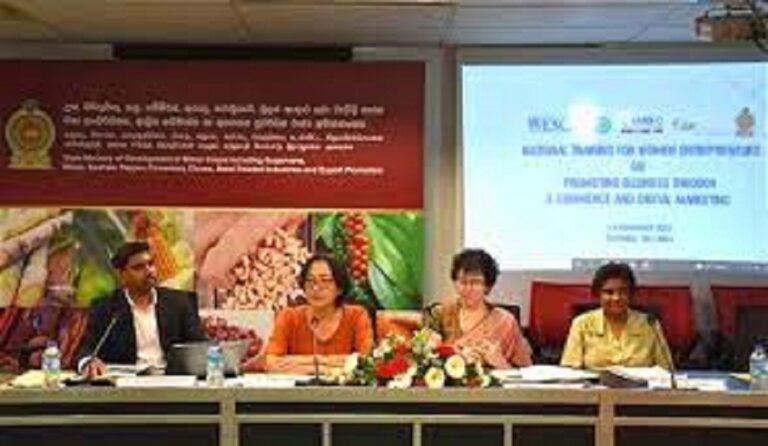
South-West Asia Office of the Economic and Social Commission for Asia and the Pacific (UNESCAP) has initiated a programme to facilitate and support women entrepreneurs in Sri Lanka and to expand their e-commerce and digital marketing enterprises in the island nation.
The National Training project for Women Entrepreneurs on Promoting Business through E-Commerce and Digital Marketing, initiated by the Sri Lanka Embassy and Permanent Mission to UNESCAP in Thailand was launched recently.
It was jointly organised with the South and South-West Asia Office of the Economic and Social Commission for Asia and the Pacific (UNESCAP) in New Delhi (ESCAP-SSWA) and seven prime Government institutions in Sri Lanka.
Under the project “E-Commerce Capacity Building for Women-led Micro Small and Medium Enterprises (MSMEs) in South Asia” of the UNESCAP, 85 women entrepreneurs participated at the training programme .
They were nominated by the Sri Lanka Export Development Board, National Crafts Council, Spices and Allied Products Marketing Board, Ministry of Women, Child Affairs & Social Empowerment, Industrial Development Board, Sri Lanka Handicrafts Board and Institute for Agro-Technology & Rural Sciences of the University of Colombo.
These 85 women entrepreneurs were provided hands on experience during the 03 day programme. Suveera Saxena and Deepali Gotadke of the ESCAP-SSWA were the resource persons.
Delivering inaugural address of the National Training was delivered by Minister of Plantation Industries and Minister of Industries of Sri Lanka, Ramesh Pathirana and welcome remarks were delivered by Director and Head, ESCAP-SSWA, Mikiko Tanaka and UN Resident Coordinator in Sri Lanka, Hanaa Singer-Hamdy.
Director and Head ESCAP-SSWA Mikiko Tanaka had bilateral meetings with Minister of Plantation Industries and Minister of Industries. Ramesh Pathirana, Minister of Education and Sri Lanka official representatives Susil Premajayantha, State Minister of Foreign Affairs Tharaka Balasuriya, Foreign Secretary Aruni Wijewardane, Director General of the Sustainable Development Council Chamindry Saparamadu, Deputy Secretary to the Treasury R.M.P. Rathnayake and Director General-Planning of the Ministry of Transport & Highways, Chinthaka Hettiarachchi during her visit. Air France resumed flights to Sri Lanka today and will operate thric
Sri Lanka’s last quarter borrowing plan via the issuance of treasury bonds and bills to meet recurrent expenditure while cutting down bank borrowings and money printing is in a bind following the recent downward trend in sales in the secondary bill and bond markets, CEOs of banks and dealers confirmed.
The General Manager of a leading bank disclosed that the drop in T-bill sales witnessed at the primary auctions recently was due to the saturation of the market.
He said that there was less participation of banks in T-bill/ bond auctions and currently the market is dominated by individual and institutional investors who were sensitive to the present economic – political uncertainties.
The Treasury is also raising money by selling bonds, often to institutional investors or pension funds.
If the government’s revenue is not adequate to pay for the payments due on bills and bonds issued in the past, then the government will issue new bills and bonds and obtain money to pay them, a senior Finance Ministry official explained.
This rolling-over or refinancing of government debt continues and net new issuance of government securities add to the total government debt, he added.
According to informed official sources, the upcoming bond and bill auctions are unlikely to raise the expected funding for the Treasury as investor sentiment remains dull and most of the participants might stay on the sidelines waiting for the 2023 budget and a change in policy interest rates.
Interest payment on outstanding public debt alone has risen to Rs. 1379 billion and is the single largest recurrent expenditure item absorbing 75 per cent of the tax revenue while leaving 25 per cent of tax revenue for all other expenses.
Total recurrent expenditure is estimated to be Rs. 3620 billion and 98 per cent of it had already been spent by the Government and the Treasury has to find the balance money of around Rs 73 billion via bills or bonds or bank borrowings.
However the sentiment at Tuesday’ s bill auction improved as the total accepted volume increased further to 98.50 per cent of its total offered volume of Rs. 90 billion and against its previous weeks 92.28, according to a market dealer.
Nevertheless the activity for both bill and bonds in the secondary market remained subdued on Tuesday.
The overall activity levels in the secondary bill and bond markets remained subdued while sentiment remained dull as well during the short trading week ending October 28 as most market participants adopted wait and see attitude.
Sri Lanka Tourism is expected its resurgence in the upcoming winter season following the vigorous promotion campaign in Europe especially in France along with the revenue recovery in the hospitality industry during the past ten months, SL Tourism Development Authority sources revealed.
SLTDA top official disclosed that the tourism promotion drive in France gained momentum with the resumption of Air France resumed flights to Sri Lanka on Friday and will operate thrice weekly flights to the country.
Air France operations on this route are seasonal and as per the winter schedule for 2022-23.“TheAirline is to resume services between Colombo – Paris with thrice weekly flights and gradually increasing to five weekly operations during the winter schedule.
This is following its ambition to expand the Air France – KLM footprint in the Indian Sub-Continent. It will operate the Boeing 787- 9 Dreamliner on this route and look forward to welcoming customers to experience a modern onboard product and high quality services,” Claude SARRE, General Manager, Air France-KLM Indian Sub-Continent said.
Meanwhile Sri Lanka’s earnings from tourism during the period from January 2022 to October 2022 surpassed US$ 1 billion mark, the Central Bank of Sri Lanka (CBSL) announced.
In October 2022, tourism earnings stood at $75.6 million in comparison to $ 54 million in September 2022.
In September 2022, Sri Lanka recorded a total of 29,802 tourist arrivals, with India, the United Kingdom, Australia and Germany remaining the main source countries for tourist arrivals.
The official reserve assets of Sri Lanka at the end of October 2022 were at $ 1,704million , the CBSL said further.
This is a decrease of 4.2% from the official reserve assets figure of $ 1,779 million in September 2022.
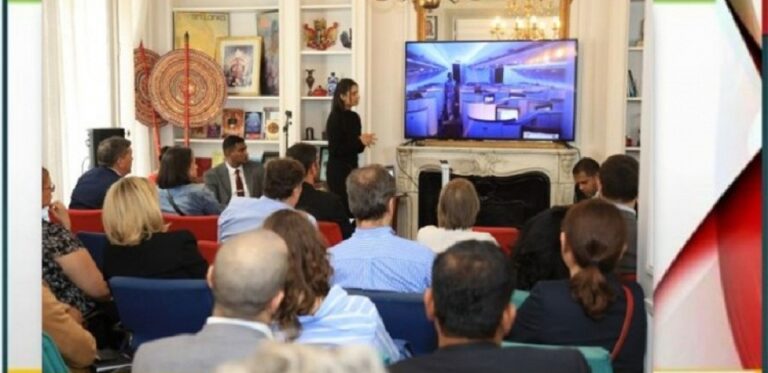
In accordance with the tourism promotion campaign, the Embassy of Sri Lanka in France successfully conducted a Sri Lanka tourism promotion awareness event on 04 October from 7.00 pm to 9.00pm in Paris organized by PONANT, a French cruise ship operating company and tour operator in France.
The company was founded in 1988 and operates tourism cruise ships under the French flag. The PONANT operates its tourism cruises to almost all regions in the World such as Africa, Middle East & Indian Ocean, Alaska, Antarctica, Asia, Atlantic Coast, Caribbean, Central America, North America, Northern Europe & Scandinavia, Ocean Voyages, Oceania & Pacific Islands, Red Sea, South America, The Arctic, the Mediterranean and Transatlantic.
The PONANT promotes Sri Lanka as a one of their destination in ASIA and this event was organized on the side lines of their proposed cruise journeys to Sri Lanka (Colombo, Galle and Trincomalee) in December 2022 and January 2023.
At the event, a detailed brief on Sri Lanka tourism was delivered in the French language. The presentation included Sri Lanka tourist attractions, bio diversity, wild, culture, authentic foods, festivals, tourism niche segments such as wedding tourism, international connectivity and domestic connectivity etc.
After the presentation, a cocktail event was organized where authentic Sri Lankan food such as Konda Kevum, Kokis, Paniwalalu, Mun Kevum and Sesame Rolls and Sri Lankan finger foods such as Patties, Rolls, Cutlets and Sandwiches were served to the invitees.
SLPP”s P. Wanniarachchi, C.B. Ratnayake and S.M. Chandrasena, together with J. Thondaman (CWC), D. Dissanayake (SLFP), and W. Abeywardene (UNP), tipped to be appointed soon as Cabinet Ministers: 2 or 3 from SJB also expected to join.
State Minister Shehan Semasinghe says all main bilateral creditors including China participated in latest debt restructuring talks: also says process to obtain IMF loan is in final stage and IMF Board approval likely by year-end.
Cardinal Malcolm Ranjith says there would be a negative impact when approaching the IMF: cautions against “bowing down” to IMF: asks people not to vote for politicians insensitive to their issues.
Official Reserve Assets dip further by 4.2% to USD 1,704 mn in Oct 22 from USD 1,779 mn in Sept 22: Forex debts accumulated but unpaid for 2nd & 3rd quarters of 2022 estimated at USD 3.2 bn: earlier “expert economist” claims that Reserves will increase if debt is defaulted, debunked.
Central Bank’s T-Bill holdings (“Money printing”) under Governor Weerasinghe’s first 210 days records a staggering Rs.713 bn: average of Rs.3.4 bn per day, even after interest rate has been nearly tripled: 54% higher than the “per day” average under Governors Cabraal and Lakshman.
PM Dinesh Gunawardene appoints 5-member National Delimitation Committee to demarcate wards for local authorities: Chairman to be Mahinda Deshapriya.
Tourist Hotels Assn President M Shanthikumar says tourist hotels are faring badly: notes tourist arrivals are far below expectations: hotel managers say there’s not much hope for the remaining 2 months in the year.
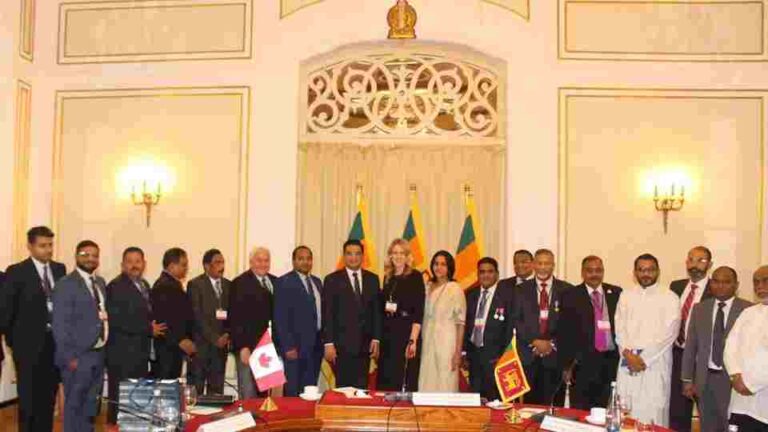
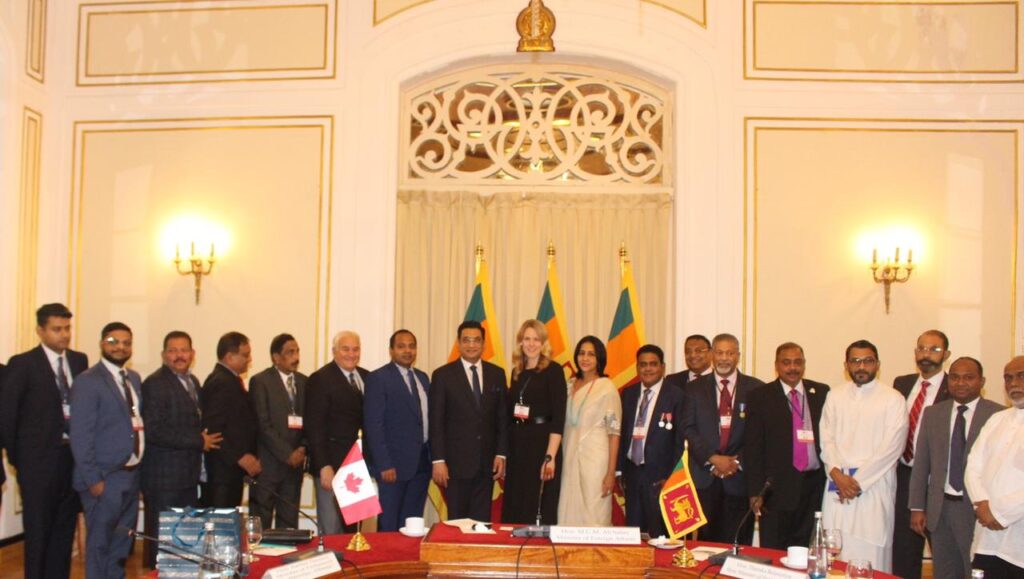
State Minister of Foreign Affairs Tharaka Balasuriya says Sri Lanka is likely to receive USD 100 mn “infrastructure investment” by Canadian diaspora into Small and Medium Enterprises: no details given.
San Diego Zoo announces that it has euthanized Sri Lanka born 45-year-old she-elephant “Devi” because of deteriorating health.
England beat Sri Lanka in the last ICC T20 Cricket World Cup Group 1 match: SL 141/8 (20 overs): ENG 144/6 (19.4 overs): New Zealand and England qualify for the Semi-Finals from the Group.
As President Wickremesinghe pointed out recently, “with the bankruptcy that we have declared, our economy has virtually come to a halt. The inflation, the bankruptcy, and everything else that is happening have brought our economy to a grinding halt. How do we restart it? That is what we are engaged in,” the President said in his speech in which he detailed measures taken to restore stability and he also listed various challenges ahead and steps taken and planned to address those.
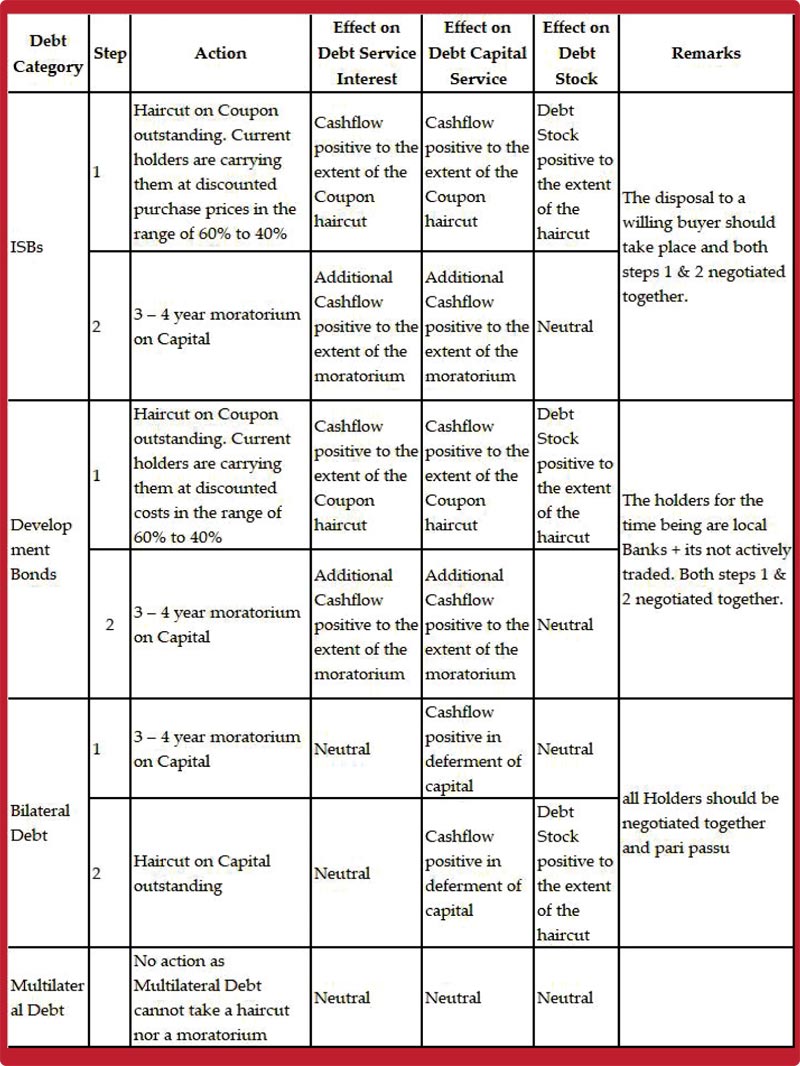
The rescheduling and restructuring of our debts are at the base of our recovery efforts. Over 60% of our debt is owed to financial markets or private creditors, amounting to around $ 35 billion, and about 8% was owed to the Exim Bank of China. All of which indicates the vital need to bring the private creditors to the negotiating table.
Bilateral side the largest lender is China | Photo: DailyFT
Four creditor groups will need to be approached. First, the bond holders. Then the traditional Government creditors, also known as the Paris Club which has been around for some decades where several governments put in their finances to assist with nations that are debt-ridden. The largest lender in the Paris Club to Sri Lanka, is Japan. On the bilateral creditors’ side, the largest lender is China. India too can be included in this group. Finally, we have the multilateral creditors e.g., IMF, World Bank, and ADB.
The first three mentioned groups are somewhat cautious about what is done by others in their category of creditors, which suggests that they are looking to ensure that any measure of debt relief offered by one group must be comparable to what is offered to the other groups. This requires skilled manoeuvring at the highest levels of Government. This cannot be left to bureaucrats only.
Restructuring options
Some creditors according to reliable sources want newly issued sovereign bonds that would be swapped with a significant haircut for old unsustainable privately held debt. Some want it in rupees for local investment. Some want a swap to rupee. Private creditors would benefit from a partial guarantee of the payment of the principal and a part of the interest payment analogous to the Brady Plan that was used effectively in the 1980s in Latin America (a Baker styled plan is not an option-WWW baker plan).
The Creditors want to be sure that they are not going to lose their capital if there is a laggardly approach to responding to the need for urgent reform due to incompetence of the debtor. They want to make sure the Debtor can pay interest, that is only possible if the Debtor earns sufficient dollars with which to pay their debt. Equally important, there must also be clear communication as to what can be done, and what cannot be done with regard to the measures proposed or undertaken.
Another option is debt moratoriums with negotiated interest rates. There is ample evidence to show that by suspending debt service, Latin America gained room to grow at much higher rates than the depression-stricken industrial countries. The trade surpluses were not enough to provide resources for both growth and interest payments. But once countries walked away from their debts, there was plenty left to support an impressive period of growth and industrialisation (Rudiger Dornbusch).
Conclusion
In the final analysis, majority now know clearly how public debt affects our lives, so debt relief should not only provide temporary breathing space, it should pave the way for the Government to lay the foundation for sustainable development with investments in health, education, digitisation, energy, but there has to be provisions in place to reduce the burden on the population who are already stressed, and this is one of the things that the IMF must assess before prescribing solutions.
We need a competent team of sharp, clever experienced people with good negotiation skills (hire them if required ) to decide on a package that can bring Sri Lanka back to a position where they will be able to access capital markets that are now virtually blocked due to a short-sighted debt default (Fidel Castro’s solution according to research was often to default, it created more problems than they solved) that has virtually dried up capital inflows.
Any debt restructuring in any country is and will always be painful, but those in power must all set an example to the public to get their support, by cutting Government cost to the bone, we must not get stuck in mismanagement by wishful thinking like what happened in Lebanon.