Home Blog Page 2182

Energy Minister announces date on which the ‘fuel ration system’ will come into effect

0

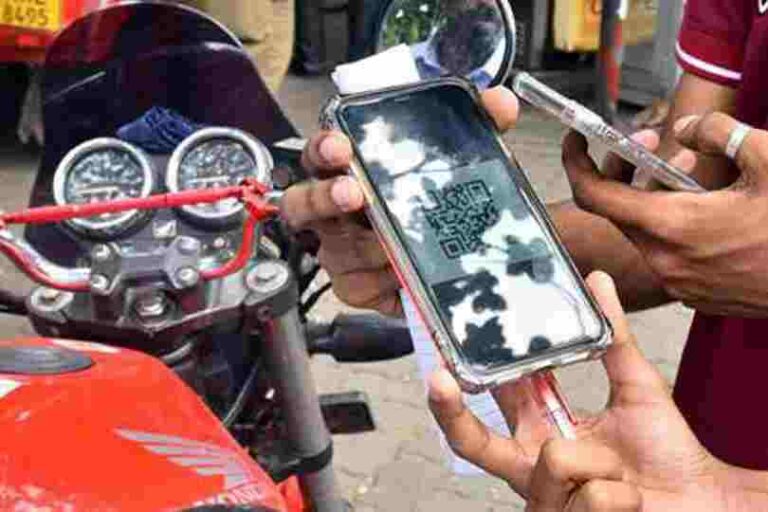
Energy Minister Kanchana Wijesekera says the fuel ration system is expected to be operational from the first week of July as an experiment.

That is why we propose to set up a ration system as an experiment from the first week of July. At that time I saw how one shed was registered as a misinterpretation and how to refuel when we went elsewhere. The nearest filling station will be registered and the number of liters given to you in a week – for example, if you are given 100 liters, you can get at least 60 liters out of that 100 liters from that registered filling station, so that you can buy the remaining 40 liters from any other filling station in the country. Discussions are still going on and we have not yet formulated that methodology. So it will take us two or three weeks to comeup with this. ”

Minister Kanchana Wijesekera stated this addressing a media briefing held at the Ministry of Energy yesterday (16).

Another fundamental rights petition filed against the appointment of Dhammika Perera

0

Another fundamental rights petition has been filed in the Supreme Court against the appointment of Dhammika Perera to fill the vacancy left by Basil Rajapaksa as the National List Member of Parliament for the SLPP.

Accordingly, the petition seeks an order restraining Dhammika Perera from being sworn in as a Member of Parliament and invalidating the gazette notification issued by the Election Commission appointing him as a Member of Parliament.

The petition was filed by Roel Raymond, editor-in-chief of the Roar website.

According to the petition, Dhammika Perera’s name was not included in the district nomination lists or national lists of the Sri Lanka People’s Front in the 2020 general election and his appointment as a Member of Parliament for that party is unconstitutional.

The General Secretary of the SLPP Sagara Kariyawasam, Speaker Mahinda Yapa Abeywardena, the Secretary General of Parliament, members of the Election Commission and the Attorney General have been named as respondents in this petition.

The Executive Director of the Center for Policy Alternatives, Pakyasothy Saravanamuttu, had earlier filed a fundamental rights petition in the Supreme Court against Dhammika Perera’s appointment as a Parliament Member.

Duminda Silva removed from the National Housing Development Authority chairman post

0

Duminda Silva has been removed from the post of Chairman of the National Housing Development Authority.

Accordingly, Rajiv Sooriyarachchi has been appointed to the post.

Rajiv Sooriyarachchi was previously the Vice President of the Airport and Aviation Company.

Duminda Silva, who was sentenced to death, was re-appointed as the Chairman of the Housing Development Authority after his release on a presidential pardon. The Supreme Court ordered the suspension of the Presidential pardon on a petition filed before the Supreme Court challenging the procedure.

Although he was to be remanded again, he is currently receiving treatment at the hospital and is in the custody of prison officials.

Nightmare’s End?

0

Rohini Hensman Sidecar Blog New Left Review 13 June 2022

I am not in Sri Lanka, and I feel torn about what is happening there. Acute anxiety about how millions will survive the shortages of food, fuel and medicine jostles against a glimmer of hope that this crisis could be the beginning of the end of a decades-long nightmare. Since the country gained its Independence in 1948, various sections of the population have been targeted by its ruling bloc: threatened with losing their homes, livelihoods and often their lives. They have fought back, but each section has been isolated and crushed by an increasingly centralized and ruthless state. Now, for the first time, the vast majority of the population has risen in revolt. Criticism of the dictatorship is widespread, and divisions between working people may finally be healing.  

It is not easy to disentangle the different strands of Sri Lanka’s long-standing political crisis, but let me try. Equality before the law – a key component of any democratic republic – was never supported by the ruling class that took power in independent Ceylon. The two main parties, the United National Party (UNP) and the Sri Lanka Freedom Party (SLFP), both endorsed ‘Sinhala-Buddhist’ supremacism. This meant persistent discrimination against ethno-religious minorities, which began right after Independence, when the UNP passed legislation disenfranchising around a million Tamils of recent Indian origin and stripping them of their citizenship. Most of those affected were plantation workers in the central hill country, who were already isolated from other sections of the working class by their confinement to the plantations.

The next major assault on equality occurred when the SLFP, led by S.W.R.D. Bandaranaike, came to power in 1956 and passed the Official Language Act, or ‘Sinhala Only Bill’. The Act discriminated against all Tamil-speakers, especially in public sector employment. It sparked major protests followed by the anti-Tamil riots of 1958, in which far-right Buddhist monks played a major part, assassinating Bandaranaike the following year for not going far enough in persecuting Tamils. The leadership of the SLFP was taken over by his widow Sirimavo Bandaranaike. Tamil was downgraded and English ceased to act as a link language, in a deliberate attempt to obstruct dialogue between communities.

Such measures were opposed by the Trotskyist Lanka Sama Samaja Party (LSSP) and the Communist Party of Ceylon (later the Communist Party of Sri Lanka, CPSL). Yet, once they failed to prevent the ratification of the anti-Tamil laws, the left parties did not continue the struggle against discrimination by building solidarity among working people from different linguistic and religious groups. Instead, they formed an alliance with the SLFP in 1964, and the parties jointly established the United Front (UF), which swept to power in 1970. At that point, principled members of the left parties split off, and Tamil socialists were left demoralized by the capitulation of their leaders. The only force that could have carried through the democratic revolution had splintered.

Once in power, the UF’s Land Reform Laws of 1972 and 1975 nationalized the plantations. Yet rather than distributing the land to Tamil workers – who were driven out and left to starve – it was handed to Sinhalese government supporters. In response, the Tamil United Liberation Front (TULF) called for the creation of an independent Tamil Eelam. Militant groups, most notably the Liberation Tigers of Tamil Eelam (LTTE), were established to fight for this goal. The LTTE initially attracted some Tamil socialists who believed it was waging a justified struggle for self-determination; but, in reality, the group was always committed to creating a Tamil-supremacist state by ethnically cleansing and killing Sinhalese. It even targeted Tamil-speaking Muslims in the Northern and Eastern Provinces which it claimed as its territory.

Despite all the privileges given to the Sinhalese majority by the UF, dissatisfaction with the regime remained widespread. Significant gains in healthcare and education were cancelled out in the public mind by inflation and food shortages. In 1971, the Janatha Vimukthi Peramuna (JVP or People’s Liberation Front), led by Rohana Wijeweera, launched an armed uprising to overthrow the government – backed overwhelmingly by Sinhalese young men for whom the problems of unemployment and poverty had not been solved by Sinhala Only.

Notwithstanding his self-description as a ‘modern Bolshevik’, Wijeweera’s revolutionary horizons were narrowed by a Sinhala-supremacist outlook which characterized Tamil plantation workers as mere tools of Indian expansionism. His uprising was powerless to reach across ethnic lines, and ultimately crushed by the UF government after a state of emergency was declared. Nonetheless, antipathy towards the ruling party lingered. When parliamentary elections were held in 1977, the UNP led by J.R. Jayawardene returned to power with 140 seats out of 168. He used this super-majority to enact a new constitution and anoint himself Executive President – with almost unlimited powers.

Sinhala dominance was entrenched under Jayawardene, with anti-Tamil pogroms sweeping the country just a month after his election. The 1979 Prevention of Terrorism Act precipitated the torture, disappearance and extrajudicial killing of thousands of Tamils. In 1981, an orgy of state-sponsored arson, rape and looting in Jaffna included the burning of the public library, with around 95,000 books and ancient manuscripts inside. The violence then shifted to the east, south and hill-country, with thousands of Tamils evicted from their homes and robbed of their possessions. The even more gruesome massacres of 1983 initiated a civil war between the LTTE and government, which lasted some 26 years.

All this perpetuated the trend set by Jayawardene’s predecessors. But what distinguished his regime was its disastrous neoliberalization programme and unabashed authoritarianism. Production of consumer goods, both agricultural and industrial, was hit by cheaper imports in the 1980s, while the import of luxuries previously unavailable in Sri Lanka added to the drain on foreign exchange. Remittances from migrant workers, tea exports, tourism and new foreign investments failed to fill the gap, due to generous tax holidays and tariff-free imports of inputs. This led to increasing reliance on foreign debt, laying the basis for the current economic crisis.

Meanwhile, Jayawardene attempted to crush all dissent and extinguish democracy. His newly established Jathika Sevaka Sangamaya (JSS) was deployed in anti-Tamil pogroms, as well as killing opposition supporters, judges, trade unionists and striking workers, all with the collusion of the police. The second JVP insurrection, starting in mid-1987 and ending in late 1989, when Wijeweera was captured and executed, left an estimated 40,000-60,000 Sinhalese slaughtered in that period alone. Death squads targeted opponents of Jayawardene and his successor Ranasinghe Premadasa, frequently abducting and torturing them to death. Ranil Wickremesinghe, the current Sri Lankan Prime Minister, was a government minister throughout this period. The current president, Gotabaya Rajapaksa, was an army commander. Both were implicated in the mass murder of Tamils and Sinhalese alike.

Since that period, the Executive Presidency has been subjected to an ongoing tug-of-war. Abolishing it has so far proved elusive, because the courts have ruled that this would require a two-thirds majority in parliament plus an absolute majority in a referendum. Yet more modest reforms have occasionally been passed to restrict the presidency’s power. Under the presidency of Chandrika Kumaratunga, from 1994 to 2005, attacks on democracy declined and the 17th Amendment was instituted, removing the president’s ability to unilaterally appoint people to institutions like the Election Commission and Supreme Court. This tentative progress was then reversed under Mahinda Rajapaksa, as state-backed death squads were revived to target dissidents. In 2009, the LTTE was finally defeated in the civil war’s horrific climax, in which an estimated 40,000 Tamil civilians were killed. In tandem, an 18th constitutional amendment reversed Kumaratunga’s reforms and abolished the presidency’s two-term limit.  

Rajapaksa rejected the UN’s demand for an independent investigation into reports of war crimes, framing this as an ‘anti-imperialist’ position. But though his rhetoric played well with some of the electorate, he lost credibility by contributing to the country’s mountain of foreign debt – with new creditors including the Chinese government and private buyers of sovereign bonds. With their popularity in decline, the president and his brother Gotabaya Rajapaksa – who, as Defence Secretary, controlled the intelligence agencies – tried to salvage their careers by scapegoating the Muslim population. They funded far-right groups of Buddhist monks, using them to violently attack Muslims while mounting an Islamophobic propaganda campaign through state-controlled media. Under the radar, the Rajapaksas also funded Islamist militants to fight against the LTTE – who remained on the government payroll as informants despite credible intelligence that they had been radicalized.   

Mahinda Rajapaksa was voted out of office in 2015, having alienated a large section of the Sinhalese population with the scandalous nepotism and corruption of his regime. In his place, ethnic minorities voted for a fragile Good Governance (Yahapalanaya) coalition between SLFP rebel Maithripala Sirisena and Ranil Wickremesinghe. The new coalition once again curtailed the powers of the president and reinstated the two-term limit with the 19th Amendment. But it, too, fell apart. The final blow to its credibility was the Easter Sunday terrorist attack in 2019, which killed 269 people in locations across the country. As it turned out, the bombings were perpetrated by the very same Islamists that the Rajapaksas had been bankrolling. Subsequent investigations revealed that during the Yahapalanaya regime, members of the terror group, including mastermind Zahran Hashim, continued to be paid and protected from prosecution by officials who remained loyal to Gotabaya. This was despite Hashim’s proclamation of allegiance to ISIS and ample evidence that his followers were accumulating arms and explosives.  

Yet, counterintuitively, it was the Rajapaksas who benefited from the Easter Sunday massacre. In the resulting panic, the government was weakened and Gotabaya was able to mount an effective presidential campaign, running as the ‘national security’ candidate. Later that year, he topped the poll with 52% of the vote. An alliance led by the Rajapaksas’ new party, the Sri Lanka Podujana Peramuna, also won the parliamentary elections with a large enough majority to pass the 20th Amendment, reversing the 19th. Gotabaya proceeded to pack the cabinet with family members including Mahinda, who was appointed prime minister.  

By this time the economy was already sinking under $51 billion of foreign debt, much of it incurred by the family’s vanity projects and endless siphoning of money out of the country. The Gotabaya regime’s tax cuts made the debt unsustainable, and an overnight ban on imports of chemical fertiliser – implemented in the face of farmer protests – led to a colossal decline in crop yields. As foreign reserves ran out, domestic production of food and exports plummeted, leading to escalating unemployment, sky-rocketing inflation, power cuts and long queues to buy basic goods.

All but the very rich have been affected by this meltdown. Workers have lost jobs, farmers are in crisis and fishermen have no fuel to power their boats. Galloping inflation has eroded wages, and parents have gone hungry in order to feed their children. So, in early March 2022, people of all ages, from all ethnic communities, came out spontaneously with home-made placards bearing slogans such as ‘Go Home Rajapaksas’. They called for democratic reform, the immediate resignation of the president and his government, and an end to economic mismanagement.  

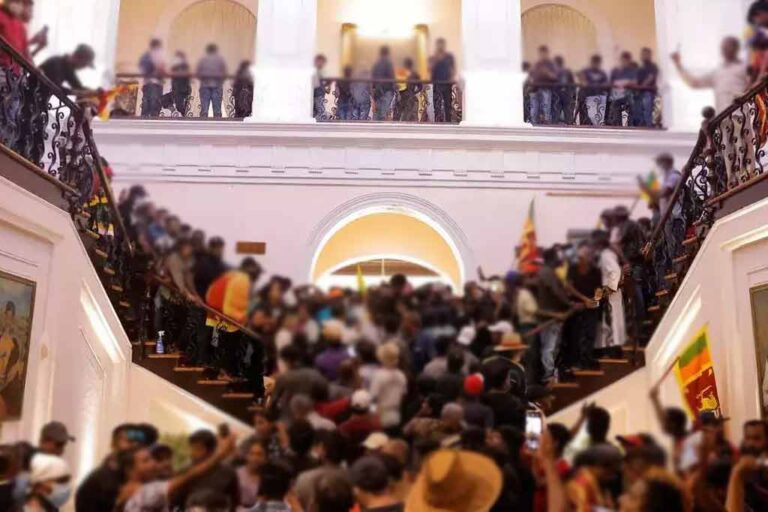
The government ignored these initial protests, but at the end of March a more militant demonstration near Gotabaya Rajapksa’s residence in Colombo was met with water cannons, tear gas and dozens of arrests. There followed a state of emergency, plus a nationwide curfew and social media ban. This heavy-handed response was expected to stamp out the unrest, but it only enabled it to spread. The president subsequently changed tack, trying to appease the demonstrators by reversing his authoritarian measures and forcing the entire cabinet (apart from Mahinda) to resign. But the protests kept up their momentum, and on 9 April activists occupied Galle Face Green: a park in Colombo facing the Presidential Secretariat. This now iconic site has been renamed ‘GotaGoGama’. The crowds were joined by a delegation from 1,000 different trade unions, who staged a general strike – the first in four decades – calling for the government to step down. 

A month later, pro-government thugs began to carry out violent attacks on the protests. Yet their resistance was so powerful that Mahinda was ultimately compelled to step down. He was evacuated from his home by security forces while the military was deployed with shoot-on-sight orders. With international criticism of the government growing, Gotabaya installed Ranil Wickremesinghe – the leader of the United National Party – as Prime Minister on 12 May. But although Wickremesinghe may be popular with the IMF, he is deeply disliked by the masses. His proposed 21st Amendment has been widely seen as a betrayal of the protesters’ demands, and his invitation to youth groups to sit on parliamentary committees has been met with the silence it deserves.

The numbers in favour of abolishing the Executive Presidency are currently smaller than those calling for Gotabaya’s resignation, but the demand is gaining traction. This creates an opening for activists, who can now push for a broader process of political restructuring which would devolve power to provincial and local governments. It also provides a space for progressive solutions to the country’s economic crisis. Socialist economists have long advocated a public audit that would repudiate Sri Lanka’s illegitimate debt, in defiance of the IMF. They have argued for importing only essential items like food and medicine and putting in place a public distribution system, while encouraging cooperative producers and defending public ownership of utilities, healthcare and education.

At GotaGoGama, Sinhalese and Tamils have reportedly celebrated New Year together, and various religious groups have shared in the breaking of the fast during Ramadan. Meanwhile, in the south, people have turned out for the very first time to mourn the Tamils killed in the civil war. Such developments suggest an easing of ethnic and religious tensions, despite the Rajapaksas attempts to stoke them. When I was conducting interviews for my 1993 book, Journey Without a Destination, the vast majority of Tamil and Muslim refugees and displaced people were admirably free of ethnic hatred, despite all they had suffered. I heard numerous stories of Sinhalese friends, neighbours, colleagues and even total strangers saving the lives of Tamils. I also encountered prejudice, especially among the Sinhalese, yet this flowed from the profound ignorance engendered by the Sinhala Only policy, as well as the suppression of dissident voices and relentless disinformation in the media. When experience contradicted propaganda, though, people were often willing to think anew. And this is precisely what is happening at present. Perhaps, if Sri Lanka’s fractured left can harness this sense of solidarity, the economic catastrophe may create the conditions for a democratic breakthrough.

SL Public Sector Accounting and Audit training strengthen with US aid

0

U.S. Launches Training to Strengthen Sri Lanka’s Public Sector Accounting and Auditing Capabilities’’

The U.S. Government, through its development agency, the U.S. Agency for International Development (USAID), is partnering with the Institute of Chartered Accountants of Sri Lanka (CA Sri Lanka) and the Association of Public Finance Accountants of Sri Lanka (APFASL) to strengthen Sri Lanka’s accounting and auditing sectors.

This partnership will train approximately 600 public sector accountants and audit professionals, and 1,200 officers on IT applications and other platforms that support strategic decision making.

Speaking at the official launch of the training program, U.S. Ambassador to Sri Lanka, Julie Chung said, “The U.S. is excited to provide public sector professionals with the necessary tools to further strengthen their knowledge on compliance requirements and contribute towards greater accountability in the public sector.

 As one of Sri Lanka’s longstanding development partners, our vision is to help the country to emerge from crises stronger than before, she added.

The training will focus on Sri Lanka’s Public Sector Accounting Standards (SLPSAS), which provide a framework for the preparation and presentation of financial statements in compliance with international best practices for quality financial accounting and reporting.

The training, conducted in all nine provinces, will strengthen the capacity of public sector accounting and auditing professionals on the recent developments and applications of SLPSAS 11-20, enhancing public sector financial management functions and reporting as well as improving financial analysis, planning, and management in the public sector.

“Strong public financial management is very critical for Sri Lanka to achieve its long-term goals. Therefore, APFASL in its capacity as the public sector wing of CA Sri Lanka, has been playing a critical role in strengthening public financial management practices in line with international best practices.

 The collaboration with USAID comes at a very opportune time as we continue to strive to enhance public sector accounting and auditing professionals so that they continue to remain relevant.

This partnership with USAID is also a testament to the important work both CA Sri Lanka and APFASL have been doing to enhance the sector”, said Mr. Sanjaya Bandara, President of CA Sri Lanka.

Additionally, the training program will strengthen public sector finance professionals’ effective use of IT systems to support strategic decision-making across all provinces.

As the facilitator of the training, the APFASL will support the implementation of the National Policy on Fiscal Management and enhance financial management systems in public institutions, universities, and local governments.

“Since its inception, APFSL has been at the forefront in developing the professional skills and expertise of the public sector accountants and auditors, and chief among the numerous groundbreaking initiatives the association launched was to publish the Sri Lanka Public Sector Accounting Standards., said Mr. V. Kanagasabapathy, President of APFASL.

WFP says 66 percent Sri Lankans reduce their daily meals

0

The World Food Programme (WFP) says 66 percent of Sri Lankans surveyed have been found to have reduced the number of meals eaten daily.

The WFP and the Government conducted a joint rapid food security assessment in April.

It surveyed the poorest households in 17 districts and found that 86 percent are using coping mechanisms such as purchasing cheaper, less nutritious food (95 percent); limiting portion sizes (83 percent); and reducing the number of meals eaten daily (66 percent).

Sri Lanka is facing its worst economic crisis since its independence in 1948. The population is struggling to meet their daily food and nutrition needs in the face of shortages and higher food prices for food and fuel.

Employment and household incomes have been battered by COVID and this latest economic crisis, directly affecting people’s ability to afford food and other essential items.

Food inflation in Sri Lanka is 57 percent, driven by rising global food prices, dwindling foreign reserves, unfavourable exchange rates and low domestic food production.

The United Nations is appealing for US$ 47.2 million to meet the most urgent humanitarian needs of 1.7 million people until September. Of this, USD10 million is for WFP activities.

The Government is providing cash transfers to 3.3 million people through its social safety net programme with support from international financial institutions. However, several vital national nutritional support programmes have stalled due to lack of funds.

Sri Lanka’s average monthly household income was estimated at Rs. 76,414 prior to the country’s economy fell deep into a recession and incomes deteriorated in the two years of the pandemic in 2020 and 2021, according to Department of Census and Statistics (DCS) data.

While the average household income was over Rs.75, 000 and appeared attractive, this reflects the income for an average household comprising 3.7 people and there are also vast disparities between the three segments—urban, rural and estate. 

The latest Household Income and Expenditure Survey 2019 results published by the Department of Census and Statistics recently showed that while the average income of an urban household was at Rs.116,670, the rural family generated an average of Rs.69,517 which has become even weaker for an estate sector family at Rs.46,865. 

While the results reflect the average income level when the country entered the pandemic, during the two years of the pandemic the country saw its incomes falling amid hyperinflation resulting in families losing 40 percent of the value of their nominal incomes within just one year through May 2022, based on the official consumer price indices. 

The survey also found out that the poorest 20 percent of the households in Sri Lanka were generating only Rs.17,572 while the poorest 40 percent of the households generating Rs.26,931. 

However, the richest 20 percent of the households in Sri Lanka on average earn Rs.196,289 per  month, which may have grown in the last two years in nominal terms, although their purchasing power fell sharply in the last six months due to double-digit inflation, which accelerated into runaway prices from March onwards. 

Meanwhile, the middle 60 percent of the households generated an average monthly income of Rs.56, 079 for a family of 3.7 persons. 

This reflects how badly the living standards of 80 percent of the households in Sri Lanka have been affected while the bottom 40 percent may have been plunged into dire poverty due to inflation which acts as an insidious tax on people’s incomes. 

Interview: Dynasty rule should be avoided at all costs

0

The man who transformed the structure of excise and customs duties in India former Revenue Secretary M R Sivaraman speaks out.

by Nilantha Ilangamuwa

“Dr. Singh allowed me to formulate all taxation reforms and I worked them out with some brilliant officers of the Indian Revenue Service,” he recalled when I asked about the secrets behind the success in solving one of the most difficult economic crises India ever encountered. In his mid-twenties he was the youngest collector ever in India and his journey is a very important trail to understand what India is today. Revenue Secretary M R Sivaraman, who transformed the structure of excise and customs duties in India, shared his experiences not only on his personal journey but also on the institutions he worked for, including the International Monetary Fund.

Joining the I.A.S. cadre of Madhya Pradesh in 1962 Mr. M. Sivaraman Ramanathan has worked in various departments in the state of Madhya Pradesh and the Central Government. With over 40 years of experience he has held important positions at various levels in the Department of Finance, Planning, Finance Commission, Economic Affairs and Ministry of Commerce and Finance. He has worked as Director General of Civil Aviation & Ex-Officio Additional Secretary of Government of India, Ministry of Civil Aviation & Revenue Secretary, Government of India, Ministry of Finance, New Delhi. He has also worked as Executive Director, International Monetary Fund and was an expert Adviser to the UN Security Council Committee to Counter Terrorism. Currently he is engaged in delivering lectures on Budget, Banking, Fiscal and Monetary policies. While talking the crisis in Sri Lanka he says, “Sri Lanka should not be attracted toward models of other countries. There is a temptation that the Chinese model is great or the American model is superb. These countries do not offer assistance for charity and they have their own agenda.” Acclaimed author on fiscal and monetary policy issues Mr. Sivaraman reaffirmed that, “dynasty rule should be avoided at all costs,” while indentifying the foundation for a regime that sincerely respects liberty, equality, fraternity without hesitating to admit the India’s mistakes in the past in dealing with certain issues in Sri Lanka.  

Excerpts of the interview;

Question: Mr Sivaraman, as a Chinese saying goes, we are living in an interesting time. Aren’t we?  The unpredictability of social calamities is becoming the norm. I, most of the time, was surprised to realize the gravity of the old Hegelian saying later popularized by Marx, “history repeats itself, first as tragedy, second as farce.”  Let’s start this discussion on your early years as a dynamic youth. Born in British India in the 1940s and became the youngest collector ever in India at the age of 25, your footprints are a trail of what India today, as one of the main economies on the planet.  Let’s recall your early professional experiences and challenges such as corruption and bribery you saw, and how do you overcome them?

A: My first encounter with corruption was when as an assistant collector I was asked to trap a corrupt forest range officer.

The man who was asked for the bribe carried marked currency notes to the RO in a remote forest guest house and I was (all of 23 years) was waiting behind a tree near the guest house at around midnight. As soon as the notes were handed over to the RO I pounced on him with a few cops and arrested him. He tried to set his dog on us but it was caught. Then when I was collector I had caught red -handed, a senior Government of India official with a hefty bribe in his hands. Corruption is endemic in every society in different forms. There is also moral corruption when you see something going wrong and you do not stop it for fear of personal consequences. This is the worst form. In my 39 years service I was never afraid of speaking the truth almost following the Kantian categorical imperative excepting when I had to deal with my country’s safety. I had not tolerated corruption in my vast revenue department as its permanent secretary and sent a few to jail and a few I dismissed from service using a rarely used constitutional provision and my orders were upheld by the courts also.

Q: India faces several financial downturns. One of the known scenarios was during the late Prime Minister P.V. Narasimha Rao’s tenure. Political instability was on a rampage, social insecurity is at the helm and the forex balance was shaking. But, Rao’s political wisdom changed the fate of the nation. He took the firmed decisions to restructure the Indian system to benefit all walks of the society. Everybody knows, that his handpick Dr Manmhohan Singh was the man behind this remarkable achievement. However, it is a smokescreen that an individual thinks that he/she alone can succeed in complicated social issues without the genuine support of a reliable and efficient team. You were the Revenue Secretary of India when Dr Singh was the Finance Minister. I know you have discussed the secrets behind this success story in many national and international forums. But I would like to have glimpses of your role and memorable incidents that you could like to recall today?

A: I had known Dr. Manmohan Singh since 1977 when I joined the Department of Economic Affairs as Director and he was my Secretary. Later he was instrumental in my getting posted as Joint Secretary there giving me opportunities to lead many intergovernmental talks and also accompany the PM on her state visits. Dr. Singh allowed me to formulate all taxation reforms and I worked them out with some brilliant officers of the Indian Revenue Service. Never did he reject any proposal of mine in the 4.5 years we were together. On one occasion I had a serious difference of opinion with him in the matter of relieving from the post of chairman of a Tribunal (equal to a High Court Judge in India) I relieved him using my position as administrative head of the Department and Dr.Singh was under political pressure to continue him not because he considered him worthy but the pressure was intense including from the PM. I declined and offered to proceed on leave. He then took the papers, studied them and agreed with me and told the PM that he would not like to overrule me. The PM P V Narasimha Rao did not overrule me. Dr.Singh was gentle and humane and kept a clean conscience as Finance Minister.

Several political luminaries including senior Cabinet Ministers came under a cloud with the SC monitoring a case of corruption under investigation by my department. Never ever I was asked to do anything contrary to my conscience and some of the cases involving surviving politicians are still pending in the court.

In my 36 years of service in the IAS never had I done anything against my conscience and nobody ever asked me to do anything. Mr. Arjun Singh the CM of MP had to quit because of a court judgement that upheld my view as correct opposing a cabinet decision. Even opposition party chiefs were always happy with the actions being taken by me.  On a few occasions there were differences of opinion between me and Montek Singh Ahluwalia Secretary Economic Affairs but invariably Dr. Singh went along with me and so did Ahluwalia.

When I approved action against Sasikala the friend of Jayalalitha then CM of Tamil Nadu there was uproar in TN and a few people committed suicide. The PM who had the support of Jayalalitha did not stop me.  Was it sheer luck or a considered decision by the PM and the FM to stand by me in my tough actions so that the people of India would know that the govt. will allow rule of law to take its course.

I would not know. But this puts the two political leaders on a pedestal at least during my time. Consistency in such an approach makes a person a great leader. But many fall on the wayside, unable to resist pressures or suffer personal consequences.

Q: You have redesigned and reengineered the function of the Central Excise and Customs of India. Why did you think it was such an essential area that needed to be addressed immediately?

A: The Customs and Central Excise department was characterised by corruption and the only way to reduce it was by making it rule based by removing discretion and all other changes in the tax system were toward that end. When for the first time the Delhi customs was to go online in a new building the construction of which I had supervised the then current Chairman would not come for its inauguration by Dr. Singh when four other former chairmen were present. He thought that it was my project an IAS officer’s and so he should boycott it. While all the 4 former chairmen lauded the effort this gentleman was absent. He was fired by Dr. Singh later when he refused to attend to even budget files. The Custom House Agents tried to sabotage the system with the assistance of subordinate customs officials whose outside incomes disappeared. But we did not budge. Similarly computers were introduced in the management of Central Excise also.

The Permanent Account Number (PAN) was introduced during my time and now it is ubiquitous in India, a dream of mine that has been realised. It is also the basis of the registration for the GST also which I had suggested when the PAN became a reality. This wholesale computerisation removed discretion at the hands of officers and drastically reduced corruption, speeded up procedures facilitating commerce and business and reduced transaction costs. Dr. Singh supported every one of these decisions. Today India’s taxation system is computerised from end to end thanks to the initial unfailing support by Dr. Singh and also the PM. Today’s GST Council of India has its origin in the first State Finance Minister’s conference organised under Dr. Singh to consider the introduction of the VAT in all the astes.

Q: Before we are going talk about your experiences at IMF, let me ask you about an existing socio-political issue on political leadership in South Asia and elsewhere. As Plato quoted Socrates, “no man chooses evil because it is evil; he only mistakes it for happiness”. I find this statement is remarkably true, not only in ancient Greek but its validity holds even in most of the social affairs today. Mr Sivaraman, Why do leaders fail, though they tried their best to revamp the rotten system?

A: Reforms have to be thought out in all its dimensions of their short, medium and long term impact on a nation’s people and also its external ramifications. When a government has formulated reforms with those considerations in view Leaders who do not devote their heart and soul in implementing those reforms and who are morally imperfect fail. This is true also of Bureaucrats who implement reforms and Political leaders who defend them in public and parliament. A leader must have a high moral calibre that he/she is incorruptible, courageous enough to sacrifice, put public welfare above self and be above suspicion. In today’s world you have to search to find one unfortunately.

Q: After successful years in Indian Administrative Service, your next hold was in International Monetary Fund (IMF). What triggered you to join the IMF? Who are the remarkable economists you worked with?

A: Mr. P C Chidambaram a brilliant lawyer every inch an aristocrat succeeded DR. Singh as the Finance Minister but from a different regional political party of TN having resigned from the Congress.

I had a very good equation with him and we put through one budget together.

I never looked for any major assignment as I was certain that I had no political back up. But surprisingly Chidambaram called me in June 1996 and asked me why I had not approached him for a posting in the IMF or the Word Bank as ED, both the posts being vacant. I told him I was not aware of those vacancies. So I also offered to be considered. But after a few hours Mr. Chidambaram called me and said the PM Deve Gowda and some members of the cabinet wanted me to be the next Cabinet Secretary. I was taken aback as there were a few seniors in the service. Chidambaram told me that the seniors have been considered and were rejected and two of them could be appointed to the IMF and the WB. I told him I would accept whatever the government offered me. But political pressure mounted on the PM for Cabinet Secretary’s post as well as for the others. Finally the PM called me and said that he was making TSR Subramanian a 1961 batch officer and senior most, although with only 3 months service left as the Cabinet Secretary. He was a fine officer and richly deserved the post. So I had to choose between the World Bank and the IMF.

Montek Ahluwalia a fair man told Chidambaram that I should be sent to the IMF as there one had to actively participate in policy making and will be confronted with the views of some of the world’s leading economists and Surendra Singh the outgoing Cabinet Secretary not an expert in financial management who had been promised one of the posts by PM P. V. Narasimha Rao should be sent to the World Bank. That is how I got posted to the IMF.

Q: When you listen to many talks in day to day discussion it’s clear that many people do not know much about what IMF is and its structural functionality. Correct me if I am wrong, IMF is not a charity but another bank with enormous commitments and different capabilities compared to our local banks. It borrows money from various nations to make it work and lends guarantees or other financial packages to countries in need. So my question is what are the basic principles you need to keep in mind when you approach the IMF for relief?

A: The IMF is an institution which basically tries to maintain the International Monetary System and exchange rates stable, for an orderly conduct of global trade and prevent crises in one country affecting other countries. That is why the Fund has Article IV consultations with member countries built into its charter. In most cases it is an annual exercise and in some it may have different periodicity also. These consultations enable the Fund to evaluate a country’s policies from global a perspective as well from its national objectives. Its advice is not mandatory supplies but the Fund cautions a country when it sees dangers ahead.

When one approaches the IMF for assistance a country has to be sure that they may have to renounce populist decisions and adopt policies that initially may be unpalatable like pricing power and other forms of energy supplies like petrol and diesel at economic cost. Reform sales and income taxation to ensure that they are collected properly. To take measures to promote exports by having realistic exchange rate and monetary policies. On the fiscal front governments have to give up profligate policies. IMF these days are careful to ensure that their conditionalities do not affect the poor. Governments can negotiate conditionalities with the IMF.

Q: Do you think IMF is the panacea for the economic downturn? What are the success stories of IMF?

A: The IMF is not a panacea for all crises. IMF succeeded in the SEA crises by arresting the exit of international banks from the affected countries even though critics condemned many conditionalities of the IMF. I was there and some measures I had opposed myself. The IMF realised its mistakes as can be seen in the evaluation report on its performance during the crisis.

Q: Among other accounts, I was engrossed by a critical analysis of IMF and World Bank where the authors suggested these organizations are turning poor countries into loans addicted countries. I quote, “Once countries accepted the conditions of structural adjustment, the World Bank and the IMF rewarded them with still more loans, thus deepening their indebtedness—rather like a fireman pouring gasoline on a burning house to stop the blaze.” What do you think? Is there an example you would like to tell that the IMF could have done better than they did?

A: Some criticisms of the IMF are valid as the economists there are mostly theoreticians and have had very little practical experience in handling crises of any country. There are very few, probably none in the IMF who has been a Finance Secretary of a country handling such a crisis. Mere theoretical solutions to every crisis do not work as economics is not an exact science.

Q: Mr Sivaraman, let’s talk about Sri Lanka. I’m sure you need no foreword about the situation in Sri Lanka. You are one of the few who have in-depth knowledge reference to economic condition in this beautiful Island nation, your immediate neighbor. How do you read the situation, and what went wrong here in Sri Lanka?

A:  I had the honour of representing Sri Lanka in the IMF. It is a beautiful country which successfully controlled its population, achieved near universal literacy, promoted health of every citizen and was attracting the attention of tourists and also administrators elsewhere on its success in achieving a satisfied society.

But political struggles amongst various groups became intense after the elimination of the LTTE. Actually, the return of peace should have catapulted the country to higher growth. This did not happen as the country could not resolve the Tamil issue. The hatred for Tamils by the Sinhalese and vice versa if not eliminated Sri Lanka will never be able to achieve its full potential. Both Tamil leaders and other leaders in Sri Lanka have to adopt a policy of give and take. Tamils must think as Sri Lankans and Sinhalese too have to cease being Sinhalese and be Sri Lankans. They cannot fight as they say like kilkenny cats as then only two tails will be left.

Q: You and one of the known intellects with whom I was fortune to keep fruitful communications for decades, Dr V Suryanarayan from the University of Madras, recently wrote an article about the Sri Lankan situation. The article ended by quoting the famous lines of Shakespeare in Macbeth echoes in our minds: “Alas, poor country, almost afraid to know itself. It cannot be called our mother, but our grave …” This, I believe, is an attempt to get the worse scenario correct. What is the way out? Apart from giving priority to monkey politics, how can the country’s resources be mobilized to overcome this tragic situation?

A: Sri Lanka should not be attracted toward models of other countries. There is a temptation that the Chinese model is great or the American model is superb. These countries do not offer assistance for charity and they have their own agenda. Similarly putting one country against another is a game that should be avoided. You may ask what about India. Yes India has its own interests to protect like it does not want to have countries hostile to it having bases economic or military in its neighbourhood.

I know India’s record dealing with the LTTE has not been correct to say the least. But neither India nor Sri Lanka can forget that they are   linked for over 2000 years culturally and historically. History may contain many mistakes but they have to be forgotten and move on for a better future.

India has a moral responsibility to ensure peace and stability in Sri Lanka so that its people live in peace.

As regards Sri Lanka’s future I would strongly advise that when once the situation stabilises fresh elections should take place and Sri Lanka should have a Cabinet controlled government accountable to its Parliament with a President as its titular head having limited powers. Dynasty rule should be avoided at all costs. I am not prescribing any measures for its economic stability as I do not have full details on its economy.

Nilantha Ilangamuwa is a journalist and author. He is former editor of Sri Lanka Guardian.

Photo Captions:

01. M. Sivaraman Ramanathan is delivering a lecture in Chennai (Photo Special Arrangement) 02. (from left) Expenditure secretary K. Venkatesan, minister of state for finance Chandrashekhara Murthy, revenue secretary M.R. Sivaraman, finance minister Manmohan Singh, finance secretary Montek Singh Ahluwalia and chief economic adviser Shankar Acharya, in 1994.  (Courtesy HarperCollins India)

Listed companies March quarter earnings record 135 percent increase

0

Listed companies combined March quarter earnings posted a whopping 135 percent increase year on year to Rs. 262 billion largely on account of substantial forex gains, First Capital Research revealed yesterday. Quarter on Quarter up 51% to Rs. 173.2 billion.

It said March earnings upsurge were influenced by the remarkable performance in Food, Beverage and Tobacco (303.3% YoY), Capital Goods (210.2% YoY), Diversified Financials (138.8% YoY), Transportation (682.1% YoY) and Consumer Services (173.6% YoY) sectors. 

The Telecommunications (-386.6% YoY), Utilities (-111.4% YoY), Materials (-12.0% YoY) and Retailing (-46.0%YoY) sectors contributed negatively towards the earnings. 

“However, the earnings boom is partially attributable to the massive devaluation in rupee against dollar which inflated the earnings of dollar earning counters.

Accordingly, identifiable net forex gains for such selective counters have accounted for approximately Rs. 82 billion of the total quarterly earnings,” First Capital said.

During the quarter of March, Food, Beverage and Tobacco, Capital Goods, Diversified Financials and Transportation sectors delivered extraordinary results while the Consumer Services sector exhibited a turnaround of performance.

Food, Beverage and Tobacco sector earnings displayed a tremendous growth of 303.3% YoY predominantly led by BIL which recorded a profit of Rs. 33.6 billion as against a loss of Rs. 0.7 billion in March 2021.

Improved performance is attributable to the gain on bargain purchase of Rs. 14 billion along with a substantial revaluation gain on its investment properties. 

First Capital said MELS delivered the next best results within the sector with enhanced performance in the Diversified and Beverage sectors.

Diversified sector is mainly represented by tourism and has aided the earnings growth in the midst of noteworthy contribution from their overseas hotels prospered by the rebound in tourism in Maldives coupled with the rupee devaluation. 

MELS’ Beverage sector, which is the largest contributor to both top line and bottom line of the group, produced strong performance owing to the upward price revisions across its entire alcoholic beverage product range, First Capital added. 

Capital Goods sector earnings surged by 210.2% YoY with outstanding results in the counters of SPEN, JKH and HAYL whose operations are largely attached to dollar earning income streams as well as outpacing tourism and leisure operations overseas.

First Capital said the Diversified Financial sector delivered an immense earnings growth of 138.8%YoY solely led by the most diversified LOLC group.  LOLC recorded a profit growth of 443.8% YoY to Rs. 39.3 billion against Rs. 7.2 billion in the comparative quarter. The historic profit growth of LOLC mainly originated as a result of the major portion of revenue flowing from its global operations. 

Its financial arm represented by LOFC also produced impressive results sweetened by the forex gains and reduction in impairment charges.

Youths and civil activists protest against controversial ADANI deal! (VIDEO)

0

A group of youths and civil activists today (16) took to the streets demonstrating objection to the controversial Wind Power Plant project being handed over to the Indian company ADANI.

The protesters demanded that Ranil Wickremesinghe, like the Rajapaksas, has failed, alleging that the country’s resources are being looted via corrupt deals.

MIAP

Did Coomaraswamy’s $12 B Borrowings the root cause for the Crisis?

0

Dr. Indrajith Coomaraswamy is building himself as an economic savior. He became CBSL Governor thanks to his school mate Malik Samarawickrama. He is certainly a gentleman economist. His knowledge of financial markets according to CBSL sources was very shallow. So he depended on his officials. During his tenure it is now clear he persuaded the Government to obtain USD 12 billion in ISB loans. By doing so, Sri Lanka’s debt servicing became unsustainable. That was the origin of Sri Lanka’s external debt problem. That’s why in the IMF Article 4 Report, it was said that the Sri Lankan economy was VULNERABLE at the “eve” (that means at the beginning) of the Pandemic.

Nevertheless, Professor Lakshman, Cabraal and Attygalle somehow secured Forex inflows to pay loans and interest, as well as roll-over maturing debt. They also sourced Forex to buy fuel, coal, medicine, gas, and foodstuffs, and to clear the containers of imports, even with some delays.

During the month of March 2022 alone, the government paid back and rolled-over sovereign Forex debt payments of a staggering USD 1,166 million, out of the total amount of repayments of approximately USD 7,100 that was due in 2022. That was successfully done under the watch of Cabraal and Attygalle.

In April 2022, the Forex debt servicing was only USD 244 million, while the Forex debt servicing for May and June was only another USD 789 million, adding to a total of USD 1033 million. The repayment and roll-over of these amounts were comfortably manageable with the likely inflows into the CBSL from the 25% export conversions of about USD 750 million, and the roll-over of maturing SLDBs of about USD 363 million totalling USD 1,133 million.

In addition, Sri Lanka was also on the verge of receiving a significant inflow of the cash loan of USD 1 billion and trade loan of USD 1.5 billion from China that were expected to materialize towards the latter part of the month or early May 2022. In the meantime, negotiations were at a fairly advanced stage on the Indian line of credit of a further USD 1 billion, as well as a further accommodation of about an additional USD 500 million by India through the postponement of the Asian Clearing Union (ACU) settlements.

But, for the then “cow-boy” like new finance team of Ali Sabry, Nandalal Weerasinghe, Mahinda Siriwardene and behind-the-scenes Harsha de Silva, it was very convenient and easy claim to make that there was no other option but to default, and make an announcement to that effect on 12th April 2022. That decision to default which was an “over-turning” of a 74-year debt honouring government policy was done without even a Monetary Board recommendation or a Cabinet approval. There was no Parliamentary approval either, although Parliament had diligently voted the required funds for the repayment of all Forex debt when it approved the Budget 2022.

By taking that reckless and highly controversial decision to default, this adventurous quad put the entire country into a huge mess and an irrecoverable spin. As a consequence, today, although the Forex loans are not paid, there’s still no Forex for the country to buy any of the vital supplies, as claimed by Ali Sabry and Nandalal Weerasinghe. Shortages and queues are increasing with no end in sight, because no country or supplier wishes to do business with Sri Lanka without up-front payment, as the country has officially announced that it is bankrupt. Based on that announcement, the Ratings Agencies have also duly placed Sri Lanka’s sovereign debt at a “D” default status.

Simply consider the situation as to what happens when a person defaults on a loan to a bank and gets his name into the CRIB. Everyone knows that such person won’t be able to get any more loans from that bank or any other bank or from other lenders. Obviously, the same principle applies to defaulting countries also. Surely, Ali Sabry and Nandalal Weerasinghe should have anticipated and known that would happen to the country, when they decided by themselves to default on Sri Lanka’s sovereign debt?

However, even in this pathetic background which has been created by Coomaraswamy, Ali Sabry, Weerasinghe, Siriwardene and Harsha Silva, it’s still Cabraal, P B Jayasundara, Attygalle and Lakshman who are being targeted and humiliated by news presenters, government ministers, opposition politicians, etc., as being the persons who are responsible for this current crisis.

Remember also that Coomaraswamy, Weerasinghe and Siriwardene, together with Harsha Silva were at the helm of affairs of the economy, until the “eve” of the Pandemic (as described by the IMF), and therefore they must definitely take responsibility for the creation of the vulnerability of the economy (as also stated by the IMF) by that time. Thereafter, under Lakshman and Attygalle, both Weerasinghe and Siriwardene served as Deputy Governors. Even under Cabraal, Siriwardene functioned as a Deputy Governor, although Weerasinghe had, by then retired as a Senior Deputy Governor, as late as April 2021.

If so, how is it that Weerasinghe and Siriwardene are now attempting to wash their hands off from blame and trying to shift the blame for the current crisis for which they should be blamed, more than anyone else?

It’s therefore time that people begin to understand the true situation which has arisen from the hasty and reckless decision to default on the debt, and hold these actual culprits who have put Sri Lanka into this trouble by defaulting debt, responsible.

The current situation also raises a suspicion as to whether there’s a specially cleverly absolve the real culprits including Coomaraswamy, Weerasinghe and Siriwardene from being held responsible for the fallout of the present economic crisis.

We need to identify the true culprits who actually led Sri Lanka into this irrecoverable mess by their reckless actions. That’s why it’s now time that the popular journalists and citizens start asking the right questions from the current authorities, without blindly believing what they are saying for public consumption..