Sri Lankans who are fully vaccinated and leaving for the United Arab Emirates after March 01, 2022 will not be needing to being referred to PCR tests, revealed Chairman of the Sri Lanka Civil Aviation Authority Upul Dharmadasa.
MIAP
Sri Lankans who are fully vaccinated and leaving for the United Arab Emirates after March 01, 2022 will not be needing to being referred to PCR tests, revealed Chairman of the Sri Lanka Civil Aviation Authority Upul Dharmadasa.
MIAP
The Ministerial Consultative Committee on Wildlife and Forest Conservation gave its approval to amend the Fauna and Flora Protection (Amendment) Bill in Parliament for the second reading.
The Bill empowers the Minister to make orders to enforce the Convention on International Trade in Endangered Species of Wild Fauna and Flora (CITES).
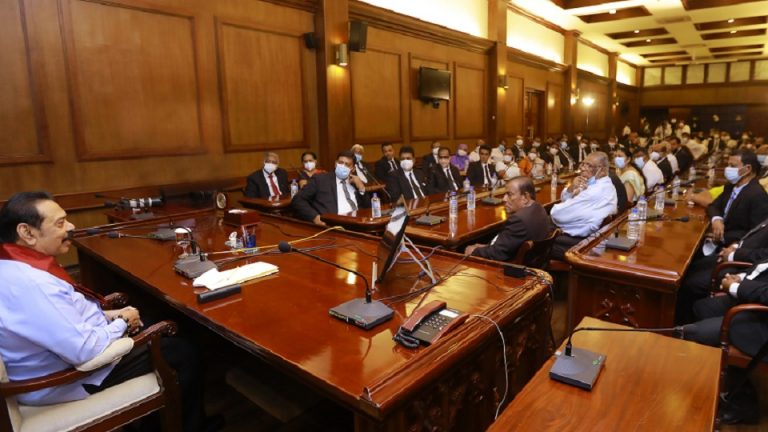
The Ministerial Consultative Committee met on Thursday under the chairmanship of Minister C.B. Ratnayake and State Minister of Wildlife Protection.
Adoption of Safety Measures including the Construction of Electrical Fences and Trenches was highlighted by Reforestation and Forest Resource Development Wimalaweera Dissanayake.
Secretary to the Ministry of Wildlife and Forest Conservation Somarathna Vidanapathirana said this amendment, which also takes into account the GSP concession, has been under discussion for nearly 15 years and was finally able to come into force.
Leader of the Opposition Sajith Premadasa who attended the CC meeting said the Ministry should work towards developing eco-tourism to increase foreign visitors and requested the Department of Wildlife Conservation to introduce more attractive programs.
These are the setting up of leopard centers in collaboration with the Ministry of Tourism. Minister Ratnayake instructed the officials to take necessary steps in this regard as well as to take steps towards establishing a Leopard Center at the Training Center of the Polonnaruwa Wildlife Conservation Department.
Premadasa also spoke on the need to make permanent volunteers who have served for many years and have not been made permanent. The Minister instructed the officials to look into the matter immediately and take necessary action.
Several MPs also told the Committee that the Yala National Park being closed for two hours during the day, causes an inconvenience to tourists. Officials were thus instructed to reduce the daytime park closure to one hour by the State Minister.
He also instructed the officials to take maximum measures to ensure the safety of wildlife.MPs also drew the attention of the Minister to a number of issues such as the human-elephant conflict, the construction of elephant fences and the concerns pertaining to the national parks.
Ukrainian tourists in Sri Lanka request extended stay amidst its crisis
Sri Lanka is bracing for what could be a major impact to the already unstable economy as a result of the crisis in Ukraine.
Russia’s military operation in Ukraine is expected to hit Sri Lanka’s tourism sector as well as tea exports and the purchasing of oil.
Foreign Secretary Admiral Jayanath Colombage said that the most number of tourists to Sri Lanka arrived from Russia and Ukraine in the recent past.
He said that Sri Lanka is expecting arrivals from those countries to be affected as a result of the crisis in Ukraine.
They are currently resorted to staying at hotels in Bettota area and are unable to travel to their home country.
They are requesting that they be allowed to remain in Sri Lanka until the war situation in Ukraine is resolved
“That will have a major impact on us,” the Foreign Secretary said at a virtual media briefing yesterday.
Colombage also said that Sri Lanka will find it hard to sell its tea as a result of the crisis in Ukraine.
Russia and Ukraine are among the key countries to which Sri Lanka exports tea.
He also said that Sri Lanka will be compelled to pay more for oil and gas imported to the country.
World oil prices have already shot up as a result of the situation in Ukraine and Sri Lanka will need more dollars to pay for the imports.
“We will once again have to face a situation,” the Foreign Secretary said with regards to the impact the crisis will have on the local economy.
Meanwhile, Former Foreign Minister Rohitha Bogollagama said that sanctions imposed on Russia by the EU and proposed by other major trading nations may also affect Sri Lanka’s trade ties with Russia.
He said that would then hurt Sri Lanka’s economy as Russia is a major trading partner of Sri Lanka.
World oil prices have already shot up as a result of the situation in Ukraine and Sri Lanka will need more dollars to pay for the imports.
“We will once again have to face a situation,” the Foreign Secretary said with regards to the impact the crisis will have on the local economy.
Meanwhile, Former Foreign Minister Rohitha Bogollagama said that sanctions imposed on Russia by the EU and proposed by other major trading nations may also affect Sri Lanka’s trade ties with Russia.
He noted that Sri Lanka will be compelled to comply with any sanctions imposed by the EU or the US on Russia.
He said that would then hurt Sri Lanka’s economy as Russia is a major trading partner of Sri Lanka.
The war in Ukraine has resulted in 198 people being killed with 3 of them being children and 1,115 wounded, with 33 of them being children.
Ukraine constituted of 10% of all arrivals into Sri Lanka within the past month while Russia made up 16% of all tourist arrivals, the SLTDA report for tourism arrivals in January 2022 reveals.
Out of the total arrivals of 82,327, over 31,000 tourists originated from central and eastern Europe, home to countries such as Ukraine, Belarus, Poland, Russia and Kazakhstan.
An analysis of Russian arrivals in the consecutive years reveals that it has almost exceeded the pre pandemic levels as experienced in January 2019.
This could be likely due to increased interest by Russian tour operators in alternative destinations to Thailand and Goa with strict public health measures in place and the launching of direct flights to Russia, the SLTDA report mentions.
Europe became the largest source of tourist traffic to Sri Lanka with 68.8% of the total traffic received in January 2022. Given the escalating number of COVID-19 cases, this can be considered as significant growth, the report further mentions
UN High Commissioner for Human Rights Michelle Bachelet has called on the international community to continue to explore possible targeted sanctions against credibly alleged Sri Lankan perpetrators of grave human rights violations and abuses.
She also called on the Sri Lankan Government to publish the findings of the Commission of Inquiry into the 2019 Easter Sunday bombings to ensure transparency for victims and pursue further independent investigations into the involvement of any other state or non-state actors.
Bachelet, yesterday (Friday) published a report on Sri Lanka which will be formally tabled at the UN Human Rights Council in Geneva at the 49th Session which begins next week.
“Bachelet recognizes recent steps taken to initiate reforms but expresses deep concern over a number of human rights trends in the country.
While we recognize the renewed willingness of the Government of Sri Lanka to engage constructively with our Office, including in the preparation of the report, we urge the Government to go much further with the legal, institutional and security sector reforms necessary to comply with Sri Lanka’s international human rights obligations,” Spokesperson for the UN High Commissioner for Human Rights Ravina Shamdasani said.
In the report the High Commissioner reiterated the recommendations made to the Government of Sri Lanka in paragraph 60 of her 2021 report to the Council.
She further recommended the Government to ensure the drafting process for a new Constitution is based on broad and inclusive consultations, and advances the devolution of political authority, which is integral to reconciliation and the full enjoyment of human rights by all members of its population;
“Avoid reliance on the military to run civilian affairs and take steps to reduce the influence of the military on civilian life,” she added.
She also urged the Government to establish a moratorium on the use of the Prevention of Terrorism Act until it is replaced by legislation that fully complies with international human rights norms and standards.
The High Commissioner urged member states to cooperate with victims and their representatives to investigate and prosecute international crimes committed by all parties in Sri Lanka.
These crimes committed through judicial proceedings in domestic jurisdictions, including under accepted principles of extraterritorial or universal jurisdictions and continue to explore possible targeted sanctions against credibly alleged perpetrators of grave human rights violations and abuses.
She also urged member states to review asylum measures with respect to Sri Lankan nationals to protect those facing reprisals and refrain from any renouncement in cases that present real risk of torture or other serious human rights violations.
The European Union and Sri Lanka have identified areas for the strengthening of partnerships between the EU and the island nation, Diplomatic sources said.
Foreign Minister Prof. G.L. Peiris met with the Commissioner of the European Union for International Partnerships Jutta Urpilainen, on the sidelines of the Ministerial Forum for Cooperation in the Indo-Pacific, held at the French Foreign Ministry in Paris.
Minister Prof. Peiris discussed with EU Commissioner Urpilainen the strengthening of partnerships between Sri Lanka and the European Union with regard to value-added exports.
These sectors are garments, flavoured teas, spices including cinnamon and pepper, fisheries products, gems and jewellery and partnerships in respect of investments in priority sectors like the hospitality sector, Information Technology, food processing, power and energy, and the production of pharmaceuticals.
The discussion also touched on health policy cooperation, connectivity among ports and harbours in the region, vocational training, digitalization and other aspects of people to people contact.
European Commissioner Urpilainen told Minister Prof. Peiris that the EU is increasingly outward-looking in reaching out to countries around the Indian Ocean and the Pacific and that there are clear synergies in the areas of activity identified by the Foreign Minister of Sri Lanka.
Meanwhile the European Union’s (EU) GSP + facility regained by Sri Lanka in 2017 providing market free access for local exporters to European countries will remain till 2023 but this continuation process will not be automatic.
This was reiterated by Ambassador Denis Chaibi, Head of the EU Delegation to Sri Lanka and the Maldives.
However he added that the government’s obligations to implement the commitments under 27 UN conventions towards regaining the GSP + will remain as well and will continue to be monitored by the EU.
Sri Lanka has now become an upper-middle income country in 2019, and thus reached a level of development that would mean it has to graduate out of the GSP+ scheme over time.
There is a 3-year transition period foreseen for the continuation of the EU facility, ending in 2023 and the strict monitoring process is being continued, he revealed.
The new status of Sri Lanka becoming this year an upper middle income country will mean that the country will lose the benefits of GSP+ sooner or later, possibly in three years’ time, he pointed out.
Essentially, EU uses trade as an incentive and its GSP and GSP+ regime does this.
The beneficiary Third World countries can develop, grow and take advantage of these schemes, while not putting their sensitive sectors and industries at risk.
“But there is no free lunch; benefits do not come without responsibilities. In exchange for this tariff-free access to the European market, countries must meet international standards in labour rights, environment and human rights,” he emphasised.
EU GSP+ is automatically lost if a country achieves ‘upper middle income’ status consecutively for three years. In July 2019 the country graduated to upper middle income status.
By P.K.Balachandran | NewsIn Asia
Colombo, February 25: Michele Bachelet, the UN High Commissioner for Human Rights, in her report to the 49 th. Session of the UNHRC beginning on February 28, has slammed Sri Lanka for not implementing its pledge to establish war crimes accountability mechanisms, to trace the forcibly disappeared persons and provide succor to the victims’ families.
According to an unedited version of the report titled “Promoting reconciliation, accountability and human rights in Sri Lanka,” Bachelet says that when the Lankan government withdrew its co-sponsorship of resolution 40/1 and related resolutions 34/1 and 30/1, it had promised to pursue an “inclusive, domestically designed and executed reconciliation and accountability process”. But two years on, it is yet to come forward with any “credible new roadmap on transitional justice towards accountability and reconciliation.”
The two transitional justice structures established by the previous government, namely, the Office on Missing Persons (OMP) and the Office on Reparations (OFR), continue to exist, “but they have struggled to secure the confidence of victims, particularly following changes in their membership,” Bachelet says.
According to the government, the OMP has been working on the verification of 6025 complaints it had received in its first phase from 2000 to 2020 and had shared 6,025 files with the relevant authorities to obtain additional information. The OMP felt that 4,200 complaints required further documentation and had notified 3,230 families to provide further details needed to process their cases. The government reported that in November 2021 the OMP established four panels of inquiry to conduct investigations and to enable it to issue Certificates of Absence or Certificates of Death to the families.
“But the OHCHR (Office of the High Commissioner of Human Rights) expresses concern that the verification is aimed at reducing the case load and closing files and not establishing the truth and ensuring justice and redress to families.”
“The High Commissioner is gravely concerned about the continuing precarious situation of the families of the disappeared – the majority of whom are represented by women. In addition to their suffering and anguish in not knowing the fate and whereabouts of their loved ones, they continue to struggle with the desperate economic and social consequences this has had on their lives,” the report says.
“The families of the disappeared have a right to truth, justice, reparation and guarantees of non-recurrence and the High Commissioner urges the Government to acknowledge their sufferings, urgently determine the fate or whereabouts of victims, provide reparations, and bring perpetrators to justice,” the report stresses.
In 2021, the Office for Reparations (OFR) was allocated LKR 800 million (USD 3.96 million) for the payment of processed claims; out of which LKR 400 million was utilized. “But the data available to OHCHR regarding compensation payments are not sufficiently disaggregated and it is unclear what payments correspond to human rights violations,” the report points out.
The Office for National Unity and Reconciliation (ONUR) has continued to conduct peace and reconciliation workshops and activities throughout the country. The ONUR is reportedly developing a “Strategic Roadmap for National Healing, Peace-building and Reconciliation ” through a consultation process with civil society and political parties. But the High Commissioner stresses that reconciliation will only be achieved “when supported by comprehensive transitional justice measures.”
Let off the Hook
The report goes on to say that: “The High Commissioner is seriously concerned by the continued lack of progress and even steps backward in several emblematic human rights cases before the courts. In August 2021, the Attorney General Department decided not to proceed with charges against former Navy commander Wasantha Karannagoda in the case of the enforced disappearances of 11 individuals in 2008 and 2009. Karannagoda had filed a writ with the Court of Appeal and secured a stay order as interim relief on the basis that he was wrongly implicated. Victims’ families challenged the decision at the Court of Appeal with hearings expected in April 2022. While the hearings on the case are set to continue against 14 other navy personnel, Karannagoda was appointed Governor of the North Western Province in December 2021.”
“In January 2021, the Attorney General informed the Batticaloa High Court that it would not proceed with the prosecution of five accused in another emblematic case, the murder of MP Joseph Pararajasingham at Christmas mass in December 2005.”
On 12 January 2022, the Colombo High Court delivered judgement in the case of three officers charged on 33 counts including murder and conspiracy to commit murder for the incidents that resulted in the death of twenty seven inmates in the Welikada Prison Riot on 9 November 2012. The first accused, Inspector of Police Neomal Rangajeewa of the Narcotics Bureau was acquitted of all charges. The second accused, former Superintendent of Welikada Magazine Prison, Lamahewage Emil Ranjan, was found guilty and given a death sentence. The third accused, Indika Sampath, an officer attached to the Prisons intelligence unit, has absconded and will be tried in absentia. But “no action appears to have been taken against other security forces involved in the incident,” the report says.
Easter Sunday Bombings
On the 2019 Easter Sunday bombings which claimed 270 lives, the report said: “The victims of the 2019 Easter Sunday bombings and religious leaders continue to call urgently for truth, justice, reparation for victims and a full account of the circumstances that permitted those attacks, in particular the role of the security establishment. The full results of the Presidential Commission of Inquiry into the attacks have not been published, but it is understood that it has recommended criminal charges against key officials.
“While hearings continue to be scheduled in several other emblematic cases, the High Commissioner is concerned that these cases continue to linger before the courts now a decade or more after the original indictments. The Attorney General’s recent use of his discretion to withdraw these long-standing cases raises serious concerns about the independence of his office and the Government’s commitment to pursue accountability. The High Commissioner is deeply disturbed by the general lack of progress over the past years in most cases,” the report says.
Targeted Sanctions
Bachelet’s report recalls that in the absence of progress towards accountability by domestic mechanisms, Resolution 46/1 had decided “to strengthen the capacity of OHCHR to collect, consolidate, analyze and preserve information and evidence and to develop possible strategies for future accountability processes, to advocate for victims and survivors, and to support relevant judicial and other proceedings, including in Member States, with competent jurisdiction.”
“This accountability mandate presents an important opportunity for OHCHR, members of the Human Rights Council and the international community to support victims and pursue accountability for serious international crimes committed in Sri Lanka through complementary strategies.”
The Accountability Office started implementing these aspects of Resolution 46/1, with a start-up team undertaking preparatory work since April 2021. The Office has developed an information and evidence repository using e-discovery software and has identified a large number of individual information items already held by the UN, the report says.
The High Commissioner’s previous report had recommended that, among a range of measures, Member States explore possible targeted sanctions against credibly alleged perpetrators of grave human rights.
Other Rights Issues
The High Commissioner has objected to the government’s plan to draft a new law on “Protection from online falsehoods and manipulation.” She has disapproved the increase in the militarization of civilian government functions, and also the renewed grabbing of land in the former war-zone populated by minority communities (Tamils and Muslims) in the guise doing archeological work to unearth a Buddhist heritage or increasing forest cover.
There will be no price revision on fuel at the Ceylon Petroleum Corporation despite the price hike proceeded by the Indian Oil Company (IOC), said the Energy Ministry.
The IOC yesterday surged the price of petrol by Rs. 20 per litre and all types of diesel by Rs. 15 per litre.
Accordingly, one litre of Octane 92 petrol sold by the IOC will be Rs. 204 and diesel, Rs. 139.
The IOC had previously surged the price of fuel on February 06 as well.
In the backdrop, the CEYPETCO has also requested the Energy Ministry for a price surge, but to no avail.
MIAP
Any pain or hurt that has been endured by Ukraine and Russia are a concern to Sri Lanka in the event that these two countries have been friends with the island nation backed by many bilateral ties and that Sri Lanka is aware of the pain and repercussion of war that brings to a nation, said Ruling Party MP Diana Gamage, speaking to Parliament two days (24) ago.
In a candid speech, the Ruling Party MP implored the Russian President to find a better to communicate.
“So many of our societies have come such a long way since the days of war. But nowhere near long enough to not remember what it truly costs on all sides. The suffering always continues to ripple through time, like dropping a zone in a pool of water. We are all a family on this earth and our neighbours are the ones who are, in many cases, closer to us than the rest; sharing many aspects of our culture and traditions. I urge President Putin to remember this and reconsider the methods and message he chooses to send out into a world that is now so interdependent and connected. A world in which citizens from so many lands travel to other nations, sharing their identities, learning from the environment and coming together to build the future we all strive for. One in which we can put our greatest strength to accomplish the difficulties we that we all inevitably face going forward,” she said.
MIAP
S. V. KIRUBAharan, France
06/07/2019 – What has been happening in Sri Lanka since Easter Sunday is more than enough for the government to find excuses after excuses for not implementing the UN Human Rights Council – UN HRC resolution 30/1. The reason for this is also why the government took no action even though it knew full well about the impending attacks on Christian churches. According to information in the media those who were in power in the past and the present, knew about the group and its members who carried out these attacks. It is a long story which has not been analysed in the correct light. Foreign intelligence services have found the root causes of everything that happened and it is all astonishing. However, Sri Lanka is trying its best to cover up the same.
If one asks why the government was not bothered about the warnings of the impending attacks especially on Christian churches – the answer is very simple. As long as there is nothing against Sinhala Buddhists, it is fine for the Sri Lankan rulers, who are believed to be behind these attacks.
How long can Sri Lanka fool the International Community – IC? Since independence in 1948, the victims of Sri Lanka continue to be victimised. Sri Lankan rulers – the Sinhala Buddhists, are using the tactics of ‘divide and rule’ among the Tamils and the Muslims who speak the same language and are progressing well.
When one looks at the methods and manipulations used by every regime in Sri Lanka – it is obvious that these rulers are only interested in protecting the interests of Sinhala Buddhists.
When the armed struggle started in the North and East in the early ‘80s – the Government of Sri Lanka’s (GOSL) very first action was to bring division among the Tamils and the Muslims who had lived in peace and harmony for centuries.
Then, the GOSL created a new force known as ‘home guards’ comprising mostly Muslims in the East. They armed the home guards and motivated them to be hostile to the Tamils in the North and East. This initiative created a huge gap and anger between the Tamils and the Muslims.
Muslims from Jaffna
It’s true that in October 1990 the Jaffna Muslims were expelled from Jaffna peninsula by the LTTE – Liberation Tigers of Tamil Eelam. But it takes time for the truth to be revealed. Recently, I was told that it was an arbitrary act by Gopalaswamy Mahendraraja alias ‘Mathaya’ in the LTTE. The leadership had endorsed it without realising its roots. Readers must do their own analysis to understand who was behind this move to bring shame to the LTTE! It took years for the LTTE to realise this behind-the-scene manipulation by a powerful political party abroad with links to a strong power.
However, since 1995, Jaffna has been fully under the control of the Sri Lankan security forces. If the GOSL really sympathised with Jaffna Muslims, why didn’t they re-settle the Muslims in Jaffna from 1995 onwards? The fact is that the GOSL used Jaffna and Mannar Muslims for their international propaganda against the LTTE. This added more fuel to the burning anger between Tamils and Muslims.
GOSL used this opportunity and motivated extreme Muslims to destroy and confiscate Tamils’ properties – land, paddy fields, fishing industry, shops, schools, temples, etc in the East. Tamils’ complaints about these incidents fell on the deaf ears of the GOSL.
Also, GOSL recruited Muslims, especially youths into their intelligence services and used them to torture and interrogate Tamil youths who were fighting for their right to self-determination. In brief, rather than finding a solution to the bloody ethnic conflict, every regime in Sri Lanka found short cuts and cunning methods to suppress the voice of the Tamils, especially by using Muslims in the island.
The whole world knew about what happened between October and December last year in the Sri Lankan parliament. The Prime Minister who had the majority in the Parliament was sacked by the unintelligent President who then gave the role of Prime Minister to a power-hungry monster who had no majority in the Parliament. However, this was resolved with the genuine support of MPs from the Tamil National Alliance – TNA.
As soon as this Parliamentary dilemma was resolved, in order to take revenge on the TNA, in other words on Tamils; the unintelligent President Sirisena, appointed the most extremist Muslim as the new governor of the Eastern province. This man had been terrorising the Tamil people in the East for decades. To be noted, presently Hizbullah is accused by many including by the government sources, as one of the men believed to be an ardent supporter of the group which carried out the attacks on Easter Sunday. Please do listen to this YouTube which is in Tamil to know the background of the ex-governor Hizbullah in the East.
https://thinakkathir.com/?p=62308
President is puzzled
Every government top position in the East has been deliberately given to the Muslims by the unintelligent President Sirisena. This is to create turmoil among the Tamils and the Muslims.
Presently the disappointed witless President is puzzled and is finding it difficult to arrest the ex-governor of the East. To be frank, appointing a Muslim as the governor to the Eastern province is not the issue here. Whether one likes it or not, just like he appointed an academic as the governor to the North, he could have appointed a Muslim academic as the governor to the East as well. Of course, an individual without an extremist history against Tamils.
Since Easter Sunday the Sri Lankan military have been making the most ugly and desperate moves. Of course, with the advice of the Sri Lankan Ministry of Defence – MOD. As I said before, rather than finding durable solutions to the ethnic conflict or finding a way to prevent future attacks on religious grounds, the government forces have approached the LTTE cadres, shedding crocodile tears, praising, apologising to them and requesting those cadres to join their forces. There is no doubt that this idea is to get ‘two birds with one stone’. This is not a genuine offer to the LTTE cadres from the GOSL.
Firstly, the Sinhala Buddhist regime is finding a cunning way of setting LTTE cadres against the Muslims in the North, East and elsewhere. Secondly by this method they are trying to halt the pressure from the IC on reconciliation and accountability. The IC should be aware of this dangerous move by the GOSL.
If the government had been genuine and honest in their approach to the LTTE cadres, like they had pardoned and released JVP members in the past, foremost of all, they should have released all LTTE cadres who are in prison. Also, they should provide information on the whereabouts of those who were ‘disappeared’ after surrendering to the military. We know that the man who was flown in from Singapore is the man behind this entirely new approach. He is the man who manipulated and separated Karuna and KP from the LTTE.
Remote-control can do wonders
Sri Lankan rulers should be honest about what is in their heart. They think that they have fooled the Tamils and now they are fooling the IC. This is not going to work in the long run. Sooner or later history will prove that they have fooled themselves. Let us wait and see.
The latest is that under the command of LTTE defector Karuna, GOSL has already established a force to counter Muslim extremism in the East and elsewhere!
Now let me come to the real story. In the recent past, the news in the local media said that a “Sri Lanka intelligence officer who wished to remain anonymous has told local journalists that investigations had confirmed that the Easter Sunday attacks were carried out purely by a local group” (Colombo Gazette of 15 June 2019). If so, firstly people with average intelligence should ask themselves – then who were the local culprits of these Easter Sunday attacks?
Now we can form the opinion that the attack in New Zealand has no connection to the East Sunday attacks in Sri Lanka.
According to the Sri Lankan deputy defence Minister, ‘the attackers were well educated from well-off families – financially independent’.
Secondly people should ask themselves whether the man believed to be the prominent leader or the founder of this extreme Islamic group volunteered to go on this mission or not? The theory shows that if the leader or founder is eliminated then his/her group becomes unmoveable or paralysed.
If the leader of this group is really believed to have carried out one of those attacks on Easter Sunday, then the question arises, who were behind these attacks? Everyone knows that ‘remote control’ can do wonders!
We should not forget that there is ample evidence to prove that all those nine attackers on the Easter Sunday were on the Payroll of the Sri Lankan Ministry of Defence – MOD and they were well known to earlier and present rulers in Sri Lanka. If so, what conclusion can be drawn?
Since the Easter Sunday attacks, anyone following and analysing the news items and statements said or given by Southern politicians as well as the Security personnel, will wonder why the Sri Lankan intelligence service remains silent regarding the attacks.
Man from Singapore
The Ministry of Defence has imported the so-called expert on terrorism from Singapore, to sabotage the truth being exposed about what really took place on Easter Sunday.This ‘expert’ is talking fiction and covering up the involvement of the MOD. They are misleading the public while they buy time to make progress in their four pillars – Buddhisation, Sinhalisation, Militarisation and Colonisation.
Also, this is a perfect opportunity to analyse the statements of the Southern politicians, Buddhist monks and Security forces to see how far they have misled the International Community regarding the thirty years of war in exercise of the right to self-determination of the Tamils. Now they are shedding crocodile tears to succeed in finalising their four pillars with the help of the Tamils.
I could write pages about what has happened and is happening presently in Sri Lanka. In Brief, the Sri Lankan intelligence service strongly believes that for Sri Lanka to become a pure Sinhala Buddhist country, a strong Sinhala Buddhist should win the next Presidential election. For this reason, the attacks on Easter Sunday, the resignation of the Muslims Ministers and deputies, the release of extreme Buddhist monks, etc are all paths proving that Sri Lanka is successfully moving towards becoming an absolute Sinhala Buddhist country.
Selfish Muslims may think that by holding a candle to different governments in power; they can survive and do wonders in Sri Lanka. Some empty-headed Tamil politicians – veterans and apprentices may think that their soft approach to the government will allow them to get at least the 13th amendment. But this is all a dream.
Regardless of the cost of human sacrifices and huge material damage, Sri Lanka is successfully moving towards absolute Sinhala Buddhist identity – Buddham Sharanam Gachchami, Dharmam Sharanam Gachchami and Sangham Sharanam Gachchami. Three chanting of Buddha – the first one ‘Buddham Sharanam Gachchami’ denotes that the disciple is now surrendered to the Buddha, awakened one. The second one ‘Dharamam Sharanam Gachchami’, the law of nature / the law of creator and the third one, ‘Sangham Sharanam Gachchami’, the disciple now surrender to this club.(end)
S. V. KIRUBAharan
France
06/07/2019
Chief Inspector Asela Kumara Herath, who was the OIC of the Mawanella Police Station, has been suspended.
During his tenure as an Inspector attached to the Vavuniya Police Station, he was suspended for accepting a bribe to release a case.
The IGP has suspended the officer following a written notification issued by the Commission to Investigate Bribery or Corruption on January 13.