The National People’s Power (NPP) emerged victorious at the 2025 Local Government (LG) election, securing the most seats and council control nationwide. Despite a decline in vote share compared to the Presidential and Parliamentary elections, the NPP more than doubled the vote count of its main rival, the Samagi Jana Balawegaya (SJB).
The NPP won 3,921 LG seats and secured majority control in over 100 local authorities, though it polled over 150 council majorities in total. However, it faced notable setbacks in urban centres and the north and east of the country, where opposition parties maintained or regained support.
Colombo Municipal Council: No Clear Winner
Despite a strong campaign led by Prime Minister Dr. Harini Amarasuriya, the NPP failed to secure outright control of the Colombo Municipal Council (CMC). The final tally showed:
NPP: 81,814 votes (36.92%) – 48 seats
SJB: 58,375 votes – 29 seats
UNP: 26,297 votes – 13 seats
With no party securing a majority in the 117-seat council, opposition groups are expected to form coalitions to gain control of the CMC.
Regional Breakdown
NPP: Strong in rural areas, especially in the Deep South.
SJB: Over two million votes, victories in Kandy and parts of the North and East.
ITAK: Resurgence in Tamil-majority areas, winning 8 local bodies in the north and east.
SLPP: Maintained a strong showing, securing 742 seats.
UNP: Won 379 seats.
People’s Alliance (PA): Took 300 seats.
Sarvajana Balaya (SB): A new entrant, won 226 seats, with notable success in several areas.
Peaceful Polls and High Engagement
Polling was held on May 6, from 7:00 a.m. to 4:00 p.m., and concluded peacefully with no major incidents reported. Election monitors praised the process as well-organized and relatively calm compared to previous elections.
The outcome of the 2025 LG election signals continued nationwide support for the NPP, but also highlights the resilience of traditional and regional parties, especially in urban and minority-dominated regions.
The National People’s Power (NPP) has claimed victory in the Thalawa Pradeshiya Sabha of the Anuradhapura District and the Alawwa Pradeshiya Sabha of the Kurunegala District while the Eelam People’s Democratic Party (EPDP) won the Kytes Pradeshiya Sabha in the Jaffna District.
Thalawa PS – Anuradhapura
National People’s Power (NPP) – 28,656 (20 seats) Samagi Jana Balawegaya (SJB) – 9,332 (6 seats) People’s Alliance (PA) – 4,336 (3 seats) Sri Lanka Podujana Peramuna (SLPP) – 3,508 (2 seats) United National Party (UNP) – 2,392 (2 seats)
Alawwa PS – Kurunegala
National People’s Power (NPP) – 15,501 (13 seats) Samagi Jana Balawegaya (SJB) – 6,377 (5 seats) Sri Lanka Podujana Peramuna (SLPP) – 3,704 (3 seats) Independent Group – 3,126 (2 seats)
The National People’s Power has won the Dambulla Municipal Council after securing 56.77% of the votes.The NPP polled 7,688 votes and secured 13 seats in the council.
The Independent Group 2 received 2,442 votes and won 4 seats.
The Sri Lanka Podujana Peramuna (SLPP) obtained 1,774 votes and secured 3 seats.
The Samagi Jana Balawegaya (SJB) polled 1,294 votes and claimed 2 seats in the Dambulla Municipal Council.
Dambulla MC | Matale District
National People’s Power (NPP) – 7,688 (13 seats) Independent Group – 2,442 (4 seats) Sri Lanka Podujana Peramuna (SLPP) – 1,774 (3 seats) Samagi Jana Balawegaya (SJB) – 1,294 (2 seats)
The National Congress has secured the Akkaraipattu Municipal Council of the Ampara District.
National Congress (NC) – 7,902 (11 seats) National People’s Power (NPP) – 3,584 (4 seats) Sri Lanka Muslim Congress (SLMC) – 3,133 (3 seats) All Ceylon Makkal Congress (ACMC) – 2,066 (2 seats) Sri Lanka Podujana Peramuna (SLPP) – 5,801 (3 seats) Independent Group (IND) – 424 (1 seat)
The Ilankai Tamil Arasu Kachchi (ITAK) has claimed victories in the Chavakachcheri, Nallur and Walikamam-West Pradeshiya Sabhas of the Jaffna District.
Chavakachcheri PS – Jaffna
Ilankai Tamil Arasu Kachchi (ITAK) – 6,938 (8 seats) ACTC – 5,917 (7 seats) National People’s Power (NPP) – 5,234 (6 seats) DTNA – 4,310 (5 seats)
Nallur PS – Jaffna
Ilankai Tamil Arasu Kachchi (ITAK) – 5,576 (7 seats) TMK – 4,921 (6 seats) National People’s Power (NPP) – 2,820 (3 seats) DTNA – 2,095 (3 seats)
Walikamam West PS – Jaffna
Ilankai Tamil Arasu Kachchi (ITAK) – 7,364 (10 seats) ACTC – 4,982 (6 seats) National People’s Power (NPP) – 3,407 (4 seats) DTNA – 2,026 (2 seats) United National Party (UNP) – 809 (1 seat)
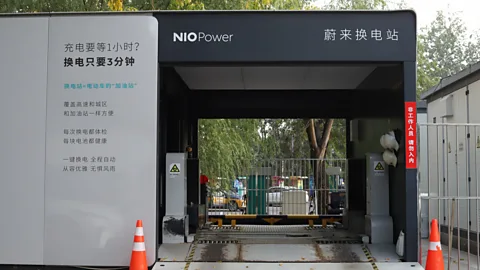
At a battery swap station near the Beijing Olympics Sports Centre, the owner of a Nio car watches as a fully charged battery is placed into his vehicle. The station’s staff drive his car onto a platform with an integrated system which removes the depleted battery from beneath the car and loads it a fresh one. The whole process takes no more than five minutes.
Behind him, a few other customers wait in line under an overcast sky, the iconic Bird’s Nest Olympic stadium not far in the distance. Outside the battery swap station, a slogan reads, “Battery swap stations are equivalent to gas stations for electric vehicles”.
Battery swapping – which simply means changing out depleted electric vehicle (EV) batteries for fresh, recharged ones – is an alternative to charging batteries inside the vehicle, as is used for the vast majority of the world’s electric cars.
China has been able to widely promote battery swap stations so quickly since it is home to the main lithium-ion battery manufacturers – Yihao Xie
While battery swap is still largely a nascent sector, China has the world’s most developed model by far. While it’s mainly used for larger vehicles – close to half of the electric heavy-duty trucks sold in China in 2023 were equipped with battery-swap technology – the country is also seriously experimenting with swaps for personal cars.
Battery swapping can have some big advantages, in particular the lower amount of time it takes compared to recharging a battery while its inside a car. Still, it faces obstacles in China, which is also developing fast charging infrastructure at breakneck speed.
In fact, experts say that it may be in the countries which, unlike China, remain in the early stage of a switch to EVs that battery swaps prove most useful for supporting electric car uptake – especially when it comes to addressing range anxiety among drivers.
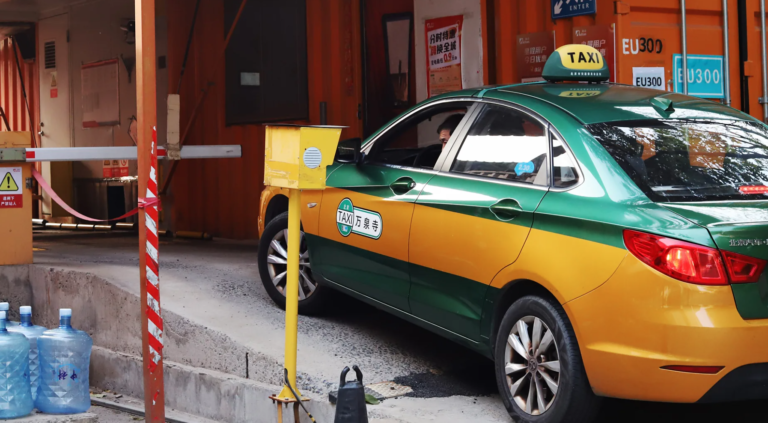
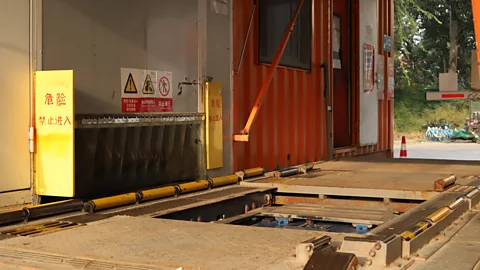
A taxi battery swap station in Beijing, the fully charged battery comes out automatically of a compartment below the car (Credit: Iris Liu)
Especially during the early days of electric vehicles, they were difficult to promote on a large scale due to range anxiety, says Daizong Liu, East Asia director of the Institute for Transportation and Development Policy (ITDP) in New York. A lack of charging facilities led to longer waiting times and interruptions during trips for EV users. Battery swap technology soon entered the field as a potential solution.
Although first tested and used more than a century ago before electric cars fell out of favour, in more recent decades battery swaps for electric cars were initially picked up by EV battery swap company Better Place, which was established in Israel in 2007. Operating in Denmark and Israel, it aimed to reduce the cost of batteries as well as reduce range anxiety and charging times, and received almost $1bn (£760m) in funding. But the company eventually went bankrupt in 2013, citing difficulties in consumer adoption and securing sufficient support from automakers, the Times of Israel reported at the time.
Just weeks after Better Place declared bankruptcy, Tesla’s plans to launch its own 90 second battery swap service were widely reported, with initial swapping locations along routes between Los Angeles and San Francisco, and Boston and Washington. But just two years later, it began phasing swapping out again, citing low market acceptance.
While battery swaps would appear to solve range anxiety, it currently isn’t always the case
China’s State Grid – the largest utility company in the world – began researching battery swaps for electric vehicles around 2006. It was seen as a way around a large-scale transformation of the power grid, as its reliance on pre-charged batteries meant charging could be done at more flexible times and places.
“After comprehensive consideration, China decided to have a route to do battery swaps,” says Liu.
Plug-in battery cars have dominated EV growth in China, but by 2021 it had also built at least 900 battery swap stations. That same year, it officially launched a pilot battery swap scheme in 11 cities. These projects are now scaling quickly: in 2023, China added around 1,600 new battery swap stations, bringing the total to some 3,570 stations, according to Chinese government data.
However, not all EVs are capable of battery swapping – the stations must be compatible with the car’s battery system, so only certain models that are designed for it can make the switch.
At present, battery swaps are most widely used by commercial vehicles such as taxis and logistics vehicles, not passenger cars. Several Chinese experts told the BBC that’s because, in several ways, the battery swap model has proven to be less advantageous than simply charging.
A two-horse race
In China, charging technology is constantly developing. Mainstream electric vehicles in China will support high-voltage fast charging of 800V and above by this year, according to one report. Major Chinese automakers such as BYD, Xpeng and Nio have now developed vehicles equipped with super-charging technology, which takes 15 minutes or so to charge batteries from 10% to about 80%. In March 2025, BYD announced a new charging system which it says can deliver 400km (250 miles) of range in five minutes of charging, making them twice as fast as Tesla’s superchargers. BYD plans to roll out a network of 4,000 of these “flash-charging” stations across China.
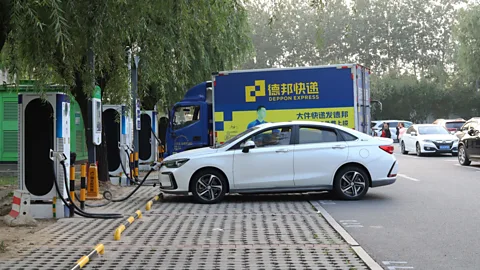
An electric car plugs in to charge at a charging station in Beijing. China is rolling out a huge number of fast chargers for EVs (Credit: Iris Liu)
The ownership question is another thing holding back battery swaps for private vehicles, both in China and elsewhere. Battery swaps inherently require car owners to relinquish ownership of a particular battery. If a car owner has just bought a new car and swaps its battery on the motorway, for example, they will very likely receive an older battery. Many car companies are aware of this issue, and some have adopted a business model of separating the car and the battery: consumers buy their cars without batteries, which they rent directly from the company.
Some companies have developed mobile battery swap vehicles, which can charge batteries in locations with lower electricity prices – Lulu Xue
But this business model requires automakers to own and manage a large number of batteries, tying up significant capital and increasing financial risk.
Popularising battery swap stations will also require automakers to accept a unified battery pack standard, so batteries can be interchanged more freely, says Jing Yang, director at the Asia-Pacific corporate ratings division of Fitch Ratings, a credit rating agency based in New York. Carmakers, however, are reluctant to do this, she says: mastering their own battery technologies is an important way for them to maintain industry influence.
And while battery swaps would appear to solve range anxiety, it currently isn’t always the case. A Nio owner I meet at the battery swap station near the Beijing Olympic Sports Centre tells me that while the time to swap the battery itself is indeed very fast, the swap stations need to reliably have a fully charged battery and few people in line to avoid long wait times. Once, he says, when visiting the suburbs, he almost missed an important meeting back in the city because no fully charged batteries were available.
Taxi swaps
For commercial vehicles, such as heavy-duty trucks, taxis and buses, such problems are easier to solve. These vehicles often operate in more predictable patterns, with centralised management, fixed routes or designated service areas, making it easier to plan and coordinate battery swaps efficiently. Battery swapping heavy-duty trucks are currently being widely promoted in China through both government policies and private companies, says Lulu Xue, mobility lead at the China office of the World Resources Institute, a global non-profit.
“The purchase cost of battery electric heavy-duty trucks was very high when they were first introduced, and batteries accounted for a large part of it,” she says. “If the battery is separated from the vehicle and users only buy the vehicle body, the price is almost the same as the purchase cost of diesel trucks.”
Chinese electric car company Nio has now built over 3,300 battery swap stations in China, but has also developed vehicles equipped with fast-charging technology (Credit: Iris Liu)
The Chinese government has extended considerable financial assistance to battery swapping schemes. In its 2021 pilot programme, three of the 11 cities are primarily focusing on battery swapping for trucks. Some provinces in China have also provided substantial financial incentives for the advancement of battery swapping technology. In 2021, China’s Hainan Province announced a one-time subsidy of 15% of the initial investment in equipment for battery swapping stations built and put into operation between 2021 and 2022.
China has been able to widely promote battery swap stations so quickly since it is home to the main lithium-ion battery manufacturers, and thus has a relatively inexpensive and abundant supply of batteries, according to Yihao Xie, a researcher on heavy-duty vehicles at the Washington-based International Council on Clean Transportation.
Using battery swaps for commercial vehicles also has its obstacles, however. Swap stations can occupy a large area, says Yang, and there tends to be a scarcity of land and power grid resources in the core areas where they are needed, which can constraint rapid expansion. “At present, battery swap operators have tried to deepen cooperation with some traditional energy companies to obtain such core resources,” she adds.
However, Liu points out that battery swap stations are a similar size to petrol stations, which can be easily repurposed to be battery swaps. The China National Petroleum Corporation, for example, has already built both charging and battery replacement facilities at some of its gas stations.
Perks and pitfalls
Some companies are also trying more specialised methods. Like many facilities in China, using land for battery swap stations requires approval and filing, making the entire cycle relatively long, and the land rent also increases the cost of the stations. To avoid these, some companies have developed mobile battery swap vehicles, says Xue, which have the added benefit of being able to charge batteries in locations with lower electricity prices, then swapping them in areas where on-site charging would be more costly or less feasible.
Liu notes that for commercial vehicles, battery ownership concerns are easier to manage, since companies can purchase batteries in bulk or rely on third-party providers. But the issue is still affecting how often at least some drivers of these vehicles use swap stations.
One taxi driver I speak to in Beijing has a taxi with both charging and battery swapping technology, meaning he can choose to charge or swap batteries. The taxi company he works for stipulates that drivers must use the battery swap mode at least once a month as part of a trial. “If I get a good battery, I won’t change it,” he tells me. “I will wait a month before changing it.” Using the battery swap service is also more expensive than charging, he adds.
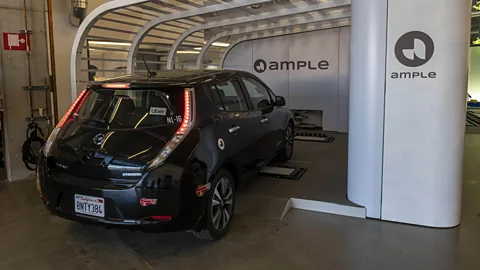
California start-up Ample has several partnerships around the world to use its battery swap station technology (Credit: Getty Images)
Taxi drivers who get a battery with a poor battery life at the swap station sometimes quarrel with the staff, according to a worker I meet at a Beijing taxi swap station. “If the driver gets a bad battery, some of them will yell at us. I tell them, yelling at us doesn’t help, we’re just here to swap the batteries. Some drivers even say they’ll call the police – it’s happened many times.”
Currently, says Xue, there is a clear business model in China for battery swaps for heavy-duty trucks, especially for intensive but short-distance uses such as in factories and mines.
Xie agrees. “Battery-swapping in commercial vehicles, especially heavy-trucks, is still faster than the fastest charger technologies currently in the market,” he says. “Trucks carry batteries with much larger capacities and those are just slower to charge until much more powerful chargers become available.” These advantages are unlikely to weaken even as fast charging technology develops, he adds.
But there is another potential reason to develop battery swap stations: to use them as energy storage stations, say Liu and Xue. Due to the variable nature of renewables like solar and wind, which are booming in China, a huge amount of energy storage is needed to ensure the stability of the power grid. EV batteries, including those in battery swap stations, are one way of providing this, says Liu. Battery swap companies could use their batteries to earn the difference in electricity prices between peaks and troughs, he says.
Some battery swap operators are already eyeing up this opportunity, but so far no stations in China or elsewhere are used in this way. It could provide another big benefit though, says Xie: supporting the grid when local distribution grids are knocked out by extreme weather. One hundred battery swap stations would be equivalent to a 50MW energy storage power station, notes one industry report.
Going global
It’s possible that battery swaps may only ever be a relatively niche offering in China, where both EVs and their charging infrastructure are now widespread. But other countries have struggled to adopt EVs, and battery swaps may in fact play their most useful role in countries where EVs are not yet popular, Xie says, especially as more Chinese EV manufacturers bring their products and technology abroad.
Battery swaps could still solve the range anxiety of some in China
4:33Why charge your electric car when you can swap batteries?
And battery swaps could still solve the range anxiety of some in China too. Growth in China’s EV market is currently driven by plug-in hybrid models, Yang says, while growth of pure EV sales has slowed significantly – showing that the convenience of energy replenishment is still valued by EV drivers. Both battery swapping and fast charging promote demand for pure electric vehicles. It remains to be seen what the final balance of these two technologies will prove to work best.
As per the Nio slogan, battery swaps can be seen as a sort of “gas station” for EVs. Whether they can ever reach the scale of gas stations, or even of EV recharging stations remains to be seen.