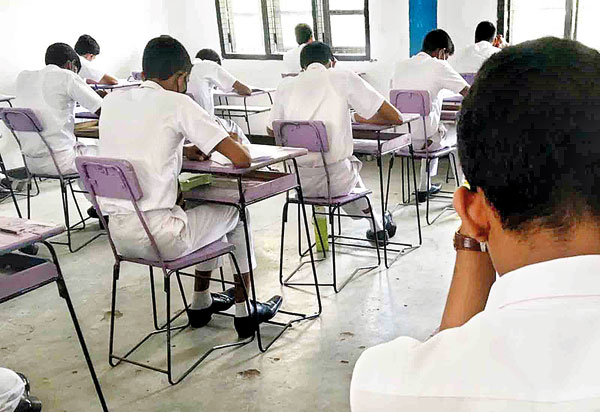
February 15, Colombo (LNW): Sri Lanka’s education authorities have confirmed that comprehensive arrangements are now in place for the conduct of this year’s GCE Ordinary Level examination, with thousands of candidates set to sit the crucial papers across the island.
Commissioner General of Examinations, Indika Kumari Liyanage, announced that the examination will be held at 3,545 centres nationwide. She noted that logistical coordination has been finalised to ensure the smooth administration of the examination process, which remains one of the most significant milestones in the country’s academic calendar.
Security has been strengthened at all venues in collaboration with the Police and the Tri-Forces to guarantee the safety and well-being of students and staff. Officials have also engaged the Disaster Management Centre to provide contingency support in the event of unforeseen circumstances, including adverse weather conditions or transport disruptions. Special transport arrangements are expected to assist candidates who may face difficulties reaching their designated centres.
In light of document losses caused by Cyclone Ditwah in certain areas, the Commissioner General clarified that temporary identification measures have been introduced. Candidates who have misplaced essential documents such as their National Identity Card may submit two recent passport-sized photographs certified by the relevant authority — the Grama Niladhari for private applicants or the school principal for school candidates — to gain admission to the examination hall.
Meanwhile, the Department of Examinations has provided an update on forthcoming results. The results of the GCE Advanced Level examination are anticipated to be released by April, while the Ordinary Level results are expected within three months of the completion of the examination.
Officials have urged candidates to adhere strictly to examination guidelines and to arrive at their centres well ahead of time, emphasising that all necessary steps have been taken to ensure the process proceeds efficiently and fairly across the country.
Nationwide Preparations Complete for GCE Ordinary Level Examination
Massive Security Operation Rolled Out for India–Pakistan T20 Showdown in Colombo
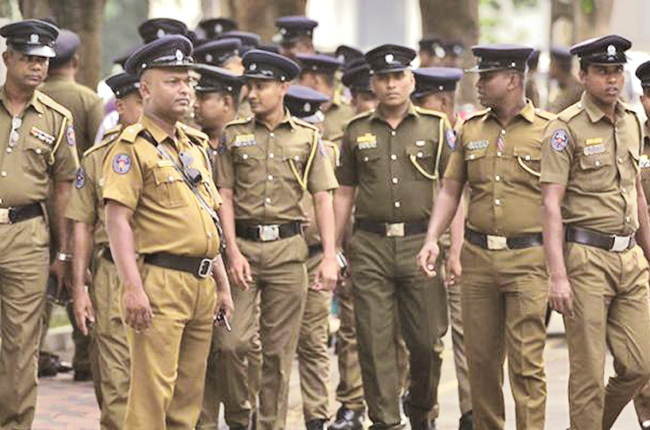
February 15, Colombo (LNW): An extensive security apparatus involving roughly 5,000 personnel has been activated in Colombo ahead of tonight’s high-stakes 2026 T20 World Cup encounter between India and Pakistan.
Addressing a dedicated media briefing, Senior Deputy Inspector General of Police for the Western Province, Sajeewa Medawatte, confirmed that comprehensive measures are in place to guarantee the smooth and secure conduct of the fixture, which is scheduled to begin at 7.00 p.m.
Heightened protection has been arranged not only at the R. Premadasa International Cricket Stadium but also at the hotels accommodating both national squads. Police patrols have been intensified along key transport routes frequently used by the teams, with escort units deployed to monitor movements and prevent potential disruptions.
According to the senior officer, the operation draws on a broad cross-section of law enforcement resources. Approximately 2,800 police officers have been assigned to ground duties, supported by 300 members of the Special Task Force and a substantial contingent of intelligence personnel tasked with surveillance and threat assessment. In addition, around 350 officers have been detailed specifically to manage traffic flow in and around the city, where heavy congestion is anticipated.
Authorities say the layered security plan includes roadblocks, vehicle inspections and real-time intelligence monitoring. Crowd management units have also been positioned at strategic locations to respond swiftly to any emergency.
Police have urged supporters travelling to the stadium to allow extra time for security screening and to cooperate fully with officers on duty. With tens of thousands of fans expected to attend and millions more watching worldwide, officials stressed that ensuring public safety remains their foremost priority as Colombo hosts one of cricket’s most fiercely contested rivalries.
BASL Convenes Rare Full Assembly in Wake of Lawyer’s Killing
February 15, Colombo (LNW): In an extraordinary show of unity, the entire membership of the Bar Association of Sri Lanka assembled in Colombo today (15) to deliberate on a collective response to the recent killing of a fellow lawyer and his wife in Akuregoda.
The meeting, held at the Association’s headquarters in Hulftsdorp — the historic heart of the country’s legal district — drew an unusually large turnout of attorneys from across the island. Senior and junior members alike gathered to reflect on the implications of the double murder for the independence and security of the legal profession.
This marks the first occasion in fourteen years that the BASL has summoned its full membership for a single assembly in the capital. The previous instance occurred in 2012 amid the constitutional crisis triggered by the parliamentary impeachment of former Chief Justice Shirani Bandaranayake, a moment widely regarded as a watershed for judicial independence in Sri Lanka.
Today’s session is being chaired by BASL President Rajeev Amarasuriya, who is expected to outline a series of proposals ranging from coordinated legal action to public advocacy initiatives aimed at reinforcing the safety of legal practitioners.
NPP Legal Wing Demands Swift Justice After Lawyer and Wife Gunned Down
LISTEN TO STORY
WATCH STORY
By: Isuru Parakrama
February 15, Colombo (LNW): The legal professionals affiliated with the National People’s Power (NPP) have strongly denounced the fatal shooting of attorney-at-law Buddhika Mallawarachchi and his wife in Akuregoda, Thalangama, describing the attack as a grave assault on the rule of law.
In a sharply worded statement released following the killings on February 13, 2026, the group expressed profound sorrow over the loss of their colleague and condemned what they characterised as a climate of violence fuelled by entrenched criminal networks.
They alleged that elements within the underworld had, in previous years, been emboldened by political patronage and allowed to flourish unchecked.
The lawyers said the murder was not merely an attack on an individual practitioner and his spouse, but a chilling message aimed at all those who work to uphold justice and protect civil liberties. They argued that when members of the legal fraternity are targeted, the implications extend far beyond the courtroom, striking at the very foundation of democratic governance.
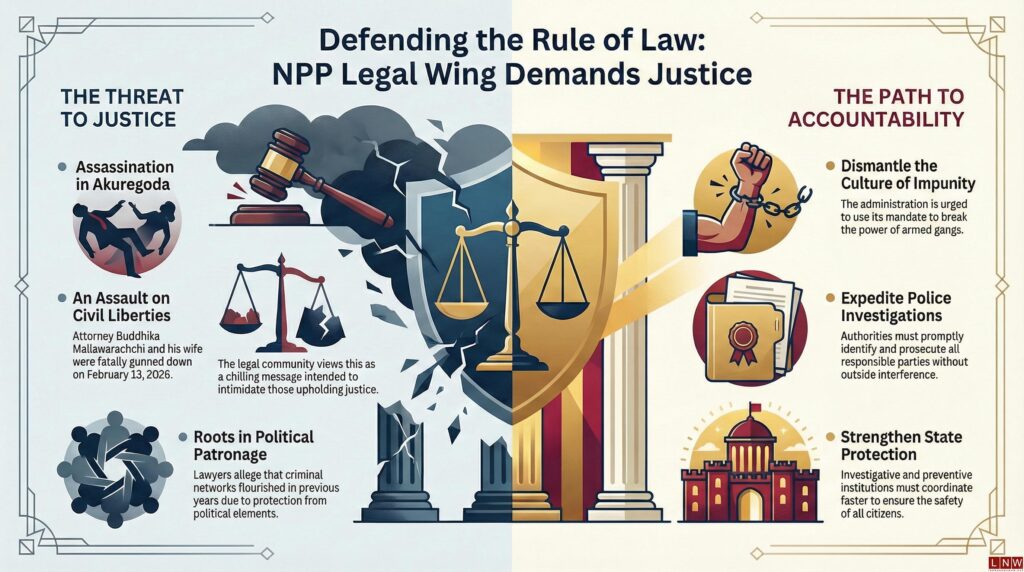
Calling for decisive action, the group stressed that the present administration carries a clear mandate to dismantle the culture of impunity that once enabled armed gangs to operate without fear of consequence. They warned that unchecked criminality poses a threat to a wide spectrum of society — from journalists and law enforcement officers to members of the judiciary and the Bar.
The statement further asserted that the State must not shirk its responsibility to ensure public safety. According to the lawyers, investigative bodies and preventive institutions must respond with greater urgency and coordination, demonstrating that justice will neither be delayed nor denied.
They urged the Government to reaffirm its commitment to safeguarding citizens’ rights and appealed to the police to expedite inquiries, identify all those responsible and ensure that prosecutions proceed without interference.
The killing has reignited debate within legal and civic circles about personal security, the resilience of institutions and the broader challenge of confronting organised crime in Sri Lanka.
Full Statement:
“We are deeply saddened by the death of our comrade Buddhika Mallawarachchi and his wife. This cruel and inhuman attack targets not only a lawyer and his spouse but also the citizens of this country at large.
The incident underscores that the current government, tasked with ending the era in which armed criminals could operate with impunity, must act with greater urgency. The threat posed by bloodthirsty criminals is not limited to any single profession, it could target journalists, police officers, judges, and now, as seen, lawyers.
The state cannot evade its responsibility. All components of the justice system, including preventive mechanisms and ongoing investigations, must operate faster than ever.
We urge the National People’s Power government to uphold its duty to ensure the safety and dignity of all citizens and call on the Sri Lanka Police to promptly complete the investigation and bring the perpetrators to justice.”
Public Mood Brightens as Confidence in Government and Economy Reaches Four-Year High

LISTEN TO STORY
WATCH STORY
By: Isuru Parakrama
February 15, Colombo (LNW): Sri Lankans appear to be increasingly hopeful about the country’s trajectory, with fresh survey findings indicating solid backing for the Government and a marked uplift in economic sentiment.
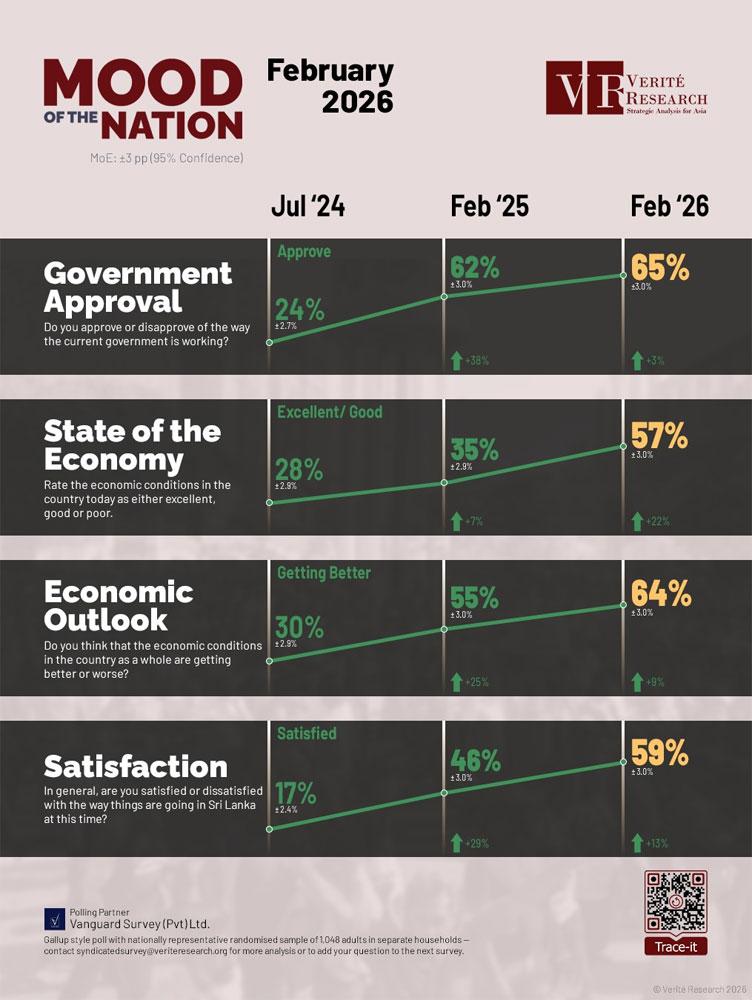
The latest nationwide “Mood of the Nation” study conducted by Verité Research, in collaboration with Vanguard Survey (Pvt) Ltd, shows that public approval of the administration has climbed to 65 per cent as of early February 2026.
Given the poll’s margin of error of plus or minus three percentage points, this represents a steady yet meaningful rise from the 62 per cent recorded at the same point last year. Levels of disapproval, meanwhile, remain comparatively low and broadly unchanged.
In a notable shift, respondents expressing positive views of current economic conditions now outnumber those who consider them poor — the first time such a crossover has occurred since the survey began four years ago. This development is being interpreted by analysts as a sign that perceptions of economic stabilisation are taking firmer root among the public.
Expectations for the future also appear to be strengthening. Nearly two-thirds of those surveyed — 64 per cent — believe the economy is on an upward path, compared with 55 per cent a year earlier. The proportion of participants who feel conditions are deteriorating has seen little movement, while the number of undecided respondents has fallen, suggesting that more citizens have formed clear and increasingly optimistic opinions.
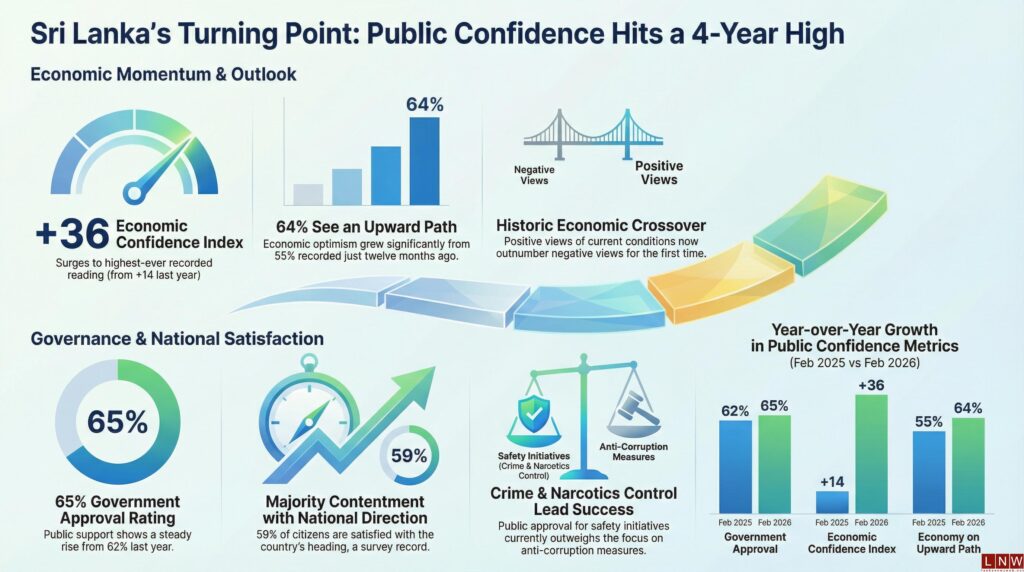
These responses feed into an Economic Confidence Index compiled by the research team, measured on a scale from minus 100 to plus 100. The index has surged to +36, a substantial leap from +14 twelve months ago and its highest reading since the tracking exercise commenced.
General satisfaction with the state of the nation has also edged into majority territory. For the first time in the poll’s history, 59 per cent of respondents indicated that they were content with the overall direction in which the country is heading, pushing aggregate satisfaction beyond the halfway mark.
When asked to compare the present administration’s performance with that of previous governments, participants awarded particularly strong marks for initiatives aimed at tackling narcotics and curbing crime. Interestingly, these efforts were rated even more favourably than anti-corruption measures, traditionally a dominant public concern.
The “Mood of the Nation” survey forms part of Verité Research’s broader syndicated polling initiative, designed to inform macro-political analysis and provide insight into public opinion trends. The platform also enables external organisations to commission additional questions for inclusion in the national sample.
The most recent wave of the survey was conducted between 24 January and 3 February 2026, drawing on a nationally representative, multi-stage random sample of 1,048 adults from separate households across Sri Lanka. Researchers estimate a maximum sampling error of ±3 percentage points at a 95 per cent confidence level, while noting that minor implementation variances may marginally influence results.
Burnt-Out Vehicle in Galle Linked to Akuregoda Double Murder
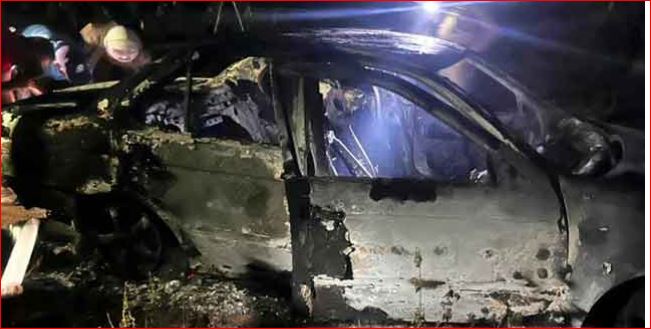
February 15, Colombo (LNW): Police have uncovered a charred vehicle in the southern district of Galle which is believed to have been used in the fatal shooting of a lawyer and his wife earlier this week in Akuregoda, Thalangama.
Officers attached to the Nugegoda Divisional Crimes Investigation Bureau said the car was located along a narrow access road in the Kuttiyawatta area of Agaliya. By the time authorities reached the scene, the vehicle had already been set ablaze and was burning fiercely, suggesting an attempt to destroy crucial evidence.
Investigators had received a tip-off that the car connected to the killing of attorney-at-law Buddhika Mallawarachchi and his spouse had been abandoned in the area. Acting swiftly on the information, police cordoned off the surroundings while firefighters battled the flames. Forensic teams later sifted through the wreckage in search of material that could assist the inquiry.
The double homicide, which occurred in broad daylight in a residential neighbourhood, has sent shockwaves through the legal community and heightened concerns over organised criminal activity. Authorities now suspect the attack may have been orchestrated by an alleged underworld figure operating from overseas, identified as Jayalath Silva alias ‘Karandeniya Sudda.’
Sources indicate that the slain lawyer had previously represented Silva in court. More recently, however, he is understood to have appeared on behalf of a rival criminal leader known as Loku Pati. Detectives are exploring the possibility that the killings were motivated by suspicions that sensitive information had been passed between opposing factions.
Senior officers have neither confirmed arrests nor ruled out further suspects, but they maintain that several leads are being actively pursued. Security has also been tightened in parts of Colombo and its suburbs as a precautionary measure.
The Nugegoda Divisional Crimes Investigation Bureau continues to lead the probe, with assistance from forensic specialists and intelligence units. Police have appealed to members of the public who may have witnessed suspicious movements in the Agaliya area to come forward with information, assuring that all tips will be treated in strict confidence.
Extensive Security and Traffic Measures Rolled Out for India–Pakistan T20 Clash in Colombo
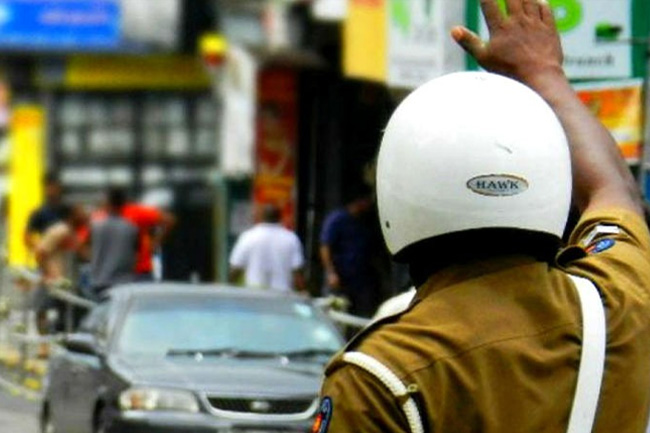
February 15, Colombo (LNW): Sri Lankan authorities have unveiled an extensive security and traffic operation ahead of this evening’s much-anticipated 2026 T20 World Cup encounter between India and Pakistan at the R. Premadasa International Cricket Stadium.
The match is set to begin at 7.00 p.m., with gates opening to spectators from 3.00 p.m.
Police officials confirmed that a coordinated plan has been activated to manage large crowds, ease congestion and safeguard public order around the stadium and adjoining neighbourhoods. Measures include carefully structured traffic diversions, clearly marked parking zones and reinforced security checks at all entry points.
A joint effort involving the Sri Lanka Police, the Police Special Task Force, the Tri-Forces and intelligence units will oversee operations throughout the day. Nearly 2,000 police officers, supported by around 600 traffic personnel, have been assigned to maintain order and regulate the expected influx of supporters from across the island and overseas.
With tickets for the fixture completely sold out, organisers have assured that all legitimate ticket holders will be accommodated in their allocated seats. Authorities have urged members of the public who were unable to secure tickets to follow the match from home via live television coverage, rather than gathering near the venue.
In a bid to ensure a family-friendly atmosphere, fans have been reminded to act responsibly and respect fellow spectators, regardless of national allegiance. Both local supporters and visiting fans are encouraged to enjoy the contest in a spirit of sportsmanship and goodwill.
Security screening will be rigorous. Attendees are prohibited from bringing plastic or glass bottles, large bags, helmets, jackets, alcoholic drinks, musical instruments or any sharp implements into the ground. The possession or operation of drones and unauthorised electronic devices is strictly banned. Officers have made clear that anyone found intoxicated, disruptive or behaving inappropriately will face immediate legal action.
Adequate drinking water points have been established inside the stadium to minimise inconvenience. Routine CCTV surveillance, physical inspections and vehicle searches will be conducted before and during the match as part of standard security protocol.
Vehicle access to certain routes surrounding the stadium will be tightly controlled. Entry via the Keththarama Mawatha junction and from Wilson Perera Mawatha towards Babapulle Place will be restricted to vehicles displaying special permits issued by cricket authorities. Several public parking areas have been designated, including the stadium car park, Sathosa grounds, Sebastian Ela, Grandpass Mati Park, Kovila Road, Apple Watta and both sides of Adi 100 Para.
Temporary traffic limitations will also apply along key roads in the vicinity, including Vinson Perera Mawatha, Grandpass Road, Babapulle Road, Sebastian Ela Road, sections near the Melwatte Bridge entrance, Temple Road junction, Maligawatte Lane and adjoining access routes.
Police have appealed for the full cooperation of the public to ensure that the high-profile fixture proceeds smoothly and safely, underscoring that these arrangements are intended to facilitate an enjoyable evening of cricket for all in attendance.
President Calls for Unity and Renewal in Maha Shivaratri Message
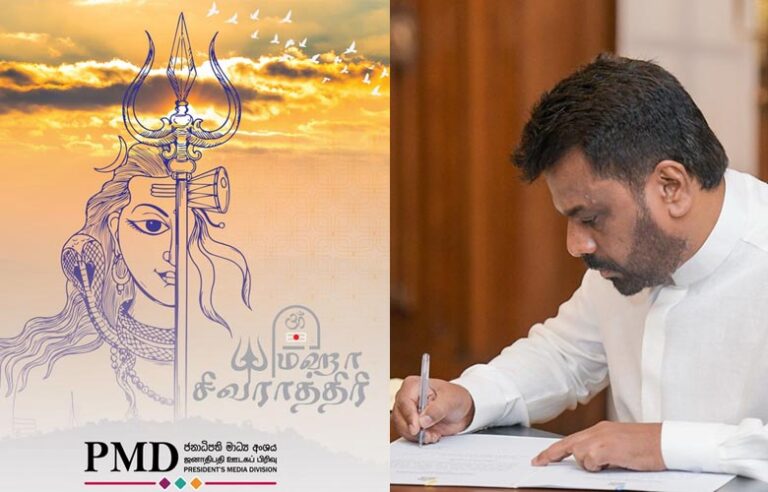
February 15, Colombo (LNW): President Anura Kumara Dissanayake has called on Sri Lankans to dispel the “darkness of ignorance” and kindle the “light of wisdom” as the sacred festival of Maha Shivaratri is observed today by Hindus across the globe.
In his Maha Shivaratri message issued on February 15, 2026, the President noted that the holy festival, devoutly observed by Hindu communities worldwide, marks an auspicious occasion of worship and reverence to Lord Shiva.
He recalled that Maha Shivaratri commemorates the divine union of Lord Shiva and Goddess Parvati, as well as the celestial Tandava dance performed by Lord Shiva, symbolising the triumph over ignorance in both the world and human life.
The President emphasised that religious and cultural observances of this nature play a vital role in building a disciplined and compassionate society that honours all human bonds. He observed that the sacred rites associated with Maha Shivaratri help dispel ego and awaken spiritual consciousness within hearts and minds, encouraging people to embrace the noble virtues of sincerity, generosity and forgiveness.
Describing the spiritual message of Maha Shivaratri as an opportunity to strengthen solidarity, President Dissanayake reflected on the challenges recently faced by the nation, including one of the most severe natural disasters in recent times. He stated that Sri Lanka is now moving forward with firm resolve and careful planning towards a new era of renewal, marked by political, economic and social transformation.
“As the lamps of Maha Shivaratri illuminate our hearts, I invite everyone to come together to further clarify and advance along the path we have chosen,” he said.
The President extended his warm felicitations for a meaningful celebration of Maha Shivaratri to Hindu devotees in Sri Lanka and around the world, expressing his wish that their noble aspirations be fulfilled.
Full Message:
With the hope that the darkness of ignorance be dispelled and the light of wisdom be kindled, the sacred festival of Maha Shivaratri, devoutly observed by Hindus around the world, falls today.
Maha Shivaratri is regarded as the auspicious occasion on which Hindu devotees offer worship and reverence to Lord Shiva. It commemorates the divine union of Lord Shiva and Goddess Parvati, as well as the moment when Lord Shiva performs his celestial dance, the Tandava. Thereby, it symbolises the triumph over “darkness of ignorance” in the world and in human life.
I firmly believe that such religious and cultural observances are of great importance in building a disciplined and compassionate society that respects all human bonds. The sacred rites of Maha Shivaratri, which dispel ego and awaken spiritual consciousness within hearts and minds, invite us to live according to the noble virtues of sincerity, generosity and forgiveness.
Furthermore, I view the spiritual message of Maha Shivaratri as an opportunity to further strengthen solidarity among one another.
Having recently faced one of the most severe natural disasters in recent times, we are now advancing, with firm resolve and careful planning, towards a new era of renewal marked by political, economic and social transformation. As the lamps of Maha Shivaratri illuminate our hearts, I invite everyone to come together to further clarify and advance along the path we have chosen.?
I extend my warm felicitations for a meaningful celebration of Maha Shivaratri to the Hindu devotees in Sri Lanka and to Hindus around the world who observe this sacred day and I wish that their noble aspirations be fulfilled.
Anura Kumara Dissanayake
President
Democratic Socialist Republic of Sri Lanka
15th February, 2026
Showers expected in several provinces: Fairly heavy falls above 75 mm may occur (Feb 15)

February 15, Colombo (LNW): Showers will occur at times in Central and Uva provinces and in Ampara, Batticaloa and Hambantota districts, the Department of Meteorology said in its daily weather forecast today (15).
A few showers may occur in Northern, North-central and North-western provinces and in Trincomalee district.
Showers or thundershowers will occur at several places elsewhere after 1.00 p.m. Fairly heavy showers about 75 mm are likely at some places in Rathnapura, Kalutara, Galle and Matara districts.
Misty conditions can be expected at some places in Western, Sabaragamuwa and Central provinces and in Galle and Matara districts during the early hours of the morning.
The general public is kindly requested to take adequate precautions to minimise damages caused by temporary localised strong winds and lightning during thundershowers.
Marine Weather:
Condition of Rain:
Showers or thundershowers will occur at times in the sea areas off the coast extending from Galle to Batticaloa via Hambantota and Pottuvil. Showers or thundershowers may occur at a few places in the other sea areas around the island in the evening or night.
Winds:
Winds will be north-easterly and wind speed will be (30-40) kmph. Wind speed can increase up to (45-50) kmph at times in the sea areas off the coast extending from Kaluthara to Mannar via Puttalam and from Matara to Pottuvil via Hambantota.
State of Sea:
The sea areas off the coast extending from Kaluthara to Mannar via Puttalam and from Matara to Pottuvil via Hambantota will be fairly rough at times. Other sea areas around the island will be moderate.
Temporarily strong gusty winds and very rough seas can be expected during thundershowers.
Ranil Wickremesinghe is arguably the most experienced statesman in the country’s modern history
We are witnessing a silent exodus of the garment industry- once the backbone of our exports- to Africa and other Asian nations, where labour is cheaper and tax regimes are friendlier. This shift has not only drained foreign exchange, but has pushed thousands of young women into the informal sector
- The tragedy of Sri Lanka is that the people with the “know-how” often lack the “know-who.”
- Wickremesinghe’s political Achilles’ heel is his inability to bridge the gap between intellectual governance and populist appeal
 In the complex landscape of Sri Lankan politics, a profound paradox exists: a nation with a 2,500-year-old civilization and a history of engineering marvels such as the world’s most advanced ancient irrigation systems now finds its modern electorate seemingly trapped in a cycle of short-term survival. The disconnect between a “Grand Vision” and the “Daily Wage” has never been more apparent than in the political fate of Ranil Wickremesinghe and his ambitious “2048 Vision”.
For an observer with an analytical mind, the 2048 Vision is not just a plan; it is a mathematical necessity for a bankrupt nation. However, for a majority of Sri Lankans, “2048” is a lifetime away, while “today’s meal” is a looming crisis. To understand why visionary leadership continues to fail at the Sri Lankan ballot box, we must dissect the socio-economic desperation and the strategic maneuvers that define our current political crossroads.
Realities vs. Slogans
Sri Lanka currently stands at a perilous junction. While the macro-indicators show a “miraculous” recovery compared to the dark days of 2022 when the treasury held a mere $20 million the micro-reality for the average citizen is a relentless struggle. The restoration of fuel, gas, and electricity under Wickremesinghe’s administration was an economic feat that drew parallels to Greece’s recovery, yet it came with the bitter pill of high taxation and austerity.
Today, the government faces a Herculean task:
 Currency Stability: Controlling the devaluation of the Rupee against the USD to prevent further inflation.
Debt Servicing: Navigating the stringent repayment schedules of foreign loans and meeting the precise targets set by the IMF.
The Investment Vacuum: Encouraging local investors and attracting Foreign Direct Investment (FDI) in a high-tax environment.
The irony is that while tax collection is the lifeblood of a state, excessive taxation is driving away the very engines of growth. We are witnessing a silent exodus of the garment industry- once the backbone of our exports- to Africa and other Asian nations, where labour is cheaper and tax regimes are friendlier. This shift has not only drained foreign exchange, but has pushed thousands of young women into the informal sector, often leading to the mushrooming of spas and other precarious livelihoods born out of sheer survival instinct.
The psychology of the voter: Why vision fails
The fundamental challenge for any visionary leader in Sri Lanka is the “Survivalist Mindset.” When a person is working for a daily wage, their cognitive horizon rarely extends beyond the next 24 hours. Long-term strategies like the 2048 Vision, which aim to turn Sri Lanka into a high-income nation by its centenary of independence, feel like “esoteric” concepts to those struggling with the current cost of living.
Historically, Sri Lankan voters have been conditioned to favour leaders who offer immediate, tangible relief. We have seen this pattern repeat with devastating consequences:
1. The 100-Day Package: Maithripala Sirisena’s 2015 campaign used a “100-day plan” to capture the imagination of the poor. It was a masterclass in catering to immediate wants, though it lacked the structural depth to sustain the country.
2. The Promise of “Free Manure”: Gotabaya Rajapaksa’s rise was fueled by popular slogans and populist promises, such as the organic fertilizer transition which, while sounding noble, was executed without scientific or economic foresight. The result was a total collapse of the agricultural sector.
3. The NPP Surge: The National People’s Power (NPP) moved from a 3% vote base to a two-thirds majority by tapping into the “anti-establishment” sentiment. They didn’t just sell a vision; they sold a “system change” and a moral crusade against corruption a narrative that resonates deeply with a population that feels cheated by the traditional elite.
The Wickremesinghe paradox
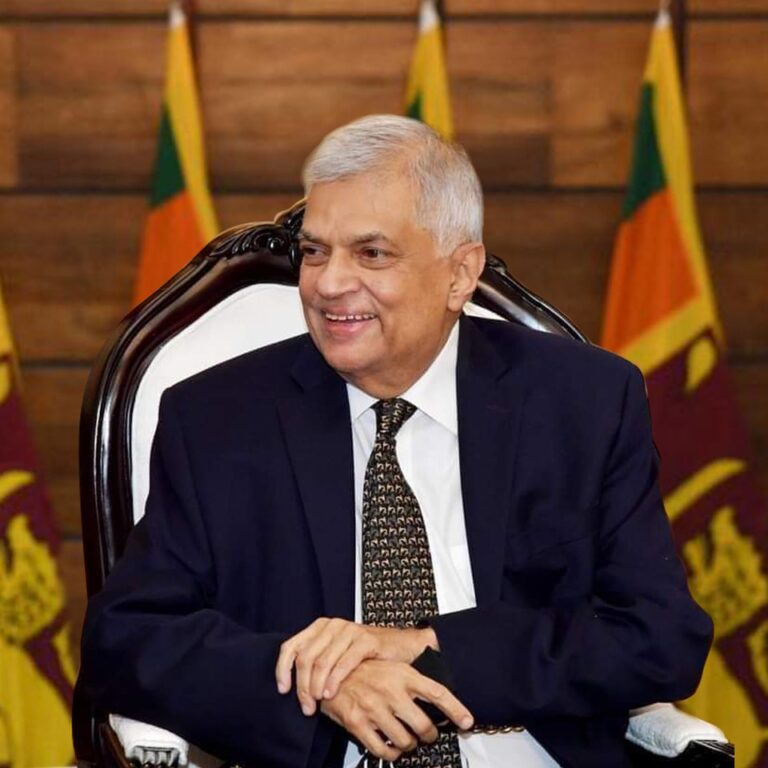
Ranil Wickremesinghe is arguably the most experienced statesman in the country’s modern history. His ability to stabilize a bankrupt economy between 2022 and 2024, in liaison with the IMF, India, and other donor nations, was a feat of high-level diplomacy and technocratic skill. He turned a “bankrupt” status into a “recovering” status within a remarkably short period.
However, Wickremesinghe’s political Achilles’ heel is his inability to bridge the gap between intellectual governance and populist appeal. His 2048 Vision is grounded in reality, but it is a “truth” that the majority isn’t yet ready to hear or cannot afford to understand. If he continues to play the “2048 card” in upcoming elections without addressing the “2026 survival,” the result is likely to be another defeat at the hands of those who offer immediate, albeit unsustainable, relief.
Case study of the NPP: From 3% to 61%
For the United National Party (UNP) and other traditional political entities, the 2024 and 2025 election results offer a vital case study. The NPP’s success wasn’t just about slogans; it was about strategy and presence.
Ground-level Mobilization: While visionary leaders speak in boardrooms and through international media, the NPP spent decades building a grassroots network that understands the “pulse” of the daily wage earner.
The Corruption Axis: They reframed the economic crisis not as a complex global issue, but as a simple moral one: “The leaders stole your money.” This simplification is powerful in an electorate that feels disenfranchised.
Consolidation: By refusing to make deals with the “old guard,” they maintained a brand of “purity” that the youth and the disillusioned middle class found irresistible.
Can vision and pulse align?
The tragedy of Sri Lanka is that the people with the “know-how” often lack the “know-who.” To win in 2029 and beyond, a leader must be a hybrid: a visionary who can navigate the IMF, but also a communicator who can explain how that vision puts bread on the table tomorrow morning.
Conclusion
The current government’s biggest challenge remains: tax collection alone cannot build a nation. If they cannot pivot from “collecting” to “creating” by revitalizing the export sector and stopping the brain drain they too will fall victim to the same cycle of popular rejection.
Sri Lanka does not need more short-sighted leaders, but it desperately needs its visionary leaders to learn the language of the people. Until then, the “2048 Vision” will remain a beautiful blueprint in a room full of people who are just looking for a candle to see through the night.
(The writer is a battle hardened Infantry Officer who served the Sri Lanka Army for over 36 years, dedicating 20 of those to active combat. In addition to his military service, Dr Perera is a respected International Researcher and Writer, having authored more than 200 research articles and 16 books. He holds a PhD in economics and is an entrepreneur and International Analyst specialising in National Security, economics and politics. He can be reached at [email protected] )